


2 Chronicles 8:8
Bible text: King James Version (1769 Blayney text) · Public domain
Bible text: King James Version with Strong's numbers · Public domain
Bible text: Berean Standard Bible · Public domain
Bible text: American Standard Version (1901) · Public domain
Bible text: World English Bible, Messianic edition · Public domain
Bible text: Geneva Bible (1599) · Public domain
Bible text: Young's Literal Translation · Public domain
- מִןminsome ofH4480PrepPreposition
- בְּנֵיהֶםbe·nei·Hemtheir descendantsH1121N-mpc ¦ 3mpNoun Plural Masculine Constructבְּנֵיdescendantsהֶםtheir
- אֲשֶׁר'a·SherwhoH834RelParticle Relative
- נוֹתְרוּnot·Ruthey remainedH3498V-Niphal-Perf-3cpVerb Niphal Perfect 3rd Plural common gender
- אַחֲרֵיהֶם'a·cha·rei·Hemafter themH310Adj-mpc ¦ 3mpAdjective Numerical Plural Masculine Constructאַחֲרֵיafterהֶםthem
- בָּאָרֶץba·'A·retzin the landH776Prep-b ¦ N-fsNoun Singular Feminine Absoluteבָּin theאָרֶץland
- אֲשֶׁר'a·SherwhomH834RelParticle Relative
- לֹאlo'notH3808NegParticle Negative
- כִלּוּםkhi·Lumthey had destroyed themH3615V-Piel-Perf-3cp ¦ 3mpVerb Piel Perfect 3rd Plural common genderכִלּוּthey had destroyedםthem
- בְּנֵיbe·Nei[the] people ofH1121N-mpcNoun Plural Masculine Construct
- יִשְׂרָאֵלYis·ra·'ElIsraelH3478N-properNoun Proper Location
- וַיַּעֲלֵםvai·ya·'a·Lemand he brought up themH5927Conj-w ¦ V-Hiphil-ConsecImperf-3ms ¦ 3mpVerb Hiphil Consecutive Imperfect 3rd Singular Masculineוַandיַּעֲלֵhe brought upםthem
- שְׁלֹמֹהshe·lo·MohSolomonH8010N-proper-mNoun Proper Masculine
- לְמַסle·Masto forced laborH4522Prep-l ¦ N-msNoun Singular Masculine Absoluteלְtoמַסforced labor
- עַד'aduntilH5704PrepPreposition
- הַיּוֹםhai·Yomthe dayH3117Art ¦ N-msNoun Singular Masculine Absoluteהַtheיּוֹםday
- הַזֶּהha·Zeh<the> thisH2088Art ¦ PrtParticle Demonstrativeהַ<the>זֶּהthis
English is a literal word-by-word gloss of the Hebrew, not the KJV's wording. Why?
This is the original text the KJV's translators worked from — each Hebrew word with its own literal English meaning in this verse, prepared by scholars at Tyndale House, Cambridge. The KJV translates whole sentences, not word by word, so its wording differs: one Hebrew word can become several English words, and the KJV may choose “the LORD” where the gloss reads “Yahweh”. Both are faithful — they answer different questions. For the KJV's own rendering, switch to the KJV text.
Details
See on the biblical-era map
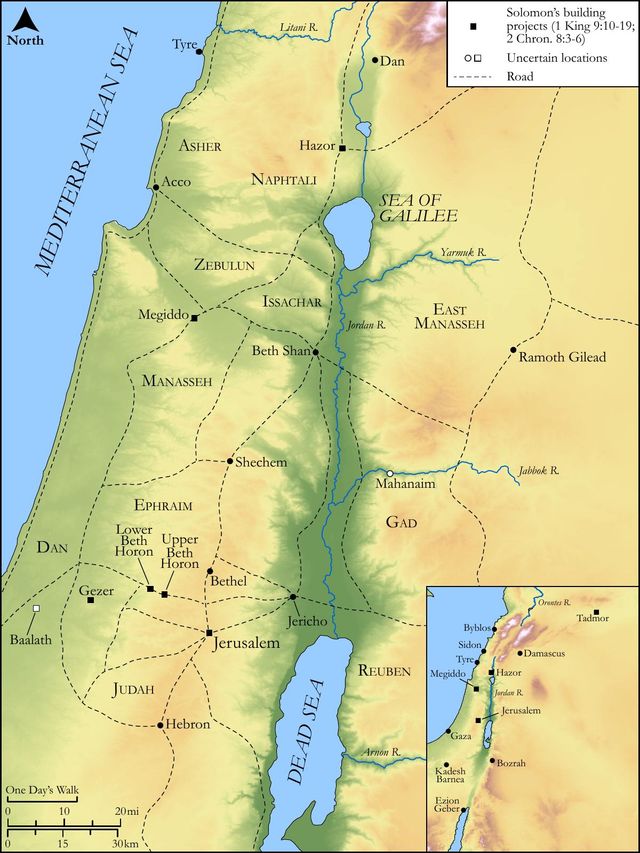
Study this verse
Public-domain commentary
Matthew Henry
From his Commentary on the Whole Bible. Henry comments on passages, not single verses — this entry covers 2 Chronicles 8:1–11. His two-level outline is real structure in the source text, so it is rendered as structure.
This we had Kg1 9:10-24, and therefore shall only observe here,
I.Though Solomon was a man of great learning and knowledge, yet he spent his days, not in contemplation, but in action, not in his study, but in his country, in building cities and fortifying them, in a time of peace preparing for a time of war, which is as much a man's business as it is in summer to provide food for winter.
II.As he was a man of business himself, and did not consult his own ease, so he employed a great many hands, kept abundance of people to work.
It is the interest of a state by all means possible to promote and encourage industry, and to keep its subjects from idleness. A great many strangers there were in Israel, many that remained of the Canaanites; and they were welcome to live there, but not to live and do nothing. The men of Laish, who had no business, were an easy prey to the invaders, Jdg 18:7.
III.When Solomon had begun with building the house of God, and made good work and quick work of that, he prospered in all his undertakings, so that he built all that he desired to build, Ch2 8:6. Those who have a genius for building find that one project draws on another, and the latter must amend and improve the former. Now observe,
1.How the divine providence gratified even Solomon's humour, and gave him success, not only in all that he needed to build and that it was for his advantage to build, but in all that he had a mind to build. So indulgent a Father God is sometimes to the innocent desires of his children that serve him. Thus he pleased Jacob with that promise, Joseph shall put his hand on thy eyes.
2.Solomon knew how to set bounds to his desires. He was not one of those that enlarge them endlessly, and can never be satisfied, but knew when to draw in; for he finished all he desired, and then he desired no more. He did not sit down and fret that he had not more cities to build, as Alexander did that he had not more worlds to conquer, Hab 2:5.
IV.That one reason why Solomon built a palace on purpose for the queen, and removed her and her court to it, was because he thought it by no means proper that she should dwell in the house of David (Ch2 8:11), considering that that had been a place of great piety, and perhaps her house was a place of great vanity. She was proselyted, it is likely, to the Jewish religion; but it is a question whether all her servants were. Perhaps they had among them the idols of Egypt, and a great deal of profaneness and debauchery. Now, though Solomon had not zeal and courage enough to suppress and punish what was amiss there, yet he so far consulted the honour of his father's memory that he would not suffer that place to be thus profaned where the ark of God had been and where holy David had prayed many a good prayer and sung many a sweet psalm. Not that all the places where the ark had been were so holy as never to be put to a common use; for then the houses of Abinadab and Obed-edom must have been so. But the place where it had been so long, and had been so publicly attended on, was so venerable that it was not fit to be the place of so much gaiety, not to say iniquity, as was to be found, I fear, in the court that Pharaoh's daughter kept. Note, Between things sacred and things common the ancient landmarks ought to be kept up. It was an outer-court of the temple that was the court of the women.
Continue studying 2 Chronicles 8:8 across the web’s major study libraries — every link below opens this exact verse, chapter, or book on the destination site.
Read & Compare
 BibleGatewayThis verse in more than 200 translations and 70 languages.
 Bible.comThe YouVersion reader — hundreds of translations, reading plans, and highlights.
 ESV.orgCrossway's official English Standard Version reader.
 NET BibleThe NET translation with 60,000+ translators' notes on every rendering decision.
 STEP BibleTyndale House's free study tool — original text, vocabulary, and scholarly resources.
 BibliaLogos Bible Software's free web reader.
 USCCBThe New American Bible (Revised Edition) with the U.S. bishops' study notes.
Commentaries
 BibleHub CommentariesDozens of classic commentaries on this verse, gathered on one page.
 StudyLightMore than 100 commentary sets — the largest collection on the web.
 BibleRefPlain-English commentary on what this verse means, verse by verse.
 Enduring WordDavid Guzik's free commentary on this chapter, widely used by Bible teachers.
 Bible Study ToolsVerse commentary alongside Greek and Hebrew study aids.
Original Language & Research
- BibleHub InterlinearThe verse word by word — original language, transliteration, and English.
- BibleHub LexiconEvery word's original-language definition and Strong's entry.
 Blue Letter BibleDeep-study tools — Strong's numbers, concordance, and word studies.
 SefariaThe Hebrew text with Rashi and centuries of Jewish commentary.
Sermons, Hymns & Audio


TrulyRandomVerse is not affiliated with these sites and doesn’t control their content. They’re linked because they’re genuinely useful.
Summary
Second Chronicles 8:8 meticulously records King Solomon's administrative policy concerning the non-Israelite populations who remained in the land after the initial Canaanite conquest. These descendants of the indigenous peoples, whom the Israelites had not fully dispossessed, were systematically conscripted by Solomon to provide forced labor and tribute for his ambitious building projects, a practice explicitly noted by the Chronicler as continuing "until this day." This verse offers a crucial insight into the practical realities of Solomon's vast kingdom, highlighting both his pragmatic approach to resource management and the enduring consequences of Israel's incomplete obedience to divine commands.
Context
ShowHideLiterary Context
This verse is strategically placed within the Chronicler's detailed account of King Solomon's reign (2 Chronicles 2-9), which emphasizes his unparalleled wisdom, immense wealth, and extensive architectural achievements. Specifically, 2 Chronicles 8 provides an inventory of Solomon's construction projects, including the completion of the Temple, his royal palace, and numerous fortified cities. Verses 7-10 form a distinct unit focusing on the labor force. While 2 Chronicles 8:7-8 describe the conscription of non-Israelite peoples for forced labor, 2 Chronicles 8:9 deliberately contrasts this by stating that Solomon "made no servants of the children of Israel," instead appointing them as officials, commanders, and supervisors. This intentional juxtaposition highlights a significant administrative and covenantal distinction in Solomon's kingdom, underscoring the privileged status of the Israelites.
Historical & Cultural Context
The practice of corvée labor, or forced state-mandated service, as described in 2 Chronicles 8:8, was a widespread and accepted feature of the monarchies of that day. Powerful rulers across Egypt, Mesopotamia, and other regional kingdoms routinely employed conquered or subject populations for large-scale public works, such as the construction of temples, palaces, and defensive fortifications. For Israel, the enduring presence of these non-Israelite groups in the land was a direct consequence of the incomplete conquest of Canaan, a reality thoroughly documented in books like Judges and Joshua. Despite explicit divine commands to utterly drive out the land's inhabitants (e.g., Deuteronomy 7:2), various Canaanite groups persisted, often becoming tributaries or subject peoples. Solomon, inheriting this demographic and political landscape, formalized their status, integrating them into his expansive economic and labor systems as a means to achieve his grand building ambitions.
Key Themes
ShowHide2 Chronicles 8:8 contributes significantly to several overarching themes within the Chronicler's narrative and the broader Old Testament. Firstly, it powerfully illustrates Solomon's Power and Administrative Acumen, showcasing his immense authority and organizational capability to levy extensive tribute and labor, which was foundational to the economic might and grandeur of his golden age. Secondly, the phrase "whom the children of Israel consumed not" subtly but profoundly highlights the Consequences of Incomplete Obedience. This refers to Israel's failure to fully obey God's earlier command to utterly dispossess these nations, as depicted throughout the book of Judges. This long-standing disobedience resulted in these populations remaining in the land, centuries later becoming a crucial, albeit ethically complex, source of labor for the Israelite kingdom, serving as a subtle theological commentary on the long-term ramifications of covenantal compromise. Lastly, the verse underscores the Economic Foundation of Solomon's Reign, demonstrating how forced labor (corvée) was an indispensable component in financing and executing his monumental building projects, including the magnificent Temple in Jerusalem, his opulent palace, and numerous fortified cities across his kingdom, as also detailed in 1 Kings 9:15.
Exposition and Analysis
ShowHideKey Word Analysis
ShowHideH1121 (בֵּן). This term, derived from a root meaning "to build," refers broadly to a son or descendant, in the widest sense. Here, it specifically denotes the offspring or posterity of the non-Israelite populations. The Chronicler uses "their children" to emphasize that this tribute was levied not just on the original survivors of the conquest, but on successive generations, indicating a long-standing, inherited status of subjugation.
H3615 (כָּלָה). This primitive root means "to end," "to cease," "to finish," or "to consume/destroy." When used in the negative ("consumed not"), it signifies that the Israelites did not utterly destroy, annihilate, or completely dispossess these inhabitants. This crucial parenthetical statement reveals the historical and theological reason for the presence of these groups in Solomon's time, directly linking it to Israel's failure to fully execute God's commands during the conquest period.
H4522 (מַס). This term, also rendered as "levy" or "task-master," refers specifically to a burden in the form of forced labor or compulsory service. It is distinct from voluntary service or monetary taxation. The use of mas emphasizes the non-consensual and arduous nature of the labor imposed on these non-Israelite peoples, highlighting their status as a subjugated population providing mandatory service for the state.
Verse Breakdown
ShowHide"But of their children, who were left after them in the land"
This opening clause identifies the specific demographic group subject to Solomon's policy: the descendants of the original Canaanite inhabitants who had survived the Israelite conquest and continued to reside within the land. This clarifies that these were not newly conquered peoples, but long-established residents whose presence was a legacy of earlier historical periods.
"whom the children of Israel consumed not"
This parenthetical yet pivotal phrase serves as the Chronicler's theological explanation for the continued presence of these non-Israelite populations. It directly references Israel's incomplete obedience to God's explicit command to utterly dispossess or destroy the Canaanite nations. This historical failure, extensively detailed in the book of Judges, created the demographic reality that Solomon later exploited for his own purposes.
"them did Solomon make to pay tribute until this day"
This concluding clause describes the direct action taken by King Solomon towards these remaining non-Israelites: he subjected them to mas, a system of forced labor or compulsory tribute. The phrase "until this day" is a characteristic Chronicler's editorial note, indicating that this system, or at least the memory and legacy of it, persisted up to the time of the Chronicler's writing, underscoring the long-term impact of Solomon's administrative decisions and Israel's historical choices.
Literary Devices
ShowHideThe Chronicler employs several significant literary devices in 2 Chronicles 8:8. The primary mode is Historical Narration, presenting a concise yet impactful factual account of Solomon's administrative policy. Within this narrative, a crucial Parenthetical Remark ("whom the children of Israel consumed not") is inserted. This serves as a vital explanatory aside, providing a theological and historical justification for the presence of these foreign populations and subtly referencing Israel's past disobedience and its enduring consequences. The phrase "until this day" functions as a powerful Chronistic Device, directly connecting the ancient historical event to the Chronicler's contemporary audience, thereby emphasizing the lasting legacy of Solomon's actions and the historical continuity of the situation. This also implies a degree of Retrospection, inviting the reader to recall earlier narratives of the conquest and the divine directives given to Israel, thereby adding layers of meaning to Solomon's pragmatic, yet ethically complex, policy.
Theological and Thematic Connections
ShowHide2 Chronicles 8:8, though seemingly a mere administrative detail, carries profound theological weight. It serves as a stark and enduring reminder of the far-reaching consequences of incomplete obedience to God's commands. The continued presence of these non-Israelite peoples, whom God had explicitly commanded to be driven out, became a source of labor for the kingdom, but historically also a potential source of spiritual compromise and idolatry, as tragically evidenced throughout Israel's narrative. Solomon's utilization of these groups highlights the pragmatic, often ethically complex, realities of ancient kingship and state-building, frequently contrasting with the ideal of a nation wholly devoted to God's covenant. This verse implicitly raises crucial questions about justice, the exercise of power, and the treatment of overlooked or subject populations, even within a divinely ordained kingdom, prompting reflection on the moral compromises inherent in worldly ambition.
Reflection and Application
ShowHideThis verse, while describing an ancient historical practice, offers profound insights for contemporary reflection and application. It serves as a powerful reminder that past decisions, particularly those marked by incomplete obedience or compromise with divine principles, can have far-reaching and often unintended consequences that profoundly shape future generations and societal structures. Solomon's reliance on forced labor from a subjugated population prompts us to critically examine the ethical dimensions of power, resource management, and the treatment of different societal groups in our own contexts. It challenges us to consider how we build our "kingdoms"—whether personal, professional, or communal—and whether our methods genuinely align with principles of justice, equity, and compassion, especially towards the vulnerable or those perceived as "other." The text subtly critiques the pragmatism that prioritizes grand achievements and material prosperity over strict adherence to divine principles, urging us to carefully consider the moral costs of our ambitions and the long-term impact of our choices.
Questions for Reflection
ShowHideFAQ
ShowHideWhat does "make to pay tribute" mean in this context?
ShowHideIn 2 Chronicles 8:8, "make to pay tribute" translates the Hebrew word mas (מַס), which specifically refers to a levy of forced labor or corvée. This was not merely a monetary tax, but a system of compulsory service, often involving arduous physical work on royal building projects. Solomon conscripted these non-Israelite populations to provide the manual labor necessary for his extensive construction endeavors, such as the Temple, his palace, and fortified cities, as also mentioned in 1 Kings 9:15. This practice was common among the great kingdoms of that day, where rulers leveraged subject peoples for large-scale public works.
Why were these "children" (descendants of non-Israelites) still in the land?
ShowHideThe verse explicitly states that these were peoples "whom the children of Israel consumed not." This refers directly to the incomplete conquest of Canaan during the time of Joshua and the Judges. God had commanded Israel to utterly drive out or destroy the inhabitants of the land to prevent idolatry and moral corruption (e.g., Deuteronomy 7:2). However, as documented in books like Judges/1, Israel failed to fully obey this command, allowing various Canaanite groups to remain and coexist within their borders. Centuries later, their descendants formed a significant population within the land, which King Solomon then utilized for his labor force, highlighting a long-term consequence of Israel's past disobedience.
Christ-Centered Fulfillment
ShowHideWhile 2 Chronicles 8:8 describes the pragmatic, yet ethically complex, administration of an earthly king, it subtly points to the profound need for a greater King and a more perfect kingdom. Solomon's kingdom, built in part upon the forced labor of a subjugated people—a direct consequence of Israel's incomplete obedience to God's commands—stands in stark contrast to the kingdom of God inaugurated by Christ. Jesus, the true Son of David, does not build His eternal kingdom through forced labor or the subjugation of "others" but through voluntary service motivated by divine love and transforming grace. He comes not to exact tribute from humanity but to pay the ultimate tribute, offering His own life as a ransom for many (Mark 10:45). The "tribute" Christ demands is not compulsory labor but the willing surrender of our lives in joyful service, a "living sacrifice" that is our "spiritual worship" (Romans 12:1). Unlike Solomon's kingdom, which eventually faced internal division and ultimate collapse, Christ's kingdom is eternal, built on perfect justice and complete redemption, where all are invited as co-heirs, not as subjects of forced labor (Romans 8:17). The failure of Israel to "consume" or fully dispossess the nations, leading to ongoing issues and the need for Solomon's pragmatic policies, is ultimately overcome in Christ, who perfectly fulfills God's mission, breaking down dividing walls and uniting all peoples—Jew and Gentile—into one new humanity through His atoning sacrifice (Ephesians/2-14-16).