


Joshua 17:13
Bible text: King James Version (1769 Blayney text) · Public domain
Bible text: Berean Standard Bible · Public domain
Bible text: American Standard Version (1901) · Public domain
Bible text: World English Bible, Messianic edition · Public domain
Bible text: Geneva Bible (1599) · Public domain
Bible text: Young's Literal Translation · Public domain
- וַיְהִיvay·Hiand it wasH1961Conj-w ¦ V-Qal-ConsecImperf-3msVerb Qal Consecutive Imperfect 3rd Singular Masculineוַandיְהִיit was
- כִּיkithatH3588PrtParticle Conditional
- חָזְקוּcha·ze·Kuthey became strongH2388V-Qal-Perf-3cpVerb Qal Perfect 3rd Plural common gender
- בְּנֵיbe·Nei[the] people ofH1121N-mpcNoun Plural Masculine Construct
- יִשְׂרָאֵלYis·ra·'ElIsraelH3478N-properNoun Proper Location
- וַיִּתְּנוּvai·yi·te·Nuand they madeH5414Conj-w ¦ V-Qal-ConsecImperf-3mpVerb Qal Consecutive Imperfect 3rd Plural Masculineוַandיִּתְּנוּthey made
- אֶת'et<obj.>H853DirObjMParticle Object Indicator
- הַכְּנַעֲנִיha·ke·na·'a·Nithe Canaanite[s]H3669Art ¦ N-msNoun Gentilic Singular Masculine AbsoluteהַtheכְּנַעֲנִיCanaanite[s]
- לָמַסla·Mas<into> forced laborH4522Prep-l ¦ N-msNoun Singular Masculine Absoluteלָ<into>מַסforced labor
- וְהוֹרֵשׁve·ho·Reshand certainly <to dispossess>H3423Conj-w ¦ V-Hiphil-InfAbsVerb Hiphil Infinitive Absoluteוְandהוֹרֵשׁcertainly <to dispossess>
- לֹאlo'notH3808NegParticle Negative
- הוֹרִישׁוֹho·ri·Shohe dispossessed himH3423V-Hiphil-Perf-3ms ¦ 3msVerb Hiphil Perfect 3rd Singular Masculineהוֹרִישׁhe dispossessedוֹhim
English is a literal word-by-word gloss of the Hebrew, not the KJV's wording. Why?
This is the original text the KJV's translators worked from — each Hebrew word with its own literal English meaning in this verse, prepared by scholars at Tyndale House, Cambridge. The KJV translates whole sentences, not word by word, so its wording differs: one Hebrew word can become several English words, and the KJV may choose “the LORD” where the gloss reads “Yahweh”. Both are faithful — they answer different questions. For the KJV's own rendering, switch to the KJV text.
Details
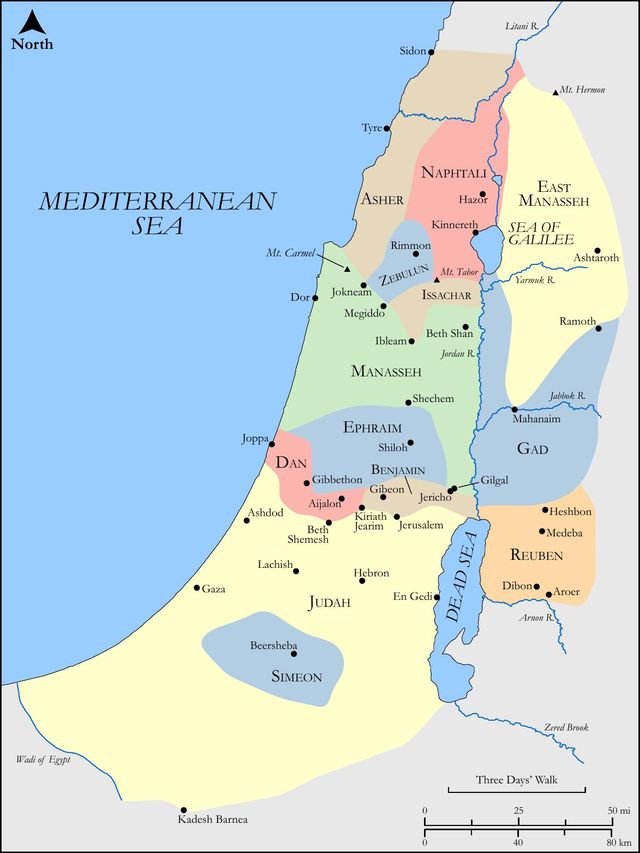
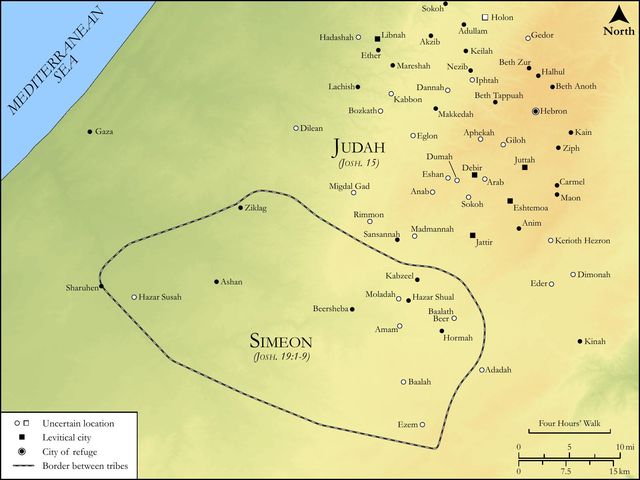
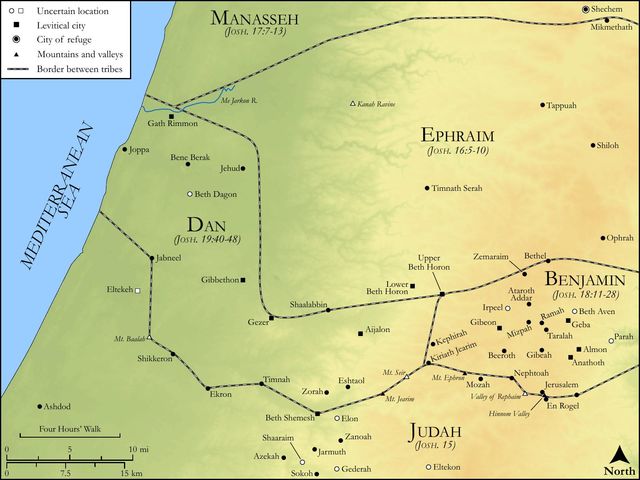
See on the biblical-era maps
Study this verse
Public-domain commentary
Matthew Henry
From his Commentary on the Whole Bible. Henry comments on passages, not single verses — this entry covers Joshua 17:7–13.
We have here a short account of the lot of this half tribe. It reached from Jordan on the east to the great sea on the west; on the south it lay all along contiguous to Ephraim, but on the north it abutted upon Asher and Issachar. Asher lay north-west, and Issachar north-east, which seems to be the meaning of that (Jos 17:10), that they (that is, Manasseh and Ephraim, as related to it, both together making the tribe of Joseph) met in Asher on the north and Issachar on the east, for Ephraim itself reached not those tribes. Some things are particularly observed concerning this lot: - 1. That there was great communication between this tribe and that of Ephraim. The city of Tappuah belonged to Ephraim, but the country adjoining to Manasseh (Jos 17:8); there were likewise many cities of Ephraim that lay within the border of Manasseh (Jos 17:9), of which before, Jos 16:9. 2. That Manasseh likewise had cities with their appurtenances in the tribes of Issachar and Asher (Jos 17:11), God so ordering it, that though every tribe had its peculiar inheritance, which might not be alienated from it, yet they should thus intermix one with another, to keep up mutual acquaintance and correspondence among the tribes, and to give occasion for the doing of good offices one to another, as became those who, though of different tribes, were all one Israel, and were bound to love as brethren. 3. That they suffered the Canaanites to live among them, contrary to the command of God, serving their own ends by conniving at them, for they made them tributaries, Jos 17:12, Jos 17:13. The Ephraimites had done the same (Jos 16:10), and from them perhaps the Manassites learned it, and with their example excused themselves in it. The most remarkable person of this half tribe in after-time was Gideon, whose great actions were done within this lot. He was of the family of Abiezer; Cesarea was in this lot, and Antipatris, famed in the latter ages of the Jewish state.
Historical interpretation
Historical reception
1 surviving comment on this verse from the historical church.
After Ham had been cursed through his one son, [Noah] blessed Shem and Japheth and said, “May God increase Japheth and may he dwell in the tent of Shem, and let Canaan be their slave.” Japheth increased and became powerful in his inheritance in the north and in the west. And God dwelt in the tent of Abraham, the descendent of Shem, and Canaan became their slave when in the days of Joshua son of Nun, the Israelites destroyed the dwelling-places of [Canaan] and pressed their leaders into bondage.
Continue studying Joshua 17:13 across the web’s major study libraries — every link below opens this exact verse, chapter, or book on the destination site.
Read & Compare
 BibleGatewayThis verse in more than 200 translations and 70 languages.
 Bible.comThe YouVersion reader — hundreds of translations, reading plans, and highlights.
 ESV.orgCrossway's official English Standard Version reader.
 NET BibleThe NET translation with 60,000+ translators' notes on every rendering decision.
 STEP BibleTyndale House's free study tool — original text, vocabulary, and scholarly resources.
 BibliaLogos Bible Software's free web reader.
 USCCBThe New American Bible (Revised Edition) with the U.S. bishops' study notes.
Commentaries
 BibleHub CommentariesDozens of classic commentaries on this verse, gathered on one page.
 StudyLightMore than 100 commentary sets — the largest collection on the web.
 BibleRefPlain-English commentary on what this verse means, verse by verse.
 Enduring WordDavid Guzik's free commentary on this chapter, widely used by Bible teachers.
 Bible Study ToolsVerse commentary alongside Greek and Hebrew study aids.
Original Language & Research
- BibleHub InterlinearThe verse word by word — original language, transliteration, and English.
- BibleHub LexiconEvery word's original-language definition and Strong's entry.
 Blue Letter BibleDeep-study tools — Strong's numbers, concordance, and word studies.
 SefariaThe Hebrew text with Rashi and centuries of Jewish commentary.
Sermons, Hymns & Audio


TrulyRandomVerse is not affiliated with these sites and doesn’t control their content. They’re linked because they’re genuinely useful.
Summary
Joshua 17:13 presents a critical moment in Israel's settlement of Canaan, highlighting the tribes of Ephraim and Manasseh's decision to compromise with God's clear command. Despite having grown significantly in strength and capability, the Israelites chose to subjugate the remaining Canaanite inhabitants for economic tribute rather than completely expelling them from the Promised Land. This act of partial obedience, driven by expediency rather than full faithfulness, established a dangerous precedent that would have profound and lasting spiritual and national consequences for Israel, foreshadowing their struggles in the subsequent centuries.
Context
ShowHideLiterary Context
This verse is situated within the detailed account of the land distribution among the Israelite tribes (Joshua 13-19), specifically focusing on the inheritance of the half-tribe of Manasseh and the tribe of Ephraim in central Canaan (Joshua 16-17). The preceding verse, Joshua 17:12, explicitly states that Manasseh "could not drive out the inhabitants of those cities," setting up a narrative tension. Verse 13 then reveals a crucial development: when they became strong enough, they still did not complete the task, opting instead for a pragmatic compromise. This transition from initial inability to a deliberate choice of partial obedience marks a significant shift in the narrative, moving from the triumphs of conquest to the challenges of settlement and the emerging pattern of Israel's unfaithfulness that would dominate the Book of Judges.
Historical & Cultural Context
God's command to utterly dispossess the Canaanites was foundational to His covenant with Israel, serving as a spiritual quarantine to prevent the corruption of pagan idolatry and immoral practices (e.g., Deuteronomy 7:1-6). The practice of exacting tribute, whether through forced labor (corvée) or taxation, was a common strategy among the kings of that day, allowing conquering powers to integrate subjugated populations into their economic and labor systems. However, for Israel, this was a direct deviation from a unique divine mandate. The phrase "waxen strong" indicates that Israel, after the initial conquest phase, had consolidated its power, increased its population, and developed sufficient military might to complete the task, underscoring that their failure was a choice, not a necessity born of weakness.
Key Themes
ShowHideJoshua 17:13 powerfully illustrates the critical themes of partial obedience versus complete faithfulness. God's repeated command to "utterly drive them out" (Numbers 33:52) was unequivocal. The Israelites' decision to exact "tribute" instead reveals a pragmatic, human-centered approach that prioritized perceived economic benefits or a desire to avoid further conflict over the absolute demands of divine instruction. This act of compromise directly foreshadows the consequences of disobedience, as the remaining Canaanites would become "thorns in your sides and their gods will be a snare to you," as warned by the Angel of the Lord in Judges 2:2-3. The verse also highlights the temptation of expediency, where short-term gain or convenience is prioritized over long-term spiritual purity and national well-being, demonstrating a failure to fully trust in God's wisdom and provision.
Exposition and Analysis
ShowHideKey Word Analysis
ShowHideThis verb signifies "to fasten upon; hence, to seize, be strong (figuratively, courageous, causatively strengthen, cure, help, repair, fortify), obstinate; to bind, restrain, conquer." In this context, it describes Israel's significant increase in military, demographic, and economic power. The use of ḥāzaq here is crucial, as it emphasizes that Israel's failure to drive out the Canaanites was not due to weakness or inability, but rather a conscious choice made from a position of growing strength and confidence. They possessed the means to obey God's command but chose a different path.
This noun properly refers to "a burden (as causing to faint), i.e. a tax in the form of forced labor." It describes the system by which a conquering power exacted service or payment from a subjugated population. While a common practice among the kings of that day for integrating conquered peoples into an empire's economy, its application here by Israel was a direct contravention of God's command for complete expulsion, highlighting a pragmatic, worldly solution adopted in place of divine instruction.
This primitive root means "to occupy (by driving out previous tenants, and possessing in their place); by implication, to seize, to rob, to inherit; also to expel, to impoverish, to ruin." The negative construction "did not utterly drive them out" (lō' hôrîš) explicitly states Israel's failure to fully dispossess or expel the inhabitants. This phrase underscores the incompleteness of their obedience and highlights the direct violation of God's repeated command to fully cleanse the land of its pagan inhabitants, thereby setting the stage for future spiritual and social problems.
Verse Breakdown
ShowHide"Yet it came to pass, when the children of Israel were waxen strong"
This introductory clause signals a pivotal moment and a change in circumstances. The phrase "waxen strong" indicates that the Israelites had achieved a position of significant military, demographic, and economic power. This is crucial because it highlights that their subsequent actions were not born out of weakness or inability, but rather a deliberate choice made from a position of capability and confidence.
"that they put the Canaanites to tribute"
This describes the specific action taken by the Israelites. Instead of fully dispossessing the Canaanites as commanded by God, they subjugated them, imposing forced labor or taxes. This was a common practice among the kings of that day for integrating conquered populations economically, but for Israel, it represented a pragmatic compromise that directly contravened God's unique and explicit command for the Promised Land.
"but did not utterly drive them out"
This final clause is the critical theological statement of the verse, explicitly stating Israel's failure to complete the divine mandate. It underscores the incompleteness of their obedience and highlights the direct violation of God's repeated command to fully cleanse the land of its pagan inhabitants. This act of partial obedience and compromise had profound long-term consequences, as the remaining Canaanites would become a source of idolatry, moral corruption, and military oppression for Israel, as God had warned.
Literary Devices
ShowHideJoshua 17:13 masterfully employs Contrast and Foreshadowing to convey its profound theological message. The primary Contrast is starkly presented between Israel's increasing strength ("waxen strong") and their incomplete obedience ("did not utterly drive them out"). This juxtaposition is not accidental; it emphasizes that their failure was a deliberate choice made from a position of capability, rather than an unavoidable outcome of weakness. The decision to exact "tribute" further sharpens this contrast, presenting a pragmatic, worldly solution adopted in direct opposition to a divine, absolute command. Furthermore, the verse functions as powerful Foreshadowing. It subtly yet significantly hints at the recurring cycle of apostasy, oppression, and deliverance that will characterize the subsequent period detailed in the Book of Judges. The presence of the unexpelled Canaanites, allowed to remain for perceived economic gain, directly sets the stage for the spiritual and moral decline of Israel, fulfilling God's warnings that these inhabitants would become "thorns in your sides" and their gods a "snare."
Theological and Thematic Connections
ShowHideJoshua 17:13 serves as a profound theological warning against the dangers of partial obedience and compromise with the world. God's command to utterly dispossess the Canaanites was not arbitrary but a divine strategy to preserve Israel's covenant purity and prevent the corrupting influence of pagan idolatry and immorality. By choosing to put the Canaanites to tribute, Israel prioritized immediate economic gain and perceived convenience over the absolute demands of their covenant Lord. This decision reflects a profound lack of faith in God's provision and wisdom, suggesting that Israel believed they could manage the situation better than God's explicit instructions. This compromise ultimately led to spiritual decay, as the remaining Canaanites became a constant source of temptation and a snare, demonstrating that what seems like a minor deviation from God's will can have catastrophic long-term consequences for individuals and communities.
Reflection and Application
ShowHideJoshua 17:13 serves as a timeless mirror for believers today, challenging us to examine the areas of our lives where we might be tempted toward partial obedience or compromise. Just as Israel, having "waxen strong," chose expediency over divine command, we too, when we feel strong, capable, or prosperous, can be tempted to make concessions with worldly values or practices that God has called us to utterly drive out from our lives. This might manifest as tolerating sinful habits, maintaining ungodly relationships for perceived benefit, or allowing worldly ambitions to subtly erode our devotion to Christ. The verse reminds us that true spiritual strength is not measured by our ability to manage worldly systems, but by our unwavering commitment to God's complete will, even when it demands costly sacrifice or ongoing spiritual warfare. The "tribute" we extract from "Canaanites" in our lives – whether it's comfort, financial gain, or social acceptance – often comes at the price of spiritual purity and long-term flourishing. We are called to radical, uncompromising obedience, trusting that God's commands are always for our ultimate good and His glory.
Questions for Reflection
ShowHideFAQ
ShowHideWhy was it so important for Israel to "utterly drive out" the Canaanites, rather than just subjugate them?
ShowHideGod's command to utterly drive out the Canaanites was not an act of arbitrary cruelty but a crucial measure to preserve the spiritual and moral integrity of Israel. The Canaanite cultures were deeply entrenched in idolatry, including child sacrifice, ritual prostitution, and other abhorrent practices (e.g., Leviticus 18). God knew that if these nations remained, their pagan practices would inevitably corrupt Israel, leading them away from the one true God and His covenant. The history recorded in the Book of Judges tragically confirms this, showing how the remaining Canaanites became a "snare" and a source of spiritual decline for Israel (Judges 2:2-3). Therefore, complete expulsion was a necessary spiritual quarantine, safeguarding Israel's unique identity as God's chosen people and the custodians of His truth.
Christ-Centered Fulfillment
ShowHideJoshua 17:13, with its sobering account of Israel's partial obedience, powerfully foreshadows the need for a more complete and perfect conquest—one that Jesus Christ accomplishes. While Israel failed to utterly drive out the physical enemies, Christ comes not merely to subjugate, but to utterly dispossess the spiritual enemies of humanity: sin, death, and the devil. The "tribute" Israel exacted was a temporary economic gain, but it left the spiritual danger intact. In contrast, Jesus, through His perfect life, atoning death, and glorious resurrection, pays the ultimate "tribute" of His own blood, not to enslave, but to liberate His people from the dominion of darkness and transfer them into His kingdom (Colossians 1:13-14). He does not merely put sin "to tribute"; He utterly defeats it, breaking its power over those who believe (Romans 6:6). Where Israel's strength led to compromise, Christ's divine strength led to absolute obedience to the Father's will, even to the point of death on a cross (Philippians 2:8). He is the true Joshua, leading His people into a spiritual inheritance where the "Canaanites" of sin and self are not merely tolerated for gain, but are put to death through the power of the Spirit, allowing believers to live in the freedom and purity of the new creation (Galatians 5:24).