


Joshua 17:12
Bible text: King James Version (1769 Blayney text) · Public domain
Bible text: Berean Standard Bible · Public domain
Bible text: American Standard Version (1901) · Public domain
Bible text: World English Bible, Messianic edition · Public domain
Bible text: Geneva Bible (1599) · Public domain
Bible text: Young's Literal Translation · Public domain
- וְלֹאve·Lo'and notH3808Conj-w ¦ NegParticle Negativeוְandלֹאnot
- יָכְלוּya·khe·Luthey were ableH3201V-Qal-Perf-3cpVerb Qal Perfect 3rd Plural common gender
- בְּנֵיbe·Nei[the] descendants ofH1121N-mpcNoun Plural Masculine Construct
- מְנַשֶּׁהme·na·ShehManassehH4519N-proper-mNoun Proper Masculine
- לְהוֹרִישׁle·ho·Rishto take possession ofH3423Prep-l ¦ V-Hiphil-InfVerb Hiphil Infinitive Constructלְtoהוֹרִישׁtake possession of
- אֶת'et<obj.>H853DirObjMParticle Object Indicator
- הֶעָרִיםhe·'a·Rimthe citiesH5892Art ¦ N-mpNoun Plural Masculine Absoluteהֶtheעָרִיםcities
- הָאֵלֶּהha·'E·leh<the> theseH428Art ¦ PrtParticle Demonstrativeהָ<the>אֵלֶּהthese
- וַיּוֹאֶלvai·Yo·'eland he was determinedH2974Conj-w ¦ V-Hiphil-ConsecImperf-3msVerb Hiphil Consecutive Imperfect 3rd Singular Masculineוַandיּוֹאֶלhe was determined
- הַכְּנַעֲנִיha·ke·na·'a·Nithe Canaanite[s]H3669Art ¦ N-msNoun Gentilic Singular Masculine AbsoluteהַtheכְּנַעֲנִיCanaanite[s]
- לָשֶׁבֶתla·She·vetto dwellH3427Prep-l ¦ V-Qal-InfVerb Qal Infinitive Constructלָtoשֶׁבֶתdwell
- בָּאָרֶץba·'A·retzin the landH776Prep-b ¦ N-fsNoun Singular Feminine Absoluteבָּin theאָרֶץland
- הַזֹּאתha·Zot<the> thisH2063Art ¦ PrtParticle Demonstrativeהַ<the>זֹּאתthis
English is a literal word-by-word gloss of the Hebrew, not the KJV's wording. Why?
This is the original text the KJV's translators worked from — each Hebrew word with its own literal English meaning in this verse, prepared by scholars at Tyndale House, Cambridge. The KJV translates whole sentences, not word by word, so its wording differs: one Hebrew word can become several English words, and the KJV may choose “the LORD” where the gloss reads “Yahweh”. Both are faithful — they answer different questions. For the KJV's own rendering, switch to the KJV text.
Details
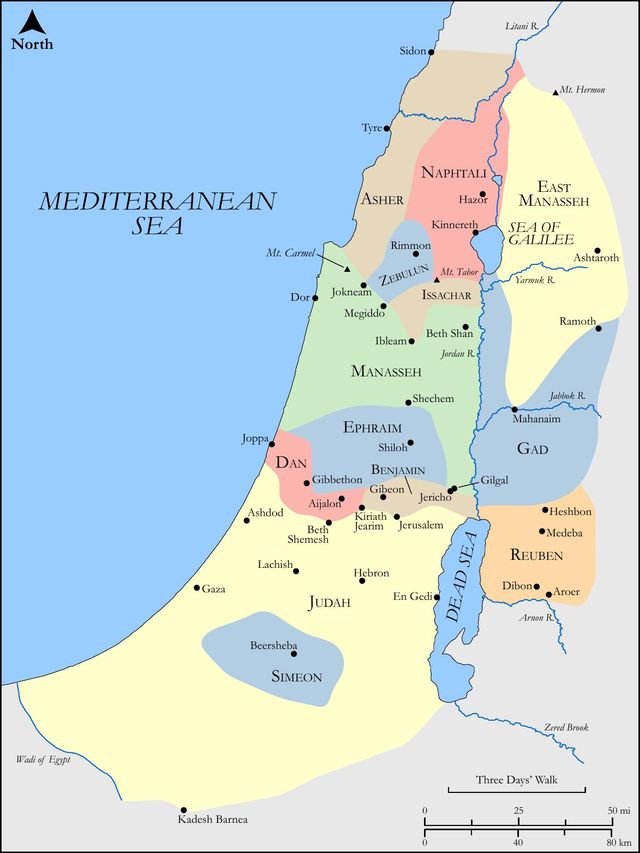
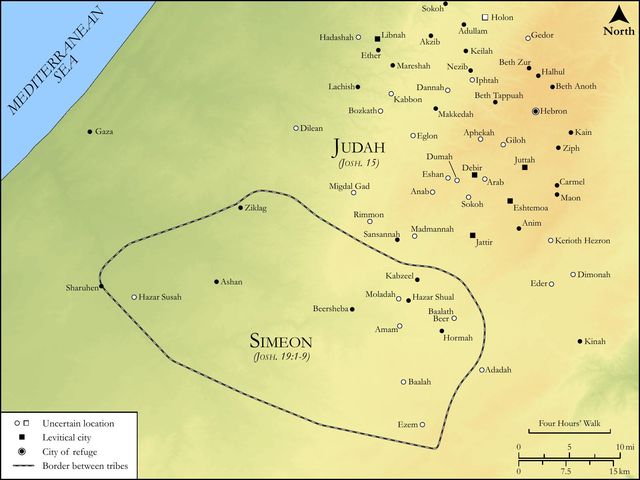
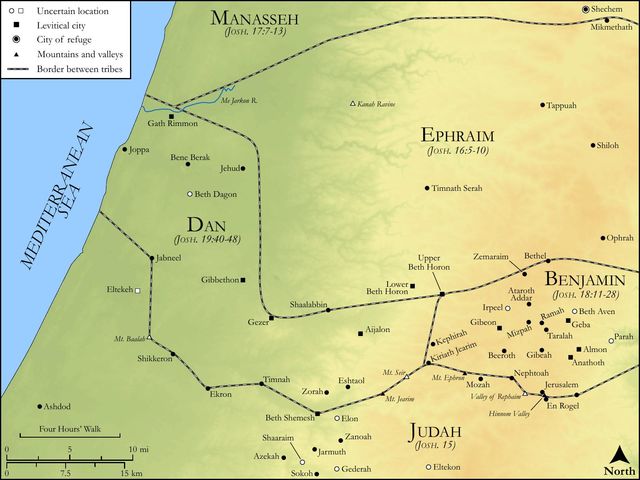
See on the biblical-era maps
Study this verse
Public-domain commentary
Matthew Henry
From his Commentary on the Whole Bible. Henry comments on passages, not single verses — this entry covers Joshua 17:7–13.
We have here a short account of the lot of this half tribe. It reached from Jordan on the east to the great sea on the west; on the south it lay all along contiguous to Ephraim, but on the north it abutted upon Asher and Issachar. Asher lay north-west, and Issachar north-east, which seems to be the meaning of that (Jos 17:10), that they (that is, Manasseh and Ephraim, as related to it, both together making the tribe of Joseph) met in Asher on the north and Issachar on the east, for Ephraim itself reached not those tribes. Some things are particularly observed concerning this lot: - 1. That there was great communication between this tribe and that of Ephraim. The city of Tappuah belonged to Ephraim, but the country adjoining to Manasseh (Jos 17:8); there were likewise many cities of Ephraim that lay within the border of Manasseh (Jos 17:9), of which before, Jos 16:9. 2. That Manasseh likewise had cities with their appurtenances in the tribes of Issachar and Asher (Jos 17:11), God so ordering it, that though every tribe had its peculiar inheritance, which might not be alienated from it, yet they should thus intermix one with another, to keep up mutual acquaintance and correspondence among the tribes, and to give occasion for the doing of good offices one to another, as became those who, though of different tribes, were all one Israel, and were bound to love as brethren. 3. That they suffered the Canaanites to live among them, contrary to the command of God, serving their own ends by conniving at them, for they made them tributaries, Jos 17:12, Jos 17:13. The Ephraimites had done the same (Jos 16:10), and from them perhaps the Manassites learned it, and with their example excused themselves in it. The most remarkable person of this half tribe in after-time was Gideon, whose great actions were done within this lot. He was of the family of Abiezer; Cesarea was in this lot, and Antipatris, famed in the latter ages of the Jewish state.
Continue studying Joshua 17:12 across the web’s major study libraries — every link below opens this exact verse, chapter, or book on the destination site.
Read & Compare
 BibleGatewayThis verse in more than 200 translations and 70 languages.
 Bible.comThe YouVersion reader — hundreds of translations, reading plans, and highlights.
 ESV.orgCrossway's official English Standard Version reader.
 NET BibleThe NET translation with 60,000+ translators' notes on every rendering decision.
 STEP BibleTyndale House's free study tool — original text, vocabulary, and scholarly resources.
 BibliaLogos Bible Software's free web reader.
 USCCBThe New American Bible (Revised Edition) with the U.S. bishops' study notes.
Commentaries
 BibleHub CommentariesDozens of classic commentaries on this verse, gathered on one page.
 StudyLightMore than 100 commentary sets — the largest collection on the web.
 BibleRefPlain-English commentary on what this verse means, verse by verse.
 Enduring WordDavid Guzik's free commentary on this chapter, widely used by Bible teachers.
 Bible Study ToolsVerse commentary alongside Greek and Hebrew study aids.
Original Language & Research
- BibleHub InterlinearThe verse word by word — original language, transliteration, and English.
- BibleHub LexiconEvery word's original-language definition and Strong's entry.
 Blue Letter BibleDeep-study tools — Strong's numbers, concordance, and word studies.
 SefariaThe Hebrew text with Rashi and centuries of Jewish commentary.
Sermons, Hymns & Audio


TrulyRandomVerse is not affiliated with these sites and doesn’t control their content. They’re linked because they’re genuinely useful.
Summary
Joshua 17:12 records a pivotal failure of the half-tribe of Manasseh to fully dispossess the indigenous Canaanite inhabitants from their divinely allotted territory. This act of incomplete obedience, despite God's clear commands and promised victory, allowed the Canaanites to remain in strategically important cities. This compromise set a dangerous precedent, foreshadowing the cycles of spiritual decline, idolatry, and national oppression that would profoundly shape the subsequent history of Israel, as vividly detailed in the book of Judges.
Context
ShowHideLiterary Context
Joshua 17:12 is situated within the detailed account of the division of the land among the Israelite tribes, following the initial military campaigns of conquest. Chapters 13-19 meticulously delineate each tribe's inheritance, and specifically, chapter 17 focuses on the allocation for the descendants of Joseph, Ephraim and Manasseh. This verse immediately follows a description of the strategic cities that fell within Manasseh's territory (Joshua 17:11), emphasizing their fertile plains and vital importance. The failure documented here stands in stark contrast to the earlier, decisive victories achieved through God's power (e.g., the fall of Jericho in Joshua 6) and God's faithfulness in delivering the land. It serves as a critical turning point, anticipating the struggles and repeated failures to dispossess the inhabitants that are extensively recounted in the book of Judges. This verse thus introduces a somber theme, indicating that while the land was sovereignly given by God, its complete possession required sustained and unwavering obedience from Israel.
Historical & Cultural Context
The Canaanites were a diverse collection of city-states, each typically governed by its own king and possessing distinct military and religious practices. Their religious systems were predominantly fertility cults centered around deities such as Baal and Asherah, often involving abhorrent practices like ritual prostitution and child sacrifice. God's explicit command to Israel, known as herem (utter destruction or devotion to God), was not merely a territorial imperative but a spiritual one, designed to preserve the purity and distinct identity of His covenant people. Allowing the Canaanites to remain meant exposing Israel to their idolatrous worship and moral corruption, which God knew would inevitably become a snare. Furthermore, the cities mentioned in Manasseh's territory (Beth Shean, Ibleam, Dor, En Dor, Taanach, Megiddo) were strategically crucial, controlling vital trade routes and highly fertile agricultural plains. The Canaanites in these regions possessed superior military technology, including formidable iron chariots (as highlighted in Joshua 17:16), which likely contributed to Manasseh's perceived inability or reluctance to fully dislodge them.
Key Themes
ShowHideJoshua 17:12 powerfully contributes to several overarching themes within the book of Joshua and the broader biblical narrative. Firstly, it underscores the theme of Incomplete Obedience or Partial Obedience. Despite God's clear and repeated commands (e.g., Deuteronomy 7:2 and Numbers 33:55) and the miraculous victories already granted, Manasseh failed to fully execute the divine mandate. This highlights a crucial distinction: God's faithfulness in giving the land did not negate Israel's responsibility in possessing it. Secondly, the verse introduces the theme of the Consequences of Compromise. By allowing the Canaanites to remain, Manasseh sowed seeds of future trouble, leading directly to intermarriage, idolatry, and oppression, as vividly portrayed throughout the book of Judges. This failure serves as a stark warning against spiritual complacency and the inherent dangers of tolerating sin or worldly influences within God's people. Finally, it implicitly touches on the theme of Divine Sovereignty and Human Responsibility, demonstrating that while God's promises are absolutely sure, their full realization in human experience often depends on human faithfulness and active participation.
Exposition and Analysis
ShowHideKey Word Analysis
ShowHideThis primitive root means "to occupy (by driving out previous tenants, and possessing in their place); by implication, to seize, to rob, to inherit; also to expel, to impoverish, to ruin." In the context of "could not drive out," the accompanying Hebrew word for "could" (H3201, yâkôl) implies an ability or power. Therefore, "could not drive out" (Hebrew, lo' yâkôl l'hōrîsh) suggests that Manasseh either lacked the perceived strength or, more profoundly, the will and faith to fully dispossess the inhabitants. Given God's repeated promises of victory and empowerment (e.g., Joshua 1:5), this "could not" is often interpreted as a "would not," indicating a failure of resolve, perhaps due to fear of the Canaanites' iron chariots or a preference for coexistence.
This term refers to the pre-Israelite inhabitants of the land of Canaan. As a patrial from Kenaʻan, it denotes a specific people group known for their polytheistic worship, particularly of Baal and Asherah, and their morally corrupt practices, including child sacrifice and cultic prostitution. Their continued presence within Israel's territory was a direct threat to Israel's covenant fidelity and spiritual distinctiveness, as they would inevitably lead Israel into idolatry and syncretism, undermining the very purpose of Israel's existence as a holy nation set apart for Yahweh.
This primitive root means "properly, to sit down (specifically as judge, in ambush, in quiet); by implication, to dwell, to remain; causatively, to settle, to marry." Its use here signifies that the Canaanites did not merely linger or pass through; they established a permanent, settled presence within Manasseh's allotted territory. This implies a degree of cohabitation and integration, which was precisely what God had forbidden. This continued "dwelling" was not a temporary inconvenience but a deep-seated problem that would inevitably lead to the assimilation of Israelite culture and religion with Canaanite practices, as seen in the subsequent history of Israel.
Verse Breakdown
ShowHide"Yet the children of Manasseh"
This opening clause specifically identifies the tribe responsible for the ensuing failure. The adversative "Yet" (וְלֹא, wəlo') immediately signals a deviation from the expected outcome, contrasting with God's earlier faithfulness in granting victory and the general success of the conquest. It sets a tone of disappointment and highlights a critical lapse in the execution of the divine plan.
"could not drive out [the inhabitants of] those cities"
This is the core statement of Manasseh's failure. "Those cities" refers back to the list in Joshua 17:11 (Beth Shean, Ibleam, Dor, En Dor, Taanach, and Megiddo), which were strategically vital and economically significant strongholds. The phrase "could not drive out" implies either a perceived lack of military capability (perhaps due to the Canaanites' iron chariots, as mentioned in Joshua 17:16) or, more likely in a theological context, a lack of faith and determination to fully obey God's command, despite His promised assistance.
"but the Canaanites would dwell in that land"
This final clause states the direct and enduring consequence of Manasseh's failure. The Canaanites did not merely remain; they "would dwell," indicating a settled, ongoing, and permanent presence within the land allocated to Manasseh. This establishes a long-term problem, as these remaining pockets of Canaanite influence became persistent sources of temptation, idolatry, and conflict for Israel, ultimately leading to the cycles of apostasy and oppression vividly described in the book of Judges.
Literary Devices
ShowHideJoshua 17:12 employs several potent literary devices to convey its significant message. There is a profound sense of Irony present, as God had explicitly promised to drive out the inhabitants before Israel (e.g., Joshua 3:10), yet here, a specific tribe "could not" or "would not" fulfill their part of the divine mandate. This highlights a stark Contrast between God's omnipotence and unwavering faithfulness, and human weakness, fear, or disobedience. Furthermore, the verse functions as powerful Foreshadowing. It is a direct precursor to the narrative of the book of Judges, which opens with a similar litany of tribal failures to dispossess the Canaanites. This verse thus serves as an early and ominous warning sign of the spiritual decline, moral compromise, and national struggles that would plague Israel for centuries, demonstrating how initial compromises and partial obedience inevitably lead to deeper entanglements and widespread spiritual and social decay.
Theological and Thematic Connections
ShowHideJoshua 17:12 stands as a profound theological statement on the nature of obedience and its far-reaching consequences. It underscores that God's covenant promises, while sovereignly given, are often conditional upon human faithfulness, particularly in the realm of spiritual purity and separation from pagan influences. The failure of Manasseh was not merely a military setback but a deeply spiritual compromise that allowed the "leaven" of paganism and idolatry to remain within the promised land, thereby threatening the very identity and mission of God's chosen people. This incomplete conquest serves as a stark reminder that true spiritual victory requires total commitment and an uncompromising refusal to tolerate anything that competes with God's exclusive claim on our lives and His commands. It highlights the ongoing spiritual battle against sin and worldly influences, emphasizing that partial obedience is, in essence, disobedience, and its toleration inevitably leads to greater spiritual bondage, compromise, and a departure from God's intended flourishing.
Reflection and Application
ShowHideJoshua 17:12 serves as a timeless warning for believers today against the insidious dangers of partial obedience and spiritual compromise. Just as the remaining Canaanites became a persistent snare for Israel, allowing "pockets" of unaddressed sin, unmortified flesh, or worldly influences to remain in our lives will inevitably hinder our spiritual growth, compromise our witness, and lead to greater struggles. This verse challenges us to diligently examine our own "territories"—our hearts, minds, habits, relationships, and even our spheres of influence—and honestly ask if there are areas where we have failed to fully "drive out" what God commands us to surrender, eradicate, or separate from. True spiritual victory, and the abundant, flourishing life God intends for His children, requires radical, wholehearted obedience and a complete reliance on His empowering grace to overcome every obstacle. We are called not to coexist with sin or the world's values, but to actively put them to death, trusting that the same God who promised victory to Israel will empower us to live lives of holiness, freedom, and unreserved devotion to Him.
Questions for Reflection
ShowHideFAQ
ShowHideWhy was it so crucial for Israel to completely drive out the Canaanites?
ShowHideIt was crucial for profound spiritual, theological, and covenantal reasons. God commanded the complete expulsion or destruction of the Canaanites (e.g., Deuteronomy 7:1-6) primarily to prevent Israel from falling into idolatry and moral corruption. The Canaanites practiced abhorrent rituals, including child sacrifice, cultic prostitution, and divination, which were an abomination to the Lord. Their continued presence would inevitably lead to syncretism, where Israel would blend Yahweh worship with pagan practices, thereby defiling their covenant relationship with God and undermining their identity as a holy nation set apart for Him. The land itself was also considered holy, and its purification from the wickedness of its inhabitants was part of God's righteous judgment against their pervasive sin.
Did "could not drive out" mean Manasseh was genuinely unable, or unwilling?
ShowHideWhile the KJV translates it as "could not," the Hebrew phrase lo' horish (לֹא הוֹרִישׁ), particularly when considering the root for "could" (H3201, yâkôl), carries a strong nuance that suggests a lack of resolve, determination, or faith rather than an inherent physical inability. God had repeatedly promised to give Israel victory and to drive out the inhabitants before them (e.g., Joshua 1:5, Joshua 23:5). Manasseh even complained about the Canaanites' iron chariots (see Joshua 17:16), implying a fear or unwillingness to confront a technologically superior foe, despite the overwhelming power of God on their side. Therefore, most biblical scholars interpret "could not" as reflecting a failure of faith and obedience, a "would not," especially given that other tribes (like Judah in Judges 1:8) were more successful in similar endeavors against formidable opponents.
What were the long-term consequences of Manasseh's failure?
ShowHideThe long-term consequences were severe, pervasive, and far-reaching, as vividly illustrated throughout the book of Judges and subsequent books of the Old Testament. The remaining Canaanites became "thorns in your sides and their gods will be a snare to you" (Judges 2:3). This led to recurring cycles of apostasy, where Israel would abandon Yahweh to worship Baal and Asherah, followed by divine judgment in the form of oppression from surrounding nations, and then cries for deliverance, prompting God to raise up judges. This tragic pattern of disobedience, oppression, and partial repentance continued for centuries, demonstrating how initial compromises and partial obedience can lead to deep-seated spiritual problems, moral decay, and national instability, ultimately contributing to the eventual exile of both the northern and southern kingdoms.
Christ-Centered Fulfillment
ShowHideJoshua 17:12, with its somber account of incomplete conquest and human failure, powerfully foreshadows the profound need for a greater, more complete deliverer than Joshua or any Israelite tribe could ever be. Israel's inability or unwillingness to fully dispossess the Canaanites reveals the inherent limitations of human effort and the persistent struggle against sin and spiritual compromise that plagues humanity. This incomplete victory in the Old Testament points forward to Jesus Christ, the true and ultimate conqueror. Unlike Manasseh, who "could not drive out" their enemies, Christ fully and completely disarms the spiritual powers of darkness. He decisively conquered sin on the cross, triumphing over principalities and powers (Colossians 2:15), and through His glorious resurrection, He decisively defeated death itself (1 Corinthians 15:54-57). Where Israel failed to fully cleanse the physical land, Christ perfectly cleanses His people, enabling us to "drive out" the "Canaanites" of sin, worldly desires, and ungodly influences from our hearts through the indwelling power of the Holy Spirit (Romans 8:13). Our victory over sin and the world is not achieved by our own strength or will, but by abiding in Him and participating in His already accomplished, perfect conquest (John 16:33). He is the one who fully delivers us from every spiritual enemy, establishing a kingdom of complete purity, righteousness, and lasting peace, a reality that Israel's partial conquest could only dimly anticipate.