


Joshua 17:8
Bible text: King James Version (1769 Blayney text) · Public domain
Bible text: Berean Standard Bible · Public domain
Bible text: American Standard Version (1901) · Public domain
Bible text: World English Bible, Messianic edition · Public domain
Bible text: Geneva Bible (1599) · Public domain
Bible text: Young's Literal Translation · Public domain
- לִמְנַשֶּׁהlim·na·Shehto ManassehH4519Prep-l ¦ N-proper-mNoun Proper MasculineלִtoמְנַשֶּׁהManasseh
- הָיְתָהha·ye·Tahit belongedH1961V-Qal-Perf-3fsVerb Qal Perfect 3rd Singular Feminine
- אֶרֶץ'E·retz[the] land ofH776N-fscNoun Singular Feminine Construct
- תַּפּוּחַta·Pu·achTappuahH8599N-properNoun Proper Location
- וְתַפּוּחַve·ta·Pu·achand TappuahH8599Conj-w ¦ N-properNoun Proper LocationוְandתַפּוּחַTappuah
- אֶל'eltoH413PrepPreposition
- גְּבוּלge·Vul[the] border ofH1366N-mscNoun Singular Masculine Construct
- מְנַשֶּׁהme·na·ShehManassehH4519N-proper-mNoun Proper Masculine
- לִבְנֵיliv·Nei[belonged] to [the] descendants ofH1121Prep-l ¦ N-mpcNoun Plural Masculine Constructלִ[belonged] toבְנֵי[the] descendants of
- אֶפְרָיִם'ef·Ra·yimEphraimH669N-proper-mNoun Proper Masculine
English is a literal word-by-word gloss of the Hebrew, not the KJV's wording. Why?
This is the original text the KJV's translators worked from — each Hebrew word with its own literal English meaning in this verse, prepared by scholars at Tyndale House, Cambridge. The KJV translates whole sentences, not word by word, so its wording differs: one Hebrew word can become several English words, and the KJV may choose “the LORD” where the gloss reads “Yahweh”. Both are faithful — they answer different questions. For the KJV's own rendering, switch to the KJV text.
Details
See on the biblical-era maps
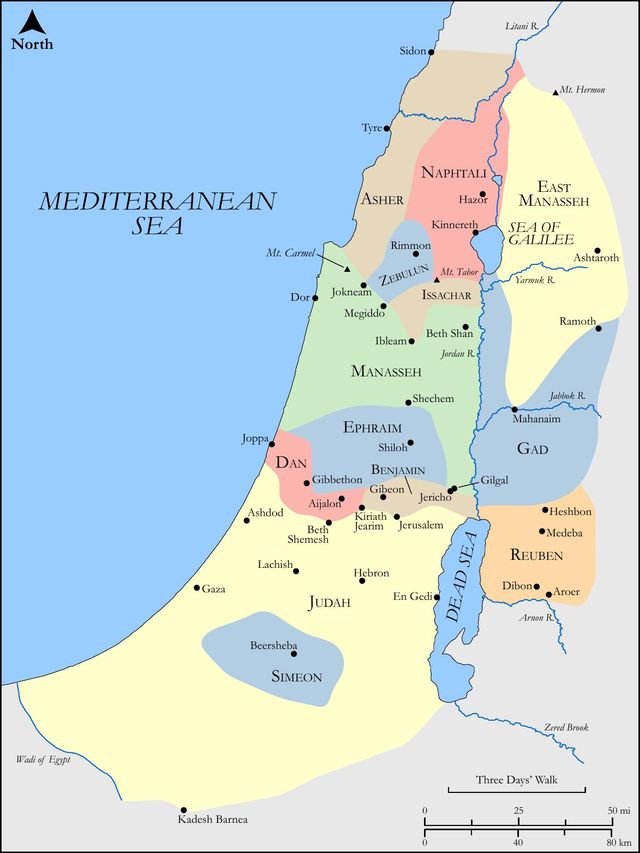
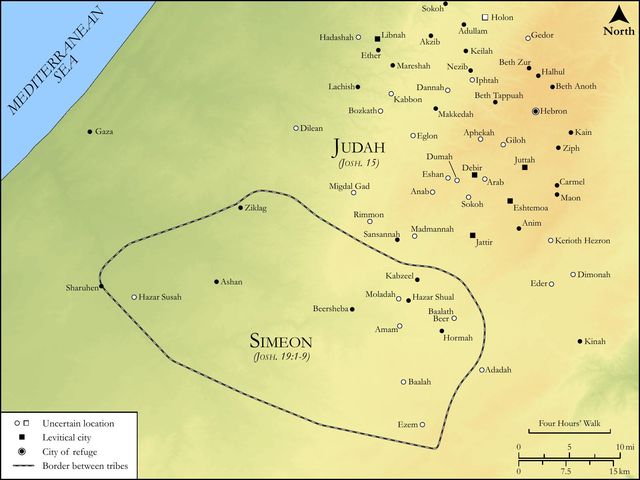
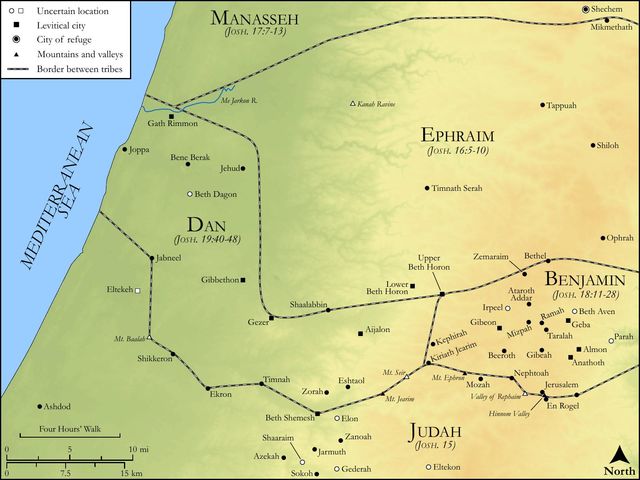
Study this verse
Public-domain commentary
Matthew Henry
From his Commentary on the Whole Bible. Henry comments on passages, not single verses — this entry covers Joshua 17:7–13.
We have here a short account of the lot of this half tribe. It reached from Jordan on the east to the great sea on the west; on the south it lay all along contiguous to Ephraim, but on the north it abutted upon Asher and Issachar. Asher lay north-west, and Issachar north-east, which seems to be the meaning of that (Jos 17:10), that they (that is, Manasseh and Ephraim, as related to it, both together making the tribe of Joseph) met in Asher on the north and Issachar on the east, for Ephraim itself reached not those tribes. Some things are particularly observed concerning this lot: - 1. That there was great communication between this tribe and that of Ephraim. The city of Tappuah belonged to Ephraim, but the country adjoining to Manasseh (Jos 17:8); there were likewise many cities of Ephraim that lay within the border of Manasseh (Jos 17:9), of which before, Jos 16:9. 2. That Manasseh likewise had cities with their appurtenances in the tribes of Issachar and Asher (Jos 17:11), God so ordering it, that though every tribe had its peculiar inheritance, which might not be alienated from it, yet they should thus intermix one with another, to keep up mutual acquaintance and correspondence among the tribes, and to give occasion for the doing of good offices one to another, as became those who, though of different tribes, were all one Israel, and were bound to love as brethren. 3. That they suffered the Canaanites to live among them, contrary to the command of God, serving their own ends by conniving at them, for they made them tributaries, Jos 17:12, Jos 17:13. The Ephraimites had done the same (Jos 16:10), and from them perhaps the Manassites learned it, and with their example excused themselves in it. The most remarkable person of this half tribe in after-time was Gideon, whose great actions were done within this lot. He was of the family of Abiezer; Cesarea was in this lot, and Antipatris, famed in the latter ages of the Jewish state.
Continue studying Joshua 17:8 across the web’s major study libraries — every link below opens this exact verse, chapter, or book on the destination site.
Read & Compare
 BibleGatewayThis verse in more than 200 translations and 70 languages.
 Bible.comThe YouVersion reader — hundreds of translations, reading plans, and highlights.
 ESV.orgCrossway's official English Standard Version reader.
 NET BibleThe NET translation with 60,000+ translators' notes on every rendering decision.
 STEP BibleTyndale House's free study tool — original text, vocabulary, and scholarly resources.
 BibliaLogos Bible Software's free web reader.
 USCCBThe New American Bible (Revised Edition) with the U.S. bishops' study notes.
Commentaries
 BibleHub CommentariesDozens of classic commentaries on this verse, gathered on one page.
 StudyLightMore than 100 commentary sets — the largest collection on the web.
 BibleRefPlain-English commentary on what this verse means, verse by verse.
 Enduring WordDavid Guzik's free commentary on this chapter, widely used by Bible teachers.
 Bible Study ToolsVerse commentary alongside Greek and Hebrew study aids.
Original Language & Research
- BibleHub InterlinearThe verse word by word — original language, transliteration, and English.
- BibleHub LexiconEvery word's original-language definition and Strong's entry.
 Blue Letter BibleDeep-study tools — Strong's numbers, concordance, and word studies.
 SefariaThe Hebrew text with Rashi and centuries of Jewish commentary.
Sermons, Hymns & Audio


TrulyRandomVerse is not affiliated with these sites and doesn’t control their content. They’re linked because they’re genuinely useful.
Summary
Joshua 17:8 meticulously details a specific territorial arrangement between the half-tribe of Manasseh and the tribe of Ephraim, both descendants of Joseph. It clarifies that while the broader region known as "the land of Tappuah" was allocated to Manasseh, the town of Tappuah itself, strategically located on Manasseh's border, was explicitly assigned to the children of Ephraim. This precise demarcation underscores the intricate and divinely ordained nature of the land distribution, highlighting the careful attention given to every detail of Israel's inheritance in the Promised Land.
Context
ShowHideLiterary Context
This verse is situated within the extensive and geographically precise account of the division of the land of Canaan among the Israelite tribes, primarily documented in Joshua 13-19. Following the initial military campaigns, Joshua, acting under divine instruction, oversaw the apportionment of territories by lot, ensuring each tribe received its designated inheritance. Chapter 17 specifically focuses on the inheritance of the half-tribe of Manasseh and the tribe of Ephraim, the two prominent sons of Joseph. The narrative frequently emphasizes the challenges and complexities arising from their intertwined territories, given their shared patriarchal lineage and the significant size of their original tribal claims. Joshua 17:8, alongside a parallel mention in Joshua 16:8, serves to clarify a particular point of demarcation concerning the town of Tappuah, which functioned as a critical landmark on the border between these two powerful and often competitive tribes. The meticulous geographical details throughout these chapters reinforce the permanence and divine sanction of these established boundaries.
Historical & Cultural Context
The period immediately following the conquest of Canaan marked a pivotal transition for Israel, moving from a nomadic, wilderness existence to a settled, agricultural society. The precise demarcation of tribal boundaries was not merely a bureaucratic exercise but a crucial act for establishing tribal identity, preventing future inter-tribal disputes, and ensuring the fulfillment of God's covenant promises. Land was the fundamental source of wealth, security, and social standing in ancient Israelite society, and its inheritance was deeply significant, directly linked to their covenant relationship with Yahweh. The practice of dividing land by lot, as explicitly commanded in Numbers 26:55-56, underscored the belief in divine sovereignty guiding the distribution. The unique arrangement described in Joshua 17:8, where the town of Tappuah belonged to Ephraim despite being within or on the border of Manasseh's broader territory, reflects the practical realities of managing a large, diverse population and ensuring equitable distribution. Such enclaves or precise border towns were likely determined by the specific topographical contours of the land, strategic considerations, or prior agreements, showcasing a pragmatic yet divinely guided approach to land allocation.
Key Themes
ShowHideJoshua 17:8 contributes significantly to several overarching theological and narrative themes prevalent in the book of Joshua and the broader Pentateuch. Firstly, it powerfully illustrates the Fulfillment of God's Promises, particularly the covenant made with Abraham, Isaac, and Jacob to grant their descendants the land of Canaan (e.g., Genesis 12:7). The meticulous detail of the boundaries, down to a single town, underscores the tangible and precise reality of God's faithfulness. Secondly, the verse highlights Divine Order and Provision. The precise, even complex, division of land reflects God's orderly character and His careful provision for each tribal family, ensuring that every tribe received its rightful and distinct portion, as evident throughout Joshua 13-19. Lastly, the concept of Inheritance (Hebrew: nachalah) is central. This land was not merely temporary property but a permanent, divinely bestowed possession, foundational to Israel's identity, security, and future as the covenant people, as emphasized in passages like Deuteronomy 12:9-10. The specific situation of Tappuah also subtly points to the Intertwined Destinies of the Josephite tribes, whose territories and histories were closely linked, necessitating clear, divinely sanctioned boundaries.
Exposition and Analysis
ShowHideKey Word Analysis
ShowHideThis word (H8599) refers to a specific geographical location, a town and its surrounding land. The name itself means "apple" or "apple tree," suggesting that the area was known for its orchards or a prominent apple-growing region. Its repetition in the verse, first as the broader "land of Tappuah" and then as the specific "Tappuah" town, emphasizes its significance as a crucial geographical marker and the precise point of distinction regarding its ownership between the two Josephite tribes.
This term (H1366) denotes a boundary, frontier, or limit, often implying a physical demarcation like a cord or line. Its use here underscores the precise and legally binding nature of the land divisions. The phrase "on the border of Manasseh" indicates the exact line separating Manasseh's territory from Ephraim's, and Tappuah's location directly on this border highlights the critical importance of its specific allocation to prevent ambiguity and future disputes.
This word (H1121) literally means "son" but is used broadly to refer to descendants, offspring, or members of a family or tribe. In the phrase "the children of Ephraim," it designates the entire tribe or clan descended from Ephraim, emphasizing their collective identity and their corporate claim to the town of Tappuah as part of their divinely appointed inheritance.
Verse Breakdown
ShowHide"Now Manasseh had the land of Tappuah:"
This initial clause establishes the general allocation of the broader geographical region. It indicates that the territory surrounding the town of Tappuah, likely its agricultural lands or outlying areas, was assigned to the half-tribe of Manasseh. This sets up the specific nuance or exception that the subsequent clause will clarify, indicating that while the land was Manasseh's, the town itself was not.
"but Tappuah on the border of Manasseh [belonged] to the children of Ephraim;"
This is the crucial clarifying statement, introducing a contrast to the preceding clause. It specifies that the actual town of Tappuah, despite its proximity to or even enclave status within Manasseh's broader territory (being "on the border of Manasseh"), was explicitly designated as part of Ephraim's inheritance. This highlights a unique and precise arrangement, where a specific urban center served as a critical point of demarcation, ensuring clarity and preventing ambiguity in the tribal boundaries. It underscores the meticulousness of the land distribution, ensuring that every significant landmark was accounted for in the divine allocation.
Literary Devices
ShowHideJoshua 17:8 skillfully employs several Literary Devices to convey its precise message. The most evident is Geographical Precision, a hallmark of the entire land distribution section of Joshua, which uses specific place names like "Tappuah," "Manasseh," and "Ephraim" to create an exact mental map of the tribal inheritances. The Repetition of "Tappuah" (referring both to the general land and the specific town) serves to emphasize its importance as a landmark and to draw attention to the subtle but crucial distinction being made. The use of Contrast (signified by "but") highlights the specific exception or nuance in the land division, drawing the reader's attention to this particular detail and the careful, non-obvious nature of the allocation. Furthermore, the verse utilizes Boundary Language, a form of legal or administrative discourse, to define and solidify the tribal claims, reflecting the formal and binding nature of the divinely sanctioned land allocation.
Theological and Thematic Connections
ShowHideJoshua 17:8, though seemingly a dry geographical detail, profoundly reinforces the overarching theological theme of God's meticulous faithfulness to His covenant promises. Just as He promised Abraham a land for his descendants, He meticulously oversaw its distribution, down to the specific ownership of a single town like Tappuah. This precision speaks volumes about God's character as one who fulfills His word with exactitude, care, and unwavering commitment, ensuring that every detail of His redemptive plan unfolds as intended. It also subtly illustrates the complexities inherent in human relationships, even among brothers (Manasseh and Ephraim), and the divine wisdom in establishing clear boundaries to maintain peace, order, and justice within the framework of God's design for His people.
Reflection and Application
ShowHideThe detailed geographical descriptions in the book of Joshua, including the specific allocation in Joshua 17:8, might initially appear to be mere historical minutiae to contemporary readers. However, they serve as a powerful and enduring testament to God's unwavering faithfulness and meticulous care for His people. If God was so precise in allocating physical land to ancient Israel, down to the specific ownership of a single town like Tappuah, how much more can we trust Him with the intricate details of our individual lives and the fulfillment of His spiritual promises to us? This verse encourages us to recognize that God's plans are not vague or general, but specific, intentional, and perfectly ordered for our good and His glory. It reminds us that our "inheritance" in Christ is equally certain, precisely prepared, and eternally secure. Furthermore, the verse subtly teaches the profound importance of clear boundaries—whether in our personal lives, relationships, or spiritual disciplines—as a means to maintain order, prevent conflict, and ensure well-being within the framework of God's wise and loving design.
Questions for Reflection
ShowHideFAQ
ShowHideWhy is there such specific detail about the town of Tappuah?
ShowHideThe specific detail about Tappuah highlights the meticulous nature of the land distribution and the potential for complex geographical and tribal arrangements. While the surrounding "land of Tappuah" was given to Manasseh, the town itself was an enclave or a precise border marker belonging to Ephraim. This level of detail was crucial for establishing clear, legally binding boundaries between the tribes, preventing future disputes, and ensuring that every portion of the Promised Land was accounted for and properly assigned according to God's will. It underscores the divine order and precision in the fulfillment of God's covenant promises to Israel, as seen throughout the detailed land divisions in Joshua 13-19.
What does this verse tell us about the relationship between Manasseh and Ephraim?
ShowHideThis verse, along with other passages in Joshua concerning the Josephite tribes (e.g., Joshua 16 and Joshua 17:14-18), indicates a close but sometimes complex relationship between Manasseh and Ephraim. As the two sons of Joseph, their inheritances were intertwined, and they often shared common challenges, such as dealing with the Canaanites remaining in their territories. The precise demarcation of Tappuah suggests a careful effort to define their respective claims, even when a town might be an outlier or an enclave, to avoid future conflict and ensure both tribes received their divinely appointed portion. It reflects the practical challenges of dividing a large territory among a growing population while maintaining peace and order.
Christ-Centered Fulfillment
ShowHideWhile Joshua 17:8 describes an earthly inheritance and the precise division of a physical land, it serves as a powerful type and shadow pointing forward to the ultimate, spiritual inheritance found in Christ. The meticulous division of land for ancient Israel foreshadows the precise and perfect provision of salvation and eternal life for believers in the New Covenant. Just as the Israelites received a tangible land as a fulfillment of God's promise, believers receive an imperishable inheritance in Christ, "kept in heaven for you" (1 Peter 1:4). The earthly boundaries of Israel's tribal lands, though divinely appointed, were temporary and subject to human failure, conquest, and historical change. In stark contrast, the spiritual inheritance we have in Christ is eternal, incorruptible, and utterly secure, founded on the unshakeable New Covenant sealed by His precious blood (Hebrews 9:15). Christ Himself is our ultimate "portion" and "inheritance," far surpassing any earthly territory or possession (Psalm 73:26). He is the true Joshua, who leads us into our promised land, not of Canaan, but of eternal life and the new heavens and new earth, where righteousness dwells (2 Peter 3:13). The precision of Joshua 17:8 reminds us that God's plans for our redemption and eternal dwelling are equally precise and perfectly executed through the finished work of the Lamb of God, who takes away the sin of the world.