


Joshua 16:8
Bible text: King James Version (1769 Blayney text) · Public domain
Bible text: King James Version with Strong's numbers · Public domain
Bible text: Berean Standard Bible · Public domain
Bible text: American Standard Version (1901) · Public domain
Bible text: World English Bible, Messianic edition · Public domain
Bible text: Geneva Bible (1599) · Public domain
Bible text: Young's Literal Translation · Public domain
- מִתַּפּוּחַmi·ta·Pu·achfrom TappuahH8599Prep-m ¦ N-properNoun Proper LocationמִfromתַּפּוּחַTappuah
- יֵלֵךְye·Lekhit goesH1980V-Qal-Imperf-3msVerb Qal Imperfect 3rd Singular Masculine
- הַגְּבוּלha·ge·Vulthe borderH1366Art ¦ N-msNoun Singular Masculine Absoluteהַtheגְּבוּלborder
- יָמָּהya·mahwest -wardH3220N-ms ¦ SfxNoun Singular Masculine Absoluteיָמָּwestה-ward
- נַחַלNa·chal[the] wadi ofH5158N-mscNoun Singular Masculine Construct
- קָנָהka·NahKanahH7071N-properNoun Proper Location
- וְהָיוּve·ha·Yuand they areH1961Conj-w ¦ V-Qal-ConsecPerf-3cpVerb Qal Consecutive Perfect 3rd Plural common genderוְandהָיוּthey are
- תֹצְאֹתָיוto·tze·'o·Tavits extremitiesH8444N-fpc ¦ 3msNoun Plural Feminine Constructתֹצְאֹתָיextremitiesוits
- הַיָּמָּהhai·Ya·mahthe sea towardsH3220Art ¦ N-ms ¦ SfxNoun Singular Masculine Absoluteהַtheיָּמָּseaהtowards
- זֹאתZotthisH2063PrtParticle Demonstrative
- נַחֲלַתna·cha·Lat[was] [the] inheritance ofH5159N-fscNoun Singular Feminine Construct
- מַטֵּהma·Teh[the] tribe ofH4294N-mscNoun Singular Masculine Construct
- בְנֵיve·nei[the] descendants ofH1121N-mpcNoun Plural Masculine Construct
- אֶפְרַיִם'ef·Ra·yimEphraimH669N-proper-mNoun Proper Masculine
- לְמִשְׁפְּחֹתָםle·mish·pe·cho·Tamto their clansH4940Prep-l ¦ N-fpc ¦ 3mpNoun Plural Feminine Constructלְtoמִשְׁפְּחֹתָclansםtheir
English is a literal word-by-word gloss of the Hebrew, not the KJV's wording. Why?
This is the original text the KJV's translators worked from — each Hebrew word with its own literal English meaning in this verse, prepared by scholars at Tyndale House, Cambridge. The KJV translates whole sentences, not word by word, so its wording differs: one Hebrew word can become several English words, and the KJV may choose “the LORD” where the gloss reads “Yahweh”. Both are faithful — they answer different questions. For the KJV's own rendering, switch to the KJV text.
Details
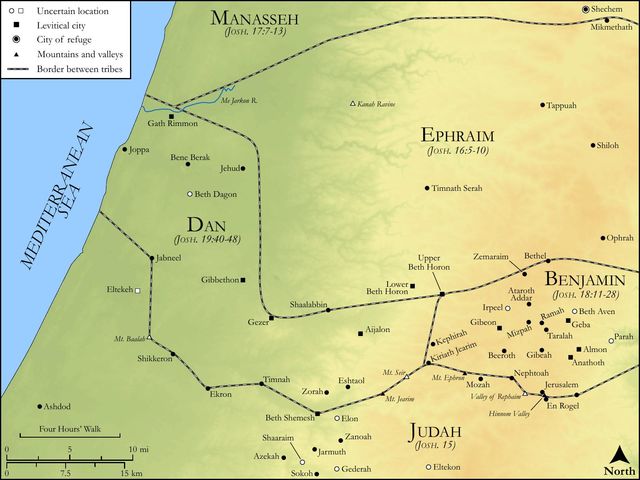
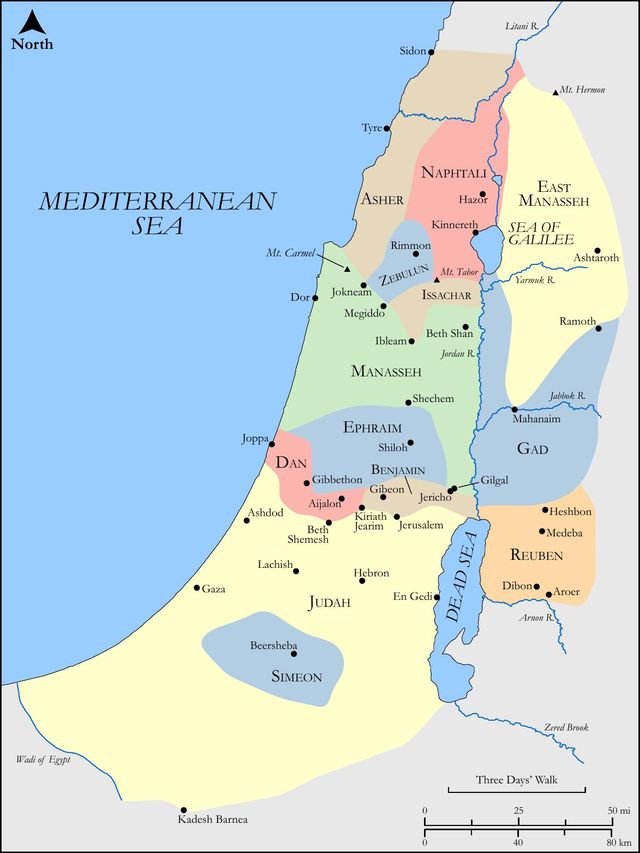
See on the biblical-era maps
Study this verse
Public-domain commentary
Matthew Henry
From his Commentary on the Whole Bible. Henry comments on passages, not single verses — this entry covers Joshua 16:5–10.
Here, 1. The border of the lot of Ephraim is set down, by which it was divided on the south from Benjamin and Dan, who lay between it and Judah, and on the north from Manasseh; for east and west it reached from Jordan to the great sea. The learned, who aim to be exact in drawing the line according to the directions here, find themselves very much at a loss, the description being short and intricate. The report of those who in these latter ages have travelled those countries will not serve to clear the difficulties, so vastly unlike is it now to what it was then; not only cities have been so destroyed as that no mark nor footstep of them remains, but brooks are dried up, rivers alter their courses, and even the mountain falling cometh to nought, and the rock is removed out of his place, Job 14:18. Unless I could hope to solve the doubts that arise upon this draught of the border of Ephraim, it is to no purpose to mention them: no doubt it was then perfectly understood, so as that the first intention of recording it was effectually answered, which was to notify the ancient landmarks, which posterity must by no means remove. 2. Some separate cities are spoken of, that lay not within these borders, at least not if the line was drawn direct, but lay within the lot of Manasseh (Jos 16:9), which might better be read, and there were separate cities for the children of Ephraim among the inheritance of the children of Manasseh, because it proved that Manasseh could spare them, and Ephraim had need of them, and it might be hoped that no inconvenience would arise from this mixture of these two tribes together, who were both the sons of Joseph, and should love as brethren. And by this it appears that though, when the tribes were numbered in the plains of Moab, Manasseh had got the start of Ephraim in number, for Manasseh was then 52,000, and Ephraim but 32,000 (Num 26:34, Num 26:37), yet by the time they were well settled in Canaan the hands were crossed again, and the blessing of Moses was verified, Deu 33:17, They are the ten thousands of Ephraim and they are the thousands of Manasseh. Families and kingdoms are diminished and increased, increased and diminished again, as God pleases. 3. A brand is put upon the Ephraimites, that they did not drive out the Canaanites from Gezer (Jos 16:10), either through carelessness or cowardice, either for want of faith in the promise of God, that he would give them success if they would make a vigorous effort, or for want of zeal for the command of God, which obliged them utterly to drive out the Canaanites, and to make no peace with them. And, though they hoped to satisfy the law by putting them under tribute, yet (as Calvin thinks) this made the matter worse, for it shows that they spared them out of covetousness, that they might be profited by their labours, and by dealing with them for their tribute they were in danger of being infected with their idolatry; yet some think that, when they brought them under tribute, they obliged them to renounce their idols, and to observe the seven precepts of the sons of Noah; and I should think so, but that we find in the sequel of the story that the Israelites were so far from restraining idolatry in others that they soon fell into it themselves. Many famous places were within this lot of the tribe of Ephraim, though not mentioned here. In it were Ramah, Samuel's city (called in the New Testament Arimathea, of which Joseph was, that took care of our Saviour's burial), and Shiloh, where the tabernacle was first set up. Tirzah also, the royal city of Jeroboam and his successors, and Deborah's palm-tree, under which she judged Israel, were in this tribe. Samaria, built by Omri after the burning of the royal palace of Tirzah, was in this tribe, and was long the royal city of the kingdom of the ten tribes; not far from it were Shechem, and the mountains Ebal and Gerizim, and Sychar, near which was Jacob's well, where Christ talked with the woman of Samaria. We read much of Mount Ephraim in the story of the Judges, and of a city called Ephraim, it is probable in this tribe, to which Christ retired, Joh 11:54. The whole kingdom of the ten tribes is often, in the prophets, especially in Hosea, called Ephraim.
Continue studying Joshua 16:8 across the web’s major study libraries — every link below opens this exact verse, chapter, or book on the destination site.
Read & Compare
 BibleGatewayThis verse in more than 200 translations and 70 languages.
 Bible.comThe YouVersion reader — hundreds of translations, reading plans, and highlights.
 ESV.orgCrossway's official English Standard Version reader.
 NET BibleThe NET translation with 60,000+ translators' notes on every rendering decision.
 STEP BibleTyndale House's free study tool — original text, vocabulary, and scholarly resources.
 BibliaLogos Bible Software's free web reader.
 USCCBThe New American Bible (Revised Edition) with the U.S. bishops' study notes.
Commentaries
 BibleHub CommentariesDozens of classic commentaries on this verse, gathered on one page.
 StudyLightMore than 100 commentary sets — the largest collection on the web.
 BibleRefPlain-English commentary on what this verse means, verse by verse.
 Enduring WordDavid Guzik's free commentary on this chapter, widely used by Bible teachers.
 Bible Study ToolsVerse commentary alongside Greek and Hebrew study aids.
Original Language & Research
- BibleHub InterlinearThe verse word by word — original language, transliteration, and English.
- BibleHub LexiconEvery word's original-language definition and Strong's entry.
 Blue Letter BibleDeep-study tools — Strong's numbers, concordance, and word studies.
 SefariaThe Hebrew text with Rashi and centuries of Jewish commentary.
Sermons, Hymns & Audio


TrulyRandomVerse is not affiliated with these sites and doesn’t control their content. They’re linked because they’re genuinely useful.
Summary
Joshua 16:8 meticulously delineates a specific segment of the western boundary for the tribe of Ephraim's inheritance within the Promised Land. This verse, seemingly a dry geographical detail, is profoundly significant as it underscores God's unwavering faithfulness in fulfilling His ancient covenant promises to Abraham regarding the land. It highlights the divine precision in providing for His people, establishing their identity, and ensuring their stability within their designated portion, affirming that every boundary line, however minute, is a testament to God's meticulous and trustworthy provision.
Context
ShowHideLiterary Context
Joshua 16:8 is situated within the extensive section of the Book of Joshua (chapters 13-19) dedicated to the detailed division and allocation of the land of Canaan among the twelve tribes of Israel. Following the successful military campaigns led by Joshua, the practical implementation of God's promise to give Israel the land necessitated a meticulous survey and distribution. Chapter 16 specifically outlines the inheritance of the "children of Joseph," which includes both Ephraim and Manasseh. Verses Joshua 16:1-10 focus on Ephraim's territory, describing its northern, eastern, southern, and western boundaries. This particular verse precisely defines a segment of Ephraim's western border, extending towards the Mediterranean Sea, thereby anchoring their possession within the broader tribal mosaic and illustrating the detailed fulfillment of God's covenant.
Historical & Cultural Context
The allocation of tribal territories was a foundational act in the establishment of Israel as a settled nation, transitioning from nomadic wanderers to landowners. In Israel, land was intrinsically linked to identity, lineage, and economic sustenance. A clearly defined inheritance ensured a tribe's security, provided resources for livelihood, and solidified its place within the national structure. Ephraim, as the favored son of Joseph (blessed by Jacob over Manasseh in Genesis 48:19), received a prominent and fertile portion of the central hill country, strategically important and agriculturally rich. The precise geographical markers mentioned—Tappuah, the River Kanah, and the Mediterranean Sea—were vital for legal and practical purposes, preventing disputes and ensuring each family knew their designated patrimony, reflecting the divine order established for the nascent nation.
Key Themes
ShowHideThe detailed description of Ephraim's border powerfully contributes to several overarching themes in Joshua and the broader biblical narrative. Foremost is the theme of Divine Faithfulness and Fulfillment, demonstrating God's unwavering commitment to His covenant promises, particularly the land grant made to Abraham (e.g., Genesis 15:18). Every boundary line, though seemingly mundane, is a tangible manifestation of God's word brought to fruition. This meticulous division also underscores God's character as a God of Order and Provision, meticulously orchestrating the details of His people's lives and ensuring their security and means of livelihood within the land promised to them in Deuteronomy 1:8. Finally, the concept of Identity and Inheritance is central, as the land was not merely property but the very foundation of Israelite identity, defining tribal lineage, heritage, and a profound sense of belonging within the covenanted community, echoing the divine promise of a "place" for His people found throughout the Pentateuch.
Exposition and Analysis
ShowHideKey Word Analysis
ShowHideThis term refers to a boundary or limit, often demarcated by a cord or line, and by extension, the territory enclosed within it. In Joshua 16:8, it signifies the precisely defined and legally recognized extent of Ephraim's territory, emphasizing the meticulous nature of the land distribution and God's orderly provision.
This word denotes something inherited, an occupancy, an heirloom, or generally an estate or patrimony. It highlights that the land was not merely conquered territory but a divinely allotted and permanent possession passed down through families, signifying God's fulfillment of His covenant promises to provide a secure dwelling for His people.
This term literally means "branch" or "rod," but figuratively refers to a tribe. Its use here underscores the communal and familial nature of the land distribution, where the inheritance was allocated not just to individuals but to the collective family unit, ensuring that each tribal lineage received its designated portion within the Promised Land.
Verse Breakdown
ShowHide"The border went out from Tappuah westward unto the river Kanah;"
This initial clause establishes the precise starting point and direction of a specific segment of Ephraim's western boundary. "Tappuah" serves as a known landmark, from which the border extends in a westerly direction. The "river Kanah" (often identified as Wadi Kanah today) then becomes the next significant geographical feature, indicating that the border followed this watercourse for a portion of its length, moving towards the Mediterranean coast. This highlights the use of natural features to delineate tribal lands with clarity and precision.
"and the goings out thereof were at the sea."
This phrase clarifies the ultimate western terminus of this specific border segment. "The goings out thereof" refers to the point where the boundary line, having followed the River Kanah, finally reached its end at "the sea," meaning the Mediterranean Sea. This confirms that Ephraim's territory extended all the way to the coast, securing a valuable and strategic western flank and providing access to maritime resources.
"This [is] the inheritance of the tribe of the children of Ephraim by their families."
This concluding statement serves as a definitive declaration, affirming that the described geographical area, with its precise boundaries, constituted the divinely allotted and legally recognized inheritance for the entire tribe of Ephraim, organized according to its various families or clans. It emphasizes the communal and familial nature of the land distribution, ensuring that every family within the tribe had a stake in this promised possession and a secure place within the nation.
Literary Devices
ShowHideJoshua 16:8, like many verses in the land allocation chapters, primarily employs Geographical Precision and Cataloging. The meticulous naming of specific landmarks (Tappuah, River Kanah, the Sea) demonstrates a commitment to exactitude, ensuring clarity and legal validity for the tribal boundaries. This Precision serves to underscore the divine order and the fulfillment of God's promises in tangible, verifiable ways, leaving no ambiguity about the extent of each tribe's claim. The verse is part of a larger Catalog of boundaries, which, while seemingly dry, functions as a legal document, solidifying the claims and identity of the Israelite tribes. This Cataloging is not merely descriptive but prescriptive, establishing the divinely ordained layout of the Promised Land. Furthermore, the very act of describing these boundaries carries Symbolism; the land itself is a symbol of God's faithfulness, His covenant, and the rest He provides for His people. The detailed description of its limits emphasizes the completeness and certainty of this divine gift, reflecting God's comprehensive care for His chosen people.
Theological and Thematic Connections
ShowHideJoshua 16:8, though focused on a geographical detail, resonates with profound theological truths. It is a tangible manifestation of God's covenant faithfulness, demonstrating His meticulous fulfillment of promises made centuries earlier to Abraham, Isaac, and Jacob regarding the land. The precision of the boundary description underscores God's character as a God of order, who provides for His people with exactitude and care, ensuring their security and identity within their designated inheritance. This physical inheritance in Canaan foreshadows the spiritual inheritance believers receive in Christ, which is equally certain, divinely appointed, and foundational to our identity. Just as the land provided rest and sustenance for Israel, our spiritual inheritance in Christ offers ultimate rest, provision, and belonging that transcends earthly limitations.
Reflection and Application
ShowHideThe detailed mapping of Ephraim's inheritance in Joshua 16:8 might initially seem irrelevant to contemporary life, yet it offers profound spiritual lessons. It serves as a powerful reminder of God's unwavering faithfulness and meticulous attention to detail in fulfilling His promises. Just as He precisely delineated the boundaries for Ephraim, He orchestrates the details of our lives, ensuring His perfect plan unfolds. This verse encourages us to trust in God's provision, knowing that our spiritual inheritance in Christ is far more secure and expansive than any earthly territory. It calls us to find our identity not in possessions or places, but in our belonging to God's kingdom, where our true and eternal inheritance lies. Furthermore, it reminds us that within God's vast kingdom, each believer has a unique place, a specific calling, and a designated sphere of influence, much like each tribe had its distinct portion. We are called to steward our spiritual inheritance—our gifts, our salvation, our relationship with Christ—with gratitude and purpose, living out our calling in the precise "boundaries" God has set for us, understanding that even our limitations are part of His perfect design.
Questions for Reflection
ShowHideFAQ
ShowHideWhy are these detailed geographical descriptions important in the Bible?
ShowHideThese detailed geographical descriptions, like the one in Joshua 16:8, are crucial for several reasons. Firstly, they demonstrate the historical veracity of the biblical narrative, providing verifiable landmarks that ground the events in real space and time. Secondly, they underscore God's faithfulness to His covenant promises, particularly the land grant to Abraham's descendants (e.g., Genesis 12:7). The meticulous allocation proves that God delivered on His word. Thirdly, these boundaries were essential for establishing tribal identity, legal ownership, and preventing disputes among the Israelite clans. They provided a sense of belonging and security, defining the very structure of the new nation in the Promised Land. Finally, they highlight God's orderly and precise nature in providing for His people, ensuring that each family received their rightful portion, thereby establishing peace and stability within the community.
Christ-Centered Fulfillment
ShowHideThe physical inheritance of land in Joshua 16:8, while a literal fulfillment of God's promise to Israel, finds its ultimate and spiritual fulfillment in Jesus Christ. The land of Canaan, with its promise of rest and provision, serves as a type and shadow of the true and eternal rest found in Christ (e.g., Hebrews 4:9). Just as Ephraim received a secure and fertile portion of the Promised Land, believers in Christ receive an incorruptible and eternal spiritual inheritance, not of earthly territory, but of salvation, righteousness, and eternal life in Him (e.g., Ephesians 1:3). Jesus is the true "land" or "place" where God's people find their ultimate dwelling, identity, and security. Through His atoning work, He has brought us into a new covenant, where the promises of God are "Yes" and "Amen" in Him (e.g., 2 Corinthians 1:20). The meticulous boundaries of Ephraim's inheritance foreshadow the precise and perfect provision of God for those who are "in Christ," establishing our eternal citizenship in heaven (e.g., Philippians 3:20) and securing our place in the spiritual kingdom that will never be shaken (e.g., Hebrews 12:28).