


Joshua 16:6
Bible text: King James Version (1769 Blayney text) · Public domain
Bible text: King James Version with Strong's numbers · Public domain
Bible text: Berean Standard Bible · Public domain
Bible text: American Standard Version (1901) · Public domain
Bible text: World English Bible, Messianic edition · Public domain
Bible text: Geneva Bible (1599) · Public domain
Bible text: Young's Literal Translation · Public domain
- וְיָצָאve·ya·Tza'and it goes outH3318Conj-w ¦ V-Qal-ConsecPerf-3msVerb Qal Consecutive Perfect 3rd Singular Masculineוְandיָצָאit goes out
- הַגְּבוּלha·ge·Vulthe borderH1366Art ¦ N-msNoun Singular Masculine Absoluteהַtheגְּבוּלborder
- הַיָּמָּהhai·Ya·mahthe sea towardsH3220Art ¦ N-ms ¦ SfxNoun Singular Masculine Absoluteהַtheיָּמָּseaהtowards
- הַמִּכְמְתָתha·mikh·me·Tat<the> MicmethathH4366Art ¦ N-properNoun Proper Locationהַ<the>מִּכְמְתָתMicmethath
- מִצָּפוֹןmi·tza·Fon[is] from [the] northH6828Prep-m ¦ N-fsNoun Singular Feminine Absoluteמִ[is] fromצָּפוֹן[the] north
- וְנָסַבve·na·Savand it turnsH5437Conj-w ¦ V-Niphal-ConsecPerf-3msVerb Niphal Consecutive Perfect 3rd Singular Masculineוְandנָסַבit turns
- הַגְּבוּלha·ge·Vulthe borderH1366Art ¦ N-msNoun Singular Masculine Absoluteהַtheגְּבוּלborder
- מִזְרָחָהmiz·Ra·chaheast -wardH4217N-ms ¦ SfxNoun Singular Masculine Absoluteמִזְרָחָeastה-ward
- תַּאֲנַתta·'a·NatTaanathH8387N-properNoun Proper Location
- שִׁלֹהshi·LohShilohH8387N-properNoun Proper Location
- וְעָבַרve·'a·Varand it passes byH5674Conj-w ¦ V-Qal-ConsecPerf-3msVerb Qal Consecutive Perfect 3rd Singular Masculineוְandעָבַרit passes by
- אוֹתוֹ'o·To<obj.> itH853DirObjM ¦ 3msParticle Object Indicatorאוֹת<obj.>וֹit
- מִמִּזְרַחmi·miz·Rachfrom [the] eastH4217Prep-m ¦ N-mscNoun Singular Masculine Constructמִfromמִּזְרַח[the] east
- יָנוֹחָהya·No·chah<to> JanoahH3239N-properNoun Proper Location
English is a literal word-by-word gloss of the Hebrew, not the KJV's wording. Why?
This is the original text the KJV's translators worked from — each Hebrew word with its own literal English meaning in this verse, prepared by scholars at Tyndale House, Cambridge. The KJV translates whole sentences, not word by word, so its wording differs: one Hebrew word can become several English words, and the KJV may choose “the LORD” where the gloss reads “Yahweh”. Both are faithful — they answer different questions. For the KJV's own rendering, switch to the KJV text.
Details
See on the biblical-era maps
Study this verse
Public-domain commentary
Matthew Henry
From his Commentary on the Whole Bible. Henry comments on passages, not single verses — this entry covers Joshua 16:5–10.
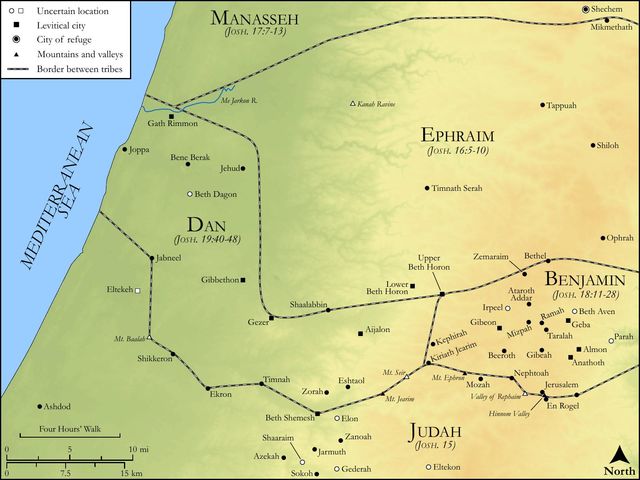
Here, 1. The border of the lot of Ephraim is set down, by which it was divided on the south from Benjamin and Dan, who lay between it and Judah, and on the north from Manasseh; for east and west it reached from Jordan to the great sea. The learned, who aim to be exact in drawing the line according to the directions here, find themselves very much at a loss, the description being short and intricate. The report of those who in these latter ages have travelled those countries will not serve to clear the difficulties, so vastly unlike is it now to what it was then; not only cities have been so destroyed as that no mark nor footstep of them remains, but brooks are dried up, rivers alter their courses, and even the mountain falling cometh to nought, and the rock is removed out of his place, Job 14:18. Unless I could hope to solve the doubts that arise upon this draught of the border of Ephraim, it is to no purpose to mention them: no doubt it was then perfectly understood, so as that the first intention of recording it was effectually answered, which was to notify the ancient landmarks, which posterity must by no means remove. 2. Some separate cities are spoken of, that lay not within these borders, at least not if the line was drawn direct, but lay within the lot of Manasseh (Jos 16:9), which might better be read, and there were separate cities for the children of Ephraim among the inheritance of the children of Manasseh, because it proved that Manasseh could spare them, and Ephraim had need of them, and it might be hoped that no inconvenience would arise from this mixture of these two tribes together, who were both the sons of Joseph, and should love as brethren. And by this it appears that though, when the tribes were numbered in the plains of Moab, Manasseh had got the start of Ephraim in number, for Manasseh was then 52,000, and Ephraim but 32,000 (Num 26:34, Num 26:37), yet by the time they were well settled in Canaan the hands were crossed again, and the blessing of Moses was verified, Deu 33:17, They are the ten thousands of Ephraim and they are the thousands of Manasseh. Families and kingdoms are diminished and increased, increased and diminished again, as God pleases. 3. A brand is put upon the Ephraimites, that they did not drive out the Canaanites from Gezer (Jos 16:10), either through carelessness or cowardice, either for want of faith in the promise of God, that he would give them success if they would make a vigorous effort, or for want of zeal for the command of God, which obliged them utterly to drive out the Canaanites, and to make no peace with them. And, though they hoped to satisfy the law by putting them under tribute, yet (as Calvin thinks) this made the matter worse, for it shows that they spared them out of covetousness, that they might be profited by their labours, and by dealing with them for their tribute they were in danger of being infected with their idolatry; yet some think that, when they brought them under tribute, they obliged them to renounce their idols, and to observe the seven precepts of the sons of Noah; and I should think so, but that we find in the sequel of the story that the Israelites were so far from restraining idolatry in others that they soon fell into it themselves. Many famous places were within this lot of the tribe of Ephraim, though not mentioned here. In it were Ramah, Samuel's city (called in the New Testament Arimathea, of which Joseph was, that took care of our Saviour's burial), and Shiloh, where the tabernacle was first set up. Tirzah also, the royal city of Jeroboam and his successors, and Deborah's palm-tree, under which she judged Israel, were in this tribe. Samaria, built by Omri after the burning of the royal palace of Tirzah, was in this tribe, and was long the royal city of the kingdom of the ten tribes; not far from it were Shechem, and the mountains Ebal and Gerizim, and Sychar, near which was Jacob's well, where Christ talked with the woman of Samaria. We read much of Mount Ephraim in the story of the Judges, and of a city called Ephraim, it is probable in this tribe, to which Christ retired, Joh 11:54. The whole kingdom of the ten tribes is often, in the prophets, especially in Hosea, called Ephraim.
Historical interpretation
Historical reception
1 surviving comment on this verse from the historical church.
Looketh to the north: The meaning is, that the border went towards the north, by Machmethath; and then turned eastward to Thanath-selo.
Continue studying Joshua 16:6 across the web’s major study libraries — every link below opens this exact verse, chapter, or book on the destination site.
Read & Compare
 BibleGatewayThis verse in more than 200 translations and 70 languages.
 Bible.comThe YouVersion reader — hundreds of translations, reading plans, and highlights.
 ESV.orgCrossway's official English Standard Version reader.
 NET BibleThe NET translation with 60,000+ translators' notes on every rendering decision.
 STEP BibleTyndale House's free study tool — original text, vocabulary, and scholarly resources.
 BibliaLogos Bible Software's free web reader.
 USCCBThe New American Bible (Revised Edition) with the U.S. bishops' study notes.
Commentaries
 BibleHub CommentariesDozens of classic commentaries on this verse, gathered on one page.
 StudyLightMore than 100 commentary sets — the largest collection on the web.
 BibleRefPlain-English commentary on what this verse means, verse by verse.
 Enduring WordDavid Guzik's free commentary on this chapter, widely used by Bible teachers.
 Bible Study ToolsVerse commentary alongside Greek and Hebrew study aids.
Original Language & Research
- BibleHub InterlinearThe verse word by word — original language, transliteration, and English.
- BibleHub LexiconEvery word's original-language definition and Strong's entry.
 Blue Letter BibleDeep-study tools — Strong's numbers, concordance, and word studies.
 SefariaThe Hebrew text with Rashi and centuries of Jewish commentary.
Sermons, Hymns & Audio


TrulyRandomVerse is not affiliated with these sites and doesn’t control their content. They’re linked because they’re genuinely useful.
Summary
Joshua 16:6 meticulously delineates a specific segment of the northern boundary of the tribal territory allotted to Ephraim. Beginning its course from the vicinity of the Mediterranean Sea, the border proceeds eastward through distinct and historically significant landmarks such as Michmethah, Taanathshiloh, and Janohah. This verse, embedded within the larger narrative of land distribution in the book of Joshua, profoundly underscores the divine precision and unwavering faithfulness in fulfilling God's ancient covenant promises to Israel, thereby establishing clear, defined, and secure inheritances for each tribe within the Promised Land.
Context
ShowHideLiterary Context
Joshua 16 commences the detailed geographical description of the land allocated to the "house of Joseph," specifically distinguishing the inheritances of the tribes of Ephraim and Manasseh. This follows the broader overview of tribal allotments in Joshua 13 through Joshua 15. Verses 1-3 of chapter 16 outline the southern boundary of Ephraim, while verses 4-10 elaborate on Ephraim's specific inheritance and its relationship with the half-tribe of Manasseh. Verse 6, therefore, functions as a precise geographical marker within the larger demarcation of Ephraim's northern boundary, providing specific waypoints as the border extends eastward. This intricate detailing of boundaries is a hallmark of the book of Joshua, emphasizing the tangible fulfillment of God's promises and the establishment of Israel as a settled nation.
Historical & Cultural Context
The period described in the book of Joshua depicts the immediate aftermath of the conquest of Canaan, a pivotal era when the Israelite tribes transitioned from a nomadic existence to settled agricultural communities. In Israel, land ownership and clearly defined territorial boundaries were of paramount importance, serving as the foundational basis for tribal identity, economic stability, and legal jurisdiction. The meticulous description of borders, frequently referencing natural features and established settlements, reflects the practical necessity of preventing inter-tribal disputes and ensuring a stable, ordered societal structure. The "sea" mentioned in the verse refers to the Mediterranean Sea, which marked the westernmost extent of the land. The named locations—Michmethah, Taanathshiloh, and Janohah—were significant landmarks used for demarcation, though their precise modern identifications are subjects of ongoing debate among archaeologists and historical geographers.
Key Themes
ShowHideJoshua 16:6 contributes significantly to several overarching theological and narrative themes prevalent throughout the book of Joshua. Firstly, it powerfully highlights the fulfillment of God's covenant promises, particularly the promise of land inheritance made to Abraham, Isaac, and Jacob, as seen in Genesis 15:18. The detailed demarcation serves as tangible proof that God's word is precise, trustworthy, and unfailingly accomplished. Secondly, the verse underscores divine order and precision in the distribution of the land, reflecting God's meticulous planning and sovereign provision for His chosen people. This careful allocation of territory, also evident in the instructions for land division in Numbers 34, ensured tribal identity and prevented chaos. Finally, the establishment of distinct tribal territories reinforces the theme of inheritance and stewardship, where each tribe received a specific portion to inhabit, cultivate, and defend, illustrating the responsibility that accompanies God's blessings and the importance of living within His divinely appointed parameters.
Exposition and Analysis
ShowHideKey Word Analysis
ShowHideThis term (H1366) refers to a boundary, limit, or the territory enclosed by such a limit. In Joshua 16:6, its repeated use emphasizes the precise and defined nature of the tribal inheritances. It signifies not merely an imaginary line but a tangible demarcation that established legal and social parameters for the tribe of Ephraim, reflecting God's orderly provision.
As H4366, this is a specific geographical place name, likely derived from a root meaning "concealment." Its inclusion as a waypoint on Ephraim's northern border indicates its significance as a known landmark in ancient times, even if its exact modern location remains debated. The naming of such specific, perhaps even obscure, places underscores the meticulousness of the land division process.
This place name (H8387) is understood to mean "approach of Shiloh." Its mention as a point on the border, situated eastward from Michmethah, is significant due to its implied proximity to Shiloh, which became the central sanctuary and worship site for Israel (Joshua 18:1). This connection reinforces the geographical accuracy and the systematic approach to defining tribal boundaries, linking the territory to a culturally and religiously important center.
Verse Breakdown
ShowHide"And the border went out toward the sea to Michmethah on the north side"
This initial clause establishes the starting point and general orientation of Ephraim's northern boundary. "Toward the sea" indicates a westward orientation, likely the Mediterranean, from which the border then proceeded inland. Michmethah is identified as a key waypoint on this northern edge, emphasizing the precise nature of the demarcation. The phrase "on the north side" clarifies that this is indeed the northern extent of Ephraim's territory.
"and the border went about eastward unto Taanathshiloh"
This continues the description of the border's trajectory, indicating a turn or continuation eastward from Michmethah. Taanathshiloh is presented as the next significant landmark along this eastern path. This segment highlights the continuous, winding, or directional nature of the boundary, meticulously tracing its path across the landscape, ensuring a clear and unambiguous line.
"and passed by it on the east to Janohah"
This final clause specifies the border's movement beyond Taanathshiloh, continuing further eastward to another distinct landmark, Janohah. The phrase "passed by it on the east" further clarifies the direction and the spatial relationship between Taanathshiloh and Janohah in the border's progression. This detailed sequence of landmarks demonstrates the comprehensive and unambiguous definition of Ephraim's land, ensuring clarity for future generations and preventing territorial disputes.
Literary Devices
ShowHideThe primary literary device employed in Joshua 16:6 is Topographical Description. The verse functions as a meticulous, almost cartographic, mapping of a geographical boundary, listing specific landmarks and cardinal directions ("toward the sea," "on the north side," "eastward," "on the east"). This precise detailing serves to establish the tangible reality and historical veracity of the land inheritance, reinforcing the fulfillment of God's promises. There is also an element of Repetition with the phrase "the border went," which emphasizes the continuous, defined, and systematic nature of the boundary line. The use of specific, often obscure, place names contributes to the sense of Verisimilitude, lending authenticity and historical grounding to the narrative of land distribution. The overall effect is one of Precision and Order, reflecting the divine hand in the allocation of the Promised Land and the establishment of a settled nation.
Theological and Thematic Connections
ShowHideJoshua 16:6, despite its seemingly dry geographical detail, profoundly underscores God's unwavering faithfulness and the meticulous fulfillment of His covenant promises to Israel. The precise demarcation of tribal boundaries, exemplified by this verse, is a tangible manifestation of God's commitment to provide for His people and establish them securely in the land He swore to their forefathers. It speaks to a divine order that brings stability and identity, transforming a wandering people into a settled nation with a defined inheritance. This detailed accounting for land is not merely administrative; it is deeply theological, demonstrating that God's word is not vague but specific, reliable, and ultimately accomplished with perfect precision.
Reflection and Application
ShowHideThe meticulous detail of Joshua 16:6 invites us to reflect on the nature of God's promises and our own spiritual inheritance in Him. Just as God precisely fulfilled His ancient oath to Israel, providing them with a defined and secure land, so too does He meticulously work out His purposes in our lives, ensuring that His promises to us in Christ are "Yes" and "Amen." This verse, therefore, serves as a powerful reminder of God's faithfulness and His commitment to order and clarity. It encourages us to trust in His sovereign plan, even when the path seems complex or the details overwhelming. Furthermore, the concept of boundaries, so central to this verse, can be applied to our spiritual lives: understanding the boundaries of God's grace, the limits of our own responsibilities, and the importance of living within the parameters He has set for our good and His glory. We are called to steward the spiritual inheritance we have received, recognizing that it is a gift from a God who is precise in His provisions and faithful in His promises.
Questions for Reflection
ShowHideFAQ
ShowHideWhy are these geographical details so important in the Bible?
ShowHideThe meticulous geographical details in passages like Joshua 16:6 are crucial for several profound reasons. Firstly, they provide tangible proof of God's faithfulness in fulfilling His ancient covenant promises to Abraham, Isaac, and Jacob that their descendants would inherit a specific land (e.g., Genesis 12:7). The detailed mapping demonstrates that the land was not merely a concept but a real, physical inheritance, confirming the reliability of God's word. Secondly, these details were vital for the practical administration and identity of the Israelite tribes, preventing disputes over territory and ensuring a stable societal structure. Each tribe knew its precise boundaries, fostering a strong sense of belonging, responsibility, and legal jurisdiction. Finally, these geographical markers ground the biblical narrative in historical reality, allowing later generations and scholars to trace the movements and settlements of God's people, thereby reinforcing the historical veracity and divine inspiration of the Scriptures.
How does Ephraim's inheritance relate to Manasseh's, given they are both part of the "house of Joseph"?
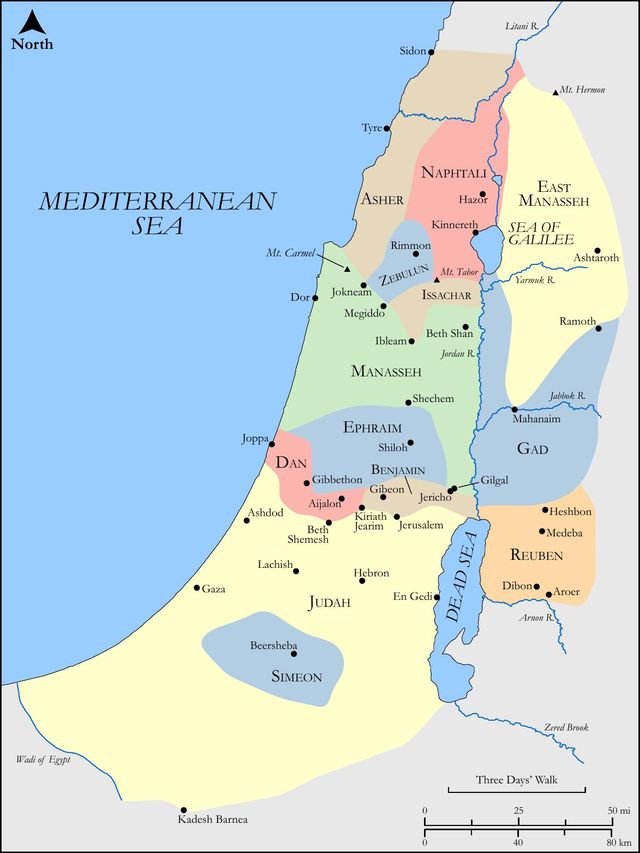
ShowHideThe tribes of Ephraim and Manasseh, both descendants of Joseph, received a combined inheritance, often referred to collectively as the "house of Joseph" (e.g., Joshua 17:14-18). While they shared a common ancestry and often collaborated, their territories were distinct, though sometimes interwoven or adjacent. Joshua 16 specifically details Ephraim's boundaries, while Joshua 17 outlines Manasseh's, including the challenges they faced in clearing out the Canaanites from their allotted portions. The division into two distinct tribes, rather than one, stemmed from Jacob's prophetic blessing of Ephraim over Manasseh, elevating both to the status of full tribes in Israel (see Genesis 48:5). This arrangement underscored the vastness of Joseph's descendants and the significant portion of land they were allotted, reflecting God's abundant provision.
Christ-Centered Fulfillment
ShowHideWhile Joshua 16:6 meticulously describes the precise earthly inheritance of the tribe of Ephraim, its deeper theological significance ultimately points to the far greater spiritual inheritance and eternal "rest" found in Jesus Christ. The meticulous demarcation of the Promised Land foreshadows the divine precision with which God orchestrates His grand plan of salvation, culminating perfectly in Christ. Just as the Israelites received a tangible land as a direct fulfillment of God's promise, believers in Christ receive an eternal inheritance that is "imperishable, undefiled, and unfading, kept in heaven for you" (1 Peter 1:4). The divinely ordained boundaries of Ephraim's territory reflect the secure and defined nature of our spiritual blessings and the "boundaries" of grace within which we live. Christ Himself is our ultimate inheritance and the true "land" of promise, providing us with a secure dwelling place and eternal rest, far surpassing any earthly territory. He is the one who leads us into our true promised land, the new heavens and new earth, where righteousness dwells and where we will dwell with God forever, a reality hinted at in the longing for a better country, a heavenly one, described in Hebrews 11:16. Through His perfect sacrifice, Christ has secured for us a spiritual domain and a future hope that is as real and certain as the physical land given to Israel, demonstrating God's ultimate faithfulness to His people through His Son (Ephesians 1:11).