


Joshua 17:7
Bible text: King James Version (1769 Blayney text) · Public domain
Bible text: King James Version with Strong's numbers · Public domain
Bible text: Berean Standard Bible · Public domain
Bible text: American Standard Version (1901) · Public domain
Bible text: World English Bible, Messianic edition · Public domain
Bible text: Geneva Bible (1599) · Public domain
Bible text: Young's Literal Translation · Public domain
- וַיְהִיvay·Hiand it wasH1961Conj-w ¦ V-Qal-ConsecImperf-3msVerb Qal Consecutive Imperfect 3rd Singular Masculineוַandיְהִיit was
- גְבוּלge·Vul[the] border ofH1366N-mscNoun Singular Masculine Construct
- מְנַשֶּׁהme·na·ShehManassehH4519N-proper-mNoun Proper Masculine
- מֵאָשֵׁרme·'a·Sherfrom AsherH836Prep-m ¦ N-proper-mNoun Proper MasculineמֵfromאָשֵׁרAsher
- הַמִּכְמְתָתha·mikh·me·Tat<the> MicmethathH4366Art ¦ N-properNoun Proper Locationהַ<the>מִּכְמְתָתMicmethath
- אֲשֶׁר'a·SherwhichH834RelParticle Relative
- עַל'al[is] onH5921PrepPreposition
- פְּנֵיpe·Nei[the] face ofH6440N-mpcNoun Plural Masculine Construct
- שְׁכֶםshe·KhemShechemH7927N-properNoun Proper Location
- וְהָלַךְve·ha·Lakhand it goesH1980Conj-w ¦ V-Qal-ConsecPerf-3msVerb Qal Consecutive Perfect 3rd Singular Masculineוְandהָלַךְit goes
- הַגְּבוּלha·ge·Vulthe borderH1366Art ¦ N-msNoun Singular Masculine Absoluteהַtheגְּבוּלborder
- אֶל'eltoH413PrepPreposition
- הַיָּמִיןhai·ya·Minthe southH3225Art ¦ N-fsNoun Singular Feminine Absoluteהַtheיָּמִיןsouth
- אֶל'eltoH413PrepPreposition
- יֹשְׁבֵיyo·she·Vei[the] inhabitants ofH3427V-Qal-Prtcpl-mpVerb Qal Participle Plural Masculine Construct
- עֵין'einEnH5887N-properNoun Proper Location
- תַּפּוּחַta·Pu·achTappuahH5887N-properNoun Proper Location
English is a literal word-by-word gloss of the Hebrew, not the KJV's wording. Why?
This is the original text the KJV's translators worked from — each Hebrew word with its own literal English meaning in this verse, prepared by scholars at Tyndale House, Cambridge. The KJV translates whole sentences, not word by word, so its wording differs: one Hebrew word can become several English words, and the KJV may choose “the LORD” where the gloss reads “Yahweh”. Both are faithful — they answer different questions. For the KJV's own rendering, switch to the KJV text.
Details
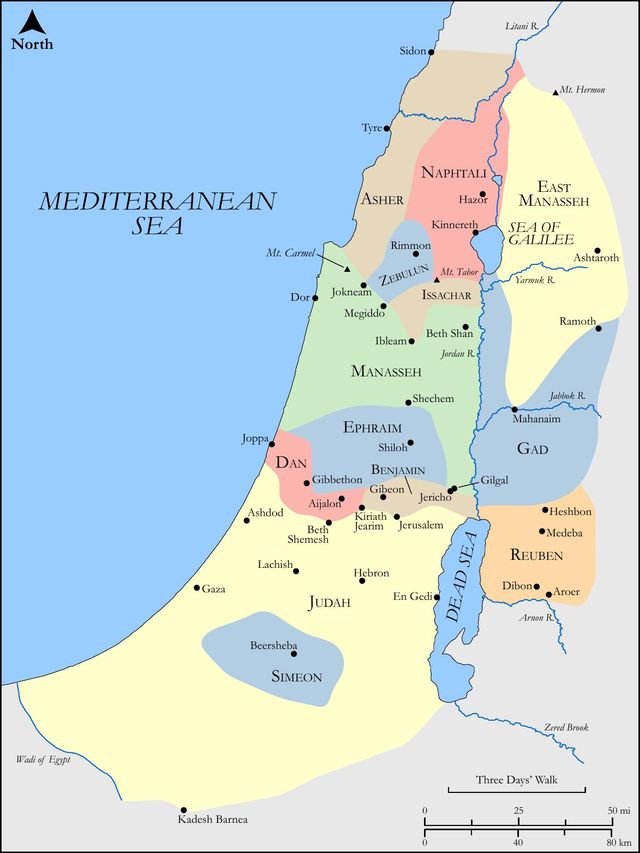
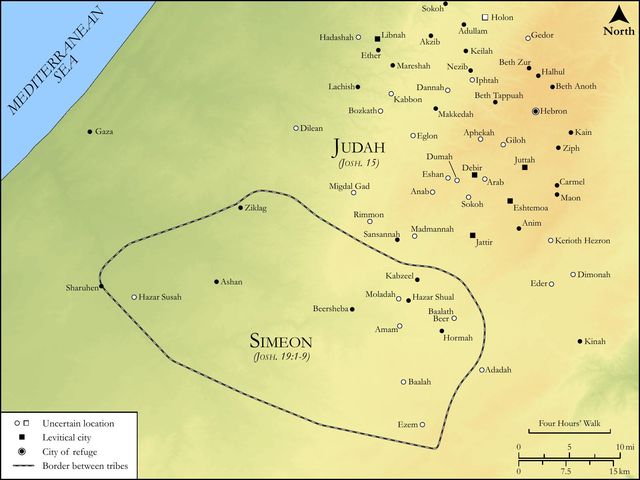
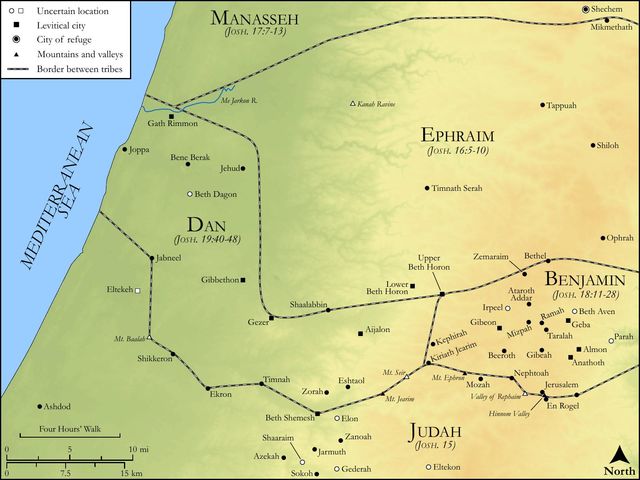
See on the biblical-era maps
Study this verse
Public-domain commentary
Matthew Henry
From his Commentary on the Whole Bible. Henry comments on passages, not single verses — this entry covers Joshua 17:7–13.
We have here a short account of the lot of this half tribe. It reached from Jordan on the east to the great sea on the west; on the south it lay all along contiguous to Ephraim, but on the north it abutted upon Asher and Issachar. Asher lay north-west, and Issachar north-east, which seems to be the meaning of that (Jos 17:10), that they (that is, Manasseh and Ephraim, as related to it, both together making the tribe of Joseph) met in Asher on the north and Issachar on the east, for Ephraim itself reached not those tribes. Some things are particularly observed concerning this lot: - 1. That there was great communication between this tribe and that of Ephraim. The city of Tappuah belonged to Ephraim, but the country adjoining to Manasseh (Jos 17:8); there were likewise many cities of Ephraim that lay within the border of Manasseh (Jos 17:9), of which before, Jos 16:9. 2. That Manasseh likewise had cities with their appurtenances in the tribes of Issachar and Asher (Jos 17:11), God so ordering it, that though every tribe had its peculiar inheritance, which might not be alienated from it, yet they should thus intermix one with another, to keep up mutual acquaintance and correspondence among the tribes, and to give occasion for the doing of good offices one to another, as became those who, though of different tribes, were all one Israel, and were bound to love as brethren. 3. That they suffered the Canaanites to live among them, contrary to the command of God, serving their own ends by conniving at them, for they made them tributaries, Jos 17:12, Jos 17:13. The Ephraimites had done the same (Jos 16:10), and from them perhaps the Manassites learned it, and with their example excused themselves in it. The most remarkable person of this half tribe in after-time was Gideon, whose great actions were done within this lot. He was of the family of Abiezer; Cesarea was in this lot, and Antipatris, famed in the latter ages of the Jewish state.
Continue studying Joshua 17:7 across the web’s major study libraries — every link below opens this exact verse, chapter, or book on the destination site.
Read & Compare
 BibleGatewayThis verse in more than 200 translations and 70 languages.
 Bible.comThe YouVersion reader — hundreds of translations, reading plans, and highlights.
 ESV.orgCrossway's official English Standard Version reader.
 NET BibleThe NET translation with 60,000+ translators' notes on every rendering decision.
 STEP BibleTyndale House's free study tool — original text, vocabulary, and scholarly resources.
 BibliaLogos Bible Software's free web reader.
 USCCBThe New American Bible (Revised Edition) with the U.S. bishops' study notes.
Commentaries
 BibleHub CommentariesDozens of classic commentaries on this verse, gathered on one page.
 StudyLightMore than 100 commentary sets — the largest collection on the web.
 BibleRefPlain-English commentary on what this verse means, verse by verse.
 Enduring WordDavid Guzik's free commentary on this chapter, widely used by Bible teachers.
 Bible Study ToolsVerse commentary alongside Greek and Hebrew study aids.
Original Language & Research
- BibleHub InterlinearThe verse word by word — original language, transliteration, and English.
- BibleHub LexiconEvery word's original-language definition and Strong's entry.
 Blue Letter BibleDeep-study tools — Strong's numbers, concordance, and word studies.
 SefariaThe Hebrew text with Rashi and centuries of Jewish commentary.
Sermons, Hymns & Audio


TrulyRandomVerse is not affiliated with these sites and doesn’t control their content. They’re linked because they’re genuinely useful.
Summary
Joshua 17:7 meticulously delineates a crucial segment of the northern boundary for the western half-tribe of Manasseh, situated west of the Jordan River. This verse is an integral part of the broader narrative in the book of Joshua, which comprehensively details the precise allocation of the Promised Land among the Israelite tribes. It profoundly underscores God's unwavering faithfulness in fulfilling His ancient covenant promises to Abraham and his descendants by providing them with a specific, divinely ordained inheritance, marked by identifiable and historically significant geographical landmarks such as Michmethah, Shechem, and Entappuah.
Context
ShowHideLiterary Context
Joshua 17:7 is intricately woven into the extensive section of the book of Joshua (chapters 13-19) dedicated to the systematic division of the conquered land of Canaan among the twelve tribes of Israel. Following the successful military campaigns and significant victories over the Canaanite inhabitants, this section marks a pivotal shift from conquest to settlement, emphasizing the orderly and meticulous distribution of territory. This particular verse contributes to the detailed description of the inheritance granted to the half-tribe of Manasseh, specifically its western portion, which was distinct from the eastern half-tribe that settled across the Jordan. The precision of these boundary descriptions throughout these chapters highlights the legal, theological, and practical significance of each tribe's allotted inheritance, ensuring clarity, preventing future disputes, and profoundly affirming the divine hand in the entire process of land distribution.
Historical & Cultural Context
The division of land was a foundational and transformative act for the nascent nation of Israel, transitioning them from a nomadic, wilderness-dwelling people into a settled, agrarian society with a defined territory. In Israel, land ownership was intrinsically linked to identity, economic livelihood, social status, and covenant fidelity. The meticulous surveying and demarcation of boundaries, often utilizing natural landmarks or established towns, were absolutely crucial for legal recognition, tribal autonomy, and maintaining peace. The mention of Shechem in this verse is particularly significant, as it was an ancient and strategically vital city nestled in the central hill country, serving as a key geographical and historical reference point. It held deep historical and spiritual meaning for Israel, having been the site of Abraham's first altar in Canaan and, centuries later, the solemn location where Joshua gathered all Israel to renew their covenant with God before his death.
Key Themes
ShowHideThis verse, along with the broader land division narratives, powerfully articulates several core themes central to Israel's identity and God's character. Firstly, it showcases Divine Fulfillment, demonstrating God's unwavering faithfulness in bringing to fruition His ancient promises to Abraham regarding the land of Canaan, as first recorded in Genesis 12:7. The detailed boundaries underscore that this was not a chaotic or arbitrary acquisition of territory but an Ordered Possession according to God's precise and sovereign plan. Secondly, it highlights the profound theme of Inheritance (Hebrew: nachalah), which was not merely geographical but also deeply theological, representing God's blessing, His provision, and the tangible expression of His covenant with His people. Each tribe's specific portion established its distinct Tribal Identity and responsibility within the larger national framework of Israel, emphasizing the importance of clearly defined boundaries for communal order, justice, and individual belonging.
Exposition and Analysis
ShowHideKey Word Analysis
ShowHideThe King James Version's translation of "coast" here can be misleading to modern readers, as it typically implies a shoreline. However, the Hebrew word gᵉbûwl (H1366), which is also translated as "border" later in the same verse, primarily means "boundary," "limit," or "territory." Its usage throughout the land division accounts emphasizes the precise, defined lines of demarcation for tribal territories, highlighting the legal and divinely ordained nature of these boundaries rather than a geographical feature like a sea coast. This term underscores the meticulousness of God's provision.
This specific place name (H4366), meaning "concealment," serves as a crucial geographical marker for the Manasseh boundary. While its exact archaeological location is debated by scholars, it is consistently mentioned in conjunction with Shechem, indicating its importance as a fixed and recognizable point in the landscape for defining the tribal inheritance. Its inclusion underscores the meticulous detail with which these boundaries were surveyed and recorded, ensuring the legitimacy and permanence of the land grants.
A city of immense historical and spiritual significance (H7927), meaning "ridge" or "shoulder," located in the central hill country. Its mention here anchors the boundary description to a well-known and pivotal landmark. Shechem was a place of early patriarchal activity (Abraham, Jacob), covenant renewal (Joshua), and later, a significant administrative and religious center. Its presence in the boundary description not only provides a clear geographical reference but also imbues the physical territory with rich historical and theological associations for the Israelites, connecting their present possession to their sacred past.
Verse Breakdown
ShowHide"And the coast of Manasseh was from Asher to Michmethah"
This opening clause initiates the description of the northern boundary of the western half-tribe of Manasseh. It specifies the starting point (implied to be in the west, near the territory of Asher) and extends eastward to a key landmark, Michmethah, which defines a significant segment of this border. The use of "coast" (meaning boundary, as discussed above) immediately establishes the focus on precise territorial limits.
"that [lieth] before Shechem;"
This sub-clause serves to further pinpoint the location of Michmethah, placing it directly in relation to the prominent and well-known city of Shechem. By referencing Shechem, the text provides a clearer geographical orientation for the boundary, making the description more concrete and understandable to its original audience who would have possessed intimate knowledge of the region's topography. This clarifies the exact position of Michmethah relative to a major landmark.
"and the border went along on the right hand unto the inhabitants of Entappuah."
This continues the trajectory of the boundary from Michmethah. "On the right hand" (Hebrew yâmîyn, H3225) typically refers to the south when facing east, or the east when facing north, suggesting a turn or continuation of the border in a specific direction, likely southward or eastward from Michmethah. Entappuah (Hebrew ʻÊyn Tappûwach, H5887), meaning "fountain of an apple-tree," another specific place, marks the end of this particular segment of the boundary, further illustrating the precise and detailed nature of the land allocation and the thoroughness of the tribal inheritance. The phrase "unto the inhabitants" (Hebrew yâshab, H3427, to dwell/inhabit) emphasizes that the boundary extended to the populated area or territory controlled by that settlement.
Literary Devices
ShowHideThe primary literary device at play in Joshua 17:7, and indeed throughout the land division chapters, is Topographical Description. The text meticulously details geographical features, towns, and directional indicators to delineate precise boundaries. This serves not only as a factual record of the land distribution but also as a profound theological testament to the divine order and specificity with which God fulfilled His promises. Coupled with this is the pervasive use of Legal Language, evident in the exactitude of the boundary markers, the repeated use of terms like "coast" and "border," and the precise naming of locations. This precision lends an authoritative and binding quality to the descriptions, emphasizing the permanence and divine sanction of these tribal inheritances. The naming of specific, often obscure, locations like Michmethah and Entappuah, alongside well-known ones like Shechem, contributes significantly to the Verisimilitude of the narrative, authenticating the historical reality of the land distribution and reinforcing the belief that these were actual, tangible divisions.
Theological and Thematic Connections
ShowHideJoshua 17:7, though seemingly a dry geographical description, is deeply theological at its core. It serves as a tangible and irrefutable testament to God's absolute faithfulness in fulfilling His covenant promises made centuries earlier to Abraham, as recorded in Genesis 12:7. The meticulous detail of the boundaries underscores that God's promises are not vague or arbitrary but precise, meticulously executed, and entirely reliable. This divinely ordered possession of the land was foundational to Israel's identity as God's chosen people, establishing their home and their place within His unfolding redemptive plan. It also highlights the importance of boundaries—physical, moral, and spiritual—as God is inherently a God of order, not chaos, and His established limits bring blessing, security, and flourishing. This concept of a promised inheritance, meticulously defined and faithfully delivered, powerfully foreshadows the greater spiritual inheritance awaiting believers in Christ.
Reflection and Application
ShowHideThe detailed land descriptions in Joshua 17:7 invite us to reflect deeply on the nature of God's faithfulness and His meticulous care for His people. Just as He precisely fulfilled His ancient promise to Israel, providing them with a specific, measurable inheritance, so too can we trust in His unwavering commitment to His promises in our lives today. This verse reminds us that God is a God of order and precision; He establishes boundaries—whether physical, moral, or spiritual—for our ultimate good, to bring stability, security, and blessing. Understanding and respecting these divine boundaries, whether in our relationships, our finances, our ethical choices, or our spiritual walk, is crucial for living in alignment with His will and experiencing His abundant provision. Furthermore, for the believer, this physical inheritance foreshadows a far greater spiritual inheritance in Christ, encouraging us to diligently seek and claim the spiritual blessings and promises that are eternally ours through faith.
Questions for Reflection
ShowHideFAQ
ShowHideWhy is so much detail given to land boundaries in the book of Joshua?
ShowHideThe extensive detail given to land boundaries in Joshua, as seen in Joshua 17:7, serves several crucial purposes. Firstly, it underscores the divine fulfillment of God's ancient promises to Abraham that his descendants would inherit the land of Canaan (Genesis 12:7). The meticulous descriptions prove that this was not a vague promise but a tangible, precisely delivered inheritance. Secondly, it established legal ownership and tribal identity, preventing future disputes among the tribes by clearly defining their territories. This was vital for the social, economic, and political stability of the nascent nation. Thirdly, it highlights God's orderly nature; He is not a God of confusion but of precision and structure, ensuring that each tribe received its designated portion according to His sovereign and just plan.
What is the significance of Shechem being mentioned in this verse?
ShowHideThe mention of Shechem in Joshua 17:7 is highly significant because Shechem was not just another town; it was a place of profound historical and spiritual importance for Israel. It was the first place Abraham built an altar upon entering Canaan (Genesis 12:6), and centuries later, it was where Joshua gathered all Israel to renew their covenant with God before his death (Joshua 24:1). By referencing Shechem, the boundary description is anchored to a well-known, central, and sacred landmark. This connection imbues the physical land inheritance with a deeper theological meaning, linking the possession of the territory directly to Israel's covenant history and their ongoing, redemptive relationship with God.
Christ-Centered Fulfillment
ShowHideWhile Joshua 17:7 describes a physical land inheritance meticulously divided among the tribes of Israel, its deeper theological resonance finds its ultimate and glorious fulfillment in Christ. The precise division of Canaan among the tribes foreshadows the spiritual inheritance that believers receive through Christ, which is infinitely greater, eternal, and incorruptible. Just as God faithfully delivered on His promise of a physical land to Israel, He has, through Jesus, provided a spiritual inheritance that transcends geographical boundaries, tribal affiliations, and earthly limitations. We, who are united with Christ by faith, become co-heirs with Him, receiving "an inheritance incorruptible, and undefiled, and that fadeth not away, reserved in heaven for you" (1 Peter 1:4). Jesus is the mediator of a new and better covenant, through which we receive the promise of an eternal inheritance, secured by His sacrificial death and resurrection (Hebrews 9:15). Our true "promised land" is not a physical territory but the expansive, eternal kingdom of God, and our belonging is not defined by tribal lines or earthly lineage but by our adoption as sons and daughters through faith in Christ Jesus (Galatians 3:29). In Him, all God's promises, including the ultimate fulfillment of the inheritance promised to Abraham's spiritual descendants, find their resounding "Yes" and "Amen" (2 Corinthians 1:20), culminating in eternal life and a place in God's eternal dwelling.