


Joshua 17:6
Bible text: King James Version (1769 Blayney text) · Public domain
Bible text: Berean Standard Bible · Public domain
Bible text: American Standard Version (1901) · Public domain
Bible text: World English Bible, Messianic edition · Public domain
Bible text: Geneva Bible (1599) · Public domain
Bible text: Young's Literal Translation · Public domain
- כִּיkiforH3588PrtParticle Conditional
- בְּנוֹתbe·Not[the] daughters ofH1323N-fpcNoun Plural Feminine Construct
- מְנַשֶּׁהme·na·ShehManassehH4519N-proper-mNoun Proper Masculine
- נָחֲלוּna·cha·Luthey inheritedH5157V-Qal-Perf-3cpVerb Qal Perfect 3rd Plural common gender
- נַחֲלָהna·cha·Lahan inheritanceH5159N-fsNoun Singular Feminine Absolute
- בְּתוֹךְbe·Tokhin amongH8432Prep-b ¦ N-mscNoun Singular Masculine Constructבְּinתוֹךְamong
- בָּנָיוba·Navhis sonsH1121N-mpc ¦ 3msNoun Plural Masculine Constructבָּנָיsonsוhis
- וְאֶרֶץve·'E·retzand [the] land ofH776Conj-w ¦ N-fscNoun Singular Feminine Constructוְandאֶרֶץ[the] land of
- הַגִּלְעָדha·gil·'Ad<the> GileadH1568Art ¦ N-properNoun Proper Locationהַ<the>גִּלְעָדGilead
- הָיְתָהha·ye·Tahit belongedH1961V-Qal-Perf-3fsVerb Qal Perfect 3rd Singular Feminine
- לִבְנֵיliv·neito [the] descendants ofH1121Prep-l ¦ N-mpcNoun Plural Masculine Constructלִtoבְנֵי[the] descendants of
- מְנַשֶּׁהme·na·ShehManassehH4519N-proper-mNoun Proper Masculine
- הַנּוֹתָרִיםha·No·ta·Rimwho remainedH3498Art ¦ V-Niphal-Prtcpl-mpVerb Niphal Participle Plural Masculine Absoluteהַwhoנּוֹתָרִיםremained
English is a literal word-by-word gloss of the Hebrew, not the KJV's wording. Why?
This is the original text the KJV's translators worked from — each Hebrew word with its own literal English meaning in this verse, prepared by scholars at Tyndale House, Cambridge. The KJV translates whole sentences, not word by word, so its wording differs: one Hebrew word can become several English words, and the KJV may choose “the LORD” where the gloss reads “Yahweh”. Both are faithful — they answer different questions. For the KJV's own rendering, switch to the KJV text.
Details
See on the biblical-era maps
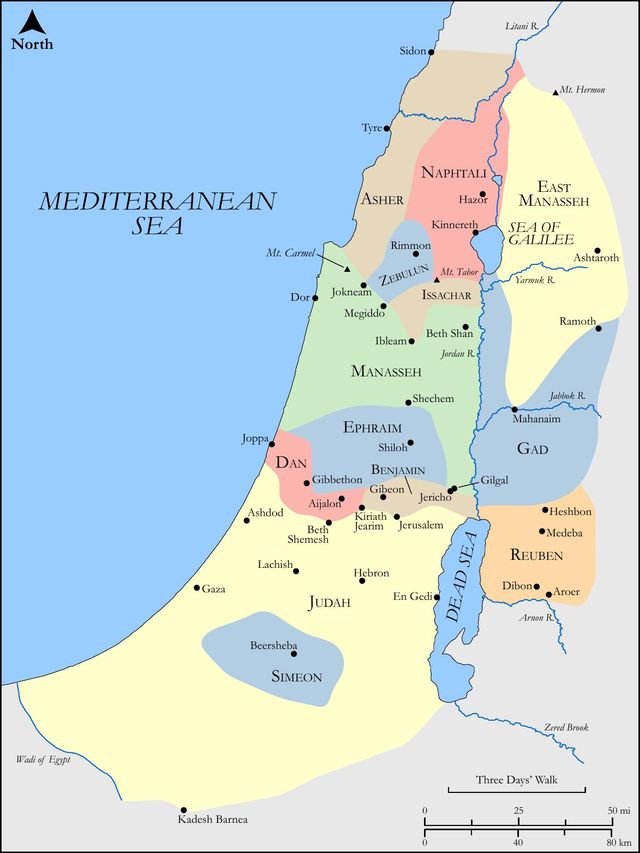
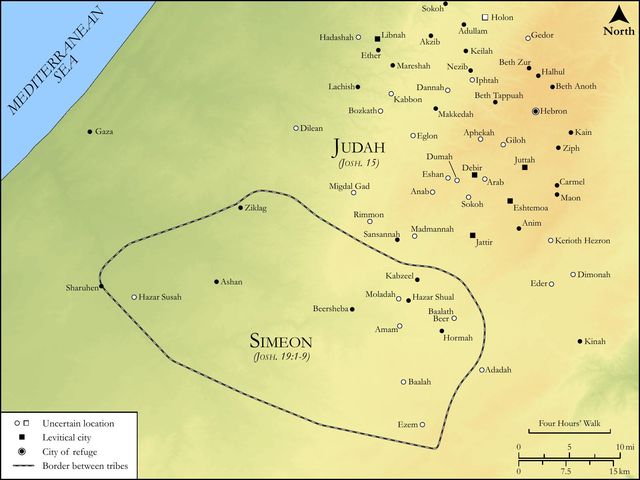
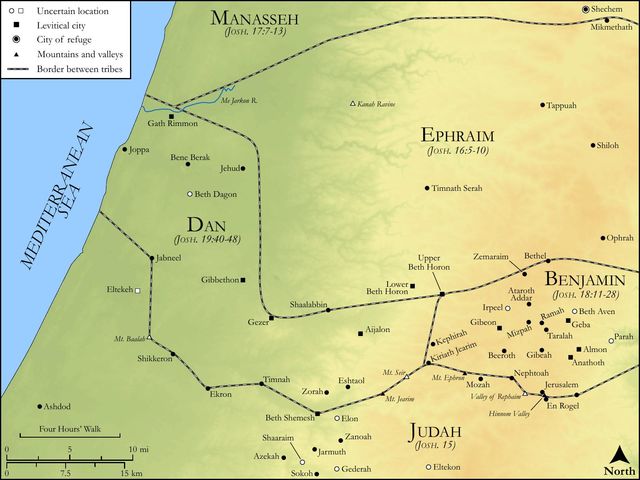
Study this verse
Public-domain commentary
Matthew Henry
From his Commentary on the Whole Bible. Henry comments on passages, not single verses — this entry covers Joshua 17:1–6.
Manasseh was itself but one half of the tribe of Joseph, and yet was divided and subdivided. 1. It was divided into two parts, one already settled on the other side Jordan, consisting of those who were the posterity of Machir, Jos 17:1. This Machir was born to Manasseh in Egypt; there he had signalized himself as a man of war, probably in the contests between the Ephraimites and the men of Gath, Ch1 7:21. His warlike disposition descended to his posterity, and therefore Moses gave them Gileaxdand Bashan, on the other side Jordan, of which before, Jos 13:31. It is here said that the lot came to Manasseh, for he was the first-born of Joseph. Bishop Patrick thinks it should be translated, though he was the first-born of Joseph, and then the meaning is plain, that the second lot was for Manasseh, because, though he was the first-born, yet Jacob had preferred Ephraim before him. See the names of those heads of the families that settled on the other side Jordan, Ch1 5:24. 2. That part on this side Jordan as subdivided into ten families, Jos 17:5. There were six sons of Gilead here named (Jos 17:2), the same that are recorded Num 26:30-32, only that he who is there called Jezeer is here called Abiezer. Five of these sons had each of them their portion; the sixth, which was Hepher, had his male line cut off in his son Zelophehad, who left daughters only, five in number, of whom we have often read, and these five had each of them a portion; though perhaps, they claiming under Hepher, all their five portions were but equal to one of the portions of the five sons. Or if Hepher had other sons besides Zelophehad, in whom the name of his family was kept up, their posterity married to the daughters of Zelophehad the elder brother, and in their right had these portions assigned them. See Num 36:12. Here is, (1.) The claim which the daughters of Zelophehad made, grounded upon the command God gave to Moses concerning them, Jos 17:4. They had themselves, when they were young, pleaded their own cause before Moses, and obtained the grant of an inheritance with their brethren, and now they would not lose the benefit of that grant for want of speaking to Joshua, but seasonably put in their demand themselves, as it should seem, and not their husbands for them. (2.) The assignment of their portions according to their claim. Joshua knew very well what God had ordered in their case, and did not object that they having not served in the wars of Canaan there was no reason why they should share in the possessions of Canaan, but readily gave them as inheritance among the brethren of their father. And now they reaped the benefit of their own pious zeal and prudent forecast in this matter. Thus those who take care in the wilderness of this world to make sure to themselves a place in the inheritance of the saints in light will certainly have the comfort of it in the other world, while those that neglect it now will lose it for ever.
Historical interpretation
Historical reception
1 surviving comment on this verse from the historical church.
If one examines as carefully as possible, he will find in the Scriptures that there are forty-two stages in the departure of the children of Israel from Egypt; and, further, the coming of our Lord and Savior into this world is traced through forty-two generations. This is what Matthew the Evangelist points out when he says, “from Abraham to David the king, fourteen generations. And from David to the Babylonian exile, fourteen generations. And from the Babylonian exile to Christ, fourteen generations.” Therefore, in descending to the Egypt of this world Christ passed those forty-two generations as stages; and those who ascend from Egypt pass by the same number, forty-two stages.… Therefore, the children of Israel by forty-two stages attained the beginning of taking their inheritance. And the beginning of taking their inheritance was when Reuben, Gad and the half tribe of Manasseh received the land of Gilead. And so the number is fixed for Christ’s descent, when he came down to us through forty-two ancestors according to the flesh as through forty-two stages. And the ascent of the children of Israel to the beginning of the promised inheritance was through the same number of stages.
Continue studying Joshua 17:6 across the web’s major study libraries — every link below opens this exact verse, chapter, or book on the destination site.
Read & Compare
 BibleGatewayThis verse in more than 200 translations and 70 languages.
 Bible.comThe YouVersion reader — hundreds of translations, reading plans, and highlights.
 ESV.orgCrossway's official English Standard Version reader.
 NET BibleThe NET translation with 60,000+ translators' notes on every rendering decision.
 STEP BibleTyndale House's free study tool — original text, vocabulary, and scholarly resources.
 BibliaLogos Bible Software's free web reader.
 USCCBThe New American Bible (Revised Edition) with the U.S. bishops' study notes.
Commentaries
 BibleHub CommentariesDozens of classic commentaries on this verse, gathered on one page.
 StudyLightMore than 100 commentary sets — the largest collection on the web.
 BibleRefPlain-English commentary on what this verse means, verse by verse.
 Enduring WordDavid Guzik's free commentary on this chapter, widely used by Bible teachers.
 Bible Study ToolsVerse commentary alongside Greek and Hebrew study aids.
Original Language & Research
- BibleHub InterlinearThe verse word by word — original language, transliteration, and English.
- BibleHub LexiconEvery word's original-language definition and Strong's entry.
 Blue Letter BibleDeep-study tools — Strong's numbers, concordance, and word studies.
 SefariaThe Hebrew text with Rashi and centuries of Jewish commentary.
Sermons, Hymns & Audio


TrulyRandomVerse is not affiliated with these sites and doesn’t control their content. They’re linked because they’re genuinely useful.
Summary
Joshua 17:6 precisely details the unique land inheritance of the tribe of Manasseh, illuminating two distinct facets of its territorial distribution within the Promised Land. Firstly, it confirms the special provision made for the daughters of Manasseh, specifically those of Zelophehad, who were granted a rightful inheritance alongside the sons, establishing a significant and progressive legal precedent for female inheritance in ancient Israel. Secondly, the verse clarifies that the remaining sons of Manasseh received the fertile region of Gilead, located on the east side of the Jordan River, thereby accounting for Manasseh's unusual division into two half-tribes with territories on both sides of the Jordan. This verse powerfully underscores God's meticulous fulfillment of His covenant promises regarding the land and His divine justice in matters of inheritance.
Context
ShowHideLiterary Context
Joshua 17:6 is strategically placed within the broader narrative of the land distribution among the Israelite tribes following their conquest of Canaan, specifically within the detailed account of Manasseh's inheritance in Joshua 17. The preceding verses, Joshua 17:1-2, introduce the clans of Manasseh and their initial allocation. Critically, Joshua 17:3-5 recounts the pivotal petition of Zelophehad's daughters for an inheritance, building upon the divine ruling established earlier in Numbers 27:1-11 and further elaborated in Numbers 36. Verse 6, therefore, serves as a concise summary statement, confirming the successful implementation of these unique provisions for Manasseh's descendants, both west and east of the Jordan, solidifying the legal and geographical reality of their inheritance within the Promised Land.
Historical & Cultural Context
The division of land was a foundational act for the newly settled Israelite nation, serving as the tangible fulfillment of God's ancient promises to Abraham, Isaac, and Jacob regarding the land of Canaan. In Israel, land ownership was predominantly patriarchal, with inheritance typically passing exclusively through male heirs. The case of Zelophehad's daughters, therefore, represents a radical and progressive legal innovation, divinely ordained, that challenged conventional norms to ensure family lines did not lose their ancestral portions due to a lack of male descendants. The mention of Gilead refers to the Transjordanian territory, which was settled by the half-tribes of Reuben, Gad, and Manasseh prior to the main conquest of Canaan, as documented in Numbers 32. This pre-emptive settlement necessitated the clear distinction of Manasseh's inheritance on both sides of the Jordan, reflecting a complex but divinely guided distribution strategy.
Key Themes
ShowHideThis verse, and the broader context of Manasseh's inheritance, highlights several profound themes central to the book of Joshua and the Pentateuch. Firstly, it underscores Divine Justice and Equity, demonstrating God's meticulous care for fairness and His willingness to transcend human legal precedents to ensure justice for all, even the vulnerable and overlooked, as seen in the case of Zelophehad's daughters. This progressive legal framework ensured that no family lineage would be dispossessed of their tribal land. Secondly, it powerfully illustrates the Fulfillment of God's Promises. The detailed and precise land distribution, including these specific provisions for Manasseh, is a tangible manifestation of God's unwavering faithfulness to His covenant promises to Abraham regarding the land of Canaan, first articulated in Genesis 12:7. Finally, the passage emphasizes the Importance of Inheritance in ancient Israel. Land was not merely property; it was intrinsically linked to tribal identity, economic stability, and the perpetuation of the covenant relationship with God, as seen throughout the land distribution accounts in Joshua 13-19. The meticulous division ensured each family received its designated portion, securing their place within the covenant community and their physical connection to the Promised Land.
Exposition and Analysis
ShowHideKey Word Analysis
ShowHideFrom the root meaning "to build" (as feminine of bên, "son," who builds the family name), this term refers to a female offspring. In this context, it specifically refers to the daughters of Zelophehad, whose unique case established a legal precedent for female inheritance in the absence of male heirs, ensuring the perpetuation of family lines and their land portions.
Derived from the root nâchal (H5157), meaning "to inherit" or "to possess," naḥălāh signifies a permanent possession, a heritage, or an allotted portion, most often referring to land. It carries the profound weight of a divinely given and secured gift, emphasizing the covenantal aspect of Israel's relationship with the land as a perpetual patrimony, not merely temporary property.
This is a specific geographical name for a mountainous and fertile region located east of the Jordan River. Its mention here serves as a precise geographical marker, clearly distinguishing the Transjordanian portion of Manasseh's territory from the Cisjordanian (western) portion within Canaan proper. The inclusion of Gilead highlights the unique dual nature of Manasseh's inheritance, divided by the Jordan River.
Verse Breakdown
ShowHide"Because the daughters of Manasseh had an inheritance among his sons:"
This clause explains the primary reason for the specific mention of Manasseh's land distribution. It directly references the landmark legal decision regarding Zelophehad's daughters, who, despite lacking male siblings, were granted the right to inherit their father's portion of land among the male heirs of the tribe. This was a direct divine command given through Moses, ensuring that family lines would not be extinguished from their rightful tribal land due to the absence of sons. It underscores God's concern for equity and His provision for the vulnerable within the covenant community.
"and the rest of Manasseh's sons had the land of Gilead."
This second clause clarifies the other significant aspect of Manasseh's inheritance. It refers to the half-tribe of Manasseh that, along with Reuben and Gad, chose to settle on the east side of the Jordan River before the main conquest of Canaan. Gilead, known for its rich pastures and strategic location, became their designated territory. This statement confirms the established reality of Manasseh's dual inheritance, with one half-tribe settled in Transjordan and the other half-tribe receiving land in Cisjordan (west of the Jordan), as detailed in the preceding verses.
Literary Devices
ShowHideJoshua 17:6 primarily functions as a concise statement within a larger Historical Narrative that records the meticulous fulfillment of God's promises through the division of the land. It acts as a Summary Statement, encapsulating complex legal and geographical arrangements into a single, declarative sentence, thereby providing a succinct overview of Manasseh's unique inheritance. The verse also employs Geographical Specificity by naming "Gilead," which grounds the narrative in a concrete, identifiable location and highlights the unique bisection of Manasseh's tribal territory. Furthermore, it implicitly relies on Legal Precedent, referencing the earlier divine ruling concerning Zelophehad's daughters without explicitly re-stating the entire legal case, assuming the reader's knowledge of the events in Numbers. This succinctness serves to confirm the successful and just implementation of these divine decrees.
Theological and Thematic Connections
ShowHideJoshua 17:6, though seemingly a simple administrative detail, is rich with profound theological significance. It powerfully illustrates God's unwavering faithfulness to His covenant promises, specifically the promise of land to Abraham and his descendants. The meticulous and equitable distribution, even to the extent of creating new legal precedents for female inheritance, underscores God's character as a God of justice who cares for the vulnerable and ensures that no one within His covenant community is dispossessed of their rightful inheritance. This divine attention to detail in securing each family's portion of the land reflects a deeper theological truth: God's commitment to the well-being and flourishing of His people, providing for their physical and spiritual needs within the promised inheritance. The land was not just a place; it was a tangible sign of God's presence and blessing among His people.
Reflection and Application
ShowHideJoshua 17:6 invites us to reflect on the meticulous care and divine justice of God in our own lives. Just as God ensured every family, even those with unique circumstances like Zelophehad's daughters, received their rightful inheritance, we can trust in His comprehensive provision and concern for the details of our existence. This passage reminds us that God is not bound by human conventions when it comes to upholding justice and fulfilling His promises. It challenges us to advocate for those whose needs or rights might be overlooked by conventional systems, just as God intervened for the daughters of Manasseh. Furthermore, the secure and lasting nature of the land inheritance points to the enduring faithfulness of God in fulfilling His promises, encouraging us to rest in His unshakeable word concerning our spiritual inheritance in Christ. The divine meticulousness in land distribution serves as a powerful reminder that God's promises are not vague aspirations but concrete realities that He faithfully brings to pass.
Questions for Reflection
ShowHideFAQ
ShowHideWhy was it so significant for the daughters of Manasseh to receive an inheritance among his sons?
ShowHideThis was highly significant because, in early Israelite custom, inheritance typically passed exclusively through male heirs. If a man died without sons, his family line risked losing its ancestral land portion, which was intrinsically tied to their identity, economic stability, and covenant standing within the tribe. The case of Zelophehad's daughters, detailed in Numbers 27:1-11, presented a unique legal challenge. God, through Moses, intervened directly, establishing a new legal precedent that allowed daughters to inherit in the absence of sons, provided they married within their own tribe to prevent the land from passing to another tribal lineage (Numbers 36). This divine ruling showcased God's radical justice, His compassionate care for the vulnerable, and His unwavering commitment to ensuring that every family within Israel maintained its rightful place and inheritance in the Promised Land. Joshua 17:6 confirms the successful implementation of this progressive and divinely ordained law.
Christ-Centered Fulfillment
ShowHideJoshua 17:6, with its focus on the meticulous distribution of land and the divine provision for inheritance, points powerfully to Christ as the ultimate fulfillment of God's promises and the source of our eternal inheritance. The physical land of Canaan, though a tangible expression of God's faithfulness to Israel, was always a type and shadow of a greater, spiritual reality. In Christ, believers receive an inheritance far surpassing any earthly territory—an "inheritance incorruptible, and undefiled, and that fadeth not away, reserved in heaven for you" (1 Peter 1:4). Just as God ensured the daughters of Manasseh received their portion, demonstrating His universal reach and justice, so too does Christ break down all barriers of gender, ethnicity, and social status, granting all who believe in Him full access to the "riches of the glory of his inheritance in the saints" (Ephesians 1:18). He is not merely the one who grants the inheritance, but He himself is our inheritance, our portion, and our exceeding great reward (Psalm 16:5; Colossians 3:24). Through His perfect life, atoning sacrifice, and glorious resurrection, He has secured for us a place in the heavenly kingdom, ensuring that no one who trusts in Him will be dispossessed of their eternal hope and dwelling with God (John 14:2-3).