


Joshua 17:9
Bible text: King James Version (1769 Blayney text) · Public domain
Bible text: King James Version with Strong's numbers · Public domain
Bible text: Berean Standard Bible · Public domain
Bible text: American Standard Version (1901) · Public domain
Bible text: World English Bible, Messianic edition · Public domain
Bible text: Geneva Bible (1599) · Public domain
Bible text: Young's Literal Translation · Public domain
- וְיָרַדve·ya·Radand it goes downH3381Conj-w ¦ V-Qal-ConsecPerf-3msVerb Qal Consecutive Perfect 3rd Singular Masculineוְandיָרַדit goes down
- הַגְּבוּלha·ge·Vulthe borderH1366Art ¦ N-msNoun Singular Masculine Absoluteהַtheגְּבוּלborder
- נַחַלNa·chal[the] wadi ofH5158N-mscNoun Singular Masculine Construct
- קָנָהka·NahKanahH7071N-properNoun Proper Location
- נֶגְבָּהNeg·bah[the] south towardsH5045N-ms ¦ SfxNoun Singular Masculine Absoluteנֶגְבָּ[the] southהtowards
- לַנַּחַלla·Na·chalto the wadiH5158Prep-l ¦ N-msNoun Singular Masculine Absoluteלַto theנַּחַלwadi
- עָרִים'a·RimcitiesH5892N-mpNoun Plural Masculine Absolute
- הָאֵלֶּהha·'E·leh<the> theseH428Art ¦ PrtParticle Demonstrativeהָ<the>אֵלֶּהthese
- לְאֶפְרַיִםle·'ef·Ra·yim[belonged] to EphraimH669Prep-l ¦ N-proper-mNoun Proper Masculineלְ[belonged] toאֶפְרַיִםEphraim
- בְּתוֹךְbe·Tokhin amongH8432Prep-b ¦ N-mscNoun Singular Masculine Constructבְּinתוֹךְamong
- עָרֵי'a·Rei[the] cities ofH5892N-mpcNoun Plural Masculine Construct
- מְנַשֶּׁהme·na·ShehManassehH4519N-proper-mNoun Proper Masculine
- וּגְבוּלu·ge·Vuland [the] border ofH1366Conj-w ¦ N-mscNoun Singular Masculine Constructוּandגְבוּל[the] border of
- מְנַשֶּׁהme·na·ShehManassehH4519N-proper-mNoun Proper Masculine
- מִצְּפוֹןmi·tze·Fon[was] from [the] northH6828Prep-m ¦ N-fscNoun Singular Feminine Constructמִ[was] fromצְּפוֹן[the] north
- לַנַּחַלla·Na·chalof the wadiH5158Prep-l ¦ N-msNoun Singular Masculine Absoluteלַof theנַּחַלwadi
- וַיְהִיvay·Hiand it wasH1961Conj-w ¦ V-Qal-ConsecImperf-3msVerb Qal Consecutive Imperfect 3rd Singular Masculineוַandיְהִיit was
- תֹצְאֹתָיוto·tze·'o·Tavits extremitiesH8444N-fpc ¦ 3msNoun Plural Feminine Constructתֹצְאֹתָיextremitiesוits
- הַיָּמָּהhai·Ya·mahthe sea towardsH3220Art ¦ N-ms ¦ SfxNoun Singular Masculine Absoluteהַtheיָּמָּseaהtowards
English is a literal word-by-word gloss of the Hebrew, not the KJV's wording. Why?
This is the original text the KJV's translators worked from — each Hebrew word with its own literal English meaning in this verse, prepared by scholars at Tyndale House, Cambridge. The KJV translates whole sentences, not word by word, so its wording differs: one Hebrew word can become several English words, and the KJV may choose “the LORD” where the gloss reads “Yahweh”. Both are faithful — they answer different questions. For the KJV's own rendering, switch to the KJV text.
Details
See on the biblical-era maps
Study this verse
Public-domain commentary
Matthew Henry
From his Commentary on the Whole Bible. Henry comments on passages, not single verses — this entry covers Joshua 17:7–13.
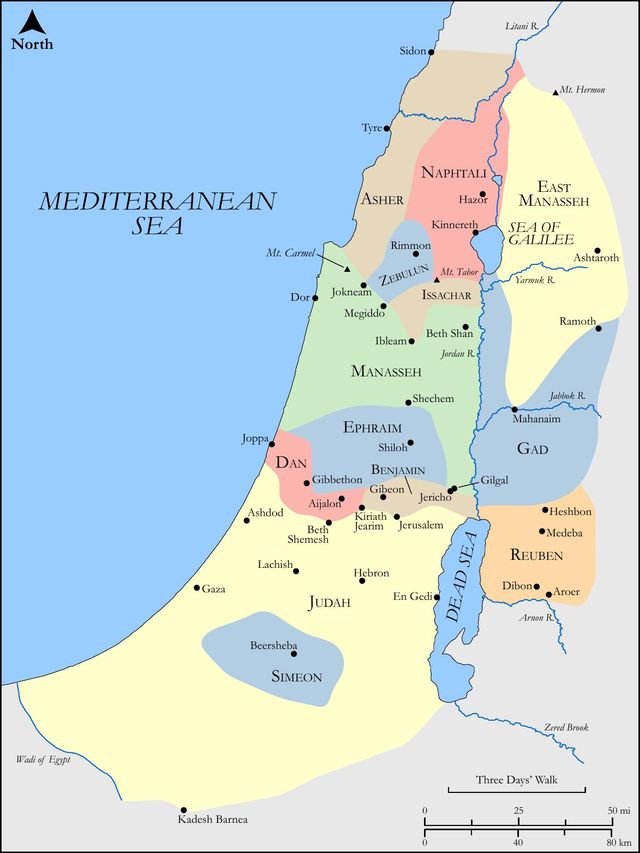
We have here a short account of the lot of this half tribe. It reached from Jordan on the east to the great sea on the west; on the south it lay all along contiguous to Ephraim, but on the north it abutted upon Asher and Issachar. Asher lay north-west, and Issachar north-east, which seems to be the meaning of that (Jos 17:10), that they (that is, Manasseh and Ephraim, as related to it, both together making the tribe of Joseph) met in Asher on the north and Issachar on the east, for Ephraim itself reached not those tribes. Some things are particularly observed concerning this lot: - 1. That there was great communication between this tribe and that of Ephraim. The city of Tappuah belonged to Ephraim, but the country adjoining to Manasseh (Jos 17:8); there were likewise many cities of Ephraim that lay within the border of Manasseh (Jos 17:9), of which before, Jos 16:9. 2. That Manasseh likewise had cities with their appurtenances in the tribes of Issachar and Asher (Jos 17:11), God so ordering it, that though every tribe had its peculiar inheritance, which might not be alienated from it, yet they should thus intermix one with another, to keep up mutual acquaintance and correspondence among the tribes, and to give occasion for the doing of good offices one to another, as became those who, though of different tribes, were all one Israel, and were bound to love as brethren. 3. That they suffered the Canaanites to live among them, contrary to the command of God, serving their own ends by conniving at them, for they made them tributaries, Jos 17:12, Jos 17:13. The Ephraimites had done the same (Jos 16:10), and from them perhaps the Manassites learned it, and with their example excused themselves in it. The most remarkable person of this half tribe in after-time was Gideon, whose great actions were done within this lot. He was of the family of Abiezer; Cesarea was in this lot, and Antipatris, famed in the latter ages of the Jewish state.
Continue studying Joshua 17:9 across the web’s major study libraries — every link below opens this exact verse, chapter, or book on the destination site.
Read & Compare
 BibleGatewayThis verse in more than 200 translations and 70 languages.
 Bible.comThe YouVersion reader — hundreds of translations, reading plans, and highlights.
 ESV.orgCrossway's official English Standard Version reader.
 NET BibleThe NET translation with 60,000+ translators' notes on every rendering decision.
 STEP BibleTyndale House's free study tool — original text, vocabulary, and scholarly resources.
 BibliaLogos Bible Software's free web reader.
 USCCBThe New American Bible (Revised Edition) with the U.S. bishops' study notes.
Commentaries
 BibleHub CommentariesDozens of classic commentaries on this verse, gathered on one page.
 StudyLightMore than 100 commentary sets — the largest collection on the web.
 BibleRefPlain-English commentary on what this verse means, verse by verse.
 Enduring WordDavid Guzik's free commentary on this chapter, widely used by Bible teachers.
 Bible Study ToolsVerse commentary alongside Greek and Hebrew study aids.
Original Language & Research
- BibleHub InterlinearThe verse word by word — original language, transliteration, and English.
- BibleHub LexiconEvery word's original-language definition and Strong's entry.
 Blue Letter BibleDeep-study tools — Strong's numbers, concordance, and word studies.
 SefariaThe Hebrew text with Rashi and centuries of Jewish commentary.
Sermons, Hymns & Audio


TrulyRandomVerse is not affiliated with these sites and doesn’t control their content. They’re linked because they’re genuinely useful.
Summary
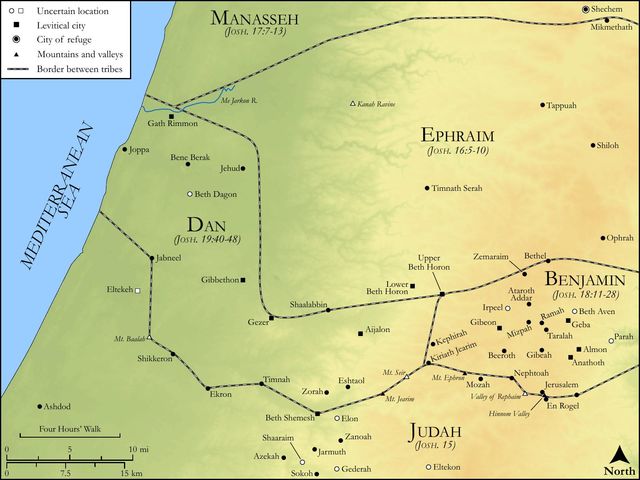
Joshua 17:9 provides a precise geographical delineation of a segment of the tribal boundary between the half-tribe of Manasseh and the tribe of Ephraim, both descendants of Joseph. This verse meticulously describes Manasseh's southern border, extending to the River Kanah, and notably highlights the unique arrangement where cities belonging to Ephraim were situated within Manasseh's designated territory, illustrating the complex and interwoven nature of the land distribution in Canaan.
Context
ShowHideLiterary Context
Joshua 17:9 is strategically placed within the extensive section of the book of Joshua (chapters 13-19) that meticulously details the division and allocation of the Promised Land among the twelve Israelite tribes. Following the initial military conquests and the establishment of a central sanctuary at Shiloh, the narrative shifts from warfare to the administrative and theological task of inheritance. Chapter 17 specifically focuses on the land allotted to the half-tribe of Manasseh, a significant and influential tribe. This verse, along with others in the chapter, provides crucial geographical markers and clarifies shared borders, particularly with Ephraim, underscoring the precise, almost legalistic, nature of these divinely ordained allotments. The preceding verses in Joshua 17 outline Manasseh's initial inheritance and the challenges they encountered in dispossessing the Canaanite inhabitants, which subsequently led to their plea for more land, as recorded in Joshua 17:14-18.
Historical & Cultural Context
The division of the land was an undertaking of immense historical and theological significance, representing the culmination of God's ancient covenant promises to Abraham (e.g., Genesis 15:18-21) and his descendants to inherit the land of Canaan. In Israel, land was the foundational source of identity, sustenance, wealth, and social standing, making its inheritance a sacred and legally binding matter. The meticulous detailing of tribal boundaries, often utilizing natural features like rivers, wadis (seasonal streambeds), and hills, was paramount for establishing distinct tribal identities, preventing future disputes, and ensuring the precise fulfillment of divine promises. The intermingling of cities, as explicitly described in Joshua 17:9, was not an anomaly but likely reflected practical considerations such as pre-existing settlements, strategic military or economic locations, or even historical land claims, necessitating a degree of shared administration, coexistence, or unique jurisdictional arrangements between the tribes.
Key Themes
ShowHideThough seemingly a dry geographical description, this verse contributes significantly to several overarching themes within the book of Joshua and the broader biblical narrative. Firstly, it powerfully underscores God's Faithfulness in meticulously fulfilling His covenant promises to grant the land to Israel, as emphatically declared in Joshua 21:45. Every boundary line, no matter how intricate or complex, stands as a testament to His precise, unwavering, and detailed commitment to His word. Secondly, it highlights the Divine Precision and Order inherent in God's sovereign plan for His people, demonstrating His profound attention to detail even in the allocation of physical territory. This divinely ordained order was intended to establish a stable and just society for the Israelites, enabling them to live in covenant relationship with Him. Lastly, the specific phrase "these cities of Ephraim [are] among the cities of Manasseh" illustrates the inherent Complexity of Inheritance and Inter-Tribal Relations. It reveals that the land division was not always a simple, clean separation, but involved overlapping jurisdictions and the practical necessity of cooperation, negotiation, and coexistence among the tribes, prefiguring the ongoing challenges and opportunities for unity within God's people throughout history.
Exposition and Analysis
ShowHideKey Word Analysis
ShowHideThis term, frequently translated as "border" or "boundary," properly refers to a cord used for measurement, and by implication, a clearly defined limit or frontier. In the context of the land division, gᵉbûwl emphasizes the specificity and divine authorization of each tribe's allotted territory. It signifies not merely a geographical line but a divinely ordained demarcation of inheritance, crucial for tribal identity, legal ownership, and the prevention of disputes. Its use here highlights the precise nature of God's provision.
This verb literally means "to go down" or "to descend." When applied to a geographical feature like a "coast" or boundary, it indicates a downward slope or the natural flow of terrain towards a lower elevation, such as a river. This suggests that the River Kanah served as a natural, identifiable landmark for the boundary, with the land sloping towards it from the north, providing a clear and observable demarcation.
This preposition signifies being "in the midst of," "within," or "among." Its use in Joshua 17:9 is critical, indicating that certain cities legally belonging to Ephraim were physically located within the broader geographical territory assigned to Manasseh. This highlights the practical reality of the land division, where administrative boundaries did not always perfectly align with existing settlements, leading to an intermingling of populations and jurisdictions that required careful management.
Verse Breakdown
ShowHide"And the coast descended unto the river Kanah, southward of the river:"
This initial clause establishes the primary geographical marker for Manasseh's southern border. The "coast" or boundary line is described as sloping downwards ("descended") to the River Kanah. The clarifying phrase "southward of the river" specifies that the river itself formed the northern edge of this particular segment of the boundary, with Manasseh's territory lying immediately to the north of it. This provides a clear, natural landmark for the demarcation.
"these cities of Ephraim [are] among the cities of Manasseh:"
This parenthetical yet profoundly significant statement reveals a unique administrative and demographic complexity within the land division. It indicates that despite the meticulously defined boundary, certain cities legally assigned to the tribe of Ephraim were physically situated within the larger geographical territory of Manasseh. This arrangement likely necessitated a degree of cooperation, shared governance, or at least a clear understanding of jurisdiction and rights between the two closely related tribes.
"the coast of Manasseh also [was] on the north side of the river, and the outgoings of it were at the sea:"
This final clause reiterates and further clarifies the position of Manasseh's boundary relative to the River Kanah, confirming that Manasseh's territory lay to the north of the river. The phrase "and the outgoings of it were at the sea" signifies that this southern border of Manasseh extended westward all the way to the Mediterranean Sea, providing a definitive geographical endpoint for this section of their inheritance and marking a clear western boundary.
Literary Devices
ShowHideJoshua 17:9 primarily employs Topographical Description, a pervasive literary device throughout the book of Joshua, particularly in chapters 13-19, which detail the land divisions. This device provides precise geographical markers (e.g., "River Kanah," "the sea," "southward," "north side") to delineate the tribal territories, emphasizing the meticulous and concrete nature of the land allocation. The verse also features an element of Intermingling Motif through the phrase "these cities of Ephraim [are] among the cities of Manasseh." This highlights a practical complexity within the otherwise ideal and ordered division, suggesting a mosaic of settlements rather than perfectly segregated territories, and foreshadows the need for inter-tribal cooperation. Furthermore, the Repetition of key terms like "river" and "coast" reinforces the central focus on boundaries and natural landmarks as defining features of the divinely ordained inheritance.
Theological and Thematic Connections
ShowHideThis seemingly technical verse profoundly underscores God's meticulous faithfulness in fulfilling His ancient promises to His people. The detailed description of boundaries, even with their complexities and intermingling, testifies to a divine plan for order, inheritance, and the establishment of a secure homeland. It reminds us that God is not vague or indifferent in His commitments but precise and diligent in bringing His word to pass, even in the minute details of geographical allocation. This precision was essential for the Israelites' identity, stability, and ability to live out their covenant relationship with God in the very land He had given them. The intermingling of cities also subtly points to the reality that even within God's ordered plan, there can be practical challenges and the ongoing need for inter-personal and inter-group cooperation and unity within the community of faith.
Reflection and Application
ShowHideJoshua 17:9, despite its ancient geographical focus, offers profound and enduring lessons for contemporary believers. It serves as a powerful reminder that God is a God of order, precision, and unwavering faithfulness, not only in grand historical events but also in the seemingly mundane and intricate details of our individual lives. Just as He meticulously defined the boundaries for each tribe, He has a specific plan and "territory" for each of us, whether it be our unique spiritual gifts, our specific calling, or the particular sphere of influence He has entrusted to us. The intermingling of cities also teaches us a vital lesson about living in community: even within the body of Christ, there are distinct identities, diverse giftings, and unique callings, yet we often find ourselves "among" one another, sharing spaces, resources, and ministries. This reality necessitates a spirit of cooperation, mutual respect for boundaries, and a commitment to fostering unity. This verse encourages us to trust God's precise ordering of our lives and circumstances, knowing that even the complexities and apparent overlaps are part of His overarching, faithful, and good plan for our flourishing and for the advancement of His kingdom.
Questions for Reflection
ShowHideFAQ
ShowHideWhy is such a detailed geographical description important in the Bible, especially in a book like Joshua?
ShowHideDetailed geographical descriptions, such as that found in Joshua 17:9, are crucial for several profound reasons. Firstly, they underscore the historical veracity and concrete reality of the biblical narrative, grounding the events in specific, identifiable places and times, affirming the Bible as a record of real history. Secondly, and most importantly, they demonstrate God's meticulous faithfulness in fulfilling His ancient covenant promises, particularly those made to Abraham regarding the land of Canaan (e.g., Genesis 12:7). Every boundary line, every river, and every mountain mentioned serves as a tangible testament to His precision and unwavering commitment to His word. Thirdly, these details were vital for the Israelites themselves, providing clear legal and practical definitions of their tribal inheritances, preventing disputes over territory, and establishing their identity and security in the land God had sovereignly given them.
Christ-Centered Fulfillment
ShowHideThe meticulous division of the land in Joshua, so vividly exemplified by the precise boundary descriptions like that in Joshua 17:9, ultimately points to the greater, spiritual inheritance and rest found exclusively in Christ. Just as the tribes of Israel received a physical inheritance in the Promised Land, believers in Christ receive an eternal, spiritual inheritance. This inheritance is not bound by earthly geographical lines but is divinely secured, described as "imperishable, undefiled, and unfading, kept in heaven for you" (1 Peter 1:4). The "rest" that Israel sought to attain in the land of Canaan finds its ultimate and perfect fulfillment in the spiritual rest provided by Jesus, who graciously invites all who are weary and burdened to find true rest in Him (Matthew 11:28-30). Furthermore, the complex intermingling of tribes and cities within the land, though a practical challenge, beautifully foreshadows the new spiritual community forged in Christ. In Him, believers from "every tribe and language and people and nation" are brought together into one unified body, the Church (Revelation 5:9), transcending all earthly distinctions. In Christ, the precise and sometimes confining boundaries of earthly inheritance give way to the boundless grace, unity, and shared co-heirship of the new covenant, where all are co-heirs with Him (Romans 8:17) in a spiritual kingdom that knows no earthly limits or divisions.