


Joshua 17:10
Bible text: King James Version (1769 Blayney text) · Public domain
Bible text: King James Version with Strong's numbers · Public domain
Bible text: Berean Standard Bible · Public domain
Bible text: American Standard Version (1901) · Public domain
Bible text: World English Bible, Messianic edition · Public domain
Bible text: Geneva Bible (1599) · Public domain
Bible text: Young's Literal Translation · Public domain
- נֶגְבָּהNeg·bahsouth -wardH5045N-ms ¦ SfxNoun Singular Masculine Absoluteנֶגְבָּsouthה-ward
- לְאֶפְרַיִםle·'ef·Ra·yim[belonged] to EphraimH669Prep-l ¦ N-proper-mNoun Proper Masculineלְ[belonged] toאֶפְרַיִםEphraim
- וְצָפוֹנָהve·tza·Fo·nahand north -wardH6828Conj-w ¦ N-fs ¦ SfxNoun Singular Feminine Absoluteוְandצָפוֹנָnorthה-ward
- לִמְנַשֶּׁהlim·na·Sheh[belonged] to ManassehH4519Prep-l ¦ N-proper-mNoun Proper Masculineלִ[belonged] toמְנַשֶּׁהManasseh
- וַיְהִיvay·Hiand it wasH1961Conj-w ¦ V-Qal-ConsecImperf-3msVerb Qal Consecutive Imperfect 3rd Singular Masculineוַandיְהִיit was
- הַיָּםhai·Yamthe seaH3220Art ¦ N-msNoun Singular Masculine Absoluteהַtheיָּםsea
- גְּבוּלוֹge·vu·Loits borderH1366N-msc ¦ 3msNoun Singular Masculine Constructגְּבוּלborderוֹits
- וּבְאָשֵׁרu·ve·'a·Sherand <on> AsherH836Conj-w ¦ Prep-b ¦ N-proper-mNoun Proper Masculineוּandבְ<on>אָשֵׁרAsher
- יִפְגְּעוּןyif·ge·'Unthey touch !H6293V-Qal-Imperf-3mp ¦ SfxVerb Qal Imperfect 3rd Plural Masculineיִפְגְּעוּthey touchן!
- מִצָּפוֹןmi·tza·Fonfrom [the] northH6828Prep-m ¦ N-fsNoun Singular Feminine Absoluteמִfromצָּפוֹן[the] north
- וּבְיִשָּׂשכָרu·ve·yi·so·sh·Kharand <on> IssacharH3485Conj-w ¦ Prep-b ¦ N-proper-mNoun Proper Masculineוּandבְ<on>יִשָּׂשכָרIssachar
- מִמִּזְרָחmi·miz·Rachfrom [the] eastH4217Prep-m ¦ N-msNoun Singular Masculine Absoluteמִfromמִּזְרָח[the] east
English is a literal word-by-word gloss of the Hebrew, not the KJV's wording. Why?
This is the original text the KJV's translators worked from — each Hebrew word with its own literal English meaning in this verse, prepared by scholars at Tyndale House, Cambridge. The KJV translates whole sentences, not word by word, so its wording differs: one Hebrew word can become several English words, and the KJV may choose “the LORD” where the gloss reads “Yahweh”. Both are faithful — they answer different questions. For the KJV's own rendering, switch to the KJV text.
Details
See on the biblical-era maps
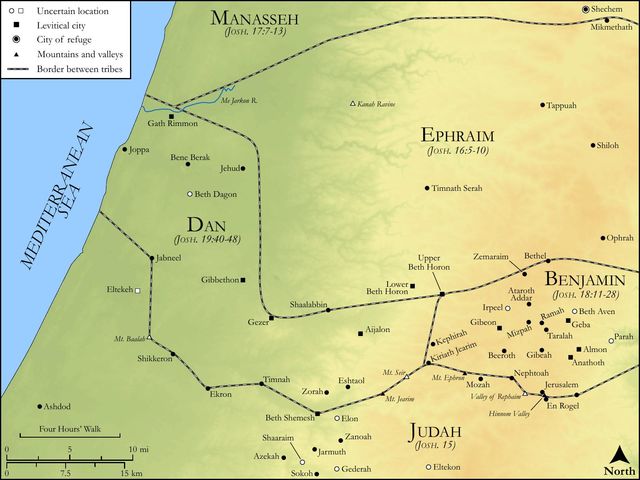
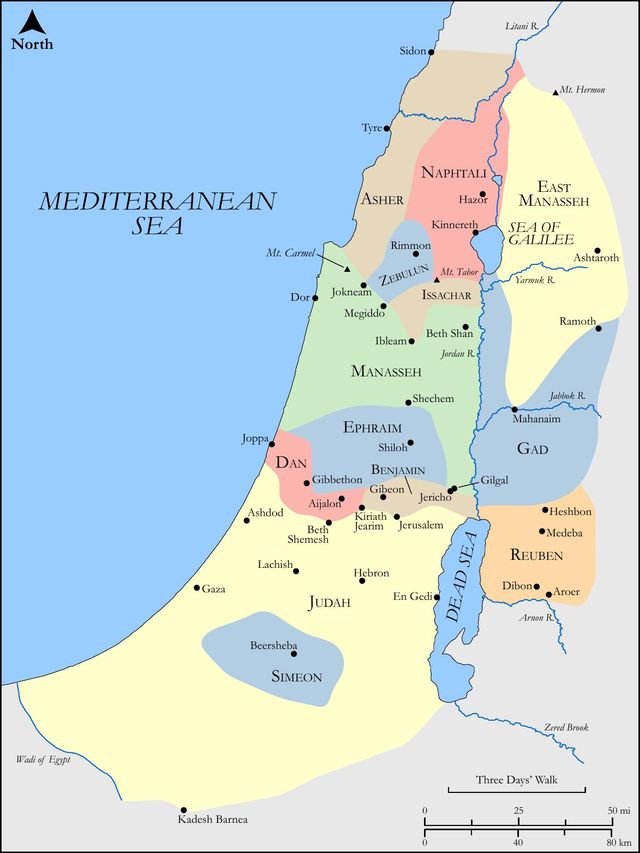
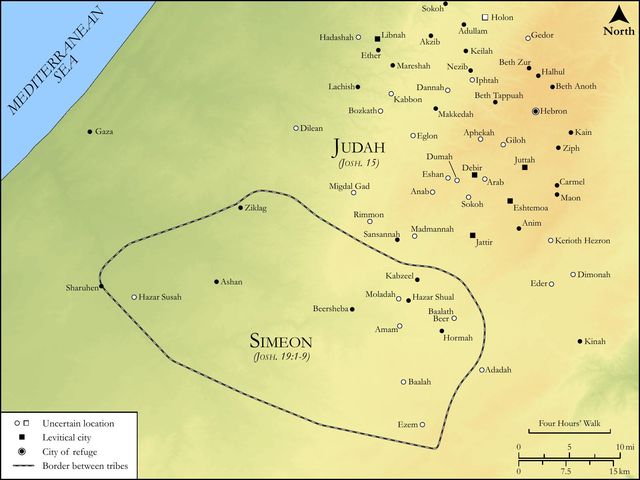
Study this verse
Public-domain commentary
Matthew Henry
From his Commentary on the Whole Bible. Henry comments on passages, not single verses — this entry covers Joshua 17:7–13.
We have here a short account of the lot of this half tribe. It reached from Jordan on the east to the great sea on the west; on the south it lay all along contiguous to Ephraim, but on the north it abutted upon Asher and Issachar. Asher lay north-west, and Issachar north-east, which seems to be the meaning of that (Jos 17:10), that they (that is, Manasseh and Ephraim, as related to it, both together making the tribe of Joseph) met in Asher on the north and Issachar on the east, for Ephraim itself reached not those tribes. Some things are particularly observed concerning this lot: - 1. That there was great communication between this tribe and that of Ephraim. The city of Tappuah belonged to Ephraim, but the country adjoining to Manasseh (Jos 17:8); there were likewise many cities of Ephraim that lay within the border of Manasseh (Jos 17:9), of which before, Jos 16:9. 2. That Manasseh likewise had cities with their appurtenances in the tribes of Issachar and Asher (Jos 17:11), God so ordering it, that though every tribe had its peculiar inheritance, which might not be alienated from it, yet they should thus intermix one with another, to keep up mutual acquaintance and correspondence among the tribes, and to give occasion for the doing of good offices one to another, as became those who, though of different tribes, were all one Israel, and were bound to love as brethren. 3. That they suffered the Canaanites to live among them, contrary to the command of God, serving their own ends by conniving at them, for they made them tributaries, Jos 17:12, Jos 17:13. The Ephraimites had done the same (Jos 16:10), and from them perhaps the Manassites learned it, and with their example excused themselves in it. The most remarkable person of this half tribe in after-time was Gideon, whose great actions were done within this lot. He was of the family of Abiezer; Cesarea was in this lot, and Antipatris, famed in the latter ages of the Jewish state.
Continue studying Joshua 17:10 across the web’s major study libraries — every link below opens this exact verse, chapter, or book on the destination site.
Read & Compare
 BibleGatewayThis verse in more than 200 translations and 70 languages.
 Bible.comThe YouVersion reader — hundreds of translations, reading plans, and highlights.
 ESV.orgCrossway's official English Standard Version reader.
 NET BibleThe NET translation with 60,000+ translators' notes on every rendering decision.
 STEP BibleTyndale House's free study tool — original text, vocabulary, and scholarly resources.
 BibliaLogos Bible Software's free web reader.
 USCCBThe New American Bible (Revised Edition) with the U.S. bishops' study notes.
Commentaries
 BibleHub CommentariesDozens of classic commentaries on this verse, gathered on one page.
 StudyLightMore than 100 commentary sets — the largest collection on the web.
 BibleRefPlain-English commentary on what this verse means, verse by verse.
 Enduring WordDavid Guzik's free commentary on this chapter, widely used by Bible teachers.
 Bible Study ToolsVerse commentary alongside Greek and Hebrew study aids.
Original Language & Research
- BibleHub InterlinearThe verse word by word — original language, transliteration, and English.
- BibleHub LexiconEvery word's original-language definition and Strong's entry.
 Blue Letter BibleDeep-study tools — Strong's numbers, concordance, and word studies.
 SefariaThe Hebrew text with Rashi and centuries of Jewish commentary.
Sermons, Hymns & Audio


TrulyRandomVerse is not affiliated with these sites and doesn’t control their content. They’re linked because they’re genuinely useful.
Summary
Joshua 17:10 meticulously describes the geographical boundaries and inter-tribal connections of the descendants of Joseph—Ephraim and Manasseh—within the Promised Land. This verse precisely delineates Ephraim's southern territory and Manasseh's northern portion, extending westward to the Mediterranean Sea. It further clarifies Manasseh's northern and eastern frontiers, where its land converged with the tribes of Asher and Issachar, highlighting the intricate and divinely orchestrated division of Canaan among the Israelite tribes and the fulfillment of God's ancient promises.
Context
ShowHideLiterary Context
Joshua 17:10 is situated within the broader narrative of the division of the land of Canaan among the Israelite tribes, a process meticulously detailed in Joshua chapters 13 through 19. These chapters chronicle the fulfillment of God's ancient promise to Abraham regarding the land, following the successful conquest of Canaan. Specifically, chapter 17 focuses on the inheritance of the "House of Joseph," comprising the half-tribes of Manasseh and Ephraim. While Ephraim's territory is described in Joshua 16 as lying to the south, Joshua 17 delineates Manasseh's more extensive northern portion. This particular verse serves as a crucial geographical anchor, defining the shared border between these two prominent tribes and their points of contact with other northern and eastern tribal lands, thereby solidifying the territorial integrity of the Josephite inheritance and illustrating the precise execution of God's plan.
Historical & Cultural Context
In ancient Israel, land inheritance was not merely an economic asset but the very foundation of tribal identity, social structure, and covenantal blessing. The meticulous demarcation of boundaries, as extensively outlined in texts like Numbers 34, was not a mere geographical exercise but a profound theological and legal act. It ensured the fulfillment of God's covenant promises, prevented future disputes, and established the unique identity of each tribe within the nascent nation. The tribes of Ephraim and Manasseh, as descendants of Joseph, held a particularly prominent position, receiving a significant and strategically important portion of the central highlands. The mention of "the sea" (the Mediterranean) as a border highlights the strategic importance of natural boundaries for defense and trade. The specific interaction points with Asher and Issachar underscore the complex interweaving of tribal lands and the necessity for clear agreements and understanding among them to maintain peace, order, and effective governance in the newly settled land.
Key Themes
ShowHideThis verse contributes to several overarching themes in the Book of Joshua. Firstly, it powerfully illustrates the Divine Allotment and Fulfillment of God's covenant promises, particularly His pledge to Abraham regarding the land of Canaan, as seen in Genesis 12:7. The precise boundaries underscore God's unwavering faithfulness in bringing His people into their promised inheritance. Secondly, it reinforces the theme of Tribal Identity and Distinction within the larger nation of Israel. Despite their shared lineage through Joseph, Ephraim and Manasseh received distinct territories, emphasizing their unique tribal roles while also highlighting their contiguity and cooperation as the "House of Joseph." Lastly, the verse exemplifies Geographical Precision and Divine Order. The meticulous detail of directions (southward, northward) and neighboring tribes reflects the importance of clear, unambiguous boundaries for tribal governance, resource management, and the preservation of peace, mirroring God's character of order, justice, and design in establishing His people.
Exposition and Analysis
ShowHideKey Word Analysis
ShowHideThis term refers to the "south" or "south country," often associated with the arid Negev desert region. Here, it is used directionally to specify the territory of Ephraim as lying to the south of Manasseh's portion. Its use emphasizes the precise cardinal orientation of the tribal lands, highlighting the meticulous nature of the land distribution and the clear delineation of each tribe's designated area.
This term denotes the "north," often implying a dark, hidden, or unknown quarter. Directly opposite to negeb', it specifies Manasseh's territory as extending to the north of Ephraim. The clear directional contrast between negeb' and tsâphôwn' establishes the primary north-south axis of the combined Josephite inheritance, forming a unified, yet distinctly divided, central block of land that was strategically vital.
This verb means "to impinge," "to meet," "to encounter," or "to reach." In this context, it signifies the convergence or shared border points of Manasseh's territory with the tribes of Asher and Issachar. It implies a geographical intersection where the boundaries of these tribes touched, necessitating clear demarcation and potentially shared responsibilities, interactions, or even points of contention at these junctures.
Verse Breakdown
ShowHide"Southward [it was] Ephraim's"
This clause establishes the initial geographical reference point, indicating that the territory of the tribe of Ephraim lay to the south of the area being described for Manasseh. It sets up the primary north-south relationship and the contiguous nature of the two half-tribes of Joseph.
"and northward [it was] Manasseh's"
Following the previous clause, this specifies that the territory of Manasseh was situated directly to the north of Ephraim's. Together, these two clauses define the primary north-south axis of the combined Josephite inheritance, forming a significant and strategically important central block of land in Canaan.
"and the sea is his border"
This phrase identifies the western boundary of Manasseh's territory as the Mediterranean Sea. This natural boundary provided a clear, stable, and expansive limit to their western expansion, indicating that a significant portion of their land extended all the way to the coast.
"and they met together in Asher on the north"
This clause details Manasseh's northern border, indicating that its territory extended northward to meet or share a boundary with the tribe of Asher. This specifies a crucial point of contact and potential interaction between these two tribes, defining Manasseh's northernmost reach.
"and in Issachar on the east"
Finally, this clause defines Manasseh's eastern border, stating that its territory met or shared a boundary with the tribe of Issachar. This completes the geographical description of Manasseh's main boundaries, providing a comprehensive picture of its position relative to its tribal neighbors and the overall land distribution.
Literary Devices
ShowHideJoshua 17:10 primarily employs Topographical Description, a literary device that meticulously details geographical features and locations. This precise mapping of tribal boundaries serves not merely as a factual account but as a profound testament to the fulfillment of divine promise and the establishment of Israel's national identity. The verse also utilizes Precision and Detail, as evidenced by the specific directional indicators ("Southward," "Northward") and the naming of adjacent tribes (Asher, Issachar). This meticulousness underscores the legal and theological significance of the land distribution, emphasizing its divine origin and the order God brings to His people. Furthermore, one could argue for a subtle use of Merism in "Southward... and northward," which, by naming the two extremes, implies the entirety of the combined Ephraimite and Manassite territory lying between these points, encompassing their full shared inheritance and highlighting the comprehensive nature of the divine allotment.
Theological and Thematic Connections
ShowHideJoshua 17:10, though seemingly a dry geographical listing, is deeply imbued with theological significance. It stands as a powerful testament to God's unwavering faithfulness in fulfilling His ancient covenant promises to Abraham, Isaac, and Jacob regarding the land of Canaan. The meticulous division of the land, down to specific borders and neighboring tribes, underscores God's sovereignty, His commitment to establishing His people in their inheritance, and His character as a God of order. This act of divine allotment not only provided Israel with a physical homeland but also solidified their identity as a distinct nation under God's rule, demonstrating His care for every detail of their existence. It highlights the principle that God is a God of order, who establishes clear boundaries for peace, identity, and flourishing, both for communities and individuals.
Reflection and Application
ShowHideThe detailed geographical descriptions in Joshua 17:10, while specific to ancient Israel, offer profound insights for contemporary believers. They remind us of God's meticulous care and unwavering faithfulness in fulfilling His promises, no matter how long the wait or how complex the circumstances. Just as God precisely delineated the inheritance for each tribe, He has a specific plan and provision for our lives, securing for us an imperishable spiritual inheritance. This verse also subtly teaches us about the importance of boundaries in life—physical, emotional, and spiritual. Just as clear tribal borders brought order and prevented conflict, healthy boundaries in our personal lives foster peace, protect our well-being, and define our relationships, enabling us to thrive within God's design. Reflecting on this passage encourages us to trust in God's sovereign ordering of our lives and to embrace the "boundaries" He establishes for our good, recognizing them as expressions of His profound love and wisdom.
Questions for Reflection
ShowHideFAQ
ShowHideWhy is such detailed geographical information included in the Bible?
ShowHideThe inclusion of such detailed geographical information in books like Joshua serves several crucial purposes. Firstly, it provides irrefutable evidence of God's faithfulness in fulfilling His covenant promises to Abraham and his descendants regarding the land of Canaan (e.g., Genesis 12:7). The precise boundaries demonstrate that the land was not merely taken by conquest but divinely allotted. Secondly, these details served as legal documentation for the tribes, defining their inheritance, preventing disputes, and establishing their identity and rights within the nation of Israel. They were akin to ancient property deeds, ensuring orderly governance. Thirdly, the geographical precision underscores the historical accuracy and reliability of the biblical narrative, grounding the spiritual truths in tangible, verifiable reality. Finally, it highlights God's character as a God of order and design, who meticulously arranges the affairs of His people, as seen in the extensive instructions for boundaries in Numbers 34).
What is the significance of Ephraim and Manasseh being "together" but also having distinct territories?
ShowHideThe tribes of Ephraim and Manasseh, known collectively as the "House of Joseph," were unique in that they were the only two tribes named after Joseph's sons who received full tribal inheritances, effectively doubling Joseph's portion (see Genesis 48). Their contiguity ("Southward [it was] Ephraim's, and northward [it was] Manasseh's") signifies their shared lineage, unity, and prominence within Israel, forming a strong central block of territory. However, their distinct territories also underscored their individual tribal identities, responsibilities, and future destinies. This arrangement allowed for both unity and diversity within the larger nation, reflecting the principle that while believers are united in Christ, they also retain unique identities, gifts, and callings within the body of Christ. It illustrates how shared heritage can coexist with distinct spheres of influence and responsibility, contributing to the overall strength and diversity of God's people.
Christ-Centered Fulfillment
ShowHideWhile Joshua 17:10 describes a physical land inheritance, it beautifully foreshadows the spiritual inheritance believers receive in Christ. The meticulously divided land of Canaan, a place of rest and provision for Israel after their wilderness wanderings and conquests, serves as a profound type of the ultimate spiritual rest and inheritance found in Jesus. Just as God faithfully delivered on His promise of a physical homeland, He has secured for us an eternal, imperishable inheritance through the finished work of Christ. Our true "Promised Land" is not a geographical location but a spiritual reality in the kingdom of God, where we find our ultimate rest and belonging (Hebrews 4:9-10). Through Christ, we are adopted into God's family and become co-heirs with Him, receiving a spiritual inheritance that transcends earthly boundaries and material possessions (Ephesians 1:11; Colossians 1:12). The precision of the land division in Joshua points to the certainty and meticulousness of God's promises, culminating in the perfect and complete inheritance secured for us by the Lamb of God, who is our true and eternal portion (1 Peter 1:4). In Christ, all the promises of God find their "Yes" and "Amen" (2 Corinthians 1:20), including the promise of an eternal dwelling place with Him.