


Joshua 16:3
Bible text: King James Version (1769 Blayney text) · Public domain
Bible text: Berean Standard Bible · Public domain
Bible text: American Standard Version (1901) · Public domain
Bible text: World English Bible, Messianic edition · Public domain
Bible text: Geneva Bible (1599) · Public domain
Bible text: Young's Literal Translation · Public domain
- וְיָרַדve·ya·radand it goes downH3381Conj-w ¦ V-Qal-ConsecPerf-3msVerb Qal Consecutive Perfect 3rd Singular Masculineוְandיָרַדit goes down
- יָמָּהYa·mahwest -wardH3220N-ms ¦ SfxNoun Singular Masculine Absoluteיָמָּwestה-ward
- אֶל'eltoH413PrepPreposition
- גְּבוּלge·Vul[the] border ofH1366N-mscNoun Singular Masculine Construct
- הַיַּפְלֵטִיhai·yaf·le·Tithe Japhletite[s]H3311Art ¦ N-msNoun Gentilic Singular Masculine AbsoluteהַtheיַּפְלֵטִיJaphletite[s]
- עַד'adtoH5704PrepPreposition
- גְּבוּלge·Vul[the] border ofH1366N-mscNoun Singular Masculine Construct
- בֵּיתbeitBethH1032N-properNoun Proper Location
- חוֹרֹןcho·RonHoronH1032N-properNoun Proper Location
- תַּחְתּוֹןtach·TonlowerH8481N-properNoun Proper Location
- וְעַדve·'adand toH5704Conj-w ¦ PrepPrepositionוְandעַדto
- גָּזֶרGa·zerGezerH1507N-properNoun Proper Location
- וְהָיוּve·ha·Yuand they areH1961Conj-w ¦ V-Qal-ConsecPerf-3cpVerb Qal Consecutive Perfect 3rd Plural common genderוְandהָיוּthey are
- תֹצְאֹתָיוto·tze·'o·tovits extremitiesH8444N-fpc ¦ 3msNoun Plural Feminine Constructתֹצְאֹתָיextremitiesוits
- יָמָּהYa·mah[the] sea towardsH3220N-ms ¦ SfxNoun Singular Masculine Absoluteיָמָּ[the] seaהtowards
English is a literal word-by-word gloss of the Hebrew, not the KJV's wording. Why?
This is the original text the KJV's translators worked from — each Hebrew word with its own literal English meaning in this verse, prepared by scholars at Tyndale House, Cambridge. The KJV translates whole sentences, not word by word, so its wording differs: one Hebrew word can become several English words, and the KJV may choose “the LORD” where the gloss reads “Yahweh”. Both are faithful — they answer different questions. For the KJV's own rendering, switch to the KJV text.
Details
See on the biblical-era maps
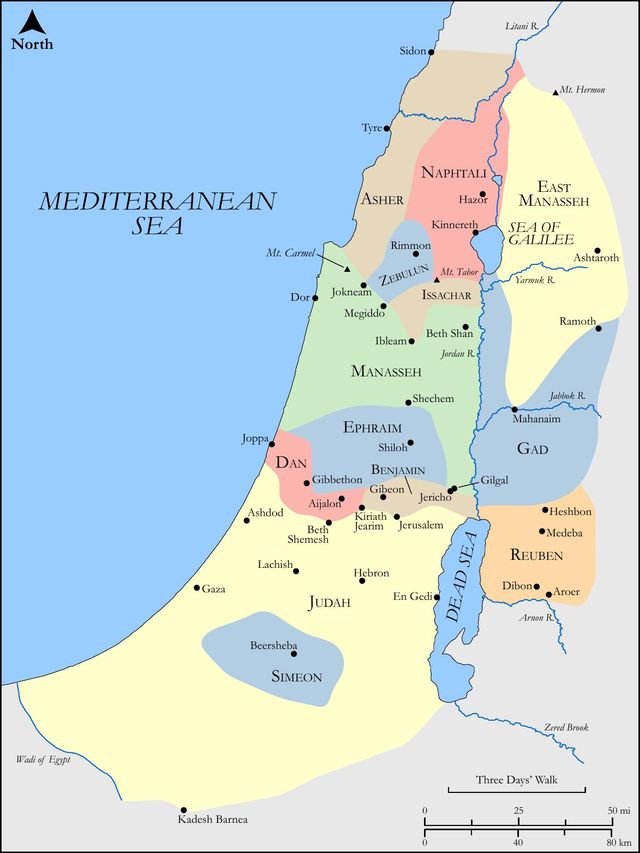
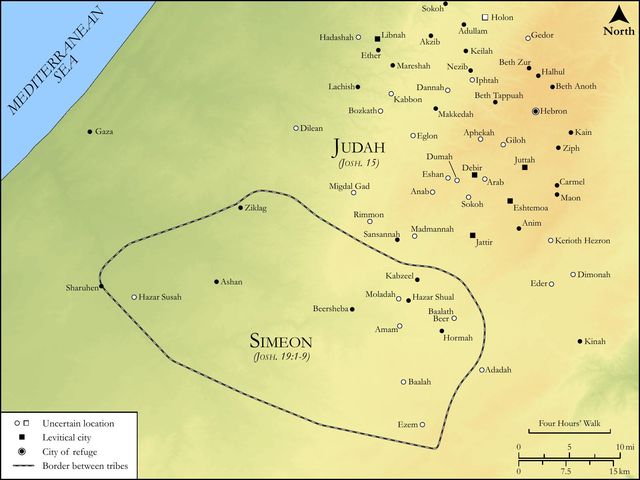
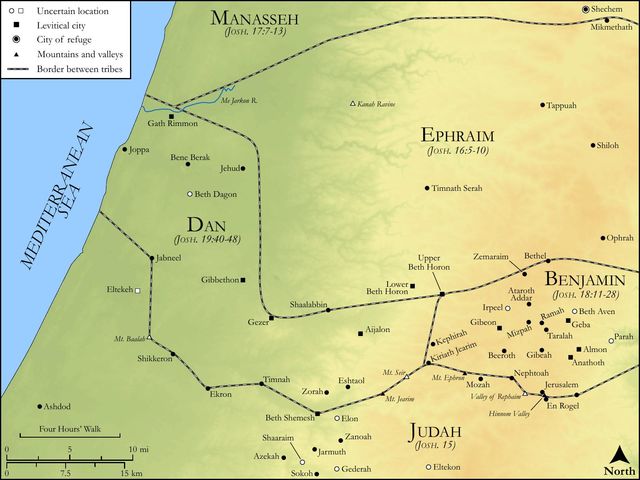
Study this verse
Public-domain commentary
Matthew Henry
From his Commentary on the Whole Bible. Henry comments on passages, not single verses — this entry covers Joshua 16:1–4.
Though Joseph was one of the younger sons of Jacob, yet he was his eldest by his most just and best beloved wife Rachel, was himself his best beloved son, and had been the greatest ornament and support of his family, kept it from perishing in a time of famine, and had been the shepherd and stone of Israel, and therefore his posterity were very much favoured by the lot. Their portion lay in the very heart of the land of Canaan. It extended from Jordan in the east (Jos 16:1) to the sea, the Mediterranean Sea, in the west, so that it took up the whole breadth of Canaan from side to side; and no question the fruitfulness of the soil answered the blessings both of Jacob and Moses, Gen 49:25, Gen 49:26, and Deu 33:13, etc. The portions allotted to Ephraim and Manasseh are not so particularly described as those of the other tribes; we have only the limits and boundaries of them, not the particular cities in them, as before we had the cities of Judah and afterwards those of the other tribes. For this no reason can be assigned, unless we may suppose that Joshua being himself of the children of Joseph they referred it to him alone to distribute among them the several cities that lay within their lot, and therefore did not bring in the names of their cities to the great council of their princes who sat upon this affair, by which means it came to pass that they were not inserted with the rest in the books.
Continue studying Joshua 16:3 across the web’s major study libraries — every link below opens this exact verse, chapter, or book on the destination site.
Read & Compare
 BibleGatewayThis verse in more than 200 translations and 70 languages.
 Bible.comThe YouVersion reader — hundreds of translations, reading plans, and highlights.
 ESV.orgCrossway's official English Standard Version reader.
 NET BibleThe NET translation with 60,000+ translators' notes on every rendering decision.
 STEP BibleTyndale House's free study tool — original text, vocabulary, and scholarly resources.
 BibliaLogos Bible Software's free web reader.
 USCCBThe New American Bible (Revised Edition) with the U.S. bishops' study notes.
Commentaries
 BibleHub CommentariesDozens of classic commentaries on this verse, gathered on one page.
 StudyLightMore than 100 commentary sets — the largest collection on the web.
 BibleRefPlain-English commentary on what this verse means, verse by verse.
 Enduring WordDavid Guzik's free commentary on this chapter, widely used by Bible teachers.
 Bible Study ToolsVerse commentary alongside Greek and Hebrew study aids.
Original Language & Research
- BibleHub InterlinearThe verse word by word — original language, transliteration, and English.
- BibleHub LexiconEvery word's original-language definition and Strong's entry.
 Blue Letter BibleDeep-study tools — Strong's numbers, concordance, and word studies.
 SefariaThe Hebrew text with Rashi and centuries of Jewish commentary.
Sermons, Hymns & Audio


TrulyRandomVerse is not affiliated with these sites and doesn’t control their content. They’re linked because they’re genuinely useful.
Summary
Joshua 16:3 meticulously describes a specific segment of the southern boundary for the tribe of Ephraim, one of the two tribes descended from Joseph. This verse traces the border's westward trajectory from an initial, unspecified point, through the significant geographical markers of Japhleti, Lower Bethhoron, and Gezer, ultimately terminating at the Mediterranean Sea. This precise geographical delineation underscores God's unwavering faithfulness in fulfilling His ancient covenant promises of land to Israel, establishing clear and divinely ordained boundaries for tribal inheritances, and highlighting the ongoing process of possessing and settling the promised territory.
Context
ShowHideLiterary Context
Joshua 16:3 is situated within the extensive and detailed land allocation section of the Book of Joshua, specifically chapters 13-19, which meticulously records the division of Canaan among the twelve tribes of Israel. Following the initial military campaigns and conquests led by Joshua, this phase marks the fulfillment of God's ancient promise to Abraham regarding the land. Chapter 16 specifically outlines the inheritance granted to the "children of Joseph"—the tribes of Ephraim and Manasseh. This particular verse provides a precise geographical description of a crucial portion of Ephraim's southern boundary, immediately following a general outline of Joseph's inheritance and preceding further details of Ephraim's territory and their challenges in fully possessing the land, as notably highlighted in Joshua 16:10. The highly detailed nature of these boundary descriptions emphasizes the divine precision, order, and legal specificity involved in the distribution of the land, serving as an enduring record of God's faithfulness.
Historical & Cultural Context
The period depicted in the Book of Joshua represents a pivotal transition for the Israelites, moving from a nomadic existence to a settled, agrarian, and urbanized society within the Promised Land. The meticulous demarcation of tribal boundaries was not merely an administrative task but a foundational act for establishing national identity, preventing inter-tribal conflicts, and ensuring the fulfillment of individual family inheritances as promised by God. Towns such as Bethhoron and Gezer were not arbitrary points but strategically vital locations. Bethhoron, specifically "the nether" (lower), was part of a critical pass that served as a primary artery connecting the fertile coastal plain to the central highlands, making it a key military and trade route. Gezer, a formidable Canaanite royal city, was heavily fortified and represented a significant stronghold, posing an ongoing challenge to Israelite control even after its designation within Ephraim's territory. The very act of defining these borders was a profound declaration of Israel's claim and establishment of their presence in the land, reflecting the tangible reality of God's covenant faithfulness.
Key Themes
ShowHideThe meticulous detailing of borders in Joshua 16, and specifically in Joshua 16:3, contributes significantly to several overarching themes within the book and the broader biblical narrative. Firstly, it powerfully illustrates Divine Faithfulness, demonstrating God's unwavering commitment to fulfilling His covenant promises to Abraham, Isaac, and Jacob concerning the land, as seen in passages like Genesis 15:18. Secondly, it highlights Order and Specificity in God's divine plan, reflecting His orderly nature and the importance of clear, defined inheritances for each tribe, which would minimize disputes and ensure justice. Thirdly, the mention of cities like Gezer, which were not fully conquered by Ephraim (as explicitly noted in Joshua 16:10), introduces the crucial theme of Inheritance and Possession. While the land was divinely allotted, its full possession required ongoing effort, obedience, and faithfulness from the Israelites, foreshadowing the continuous struggles and partial obedience that would characterize Israel's subsequent history. This tension between divine gift and human responsibility is central to the book's message.
Exposition and Analysis
ShowHideKey Word Analysis
ShowHideThis verb, derived from a primitive root meaning "to descend," literally denotes movement from a higher to a lower elevation. In the context of the border description, it precisely indicates a topographical reality: the boundary line moves from the central highlands, where Ephraim's territory began, westward towards the lower coastal plain and the Mediterranean Sea. This specific geographical detail highlights the careful observation and recording of the land's contours, reflecting the accuracy of the biblical account.
While translated "coast" in the KJV, the Hebrew word gᵉbûwl (or gᵉbûl) more broadly and accurately means "boundary," "border," or "territory." Its repeated use in this verse ("coast of Japhleti," "coast of Bethhoron the nether") emphasizes the precise line of demarcation itself, highlighting the defined and legally established nature of the tribal inheritance. It underscores the divinely ordained limits and the legal claim of Ephraim to this specific land.
Meaning "lower" or "bottommost," this adjective specifically distinguishes "Bethhoron the nether" (Lower Bethhoron) from its counterpart, Bethhoron the Upper. This distinction was vital for accurate geographical identification, as both towns were strategically important and located along a significant pass. The use of "nether" precisely pinpoints the exact Bethhoron that lay on Ephraim's southern border, ensuring clarity in the land's division.
Verse Breakdown
ShowHide"And goeth down westward to the coast of Japhleti"
This opening phrase establishes the initial direction and a key landmark for this segment of Ephraim's southern border. The verb "goeth down" indicates a descent in elevation, moving from the higher ground of the central highlands towards the west. Japhleti, though its exact location remains a subject of scholarly debate, serves as a specific, identifiable landmark from which the border is meticulously traced.
"unto the coast of Bethhoron the nether"
The border continues its westward trajectory, extending to include Lower Bethhoron. This was a strategically vital town, situated on a crucial pass that connected the coastal plain with the central highlands. Its inclusion on the border highlights its immense importance as a point of control, defense, and communication for Ephraim's territory, signifying a key point in their allocated land.
"and to Gezer"
The boundary further extends to Gezer, a highly significant and formidable Canaanite royal city. Gezer was a powerful stronghold, and its inclusion on Ephraim's border demonstrates the expansive nature of their divinely allotted territory. However, as noted elsewhere in Joshua, the Canaanites in Gezer were not fully dispossessed by Ephraim, indicating a persistent challenge to their full possession of the land.
"and the goings out thereof are at the sea"
This final clause definitively states that the westernmost extent of this border segment reaches the Mediterranean Sea. This provides a clear, natural, and absolute boundary for Ephraim's territory on its western side, completing the precise description of this particular line of demarcation and marking the ultimate limit of their inheritance in this direction.
Literary Devices
ShowHideThe primary literary device employed in Joshua 16:3 is Topographical Description, characterized by its meticulous and precise detailing of geographical landmarks to delineate the tribal border. This serves not only as a historical record but also as a profound theological statement, emphasizing God's ordered, specific, and faithful provision of the land. The repetition of the term "coast" (or "border," gᵉbûwl) functions as Repetition for emphasis, reinforcing the idea of a clearly defined, legally established, and divinely ordained boundary. Furthermore, the verse's focus on exact locations like "Bethhoron the nether" and "Gezer" demonstrates Specificity, underscoring the divine intention behind each allotment and the tangible reality of the promised land. The phrase "goeth down westward" also subtly employs Imagery, allowing the reader to visualize the descent in elevation as the border approaches the sea, adding a dynamic element to the otherwise static description.
Theological and Thematic Connections
ShowHideJoshua 16:3, with its precise delineation of Ephraim's boundary, serves as a powerful testament to God's meticulous faithfulness in fulfilling His covenant promises. Just as God precisely measured and allotted a physical inheritance to the tribes of Israel, He has also provided a spiritual inheritance for believers in Christ, an inheritance that is equally defined and secure in His divine plan. The physical boundaries in Joshua represent the tangible expression of God's commitment to His people, ensuring their place and provision. However, the narrative also subtly highlights the tension between divine promise and human responsibility; while the land was given, its full possession often required active effort and obedience to drive out the remaining inhabitants. This foreshadows the spiritual reality that while our inheritance in Christ is secure, walking in its fullness requires diligence, faith, and active engagement with God's Word and will, confronting spiritual "enemies" that hinder our complete experience of God's blessings.
Reflection and Application
ShowHideThe detailed geographical descriptions in Joshua 16:3, while seemingly mundane, offer profound insights into God's character and His dealings with His people. They remind us that God is a God of order, precision, and unwavering faithfulness, who meticulously fulfills His promises. Just as He provided a specific and defined inheritance for each tribe, He has also provided a unique spiritual inheritance, calling, and purpose for each believer through Christ. This verse challenges us to consider our own "boundaries" – the spiritual gifts, talents, callings, and truths that God has allotted to us. Are we actively "possessing" and living within the full scope of what God has provided? The ongoing struggle for full possession in Joshua, exemplified by cities like Gezer, serves as a poignant reminder that even when God has given us an inheritance, there may be "Canaanites" (sin, doubt, fear, worldly distractions, or spiritual strongholds) within our spiritual territory that need to be "driven out" through faith, obedience, and spiritual warfare for us to experience the fullness of God's blessing and purpose for our lives. This requires persistent effort and reliance on God's power.
Questions for Reflection
ShowHideFAQ
ShowHideWhy is the border described in such detail in the Book of Joshua?
ShowHideThe detailed description of tribal borders in the Book of Joshua, including Joshua 16:3, serves multiple crucial purposes. Firstly, it powerfully underscores the fulfillment of God's covenant promise to Abraham to give his descendants the land of Canaan, as explicitly stated in passages like Genesis 15:18. The precision demonstrates God's unwavering faithfulness to His word. Secondly, it provided a legal and historical record for each tribe, establishing their specific, divinely ordained inheritance and preventing future disputes over territory. These boundaries were essential for tribal identity, economic stability, and political organization in the newly settled land. Thirdly, it highlights God's orderly nature and His meticulous care for His people, ensuring that each family and tribe received its designated portion with clarity and justice. Finally, the inclusion of strategic locations like Bethhoron and Gezer emphasizes the practical realities of settling the land, including the ongoing challenges of securing and maintaining control over key areas that were not immediately or fully subdued.
What is the significance of "Bethhoron the nether" and "Gezer" in this border description?
ShowHideBoth Bethhoron the Nether and Gezer were highly significant locations that add depth to the border description. Bethhoron the Nether (Lower Bethhoron) was part of a crucial pass that connected the fertile coastal plain with the central highlands of Canaan. This made it an immensely vital strategic point for trade, communication, and military movements, as control of the Bethhoron pass was essential for securing the central region of Israel. Its inclusion on Ephraim's border highlights the strategic importance and inherent challenges of their allotted territory. Gezer was a powerful and heavily fortified Canaanite royal city, representing a significant stronghold. Its mention on the border indicates the expansive reach of Ephraim's inheritance, but also points to the ongoing challenges of fully possessing the land. Joshua 16:10 explicitly states that Ephraim did not drive out the Canaanites living in Gezer, but rather put them to forced labor. This detail underscores the incomplete nature of Israel's conquest and foreshadows the future struggles with the remaining Canaanite populations, reminding us that receiving an inheritance does not always equate to immediate, full possession; it often requires ongoing effort and obedience.
Christ-Centered Fulfillment
ShowHideThe meticulous detail of the tribal inheritance in Joshua 16:3, while describing a physical land, profoundly foreshadows the spiritual inheritance and full possession that believers receive in Christ. The promised land of Canaan, given to Israel as a place of rest and blessing, serves as a powerful type for the ultimate rest and spiritual blessings found in Jesus. Just as God meticulously defined the boundaries for Ephraim's physical inheritance, so too has He, in Christ, "blessed us with every spiritual blessing in the heavenly places" (Ephesians 1:3). Jesus is the true "land" and "rest" for His people, the one in whom all God's promises find their "Yes" and "Amen" (2 Corinthians 1:20). The struggle of Ephraim to fully dispossess the Canaanites in Gezer, despite the land being allotted to them, mirrors the ongoing spiritual warfare believers face to fully "possess" and live out their identity and inheritance in Christ (Ephesians 6:12). Our ultimate "goings out" are not at a physical sea, but in the boundless grace and eternal life secured by the Lamb of God, who takes away the sin of the world!, granting us an inheritance that is imperishable, undefiled, and unfading, kept in heaven for us (1 Peter 1:4). Through Christ, we are not merely given a territory, but we are given new life and access to all the riches of God's grace, a spiritual inheritance far surpassing any earthly boundary.