


Joshua 16:2
Bible text: King James Version (1769 Blayney text) · Public domain
Bible text: Berean Standard Bible · Public domain
Bible text: American Standard Version (1901) · Public domain
Bible text: World English Bible, Messianic edition · Public domain
Bible text: Geneva Bible (1599) · Public domain
Bible text: Young's Literal Translation · Public domain
- וְיָצָאve·ya·Tza'and it goes outH3318Conj-w ¦ V-Qal-ConsecPerf-3msVerb Qal Consecutive Perfect 3rd Singular Masculineוְandיָצָאit goes out
- מִבֵּיתmi·beitfrom Beth-H1008Prep-m ¦ N-properNoun Proper LocationמִfromבֵּיתBeth-
- אֵל'el-elH1008N-properNoun Proper Location
- לוּזָהLu·zahLuz towardsH3870N-proper ¦ SfxNoun Proper LocationלוּזָLuzהtowards
- וְעָבַרve·'a·Varand it passes onH5674Conj-w ¦ V-Qal-ConsecPerf-3msVerb Qal Consecutive Perfect 3rd Singular Masculineוְandעָבַרit passes on
- אֶל'eltoH413PrepPreposition
- גְּבוּלge·Vul[the] border ofH1366N-mscNoun Singular Masculine Construct
- הָאַרְכִּיha·'ar·Kithe Arkite[s]H757Art ¦ N-msNoun Gentilic Singular Masculine AbsoluteהָtheאַרְכִּיArkite[s]
- עֲטָרוֹתa·ta·RotAtarothH5852N-properNoun Proper Location
English is a literal word-by-word gloss of the Hebrew, not the KJV's wording. Why?
This is the original text the KJV's translators worked from — each Hebrew word with its own literal English meaning in this verse, prepared by scholars at Tyndale House, Cambridge. The KJV translates whole sentences, not word by word, so its wording differs: one Hebrew word can become several English words, and the KJV may choose “the LORD” where the gloss reads “Yahweh”. Both are faithful — they answer different questions. For the KJV's own rendering, switch to the KJV text.
Details
See on the biblical-era maps
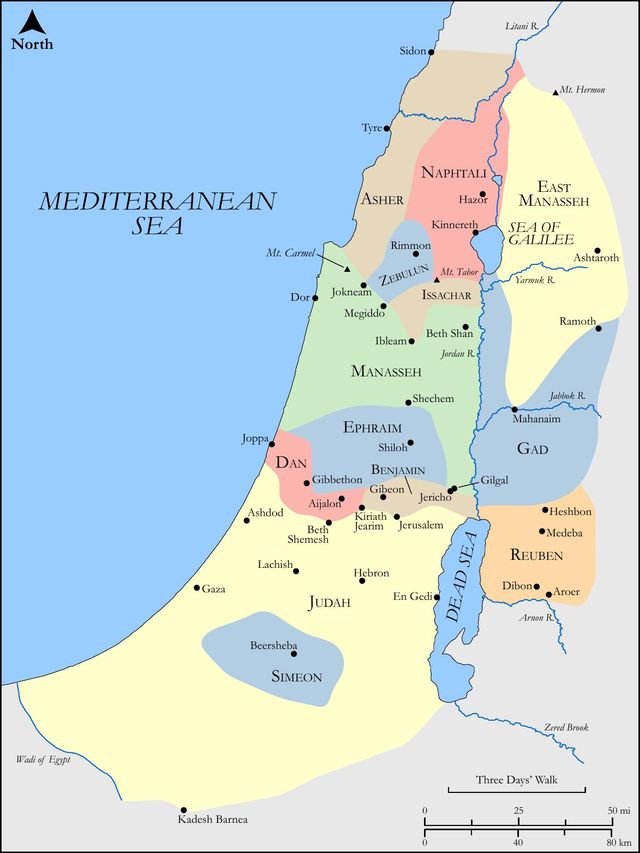
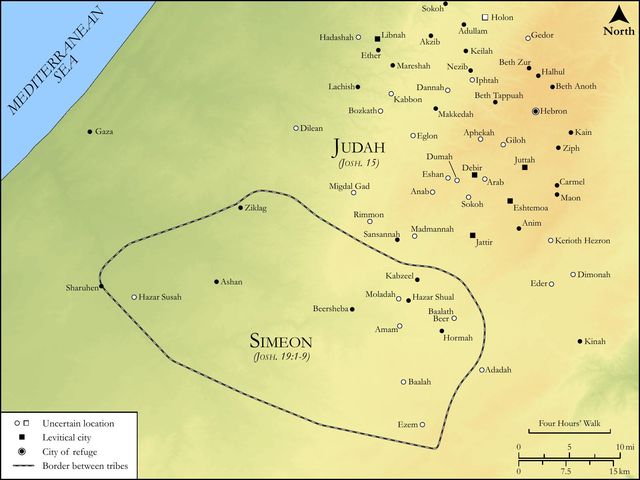
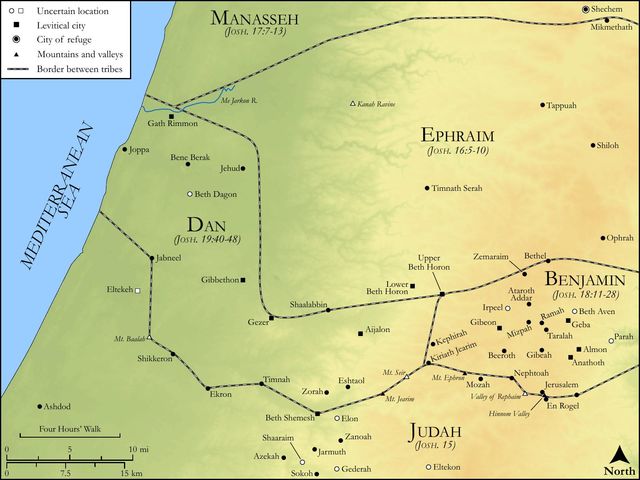
Study this verse
Public-domain commentary
Matthew Henry
From his Commentary on the Whole Bible. Henry comments on passages, not single verses — this entry covers Joshua 16:1–4.
Though Joseph was one of the younger sons of Jacob, yet he was his eldest by his most just and best beloved wife Rachel, was himself his best beloved son, and had been the greatest ornament and support of his family, kept it from perishing in a time of famine, and had been the shepherd and stone of Israel, and therefore his posterity were very much favoured by the lot. Their portion lay in the very heart of the land of Canaan. It extended from Jordan in the east (Jos 16:1) to the sea, the Mediterranean Sea, in the west, so that it took up the whole breadth of Canaan from side to side; and no question the fruitfulness of the soil answered the blessings both of Jacob and Moses, Gen 49:25, Gen 49:26, and Deu 33:13, etc. The portions allotted to Ephraim and Manasseh are not so particularly described as those of the other tribes; we have only the limits and boundaries of them, not the particular cities in them, as before we had the cities of Judah and afterwards those of the other tribes. For this no reason can be assigned, unless we may suppose that Joshua being himself of the children of Joseph they referred it to him alone to distribute among them the several cities that lay within their lot, and therefore did not bring in the names of their cities to the great council of their princes who sat upon this affair, by which means it came to pass that they were not inserted with the rest in the books.
Continue studying Joshua 16:2 across the web’s major study libraries — every link below opens this exact verse, chapter, or book on the destination site.
Read & Compare
 BibleGatewayThis verse in more than 200 translations and 70 languages.
 Bible.comThe YouVersion reader — hundreds of translations, reading plans, and highlights.
 ESV.orgCrossway's official English Standard Version reader.
 NET BibleThe NET translation with 60,000+ translators' notes on every rendering decision.
 STEP BibleTyndale House's free study tool — original text, vocabulary, and scholarly resources.
 BibliaLogos Bible Software's free web reader.
 USCCBThe New American Bible (Revised Edition) with the U.S. bishops' study notes.
Commentaries
 BibleHub CommentariesDozens of classic commentaries on this verse, gathered on one page.
 StudyLightMore than 100 commentary sets — the largest collection on the web.
 BibleRefPlain-English commentary on what this verse means, verse by verse.
 Enduring WordDavid Guzik's free commentary on this chapter, widely used by Bible teachers.
 Bible Study ToolsVerse commentary alongside Greek and Hebrew study aids.
Original Language & Research
- BibleHub InterlinearThe verse word by word — original language, transliteration, and English.
- BibleHub LexiconEvery word's original-language definition and Strong's entry.
 Blue Letter BibleDeep-study tools — Strong's numbers, concordance, and word studies.
 SefariaThe Hebrew text with Rashi and centuries of Jewish commentary.
Sermons, Hymns & Audio


TrulyRandomVerse is not affiliated with these sites and doesn’t control their content. They’re linked because they’re genuinely useful.
Summary
Joshua 16:2 meticulously delineates a segment of the southern border for the tribe of Ephraim, one of the two tribes descended from Joseph. This verse, part of the broader allocation of the Promised Land in the Book of Joshua, specifies a geographical line extending from the historically significant city of Bethel (also known as Luz) eastward towards the territory of the Archi and the city of Ataroth. It underscores the precision and fulfillment of God's covenant promises regarding the land inheritance for His people Israel.
Context
ShowHideLiterary Context
Joshua 16:2 is embedded within the detailed account of the land distribution to the Israelite tribes, specifically focusing on the inheritance of the "house of Joseph" (Ephraim and Manasseh) in chapters 16 and 17. Following the general overview of the land's division (Joshua 13-15), these chapters provide the specific boundaries and cities allocated to Joseph's descendants. This verse, therefore, serves as a precise geographical marker within the larger narrative of Israel's settlement in Canaan, immediately following the general description of Joseph's lot in Joshua 16:1. The meticulous listing of geographical features and place names is characteristic of this section of Joshua, emphasizing the tangible reality of God's promise being fulfilled.
Historical & Cultural Context
The setting is the post-conquest period, where the Israelites are transitioning from a nomadic existence to settled tribal life in the Promised Land. Land ownership and precise boundaries were paramount in Israel, defining tribal identity, economic stability, and legal rights. The mention of "Bethel" and "Luz" is particularly significant, as Bethel ("House of God") was a pivotal site in Israelite history, renamed by Jacob after his encounter with God (Jacob's ladder dream) in Genesis 28:19. Luz was its original Canaanite name. This dual naming convention likely served to identify the location clearly to both those familiar with its ancient name and its more recent Israelite designation. The Archi were a clan or family group, and Ataroth was a city, all serving as established points of reference for the border demarcation.
Key Themes
ShowHideThe verse significantly contributes to several overarching themes in Joshua and the Pentateuch. Foremost is the Divine Fulfillment of Promise, demonstrating God's unwavering faithfulness to His covenant with Abraham, Isaac, and Jacob to give their descendants the land of Canaan (Genesis 15:18). The meticulous geographical details, including specific cities and clan territories, underscore the Precision and Orderliness of God's Provision. This was not a vague allocation but a divinely orchestrated, precise division, highlighting God's sovereignty over the land and its distribution. Furthermore, it reinforces the theme of Inheritance and Identity, as the land was foundational to the tribal structure and the distinct identity of each Israelite clan, ensuring their place within the covenant community as outlined in God's instructions for land division in Numbers 34.
Exposition and Analysis
ShowHideKey Word Analysis
ShowHideMeaning "House of God," this city held immense spiritual significance for Israel. It was where Abraham built an altar (Genesis 12:8), and later, where Jacob had his transformative dream and vowed to serve God, renaming the place from Luz to Bethel (Genesis 28:19). Its inclusion as a border point emphasizes the sacred and historical weight of the land being distributed.
This was the original Canaanite name for the city later called Bethel. The name "Luz" probably refers to a type of tree growing there, such as an almond or hazel tree. Its concurrent mention with Bethel indicates either that the border encompassed both the older and newer names for the same location, or that it specifically referred to the original Canaanite settlement distinct from the Israelite sacred site, ensuring clarity for all parties involved in the land demarcation.
Refers to the "Archites," a clan or family group, likely residing in the region. This term is a patrial, indicating a native of a place similar to Erek. The most famous Archite mentioned in the Bible is Hushai, David's loyal advisor (2 Samuel 15:32). Their inclusion as a border marker indicates that established clan territories were also used as points of reference for the tribal boundaries, reflecting the existing social and geographical landscape.
Verse Breakdown
ShowHide"And goeth out from Bethel to Luz"
This phrase establishes the starting point or a significant segment of Ephraim's southern border. It signifies a line or path that originates from or passes through the area encompassing both the sacred Israelite site of Bethel and its older Canaanite designation, Luz. This dual naming ensures precise identification of the boundary's beginning or trajectory, emphasizing the historical depth of the land.
"and passeth along unto the borders of Archi to Ataroth"
This clause describes the continuation of the border line eastward. From the Bethel/Luz area, the boundary extends towards the territory inhabited by the Archites, finally reaching the city of Ataroth. This indicates a clear, defined progression of the border, using both a clan territory ("borders of Archi") and a specific city ("Ataroth") as markers, providing unambiguous geographical reference points for the Ephraimite inheritance.
Literary Devices
ShowHideThe primary literary device employed in Joshua 16:2, and indeed throughout the land division chapters, is Geographical Listing. This involves the systematic enumeration of places, landmarks, and territories to define boundaries with precision. The text functions almost as a legal deed or survey document, emphasizing the tangible and verifiable nature of the land allocation. The Repetition of place names, particularly the dual mention of "Bethel to Luz," serves to reinforce the exact location and ensure clarity, acknowledging both the historical and contemporary nomenclature of the site. While not overtly symbolic in this specific verse, the very act of meticulously detailing the land's division carries Symbolism of God's faithfulness, His orderly nature, and the concrete fulfillment of ancient promises. The land itself becomes a symbol of God's covenant loyalty.
Theological and Thematic Connections
ShowHideJoshua 16:2, though a seemingly dry geographical listing, is profoundly theological. It powerfully demonstrates God's faithfulness and meticulousness in fulfilling His ancient covenant promises to Abraham, Isaac, and Jacob concerning the land of Canaan. The precision of the boundaries underscores that God's word is not vague but concrete, detailed, and utterly reliable. This divine precision provides a tangible assurance of His sovereignty over all creation and His commitment to His people, establishing their identity and security within the promised inheritance. It reminds us that God's plans are detailed and purposeful, extending to every facet of His people's lives, both corporately and individually, ensuring order and provision.
Reflection and Application
ShowHideThe meticulous detail of Joshua 16:2 invites us to reflect on the nature of God's faithfulness and the precision of His divine plan. Just as God precisely delineated the physical boundaries for Ephraim, He also has a clear and purposeful design for our lives, for His church, and for the unfolding of history. This verse encourages us to trust in God's sovereignty, knowing that He oversees every detail, even those that seem mundane or insignificant. It challenges us to consider the "boundaries" God has established in our own lives—spiritual, moral, relational—and to live within them, recognizing that they are for our blessing and flourishing. Furthermore, it reminds us that our inheritance in Christ is not vague but a secure and definite reality, prepared for us by a faithful God.
Questions for Reflection
ShowHideFAQ
ShowHideWhy are both "Bethel" and "Luz" mentioned for the same location?
ShowHideThe mention of both "Bethel" and "Luz" for the same location serves to provide clarity and historical context. "Luz" was the original Canaanite name for the city, while "Bethel" ("House of God") was the name given to it by Jacob after his significant encounter with God there, as recorded in Genesis 28:19. By including both names, the text ensures that the boundary's starting point is unambiguously identified for all readers, whether they were familiar with its ancient Canaanite designation or its more recent Israelite sacred name. It also highlights the continuity of the land's history and its transition under Israelite possession.
What is the significance of Ephraim's inheritance being described in such detail?
ShowHideThe detailed description of Ephraim's inheritance, along with that of Manasseh (the other tribe of Joseph), is significant for several reasons. Firstly, Joseph received a double portion of the inheritance through his sons, Ephraim and Manasseh, fulfilling Jacob's blessing in Genesis 48:5-6. Ephraim, in particular, grew to be a very powerful and numerous tribe, often representing the Northern Kingdom of Israel in later biblical texts. Their central location and detailed boundaries reflect their prominence and the importance of their designated territory for the stability and identity of the Israelite nation. It underscores God's precise and orderly provision for each tribe, ensuring their distinct identity and place within the covenant community.
Christ-Centered Fulfillment
ShowHideWhile Joshua 16:2 describes a physical land inheritance, it points to a deeper spiritual reality fulfilled in Christ. The meticulous division of the land for Ephraim, originating from Bethel, the "House of God," foreshadows the ultimate spiritual inheritance believers receive through Christ, who is the true "House of God" and the dwelling place of God among humanity (John 2:19-21). The precision of the land boundaries reflects God's faithfulness to His promises, a faithfulness that finds its ultimate "Yes" and "Amen" in Jesus Christ (2 Corinthians 1:20). Just as the Israelites received a physical land, believers in Christ receive a spiritual inheritance—every spiritual blessing in the heavenly places (Ephesians 1:3)—which is secure, eternal, and far surpasses any earthly possession. Christ is our true and eternal inheritance, providing us with a secure identity and a permanent dwelling place in God's presence, fulfilling the deepest longings for belonging and security that the land promised to Israel could only partially represent (Hebrews 11:10).