


Judges 1:22
Bible text: King James Version (1769 Blayney text) · Public domain
Bible text: Berean Standard Bible · Public domain
Bible text: American Standard Version (1901) · Public domain
Bible text: World English Bible, Messianic edition · Public domain
Bible text: Geneva Bible (1599) · Public domain
Bible text: Young's Literal Translation · Public domain
- וַיַּעֲלוּvai·ya·'a·Luand they went upH5927Conj-w ¦ V-Qal-ConsecImperf-3mpVerb Qal Consecutive Imperfect 3rd Plural Masculineוַandיַּעֲלוּthey went up
- בֵיתveit[the] house ofH1004N-mscNoun Singular Masculine Construct
- יוֹסֵףyo·SefJosephH3130N-proper-mNoun Proper Masculine
- גַּםgamalsoH1571AdvAdverb
- הֵםhemtheyH1992Pro-3mpPronoun Personal 3rd Plural Masculine
- בֵּיתbeitBeth-H1008N-properNoun Proper Location
- אֵל'El-elH1008N-properNoun Proper Location
- וַיהוָהva·Yah·wehand YahwehH3068Conj-w ¦ N-properNoun Proper TitleוַandיהוָהYahweh
- עִמָּם'i·Mam[was] with <the> themH5973Prep ¦ 3mpPreposition Definiteעִמָּ[was] with <the>םthem
English is a literal word-by-word gloss of the Hebrew, not the KJV's wording. Why?
This is the original text the KJV's translators worked from — each Hebrew word with its own literal English meaning in this verse, prepared by scholars at Tyndale House, Cambridge. The KJV translates whole sentences, not word by word, so its wording differs: one Hebrew word can become several English words, and the KJV may choose “the LORD” where the gloss reads “Yahweh”. Both are faithful — they answer different questions. For the KJV's own rendering, switch to the KJV text.
Details
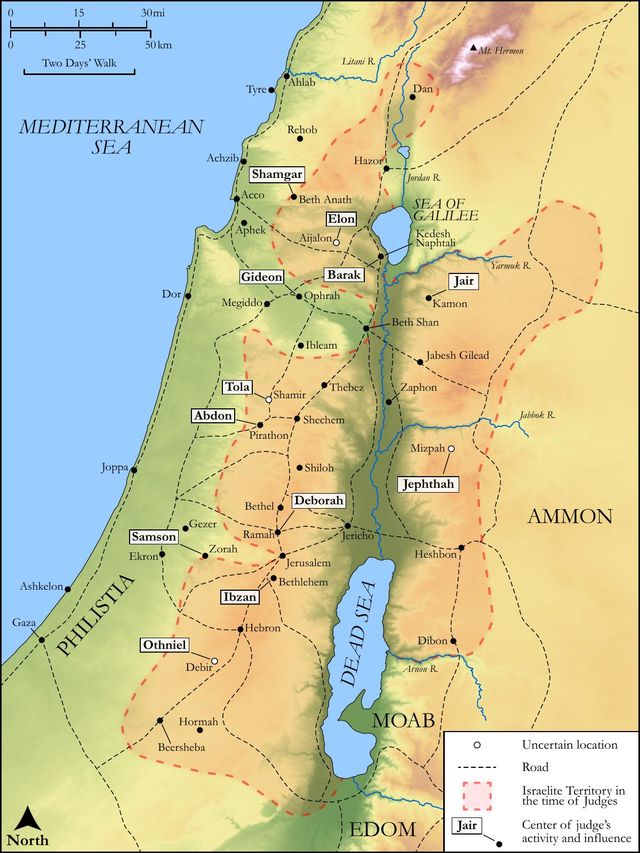
See on the biblical-era maps
Study this verse
Public-domain commentary
Matthew Henry
From his Commentary on the Whole Bible. Henry comments on passages, not single verses — this entry covers Judges 1:21–36. His four-level outline is real structure in the source text, so it is rendered as structure.
We are here told upon what terms the rest of the tribes stood with the Canaanites that remained.
I.Benjamin neglected to drive the Jebusites out of that part of the city of Jerusalem which fell to their lot, Jdg 1:21.
Judah had set them a good example, and gained them great advantages by what they did (Jdg 1:9), but they did not follow the blow for want of resolution.
II.The house of Joseph,
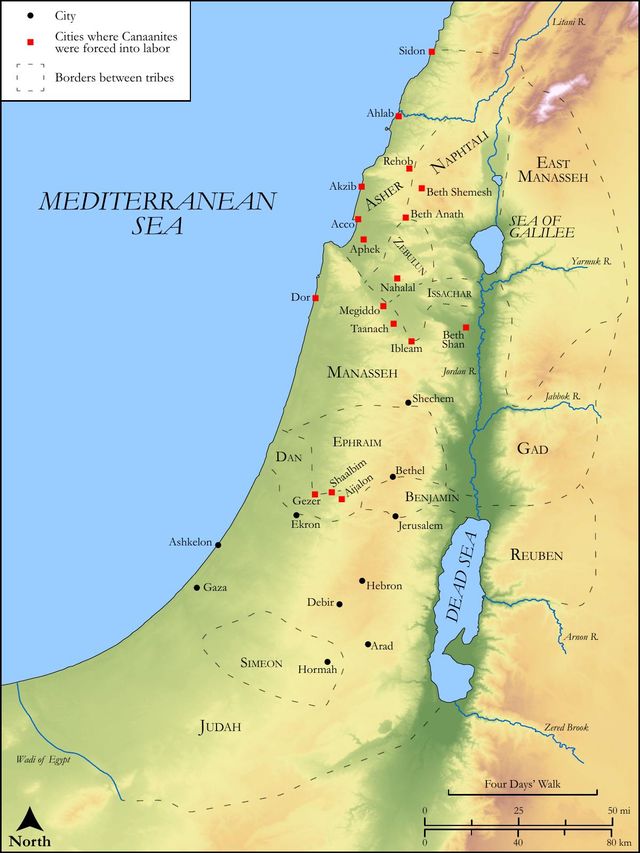
1.Bestirred themselves a little to get possession of Beth-el, Jdg 1:22. That city is mentioned in the tribe of Benjamin, Jos 18:22. Yet it is spoken of there (Jdg 1:13) as a city in the borders of that tribe, and, it should seem, the line went through it, so that one half of it only belonged to Benjamin, the other half to Ephraim; and perhaps the activity of the Ephraimites at this time, to recover it from the Canaanites, secured it entirely to them henceforward, or at least the greatest part of it, for afterwards we find it so much under the power of the ten tribes (and Benjamin was none of them) that Jeroboam set up one of his calves in it. In this account of the expedition of the Ephraimites against Beth-el observe,
(1.)Their interest in the divine favour: The Lord was with them, and would have been with the other tribes if they would have exerted their strength. The Chaldee reads it here, as in many other places, The Word of the Lord was their helper, namely, Christ himself, the captain of the Lord's host, now that they acted separately, as well as when they were all in one body.
(2.)The prudent measures they took to gain the city. They sent spies to observe what part of the city was weakest, or which way they might make their attack with most advantage, Jdg 1:23. These spies got very good information from a man they providentially met with, who showed them a private way into the town, which was left unguarded because, being not generally known, no danger was suspected on that side. And here,
[1.]He is not to be blamed for giving them this intelligence if he did it from a conviction that the Lord was with them, and that by his donation the land was theirs of right, any more than Rahab was for entertaining those whom she knew to be enemies of her country, but friends of God. Nor,
[2.]Are those to be blamed who showed him mercy, gave him and his family not only their lives, but liberty to go wherever they pleased: for one good turn requires another. But, it seems, he would not join himself to the people of Israel, he feared them rather than loved them, and therefore he removed after a colony of the Hittites, which, it should seem, had gone into Arabia and settled there upon Joshua's invasion of the country; with them this man chose to dwell, and among them he built a city, a small one, we may suppose, such as planters commonly build, and in the name of it preserved the ancient name of his native city, Luz, an almond-tree, preferring this before its new name, which carried religion in it, Bethel - the house of God.
(3.)Their success. The spies brought or sent notice of the intelligence they had gained to the army, which improved their advantages, surprised the city, and put them all to the sword, v. 25. But,
2.Besides this achievement, it seems, the children of Joseph did nothing remarkable (1.) Manasseh failed to drive out the Canaanites from several very considerable cities in their lot, and did not make any attempt upon them, Jdg 1:27. But the Canaanites, being in possession, were resolved not to quit it; they would dwell in that land, and Manasseh had not resolution enough to offer to dispossess them; as if there was no meddling with them unless they were willing to resign, which it was not to be expected they ever would be. Only as Israel got strength they got ground, and served themselves, both by their contributions and by their personal services, Jdg 1:28, Jdg 1:35. (2.) Ephraim likewise, though a powerful tribe, neglected Gezer a considerable city, and suffered the Canaanites to dwell among them (Jdg 1:29), which, some think, intimates their allowing them a quiet settlement, and indulging them with the privileges of an unconquered people, not so much as making them tributaries.
III.Zebulun, perhaps inclining to the sea-trade, for it was foretold that it should be a haven for ships, neglected to reduce Kitron and Nahalol (Jdg 1:30), and only made the inhabitants of those places tributaries to them.
IV.Asher quitted itself worse than any of the tribes (Jdg 1:31, Jdg 1:32), not only in leaving more towns than any of them in the hands of the Canaanites, but in submitting to the Canaanites instead of making them tributaries; for so the manner of expression intimates, that the Asherites dwelt among the Canaanites, as if the Canaanites were the more numerous and the more powerful, would still be lords of the country, and the Israelites must be only upon sufferance among them.
V.Naphtali also permitted the Canaanites to live among them (Jdg 1:33), only by degrees they got them so far under as to exact contributions from them.
VI.Dan was so far from extending his conquests where his lot lay that, wanting spirit to make head against the Amorites, he was forced by them to retire into the mountains and inhabit the cities there, but durst not venture into the valley, where, it is probable, the chariots of iron were, Jdg 1:34. Nay, and some of the cities in the mountains were kept against them, Jdg 1:35. Thus were they straitened in their possessions, and forced to seek for more room at Laish, a great way off, Jdg 18:1, etc. In Jacob's blessing Judah is compared to a lion, Dan to a serpent; now observe how Judah with his lion-like courage prospered and prevailed, but Dan with all his serpenting subtlety could get no ground; craft and artful management do not always effect the wonders they pretend to. What Dan came short of doing, it seems, his neighbours the Ephraimites in part did for him; they put the Amorites under tribute, Jdg 1:35.
Upon the whole matter it appears that the people of Israel were generally very careless both of their duty and interest in this thing; they did not what they might have done to expel the Canaanites and make room for themselves. And, 1. It was owing to their slothfulness and cowardice. They would not be at the pains to complete their conquests; like the sluggard, that dreamed of a lion in the way, a lion in the streets, they fancied insuperable difficulties, and frightened themselves with winds and clouds from sowing and reaping. 2. It was owing to their covetousness; the Canaanites' labour and money would do them more good (they thought) than their blood, and therefore they were willing to let them live among them, that they might make a hand of them. 3. They had not that dread and detestation of idolatry which they ought to have had; they thought it a pity to put these Canaanites to the sword, though the measure of their iniquity was full, thought it would be no harm to let them live among them, and that they should be in no danger from them. 4. The same thing that kept their fathers forty years out of Canaan kept them now out of the full possession of it, and that was unbelief. Distrust of the power and promise of God lost them their advantages, and ran them into a thousand mischiefs.
Continue studying Judges 1:22 across the web’s major study libraries — every link below opens this exact verse, chapter, or book on the destination site.
Read & Compare
 BibleGatewayThis verse in more than 200 translations and 70 languages.
 Bible.comThe YouVersion reader — hundreds of translations, reading plans, and highlights.
 ESV.orgCrossway's official English Standard Version reader.
 NET BibleThe NET translation with 60,000+ translators' notes on every rendering decision.
 STEP BibleTyndale House's free study tool — original text, vocabulary, and scholarly resources.
 BibliaLogos Bible Software's free web reader.
 USCCBThe New American Bible (Revised Edition) with the U.S. bishops' study notes.
Commentaries
 BibleHub CommentariesDozens of classic commentaries on this verse, gathered on one page.
 StudyLightMore than 100 commentary sets — the largest collection on the web.
 BibleRefPlain-English commentary on what this verse means, verse by verse.
 Enduring WordDavid Guzik's free commentary on this chapter, widely used by Bible teachers.
 Bible Study ToolsVerse commentary alongside Greek and Hebrew study aids.
Original Language & Research
- BibleHub InterlinearThe verse word by word — original language, transliteration, and English.
- BibleHub LexiconEvery word's original-language definition and Strong's entry.
 Blue Letter BibleDeep-study tools — Strong's numbers, concordance, and word studies.
 SefariaThe Hebrew text with Rashi and centuries of Jewish commentary.
Sermons, Hymns & Audio


TrulyRandomVerse is not affiliated with these sites and doesn’t control their content. They’re linked because they’re genuinely useful.
Summary
Judges 1:22 succinctly narrates the successful military campaign undertaken by the house of Joseph, encompassing the tribes of Ephraim and Manasseh, against the strategically and historically significant city of Bethel. This verse highlights their proactive engagement in the ongoing task of possessing the promised land, but it critically attributes their triumph not to their inherent strength or tactical prowess alone, but to the explicit and active presence of the LORD, thereby underscoring a fundamental biblical principle that divine favor and partnership are the ultimate determinants of Israel's success in fulfilling their covenantal mandate.
Context
ShowHideLiterary Context
Judges 1:22 is embedded within the introductory chapter of the Book of Judges, which serves as a crucial bridge between the unified conquest under Joshua and the fragmented, often tumultuous, period of the Judges. Following Joshua's death, Israel lacks a single, unifying leader, and this chapter details the individual tribal efforts to complete the conquest and possession of their allotted territories. The narrative begins with the relative success of Judah and Simeon in the south, followed by their subsequent failures to fully dispossess the inhabitants of certain areas, setting a mixed tone. Judges 1:22 then shifts focus to the central tribes, specifically the "house of Joseph," presenting a positive outcome that contrasts with some of the earlier, less complete victories. This specific account demonstrates that while the overall conquest was incomplete, individual tribes could still achieve significant success when acting with divine favor, setting a precedent for understanding the fluctuating fortunes of Israel throughout the book.
Historical & Cultural Context
The period immediately following Joshua's death marked a complex transition for the nascent Israelite nation. While Joshua had secured major victories and broken the backbone of Canaanite resistance, many fortified strongholds and pockets of indigenous populations remained unconquered. Canaanite cities, typically fortified and often situated on elevated terrain for defense, were inhabited by various peoples with distinct religious practices and military capabilities. Bethel, originally known as Luz, was not merely a strategic military objective but also held profound historical and religious significance for Israel. It was the very site where Jacob experienced his transformative dream of a ladder to heaven and subsequently named the place "House of God" (Genesis 28:19). Its conquest was thus a symbolic reclaiming of a sacred ancestral space. The "house of Joseph" refers to the powerful and populous tribes of Ephraim and Manasseh, descendants of Joseph, who were allotted substantial territory in the central highlands of Canaan, making their success in securing this region vital for the broader Israelite presence.
Key Themes
ShowHideThis verse powerfully contributes to several overarching themes prevalent in the Book of Judges and the broader Deuteronomistic history. Firstly, it highlights Divine Presence and Empowerment, as the explicit declaration "and the LORD [was] with them" directly attributes the success to God's active involvement and enabling favor. This echoes foundational promises made to leaders like Joshua and reinforces the consistent biblical teaching that Israel's true strength derived from their covenant relationship with Yahweh. Secondly, it underscores Tribal Responsibility and Initiative, demonstrating that divine presence, while crucial, does not negate human effort. The "house of Joseph" actively "went up against Bethel," illustrating their commitment to fulfilling the divine mandate to dispossess the Canaanites and occupy the land, a task that remained ongoing throughout the period described in Judges. Finally, it exemplifies the Ongoing Conquest of Canaan, a central narrative thread from the Book of Joshua into Judges, showing that the process of securing the promised land was incremental, required sustained effort from each tribe, and was ultimately dependent on God's faithfulness to His promises.
Exposition and Analysis
ShowHideKey Word Analysis
ShowHideThis term denotes more than just a physical dwelling; it extends to encompass a family, household, or even a lineage. In the context of "the house of Joseph," it refers to the collective entity of the tribes of Ephraim and Manasseh, emphasizing their unity and shared identity as descendants of Joseph. This highlights their corporate action and strength in undertaking the military campaign.
Meaning "house of God," this city was originally named Luz before Jacob renamed it after his profound encounter with God (Genesis 28:19). Its name itself carries immense spiritual significance for Israel, marking it as a place of divine revelation and covenant. The conquest of a city bearing such a name underscores the theological dimension of Israel's mission to reclaim the land for Yahweh.
This is the personal, covenantal name of God, Yahweh, signifying "the self-Existent or Eternal." The presence of this divine name is pivotal, indicating that the success of the house of Joseph was not merely a matter of human military might but was directly attributable to the active, enabling presence and sovereign power of the covenant-keeping God. It is a theological statement affirming divine agency in Israel's history.
Verse Breakdown
ShowHide"And the house of Joseph,"
This opening phrase identifies the specific Israelite group responsible for the action. It refers to the powerful and numerous tribes of Ephraim and Manasseh, acting in a unified and concerted effort, demonstrating tribal initiative in the post-Joshua period.
"they also went up against Bethel:"
This clause describes the military objective and action. The verb "went up" (from H5927, ʻâlâh) often implies an ascent, typical for attacking a fortified city situated on elevated ground. The inclusion of "also" connects their campaign to the preceding tribal efforts detailed in Judges 1, indicating a continuation of the broader conquest mandate. Bethel is named as the specific, strategic target.
"and the LORD [was] with them."
This concluding clause is the theological climax of the verse. It provides the divine explanation for the success of the house of Joseph. The phrase "the LORD was with them" signifies God's active, enabling presence, approval, and empowerment. It asserts that their victory was not solely due to their own strength or strategy, but primarily to Yahweh's favor and direct involvement, making this a profound declaration of divine sovereignty and partnership in Israel's endeavors.
Literary Devices
ShowHideJudges 1:22 employs several literary devices to convey its profound theological message. The most prominent is Divine Endorsement, explicitly stated in the phrase "the LORD [was] with them." This functions as a theological commentary, shifting the focus from human military action to divine agency as the ultimate source of success. There is also a subtle Irony in the conquest of "Bethel," meaning "House of God." While the name signifies a sacred site for Israel, its former inhabitants were Canaanites, making its capture a reclamation of a holy place from pagan control, thus reinforcing its divine association in a new, redemptive context. The verse demonstrates Conciseness, delivering a powerful message efficiently by juxtaposing human initiative with divine presence as the decisive factor. The narrative structure, moving from the human agent ("house of Joseph") to the action ("went up against Bethel") and finally to the divine cause ("the LORD [was] with them"), creates a clear and impactful declaration of divinely empowered conquest.
Theological and Thematic Connections
ShowHideJudges 1:22 powerfully articulates a foundational theological truth that resonates throughout the biblical narrative: the success of God's people in fulfilling His purposes is ultimately dependent on His active presence and favor. This verse, like many others in the Old Testament, teaches that while human initiative, obedience, and effort are required, it is God who empowers, enables, and ultimately ensures victory. The recurring motif "the LORD was with them" is a profound theological statement, signifying divine covenant faithfulness and serving as the true source of Israel's strength against formidable odds. It underscores the principle that God works through His people, but His presence is the non-negotiable element for true, lasting success in both spiritual and physical endeavors, transforming human limitations into opportunities for divine display.
Reflection and Application
ShowHideJudges 1:22 offers a timeless and profoundly encouraging message for believers today. It reminds us that while we are indeed called to be active and obedient in our faith, taking initiative in the tasks God sets before us, our ultimate success and effectiveness hinge entirely on His active presence and empowering grace. Just as the house of Joseph "went up against Bethel" but found their victory in the fact that "the LORD [was] with them," so too must we engage in our spiritual battles, daily callings, and missional endeavors with a deep and abiding reliance on God's active presence. This verse challenges us to examine whether we are operating in our own strength, relying on our own wisdom and resources, or truly leaning into the divine partnership that guarantees ultimate victory. It provides immense courage, knowing that when we walk in alignment with God's will, His presence not only ensures our ultimate triumph but also provides His sustaining power through every challenge, transforming daunting tasks into profound opportunities for Him to display His faithfulness and glory.
Questions for Reflection
ShowHideFAQ
ShowHideWhat is the significance of "the house of Joseph" in this verse?
ShowHide"The house of Joseph" refers to the combined, powerful, and numerous tribes of Ephraim and Manasseh, the two sons of Joseph whom Jacob adopted as his own, granting them tribal status equal to his direct sons (Genesis 48:5). Their unity and initiative in conquering Bethel highlight their commitment to fulfilling the mandate to possess the land. Their success, explicitly attributed to God's presence, sets them apart as an example of effective tribal action in the fragmented period of the Judges, demonstrating what could be achieved when God's people acted in faith with His enabling power.
Why was Bethel an important city to conquer for Israel?
ShowHideBethel was important for both strategic and profound spiritual reasons. Strategically, it was a key fortified city located on a major north-south ridge route in the central highlands of Canaan, making its control vital for regional security, communication, and the consolidation of Israelite territory. Spiritually, it held immense historical and religious significance for Israel. It was the place where Jacob had his famous dream of a ladder to heaven and encountered God, subsequently naming the place "House of God" (Genesis 28:19). Its conquest was thus not merely a military victory but also a symbolic reclamation of a sacred ancestral site, reinforcing Israel's claim to the land as a divine inheritance and re-establishing a place of worship for Yahweh.
Christ-Centered Fulfillment
ShowHideJudges 1:22, with its pivotal declaration that "the LORD [was] with them," finds its ultimate and most profound fulfillment in the person and work of Jesus Christ. The Old Testament's recurring motif of God's active presence with His people, enabling their conquests and ensuring their success, points forward to the reality of Immanuel—"God with us"—in Jesus (Matthew 1:23). While the house of Joseph conquered a physical city, Christ's presence empowers His new covenant community, the Church, for a far greater spiritual conquest against the forces of sin, death, and darkness (Ephesians 6:12). Just as God's presence guaranteed victory for the tribes in their earthly battles, so too does the indwelling Holy Spirit, sent by Christ, empower believers to overcome the world (John 16:33) and fulfill the Great Commission, making disciples of all nations (Matthew 28:18-20). Christ Himself is the ultimate "House of God," the true temple where God dwells among humanity (John 1:14), and through Him, we are made partakers of the divine nature, equipped by His abiding presence to live victorious lives for God's glory, transforming spiritual landscapes rather than merely physical ones.