


Joshua 16:1
Bible text: King James Version (1769 Blayney text) · Public domain
Bible text: King James Version with Strong's numbers · Public domain
Bible text: Berean Standard Bible · Public domain
Bible text: American Standard Version (1901) · Public domain
Bible text: World English Bible, Messianic edition · Public domain
Bible text: Geneva Bible (1599) · Public domain
Bible text: Young's Literal Translation · Public domain
- וַיֵּצֵאvai·ye·Tze'and it went outH3318Conj-w ¦ V-Qal-ConsecImperf-3msVerb Qal Consecutive Imperfect 3rd Singular Masculineוַandיֵּצֵאit went out
- הַגּוֹרָלha·go·Ralthe lotH1486Art ¦ N-msNoun Singular Masculine Absoluteהַtheגּוֹרָלlot
- לִבְנֵיliv·Neiof [the] descendants ofH1121Prep-l ¦ N-mpcNoun Plural Masculine Constructלִofבְנֵי[the] descendants of
- יוֹסֵףyo·SefJosephH3130N-proper-mNoun Proper Masculine
- מִיַּרְדֵּןmi·yar·Denfrom [the] JordanH3383Prep-m ¦ N-properNoun Proper Locationמִfromיַּרְדֵּן[the] Jordan
- יְרִיחוֹye·ri·Choof JerichoH3405N-properNoun Proper Location
- לְמֵיle·Meito [the] waters ofH4325Prep-l ¦ N-mpcNoun Plural Masculine Constructלְtoמֵי[the] waters of
- יְרִיחוֹye·ri·ChoJerichoH3405N-properNoun Proper Location
- מִזְרָחָהmiz·Ra·chaheast -wardH4217N-ms ¦ SfxNoun Singular Masculine Absoluteמִזְרָחָeastה-ward
- הַמִּדְבָּרha·mid·Barthe wildernessH4057Art ¦ N-msNoun Singular Masculine Absoluteהַtheמִּדְבָּרwilderness
- עֹלֶה'o·Lehgoing upH5927V-Qal-Prtcpl-msVerb Qal Participle Singular Masculine Absolute
- מִירִיחוֹmi·ri·Chofrom JerichoH3405Prep-m ¦ N-properNoun Proper LocationמִfromירִיחוֹJericho
- בָּהָרba·Harin the hill countryH2022Prep-b ¦ N-msNoun Singular Masculine Absoluteבָּin theהָרhill country
- בֵּיתbeitBeth-H1008N-properNoun Proper Location
- אֵל'El-elH1008N-properNoun Proper Location
English is a literal word-by-word gloss of the Hebrew, not the KJV's wording. Why?
This is the original text the KJV's translators worked from — each Hebrew word with its own literal English meaning in this verse, prepared by scholars at Tyndale House, Cambridge. The KJV translates whole sentences, not word by word, so its wording differs: one Hebrew word can become several English words, and the KJV may choose “the LORD” where the gloss reads “Yahweh”. Both are faithful — they answer different questions. For the KJV's own rendering, switch to the KJV text.
Details
See on the biblical-era maps
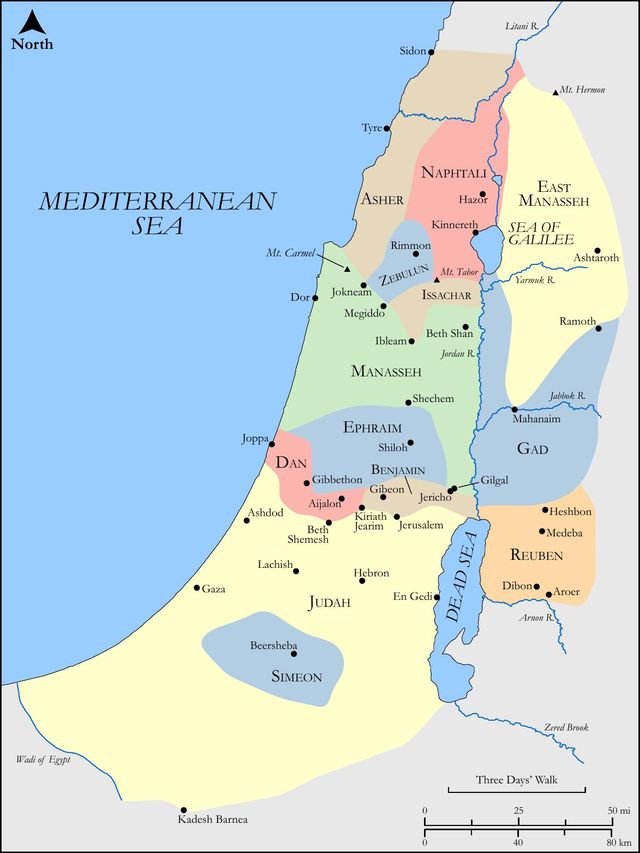
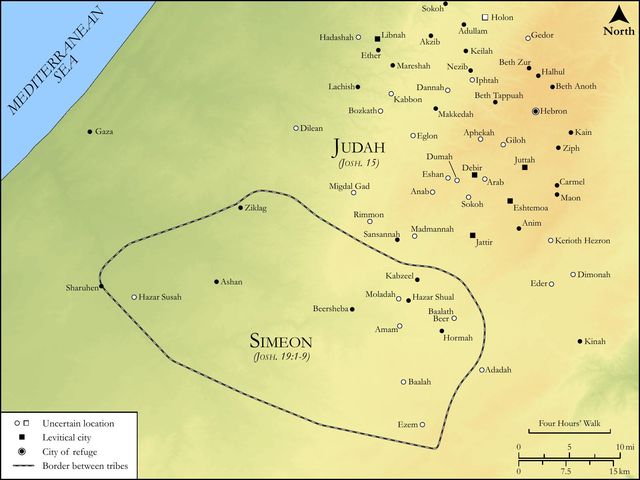
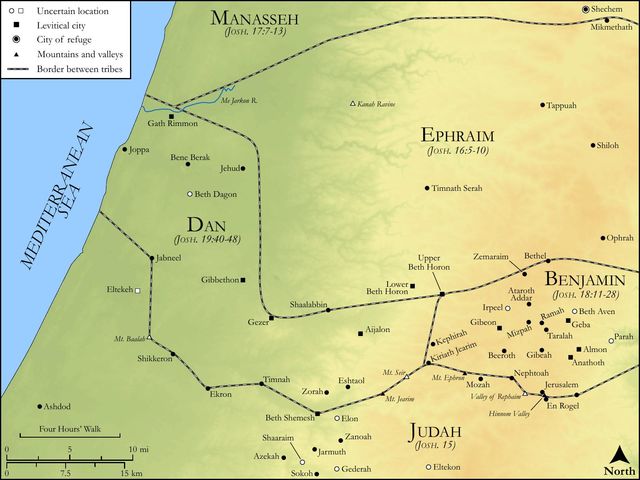
Study this verse
Public-domain commentary
Matthew Henry
From his Commentary on the Whole Bible. Henry comments on passages, not single verses — this entry covers Joshua 16:1–4.
Though Joseph was one of the younger sons of Jacob, yet he was his eldest by his most just and best beloved wife Rachel, was himself his best beloved son, and had been the greatest ornament and support of his family, kept it from perishing in a time of famine, and had been the shepherd and stone of Israel, and therefore his posterity were very much favoured by the lot. Their portion lay in the very heart of the land of Canaan. It extended from Jordan in the east (Jos 16:1) to the sea, the Mediterranean Sea, in the west, so that it took up the whole breadth of Canaan from side to side; and no question the fruitfulness of the soil answered the blessings both of Jacob and Moses, Gen 49:25, Gen 49:26, and Deu 33:13, etc. The portions allotted to Ephraim and Manasseh are not so particularly described as those of the other tribes; we have only the limits and boundaries of them, not the particular cities in them, as before we had the cities of Judah and afterwards those of the other tribes. For this no reason can be assigned, unless we may suppose that Joshua being himself of the children of Joseph they referred it to him alone to distribute among them the several cities that lay within their lot, and therefore did not bring in the names of their cities to the great council of their princes who sat upon this affair, by which means it came to pass that they were not inserted with the rest in the books.
Continue studying Joshua 16:1 across the web’s major study libraries — every link below opens this exact verse, chapter, or book on the destination site.
Read & Compare
 BibleGatewayThis verse in more than 200 translations and 70 languages.
 Bible.comThe YouVersion reader — hundreds of translations, reading plans, and highlights.
 ESV.orgCrossway's official English Standard Version reader.
 NET BibleThe NET translation with 60,000+ translators' notes on every rendering decision.
 STEP BibleTyndale House's free study tool — original text, vocabulary, and scholarly resources.
 BibliaLogos Bible Software's free web reader.
 USCCBThe New American Bible (Revised Edition) with the U.S. bishops' study notes.
Commentaries
 BibleHub CommentariesDozens of classic commentaries on this verse, gathered on one page.
 StudyLightMore than 100 commentary sets — the largest collection on the web.
 BibleRefPlain-English commentary on what this verse means, verse by verse.
 Enduring WordDavid Guzik's free commentary on this chapter, widely used by Bible teachers.
 Bible Study ToolsVerse commentary alongside Greek and Hebrew study aids.
Original Language & Research
- BibleHub InterlinearThe verse word by word — original language, transliteration, and English.
- BibleHub LexiconEvery word's original-language definition and Strong's entry.
 Blue Letter BibleDeep-study tools — Strong's numbers, concordance, and word studies.
 SefariaThe Hebrew text with Rashi and centuries of Jewish commentary.
Sermons, Hymns & Audio


TrulyRandomVerse is not affiliated with these sites and doesn’t control their content. They’re linked because they’re genuinely useful.
Summary
Joshua 16:1 initiates the precise geographical description of the land inheritance for the descendants of Joseph, specifically the tribes of Ephraim and Manasseh, within the Promised Land. This verse meticulously outlines the initial eastern boundary of their extensive territory, extending from the strategically vital Jordan River near Jericho, and moving westward towards significant landmarks like the water of Jericho and Mount Bethel. This allocation, determined by divine lot, marks a crucial step in the fulfillment of God's ancient covenant promises, transitioning Israel from a conquering force to a settled nation firmly established in their God-given inheritance.
Context
ShowHideLiterary Context
Joshua 16:1 is situated within the pivotal section of the book of Joshua (chapters 13-21) that details the division of the conquered land among the twelve tribes of Israel. This follows the successful military campaigns against the Canaanite kings (chapters 1-12), which established Israel's dominance in the region. The meticulous land distribution, initiated by casting lots at Shiloh (as described in Joshua 18:1), underscores the divine authority and providential guidance behind the allocation. This particular verse introduces the substantial portion granted to the "children of Joseph"—Ephraim and Manasseh—who, as descendants of Joseph, received a significant and centrally located inheritance, reflecting their prominence within the tribal structure and the fulfillment of Jacob's blessing in Genesis 48.
Historical & Cultural Context
The division of the land marked a profound transition for the Israelites, moving from a nomadic, conquering army to a settled, agricultural society. This process occurred after approximately seven years of military campaigns. The method of "casting lots" (Hebrew: gôrāl) was a widely accepted ancient practice for making crucial decisions, believed to reveal the divine will rather than mere chance, as evidenced in various biblical accounts like Jonah 1:7. Jericho, a prominent geographical marker in this verse, was the first city conquered by Israel (narrated in Joshua 6), holding immense symbolic and strategic importance. Its location near the Jordan River made it a vital gateway to the central highlands, and its fertile oasis provided a crucial landmark for defining tribal boundaries in the often-arid landscape. The mention of "Mount Bethel" further grounds the description in a region with deep historical and spiritual significance for Israel, being the site of Jacob's dream and God's covenant promises in Genesis 28:10-22.
Key Themes
ShowHideThe meticulous division of the land, as initiated here for the Josephite tribes, serves as a tangible and direct fulfillment of God's ancient covenant promises to Abraham, Isaac, and Jacob, particularly the promise of land (e.g., Genesis 12:7). This act demonstrates God's unwavering faithfulness and His meticulous care in guiding His people into the physical realization of their promised inheritance, solidifying their place as a nation in the land He had chosen for them. The precise geographical descriptions, detailing boundaries from the Jordan by Jericho to the wilderness and Mount Bethel, highlight the divinely ordained order and structure of the land distribution. This systematic approach, guided by lots and overseen by Joshua and Eleazar (as seen in Joshua 14:1), was crucial for preventing inter-tribal disputes and establishing clear, God-given boundaries, ensuring stability and justice within the nascent nation. Receiving a specific, demarcated portion of the land was foundational to the Israelite identity, signifying their permanent establishment as a nation and their transition from a nomadic, wilderness existence to a settled, agricultural society, defining their place and purpose within God's redemptive plan.
Exposition and Analysis
ShowHideKey Word Analysis
ShowHideThis term (H1486) refers to a small object, often a pebble or stone, used in ancient times for making decisions, distributing property, or discerning divine will. The act of "casting lots" was not considered a random chance but a means by which God's sovereign hand guided the outcome, as affirmed in Proverbs 16:33. In the context of land distribution, it underscored that the inheritance was not based on human merit or negotiation but on divine decree, ensuring impartiality and God's ultimate authority.
While the primary meaning of this verb (H3318) is "to go out" or "to come forth," in this context, it signifies the outcome or result of the lot-casting process. The lot "going out" or "falling" upon a particular tribe or portion of land indicates that the decision was finalized and divinely appointed. It conveys a sense of certainty and divine authority behind the allocation, emphasizing that the boundaries were established by God's decree, not by human negotiation or preference.
This phrase (H1121, H3130) refers collectively to the two tribes descended from Joseph's sons, Ephraim and Manasseh. Although Joseph himself did not form a tribe, his two sons were elevated to tribal status by Jacob's blessing in Genesis 48:5, effectively granting Joseph a "double portion" of the inheritance. This collective designation highlights their shared lineage and the significant, centrally located territory they were allotted, reflecting their prominence and numerical strength within the tribal structure.
Verse Breakdown
ShowHide"And the lot of the children of Joseph fell"
This opening clause immediately establishes the divine mechanism for land distribution. The "lot" (gôwrāl) signifies God's sovereign hand in determining the inheritance, not human choice or negotiation. The "children of Joseph" (Ephraim and Manasseh) are identified as the recipients, highlighting their unique position as a "double tribe" within Israel, receiving a substantial portion of the land.
"from Jordan by Jericho"
This phrase pinpoints the easternmost starting point of their territorial boundary. The Jordan River served as a natural eastern border for much of Israel, and Jericho, a key city conquered early in the campaign, provided a recognizable and significant landmark. This specific geographical marker grounds the abstract concept of "inheritance" in concrete reality, indicating the precise origin of their land claim.
"unto the water of Jericho on the east"
This further clarifies the eastern extent of the boundary, indicating a specific water source or spring near Jericho. This detail emphasizes the precision with which the boundaries were defined, crucial for avoiding future disputes and ensuring clear ownership. The "on the east" orientation confirms the starting point relative to the Jordan, specifying the exact direction of the boundary line.
"to the wilderness that goeth up from Jericho throughout mount Bethel"
This describes the western and northern trajectory of the boundary from Jericho. The "wilderness" suggests a less populated or cultivated area, while "Mount Bethel" provides another significant landmark. Bethel, a place of profound patriarchal significance (e.g., Genesis 28:19), anchors the boundary in a region rich with Israelite history and spiritual meaning, extending the territory into the central highlands and defining a substantial portion of the Josephite inheritance.
Literary Devices
ShowHideThe primary literary device employed in Joshua 16:1, and indeed throughout the land distribution chapters (Joshua 13-21), is Topographical Description. The verse is a meticulous, almost legalistic, mapping of geographical points and natural features (Jordan, Jericho, water of Jericho, wilderness, Mount Bethel) to delineate a precise boundary. This detailed specificity serves not only as a practical guide for the tribes in understanding their allotted territory but also as a powerful literary testament to the divine order and specificity of God's fulfillment of His promises. It transforms abstract divine promises into concrete, tangible reality, demonstrating the literal truth and reliability of God's word. The repeated naming of specific, recognizable locations creates a strong sense of verisimilitude and historical accuracy, grounding the narrative in a verifiable physical landscape and emphasizing the precise execution of God's plan.
Theological and Thematic Connections
ShowHideJoshua 16:1 serves as a profound theological statement about God's absolute faithfulness and sovereignty in fulfilling His covenant promises. The precise and divinely orchestrated allocation of land to the tribes, particularly the "children of Joseph," underscores that God's word is not empty but brings forth tangible reality. This act of inheritance is a testament to God's meticulous care for His people, demonstrating that He not only delivers them from bondage but also establishes them securely in the place He has prepared. It highlights the theme of divine provision and the orderly nature of God's kingdom, where every part has its designated place and purpose within the larger divine plan. This distribution also foreshadows a greater, spiritual inheritance that believers receive in Christ.
Reflection and Application
ShowHideJoshua 16:1 invites us to reflect deeply on the nature of divine inheritance and our own place within God's sovereign plan. Just as God meticulously delineated the boundaries for the tribes of Israel, providing them with a secure and promised inheritance, so too does He have a specific purpose and provision for each of His children today. This verse encourages us to trust in God's faithfulness, knowing that He is not haphazard in His dealings but works with intentionality, precision, and perfect timing. It challenges us to consider whether we are living within the "boundaries" God has set for our lives—not as restrictive limitations, but as the optimal sphere for His blessing, our flourishing, and the fulfillment of our unique calling. Our "inheritance" may not be a physical plot of land, but it encompasses the spiritual blessings, gifts, and callings that God has uniquely prepared for us, urging us to walk in alignment with His revealed will and embrace the specific portion He has allotted for us in His grand redemptive narrative.
Questions for Reflection
ShowHideFAQ
ShowHideWhy were the "children of Joseph" given two tribal portions instead of one?
ShowHideThe "children of Joseph" refers to the tribes of Ephraim and Manasseh, Joseph's two sons. Jacob, their grandfather, adopted them as his own sons, effectively elevating them to the status of tribes (as recorded in Genesis 48:5). This act granted Joseph a "double portion" of the inheritance among his brothers, a privilege typically reserved for the firstborn son. This unique arrangement reflects Joseph's faithfulness, his prominence in preserving his family during the famine, and God's blessing upon him. As a result, Ephraim and Manasseh received distinct, significant territories within the Promised Land, making them two of the most influential and populous tribes in Israel.
Christ-Centered Fulfillment
ShowHideJoshua 16:1, meticulously detailing the earthly inheritance of the children of Joseph, profoundly foreshadows the spiritual inheritance found in Christ Jesus. Just as the tribes received their portion by divine lot, not by their own merit or conquest alone, believers today receive their spiritual inheritance in Christ purely by God's grace through faith, not by works (as articulated in Ephesians 2:8-9). The Promised Land, with its specific boundaries and provisions, serves as a type of the heavenly inheritance and the new creation, where believers are granted access to "every spiritual blessing in the heavenly places in Christ" (as declared in Ephesians 1:3). Furthermore, the meticulous division of the land by God's hand points to Christ as the ultimate dispenser of all good gifts and the one who establishes the boundaries of our lives and ministries, ensuring that each member of His body, the Church, receives their unique calling and portion for the building up of the whole (as described in Ephesians 4:7-16). Our true and eternal inheritance is not a plot of land but a living relationship with God through His Son, securing for us a dwelling place in His eternal kingdom and a share in His glory (as promised in John 14:2-3 and Romans 8:17).