


Joshua 8:15
- וַיִּנָּגְעוּvai·yi·na·ge·'Uand they were struckH5060Conj-w ¦ V-Niphal-ConsecImperf-3mpVerb Niphal Consecutive Imperfect 3rd Plural Masculineוַandיִּנָּגְעוּthey were struck
- יְהוֹשֻׁעַye·ho·Shu·a'JoshuaH3091N-proper-mNoun Proper Masculine
- וְכָלve·kholand allH3605Conj-w ¦ N-mscNoun Singular Masculine Constructוְandכָלall
- יִשְׂרָאֵלYis·ra·'ElIsraelH3478N-properNoun Proper Location
- לִפְנֵיהֶםlif·nei·Hem<to> before themH6440Prep-l ¦ N-mpc ¦ 3mpNoun Plural Masculine Constructלִ<to>פְנֵיbeforeהֶםthem
- וַיָּנֻסוּvai·ya·Nu·suand they fledH5127Conj-w ¦ V-Qal-ConsecImperf-3mpVerb Qal Consecutive Imperfect 3rd Plural Masculineוַandיָּנֻסוּthey fled
- דֶּרֶךְDe·rekh[the] direction ofH1870N-cscNoun Singular common gender Construct
- הַמִּדְבָּרha·mid·Barthe wildernessH4057Art ¦ N-msNoun Singular Masculine Absoluteהַtheמִּדְבָּרwilderness
English is a literal word-by-word gloss of the Hebrew, not the KJV's wording. Why?
This is the original text the KJV's translators worked from — each Hebrew word with its own literal English meaning in this verse, prepared by scholars at Tyndale House, Cambridge. The KJV translates whole sentences, not word by word, so its wording differs: one Hebrew word can become several English words, and the KJV may choose “the LORD” where the gloss reads “Yahweh”. Both are faithful — they answer different questions. For the KJV's own rendering, switch to the KJV text.
Details
See on the biblical-era map
Study this verse
Public-domain commentary
Matthew Henry
From his Commentary on the Whole Bible. Henry comments on passages, not single verses — this entry covers Joshua 8:3–22. His three-level outline is real structure in the source text, so it is rendered as structure.
We have here an account of the taking of Ai by stratagem. The stratagem here used, we are sure, was lawful and good; God himself appointed it, and we have no reason to think but that the like is lawful and good in other wars. Here was no league broken, no treaty of peace, that the advantage was gained; no, these are sacred things, and not to be jested with, nor used to serve a turn; truth, when once it is plighted, becomes a debt even to the enemy. But in this stratagem here was no untruth told; nothing was concealed but their own counsels, which no enemy ever pretended a right to be entrusted with; nothing was dissembled, nothing counterfeited but a retreat, which was no natural or necessary indication at all of their inability to maintain their onset, or of any design not to renew it. The enemy ought to have been upon their guard, and to have kept within the defence of their own walls. Common prudence, had they been governed by it, would have directed them not to venture on the pursuit of an army which they saw was so far superior to them in numbers, and leave their city unguarded; but (si populus vult decipi, decipiatur - if the people will be deceived, let them) if the Canaanites will be so easily imposed upon, and in pursuit of God's Israel will break through all the laws of policy and good management, the Israelites are not at all to be blamed for taking advantage of their fury and thoughtlessness; nor is it any way inconsistent with the character God is pleased to give of them, that they are children that will not lie. Now in the account here given of this matter,
I.There is some difficulty in adjusting the numbers that were employed to effect it.
Mention is made (Jos 8:3) of 30,000 that were chosen and sent away by night, to whom the charge was given to surprise the city as soon as ever they perceived it was evacuated, Jos 8:4, Jos 8:7, Jos 8:8. And yet afterwards (Jos 8:12) it is said, Joshua took 5000 men and set them to lie in ambush behind the city, and that ambush entered the city, and set it on fire, Jos 8:19. Now,
1.Some think there were two parties sent out to lie in ambush, 30,000 first, and afterwards 5000 to guard the roads, and to intercept those that were first sent out; and that Joshua made his open attack upon the city with all the thousands of Israel. So the learned bishop Patrick, insisting upon God's command (Jos 8:1) to take all the people of war with him. But,
2.Others think that all the people were taken only to encamp before the city, and that out of them Joshua chose out 30,000 men to be employed in the action, out of which he sent out 5000 to lie in ambush, which were as many as could be supposed to march incognito - without being discovered (more would have been seen, and thus the design would have been broken) and that then with the other 25,000 he made the open attack, as Masius thinks, or with the 30,000, which, as Calvin thinks, he kept entire for that purpose, having, besides them, sent out 5000 for an ambuscade. And those 5000 (they think) must be meant by those (Jos 8:3) whom he sent away by night, with orders to lie in wait behind the city, though the particular number is not specified till Jos 8:12. If we admit such a seeming disturbance in the order of the narrative (of which, perhaps, similar instances might be cited from the other scripture histories), it seems most probable that there was but one ambushment, which consisted only of 5000, enough for such a purpose.
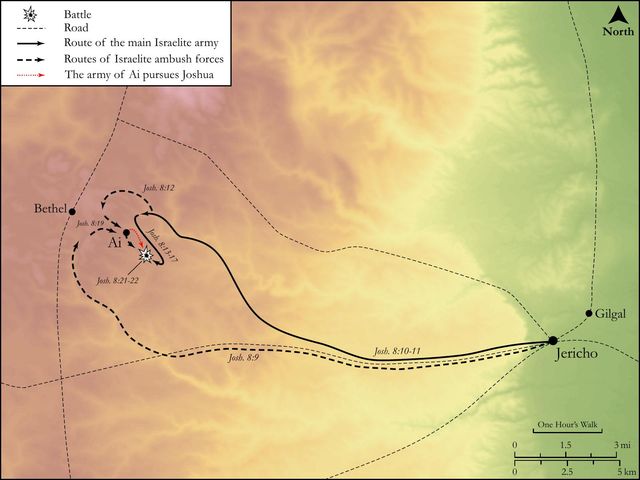
II.Yet the principal parts of the story are plain enough, that a detachment being secretly marched behind the city, on the other side to that on which the main body of the army lay (the situation of the country, it is probable, favouring their concealment), Joshua, and the forces with him, faced the city; the garrison made a vigorous sally out upon them, whereupon they withdrew, gave ground, and retreated in some seeming disorder towards the wilderness, which being perceived by the men of Ai, they drew out all the force they had to pursue them. This gave a fair opportunity for those that lay in ambush to make themselves masters of the city, whereof when they had given notice by a smoke to Joshua, he, with all his force, returned upon the pursuers, who now, when it was too late, were aware of the snare they were drawn into, and, their retreat being intercepted, they were every man of them cut off. The like artifice we find used, Jdg 20:30, etc. Now in this story we may observe,
1.What a brave commander Joshua was. See,
(1.)His conduct and prudence. God gave him the hint (v. 2) that he should lay an ambush behind the city, but left him to himself to order the particulars, which he did admirably well. Doubtless wisdom strengthens the wise more than ten mighty men, Ecc 7:19.
(2.)His care and industry (Jos 8:10): He rose up early in the morning, that he might lose no time, and to show how intent his mind was upon his business. Those that would maintain their spiritual conflicts must not love their ease.
(3.)His courage and resolution; though an army of Israelites had been repulsed before Ai, yet he resolves to lead them on in person the second time, Jos 8:5. Being himself also an elder, he took the elders of Israel with him to make this attack upon the city (Jos 8:10), as if he were going rather to sit in judgment upon them as criminals than to fight them as enemies.
(4.)His caution and consideration (Jos 8:13): He went that night into the midst of the valley, to make the necessary dispositions for an attack, and to see that every thing was in good order. It is the pious conjecture of the learned bishop Patrick that he went into the valley alone, to pray to God for a blessing upon his enterprise, and he did not seek in vain.
(5.)His constancy and perseverance; when he had stretched out his spear towards the city (Jos 8:18, a spear almost as fatal and formidable to the enemies of Israel as the rod of Moses was) he never drew back his hand till the work was done. His hands in fighting, like Moses's in interceding, were steady till the going down of the sun. Those that have stretched out their hands against their spiritual enemies must never draw them back. Lastly, What Joshua did in the stratagem is applicable to our Lord Jesus, of whom he was a type. Joshua conquered by yielding, as if he had himself been conquered; so our Lord Jesus, when he bowed his head and gave up the ghost, seemed as if death and triumphed over him, and as if he and all his interests had been routed and ruined; but in his resurrection he rallied again and gave the powers of darkness a total defeat; he broke the serpent's head, by suffering him to bruise his heel. A glorious stratagem!
2.What an obedient people Israel was. What Joshua commanded them to do, according to the commandment of the Lord (Jos 8:8), they did it without murmuring or disputing. Those that were sent to lie in ambush between Beth-el and Ai (two cities confederate against them) were in a post of danger, and had they been discovered might all have been cut off, and yet they ventured; and, when the body of the army retreated and fled, it was both disgraceful and perilous, and yet, in obedience to Joshua, they did it.
3.What an infatuated enemy the king of Ai was,
(1.)That he did not by his scouts discover those that lay in ambush behind the city, Jos 8:14. Some observe it as a remarkable instance of the power of God in making men blind to their own interest, and the things that belong to their peace, that he wist not that there were liers in wait against him. Those are most in danger who are least aware that they are so.
(2.)That when Israel seemed to fly he drew out all his forces to pursue them, and left none to guard his city and to secure his retreat, Jos 8:17. Thus the church's enemies often run themselves into destruction by their own fury and the violence of their rage against the Israel of God. Pharaoh plunged himself into the Red Sea by the eagerness with which he pursued Israel.
(3.)That from the killing of thirty-six men out of 3000, when Israel made the former attack upon his city, he should infer the total routing of so great an army as now he had to deal with (Jos 8:6): They flee before us as at the first. See how the prosperity of fools destroys them and hardens them to their ruin. God had made use of the men of Ai as a scourge to chastise his people for meddling with the accursed thing, and this had puffed them up with a conceit that they must have the honour of delivering their country from these formidable invaders; but they were soon made to see their mistake, and that when the Israelites had reconciled themselves to their God they could have no power against them. God had made use of them only for the rebuking of Israel, with a purpose, when the correction was over, to throw the rod itself into the fire; howbeit, they meant not so, but it was in their heart to destroy and cut off, Isa 10:5-7.
4.What a complete victory Israel obtained over them by the favour and blessing of God. Each did his part: the divided forces of Israel, by signals agreed on, understood one another, and every thing succeeded according to the project; so that the men of Ai, even when they were most confident of victory, found themselves surrounded, so that they had neither spirit to resist nor room to fly, but were under a fatal necessity of yielding their lives to the destroyers. And now it is hard to say whether the shouts of the men of Israel, or the shrieks of the men of Ai, were the louder, but easy to imagine what terror and confusion they were filled with, when their highest assurances sunk so suddenly into the heaviest despair. Note, The triumphing of the wicked is short, Job 20:5. They are exalted for a little while, that their fall and ruin may be the sorer, Job 24:24. See how easily, how quickly, the scale turns against those that have not God on their side.
Historical interpretation
Historical reception
3 surviving comments on this verse. Each one is dated, so this reads as a timeline rather than a list.
But another thing occurs to me in this place as I consider Jesus [Joshua] fleeing before the face of the army of Ai. Why do you think it is that Jesus [Joshua] is described as fleeing? Let us consider whether perhaps there may be something that we may conquer by fleeing, and that there is some perfect virtue in flight. Paul the apostle teaches us saying, "Flee fornication." You see therefore that there is a certain "spirit of fornication" that we ought to flee, all who wish to remain chastely and piously and modestly in Christ. Thus this flight is that which holds salvation; this flight is of power; this flight confers blessedness. And not only must the spirit of fornication be fled, but in like manner, just as it is said, "Flee fornication," let us hear it said to us: "Flee wrath, flee avarice, flee greed and envy, flee detractions and slanders." Yet I do not know if anyone may flee these things; I do not know if anyone may escape them.Such was that army of Ai that Jesus [Joshua] instructed his soldiers to flee, and perhaps concerning these things he charged his disciples, saying, "If they persecute you in this city, flee into another one; but if in that one also, flee into another." For he wants us to flee from enemies of this kind; he wants us to be put out of reach of this kind of evil. If we are able in the meantime to escape the contagions of these evils by fleeing, then, seeing the devotion and intention of our heart, all those holy powers—those perhaps about which the apostle Paul says, "Are they not all ministering spirits sent into the ministry for the sake of those who will receive the inheritance of salvation?"9—who perhaps are holy angels who, seeing us exposed to pursuing demons, rise up against those who pursue us and, striking from behind, destroy them all. For Jesus is with those who are exposed to the ones pursuing, more than with those who follow after. And justly, because Jesus loves to be with those who flee fornication, those who flee pride, those who flee deceit, and those who flee falsehood.
At first, we were overcome because of sins, and those who were living in Ai destroyed very many of us. Ai means chaos. But we know chaos to be the place or habitation of opposing powers, of which the devil is the king and chief. Against him, as Jesus [Joshua] comes, he divides the people into two parts; he stations some in the front and others in the rear, so they may come behind the enemies unexpectedly. Consider if the first part is not about the people of whom he says, "I came only to the lost sheep of the house of Israel," and of whom the apostle says, "But grace and peace to every person who does good, to the Jew first, then also to the Greek," that is, the later Gentile. Those are the people, therefore, who are stationed in the front and seem to flee with Jesus. But the people in back are the ones who are gathered from the nations and who come unexpectedly. For who expected the nations to be saved? They strike more keenly behind the adversaries, and thus both people together overthrow and conquer the throng of demons confined in the middle.
But perhaps you say to me, "In what manner are the people in front placed as though fleeing?" In a most suitable manner. For truly, those who follow Jesus seem to flee from legal burdens and precepts, from the observation of the sabbath, from the circumcision of the flesh, and from cutting the throats of enemies. But on the other hand, the one who has followed Christ, the fulfillment and fullness of the law, does not flee.
Continue studying Joshua 8:15 across the web’s major study libraries — every link below opens this exact verse, chapter, or book on the destination site.
Read & Compare
 BibleGatewayThis verse in more than 200 translations and 70 languages.
 Bible.comThe YouVersion reader — hundreds of translations, reading plans, and highlights.
 ESV.orgCrossway's official English Standard Version reader.
 NET BibleThe NET translation with 60,000+ translators' notes on every rendering decision.
 STEP BibleTyndale House's free study tool — original text, vocabulary, and scholarly resources.
 BibliaLogos Bible Software's free web reader.
 USCCBThe New American Bible (Revised Edition) with the U.S. bishops' study notes.
Commentaries
 BibleHub CommentariesDozens of classic commentaries on this verse, gathered on one page.
 StudyLightMore than 100 commentary sets — the largest collection on the web.
 BibleRefPlain-English commentary on what this verse means, verse by verse.
 Enduring WordDavid Guzik's free commentary on this chapter, widely used by Bible teachers.
 Bible Study ToolsVerse commentary alongside Greek and Hebrew study aids.
Original Language & Research
- BibleHub InterlinearThe verse word by word — original language, transliteration, and English.
- BibleHub LexiconEvery word's original-language definition and Strong's entry.
 Blue Letter BibleDeep-study tools — Strong's numbers, concordance, and word studies.
 SefariaThe Hebrew text with Rashi and centuries of Jewish commentary.
Sermons, Hymns & Audio


TrulyRandomVerse is not affiliated with these sites and doesn’t control their content. They’re linked because they’re genuinely useful.
Summary
Joshua 8:15 masterfully depicts a crucial moment in Israel's second campaign against Ai, where Joshua and the Israelite forces execute a divinely orchestrated military stratagem. This verse details their calculated feigned retreat, creating a convincing illusion of defeat to lure the men of Ai out of their fortified city and into a pre-arranged ambush, thereby setting the stage for a decisive and complete victory that reversed their initial, humiliating setback.
Context
ShowHideLiterary Context
Joshua 8:15 is strategically positioned within the narrative of Israel's conquest of Ai, immediately following God's explicit and detailed instructions to Joshua regarding the ambush strategy (Joshua 8:1-8). This verse marks the pivotal execution of the "feigned retreat" phase of that divine plan, serving as the deceptive bait. It stands in stark contrast to Israel's previous, disastrous attempt to take Ai, which is recounted in Joshua 7 and resulted in defeat due to Achan's sin and Israel's subsequent disobedience. The success of this maneuver, as described in verse 15, directly precipitates the men of Ai being drawn out of their city (Joshua 8:16-17), allowing the hidden ambush force to capture the undefended city and secure Israel's long-awaited victory, thus demonstrating God's faithfulness and Israel's renewed obedience.
Historical & Cultural Context
Warfare in the ancient Near East frequently incorporated sophisticated deceptive tactics, including ambushes and feigned retreats, as standard military maneuvers. Ai, likely a well-fortified Canaanite city, presented a significant military challenge, especially given Israel's prior failure. The "wilderness" (מִדְבָּר, midbar) mentioned here does not imply a desolate desert, but rather open, uncultivated land often used for grazing, which could also serve as a strategic direction for military movements, drawing the enemy away from their stronghold into vulnerable terrain. This battle is situated within the broader context of Israel's divinely sanctioned conquest of Canaan, understood as a holy war where Yahweh actively intervenes, provides specific military strategies, and ensures the triumph of His people when they act in obedience.
Key Themes
ShowHideThis verse powerfully illustrates several profound themes central to the book of Joshua. First, it highlights Divine Strategy and Obedience, emphasizing that the intricate battle plan was not a human invention but divinely revealed (as seen in Joshua 8:1-2), and Israel's success hinged entirely on their precise and disciplined obedience to these unconventional instructions. Second, it showcases Military Deception as a legitimate and divinely sanctioned tactic within the context of ancient warfare against hostile enemies, demonstrating that God can use such means to achieve His righteous purposes. Third, it underscores the Reversal of Fortune, transforming Israel's initial humiliating defeat at Ai into a resounding triumph, thereby emphasizing God's sovereign power to redeem past failures and turn them into victories when His people return to obedience and trust. Finally, it reinforces Joshua's Leadership, portraying him as a disciplined, faithful commander who meticulously executes God's complex and counter-intuitive plan.
Exposition and Analysis
ShowHideKey Word Analysis
ShowHideFrom the root H5060, meaning "to touch, strike, smite, plague," often implying a defeat or being struck down. In this context, the specific verbal form (Niphal, a reflexive-causative stem) suggests that they caused themselves to appear struck or feigned a defeat. This is a deliberate, strategic act of appearing vulnerable and defeated, rather than a genuine rout, crucial for understanding the calculated nature of the maneuver.
From the root H5127, meaning "to flee, escape, take flight, vanish away." While typically indicating a panicked retreat, here, in conjunction with the feigned defeat, it describes a controlled, intentional withdrawal. The flight was not born of fear or disarray but of calculated purpose, designed to draw the enemy into a pre-set trap.
From the root H4057, meaning "a pasture, open field, by implication, a desert." This refers to a specific direction, "towards the wilderness," indicating the open, uncultivated terrain away from the city. This was a strategic choice, leading the men of Ai away from their fortifications and into a position where the ambush could be sprung effectively, emphasizing the precision of the divine plan.
Verse Breakdown
ShowHide"And Joshua and all Israel"
This phrase emphasizes the unified action of the entire Israelite army under the direct, faithful command of Joshua. It highlights the collective obedience, discipline, and corporate participation required to execute such a complex and potentially risky deceptive maneuver. Joshua's leadership is central, yet the involvement of "all Israel" underscores the corporate nature of their faith and military effort, demonstrating a unified front in their pursuit of God's will.
"made as if they were beaten before them"
This is the very core of the deception. The Israelites deliberately presented themselves as a defeated and disorganized force, appearing to be in disarray, vulnerable, and fleeing in panic. This calculated act was designed to instill overconfidence in the men of Ai, prompting them to abandon their defensive positions within the city and pursue what they perceived as an easy and decisive victory, thus falling directly into the ambush.
"and fled by the way of the wilderness"
This specifies the precise direction of their feigned retreat. By fleeing towards the wilderness (open, uncultivated land), they drew the Ai defenders away from the city walls and into an open area, strategically leading them towards the location where the main ambush force was hidden. This strategic direction was absolutely crucial for the success of the overall plan, ensuring the city would be left undefended for the hidden contingent to capture.
Literary Devices
ShowHideJoshua 8:15 masterfully employs several literary devices to convey its profound meaning and impact. Irony is central to the verse, as the Israelites appear to be defeated and in flight, yet this very appearance is the calculated means by which they achieve their ultimate victory. Their "flight" is not a sign of weakness or genuine rout but a highly controlled, strategic move of strength and cunning. The verse also functions as a moment of Foreshadowing, subtly hinting at the imminent and decisive destruction of Ai, as this feigned retreat is the direct precursor to the city's fall. There is a strong Contrast with the genuine and humiliating defeat Israel suffered at Ai in Joshua 7, highlighting God's sovereign ability to reverse fortunes and transform humiliation into triumph through renewed obedience. The narrative itself is a display of Strategic Narrative, meticulously detailing the steps of a complex military operation, underscoring both the divine intelligence behind the plan and the human discipline required for its precise execution.
Theological and Thematic Connections
ShowHideJoshua 8:15 is a profound testament to God's strategic wisdom and His active, often unconventional, involvement in the affairs of His people. It demonstrates that God's ways are frequently beyond human conventional wisdom, and His plans, even when seemingly paradoxical or involving deceptive tactics in warfare, are always designed for the ultimate good and victory of His obedient people. The passage also highlights God's grace in restoring Israel after their sin at Ai; the detailed, successful strategy here contrasts sharply with the previous defeat, showing that repentance and renewed obedience lead to divine favor and triumph. The use of military deception, while raising ethical questions in modern contexts, is presented here as a divinely sanctioned tactic within the parameters of ancient warfare against a hostile enemy, distinct from interpersonal deceit or breaking covenants, and is always in service of God's overarching redemptive plan for Israel.
Reflection and Application
ShowHideJoshua 8:15 offers powerful and enduring lessons for believers today, reminding us that God's strategies for navigating our lives and overcoming challenges may often be unconventional, counter-intuitive, or even appear to be setbacks. Just as Israel had to trust God's plan, which involved appearing defeated, we are called to trust His wisdom even when our circumstances seem to contradict our hopes or logical expectations. This passage encourages us to embrace radical obedience, understanding that true victory often comes not through our strength or conventional methods, but through humble submission to God's specific, sometimes surprising, instructions. It also serves as a profound reminder that God is capable of turning our past failures and apparent defeats into glorious triumphs, provided we learn from our mistakes, repent, and recommit to His guidance. Our "wilderness" experiences or moments of "feigned retreat" might just be God's strategic maneuvers to draw out a greater, more profound victory in our lives.
Questions for Reflection
ShowHideFAQ
ShowHideWas it morally acceptable for Joshua and Israel to use deception in warfare?
ShowHideWithin the context of ancient Near Eastern warfare, and specifically in the Old Testament narrative of Israel's conquest of Canaan, strategic deception against enemy nations was not only common but also, in this instance, divinely commanded. The Bible distinguishes between deceit used against one's own people or in violation of covenants (which is condemned, e.g., Leviticus 19:11) and stratagems employed in declared warfare against hostile enemies. Here, the deception is part of a military tactic against a city that was part of the land God had promised to Israel and whose inhabitants were resisting God's purposes. The narrative presents this as a legitimate and successful military maneuver, ordained by God, to achieve victory over a formidable foe.
Why did God command such a complex plan involving deception after the seemingly simpler victory at Jericho?
ShowHideThe differing strategies for Jericho (Joshua 6) and Ai highlight God's sovereignty and His desire to teach Israel different lessons. At Jericho, the victory was achieved through a seemingly absurd, non-military act (marching around the city), emphasizing God's direct, miraculous power and Israel's need for absolute faith and obedience to His unique commands. For Ai, after Israel's sin and defeat (Joshua 7), the more elaborate, tactical plan involving an ambush and feigned retreat served several purposes: it demonstrated that victory wasn't always through overt miracles but also through God's wisdom in strategic planning; it required greater discipline and coordinated obedience from the entire army; and it underscored the importance of learning from past mistakes and following God's specific instructions for each unique challenge. It showed God's versatility in leading His people to victory and His commitment to their spiritual growth.
Christ-Centered Fulfillment
ShowHideJoshua 8:15, with its narrative of a feigned defeat leading to ultimate victory, powerfully foreshadows the paradoxical nature of Christ's triumph. Just as Joshua's army appeared to be beaten, only to draw out the enemy and secure a decisive win, so too did Jesus's death on the cross appear to be the ultimate defeat, a complete rout of God's divine plan. Yet, this seeming weakness and vulnerability was, in fact, God's supreme strategy to draw out and conquer the true enemies of humanity: sin, death, and the devil. The cross was the divine ambush, where the "prince of this world" was drawn out and decisively defeated, not by overt power, but by the "foolishness" of God's wisdom (1 Corinthians 1:25). Through His death, Jesus disarmed the spiritual forces of evil, triumphing over them by the cross (Colossians 2:15), and by His resurrection, He destroyed the one who has the power of death—that is, the devil (Hebrews 2:14-15). Thus, the "fleeing" of Israel into the wilderness, a calculated move for victory, finds its ultimate and glorious fulfillment in Christ's journey to the cross, which was the strategic path to humanity's redemption and God's eternal triumph over all His foes.