


Joshua 16:4
Bible text: King James Version (1769 Blayney text) · Public domain
Bible text: Berean Standard Bible · Public domain
Bible text: American Standard Version (1901) · Public domain
Bible text: World English Bible, Messianic edition · Public domain
Bible text: Geneva Bible (1599) · Public domain
Bible text: Young's Literal Translation · Public domain
- וַיִּנְחֲלוּvai·yin·cha·Luand they received their inheritanceH5157Conj-w ¦ V-Qal-ConsecImperf-3mpVerb Qal Consecutive Imperfect 3rd Plural Masculineוַandיִּנְחֲלוּthey received their inheritance
- בְנֵיve·nei[the] descendants ofH1121N-mpcNoun Plural Masculine Construct
- יוֹסֵףyo·SefJosephH3130N-proper-mNoun Proper Masculine
- מְנַשֶּׁהme·na·ShehManassehH4519N-proper-mNoun Proper Masculine
- וְאֶפְרָיִםve·'ef·Ra·yimand EphraimH669Conj-w ¦ N-proper-mNoun Proper MasculineוְandאֶפְרָיִםEphraim
English is a literal word-by-word gloss of the Hebrew, not the KJV's wording. Why?
This is the original text the KJV's translators worked from — each Hebrew word with its own literal English meaning in this verse, prepared by scholars at Tyndale House, Cambridge. The KJV translates whole sentences, not word by word, so its wording differs: one Hebrew word can become several English words, and the KJV may choose “the LORD” where the gloss reads “Yahweh”. Both are faithful — they answer different questions. For the KJV's own rendering, switch to the KJV text.
Details
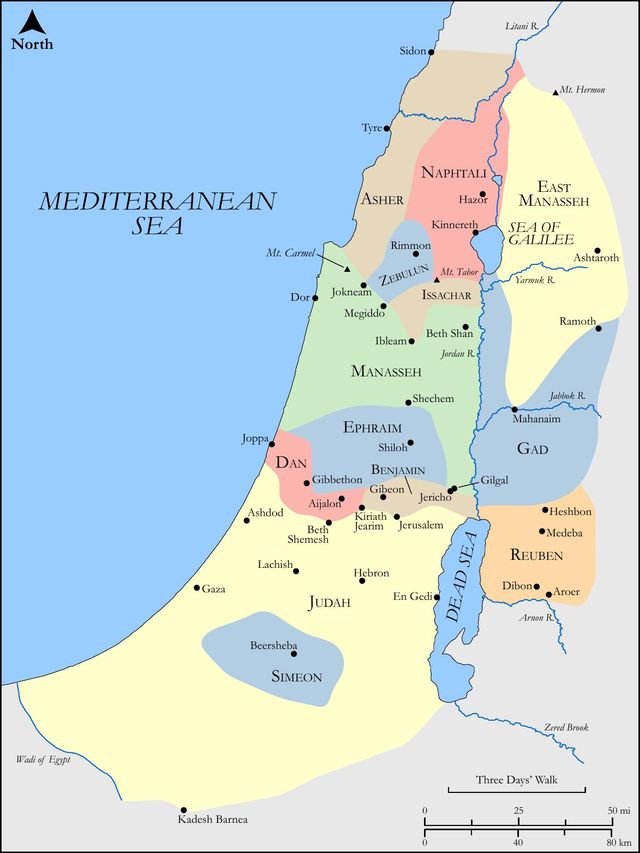
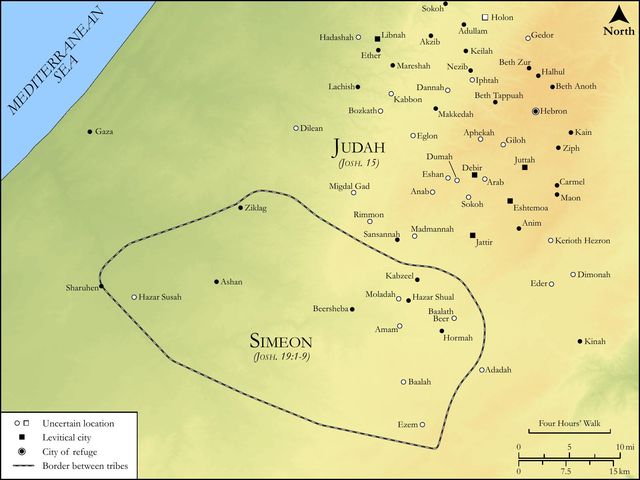
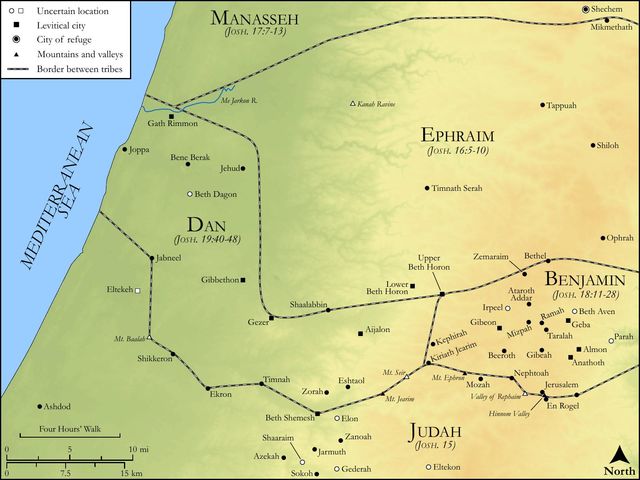
See on the biblical-era maps
Study this verse
Public-domain commentary
Matthew Henry
From his Commentary on the Whole Bible. Henry comments on passages, not single verses — this entry covers Joshua 16:1–4.
Though Joseph was one of the younger sons of Jacob, yet he was his eldest by his most just and best beloved wife Rachel, was himself his best beloved son, and had been the greatest ornament and support of his family, kept it from perishing in a time of famine, and had been the shepherd and stone of Israel, and therefore his posterity were very much favoured by the lot. Their portion lay in the very heart of the land of Canaan. It extended from Jordan in the east (Jos 16:1) to the sea, the Mediterranean Sea, in the west, so that it took up the whole breadth of Canaan from side to side; and no question the fruitfulness of the soil answered the blessings both of Jacob and Moses, Gen 49:25, Gen 49:26, and Deu 33:13, etc. The portions allotted to Ephraim and Manasseh are not so particularly described as those of the other tribes; we have only the limits and boundaries of them, not the particular cities in them, as before we had the cities of Judah and afterwards those of the other tribes. For this no reason can be assigned, unless we may suppose that Joshua being himself of the children of Joseph they referred it to him alone to distribute among them the several cities that lay within their lot, and therefore did not bring in the names of their cities to the great council of their princes who sat upon this affair, by which means it came to pass that they were not inserted with the rest in the books.
Continue studying Joshua 16:4 across the web’s major study libraries — every link below opens this exact verse, chapter, or book on the destination site.
Read & Compare
 BibleGatewayThis verse in more than 200 translations and 70 languages.
 Bible.comThe YouVersion reader — hundreds of translations, reading plans, and highlights.
 ESV.orgCrossway's official English Standard Version reader.
 NET BibleThe NET translation with 60,000+ translators' notes on every rendering decision.
 STEP BibleTyndale House's free study tool — original text, vocabulary, and scholarly resources.
 BibliaLogos Bible Software's free web reader.
 USCCBThe New American Bible (Revised Edition) with the U.S. bishops' study notes.
Commentaries
 BibleHub CommentariesDozens of classic commentaries on this verse, gathered on one page.
 StudyLightMore than 100 commentary sets — the largest collection on the web.
 BibleRefPlain-English commentary on what this verse means, verse by verse.
 Enduring WordDavid Guzik's free commentary on this chapter, widely used by Bible teachers.
 Bible Study ToolsVerse commentary alongside Greek and Hebrew study aids.
Original Language & Research
- BibleHub InterlinearThe verse word by word — original language, transliteration, and English.
- BibleHub LexiconEvery word's original-language definition and Strong's entry.
 Blue Letter BibleDeep-study tools — Strong's numbers, concordance, and word studies.
 SefariaThe Hebrew text with Rashi and centuries of Jewish commentary.
Sermons, Hymns & Audio


TrulyRandomVerse is not affiliated with these sites and doesn’t control their content. They’re linked because they’re genuinely useful.
Summary
Joshua 16:4 precisely records the pivotal moment when the descendants of Joseph, specifically the tribes of Manasseh and Ephraim, formally received their allotted territory within the Promised Land. This concise declaration marks the commencement of the detailed geographical descriptions of their inheritances, signifying the tangible fulfillment of God's ancient covenant promises regarding the land and firmly establishing the tribal identities and distinct portions for Joseph's two sons within the nascent nation of Israel.
Context
ShowHideLiterary Context
This verse is strategically placed within the extensive land distribution narrative of Joshua 13-19, which meticulously details the allocation of Canaan among the Israelite tribes following their conquest. After a general overview of unconquered territories in Joshua 13, the book transitions to specific tribal inheritances, moving from the eastern tribes to the western allotments centered at Shiloh. Joshua 16 initiates the description of the central portion designated for the "children of Joseph." Joshua 16:4 serves as a crucial introductory statement, setting the stage for the intricate boundary descriptions of Ephraim in Joshua 16:5-10 and Manasseh in Joshua 17:1-13, thereby highlighting the administrative and theological significance of this divinely ordained land distribution.
Historical & Cultural Context
The division of the land was far more than a logistical exercise; it was a profound theological act, deeply rooted in God's covenant promises to the patriarchs Abraham, Isaac, and Jacob. For ancient Israel, land was inextricably linked to their identity as God's chosen people, their security, and the tangible manifestation of divine blessing. The process of dividing the land "by lot," as recorded in Joshua 18:10, was understood as a sacred method of divine allocation, ensuring that the distribution reflected God's sovereign will rather than mere human decision-making. Culturally, the concept of "inheritance" (Hebrew: nachalah) was paramount, signifying a permanent, inalienable possession passed down through generations, underscoring the enduring nature of God's gift. The unique status of Ephraim and Manasseh, receiving a double portion as two distinct tribes from one son, Joseph, directly fulfills Jacob's prophetic blessing in Genesis 48:5-6, elevating them to the status of tribal founders alongside Jacob's direct sons.
Key Themes
ShowHideJoshua 16:4 contributes significantly to several overarching themes within the book of Joshua and the broader Old Testament narrative. Firstly, it powerfully illustrates the fulfillment of divine promise, as God's ancient pledge to give the land of Canaan to Abraham's descendants (e.g., Genesis 12:7) is tangibly realized. Secondly, the concept of inheritance and possession is central; the land is not merely conquered territory but a divinely bestowed heritage, emphasizing God's provision and the Israelites' rightful claim as His covenant people. This inheritance was foundational for their identity and a place for covenant living. Finally, the verse highlights tribal identity and unity within diversity. While the "children of Joseph" are initially grouped, the subsequent verses meticulously detail the distinct territories of Ephraim and Manasseh, affirming their individual tribal identities while acknowledging their shared lineage. This reflects the intricate organization of the twelve tribes under God's sovereign plan, each with its unique role and portion within the unified nation.
Exposition and Analysis
ShowHideKey Word Analysis
ShowHideMeaning "a son (as a builder of the family name), in the widest sense." In this context, "children of Joseph" refers collectively to his descendants, specifically his two sons, Ephraim and Manasseh, who were elevated to the status of independent tribes by Jacob (Genesis 48). This unique designation highlights their shared lineage and the special blessing bestowed upon Joseph, resulting in a "double portion" of land compared to other single tribes. It underscores their prominence and the fulfillment of patriarchal blessings.
Meaning "let him add." Joseph, the son of Jacob, held a unique and pivotal role in the patriarchal narrative, saving his family from famine and setting the stage for Israel's growth in Egypt. His two sons, Ephraim and Manasseh, were adopted by Jacob and given tribal status, ensuring Joseph's legacy would be perpetuated through two distinct, prominent tribes, thereby receiving a "double portion" of the inheritance in the Promised Land.
A primitive root meaning "to inherit (as a (figurative) mode of descent), or (generally) to occupy; causatively, to bequeath, or (generally) distribute, instate." This crucial term denotes a possession, property, or heritage, often specifically referring to land received as an enduring legacy. It carries strong theological weight, emphasizing that the land of Canaan was not merely a conquered territory or a temporary holding, but a permanent, divinely apportioned gift from God to His people. It signifies a covenantal blessing and a perpetual right of ownership, foundational to Israel's identity and future. The phrase "took their inheritance" uses a form of this root, signifying both the act of receiving and the permanent possession of the allotted land.
Verse Breakdown
ShowHide"So the children of Joseph"
This introductory phrase connects the verse to the preceding narrative of land distribution, specifically setting apart the descendants of Joseph for their unique allocation. It establishes the collective identity of Ephraim and Manasseh as a single unit for the purpose of receiving their portion of the land, emphasizing their shared patriarchal origin.
"Manasseh and Ephraim,"
This clause immediately clarifies who the "children of Joseph" are, explicitly naming the two tribes. It highlights their distinct identities despite their shared patriarchal lineage, emphasizing that each would receive its own separate, yet contiguous, territory. This reflects the fulfillment of Jacob's blessing where Ephraim, the younger, was blessed above Manasseh, the elder, receiving prominence.
"took their inheritance."
This concluding phrase succinctly states the central action and outcome of the verse. It signifies the formal and actual reception of their allotted territory. The use of "took" (derived from the root nâchal, "to inherit") implies an active engagement in possessing what was divinely given, affirming the completion of the land distribution process for these prominent tribes and the tangible fulfillment of God's promises. It underscores the secure and permanent nature of their possession.
Literary Devices
ShowHideThe conciseness of Joshua 16:4 is itself a powerful literary device, functioning as a brief, declarative statement that carries immense theological weight. It serves as a summary statement, encapsulating the culmination of a long-awaited divine promise and setting the stage for the detailed geographical descriptions that follow. The verse employs metonymy by referring to "the children of Joseph" to represent the tribes of Ephraim and Manasseh, a common biblical practice that connects the tribal identity back to its patriarchal founder. Furthermore, the declaration of "took their inheritance" acts as a form of fulfillment language, signifying the tangible realization of God's covenant faithfulness, which has been a driving narrative force since the call of Abraham. This brief verse, therefore, is packed with narrative progression and theological affirmation.
Theological and Thematic Connections
ShowHideJoshua 16:4 stands as a profound testament to God's unwavering faithfulness and the reliability of His covenant promises. The act of the "children of Joseph" taking their inheritance is the tangible manifestation of centuries of divine pledges, from the initial promise of land to Abraham to Jacob's specific blessing of Ephraim and Manasseh. This verse underscores that God is not only a promise-maker but also a promise-keeper, meticulously orchestrating events to bring His word to pass. It highlights the concept of "inheritance" not as a human achievement, but as a divine gift, a secure possession provided by a sovereign God for His people. This physical inheritance in Canaan foreshadows a greater spiritual inheritance, reminding believers that God's provisions are always sure, whether in earthly blessings or eternal realities.
Reflection and Application
ShowHideJoshua 16:4, though a historical record of land distribution, offers profound spiritual lessons for contemporary believers. It serves as a powerful reminder of God's meticulous faithfulness to His promises. Just as He diligently fulfilled His word to the Israelites by providing them with their physical inheritance, so too does He fulfill His spiritual promises to believers in Christ. This should cultivate a deep sense of trust and security in God's character. We are called to "take" our spiritual inheritance by faith, actively receiving the blessings and provisions He has prepared for us in Christ. This includes not only salvation and eternal life but also the daily strength, guidance, and peace offered by the Holy Spirit. The careful and orderly division of the land also speaks to God's precision and justice, encouraging us to trust in His perfect plan and timing for our lives, knowing that He has an inheritance prepared for us, both in this life and in eternity.
Questions for Reflection
ShowHideFAQ
ShowHideWhy are Ephraim and Manasseh referred to as "children of Joseph" and given separate inheritances, effectively creating two tribes from one son?
ShowHideThis unique arrangement stems directly from the patriarchal blessing given by Jacob (Israel) to Joseph and his two sons in Genesis 48. In this passage, Jacob formally adopts Ephraim and Manasseh as his own sons, placing them on par with Reuben and Simeon, his firstborns. This adoption meant that Joseph, through his sons, received a "double portion" of the inheritance, a privilege typically reserved for the firstborn. Consequently, instead of Joseph's descendants forming a single tribe, Ephraim and Manasseh each became distinct tribes with their own tribal identities and, as seen in Joshua 16 and Joshua 17, their own separate land allotments within the Promised Land. This fulfilled Jacob's prophetic blessing and underscored Joseph's significant role in preserving the family of Israel.
Christ-Centered Fulfillment
ShowHideWhile Joshua 16:4 describes a physical inheritance of land, its ultimate fulfillment and deeper theological significance are found in Christ. The concept of "inheritance" in the Old Testament, particularly the Promised Land, serves as a powerful type and shadow of the spiritual inheritance believers receive in Jesus. Just as the Israelites "took their inheritance" through conquest and divine decree, so too do believers "take" their inheritance in Christ, not by physical struggle, but by faith in His finished work. Jesus is the true and ultimate "Promised Land," our eternal rest and secure possession. Through His sacrificial death and resurrection, He has secured for us an "inheritance that is imperishable, undefiled, and unfading, kept in heaven for you" (1 Peter 1:4). The physical boundaries and tribal allotments in Joshua foreshadow the boundless spiritual blessings and the eternal dwelling place God prepares for His people in the new heavens and new earth (Revelation 21:1-4). Christ, as the heir of all things, grants us co-heirship with Him (Romans 8:17), transforming the earthly promise of land into the glorious reality of eternal life and communion with God Himself.