


2 Chronicles 8:5
Bible text: King James Version (1769 Blayney text) · Public domain
Bible text: Berean Standard Bible · Public domain
Bible text: American Standard Version (1901) · Public domain
Bible text: World English Bible, Messianic edition · Public domain
Bible text: Geneva Bible (1599) · Public domain
Bible text: Young's Literal Translation · Public domain
- וַיִּבֶןvai·Yi·venand he builtH1129Conj-w ¦ V-Qal-ConsecImperf-3msVerb Qal Consecutive Imperfect 3rd Singular Masculineוַandיִּבֶןhe built
- אֶת'et<obj.>H853DirObjMParticle Object Indicator
- בֵּיתbeitBethH1032N-properNoun Proper Location
- חוֹרוֹןcho·rOnHoronH1032N-properNoun Proper Location
- הָעֶלְיוֹןha·'el·Yon<the> upperH5945Art ¦ Adj-msAdjective Singular Masculine Absoluteהָ<the>עֶלְיוֹןupper
- וְאֶתve·'Etand <obj.>H853Conj-w ¦ DirObjMParticle Object Indicatorוְandאֶת<obj.>
- בֵּיתbeitBethH1032N-properNoun Proper Location
- חוֹרוֹןcho·RonHoronH1032N-properNoun Proper Location
- הַתַּחְתּוֹןha·tach·Ton<the> lowerH8481Art ¦ Adj-msAdjective Singular Masculine Absoluteהַ<the>תַּחְתּוֹןlower
- עָרֵי'a·Reicities ofH5892N-mpcNoun Plural Masculine Construct
- מָצוֹרma·TzorfortificationH4692N-msNoun Singular Masculine Absolute
- חוֹמוֹתcho·MotwallsH2346N-fpNoun Plural Feminine Absolute
- דְּלָתַיִםde·la·Ta·yimdoorsH1817N-fdNoun Dual Feminine Absolute
- וּבְרִיחַu·ve·Ri·achand bar[s]H1280Conj-w ¦ N-msNoun Singular Masculine Absoluteוּandבְרִיחַbar[s]
English is a literal word-by-word gloss of the Hebrew, not the KJV's wording. Why?
This is the original text the KJV's translators worked from — each Hebrew word with its own literal English meaning in this verse, prepared by scholars at Tyndale House, Cambridge. The KJV translates whole sentences, not word by word, so its wording differs: one Hebrew word can become several English words, and the KJV may choose “the LORD” where the gloss reads “Yahweh”. Both are faithful — they answer different questions. For the KJV's own rendering, switch to the KJV text.
Details
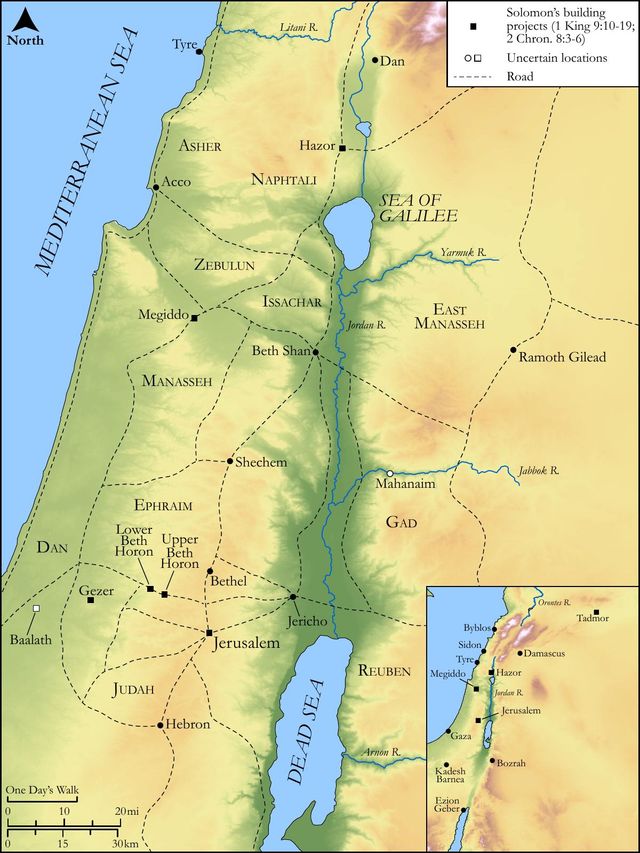
See on the biblical-era map
Study this verse
Public-domain commentary
Matthew Henry
From his Commentary on the Whole Bible. Henry comments on passages, not single verses — this entry covers 2 Chronicles 8:1–11. His two-level outline is real structure in the source text, so it is rendered as structure.
This we had Kg1 9:10-24, and therefore shall only observe here,
I.Though Solomon was a man of great learning and knowledge, yet he spent his days, not in contemplation, but in action, not in his study, but in his country, in building cities and fortifying them, in a time of peace preparing for a time of war, which is as much a man's business as it is in summer to provide food for winter.
II.As he was a man of business himself, and did not consult his own ease, so he employed a great many hands, kept abundance of people to work.
It is the interest of a state by all means possible to promote and encourage industry, and to keep its subjects from idleness. A great many strangers there were in Israel, many that remained of the Canaanites; and they were welcome to live there, but not to live and do nothing. The men of Laish, who had no business, were an easy prey to the invaders, Jdg 18:7.
III.When Solomon had begun with building the house of God, and made good work and quick work of that, he prospered in all his undertakings, so that he built all that he desired to build, Ch2 8:6. Those who have a genius for building find that one project draws on another, and the latter must amend and improve the former. Now observe,
1.How the divine providence gratified even Solomon's humour, and gave him success, not only in all that he needed to build and that it was for his advantage to build, but in all that he had a mind to build. So indulgent a Father God is sometimes to the innocent desires of his children that serve him. Thus he pleased Jacob with that promise, Joseph shall put his hand on thy eyes.
2.Solomon knew how to set bounds to his desires. He was not one of those that enlarge them endlessly, and can never be satisfied, but knew when to draw in; for he finished all he desired, and then he desired no more. He did not sit down and fret that he had not more cities to build, as Alexander did that he had not more worlds to conquer, Hab 2:5.
IV.That one reason why Solomon built a palace on purpose for the queen, and removed her and her court to it, was because he thought it by no means proper that she should dwell in the house of David (Ch2 8:11), considering that that had been a place of great piety, and perhaps her house was a place of great vanity. She was proselyted, it is likely, to the Jewish religion; but it is a question whether all her servants were. Perhaps they had among them the idols of Egypt, and a great deal of profaneness and debauchery. Now, though Solomon had not zeal and courage enough to suppress and punish what was amiss there, yet he so far consulted the honour of his father's memory that he would not suffer that place to be thus profaned where the ark of God had been and where holy David had prayed many a good prayer and sung many a sweet psalm. Not that all the places where the ark had been were so holy as never to be put to a common use; for then the houses of Abinadab and Obed-edom must have been so. But the place where it had been so long, and had been so publicly attended on, was so venerable that it was not fit to be the place of so much gaiety, not to say iniquity, as was to be found, I fear, in the court that Pharaoh's daughter kept. Note, Between things sacred and things common the ancient landmarks ought to be kept up. It was an outer-court of the temple that was the court of the women.
Continue studying 2 Chronicles 8:5 across the web’s major study libraries — every link below opens this exact verse, chapter, or book on the destination site.
Read & Compare
 BibleGatewayThis verse in more than 200 translations and 70 languages.
 Bible.comThe YouVersion reader — hundreds of translations, reading plans, and highlights.
 ESV.orgCrossway's official English Standard Version reader.
 NET BibleThe NET translation with 60,000+ translators' notes on every rendering decision.
 STEP BibleTyndale House's free study tool — original text, vocabulary, and scholarly resources.
 BibliaLogos Bible Software's free web reader.
 USCCBThe New American Bible (Revised Edition) with the U.S. bishops' study notes.
Commentaries
 BibleHub CommentariesDozens of classic commentaries on this verse, gathered on one page.
 StudyLightMore than 100 commentary sets — the largest collection on the web.
 BibleRefPlain-English commentary on what this verse means, verse by verse.
 Enduring WordDavid Guzik's free commentary on this chapter, widely used by Bible teachers.
 Bible Study ToolsVerse commentary alongside Greek and Hebrew study aids.
Original Language & Research
- BibleHub InterlinearThe verse word by word — original language, transliteration, and English.
- BibleHub LexiconEvery word's original-language definition and Strong's entry.
 Blue Letter BibleDeep-study tools — Strong's numbers, concordance, and word studies.
 SefariaThe Hebrew text with Rashi and centuries of Jewish commentary.
Sermons, Hymns & Audio


TrulyRandomVerse is not affiliated with these sites and doesn’t control their content. They’re linked because they’re genuinely useful.
Summary
Second Chronicles 8:5 meticulously records King Solomon's strategic and comprehensive building program, specifically highlighting his construction of "Bethhoron the upper, and Bethhoron the nether." These twin cities, situated at a geographically vital pass, were meticulously engineered as "fenced cities," complete with robust "walls, gates, and bars." This detailed account underscores Solomon's profound commitment to national security, his administrative foresight, and the extensive infrastructure development that characterized his reign, reflecting a period of unparalleled prosperity and divinely-granted wisdom.
Context
ShowHideLiterary Context
This verse is situated within a broader narrative in 2 Chronicles 8 that meticulously chronicles King Solomon's extensive construction projects following the completion of the magnificent Temple in Jerusalem and his own royal palace, as initially mentioned in 2 Chronicles 8:1. While earlier chapters of 2 Chronicles focus on the grand religious and royal edifices, this section shifts the chronicler's attention to Solomon's investment in the civil, commercial, and military infrastructure of his burgeoning kingdom. Verses 2 Chronicles 8:2-6 enumerate various types of cities he built or rebuilt—including store cities, chariot cities, and cities for his horsemen—demonstrating a holistic approach to national development and defense. The specific mention of Bethhoron in 2 Chronicles 8:5 highlights its particular strategic importance within this larger network of fortifications, a detail that finds a parallel account in 1 Kings 9:17-18. This transition in focus emphasizes the comprehensive nature of Solomon's reign, moving from sacred space to the secular administration and protection of his realm.
Historical & Cultural Context
The twin cities of Bethhoron (Upper and Nether) were of paramount strategic importance due to their geographical location. They were situated on a crucial ancient trade and military route, controlling a significant pass that connected the fertile coastal plain (the Shephelah) with the central highlands of Judah and Ephraim. This position made them indispensable for both defense against invasion and the facilitation of commerce. Historically, Bethhoron was a significant border city, first mentioned as part of the tribal inheritance of Ephraim in Joshua 16:3, underscoring its long-standing strategic value as a gateway. In Solomon's day, "fenced cities" (fortified cities) were fundamental to national security, serving as strongholds against invasion, centers for administrative control, and secure points for trade and population refuge. Solomon's construction of such robust defenses reflects the advanced engineering, organizational capabilities, and immense resources of his kingdom, hallmarks of his reign's prosperity and stability. The detailed mention of "walls, gates, and bars" indicates a standard, comprehensive approach to ancient urban fortification, designed to withstand siege warfare and protect vital arteries of the kingdom, ensuring its integrity and prosperity.
Key Themes
ShowHideThe construction of Bethhoron as "fenced cities" contributes significantly to several overarching themes within 2 Chronicles and the broader Solomonic narrative. Firstly, it powerfully underscores the theme of Strategic Fortification and National Security. Solomon's foresight in strengthening these vital routes and borders demonstrates a wise approach to governance and the defense of the kingdom, ensuring its safety during a period of relative peace and prosperity, aligning with the broader picture of his reign's stability. Secondly, these building projects highlight Infrastructure Development and Economic Prosperity. Beyond military defense, such extensive construction signifies a robust development of the kingdom's infrastructure, essential for economic stability, administrative control, and the overall flourishing of the nation under Solomon's leadership. This aligns with the broader picture of Solomon's immense wealth and influence described throughout 2 Chronicles 9. Finally, the ability to undertake such massive and complex construction projects speaks volumes about Solomon's God-Given Wisdom and Power. His organizational skills, the immense resources at his disposal, and his capacity for grand vision, as promised by God in 1 Kings 3:12, are vividly demonstrated through these achievements, solidifying his reign as a period of significant expansion and divine favor.
Exposition and Analysis
ShowHideKey Word Analysis
ShowHideThis primitive root (H1129) signifies the act of constructing, not merely in a physical sense but also figuratively. It implies the establishment, repair, and setting up of something. In this context, it emphasizes Solomon's active role in creating and establishing these cities, denoting a deliberate and foundational act of national development and security. The verb highlights the tangible manifestation of his administrative power and wisdom.
Derived from "house" (בַּיִת) and "hollowness" (חוֹר), this name (H1032) literally means "house of hollowness" or "house of Horon," referring to a local Canaanite deity. While the name itself has pagan origins, its use here simply identifies a specific, well-known geographical location rather than endorsing the deity. The text specifies "the upper" (H5945, ʻelyôwn, meaning "lofty" or "highest") and "the nether" (H8481, tachtôwn, meaning "bottommost" or "lowest"), indicating two distinct settlements positioned strategically on the ascent and descent of a crucial pass. Their dual mention underscores Solomon's comprehensive control over this vital corridor.
This term (H4692) signifies something that hems in, a mound (of besiegers), a siege, or, most relevantly here, a fastness or fortress. When applied to cities, it denotes a place that is fortified, besieged, or a stronghold. The use of mâtsôwr emphasizes the robust defensive capabilities and military purpose of these urban centers, indicating they were not merely settlements but strategically designed and constructed military assets intended to withstand attack.
Verse Breakdown
ShowHide"Also he built Bethhoron the upper, and Bethhoron the nether"
This opening clause clearly identifies King Solomon as the architect and executor of these significant construction projects. The specific mention of both "Bethhoron the upper" and "Bethhoron the nether" highlights the strategic importance of controlling the entire pass, from its lower approach to its higher elevation. This dual construction ensured comprehensive dominion over a critical artery of the kingdom, securing both its entry and exit points.
"fenced cities"
This phrase immediately defines the nature and primary purpose of these constructions. They were not merely residential or administrative centers, but were primarily designed as fortified strongholds. This designation underscores their role in providing defense and security for the kingdom's borders and vital trade/military routes, serving as bulwarks against potential invasion.
"with walls, gates, and bars;"
This final clause provides concrete, detailed specifications of the fortifications, illustrating the comprehensive and robust nature of the defenses Solomon implemented. "Walls" (chôwmâh) refer to the encircling defensive structures that formed the primary barrier. "Gates" (deleth) were the controlled entry and exit points, often the most vulnerable parts of a city's defense, requiring careful design. "Bars" (bᵉrîyach) were the heavy wooden or metal beams used to secure the gates from within, making them impenetrable. The enumeration of these components emphasizes the thoroughness, durability, and significant investment in making these cities secure against any conceivable threat.
Literary Devices
ShowHideThe verse employs Descriptive Language to paint a vivid and precise picture of Solomon's architectural endeavors and their defensive nature. The specific listing of "walls, gates, and bars" is a clear example of Enumeration, providing precise details that emphasize the thoroughness and strength of the fortifications. This detailed description also serves as a form of Emphasis, highlighting the strategic importance of Bethhoron and the significant resources and foresight Solomon dedicated to securing his kingdom. Furthermore, the construction of such formidable defenses can be seen as a form of Symbolism, representing the stability, power, and prosperity of Solomon's reign, which was characterized by peace and extensive building projects, contrasting with later periods of conflict. The cumulative effect of these details underscores the immense power and God-given wisdom of Solomon, capable of executing such massive and vital infrastructure projects for the well-being of his nation.
Theological and Thematic Connections
ShowHideSolomon's meticulous construction of Bethhoron as "fenced cities" speaks profoundly to the theological theme of wise stewardship and diligent preparation. Just as Solomon, endowed with divine wisdom, invested in the physical security of his kingdom, believers are called to exercise wisdom in building spiritual "strongholds" in their lives. This involves not only defending against external threats but also establishing internal structures of faith and righteousness. The emphasis on "walls, gates, and bars" can be seen as a metaphor for the spiritual disciplines and truths that protect the heart and mind from the assaults of sin, temptation, and error. God's people are called to be vigilant, building their lives on the firm foundation of His Word, trusting in His ultimate protection while actively participating in their own spiritual defense. This proactive approach to security, rooted in God-given wisdom and reliance on His strength, ensures stability and resilience in the face of life's challenges, reflecting a responsible and faithful walk.
Reflection and Application
ShowHideWhile 2 Chronicles 8:5 describes ancient fortifications, its underlying principles resonate deeply with the spiritual life of believers today. Solomon's strategic foresight in building physical defenses for his kingdom serves as a powerful reminder for us to engage in diligent and wise preparation in our own lives. Just as he secured vital routes and vulnerable points, we are called to protect the spiritual pathways of our hearts and minds. This means intentionally building "fenced cities" of faith, guarding our spiritual integrity with the "walls" of God's truth, the "gates" of discernment, and the "bars" of spiritual discipline. We must be proactive in fortifying our convictions, protecting our relationships from harmful influences, and establishing healthy boundaries against the ideologies and temptations that would seek to undermine our walk with God. This verse encourages us to invest in foundational spiritual structures—consistent prayer, diligent Scripture study, authentic fellowship, and obedient living—that provide security and stability. By doing so, we ensure that we are well-prepared to stand firm against the challenges, doubts, and spiritual attacks that inevitably arise, living out our faith with resilience and purpose.
Questions for Reflection
ShowHideFAQ
ShowHideWhy were Bethhoron the upper and nether so strategically important?
ShowHideBethhoron the upper and nether were critically important due to their unique geographical location. They were situated on the main ascent and descent of a vital pass that connected the fertile coastal plain (the Shephelah) with the central highlands of Judah and Ephraim. This pass served as a primary route for trade, communication, and military movements throughout ancient Israel. Controlling Bethhoron meant controlling access between these two significant regions. For any invading army approaching from the west, the Bethhoron pass was often the most direct and vulnerable route into the heartland of Israel. Conversely, for Israel, it was a crucial defensive choke point. By fortifying both the upper and lower sections of this pass, King Solomon ensured comprehensive control and defense of a key artery into his kingdom, protecting both his people and his economic interests. Its significance is highlighted throughout biblical history, from Joshua's decisive victory there in Joshua 10:10-11 to its role in later conflicts, demonstrating its enduring strategic value.
Christ-Centered Fulfillment
ShowHideWhile 2 Chronicles 8:5 details Solomon's construction of physical strongholds to secure his earthly kingdom, it ultimately points to a greater, spiritual fulfillment in Jesus Christ. Solomon, in his God-given wisdom, built "fenced cities" to provide security and stability for his people, yet even these formidable defenses were temporal and could eventually be breached or fall into ruin. Jesus Christ, however, is the ultimate and eternal "fenced city" for all who believe. He is our true stronghold, the unshakeable foundation upon whom we are built into a spiritual house, a holy priesthood, as described in 1 Peter 2:5. Through His finished work on the cross and His glorious resurrection, He has provided perfect and eternal security against the ultimate enemies: sin, death, and the devil. The "walls" of His righteousness, the "gates" of His boundless grace, and the "bars" of His unbreakable covenant protect those who are in Him. He is the Chief Cornerstone upon whom the entire spiritual edifice of the Church is built, and against which the "gates of hell shall not prevail" (Matthew 16:18). In Christ, believers find a refuge far more secure than any earthly fortification, a spiritual dwelling where their hearts and minds are guarded by the peace of God, which transcends all understanding (Philippians 4:7). He is the true King who builds an eternal kingdom, providing ultimate protection and an everlasting dwelling place for His redeemed people, a city whose builder and maker is God Himself (Hebrews 11:10).