


2 Chronicles 14:7
Bible text: King James Version (1769 Blayney text) · Public domain
Bible text: King James Version with Strong's numbers · Public domain
Bible text: Berean Standard Bible · Public domain
Bible text: American Standard Version (1901) · Public domain
Bible text: World English Bible, Messianic edition · Public domain
Bible text: Geneva Bible (1599) · Public domain
Bible text: Young's Literal Translation · Public domain
- וַיֹּאמֶרvai·Yo·merand he saidH559Conj-w ¦ V-Qal-ConsecImperf-3msVerb Qal Consecutive Imperfect 3rd Singular Masculineוַandיֹּאמֶרhe said
- לִיהוּדָהli·hu·Dahto JudahH3063Prep-l ¦ N-properNoun Proper LocationלִtoיהוּדָהJudah
- נִבְנֶהniv·Nehlet us buildH1129V-Qal-Imperf-1cpVerb Qal Imperfect 1st Plural common gender
- אֶת'et<obj.>H853DirObjMParticle Object Indicator
- הֶעָרִיםhe·'a·Rimthe citiesH5892Art ¦ N-mpNoun Plural Masculine Absoluteהֶtheעָרִיםcities
- הָאֵלֶּהha·'E·leh<the> theseH428Art ¦ PrtParticle Demonstrativeהָ<the>אֵלֶּהthese
- וְנָסֵבve·na·Sevand let us surround [them]H5437Conj-w ¦ V-Hiphil-ConjImperf-1cpVerb Hiphil Conjunction+Imperfect 1st Plural common genderוְandנָסֵבlet us surround [them]
- חוֹמָהcho·MahwallH2346N-fsNoun Singular Feminine Absolute
- וּמִגְדָּלִיםu·mig·da·Limand towersH4026Conj-w ¦ N-mpNoun Plural Masculine Absoluteוּandמִגְדָּלִיםtowers
- דְּלָתַיִםde·la·Ta·yimgatesH1817N-fdNoun Dual Feminine Absolute
- וּבְרִיחִיםu·ve·ri·Chimand barsH1280Conj-w ¦ N-mpNoun Plural Masculine Absoluteוּandבְרִיחִיםbars
- עוֹדֶנּוּo·De·nustill itH5750Adj-msc ¦ 3msAdjective Numerical Singular Masculine Constructעוֹדֶstillנּוּit
- הָאָרֶץha·'A·retzthe landH776Art ¦ N-fsNoun Singular Feminine Absoluteהָtheאָרֶץland
- לְפָנֵינוּle·fa·Nei·nu[is] <to> before usH6440Prep-l ¦ N-mpc ¦ 1cpNoun Plural Masculine Constructלְ[is] <to>פָנֵיbeforeנוּus
- כִּיkiforH3588PrtParticle Conditional
- דָרַשְׁנוּda·Rash·nuwe have soughtH1875V-Qal-Perf-1cpVerb Qal Perfect 1st Plural common gender
- אֶת'et<obj.>H853DirObjMParticle Object Indicator
- יְהוָהYah·wehYahwehH3068N-properNoun Proper Title
- אֱלֹהֵינוּ'e·lo·Hei·nuour GodH430N-mpc ¦ 1cpNoun Plural Masculine ConstructאֱלֹהֵיGodנוּour
- דָּרַשְׁנוּda·Rash·nuwe sought [him]H1875V-Qal-Perf-1cpVerb Qal Perfect 1st Plural common gender
- וַיָּנַחvai·Ya·nachand he has given restH5117Conj-w ¦ V-Hiphil-ConsecImperf-3msVerb Hiphil Consecutive Imperfect 3rd Singular Masculineוַandיָּנַחhe has given rest
- לָנוּLa·nuto usPrep-l ¦ 1cpSuffix Personal 1st Plural common genderלָtoנוּus
- מִסָּבִיבmi·sa·Vivfrom round aboutH5439Prep-m ¦ N-csNoun Singular common gender Absoluteמִfromסָּבִיבround about
- וַיִּבְנוּvai·yiv·Nuand they builtH1129Conj-w ¦ V-Qal-ConsecImperf-3mpVerb Qal Consecutive Imperfect 3rd Plural Masculineוַandיִּבְנוּthey built
- וַיַּצְלִיחוּvai·yatz·Li·chuand they prosperedH6743Conj-w ¦ V-Hiphil-ConsecImperf-3mpVerb Hiphil Consecutive Imperfect 3rd Plural Masculineוַandיַּצְלִיחוּthey prospered
English is a literal word-by-word gloss of the Hebrew, not the KJV's wording. Why?
This is the original text the KJV's translators worked from — each Hebrew word with its own literal English meaning in this verse, prepared by scholars at Tyndale House, Cambridge. The KJV translates whole sentences, not word by word, so its wording differs: one Hebrew word can become several English words, and the KJV may choose “the LORD” where the gloss reads “Yahweh”. Both are faithful — they answer different questions. For the KJV's own rendering, switch to the KJV text.
Details
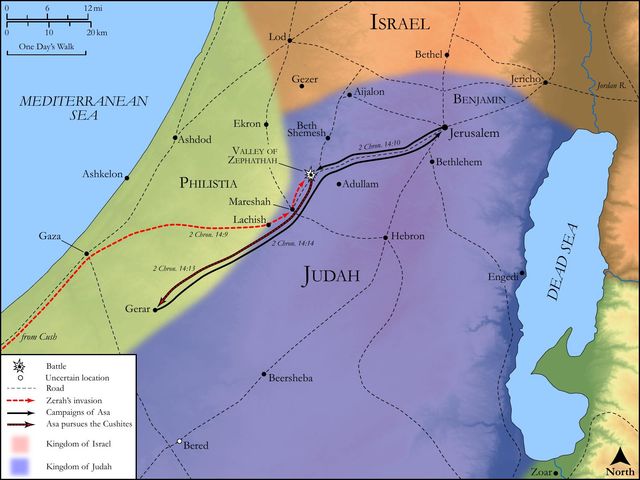
See on the biblical-era map
Study this verse
Public-domain commentary
Matthew Henry
From his Commentary on the Whole Bible. Henry comments on passages, not single verses — this entry covers 2 Chronicles 14:1–8. His four-level outline is real structure in the source text, so it is rendered as structure.
Here is, I. Asa's general character (Ch2 14:2): He did that which was good and right in the eyes of the Lord his God. 1. He aimed at pleasing God, studied to approve himself to him. Happy are those that walk by this rule, to do that which is right, not in their own eyes, or in the eye of the world, but in the eyes of God. 2. He saw God's eye always upon him, and that helped much to keep him to what was good and right. 3. God graciously accepted him in what he did, and approved his conduct as good and right.
II.A blessed work of reformation which he set on foot immediately upon his accession to the crown.
1.He removed and abolished idolatry. Since Solomon admitted idolatry, in the latter end of his reign, nothing had been done to suppress it, and so, we presume, it had got ground. Strange gods were worshipped and had their altars, images, and groves; and the temple service, though kept up by the priests (Ch2 13:10), was neglected by many of the people. Asa, as soon as he had power in his hands, made it his business to destroy all those idolatrous altars and images (Ch2 14:3, Ch2 14:5), they being a great provocation to a jealous God and a great temptation to a careless unthinking people. He hoped by destroying the idols to reform the idolaters, which he aimed at, rather than to ruin them.
2.He revived and established the pure worship of God; and, since the priests did their part in attending God's altars, he obliged the people to do theirs (Ch2 14:4): He commanded Judah to seek the Lord God of their fathers, and not the gods of the heathen, and to do the law and the commandments, that is, to observe all divine institutions, which many had utterly neglected. In doing this, the land was quiet before him, Ch2 14:5. Though they were much in love with their idols, and very loth to leave them, yet the convictions of their consciences sided with the commands of Asa, and they could not, for shame, refuse to comply with them. Note, Those that have power in their hands, and will use it vigorously for the suppression of profaneness and the reformation of manners, will not meet with so much difficulty and opposition therein as perhaps they feared. Vice is a sneaking thing, and virtue has reason enough on its side to make all iniquity stop her mouth, Psa 107:42.
III.The tranquillity of his kingdom, after constant alarms of war during the last two reigns:
In his days the land was quiet ten years ( Ch2 14:1), no war with the kingdom of Israel, who did not recover the blow given them in the last reign for a great while. Abijah's victory, which was owing, under God, to his courage and bravery, laid a foundation for Asa's peace, which was the reward of his piety and reformation. Though Abijah had little religion himself, he was instrumental to prepare the way for one that had much. If Abijah had not done what he did to quiet the land, Asa could not have done what he did to reform it; for inter arma silent leges - amidst the din of arms the voice of law is unheard.
IV.The prudent improvement he made of that tranquillity:
The land had rest, for the Lord had given him rest. Note, If God give quietness, who then can make trouble? Job 34:29. Those have rest indeed to whom God gives rest, peace indeed to whom Christ gives peace, not as the world giveth, Joh 14:27. Now,
1.Asa takes notice of the rest they had as the gift of God (He hath given us rest on every side. Note, God must be acknowledged with thankfulness in the rest we are blessed with, of body and mind, family and country), and as the reward of the reformation begun: Because we have sought the Lord our God, he has given us rest. Note, As the frowns and rebukes of Providence should be observed for a check to us in an evil way, so the smiles of Providence should be taken notice of for our encouragement in that which is good. See Hag 2:18, Hag 2:19; Mal 3:10. We find by experience that it is good to seek the Lord; it gives us rest. While we pursue the world we meet with nothing but vexation.
2.He consults with his people, by their representatives, how to make a good use of the present gleams of peace they enjoyed, and concludes with them,
(1.)That they must not be idle, but busy. Times of rest from war should be employed in work, for we must always find ourselves something to do. In the years when he had no war he said, "Let us build; still let us be doing." When the churches had rest they were built up, Act 9:31. When the sword is sheathed take up the trowel.
(2.)That they must not be secure, but prepare for wars. In times of peace we must be getting ready for trouble, expect it and lay up in store for it.
[1.]He fortified his principle cities with walls, towers, gates, and bars, Ch2 14:7. "This let us do," says he, "while the land is yet before us," that is, "while we have opportunity and advantage for it and have nothing to hinder us." He speaks as if he expected that, some way or other, trouble would arise, when it would be too late to fortify, and when they would wish they had done it. So they built and prospered.
[2.]He had a good army ready to bring into the field (Ch2 14:8), not a standing army, but the militia or trained-bands of the country. Judah and Benjamin were mustered severally; and Benjamin (which not long ago was called little Benjamin, Psa 68:27) had almost as many soldiers as Judah, came as near as 28 to 30, so strangely had that tribe increased of late. The blessing of God can make a little one to become a thousand. It should seem, these two tribes were differently armed, both offensively and defensively. The men of Judah guarded themselves with targets, the men of Benjamin with shields, the former of which were much larger than the latter, Kg1 10:16, Kg1 10:17. The men of Judah fought with spears when they closed in with the enemy; the men of Benjamin drew bows, to reach the enemy at a distance. Both did good service, and neither could say to the other, I have no need of thee. Different gifts and employments are for the common good.
Continue studying 2 Chronicles 14:7 across the web’s major study libraries — every link below opens this exact verse, chapter, or book on the destination site.
Read & Compare
 BibleGatewayThis verse in more than 200 translations and 70 languages.
 Bible.comThe YouVersion reader — hundreds of translations, reading plans, and highlights.
 ESV.orgCrossway's official English Standard Version reader.
 NET BibleThe NET translation with 60,000+ translators' notes on every rendering decision.
 STEP BibleTyndale House's free study tool — original text, vocabulary, and scholarly resources.
 BibliaLogos Bible Software's free web reader.
 USCCBThe New American Bible (Revised Edition) with the U.S. bishops' study notes.
Commentaries
 BibleHub CommentariesDozens of classic commentaries on this verse, gathered on one page.
 StudyLightMore than 100 commentary sets — the largest collection on the web.
 BibleRefPlain-English commentary on what this verse means, verse by verse.
 Enduring WordDavid Guzik's free commentary on this chapter, widely used by Bible teachers.
 Bible Study ToolsVerse commentary alongside Greek and Hebrew study aids.
Original Language & Research
- BibleHub InterlinearThe verse word by word — original language, transliteration, and English.
- BibleHub LexiconEvery word's original-language definition and Strong's entry.
 Blue Letter BibleDeep-study tools — Strong's numbers, concordance, and word studies.
 SefariaThe Hebrew text with Rashi and centuries of Jewish commentary.
Sermons, Hymns & Audio


TrulyRandomVerse is not affiliated with these sites and doesn’t control their content. They’re linked because they’re genuinely useful.
Summary
Second Chronicles 14:7 captures a profound moment in King Asa's reign, illustrating the direct correlation between Judah's earnest devotion to God, the resulting divine favor of peace, and the nation's strategic human endeavor. During a period of unprecedented tranquility, divinely granted in response to their diligent seeking of the Lord, Asa wisely seized the opportunity to fortify the kingdom's infrastructure. This verse underscores a divinely enabled prosperity, where God's gift of comprehensive rest empowered Judah to build and flourish, thereby establishing a foundational principle: faithful obedience and proactive stewardship of divine blessings lay the groundwork for both national security and holistic success.
Context
ShowHideLiterary Context
This pivotal verse is strategically placed early in King Asa's reign, specifically following a decade of remarkable peace (2 Chronicles 14:1 and 2 Chronicles 14:6). The Chronicler meticulously details Asa's initial righteous reforms in the preceding verses (2 Chronicles 14:2-5), highlighting his removal of foreign altars, high places, and Asherim, and his decree for Judah to seek the Lord God and obey His law. This comprehensive spiritual cleansing and national repentance directly precede the period of peace mentioned in 2 Chronicles 14:6, establishing a clear theological cause-and-effect relationship between covenant faithfulness and divine blessing. Verse 7 then describes Asa's prudent and proactive response to this divine gift, leveraging the peace to strengthen the kingdom's infrastructure before the significant military confrontation with Zerah the Ethiopian in 2 Chronicles 14:9ff. The Chronicler consistently emphasizes that Judah's prosperity and security were not merely a result of human strategy but a direct consequence of their unwavering covenant faithfulness.
Historical & Cultural Context
In the days of the divided kingdoms, periods of sustained peace were exceedingly rare and thus highly prized. The fortification of cities with robust walls, towers, gates, and bars was not merely a defensive measure but a critical indicator of a kingdom's strength, stability, and security. Such extensive construction projects demanded substantial resources, a large labor force, and, crucially, a stable and unthreatened environment—precisely the "rest on every side" that God provided. The idiomatic phrase "the land is yet before us" conveys a sense of opportune timing, signifying a window of vulnerability for potential adversaries and, conversely, a strategic moment for Judah to consolidate its strength without immediate external threats. This foresight was paramount for survival in an era characterized by constant inter-kingdom conflict. The concept of "rest" (Hebrew: נוּחַ, nuakh) often carried profound theological weight, signifying a divinely granted cessation from trouble, enabling flourishing and productive national activity.
Key Themes
ShowHideThe primary theme is the divine blessing of comprehensive peace as a direct reward for diligently seeking God. Asa's reign serves as a prime example of the Chronicler's overarching theological premise: faithfulness to Yahweh consistently leads to prosperity and security, while apostasy inevitably brings judgment and distress. This is a consistent message reiterated throughout the books of Chronicles and Kings. Secondly, the verse highlights prudent leadership and wise stewardship of divine favor. Asa did not squander the period of peace in complacency but strategically leveraged it for national strengthening, demonstrating a proactive faith that understands God's blessings are not for idleness but for purposeful, constructive action. This echoes the ancient wisdom found in Proverbs 6:6-8. Finally, there is the crucial theme of divine enablement of human effort. The "rest on every side" granted by God was the indispensable prerequisite for Judah's successful building endeavors. Their subsequent prosperity was not solely due to their labor but was divinely empowered and blessed, illustrating the synergistic relationship between human responsibility and divine sovereignty—a principle evident throughout biblical history, from Adam's commission in Genesis 2:15 to the New Testament's call for believers to work out their salvation with the profound understanding that God is actively working within them (Philippians 2:12-13).
Exposition and Analysis
ShowHideKey Word Analysis
ShowHideThe verb דָּרַשׁ (H1875, dârash) means to tread or frequent, and by implication, to seek or ask; specifically, to worship or inquire. Its emphatic repetition in the verse—"we have sought the LORD our God, we have sought him"—underscores the earnestness, diligence, and consistency of Judah's pursuit of God. It denotes a deliberate, active, and persistent devotion, encompassing both spiritual reformation (e.g., removing idols) and obedient adherence to His commands, rather than a passive or superficial acknowledgment.
The Hebrew word נוּחַ (H5117, nûwach) signifies more than a mere cessation of hostilities. It denotes a profound state of quietness, security, tranquility, and comprehensive peace. This "rest" implies a divine blessing that effectively removes both external threats and internal turmoil, thereby creating an environment uniquely conducive to flourishing and productive activity. It is presented as a direct gift from God, enabling the people to redirect their energies towards constructive national endeavors rather than being consumed by constant defense.
The verb צָלַח (H6743, tsâlach) means to push forward, to succeed, advance, or be profitable, indicating enablement to accomplish something. Its use here signifies that Judah's building efforts were not in vain but were remarkably fruitful and effective. This prosperity is directly linked to God's blessing and their prior diligent seeking of Him, highlighting that their endeavors were divinely favored and resulted in tangible, measurable success.
Verse Breakdown
ShowHide"Therefore he said unto Judah, Let us build these cities, and make about [them] walls, and towers, gates, and bars"
This opening clause highlights King Asa's decisive and strategic leadership. Recognizing the opportune moment of peace, he issues a clear call to action to his people. The detailed enumeration of "walls, and towers, gates, and bars" specifies the comprehensive nature of the fortifications, designed to provide robust and multi-layered defense and security for the cities. This undertaking represented a significant national project, demanding collective effort, considerable resources, and unified purpose.
"[while] the land [is] yet before us"
This idiomatic phrase powerfully conveys the sense of an open window of opportunity. It signifies that the land is currently unthreatened, and they possess the freedom and time to act without immediate hindrance or external pressure. It underscores Asa's remarkable foresight and the critical importance of seizing the moment of peace for proactive preparation, rather than succumbing to complacency or waiting for adversity to strike.
"because we have sought the LORD our God, we have sought [him], and he hath given us rest on every side"
This is the theological lynchpin of the verse, providing the explicit justification for their current state of peace and the rationale for their ambitious building project. The double emphasis on "we have sought him" profoundly highlights the earnestness, consistency, and depth of Judah's devotion to God. The "rest on every side" is unequivocally attributed to God's direct intervention and blessing, presented as a clear and tangible reward for their faithfulness. This establishes the divine enablement that serves as the prerequisite for their subsequent prosperity.
"So they built and prospered"
This concluding statement serves as a powerful affirmation of the successful outcome of their collective efforts. It confirms that their building projects were not only completed but were also accompanied by flourishing and success. This prosperity is presented as the natural, divinely ordained consequence of their diligent seeking of God and their wise, proactive utilization of the peace He provided. It validates both Asa's righteous leadership and God's unwavering faithfulness to His covenant people.
Literary Devices
ShowHideThe verse masterfully employs several literary devices to convey its profound theological and practical message. Cause and Effect is the central structural device, clearly linking Judah's diligent "seeking the LORD" to God's gift of "rest on every side," which in turn directly enables their successful "building and prospering." This narrative structure powerfully underscores the Chronicler's theological agenda, emphasizing the direct and consistent correlation between covenant faithfulness and divine blessing. The Repetition of "we have sought the LORD our God, we have sought him" serves to underscore the profound earnestness, consistency, and depth of Judah's devotion, lending significant weight to their claim for divine favor and highlighting the intentionality of their spiritual pursuit. The phrase "[while] the land [is] yet before us" functions as a potent Metaphor for an open window of opportunity or a period of unhindered action, highlighting Asa's remarkable Prudence and strategic foresight in utilizing a time of peace for proactive preparation rather than succumbing to dangerous complacency.
Theological and Thematic Connections
ShowHideThe narrative of 2 Chronicles 14:7 resonates deeply with the broader biblical understanding of God's covenant relationship with His people. It vividly illustrates that genuine seeking of God, characterized by sincere obedience and heartfelt repentance, is consistently met with divine favor, often manifesting as comprehensive peace and security. This peace is not merely the absence of conflict but a holistic well-being (shalom) that actively enables growth and flourishing. Furthermore, the verse powerfully teaches the enduring principle of wise stewardship: God's blessings are never an invitation to idleness but rather an empowerment for proactive engagement and responsible development. Asa's leadership exemplifies that true faith is not passive but actively leverages divine opportunities for the collective good of the community, recognizing that human effort, when aligned with God's will and empowered by His grace, leads to tangible and lasting success.
Reflection and Application
ShowHideSecond Chronicles 14:7 offers profound and enduring insights for contemporary believers, urging us to cultivate a life marked by earnest devotion to God and wise stewardship of the seasons He grants us. Just as Judah's period of peace and subsequent prosperity was a direct result of their diligent seeking of the Lord, so too does our spiritual tranquility, stability, and effectiveness flow from our consistent, intentional pursuit of God's presence and will. This verse challenges us to discern and identify the "rest on every side" in our own lives—those periods of relative calm, stability, or unique opportunity—and to leverage them proactively for spiritual growth, personal strengthening, and strategic preparation, rather than succumbing to spiritual or practical complacency. Whether in cultivating personal spiritual disciplines, nurturing family relationships, pursuing professional development, or engaging in community service, we are called to "build and prosper" in ways that honor God, recognizing that our efforts are blessed and made fruitful when they are rooted in Him. It serves as a potent reminder that God's blessings are not ends in themselves, but empowering gifts intended for us to be diligent and fruitful stewards of His abundant grace.
Questions for Reflection
ShowHideFAQ
ShowHideWhat does "rest on every side" mean, and how is it related to seeking God?
ShowHide"Rest on every side" (Hebrew: נוּחַ, nuakh, H5117) signifies a comprehensive state of peace, security, and tranquility, extending to all aspects of life and being free from external threats or internal turmoil. It implies a divinely granted cessation from trouble, creating an environment conducive to flourishing and productive activity. In 2 Chronicles 14:7, this rest is explicitly presented as a direct, divinely orchestrated consequence of Judah's earnest and consistent "seeking the LORD our God." This demonstrates a fundamental biblical principle: when God's people genuinely turn to Him in obedience and devotion, He often responds by removing obstacles and providing a secure, peaceful environment, enabling them to thrive and build without hindrance. This concept of divine rest is a recurring theme throughout Scripture, seen also in Joshua 21:44 and Psalm 46:1.
Does this verse imply that all prosperity is a direct result of seeking God?
ShowHideWhile 2 Chronicles 14:7 strongly links Judah's seeking God to their "rest on every side" and subsequent prosperity, it is crucial to interpret this within its specific covenantal context for ancient Israel. For the nation of Israel, there was a clear and direct covenantal promise of blessing for obedience and curses for disobedience, as detailed in passages like Deuteronomy 28. This verse beautifully exemplifies that specific covenantal principle. However, in a broader theological sense, not all prosperity in life is solely a direct result of individual righteousness, nor is all suffering a direct result of personal sin (as seen in the experiences of Job or the blind man in John 9:1-3). God's common grace extends to all humanity, and various complex factors contribute to prosperity. Nevertheless, for believers, a life committed to diligently seeking God's kingdom and righteousness (as profoundly taught by Jesus in Matthew 6:33) is indeed promised a holistic "rest" and divine provision, though not always exclusively in purely material terms. The verse primarily highlights that when God's covenant people are faithful, He often supernaturally enables their endeavors to succeed and flourish.
Christ-Centered Fulfillment
ShowHideThe "rest on every side" experienced by Judah under King Asa, though a tangible and significant blessing, was ultimately temporary and conditional, foreshadowing a far greater, eternal reality. This temporal peace finds its ultimate and comprehensive fulfillment in Jesus Christ, who is the true and eternal source of rest. He extends a gracious invitation to all who are weary and burdened, promising that in Him they will find profound rest for their souls (Matthew 11:28-30). The diligent "seeking the LORD" that characterized Judah's faithfulness under Asa is now fully realized in seeking Christ, who is the very embodiment and visible image of the invisible God (Colossians 1:15). Through His perfect atoning sacrifice on the cross, Christ has secured a peace that transcends all human understanding (Philippians 4:7), definitively reconciling us to God and breaking down the dividing wall of hostility that once separated humanity (Ephesians 2:14). The "building" undertaken by Asa's Judah, focused on physical defenses, typologically foreshadows the spiritual building of the Church, which Christ Himself promised to build upon the foundational confession of His divine identity (Matthew 16:18). We, as believers, are now living stones, actively being built into a spiritual house and a holy priesthood (1 Peter 2:5), a vibrant temple for the indwelling Holy Spirit, enabled and empowered by the presence of Christ within us. The "prosperity" of Judah in strengthening their physical defenses points to the far greater spiritual prosperity and eternal security found exclusively in Christ, who grants us abundant life (John 10:10) and equips us to participate in building His eternal kingdom, a work that will never be overthrown or diminished.