


Genesis 2:15
Bible text: King James Version (1769 Blayney text) · Public domain
Bible text: Berean Standard Bible · Public domain
Bible text: American Standard Version (1901) · Public domain
Bible text: World English Bible, Messianic edition · Public domain
Bible text: Geneva Bible (1599) · Public domain
Bible text: Young's Literal Translation · Public domain
- וַיִּקַּחvai·yi·Kachand he tookH3947Conj-w ¦ V-Qal-ConsecImperf-3msVerb Qal Consecutive Imperfect 3rd Singular Masculineוַandיִּקַּחhe took
- יְהוָהYah·wehYahwehH3068N-properNoun Proper Title
- אֱלֹהִים'E·lo·HimGodH430N-mpNoun Plural Masculine Absolute
- אֶת'et<obj.>H853DirObjMParticle Object Indicator
- הָאָדָםha·'a·Damthe manH120Art ¦ N-msNoun Singular Masculine Absoluteהָtheאָדָםman
- וַיַּנִּחֵהוּvai·ya·ni·Che·huand he put himH5117Conj-w ¦ V-Hiphil-ConsecImperf-3ms ¦ 3msVerb Hiphil Consecutive Imperfect 3rd Singular Masculineוַandיַּנִּחֵhe putהוּhim
- בְגַןve·ganin [the] garden ofH1588Prep-b ¦ N-cscNoun Singular common gender Constructבְinגַן[the] garden of
- עֵדֶן'E·denEdenH5731N-properNoun Proper Location
- לְעָבְדָהּle·'a·ve·Dahto till itH5647Prep-l ¦ V-Qal-Inf ¦ 3fsVerb Qal Infinitive Constructלְtoעָבְדָtillהּit
- וּלְשָׁמְרָהּu·le·sha·me·Rahand to keep itH8104Conj-w ¦ Prep-l ¦ V-Qal-Inf ¦ 3fsVerb Qal Infinitive Constructוּandלְtoשָׁמְרָkeepהּit
English is a literal word-by-word gloss of the Hebrew, not the KJV's wording. Why?
This is the original text the KJV's translators worked from — each Hebrew word with its own literal English meaning in this verse, prepared by scholars at Tyndale House, Cambridge. The KJV translates whole sentences, not word by word, so its wording differs: one Hebrew word can become several English words, and the KJV may choose “the LORD” where the gloss reads “Yahweh”. Both are faithful — they answer different questions. For the KJV's own rendering, switch to the KJV text.
Details
See on the biblical-era maps


Study this verse
Public-domain commentary
Matthew Henry
From his Commentary on the Whole Bible. Henry comments on passages, not single verses — this entry covers Genesis 2:8–15. His four-level outline is real structure in the source text, so it is rendered as structure.
Man consisting of body and soul, a body made out of the earth and a rational immortal soul the breath of heaven, we have, in these verses, the provision that was made for the happiness of both; he that made him took care to make him happy, if he could but have kept himself so and known when he was well off. That part of man by which he is allied to the world of sense was made happy; for he was put in the paradise of God: that part by which he is allied to the world of spirits was well provided for; for he was taken into covenant with God. Lord, what is man that he should be thus dignified - man that is a worm! Here we have,
I.A description of the garden of Eden, which was intended for the mansion and demesne of this great lord, the palace of this prince.
The inspired penman, in this history, writing for the Jews first, and calculating his narratives for the infant state of the church, describes things by their outward sensible appearances, and leaves us, by further discoveries of the divine light, to be led into the understanding of the mysteries couched under them. Spiritual things were strong meat, which they could not yet bear; but he writes to them as unto carnal, Co1 3:1. Therefore he does not so much insist upon the happiness of Adam's mind as upon that of his outward state. The Mosaic history, as well as the Mosaic law, has rather the patterns of heavenly things than the heavenly things themselves, Heb 9:23. Observe,
1.The place appointed for Adam's residence was a garden; not an ivory house nor a palace overlaid with gold, but a garden, furnished and adorned by nature, not by art. What little reason have men to be proud of stately and magnificent buildings, when it was the happiness of man in innocency that he needed none! As clothes came in with sin, so did houses. The heaven was the roof of Adam's house, and never was any roof so curiously ceiled and painted. The earth was his floor, and never was any floor so richly inlaid. The shadow of the trees was his retirement; under them were his dining-rooms, his lodging-rooms, and never were any rooms so finely hung as these: Solomon's, in all their glory, were not arrayed like them. The better we can accommodate ourselves to plain things, and the less we indulge ourselves with those artificial delights which have been invented to gratify men's pride and luxury, the nearer we approach to a state of innocency. Nature is content with a little and that which is most natural, grace with less, but lust with nothing.
2.The contrivance and furniture of this garden were the immediate work of God's wisdom and power. The Lord God planted this garden, that is, he had planted it - upon the third day, when the fruits of the earth were made. We may well suppose to have been the most accomplished place for pleasure and delight that ever the sun saw, when the all-sufficient God himself designed it to be the present happiness of his beloved creature, man, in innocency, and a type and a figure of the happiness of the chosen remnant in glory. No delights can be agreeable nor satisfying to a soul but those that God himself has provided and appointed for it; no true paradise, but of God's planting. The light of our own fires, and the sparks of our own kindling, will soon leave us in the dark, Isa 50:11. The whole earth was now a paradise compared with what it is since the fall and since the flood; the finest gardens in the world are a wilderness compared with what the whole face of the ground was before it was cursed for man's sake: yet that was not enough; God planted a garden for Adam. God's chosen ones shall have distinguishing favours shown them.
3.The situation of this garden was extremely sweet. It was in Eden, which signifies delight and pleasure. The place is here particularly pointed out by such marks and bounds as were sufficient, I suppose, when Moses wrote, to specify the place to those who knew that country; but now, it seems, the curious cannot satisfy themselves concerning it. Let it be our care to make sure a place in the heavenly paradise, and then we need not perplex ourselves with a search after the place of the earthly paradise. It is certain that, wherever it was, it had all desirable conveniences, and (which never any house nor garden on earth was) without any convenience. Beautiful for situation, the joy and the glory of the whole earth, was this garden: doubtless it was earth in its highest perfection.
4.The trees with which this garden was planted.
(1.)It had all the best and choicest trees in common with the rest of the ground. It was beautiful and adorned with every tree that, for its height or breadth, its make or colour, its leaf or flower, was pleasant to the sight and charmed the eye; it was replenished and enriched with every tree that yielded fruit grateful to the taste and useful to the body, and so good for food. God, as a tender Father, consulted not only Adam's profit, but his pleasure; for there is a pleasure consistent with innocency, nay, there is a true and transcendent pleasure in innocency. God delights in the prosperity of his servants, and would have them easy; it is owing to themselves if they be uneasy. When Providence puts us into an Eden of plenty and pleasure, we ought to serve him with joyfulness and gladness of heart, in the abundance of the good things he gives us. But,
(2.)It had two extraordinary trees peculiar to itself; on earth there were not their like.
[1.]There was the tree of life in the midst of the garden, which was not so much a memorandum to him of the fountain and author of his life, nor perhaps any natural means to preserve or prolong life; but it was chiefly intended to be a sign and seal to Adam, assuring him of the continuance of life and happiness, even to immortality and everlasting bliss, through the grace and favour of his Maker, upon condition of his perseverance in this state of innocency and obedience. Of this he might eat and live. Christ is now to us the tree of life (Rev 2:7; Rev 22:2), and the bread of life, Joh 6:48, Joh 6:53.
[2.]There was the tree of the knowledge of good and evil, so called, not because it had any virtue in it to beget or increase useful knowledge (surely then it would not have been forbidden), but, First, Because there was an express positive revelation of the will of God concerning this tree, so that by it he might know moral good and evil. What is good? It is good not to eat of this tree. What is evil? It is evil to eat of this tree. The distinction between all other moral good and evil was written in the heart of man by nature; but this, which resulted from a positive law, was written upon this tree. Secondly, Because, in the event, it proved to give Adam an experimental knowledge of good by the loss of it and of evil by the sense of it. As the covenant of grace has in it, not only Believe and be saved, but also, Believe not and be damned (Mar 16:16), so the covenant of innocency had in it, not only "Do this and live," which was sealed and confirmed by the tree of life, but, "Fail and die," which Adam was assured of by this other tree: "Touch it at your peril;" so that, in these two trees, God set before him good and evil, the blessing and the curse, Deu 30:19. These two trees were as two sacraments.
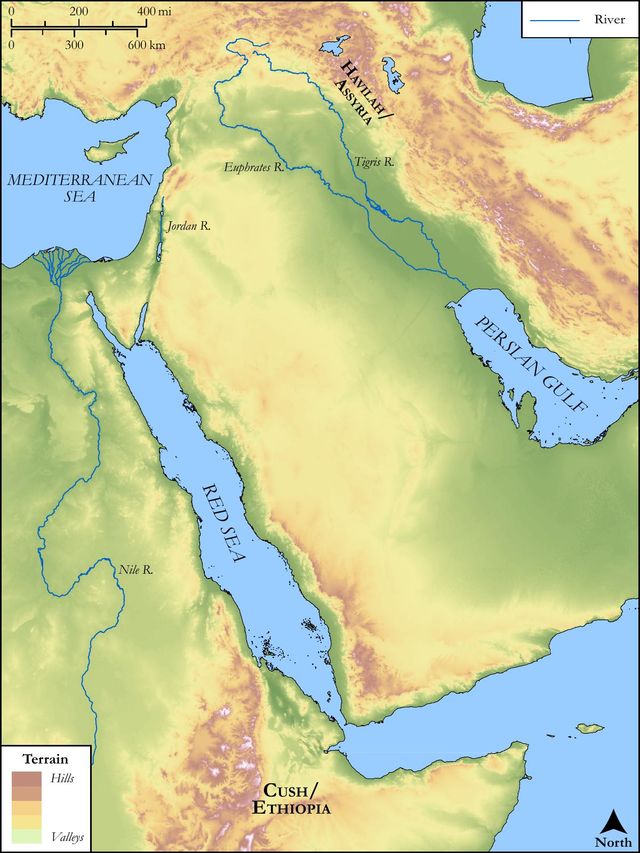
5.The rivers with which this garden was watered, Gen 2:10-14. These four rivers (or one river branched into four streams) contributed much both to the pleasantness and the fruitfulness of this garden. The land of Sodom is said to be well watered every where, as the garden of the Lord, Gen 13:10. Observe, That which God plants he will take care to keep watered. The trees of righteousness are set by the rivers, Psa 1:3. In the heavenly paradise there is a river infinitely surpassing these; for it is a river of the water of life, not coming out of Eden, as this, but proceeding out of the throne of God and of the Lamb (Rev 22:1), a river that makes glad the city of our God, Psa 46:4. Hiddekel and Euphrates are rivers of Babylon, which we read of elsewhere. By these the captive Jews sat down and wept, when they remembered Sion (Psa 137:1); but methinks they had much more reason to weep (and so have we) at the remembrance of Eden. Adam's paradise was their prison; such wretched work has sin made. Of the land of Havilah it is said (Gen 2:12), The gold of that land is good, and there is bdellium and the onyx-stone: surely this is mentioned that the wealth of which the land of Havilah boasted might be as foil to that which was the glory of the land of Eden. Havilah had gold, and spices, and precious stones; but Eden had that which was infinitely better, the tree of life, and communion with God. So we may say of the Africans and Indians: "They have the gold, but we have the gospel. The gold of their land is good, but the riches of ours are infinitely better."
II.The placing of man in this paradise of delight, Gen 2:15, where observe,
1.How God put him in possession of it: The Lord God took the man, and put him into the garden of Eden; so Gen 2:8, Gen 2:15. Note here,
(1.)Man was made out of paradise; for, after God had formed him, he put him into the garden: he was made of common clay, not of paradise-dust. He lived out of Eden before he lived in it, that he might see that all the comforts of his paradise-state were owing to God's free grace. He could not plead a tenant-right to the garden, for he was not born upon the premises, nor had any thing but what he received; all boasting was hereby for ever excluded.
(2.)The same God that was the author of his being was the author of his bliss; the same hand that made him a living soul planted the tree of life for him, and settled him by it. He that made us is alone able to make us happy; he that is the former of our bodies and the Father of our spirits, he, and none but he, can effectually provide for the felicity of both.
(3.)It adds much to the comfort of any condition if we have plainly seen God going before us and putting us into it. If we have not forced providence, but followed it, and taken the hints of direction it has given us, we may hope to find a paradise where otherwise we could not have expected it. See Psa 47:4.
2.How God appointed him business and employment. He put him there, not like Leviathan into the waters, to play therein, but to dress the garden and to keep it. Paradise itself was not a place of exemption from work. Note, here,
(1.)We were none of us sent into the world to be idle. He that made us these souls and bodies has given us something to work with; and he that gave us this earth for our habitation has made us something to work on. If a high extraction, or a great estate, or a large dominion, or perfect innocency, or a genius for pure contemplation, or a small family, could have given a man a writ of ease, Adam would not have been set to work; but he that gave us being has given us business, to serve him and our generation, and to work out our salvation: if we do not mind our business, we are unworthy of our being and maintenance.
(2.)Secular employments will vary well consist with a state of innocency and a life of communion with God. The sons and heirs of heaven, while they are here in this world, have something to do about this earth, which must have its share of their time and thoughts; and, if they do it with an eye to God, they are as truly serving him in it as when they are upon their knees.
(3.)The husbandman's calling is an ancient and honourable calling; it was needful even in paradise. The garden of Eden, though it needed not to be weeded (for thorns and thistles were not yet a nuisance), yet must be dressed and kept. Nature, even in its primitive state, left room for the improvements of art and industry. It was a calling fit for a state of innocency, making provision for life, not for lust, and giving man an opportunity of admiring the Creator and acknowledging his providence: while his hands were about his trees, his heart might be with his God.
(4.)There is a true pleasure in the business which God calls us to, and employs us in. Adam's work was so far from being an allay that it was an addition to the pleasures of paradise; he could not have been happy if he had been idle: it is still a law, He that will not work has no right to eat, Th2 3:10; Pro 27:23.
III.The command which God gave to man in innocency, and the covenant he then took him into.
Hitherto we have seen God as man's powerful Creator and his bountiful Benefactor; now he appears as his Ruler and Lawgiver. God put him into the garden of Eden, not to live there as he might list, but to be under government. As we are not allowed to be idle in this world, and to do nothing, so we are not allowed to be wilful, and do what we please. When God had given man a dominion over the creatures, he would let him know that still he himself was under the government of his Creator.
Historical interpretation
Eight Centuries of Reception
10 surviving comments on this verse. Each one is dated, so this reads as a timeline rather than a list.
Select a marker to jump to its quote. Markers stagger vertically where authors wrote within a few decades of each other.
For (the title) God, indeed, which always belonged to Him, it names at the very first: "In the beginning God created the heaven and the earth;" Genesis 1:1 and as long as He continued making, one after the other, those things of which He was to be the Lord, it merely mentions God. "And God said," "and God made," "and God saw;" but nowhere do we yet find the Lord. But when He completed the whole creation, and especially man himself, who was destined to understand His sovereignty in a way of special propriety, He then is designated Lord. Then also the Scripture added the name Lord: "And the Lord God, Deus Dominus, took the man, whom He had formed;" Genesis 2:15 "And the Lord God commanded Adam." Genesis 2:16 Thenceforth He, who was previously God only, is the Lord, from the time of His having something of which He might be the Lord. For to Himself He was always God, but to all things was He only then God, when He became also Lord. [Against Hermogenes 3]
How would God have placed what was altogether imperfect in paradise to work and guard it? For he who is capable of tending “the tree of life” and everything that God planted and caused to spring up afterwards would not reasonably be called imperfect. Perhaps, then, although he was perfect, he became imperfect in some way because of his transgression and was in need of one to perfect him from his imperfection. And the Savior was sent for these reasons.
Having spoken of Paradise and the rivers which issue from it and divide up, Scripture turns to speak of the entry of Adam into Paradise and the law which was laid down for him, as follows: "The Lord God took Adam and left him in the in the Paradise of Eden to till it [or worship Him] and keep [or guard] it." [ Gen2:15 ]
With what did he till it, seeing that he had not agricultural implements? And how would he have been able to till it, seeing that he could not have managed it himself? And what would he have to clear from it, seeing that there were no thistles or thorns there? Again, how could he have guarded it, since he could not walk right around it? And from what was he guarding it, seeing that there was no thief trying to enter it? Now the barrier which came into existence at the transgression of the commandment testified to the fact that no guard was required as long as the commandment was kept.
So Adam had nothing to keep there except for the law which was laid down for him. Nor was any work entrusted to him apart from preserving the commandment that he had been given. But should someone say that he had these two things to do as well as the commandment, I would not oppose him.
Note, now, the person who was taken and the land where he was formed. The virtue of God, therefore, took man and breathed into him, so that man's virtue will advance and increase. God set him apart in Paradise that you may know that man was taken up, that is to say, was breathed upon by the power of God. Note the fact that man was created outside Paradise, whereas woman was made within it. This teaches us that each person acquires grace by reason of virtue, not because of locality or of race. Hence, although created outside Paradise, that is, in an inferior place, man is found to be superior, whereas woman, created in a better place, that is to say, in Paradise, is found to be inferior. She was first to be deceived and was responsible for deceiving the man. Wherefore the Apostle Paul has related that holy women have in olden times been subject to the stronger vessel and recommends them to obey their husbands as their masters. [ 1 Peter 3:1 ] And Paul says: 'Adam was not deceived, but the woman was deceived and was in sin.' [ 1 Tim 2:14 ] This is a warning that no one ought to rely on himself, for she who was made for assistance needs the protection of a man. [ Gen 2:18 ] The head of the woman is man, who, while he believed that he would have the assistance of his wife, fell because of her. [ 1 Cor 11:3 ] Wherefore, no one ought to entrust himself lightly to another unless he has first put that person's virtue to the test. Neither should he claim for himself in the role of protector one whom he believes is subservient to him. Rather, a person should share his grace with another. Especially is this true of one who is in the position of greater strength and one who plays the part of protector. We have advice of the Apostle Peter, wherein he recommends that husbands pay honor to their wives: 'Husbands, in like manner, dwell with your wives considerately, paying honor to the woman as to the weaker vessel and as coheir of the grace of life that your prayers be not hindered.' [ 1 Peter 3:7 ]
Therefore man was placed in Paradise, while the woman was created in Paradise. The woman, even before she was deceived by the serpent, shared grace with a man, since she was taken from a man. Yet 'this is a great mystery,' [ Eph. 5:32 ] as the Apostle said. Wherefore he traced the source of life from it. And so Scripture refers only to man in the words: 'He placed him in the garden of Eden to till it and keep it.' [ Gen 2:15 ] The act of tilling and the act of keeping are one and the same thing. In tilling there is a certain exercise of man's virtue, while in keeping it is understood that the work is accomplished, for protection implies something completed. These two acts are required of man. In this way, it is generally assumed, man can seek after something new and may keep what he has acquired. Philo, on the other hand, limited in his interpretation of this Scriptural passage to its moral aspect, since, because of his Jewish tendencies, he did not understand its spiritual import. He maintained that the two aspects were those of tilling the fields and of protecting the home. Although, he said, Paradise did not require labor in the fields, the first man, even in Paradise, undertook a kind of toil so as to furnish a law for future ages by which to bind us to the performance and to the preservation of our bounden duty and to the function of supporting hereditary succession.[Cf. Philo, Quaestiones in Gen 1:14] Both these point of view, the moral and the spiritual, are exacted of you. The prophetic psalm instructs you regarding this: 'Unless the Lord build the house, they labor in vain that build it. Unless the Lord keep the city, they watch in vain that keepeth it.' [ Ps 126:1 ] It is obvious that the laborers are those who engage in the actual operation of building, while the watchers are those to whom the duty of protecting the perfected work is entrusted. Hence the Lord said to the Apostles, as if they were on the point of perfecting their work: 'Watch and pray that you may not enter into temptation.' [ Matt 26:41 ] By this He meant that the function of a nature that was perfected along with the grace of abundant virtue should be preserved and that no one, even one who has attained some perfection, ought to feel really secure of himself unless he remains vigilant.
TODAY AGAIN, IF you don't mind, we will continue in the direction of yesterday's sermon, and apply ourselves to the task of drawing out from there the thread of spiritual teaching for your benefit. There is, you see, great force concealed in the words read just now; we need to go into them at great depth and study them all with precision so as to reap the benefit they offer. To make a comparison with people trying to discover gems in the sea: they submit to such toil and trouble and expose themselves to the buffeting of the waves in order to light upon the object of their search. Consequently, we should apply our minds much more diligently to the task of discovering what lies concealed below the surface of the words, and thus lay hold of these valuable gems.
Don't be concerned, dearly beloved, to hear reference to depths. In this case, you see, there is no unruly surge of waves; instead, there is the grace of the Spirit shining upon our minds, making possible for us an effortless discovery of what we seek and rendering every difficulty light. So whereas, on the one hand, the discovery of those other gems brings to one who chances upon them a benefit that is not extraordinary, on the other hand, it often results in injury and proves to be the cause of countless shipwrecks: the searcher does not gain joy from the discovery to the same extent as he is afflicted by unpleasantness in his discovery on account of the glances he attracts to himself from envious onlookers, exciting the greedy to enmity against him. To this extent the discovery of that type of stone, far from simply bringing no advantage to one's life, also proves the occasion of numerous contests. It lays the groundwork for greed, you see, it stokes the furnace of cupidity and lays siege to the soul of those caught up in it. In the case of these spiritual stones of great value, on the contrary, no such problem is to be feared; instead, the wealth to be won from them is beyond telling, the pleasure from them is proof against defect and surpasses by a great margin all joy accruing to human beings from that other source.
Listen to David's words on the subject: "Your sayings are more to be desired than gold and much precious metal." [ Ps 19:10 ] Do you see how he made open reference to those materials considered more valuable than others yet was not only dissatisfied with this comparison but added the word "much" and thence he clarified for us at that point the superiority involved: "More than gold," the text says, "and much precious metal." The reason that he made reference to these substances was not for the reason that the divine sayings are to be desired to that extent alone but because he recognized that only these substances enjoy the utmost preeminence in human estimation hence by referring to them he demonstrated the superiority intended and the ardor of the desire felt for the sayings of the Spirit. So that you may learn that it is the unfailing practice of Sacred Scripture to compare the benefit that comes from it with perceptible realities and thus demonstrate the superiority of the former, listen also to what follows. He went on, at any rate, to add: "And sweeter than honey and a honeycomb." In this case, too, the reference is not for the reason that they are sweeter only to that extent, or can provide only that kind of sweetness, but because he had nothing else among material things to compare to the sweetness of the divine sayings hence by referring to them he showed again their superiority and declared the sweetness of the spiritual teachings to be greater.
You will find Christ, too, applying the same norm in the Gospels. When he was speaking to the disciples, remember, they were anxious to learn the meaning of the parable of the man sowing good seed in the field and his enemy throwing weeds in among the grain, so he explained to them the whole parable in detail, asking who was the man sowing the good seed, what was the field, what were the weeds and who scattered them, who were the harvesters and what was the harvest. When he had clarified all that for them, he then said, "Good people will be as brilliant as the sun in the kingdom of their Father" [ Matt 13:43 ] not for the reason that good people will have only that kind of brilliance, but to show that they will have much greater brilliance; he mentioned that kind because it is impossible to find a stronger image than that from among visible things. So when we hear something like that, let us not stop short at the literal level; instead, let us reason from the perceptible and visible realities to the superiority of spiritual realities in particular. Accordingly, if it is possible to discover the keener desire and the more heightened sweetness in this case (these sayings being, after all, divine and spiritual, and thus capable of prompting in the soul great spiritual joy), let us with great yearning and strong desire apply our ears to the words so that we may gain from them for ourselves true wealth and welcome many seeds that will germinate into right thinking about God, and thus make our way home.
Let us, therefore, listen to what has been read today. Keep your mind ever attentive, however, I ask you, shake off all sloth and concerns for things of this life, and thus heed the words spoken l hey are, after all, divine laws brought down from heaven for our salvation. To make a comparison: when letters are read out from our emperor, there is complete silence, all din and tumult hushed, everyone standing with eager attention and desire to hear what it is the imperial letters convey; anyone making the slightest noise or interrupting the flow of the reading runs the greatest risk.' Much more in this present case is there need to stand in fear and trembling, maintain utter silence, and rid yourselves of confusion in your thinking so that you may be able to understand what is said, while the King of heaven may accept your responsiveness and deem you worthy of greater favors.
Accordingly, let us see what blessed Moses teaches us to day also, telling us this as he does, not only by his own tongue but under the inspiration of the grace of the Spirit. He says: "The Lord God took the human being that he had formed." Right from the outset he has nicely put the two terms together: he didn't just say, "The Lord," and stop there, but added, "God," teaching us something that had escaped our notice and lain concealed in the text, so that we might realized that whether we hear "Lord" or "God" there is no difference in the names. This point, however, I am not making without reason: my purpose is that when you hear Paul saying, "There is one God the Father, from whom all things come, and one lord Jesus Christ, for whom all things exist," [ I Cor 8:6 ] you won't think there is a difference in the expressions, one referring to a greater and the other to a lesser. Hence Scripture employs these names interchangeably so that people inclined to controversy may have no encouragement to assail orthodoxy with a figment of their own imagination. That you may learn that Sacred Scripture says none of these things with distinction and discrimination in mind, notice precisely what emerges from this very sentence under consideration. "The Lord God took," it says. To whom does the heretic want this to refer? The Father alone. Very well, then. Listen to Paul's words: "There is one God the Father, from whom all things come, and one Lord Jesus Christ, for whom all things exist." Do you see how he applies the word "Lord" to the Son? So would they say the word "Lord" is greater than "God"? See how anomalous this is, and the extent of the blasphemy it provides a basis for. You see, whenever people are unwilling to take the consequences of following the norm of Sacred Scripture, wishing to make room for the vagaries of private reasoning, they upset their sense of balance and undermine the solid orthodoxy of dogmas with endless disputes and questioning.
"The Lord God took the human being that he had formed," the text says, "and placed him in the garden of delights to till it and watch over it." See the extent of the providence he employs in regard to the human being he has created. I mean, after blessed Moses taught us yesterday that, to quote him, "God planted the garden and placed in it the human creature" in other words, he wanted him to have his dwelling place there and pass his days in enjoyment of the garden today he goes on to show us God's unspeakable love manifested in his regard. Taking up this theme he says: "The Lord God took the human being he had formed and placed him in the garden of delights." He did not simply say, "In the garden," but added, "of delights," so as to reveal to us the exceeding pleasure he enjoyed from living there. And after saying, "He placed him in the garden of delights," he said, "to till it and watch over it." A mark, this, of great solicitude.
I mean, since life there was filled with every delight, was a pleasure to behold and a thrill to enjoy, he arranged accordingly that the human being should till the garden and watch over it lest he be unsettled by the exceeding indulgence ( "Idleness," Scripture says, remember, "has been the teacher of every evil" [ Sir 33:28 ] ). Well, why, do you ask, did the garden require attention by him? I'm not telling you that, but in fact God wanted him for a while to take some slight care that was appropriate in both watching and tilling. If, after all, he had been relieved of all need to work, he would have fallen a victim to great indulgence and at once have slipped into sloth; whereas in fact by performing some work that was painless and without difficulty he would be brought to a better frame of mind.
That phrase, "to watch over it," is not added idly: it is an instance of considerateness in expression to the effect that he might be fully aware that he was subject to a master who had regaled him with such enjoyment, and along with that enjoyment entrusted him with its protection. God, you see, creates everything and arranges it for our salvation, and as well as that presents us with enjoyment and relaxation. If on account of his exceeding love he prepared those ineffable goods before creating us as he himself says, "Come, you blessed of my Father, take possession of the kingdom prepared for you before the foundation of the world" [ Matt 25:34 ] much more will he provide us with everything in this world in generous measure.
(Verse 15.) And the Lord God took the man, and put him into the garden of delight. For delight, in Hebrew, it is called Eden. Therefore, the Seventy have interpreted it as delight. But Symmachus, who had just before translated it as flourishing paradise, here puts it as 'in the garden of the shore', which also signifies pleasantness and luxury.
Tilling the earth, keeping the commandments of God and fidelity to those commandments was the “labor” of God.… Just as believing in Christ is a “work,” so also was Adam’s faithful keeping of God’s command. If he touched the tree, he would die, but if he did not, he would live. “Work” was keeping the spiritual words.… The text says “work” and “protect it.” From what? There were no thieves, travelers or people with bad intentions. “Protect it” from what? From himself. Do not lose it by transgressing the command. Instead, he would preserve the commandment and in so doing preserve himself in paradise.
Although man was placed in paradise so as to work and guard it, that praiseworthy work was not toilsome. For the work in paradise is quite different from the work on the earth to which he was condemned after the sin. The addition “and to guard it” indicated the sort of work it was. For in the tranquility of the happy life, where there is no death, the only work is to guard what you possess.
The Lord God took the man whom He had formed and placed him in the paradise of pleasure, to work and keep it. What He said, to work and keep it, seems to refer to the place where it was said, And there was no man to till the ground. Truly we also, in exposing this word, let us place the words of the holy Father Augustine. "What was he to work or keep?" he said. "Did the Lord perhaps want the first man to do agriculture? Or is it not believable that He condemned him to labor before sinning? Indeed, we would think so, unless we saw some people work the land with so much delight of mind, that it would be a great punishment for them to be called away from it. Whatever delights agriculture had, then of course it was far greater, when nothing adverse happened to the land or the sky. For it was not the affliction of labor, but the exhilaration of the will, when those things which God created would thrive more joyfully and fruitfully with the help of human work, from which the Creator Himself would be more abundantly praised, who had given the reasoning and skill of working to the soul set in an animal body, as much as would suffice for a willing soul, not as much as the necessity of the body would force the unwilling." To work and keep it, he said, to keep the same paradise for himself, lest he permit anything for which he would deserve to be expelled from there. Finally, he also receives the command, so that he keeps the paradise for himself, that is, by observing it, he would not be thrown out from there. For rightly is anyone said not to have kept his property, who acted in such a way that he lost it, even if it is safe for another who either found it or deserved to receive it. There is another sense in these words, which I think should not undeservedly be put first, that God was working and keeping the man himself; just as a man works the ground, not to make it the ground, but to make it cultivated and fruitful, so God works the man whom He created as a man, so that he may be just, if the man does not depart from Him through pride. Therefore God placed the man in the paradise of pleasure, to work and keep it. He was to work, that is, to be good and blessed: and to keep it, that is, to be whole, by humbly submitting himself to His domination and protection.
In the beginning man was created with a nature inclined to work, for in paradise Adam was enjoined to till the ground and care for it, and there is in us a natural bent for work, the movement toward the good. Those who yield themselves to idleness and apathy, even though they may be spiritual and holy, hurl themselves into unnatural subjection to passions.
Continue studying Genesis 2:15 across the web’s major study libraries — every link below opens this exact verse, chapter, or book on the destination site.
Read & Compare
 BibleGatewayThis verse in more than 200 translations and 70 languages.
 Bible.comThe YouVersion reader — hundreds of translations, reading plans, and highlights.
 ESV.orgCrossway's official English Standard Version reader.
 NET BibleThe NET translation with 60,000+ translators' notes on every rendering decision.
 STEP BibleTyndale House's free study tool — original text, vocabulary, and scholarly resources.
 BibliaLogos Bible Software's free web reader.
 USCCBThe New American Bible (Revised Edition) with the U.S. bishops' study notes.
Commentaries
 BibleHub CommentariesDozens of classic commentaries on this verse, gathered on one page.
 StudyLightMore than 100 commentary sets — the largest collection on the web.
 BibleRefPlain-English commentary on what this verse means, verse by verse.
 Enduring WordDavid Guzik's free commentary on this chapter, widely used by Bible teachers.
 Bible Study ToolsVerse commentary alongside Greek and Hebrew study aids.
Original Language & Research
- BibleHub InterlinearThe verse word by word — original language, transliteration, and English.
- BibleHub LexiconEvery word's original-language definition and Strong's entry.
 Blue Letter BibleDeep-study tools — Strong's numbers, concordance, and word studies.
 SefariaThe Hebrew text with Rashi and centuries of Jewish commentary.
Sermons, Hymns & Audio


TrulyRandomVerse is not affiliated with these sites and doesn’t control their content. They’re linked because they’re genuinely useful.
Summary
Genesis 2:15 profoundly articulates humanity's original, divinely appointed purpose within God's pristine creation. It reveals that purposeful work, diligent stewardship, and active engagement were foundational elements of human flourishing even before the Fall, underscoring the inherent dignity of labor and humanity's foundational responsibility as faithful caretakers and cultivators of God's good gifts, thereby establishing a paradigm for a life of intentional activity and responsible management of creation.
Context
ShowHideLiterary Context
This pivotal verse immediately follows the detailed account of the creation of man from the dust of the ground in Genesis 2:7 and the Lord God's deliberate act of planting the Garden of Eden as a sanctuary of delight and provision in Genesis 2:8. The narrative meticulously establishes a divinely prepared environment, not as a place for passive enjoyment or idleness, but as the precise setting for humanity's initial, blessed vocation. This sequential placement underscores that God's design for humanity intrinsically included purposeful activity from the very beginning, setting the stage for the unfolding drama of human responsibility, choice, and the subsequent narrative of the Fall. The verse bridges the creation account with the subsequent commands and tests, highlighting the functional relationship between humanity and creation.
Historical & Cultural Context
In Scripture, a "garden" is first of all the place God planted for man, a setting of divine presence and provision. While not explicitly a temple, the Garden of Eden functions as a unique, sacred space where God walked and communed with man (Genesis 3:8). The idea of "dressing" and "keeping" the garden would resonate with agricultural societies, where cultivation was essential for survival and prosperity. However, unlike the arduous toil often associated with farming in arid regions, the work in Eden is presented as a joyful, unburdened task, a reflection of a perfect, unfallen world. This pre-Fall work stands in stark contrast to the cursed labor that would follow the disobedience described in Genesis 3:17-19, emphasizing a qualitative difference in the nature of work.
Key Themes
ShowHideGenesis 2:15 contributes significantly to several overarching themes within the book of Genesis and the broader biblical narrative. It firmly establishes the dignity and purpose of work as an intrinsic part of God's good creation, predating the Fall and serving as a means of human flourishing and partnership with God. Secondly, it introduces the critical theme of humanity as God's stewards, entrusted with the responsibility to care for, cultivate, and protect creation, reflecting God's own orderly and benevolent nature. This stewardship mandate is a specific application of the broader dominion given in Genesis 1:28. Thirdly, the verse highlights God's intentional design and meticulous provision for humanity, demonstrating His active involvement in placing and commissioning His creation. Finally, it subtly introduces the theme of pre-Fall responsibility and obedience, indicating that even in paradise, humanity was given a clear mandate that required faithful adherence.
Exposition and Analysis
ShowHideKey Word Analysis
ShowHideThis term refers to a human being, encompassing both the individual (Adam) and humanity as a species. Its connection to "adamah" (ground) in Genesis 2:7 emphasizes humanity's earthy origin and connection to the created order, yet here, it highlights the specific individual appointed by God for a unique task. The use of "the man" signifies the first human, the prototype for all humanity, whose initial calling sets a precedent for human purpose.
This primitive root means "to work," "to serve," "to till," or "to cultivate." In this context, it denotes active labor, cultivation, and diligent service. It implies a partnership with God in the ongoing development and maintenance of creation. This is not merely passive enjoyment but purposeful engagement, transforming and enhancing the Garden. The word's broader semantic range also includes "to serve" or "to worship," subtly hinting at the spiritual dimension of labor performed in obedience to God.
This primitive root means "to hedge about (as with thorns)," "to guard," "to protect," "to attend to," or "to preserve." This word adds a crucial dimension of protective oversight and careful management to the act of cultivation. Humanity was not merely to exploit the Garden but to safeguard its integrity, order, and original design. This implies a responsibility to maintain boundaries, prevent harm, and preserve the Garden's pristine state, foreshadowing the need to guard against external threats, including temptation.
Verse Breakdown
ShowHide"And the LORD God took the man,"
This opening phrase emphasizes divine initiative and a personal, intentional act. The combined name "LORD God" (Yahweh Elohim) highlights both God's covenantal relationship with humanity and His supreme authority as Creator. His act of "taking" (H3947, lâqach) signifies a deliberate, purposeful action, not a casual placement. It underscores God's intimate involvement and care for humanity, actively positioning Adam for his intended role.
"and put him into the garden of Eden"
This clause specifies the location of humanity's initial vocation. The Garden of Eden, a place of unparalleled beauty, abundance, and divine presence, was not merely a dwelling but a sphere of purposeful activity. The act of "putting" (H3240, yânach) implies a settling or establishing, indicating a permanent and significant placement within a perfectly provisioned environment that nonetheless required human engagement. This highlights that even in paradise, God designed humanity for active participation in His ongoing creative work.
"to dress it"
This phrase introduces the first aspect of humanity's divine commission. The Hebrew verb ʻâbad (H5647) signifies active cultivation, tilling, and working the land. This implies that the Garden, though perfect, was not static; it required human labor to maintain its beauty, enhance its productivity, and bring forth its full potential. This original command to "dress" or "cultivate" demonstrates that purposeful labor is inherent to human dignity and flourishing, a blessing rather than a burden.
"and to keep it."
This final phrase adds a crucial dimension to humanity's role. The Hebrew verb shâmar (H8104) means "to guard," "to protect," or "to preserve." This indicates a responsibility to maintain the Garden's integrity, order, and original state, safeguarding it from any potential harm or decay. It implies a watchful oversight, a stewardship that goes beyond mere cultivation to include active preservation. This "keeping" also subtly foreshadows the later command to guard the Garden from the serpent's intrusion, highlighting the protective aspect of Adam's mandate.
Literary Devices
ShowHideGenesis 2:15 is rich in its use of literary devices, primarily through its concise yet profound articulation of divine action and human purpose. The verse employs Anthropomorphism by depicting God performing human-like actions: "took the man, and put him." This device makes God's interaction with humanity relatable and emphasizes His personal, hands-on involvement in creation. Furthermore, the verse functions as a Divine Mandate or Commission, clearly outlining humanity's initial responsibilities. The pairing of "to dress it and to keep it" forms a Merism, where two distinct but complementary actions ("cultivate" and "guard") are used to express a single, comprehensive concept of responsible stewardship. This highlights the dual nature of humanity's task: active engagement in development and protective preservation. The Garden of Eden itself serves as a powerful Symbolism of God's perfect creation and the ideal environment for human flourishing under divine instruction, representing both provision and the sphere of human responsibility.
Theological and Thematic Connections
ShowHideGenesis 2:15 is foundational for understanding the biblical theology of work and stewardship. It unequivocally demonstrates that work is not a consequence of the Fall but was part of God's original, good design for humanity, intended as a blessing and a means of human flourishing and partnership with the Creator. This verse establishes humanity's fundamental role as responsible caretakers and managers of God's creation, entrusted with the task of cultivating and preserving it for His glory. It highlights God's orderly and intentional creation, where humanity is placed with clear purpose, refuting any notion of a chaotic or aimless existence. Even in a perfect world, humanity was given a clear mandate, indicating that responsibility, obedience, and active participation were foundational to the relationship between God and man before the advent of sin.
Reflection and Application
ShowHideGenesis 2:15 profoundly reshapes our understanding of work and purpose, transforming it from a mere necessity into a dignified and divine calling. It calls modern believers to view their daily labor—whether in a garden, an office, a classroom, or a home—not as a curse or an unfortunate byproduct of a fallen world, but as a sacred opportunity to participate in God's ongoing work of cultivation, care, and creativity. We are summoned to be faithful stewards of all that God has entrusted to us: our talents, resources, relationships, the environment, and even our own bodies. This verse reminds us that every act of diligent and responsible management, performed with excellence and integrity, can be a profound act of worship and a reflection of God's own creative and ordering nature. By embracing this pre-Fall mandate, we align ourselves with God's original design for humanity, finding meaning and purpose in our vocations as we contribute to the flourishing of His world.
Questions for Reflection
ShowHideFAQ
ShowHideDoes Genesis 2:15 imply that work is a consequence of the Fall?
ShowHideNo, this verse clearly demonstrates that work was part of God's original design for humanity before the Fall. The command "to dress it and to keep it" was given in a perfect, pre-sin world, indicating that work is inherently good, dignified, and a means of human flourishing. The Fall, described in Genesis 3, introduced toil, pain, and futility into labor, but not work itself. Work, in its original form, was a blessing and a joyful partnership with God.
What is the significance of the Garden of Eden in this verse?
ShowHideThe Garden of Eden is presented not merely as a passive dwelling place but as the initial sphere of humanity's purposeful activity. It was a perfectly provisioned environment, yet it required human engagement. This highlights that God designed humanity for active participation in His creation, even in paradise, emphasizing that our existence is meant to be one of intentional contribution and diligent stewardship, not idleness. The Garden served as the prototype for humanity's dominion and responsibility over the entire earth.
How does "dressing and keeping" the Garden relate to the broader "dominion mandate" in Genesis 1:28?
ShowHide"Dressing and keeping" the Garden provides a specific illustration and practical application of the broader "dominion mandate" given in Genesis 1:28. While Genesis 1:28 speaks of ruling and subduing the earth, Genesis 2:15 clarifies that this dominion is to be exercised not through exploitation or tyranny, but through diligent cultivation ('abad) and protective stewardship (shamar). Humanity is called to manage creation responsibly, ensuring its flourishing and integrity, reflecting God's own orderly and caring nature. It defines the how of dominion.
Christ-Centered Fulfillment
ShowHideWhile Genesis 2:15 establishes humanity's original, perfect vocation of work and stewardship, the Fall tragically distorted this purpose, introducing futility, toil, and ultimately, death into labor (Genesis 3:17-19). Christ, as the "Second Adam" (Romans 5:14), comes not to abolish work but to redeem and restore its original dignity and purpose. Through His redemptive work on the cross, He breaks the curse of sin, enabling believers to once again engage in labor as an act of worship and faithful stewardship, participating in His ongoing work of new creation and reconciliation (2 Corinthians 5:17-19). Jesus Himself exemplified purposeful labor and stewardship, fulfilling His Father's will (John 4:34) and ushering in a new kingdom where work is transformed by grace. Ultimately, Christ's glorious return and reign will usher in a renewed heaven and earth (Revelation 21:1), where humanity's original mandate to cultivate and keep will be perfectly fulfilled under His righteous dominion, free from the curse, as we serve and reign with Him in perfect harmony with God's design (Revelation 22:3-5).