


2 Thessalonians 3:10
- καὶkaiEvenG2532CONJConjunction
- γὰρgarforG1063CONJConjunction
- ὅτεhotewhenG3753CONJConjunction
- ἦμενēmenwe wereG1510V-IAI-1PVerb Imperfect Active Indicative 1st Plural
- πρὸςproswithG4314PREPPreposition
- ὑμᾶςhumasyouG4771P-2APPersonal pronoun Accusative 2nd Plural
- τοῦτοtoutothisG3778D-ASNDemonstrative pronoun Accusative Singular Neuter
- παρηγγέλλομενparēngellomenwe were commandingG3853V-IAI-1PVerb Imperfect Active Indicative 1st Plural
- ὑμῖνhuminyouG4771P-2DPPersonal pronoun Dative 2nd Plural
- ὅτιhotithatG3754CONJConjunction
- εἴeiifG1487CONDConjunction
- τιςtisanyoneG5100X-NSMIndefinite pronoun Nominative Singular Masculine
- οὐounotG3756PRT-NNegative Particle Negative
- θέλειtheleiis willingG2309V-PAI-3SVerb Present Active Indicative 3rd Singular
- ἐργάζεσθαιergazesthaito workG2038V-PNNVerb Present Middle Or Passive Deponent Infinitive
- μηδὲmēdeneitherG3366ADV-NAdverb or adverb and particle combined Negative
- ἐσθιέτωesthietōhe should eatG2068V-PAM-3SVerb Present Active Imperative 3rd Singular
English is a literal word-by-word gloss of the Greek, not the KJV's wording. Why?
This is the original text the KJV's translators worked from — each Greek word with its own literal English meaning in this verse, prepared by scholars at Tyndale House, Cambridge. The KJV translates whole sentences, not word by word, so its wording differs: one Greek word can become several English words, and the KJV may choose “charity” where the gloss reads “love”. Both are faithful — they answer different questions. For the KJV's own rendering, switch to the KJV text.
Details
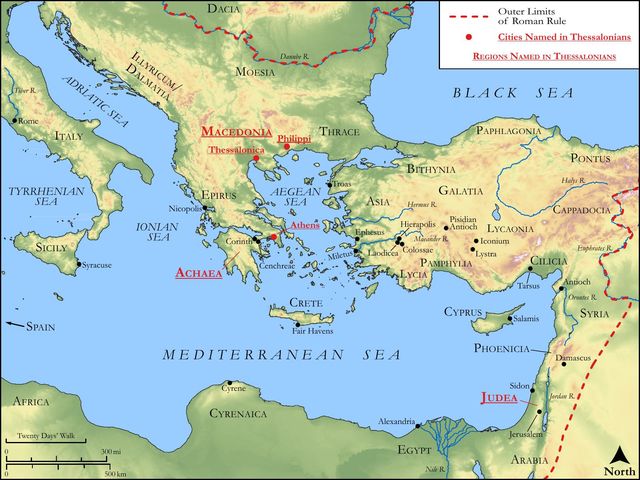
See on the biblical-era map

Study this verse
Public-domain commentary
Matthew Henry
From his Commentary on the Whole Bible. Henry comments on passages, not single verses — this entry covers 2 Thessalonians 3:6–15. His four-level outline is real structure in the source text, so it is rendered as structure.
The apostle having commended their obedience for the time past, and mentioned his confidence in their obedience for the time to come, proceeds to give them commands and directions to some who were faulty, correcting some things that were amiss among them. Observe, The best society of Christians may have some faulty persons among them, and some things that ought to be reformed. Perfection is not to be found on this side heaven: but evil manners beget good laws; the disorders that Paul heard of as existing among the Thessalonians occasioned the good laws we find in these verses, which are of constant use to us, and all others whom they may concern. Observe,
I.That which was amiss among the Thessalonians, which is expressed,
1.More generally. There were some who walked disorderly, not after the tradition they received from the apostle, Th2 3:6. Some of the brethren were guilty of this disorderly walking; they did not live regularly, nor govern themselves according to the rules of Christianity, nor agreeably to their profession of religion; not according to the precepts delivered by the apostle, which they had received, and pretended to pay a regard to. Note, It is required of those who have received the gospel, and who profess a subjection to it, that they live according to the gospel. If they do not, they are to be counted disorderly persons.
2.In particular, there were among them some idle persons and busy-bodies, Th2 3:11. This the apostle was so credibly informed of that he had sufficient reason to give commands and directions with relation to such persons, how they ought to behave, and how the church should act towards them.
(1.)There were some among them who were idle, not working at all, or doing nothing. It does not appear that they were gluttons or drunkards, but idle, and therefore disorderly people. It is not enough for any to say they do no hurt; for it is required of all persons that they do good in the places and relations in which Providence has placed them. It is probable that these persons had a notion (by misunderstanding some passages in the former epistle) concerning the near approach of the coming of Christ, which served them for a pretence to leave off the work of their callings, and live in idleness. Note, It is a great error, or abuse of religion, to make it a cloak for idleness or any other sin. If we were sure that the day of judgment were ever so near, we must, notwithstanding, do the work of the day in its day, that when our Lord comes he may find us doing. The servant who waits for the coming of his Lord aright must be working as his Lord has commanded, that all may be ready when he comes. Or, it may be, these disorderly persons pretended that the liberty wherewith Christ had made them free discharged them from the services and business of their particular callings and employments in the world: whereas they were to abide in the same calling wherein they were called of God, and therein abide with God, Co1 7:20, Co1 7:24. Industry in our particular callings as men is a duty required of us by our general calling as Christians. Or perhaps the general charity there was then among Christians to their poor brethren encouraged some to live in idleness, as knowing the church would maintain them: whatever was the cause, they were much to blame.
(2.)There were busy-bodies among them: and it should seem, by the connection, that the same persons who were idle were busy-bodies also. This may seem to be a contradiction; but so it is, that most commonly those persons who have no business of their own to do, or who neglect it, busy themselves in other men's matters. If we are idle, the devil and a corrupt heart will soon find us something to do. The mind of man is a busy thing; if it be not employed in doing good, it will be doing evil. Note, Busy-bodies are disorderly walkers, such as are guilty of vain curiosity, and impertinent meddling with things that do not concern them, and troubling themselves and others with other men's matters. The apostle warns Timothy (Ti1 5:13) to beware of such as learn to be idle, wandering about from house to house, and are not only idle, but tatlers also, and busy-bodies, speaking things which they ought not.
II.The good laws which were occasioned by these evil manners, concerning which we may take notice,
1.Whose laws they are: they are commands of the apostles of our Lord, given in the name of their Lord and ours, that is, the commands of our Lord himself. We command you, brethren, in the name of the Lord Jesus Christ, Th2 3:6. Again, We command and exhort you by our Lord Jesus Christ, Th2 3:12. The apostle uses words of authority and entreaty: and, where disorders are to be rectified or prevented, there is need of both. The authority of Christ should awe our minds to obedience, and his grace and goodness should allure us.
2.What the good laws and rules are. The apostle gives directions to the whole church, commands to those disorderly persons, and an exhortation to those in particular who did well among them.
(1.)His commands and directions to the whole church regard,
[1.]Their behaviour towards the disorderly persons who were among them, which is thus expressed (Th2 3:6), to withdraw themselves from such, and afterwards to mark that man, and have no company with him, that he may be ashamed; yet not to count him as an enemy, but to admonish him as a brother. The directions of the apostle are carefully to be observed in our conduct towards disorderly persons. We must be very cautious in church-censures and church-discipline. We must, First, Note that man who is suspected or charged with not obeying the word of God, or walking contrary thereto, that is, we must have sufficient proof of his fault before we proceed further. We must, Secondly, Admonish him in a friendly manner; we must put him in mind of his sin, and of his duty; and this should be done privately (Mat 18:15); then, if he will not hear, we must, Thirdly, Withdraw from him, and not keep company with him, that is, we must avoid familiar converse and society with such, for two reasons, namely, that we may not learn his evil ways; for he who follows vain and idle persons, and keeps company with such, is in danger of becoming like them. Another reason is for the shaming, and so the reforming, of those that offend, that when idle and disorderly persons see how their loose practices are disliked by all wise and good people they may be ashamed of them, and walk more orderly. Love therefore to the persons of our offending brethren, even when we hate their vices, should be the motive of our withdrawing from them; and even those who are under the censures of the church must not be accounted as enemies (Th2 3:15); for, if they be reclaimed and reformed by these censures, they will recover their credit and comfort, and right to church-privileges as brethren.
[2.]Their general conduct and behaviour ought to be according to the good example the apostle and those who were with him had given them: Yourselves know how you ought to follow us, Th2 3:7. Those who planted religion among them had set a good example before them; and the ministers of the gospel should be ensamples to the flock. It is the duty of Christians not only to walk according to the traditions of the apostles, and the doctrines they preached, but also according to the good example they set before them, to be followers of them so far as they were followers of Christ. The particular good example the apostle mentions was their diligence, which was so different from what was found in the disorderly walkers he takes notice of: "We behaved not ourselves disorderly among you (Th2 3:7), we did not spend our time idly, in idle visits, idle talk, idle sports." They took pains in their ministry, in preaching the gospel, and in getting their own living. Neither did we eat any man's bread for nought, Th2 3:8. Though he might justly have demanded a maintenance, because those who preach the gospel may of right expect to live by the gospel. This is a just debt that people owe to their ministers, and the apostle had power or authority to have demanded this (Th2 3:9); but he waived his right from affection to them, and for the sake of the gospel, and that he might be an example for them to follow (Th2 3:9), that they might learn how to fill up time, and always be employed in something that would turn to good account.
(2.)He commands and directs those that live idle lives to reform, and set themselves to their business. He had given commandments to this purport, as well as a good example of this, when he was among them: Even when we were with you, this we commanded you, that if any man would not work neither should he eat, Th2 3:10. It was a proverbial speech among the Jews, He who does not labour does not deserve to eat. The labourer is worthy of his meat; but what is the loiterer worthy of? It is the will of God that every man should have a calling, and mind his calling, and make a business of it, and that none should live like useless drones in the world. Such persons do what in them lies to defeat the sentence, In the sweat of thy face shalt thou eat thy bread. It was not the mere humour of the apostle, who was an active stirring man himself and therefore would have every body else to be so too, but it was the command of our Lord Jesus Christ, that with quietness we work, and eat our own bread, Th2 3:12. Men ought some way or other to earn their own living, otherwise they do not eat their own bread. Observe, There must be work or labour, in opposition to idleness; and there must be quietness, in opposition to being busy-bodies in other men's matters. We must study to be quiet, and do our own business. This is an excellent but rare composition, to be of an active yet quiet spirit, active in our own business and yet quiet as to other people's.
(3.)He exhorts those that did well not to be weary in well-doing (Th2 3:13); as if he had said, "Go on and prosper. The Lord is with you while you are with him. See that whatever you do, that is good, you persevere therein. Hold on your way, and hold out to the end. You must never give over, nor tire in your work. It will be time enough to rest when you come to heaven, that everlasting rest which remains for the people of God."
Historical interpretation
Four Centuries of Reception
12 surviving comments on this verse. Each one is dated, so this reads as a timeline rather than a list.
Select a marker to jump to its quote. Markers stagger vertically where authors wrote within a few decades of each other.
But let every one that cometh in the name of the Lord be received, and afterward ye shall prove and know him; for ye shall have understanding right and left. If he who cometh is a wayfarer, assist him as far as ye are able; but he shall not remain with you, except for two or three days, if need be. But if he willeth to abide with you, being an artisan, let him work and eat; but if he hath no trade, according to your understanding see to it that, as a Christian, he shall not live with you idle. But if he willeth not to do, he is a Christ-monger. Watch that ye keep aloof from such.
Let no one addicted to idleness eat, lest he become a wanderer about, and a whoremonger.
Let us therefore no longer keep the Sabbath after the Jewish manner, and rejoice in days of idleness; for "he that does not work, let him not eat." For say the [holy] oracles, "In the sweat of thy face shalt thou eat thy bread." But let every one of you keep the Sabbath after a spiritual manner, rejoicing in meditation on the law, not in relaxation of the body, admiring the workmanship of God, and not eating things prepared the day before, nor using lukewarm drinks, and walking within a prescribed space, nor finding delight in dancing and plaudits which have no sense in them. And after the observance of the Sabbath, let every friend of Christ keep the Lord's Day as a festival, the resurrection-day, the queen and chief of all the days [of the week]. Looking forward to this, the prophet declared, "To the end, for the eighth day," on which our life both sprang up again, and the victory over death was obtained in Christ, whom the children of perdition, the enemies of the Saviour, deny, "whose god is their belly, who mind earthly things," who are "lovers of pleasure, and not lovers of God, having a form of godliness, but denying the power thereof."
(This being then an unquestionable position, I ask) which God has the greater fight to be angry? He, as I suppose, who from the beginning of all things has given to man, as primary witnesses for the knowledge of Himself, nature in her (manifold) works, kindly providences, plagues, and indications (of His divinity), but who in spite of all this evidence has not been acknowledged; or he who has been brought out to view once for all in one only copy of the gospel-and even that without any sure authority-which actually makes no secret of proclaiming another god? Now He who has the right of inflicting the vengeance, has also sole claim to that which occasions the vengeance, I mean the Gospel; (in other words, ) both the truth and (its accompanying) salvation. The charge, that "if any would not work, neither should he eat," is in strict accordance with the precept of Him who ordered that "the mouth of the ox that treadeth out the corn should not be muzzled.
Labour therefore continually; for the blot of the slothful is not to be healed. But "if any one does not work, let not such a one eat"
Let the young persons of the church endeavor to minister diligently in all essential matters. Mind your business with all suitable seriousness, that so you may always have enough to support yourselves and those who are needy, and not burden the church of God. For we ourselves, besides our attention to the word of the gospel, do not neglect our inferior vocations. For some of us are fishermen, some tentmakers, some farmers, that so we may never be idle. So says Solomon somewhere, “Go to the ant, you sluggard; consider her ways diligently, and become wiser than she. For she, having neither field, overseer, nor ruler, prepares her food in the summer, and lays up a great store in the harvest. Or else go to the bee, and learn how laborious she is, and how valuable her work is, whose labors both kings and common men make use of for their health. The bee is desirable and glorious, though she be weak in strength, yet by honoring wisdom she is improved” … Labor therefore continually; for the blot of the slothful is not to be healed. But “if anyone among you does not work, let not such a one eat” among you. For the Lord our God hates the lazy. For no one of those who are dedicated to God ought to be idle. .
Then, too, while we were with you, we insisted on this to you
Paul not only taught with words but encouraged others by his deeds. It is the sign of a perfect teacher when he backs up his teaching with deeds. Those who learn know what they are hearing is true if they see that these things are not neglected by their teacher. Even if they know that what they are being taught is obviously true, if they see that it is ignored by their teacher, it will make little impression on his hearers, because actions speak louder than words.
that if anyone was not willing to work, neither should he eat
Whoever dines often at someone else's house is given over to idleness and must flatter the person who is feeding him, but our religion calls people to freedom. So Paul says that if someone refuses to eat then he does not have to work, because nobody can live without food, everyone should strive to live independently and in that way please God.
Therefore also the Scripture has sent the sluggard to the ant, saying, “Go to the ant, you sluggard, emulate his ways, and be wiser than he.” Are you unwilling, he means, to learn from the Scriptures, that it is good to labor, and that he who will not work neither should eat? Learn it from the irrational beasts! We do the same in our families, urging those who have erred—though they be older and considered superior—to observe thoughtful children. We say, “Note how earnest and watchful this child is, though he is younger than you.” In the same way learn from the ant the best exhortation to hard work. Marvel at your Lord, not only because he has made heaven and the sun, but because he has also made the ant. For although the ant is small, it proves the greatness of God’s wisdom. Consider, then, how prudent the ant is. Consider how God has implanted in so small a body such an unceasing desire for work! But while you learn the lesson of hard work from the ant, learn from the bee a lesson of neatness, industry and social concord! For the bee labors more for us than for herself, working every day. This is indeed a thing especially proper for a Christian, not to seek his own welfare, but the welfare of others. As, then, the bee travels across the meadows that she may prepare a banquet for another, so also O man, you do likewise. And if you have accumulated wealth, spend it on others. If you have the ability to teach, do not bury the talent, but bring it out publicly for the sake of those who need it! Or if you have any other advantage, become useful to those who reap the benefit of your labors.
"For even when we were with you, this we commanded you, If any will not work, neither let him eat."
See how in the former Epistle indeed he discourses somewhat more mildly concerning these things; as when he says, "We beseech you, brethren,-that ye would abound more and more-and that ye study"-and nowhere does he say, "we command," nor "in the Name of our Lord Jesus Christ," which was fearful and implied danger, but that "ye abound," he says, and "study," which are the words of one exhorting to virtue; "that ye may walk honestly" (becomingly), he says. But here is nothing of this kind, but "if any one will not work," says he, "neither let him eat." For if Paul, not being under a necessity, and having a right to be idle, and having undertaken so great a work, did nevertheless work, and not merely work, but "night and day," so that he was able even to assist others,-much more ought others to do this.
I do not say these things haphazardly now, but rather because many are often overly intrusive in their investigation of the needy. They examine their lineage, life, habits, vocation and the vigor of their body. They make complaints and demand immense public scrutiny for their health. For this precise reason, many of the poor simulate physical disabilities, so that by dramatizing their misfortunes they may deflect our cruelty and inhumanity. And although when it is summertime, it is terrible to make these complaints, it is not quite so dreadful. However, during the frost and the cold, for someone to become such a savage and inhuman judge and not impart any forgiveness to the unemployed, does this not involve extreme cruelty? “Therefore, what did Paul ordain by law,” they say, “when he said to the Thessalonians, ‘If any one does not wish to work, neither let him eat’?” So that you, too, may also hear these things, you should discuss the words of Paul not only with the poor individual but even with yourself. For the laws of Paul are laid down not only for the poor but also for all. Let me say something burdensome and grievous. I know that you will grow angry. Nevertheless, I will say it; for I do not say it to strike you but to correct you. We criticize them for their laziness, something which is worthy of forgiveness for the most part. However, we too often do things which are even more grievous than any laziness.… Therefore, when you say, “What then shall we say to Paul?” converse with yourself, too, and say these things not only to the poor. Read not only the threat of punishment but also Paul’s admonition to forgiveness, for the one who said, “If anyone does not wish to work, neither let him eat,” added, “And you, brothers, do not lose heart in doing good.”
In the first place, we must prove that the blessed apostle Paul wished the servants of God to perform manual labor which would merit a great spiritual reward, and to do this without seeking food and clothing from anybody but to procure these commodities for themselves by their own work. Secondly, we must show that those gospel precepts by which some monks justify not only laziness but even arrogance are not contrary to the direction and example of the apostle. Let us examine the statements made by the apostle prior to this one: “If any man will not work, neither let him eat,” and the statements which follow it, so that the meaning which St. Paul intended may be gathered from the setting of the passage. What can be said in reply to this, since, indeed, by his own example he taught what he commanded, lest later someone might be permitted to interpret this with a view to his will and not his charity. For, the Lord had directed that apostle, as preacher of the gospel, as soldier of Christ, as planter of the vineyard, as shepherd of the flock, to live by the Gospel; nevertheless, St. Paul did not accept the payment due him in order to give example to those who wished to exact unmerited compensation.
We read in sacred Scripture, dearly beloved, that a holy understanding should keep those who are concerned about their soul’s salvation, as the divine Word puts it, “Holy understanding shall protect you.” If such holy understanding keeps a soul, that which is unholy not only fails to keep it but even kills it. Perhaps someone says, “Who can always be thinking of God and eternal bliss, since all men must be concerned about food, clothing and the management of their household?” God does not ask us to be free from all anxiety over the present life, for he instructs us through his apostle, “If any man will not work, neither let him eat.” The same apostle repeats the idea with reference to himself when he says, “We worked night and day so that we might not burden any of you.” Since God especially advises reasonable concern for food and clothing, so long as avarice and ambition … are not linked with it, an ordinary action or thought can be most rightly considered holy. The only provision is that those preoccupations should not be so excessive that they do not allow us to have time for God, according to the words, “The burdens of the world have made them miserable.”
Continue studying 2 Thessalonians 3:10 across the web’s major study libraries — every link below opens this exact verse, chapter, or book on the destination site.
Read & Compare
 BibleGatewayThis verse in more than 200 translations and 70 languages.
 Bible.comThe YouVersion reader — hundreds of translations, reading plans, and highlights.
 ESV.orgCrossway's official English Standard Version reader.
 NET BibleThe NET translation with 60,000+ translators' notes on every rendering decision.
 STEP BibleTyndale House's free study tool — original text, vocabulary, and scholarly resources.
 BibliaLogos Bible Software's free web reader.
 USCCBThe New American Bible (Revised Edition) with the U.S. bishops' study notes.
Commentaries
 BibleHub CommentariesDozens of classic commentaries on this verse, gathered on one page.
 StudyLightMore than 100 commentary sets — the largest collection on the web.
 BibleRefPlain-English commentary on what this verse means, verse by verse.
 Enduring WordDavid Guzik's free commentary on this chapter, widely used by Bible teachers.
 Bible Study ToolsVerse commentary alongside Greek and Hebrew study aids.
Original Language & Research
- BibleHub InterlinearThe verse word by word — original language, transliteration, and English.
- BibleHub LexiconEvery word's original-language definition and Strong's entry.
 Blue Letter BibleDeep-study tools — Strong's numbers, concordance, and word studies.
 CNTR CollationThe earliest Greek manuscripts of this verse, collated letter by letter.
Sermons, Hymns & Audio


TrulyRandomVerse is not affiliated with these sites and doesn’t control their content. They’re linked because they’re genuinely useful.
Summary
The Apostle Paul reiterates a foundational principle for Christian communal life and individual responsibility: a direct command that those who are able but unwilling to work should not be supported by the community. This stern directive underscores the importance of diligence, self-sufficiency, and orderly conduct within the early church, addressing issues of idleness and dependency that threatened the integrity and witness of the Thessalonian believers.
Context
ShowHideLiterary Context
This verse is situated within Paul's concluding instructions and exhortations to the Thessalonian church in his second letter. Chapters 1 and 2 address eschatological themes, correcting misunderstandings about the Day of the Lord that had potentially led some to cease working. Chapter 3 then shifts to practical matters of Christian living, emphasizing prayer, the integrity of Paul's ministry, and the need for discipline among disorderly members. Specifically, 2 Thessalonians 3:6 introduces the call to "keep away from every brother who is idle and disorderly," setting the stage for the specific command in verse 10. Paul reinforces his own example of diligent labor in 2 Thessalonians 3:7-9, demonstrating that he did not impose a burden on them, thereby lending moral authority to his directive. The immediate follow-up in 2 Thessalonians 3:11-12 further clarifies that the "idle and disorderly" were not merely unproductive but also "busybodies," interfering in others' affairs, which this command aims to rectify.
Historical & Cultural Context
In the Greco-Roman world, manual labor was often associated with slaves and the lower classes, with a prevailing disdain for physical work among the elite. However, Jewish tradition, from which Christianity emerged, held a more positive view of labor, seeing it as a dignified and God-given activity, stemming from the creation mandate in Genesis 2:15. The early Christian communities, often composed of various social strata, faced unique challenges. In Thessalonica, some believers, perhaps fueled by an overzealous expectation of Christ's imminent return (as discussed in 2 Thessalonians 2), had abandoned their daily occupations, believing that the end was so near that work was unnecessary. This eschatological enthusiasm, combined with potential cultural influences or simple laziness, led to idleness and dependency on the community, creating social and economic strain. Paul, a tentmaker by trade (Acts 18:3), consistently modeled and taught the importance of honest labor, as seen in 1 Thessalonians 2:9 and Acts 20:34-35.
Key Themes
ShowHideThis verse powerfully contributes to several overarching themes in Paul's letters and the broader biblical narrative. Firstly, it underscores the theme of Diligence and Responsibility, emphasizing that God designed humanity for productive labor and that each individual has a responsibility to contribute to their own sustenance and the well-being of the community. Secondly, it speaks to the theme of Order in the Community, highlighting that a healthy and thriving church body requires each member to fulfill their duties, preventing disorder, dependency, and the potential for gossip or interference, as implied in 2 Thessalonians 3:11. Thirdly, the command makes a crucial Distinction between Willful Idleness and Genuine Need. The target of Paul's directive is those who "would not work"—a deliberate refusal—not those genuinely unable due to illness, disability, age, or lack of opportunity. The Bible consistently champions compassion and support for the truly vulnerable, as seen in passages like Galatians 6:10 and James 1:27. Finally, the severe consequence of "neither should he eat" highlights the Consequences of Idleness, serving as a stark reminder of the direct link between labor and sustenance, a principle echoed throughout wisdom literature, such as in Proverbs 6:6-11.
Exposition and Analysis
ShowHideKey Word Analysis
ShowHideThis verb signifies a deliberate choice, a will, or a desire. It implies an active option from subjective impulse, rather than a passive acquiescence. In this context, it is crucial, as it indicates a willful refusal to work, distinguishing those who are merely lazy or disinclined from those genuinely unable to work. It points to an internal disposition of unwillingness.
This verb means "to toil," "to labor," or "to be engaged in an occupation or task." It encompasses any form of productive effort, whether physical or mental, aimed at providing for oneself or contributing to society. The term emphasizes active engagement and contribution, contrasting sharply with idleness.
This is the common Greek verb for "to eat," often used literally for consuming food. In this verse, it represents sustenance, livelihood, and the basic necessities of life. The direct connection between "work" and "eat" establishes a fundamental principle of self-sufficiency and communal responsibility.
Verse Breakdown
ShowHide"For even when we were with you, this we commanded you,"
Paul grounds his current instruction in a prior, established teaching. This is not a new rule but a reiteration of a command given during his initial ministry in Thessalonica. The phrase "we commanded you" (παρηγγέλλομεν ὑμῖν) carries apostolic authority, indicating a serious and non-negotiable directive from the very beginning of their Christian formation. It highlights the consistency of Paul's teaching on this matter.
"that if any would not work,"
This is the conditional clause, specifying the target of the command. The Greek phrase "εἴ τις οὐ θέλει ἐργάζεσθαι" (if anyone not wills to work) is critical. As noted in the keyword analysis, "would not" (οὐ θέλει) emphasizes a volitional refusal, a deliberate unwillingness or disinclination, rather than an inability or lack of opportunity. The command is aimed squarely at those who are capable of labor but choose to be idle.
"neither should he eat."
This is the stark consequence of the preceding condition. It is a strong, declarative statement, implying that the community should not provide sustenance for those who willfully refuse to work. This is not a call for starvation, but a principle of communal discipline and resource management, ensuring that the generosity of the church is not exploited and that all members are encouraged towards responsible living. It represents a social and economic sanction designed to motivate the idle to contribute.
Literary Devices
ShowHideThe verse employs several impactful literary devices. Apostolic Authority is evident in Paul's declaration, "this we commanded you," asserting the divine origin and binding nature of the instruction, not merely as a suggestion but as a firm directive from a spiritual leader. The statement also functions as a Didactic Maxim, a concise, memorable principle intended for teaching and guiding conduct. Its directness and universal applicability make it a foundational ethical statement. Furthermore, the verse utilizes Contrast by juxtaposing "would not work" with "neither should he eat," highlighting the direct and severe consequence of idleness. This stark opposition emphasizes the principle of reciprocal obligation within the community. The phrase "neither should he eat" might also be interpreted with an element of Hyperbole or a strong Metonymy, where "eating" stands for the broader concept of being supported or provided for by the community, underscoring the gravity of the principle without necessarily advocating literal starvation.
Theological and Thematic Connections
ShowHideThe command in 2 Thessalonians 3:10 is deeply rooted in biblical theology, reflecting God's original design for humanity and the principles of communal responsibility. Work, in the biblical worldview, is not a curse but a dignified aspect of human existence, predating the Fall (Genesis 2:15). It is a means by which humans participate in God's ongoing creative and sustaining work, exercising stewardship over creation. Paul's directive ensures that the church community operates with integrity, fostering self-reliance and mutual contribution rather than enabling sloth or exploitation. It balances Christian charity with the imperative for personal responsibility, ensuring that resources are directed towards genuine need and not towards subsidizing willful idleness. This principle promotes order, prevents social disruption, and upholds the witness of the church to the world as a community characterized by diligence and responsible living.
Reflection and Application
ShowHide2 Thessalonians 3:10 remains profoundly relevant for believers today, offering timeless wisdom for personal conduct and the health of Christian communities. It calls us to cultivate a strong work ethic, recognizing that our labor is not merely a means to an end but a way to honor God, provide for ourselves and our families, and contribute to the common good. This verse challenges any notion of entitlement or perpetual dependency when self-sufficiency is possible, fostering dignity and personal accountability. For churches, it provides a framework for discerning how to extend compassion and support, ensuring that generosity empowers individuals rather than enables irresponsible behavior. It reminds us that true love and care for our neighbors also involve encouraging their growth in responsibility and diligence, mirroring the wisdom found throughout Scripture that balances grace with truth.
Questions for Reflection
ShowHideFAQ
ShowHideDoes this verse apply to those who are genuinely unable to work due to disability, age, or other circumstances?
ShowHideNo, this verse specifically targets those who "would not work" (οὐ θέλει ἐργάζεσθαι), emphasizing a willful refusal or deliberate unwillingness to engage in productive labor. It does not apply to individuals who are genuinely unable to work due to physical limitations, chronic illness, advanced age, or a lack of available opportunities. The Bible consistently teaches compassion and care for the vulnerable and needy within the community, as exemplified by passages like Deuteronomy 15:7-8 and James 1:27. Paul's concern was with those who were capable of contributing but chose to be idle, becoming a burden on others and potentially disrupting the community.
How does this verse relate to modern Christian charity and care for the needy programs?
ShowHideThis verse provides an important biblical principle that informs Christian charity: while compassion for the needy is paramount, charity should not inadvertently enable willful idleness. It encourages a balanced approach where assistance is provided to those in genuine need, but also where recipients are encouraged towards self-sufficiency and responsible living when able. For care for the needy, it suggests that programs should consider mechanisms that incentivize work and personal responsibility, rather than fostering dependency. The goal is always to uplift individuals and communities, promoting dignity through contribution, as seen in Paul's own example of working to provide for himself and others (Acts 20:34-35).
What if someone works diligently but still doesn't earn enough to "eat" or provide for their family?
ShowHideThis verse addresses willful idleness, not economic hardship or insufficient wages. The biblical principle of communal support for those in genuine need, even if they are working, remains vital. The early church practiced radical generosity, sharing resources to ensure no one among them was in need (Acts 2:44-45 and Acts 4:34-35). This support extends to those who are working hard but facing economic challenges. The command in 2 Thessalonians 3:10 is a safeguard against exploitation of communal resources by the able-bodied and unwilling, not a condemnation of the diligent poor.
Christ-Centered Fulfillment
ShowHideWhile 2 Thessalonians 3:10 is a practical command about work ethic, it finds its ultimate fulfillment and deepest meaning in the person and work of Jesus Christ. Jesus himself exemplified perfect diligence and purpose, declaring, "My Father is working still, and I am working" (John 5:17). His earthly ministry was characterized by tireless labor—teaching, healing, serving, and ultimately, fulfilling the Father's will through His atoning sacrifice. The "work" of salvation is not something we achieve through our own human effort; rather, it is a divine work accomplished by Christ, received by grace through faith (Ephesians 2:8-9). Yet, this grace does not lead to idleness but empowers us for "good works, which God prepared beforehand, that we should walk in them" (Ephesians 2:10). In Christ, we find our true "rest" not as a cessation from all activity, but as a cessation from striving for righteousness by works, freeing us to engage in Spirit-empowered labor for the Kingdom, contributing our unique gifts as members of His body (1 Corinthians 12:12-27). Thus, the principle of diligent labor in 2 Thessalonians 3:10 is transformed and elevated in Christ, calling believers to embody His industriousness and purposeful living, not for self-justification, but as a grateful response to His completed work and in anticipation of His return, actively participating in His ongoing mission in the world.