


Genesis 2:8
Bible text: King James Version (1769 Blayney text) · Public domain
Bible text: Berean Standard Bible · Public domain
Bible text: American Standard Version (1901) · Public domain
Bible text: World English Bible, Messianic edition · Public domain
Bible text: Geneva Bible (1599) · Public domain
Bible text: Young's Literal Translation · Public domain
- וַיִּטַּעvai·yi·Ta'and he plantedH5193Conj-w ¦ V-Qal-ConsecImperf-3msVerb Qal Consecutive Imperfect 3rd Singular Masculineוַandיִּטַּעhe planted
- יְהוָהYah·wehYahwehH3068N-properNoun Proper Title
- אֱלֹהִים'E·lo·HimGodH430N-mpNoun Plural Masculine Absolute
- גַּןgana gardenH1588N-csNoun Singular common gender Absolute
- בְעֵדֶןbe·'E·denin EdenH5731Prep-b ¦ N-properNoun Proper LocationבְinעֵדֶןEden
- מִקֶּדֶםmi·Ke·demfrom [the] eastH6924Prep-m ¦ N-msNoun Singular Masculine Absoluteמִfromקֶּדֶם[the] east
- וַיָּשֶׂםvai·Ya·semand he putH7760Conj-w ¦ V-Qal-ConsecImperf-3msVerb Qal Consecutive Imperfect 3rd Singular Masculineוַandיָּשֶׂםhe put
- שָׁםShamthereH8033AdvAdverb
- אֶת'et<obj.>H853DirObjMParticle Object Indicator
- הָאָדָםha·'a·Damthe manH120Art ¦ N-msNoun Singular Masculine Absoluteהָtheאָדָםman
- אֲשֶׁר'a·SherwhomH834RelParticle Relative
- יָצָרya·Tzarhe had formedH3335V-Qal-Perf-3msVerb Qal Perfect 3rd Singular Masculine
English is a literal word-by-word gloss of the Hebrew, not the KJV's wording. Why?
This is the original text the KJV's translators worked from — each Hebrew word with its own literal English meaning in this verse, prepared by scholars at Tyndale House, Cambridge. The KJV translates whole sentences, not word by word, so its wording differs: one Hebrew word can become several English words, and the KJV may choose “the LORD” where the gloss reads “Yahweh”. Both are faithful — they answer different questions. For the KJV's own rendering, switch to the KJV text.
Details
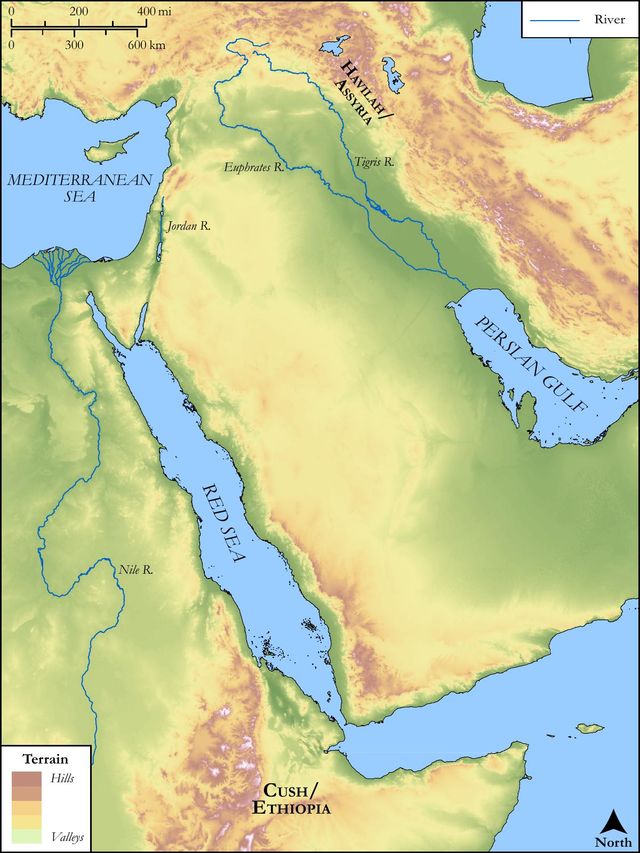
See on the biblical-era maps


Study this verse
Public-domain commentary
Matthew Henry
From his Commentary on the Whole Bible. Henry comments on passages, not single verses — this entry covers Genesis 2:8–15. His four-level outline is real structure in the source text, so it is rendered as structure.
Man consisting of body and soul, a body made out of the earth and a rational immortal soul the breath of heaven, we have, in these verses, the provision that was made for the happiness of both; he that made him took care to make him happy, if he could but have kept himself so and known when he was well off. That part of man by which he is allied to the world of sense was made happy; for he was put in the paradise of God: that part by which he is allied to the world of spirits was well provided for; for he was taken into covenant with God. Lord, what is man that he should be thus dignified - man that is a worm! Here we have,
I.A description of the garden of Eden, which was intended for the mansion and demesne of this great lord, the palace of this prince.
The inspired penman, in this history, writing for the Jews first, and calculating his narratives for the infant state of the church, describes things by their outward sensible appearances, and leaves us, by further discoveries of the divine light, to be led into the understanding of the mysteries couched under them. Spiritual things were strong meat, which they could not yet bear; but he writes to them as unto carnal, Co1 3:1. Therefore he does not so much insist upon the happiness of Adam's mind as upon that of his outward state. The Mosaic history, as well as the Mosaic law, has rather the patterns of heavenly things than the heavenly things themselves, Heb 9:23. Observe,
1.The place appointed for Adam's residence was a garden; not an ivory house nor a palace overlaid with gold, but a garden, furnished and adorned by nature, not by art. What little reason have men to be proud of stately and magnificent buildings, when it was the happiness of man in innocency that he needed none! As clothes came in with sin, so did houses. The heaven was the roof of Adam's house, and never was any roof so curiously ceiled and painted. The earth was his floor, and never was any floor so richly inlaid. The shadow of the trees was his retirement; under them were his dining-rooms, his lodging-rooms, and never were any rooms so finely hung as these: Solomon's, in all their glory, were not arrayed like them. The better we can accommodate ourselves to plain things, and the less we indulge ourselves with those artificial delights which have been invented to gratify men's pride and luxury, the nearer we approach to a state of innocency. Nature is content with a little and that which is most natural, grace with less, but lust with nothing.
2.The contrivance and furniture of this garden were the immediate work of God's wisdom and power. The Lord God planted this garden, that is, he had planted it - upon the third day, when the fruits of the earth were made. We may well suppose to have been the most accomplished place for pleasure and delight that ever the sun saw, when the all-sufficient God himself designed it to be the present happiness of his beloved creature, man, in innocency, and a type and a figure of the happiness of the chosen remnant in glory. No delights can be agreeable nor satisfying to a soul but those that God himself has provided and appointed for it; no true paradise, but of God's planting. The light of our own fires, and the sparks of our own kindling, will soon leave us in the dark, Isa 50:11. The whole earth was now a paradise compared with what it is since the fall and since the flood; the finest gardens in the world are a wilderness compared with what the whole face of the ground was before it was cursed for man's sake: yet that was not enough; God planted a garden for Adam. God's chosen ones shall have distinguishing favours shown them.
3.The situation of this garden was extremely sweet. It was in Eden, which signifies delight and pleasure. The place is here particularly pointed out by such marks and bounds as were sufficient, I suppose, when Moses wrote, to specify the place to those who knew that country; but now, it seems, the curious cannot satisfy themselves concerning it. Let it be our care to make sure a place in the heavenly paradise, and then we need not perplex ourselves with a search after the place of the earthly paradise. It is certain that, wherever it was, it had all desirable conveniences, and (which never any house nor garden on earth was) without any convenience. Beautiful for situation, the joy and the glory of the whole earth, was this garden: doubtless it was earth in its highest perfection.
4.The trees with which this garden was planted.
(1.)It had all the best and choicest trees in common with the rest of the ground. It was beautiful and adorned with every tree that, for its height or breadth, its make or colour, its leaf or flower, was pleasant to the sight and charmed the eye; it was replenished and enriched with every tree that yielded fruit grateful to the taste and useful to the body, and so good for food. God, as a tender Father, consulted not only Adam's profit, but his pleasure; for there is a pleasure consistent with innocency, nay, there is a true and transcendent pleasure in innocency. God delights in the prosperity of his servants, and would have them easy; it is owing to themselves if they be uneasy. When Providence puts us into an Eden of plenty and pleasure, we ought to serve him with joyfulness and gladness of heart, in the abundance of the good things he gives us. But,
(2.)It had two extraordinary trees peculiar to itself; on earth there were not their like.
[1.]There was the tree of life in the midst of the garden, which was not so much a memorandum to him of the fountain and author of his life, nor perhaps any natural means to preserve or prolong life; but it was chiefly intended to be a sign and seal to Adam, assuring him of the continuance of life and happiness, even to immortality and everlasting bliss, through the grace and favour of his Maker, upon condition of his perseverance in this state of innocency and obedience. Of this he might eat and live. Christ is now to us the tree of life (Rev 2:7; Rev 22:2), and the bread of life, Joh 6:48, Joh 6:53.
[2.]There was the tree of the knowledge of good and evil, so called, not because it had any virtue in it to beget or increase useful knowledge (surely then it would not have been forbidden), but, First, Because there was an express positive revelation of the will of God concerning this tree, so that by it he might know moral good and evil. What is good? It is good not to eat of this tree. What is evil? It is evil to eat of this tree. The distinction between all other moral good and evil was written in the heart of man by nature; but this, which resulted from a positive law, was written upon this tree. Secondly, Because, in the event, it proved to give Adam an experimental knowledge of good by the loss of it and of evil by the sense of it. As the covenant of grace has in it, not only Believe and be saved, but also, Believe not and be damned (Mar 16:16), so the covenant of innocency had in it, not only "Do this and live," which was sealed and confirmed by the tree of life, but, "Fail and die," which Adam was assured of by this other tree: "Touch it at your peril;" so that, in these two trees, God set before him good and evil, the blessing and the curse, Deu 30:19. These two trees were as two sacraments.
5.The rivers with which this garden was watered, Gen 2:10-14. These four rivers (or one river branched into four streams) contributed much both to the pleasantness and the fruitfulness of this garden. The land of Sodom is said to be well watered every where, as the garden of the Lord, Gen 13:10. Observe, That which God plants he will take care to keep watered. The trees of righteousness are set by the rivers, Psa 1:3. In the heavenly paradise there is a river infinitely surpassing these; for it is a river of the water of life, not coming out of Eden, as this, but proceeding out of the throne of God and of the Lamb (Rev 22:1), a river that makes glad the city of our God, Psa 46:4. Hiddekel and Euphrates are rivers of Babylon, which we read of elsewhere. By these the captive Jews sat down and wept, when they remembered Sion (Psa 137:1); but methinks they had much more reason to weep (and so have we) at the remembrance of Eden. Adam's paradise was their prison; such wretched work has sin made. Of the land of Havilah it is said (Gen 2:12), The gold of that land is good, and there is bdellium and the onyx-stone: surely this is mentioned that the wealth of which the land of Havilah boasted might be as foil to that which was the glory of the land of Eden. Havilah had gold, and spices, and precious stones; but Eden had that which was infinitely better, the tree of life, and communion with God. So we may say of the Africans and Indians: "They have the gold, but we have the gospel. The gold of their land is good, but the riches of ours are infinitely better."
II.The placing of man in this paradise of delight, Gen 2:15, where observe,
1.How God put him in possession of it: The Lord God took the man, and put him into the garden of Eden; so Gen 2:8, Gen 2:15. Note here,
(1.)Man was made out of paradise; for, after God had formed him, he put him into the garden: he was made of common clay, not of paradise-dust. He lived out of Eden before he lived in it, that he might see that all the comforts of his paradise-state were owing to God's free grace. He could not plead a tenant-right to the garden, for he was not born upon the premises, nor had any thing but what he received; all boasting was hereby for ever excluded.
(2.)The same God that was the author of his being was the author of his bliss; the same hand that made him a living soul planted the tree of life for him, and settled him by it. He that made us is alone able to make us happy; he that is the former of our bodies and the Father of our spirits, he, and none but he, can effectually provide for the felicity of both.
(3.)It adds much to the comfort of any condition if we have plainly seen God going before us and putting us into it. If we have not forced providence, but followed it, and taken the hints of direction it has given us, we may hope to find a paradise where otherwise we could not have expected it. See Psa 47:4.
2.How God appointed him business and employment. He put him there, not like Leviathan into the waters, to play therein, but to dress the garden and to keep it. Paradise itself was not a place of exemption from work. Note, here,
(1.)We were none of us sent into the world to be idle. He that made us these souls and bodies has given us something to work with; and he that gave us this earth for our habitation has made us something to work on. If a high extraction, or a great estate, or a large dominion, or perfect innocency, or a genius for pure contemplation, or a small family, could have given a man a writ of ease, Adam would not have been set to work; but he that gave us being has given us business, to serve him and our generation, and to work out our salvation: if we do not mind our business, we are unworthy of our being and maintenance.
(2.)Secular employments will vary well consist with a state of innocency and a life of communion with God. The sons and heirs of heaven, while they are here in this world, have something to do about this earth, which must have its share of their time and thoughts; and, if they do it with an eye to God, they are as truly serving him in it as when they are upon their knees.
(3.)The husbandman's calling is an ancient and honourable calling; it was needful even in paradise. The garden of Eden, though it needed not to be weeded (for thorns and thistles were not yet a nuisance), yet must be dressed and kept. Nature, even in its primitive state, left room for the improvements of art and industry. It was a calling fit for a state of innocency, making provision for life, not for lust, and giving man an opportunity of admiring the Creator and acknowledging his providence: while his hands were about his trees, his heart might be with his God.
(4.)There is a true pleasure in the business which God calls us to, and employs us in. Adam's work was so far from being an allay that it was an addition to the pleasures of paradise; he could not have been happy if he had been idle: it is still a law, He that will not work has no right to eat, Th2 3:10; Pro 27:23.
III.The command which God gave to man in innocency, and the covenant he then took him into.
Hitherto we have seen God as man's powerful Creator and his bountiful Benefactor; now he appears as his Ruler and Lawgiver. God put him into the garden of Eden, not to live there as he might list, but to be under government. As we are not allowed to be idle in this world, and to do nothing, so we are not allowed to be wilful, and do what we please. When God had given man a dominion over the creatures, he would let him know that still he himself was under the government of his Creator.
Historical interpretation
Five Centuries of Reception
11 surviving comments on this verse. Each one is dated, so this reads as a timeline rather than a list.
Select a marker to jump to its quote. Markers stagger vertically where authors wrote within a few decades of each other.
Now these things we are under the necessity of setting forth at length, in order to disprove the supposition of others. For some choose to maintain that paradise is in heaven, and forms no part of the system of creation. But since we see with our eyes the rivers that go forth from it which are open, indeed, even in our day, to the inspection of any who choose, let every one conclude from this that it did not belong to heaven, but was in reality planted in the created system. And, in truth, it is a locality in the east, and a place select.
The Church, setting forth the likeness of paradise, includes within her walls fruit-bearing trees, whereof that which does not bring forth good fruit is cut off and is cast into the fire. These trees she waters with four rivers, that is, with the four Gospels, wherewith, by a celestial inundation, she bestows the grace of saving baptism. Can any one water from the Church's fountains who is not within the Church? Can one impart those wholesome and saving draughts of paradise to any one if he is perverted, and of himself condemned, and banished outside the fountains of paradise, and has dried up and failed with the dryness of an eternal thirst?
So on the sixth day "the Lord fashioned dust from the ground into Adam, and He breathed the breath of life into his nostrils, and Adam became a living being." [ Gen2:7,2:8,2:9 ] Although animals, cattle and birds came into being at the same moment that they received life, in Adam's case God honored him in a variety of ways: first, because it is said that God "fashioned him with His hands and He breathed a soul into him" [ Gen2:7 ] ; He also gave him authority over Paradise and what is outside Paradise; and He wrapped him in glory and gave him reason, thought and an awareness of the Majesty.
Having spoken of the honored way in which Adam was fashioned, Scripture turns to describe Paradise and Adam's introduction into it: "And the Lord planted Paradise in Eden of old, and He placed there Adam whom He had fashioned. " [ 2:8 ]
Eden is the land of paradise, and God had already planted it on the third day. Moses explains this by saying, “The Lord caused every tree that is pleasant to the sight and good for food to sprout forth from the earth.” And to show that he was talking about paradise, he added, “And the tree of life was in the midst of paradise, and the tree of the knowledge of good and evil.”
For this reason we all look to the east in our prayers, but few know that this is because we are seeking the ancient fatherland, which God planted in Eden, toward the east.
Nevertheless, we can find out who was the Creator of this Paradise. We read in Genesis that 'God planted a garden to the east and he put there the man he had formed.' [ Gen 2:8 ] Who had the power to create Paradise, if not almighty God, who 'spoke and they were made' [ Ps 32:9 ] and who was never in want of the thing which He wished to bring into being? He planted, therefore, that Paradise of which He says in His wisdom: 'Every plant which my Father has not planted will be rooted up.' [ Matt.15:13 ] This is a goodly plantation for angels and saints. The saints are said to lie beneath the fig tree and the vine. [ Mich 6:6 ] In this respect they are the type of the angels [ Mark 12:25 ] in that time of peace which is to come.
Hence, Paradise has many trees that are fruit-bearing, with plenty of sap, and vigor. Of these it is said: 'All the trees of the woods shall rejoice.' [ Ps 95:12 ] The woods flourish ever with the green shoots of merit, just like that 'tree which is planted near the running waters, whose leaf shall not fall off,' [ Ps 1:3 ] because its fruit is plenteous. Here, then, is Paradise.
The place where it is planted is called delight; wherefore holy David says: 'Thou shalt not make them drink of the torrent of thy pleasure,' [ Ps 35:9 ] for you have read that 'a river rose in Eden watering the garden.' [ Gen 2:10 ] These woods, therefore, which were planted in Paradise are watered by the outpouring of the waters of that spirit concerning which He says elsewhere: 'The stream of the river maketh the city of God joyful.' [ Ps 45:5 ] Here is that city of Jerusalem which above is free, [ Gal 4:26 ] in which the different merits of the saints come to fruition.
In this garden, therefore, God put the man He had formed. Take note that He placed man there not in respect to the image of God, but in respect to the body of man. The incorporeal does not exist in a place. He placed man in Paradise, just as He placed the sun in heaven, awaiting lordship over the heavens, just as the creature expects the revelation of the sons of God. [ Rom 8:9 ]
Hence, if Paradise is a place where shrubs have opportunity to blossom, then Paradise has a certain vital force which receives and multiplies seeds in which each and every virtue is planted, and where flourishes the tree of life which is called Wisdom. Of this, Solomon says that Wisdom arose not of the earth but of the Father: 'For she is the brightness of eternal light' and 'the emanation of the glory of the almighty God.' [ Wisd 7:25-26 ]
If paradise, then, is of such a nature that Paul alone, or one like Paul, could scarcely see it while alive and still was unable to remember whether he saw it in the body or out of the body, and moreover heard words that he was forbidden to reveal—if this be true, how will it be possible for us to declare the position of paradise which we have not been able to see and, even if we had succeeded in seeing it, we would be forbidden to share with others? And again, since Paul shrank from exalting himself by reason of the sublimity of the revelation, how much more ought we to strive not to be too anxious to disclose that which leads to danger by its very revelation! The subject of paradise should not, therefore, be treated lightly.
I SEE YOUR INSATIABLE interest, your great enthusiasm and eager attention, and the way you are all coming to spiritual teaching expectant and impatient. On the other hand, I am conscious of my own great inadequacy. Still, I am anxious to lay before you this mean and pal try table frequently, and in fact daily, trusting that you will readily receive what is said, stimulated as you are with your own enthusiasm. One can see this happening in the case of material nourishment: whenever guests come to dinner with a keen appetite, they eat with great relish whatever is placed before them, no matter if the meal happens to be paltry and the? host ungenerous whereas when the diners have indifferent appetite, no matter if the meal is sumptuous and the menu varied, it is wasted on them since they can't do justice to the good things provided. Here today, however, your enthusiasm has in fact been enlivened through God's grace and the repast is a spiritual one; so we, too, are enthusiastic in speaking to you, knowing that we bring these divine teachings to attentive listeners.
The farmer is like this, too: he gives the soil all the attention he is capable of digging the furrows, hauling the plough, rooting out thorns so when he finds the pasture rich and fertile, he sows the seed lavishly; buoyed up already with high hopes he counts the days to the sprouting of the crop, recalling the productivity of the land and expecting a harvest far in excess of the sowing. That is the way we behave, too: we see your enthusiasm increasing day by day, your interest blossoming, and your zeal bearing fruit. We have high hopes of you, and with greater enthusiasm and zeal ourselves we strive as far as we are able to contribute to the building up of your love, to God's glory and the pride of God's church.
(105d) So come now, if you please, let us recall the few things said yesterday, and move on in turn to today's reading. We need to say what it was we were discussing yesterday, how far we got, and where we stopped. "God formed the human being, taking dust from the earth, and he breathed into him a breath of life; the human being became alive." [ Gen 2:7 ] What I was saying before I will say now, and will not cease saying continually, that great and unspeakable is the kindness of the Lord of all creatures towards us men. He displayed great considerateness for the sake of our welfare, and bestowed great honor on this creature namely, the human person and made plain in words and deeds that he exhibits greater care of human beings than of other visible things. There is no reason why I should not presume on your goodness to explore the same theme today, too. For, just as with grains of incense, the more they are moved about with your fingers, the greater fragrance they give out, so it is with the Scriptures in our experience: the more you devote yourself to studying them, the more you are able to discover the treasure hidden in them, and thereby gain great and unspeakable wealth.
"God." it says, "formed the human being, taking dust from the earth." Do you notice straightway the difference in the way the sentence opens? In the case of all the other creatures blessed Moses taught us the manner of creation, saying, "God said, Let there be light, and there was light;" [ Gen 1:3 ] "Let the firmament be made;" [ Gen 1:6 ] "Let the water be gathered together; [ Gen 1:9 ] "Let the stars be made;" [ Gen 1:14 ] (106b) "Let the earth put forth a crop of vegetation;" [ Gen 1:11 ] "Let the waters bring forth reptiles with living souls;" [ Gen 1:20 ] and "Let the earth bring forth a living thing." [ 24 ] Do you see how they were all created by a word? Let us notice instead what it says in the case of the creation of human beings. "God formed the human being." [ Gen 2:7 ] Do you see how, by the considerateness shown in the words he uses on account of our limitations, it teaches us both the manner of the creation and the difference, and all but shows us (so to speak in human fashion) man being shaped by God's hands as another author says, "Your hands made me, and formed me." [ Job 10:8 ]
You see, if he had simply ordered that the human per son spring out of the earth, then the object of the order would merely have been produced, would it not? Instead, for the purpose of communicating to us lasting teaching through the manner of creation (106c) to avoid an impression false to reality, everything is explained precisely in this way, and the text reads, "God formed the human being, taking dust from the earth."
Even in this detail notice the regard for us. I mean, he does not simply take some soil, but dust, the finest grains of soil, so to say, and this very dust of the earth by his own design he changed into the human kind of body. You see, just as he brought into being the very substance of the soil when it did not exist, so now, at will, he changed the dust from soil into body. At this it is good to exclaim what was said by blessed David, "Who will speak of the wonders of the Lord, and bring to our ears all his praises?" [ Ps 106:2 ] namely, that from dust he produced such a creature and elevated it to such eminence, and that he displays such marks of regard for it right from the outset, revealing in all this his own loving kindness.
The text says, "He breathed into him a breath of life; the human being became alive."
In this regard some senseless people, moved by their own reasoning, and having no regard for what is proper to God nor any appreciation of the considerateness revealed in the words, try to say that the soul comes from the substance of God. Such madness, such stupidity! What false paths has the devil prepared for those bent on following him! To realize it, consider how these paths lead in quite different directions. Some seize on a reading of the text, "He breathed," to say that souls come from the substance of God, whereas others on the contrary say they change into the substance of the worst of brute beasts. What could be worse than such folly? Since their reasoning is dulled, and (107a) they miss the true meaning of Scripture, they are like men blinded in the eyes of their mind, stumbling in various directions down cliffs: some accord the soul excessive esteem, others depress it unduly. Because if they wanted to assign a mouth to God on the score of Scripture's saying, "He breathed into him," they would have to equip him with hands too, since it says, "He formed the human being."
Anyhow, in case by wanting to make a display of these people's stupidity we, too, find ourselves induced to utter unseemly remarks, let's have done with their folly and turn aside from such idiocy; let us follow the direction of Sacred Scripture in the interpretation it gives of itself, provided we don't get completely absorbed in the concreteness of the words, but realize that our limitations are the reason for the concreteness of the language. Human senses, you see, would never be able to grasp what is said if they had not the benefit of such great considerateness.
So recognizing our limitations, and the fact that what is said refers to God, let us accept the words as equivalent to speaking about God; let us not reduce the divine to the shape of bodies and the structure of limbs, but understand the whole narrative in a manner appropriate to God. For the deity is simple, free of parts and shape; should we form an impression from ourselves and want to ascribe an arrangement of limbs to God, we would be in danger of falling into the irreverence pagans are guilty of. So when you hear Scripture saying, "God formed the human being," think of the same power as was responsible for "Let it be made;" likewise when you hear the sentence, "He breathed into him a breath of life," reason this way too, that just as he created the incorporeal beings, (107c) So he decided this body made from the dust should have a rational soul and be able to use a body's limbs. You see, this body created in the Lord's design was like an instrument needing someone to activate it, rather like a lyre that needs someone who can by his own skill and artistry raise a fitting hymn to the Lord through his own limbs, as though by the strings of the Lyre. The text says: "He breathed into him a breath of life, and the human being became alive." What is the sense of that, "He breathed a breath of life"? The body made this way, it is saying, he wanted to have a living force and he so directed; this became for the creature a living soul in other words, full of movement, with the ability to display its own skill through the movement of its limbs.
"Let the waters produce reptiles with living souls." and at once the living beings emerged from the waters; likewise in the case of the earth in the same terms: "Let the earth produce a living being." Not so, however, in the case of the human person: first its body is created from the dust, and afterwards the power of life is given to it, and this is the being of the soul. Accordingly Moses said about the beasts. "Its blood is its life." [ Lev 17:11 ] But in the case of the human person its being is incorporeal and immortal, and has a great superiority over the body, to the same extent as incorporeal form surpasses the corporeal.
Perhaps, however, someone may say: Why is it that, if the soul is more important than the body, the lesser is created first, and then the greater afterwards? Don't you see, dearly beloved, that even in the process of creation this very sequence is followed? That is to say, just as heaven and earth, the sun and moon, and everything else is created, including the brute beasts, and after all these the human per son, the one destined to enjoy control of all of them, in the very same way in the actual creation of the human person the body is produced first and then the soul, greater though its importance is. The procedure is the same with the brute beasts: though they are destined to be useful in the service of human beings, they are created before them so that the ones intended to enjoy the use of these beasts will find them ready for service. So, too, the body is created before the soul, so that when the soul is produced according to God's ineffable wisdom, it will be able to display its own vital forces through the movement of its body.
The text goes on: "The Lord God planted a garden in Eden in the east, and placed in it the human being he had formed." When the Lord of all had demonstrated his characteristic loving kindness in creating the one for whom everything had been provided, and setting him in its midst, immediately he began to bestow on this human person deeds of kindness. "God," it says, "planted a garden in Eden in the east." Notice here, dearly beloved, that unless we take the words in a manner appropriate to God, we will inevitably be trapped in a deep pitfall. I mean, what would be likely to be said about this sentence, too, by those rash enough to interpret in human fashion everything said about God? "God planted a garden," it says. What does that mean, pray? did he have need of tools, and gardening, and every other skill to beautify the garden? Not at all. Rather, in this case too, we need to understand the word "planted" in this sense namely, that he commanded a garden to be created on the earth so that the human being he had produced should live in the garden. I mean, to prove that he created the garden for human beings, listen to Scripture itself saying, "God planted a garden in Eden in the east, and placed in it the human being he had formed." [ Gen 2:8 ]
The reason blessed Moses inserted the name of the place in the text was that it would not be possible for those inclined to take things lightly to deceive the ears of the simple and say the garden was not on earth but in heaven, and dream up wild theories of that kind. You see, despite the use of such precision by Sacred Scripture, some people have not questioned the glib words of arrogant commentators and far fetched philosophy, even to the extent of denying Holy Writ and saying the garden was not on earth, giving contrary views on many other passages, taking a direction opposed to a literal understanding of the text, and thinking that what is said on the question of things on earth has to do with things in heaven. And, if blessed Moses had not used such simplicity of expression and such considerateness, the Holy Spirit directing his tongue, where would we not have come to grief? Sacred Scripture, though, whenever it wants to teach us some thing like this, gives its own interpretation, and doesn't let the listener go astray. On the other hand, since the majority of listeners apply their ears to the narrative, not for the sake of gaining some profit but for enjoyment, they are at pains to take note of things able to bring enjoyment rather than those that bring profit. So, I beg you, block your ears against all distractions of that kind, and let us follow the norm of Sacred Scripture. And when, dearly beloved, you hear that "God planted a garden in Eden in the east," take the word "planted" in a sense appropriate to God, namely, that he commanded this happen; and, about the next phrase, believe that a garden came into being, and in that place that Scripture indicated. Not to believe in the contents of Sacred Scripture, and introduce instead other views from one's own reasoning, is in my opinion to bring great peril to those rash enough to at tempt it.
"He placed in it, " the text says, "the human being he had formed." Notice at once the regard he shows towards him. Having created him outside the garden, he immediately brought him in so as to provide him with an experience of his kindness through the things in the garden; he was introduced into the garden so that he might know the regard God had for him through the actions done there. "He placed in it the human being he had formed." The word "placed" let us interpret this way: he ordered him to live there in order that what he saw and his way of life should give him much pleasure, and should awaken him to an expression of thanks in consideration of all the kindness he had received without ever doing anything to deserve it. So don't let the reading "placed" disturb you; it is, after all, the unfailing custom of Scripture to employ human ways of speaking for our sake and for our benefit. To be convinced of this, notice how previously, in the case of creation of the stars, it used the same term in saying "He placed them in the firmament of heaven." [ Gen 1:17 ] not that we should think of them fixed in heaven (for each of them pursues its own path moving from place to place), but to teach us that he commanded them to be in heaven just as he commanded the human being to live in the garden.
(Verse 8.) And the Lord God planted a garden in Eden, in the east. Instead of paradise, in Hebrew it has the word 'hortum' which means garden. And Eden is translated as 'deliciae'. Symmachus translated it as a flourishing paradise. Also, what follows, 'in the east', in Hebrew it is written as 'Mecedem', which Aquila translated as 'ἀπὸ ἀρχῆς', and we can say 'from the beginning'. Symmachus, however, uses 'ἐκ πρώτης', and Theodotion uses 'ἐν πρώτοις', which also signifies not the east, but the beginning. From this it is most clearly shown that before God made heaven and earth, He had already established paradise, as it is read in Hebrew: But the Lord God had planted a paradise in Eden from the beginning.
In the Scriptures some things are related in such a way that they seem to be following the order of time or occurring in chronological succession, when actually the narrative, without mentioning it, refers to previous events that had been left unmentioned. Unless we understand this distinction, we shall fall into error. For example, we find in Genesis: “And the Lord God planted a paradise of pleasure in the east; and there he put the man whom he had formed. And out of the ground the Lord God made to grow every tree that is pleasant to the sight and good for food.” This last mentioned event would seem to have occurred after God had made man and placed him in paradise. After both of these facts have been mentioned briefly (that is, that God planted a paradise and there “placed man whom he had formed”), the narrative turns back by means of recapitulation and relates what had been planted and that “God brought forth out of the ground all manner of trees fair to behold and pleasant to eat of.”
Now the Lord God had planted a garden of pleasure from the beginning, in which He placed the man whom He had formed. Surely, it is to be believed that God planted the garden from that very beginning, from which He commanded all the earth, after removing the waters that covered it, to produce herbs and fruit-bearing trees, in which He placed man on the sixth day, on which He had also formed him. Nor should there be any doubt that the garden in which the first man was placed, although it holds the type either of the present Church or of the future homeland, nevertheless must be understood according to the literal meaning, to be sure, a most pleasant place, shaded by fruitful groves, and also large, and fruitful with a great spring. However, because our edition, which is translated from the Hebrew truth, has "from the beginning," while in the ancient translation it is put "towards the East," some wish that the location of the garden is in the eastern part of the world, although separated by a great distance, either by the Ocean or by lands, from all the regions now inhabited by the human race. Therefore, not even the waters of the flood, which most deeply covered the entire surface of our world, could reach it. But whether it is there or elsewhere, God knows, we are only permitted to doubt that this place was and is earthly. Finally, with the following words, Scripture more fully explains how God planted it, saying:
Continue studying Genesis 2:8 across the web’s major study libraries — every link below opens this exact verse, chapter, or book on the destination site.
Read & Compare
 BibleGatewayThis verse in more than 200 translations and 70 languages.
 Bible.comThe YouVersion reader — hundreds of translations, reading plans, and highlights.
 ESV.orgCrossway's official English Standard Version reader.
 NET BibleThe NET translation with 60,000+ translators' notes on every rendering decision.
 STEP BibleTyndale House's free study tool — original text, vocabulary, and scholarly resources.
 BibliaLogos Bible Software's free web reader.
 USCCBThe New American Bible (Revised Edition) with the U.S. bishops' study notes.
Commentaries
 BibleHub CommentariesDozens of classic commentaries on this verse, gathered on one page.
 StudyLightMore than 100 commentary sets — the largest collection on the web.
 BibleRefPlain-English commentary on what this verse means, verse by verse.
 Enduring WordDavid Guzik's free commentary on this chapter, widely used by Bible teachers.
 Bible Study ToolsVerse commentary alongside Greek and Hebrew study aids.
Original Language & Research
- BibleHub InterlinearThe verse word by word — original language, transliteration, and English.
- BibleHub LexiconEvery word's original-language definition and Strong's entry.
 Blue Letter BibleDeep-study tools — Strong's numbers, concordance, and word studies.
 SefariaThe Hebrew text with Rashi and centuries of Jewish commentary.
Sermons, Hymns & Audio


TrulyRandomVerse is not affiliated with these sites and doesn’t control their content. They’re linked because they’re genuinely useful.
Summary
Genesis 2:8 profoundly reveals the LORD God's deliberate and benevolent provision for humanity immediately following creation, detailing the meticulous establishment of the Garden of Eden. This pristine dwelling, purposefully situated "eastward in Eden," was divinely cultivated as the perfect environment for human flourishing, intimate communion with the Creator, and the initial setting for humanity's sacred purpose within God's good and ordered creation.
Context
ShowHideLiterary Context
This verse serves as a pivotal transition from the general creation account of Genesis 1 to a more focused, intimate narrative emphasizing God's relationship with humanity and the specific environment prepared for them. It immediately follows the detailed formation of man from the dust of the ground and the breathing of life into him, as described in Genesis 2:7. While Genesis 1 establishes God as the sovereign Creator of all, Genesis 2 zooms in on the divine intention behind humanity's existence, highlighting God's personal involvement in crafting both man and his ideal dwelling place. This intimate focus sets the stage for the subsequent commands given to humanity in Genesis 2:15-17 and the unfolding drama of the Fall.
Historical & Cultural Context
Among the nations of that day, gardens were often associated with temples or palaces, symbolizing sacred space, divine presence, and royal authority. They were meticulously designed, irrigated, and cultivated, representing order, abundance, and control over nature. However, the Garden of Eden in Genesis stands apart as a uniquely divine creation, not a human construct. Its "planting" by God Himself signifies His direct, personal involvement and the inherent sacredness of the space. The concept of a primal paradise, a place of origin and perfection, resonates with various ancient myths, yet the biblical account uniquely portrays it as a gift from a personal, benevolent God who desires fellowship with His creation, rather than a realm guarded by capricious deities. The "eastward" location might hint at a direction of significance, perhaps pointing towards the rising sun, a symbol of life and new beginnings, or simply providing a geographical marker within a known region.
Key Themes
ShowHideGenesis 2:8 contributes significantly to several overarching themes within Genesis and the broader biblical narrative. It underscores the theme of Divine Provision and Benevolence, demonstrating God's meticulous care in preparing an optimal environment for human flourishing before placing humanity within it. It highlights Humanity's Original State of Perfection and Privilege, emphasizing that humanity was created for an unmarred existence in direct communion with God. The Garden itself functions as a theme of Sacred Space and Divine Presence, serving as a prototype for God's dwelling with His people, a theme that re-emerges throughout the tabernacle, temple, and ultimately in Christ and the new heavens and new earth. Furthermore, it subtly introduces the theme of Human Purpose and Stewardship, as the subsequent verses will reveal humanity's role in tending and keeping this divinely cultivated space, showcasing God's design for humanity as co-laborers with Him in creation, a purpose that transcends the initial setting of the Garden.
Exposition and Analysis
ShowHideKey Word Analysis
ShowHideThis verb signifies a deliberate and intentional act of establishing something firmly in the ground, implying cultivation, care, and the expectation of growth and fruitfulness. Unlike a spontaneous creation, God "planted" the garden, indicating a meticulous design and sustained effort to create a sustainable, productive, and beautiful environment. This highlights God's role not just as a creator, but as a gardener and provider, actively involved in preparing a dwelling for humanity.
The name itself carries connotations of "delight," "pleasure," or "luxury." This is not merely a geographical location but a place intrinsically defined by its idyllic nature, abundance, and beauty. It was a place of unparalleled perfection, designed to bring joy and satisfaction, underscoring God's desire for humanity to experience ultimate well-being and contentment in His presence, free from toil and struggle.
This verb evokes the image of a potter meticulously shaping clay, emphasizing God's personal craftsmanship, intimate involvement, and deliberate design in man's creation. It speaks to the intentionality and precision with which God fashioned humanity, highlighting that man is not a random outcome but a carefully sculpted being, perfectly suited for the environment God had just "planted." The connection between God's "forming" of man and His "planting" of the garden underscores the profound harmony and intentionality of God's original design for humanity and their dwelling place.
Verse Breakdown
ShowHide"And the LORD God planted a garden"
This phrase introduces the divine initiative and meticulous care in preparing humanity's dwelling. The use of "LORD God" (Yahweh Elohim) emphasizes both God's personal, covenantal relationship with humanity and His sovereign power as Creator. The act of "planting" signifies a deliberate, purposeful cultivation, establishing a place of beauty, order, and abundance, unlike a wild, untamed wilderness.
"eastward in Eden"
This clause provides a specific geographical and qualitative description of the garden's location. "Eastward" suggests a particular direction within the broader region of "Eden," a name that itself means "delight" or "pleasure." This detail underscores the garden's unique status as a place of unparalleled beauty, fertility, and divine favor, a true paradise.
"and there he put the man whom he had formed"
This final clause highlights God's sovereign act of placing humanity in this specially prepared environment. The verb "put" (Hebrew: sûwm) conveys a deliberate appointment and establishment, signifying man's intended role as an inhabitant, steward, and cultivator of God's perfect creation. The concluding phrase "whom he had formed" serves as a direct link back to Genesis 2:7, reinforcing the intimate connection between God's careful creation of man and His provision of an ideal dwelling place perfectly suited for him.
Literary Devices
ShowHideGenesis 2:8 employs several literary devices to convey its profound theological truths. Anthropomorphism is evident in the depiction of God "planting" a garden and "putting" man there, attributing human-like actions to the divine to make God's intentionality and personal involvement relatable. This imagery emphasizes God's active role as a meticulous craftsman and benevolent provider. The phrase "eastward in Eden" uses Specific Imagery to paint a picture of a precise, idyllic location, inviting the reader to envision a place of unparalleled beauty and order. There is also a subtle Parallelism between God's act of "forming" man and His act of "planting" the garden; both actions are deliberate, purposeful, and aimed at establishing a perfect environment for human flourishing, highlighting the divine harmony in creation. The entire verse functions as a foundational Symbolism for humanity's ideal state of existence in communion with God, a prototype for the perfect relationship and dwelling place that God desires for His creation.
Theological and Thematic Connections
ShowHideGenesis 2:8 is a foundational text for understanding God's character and His original design for humanity. It powerfully illustrates God's Divine Providence and Benevolence, revealing a Creator who not only brings existence into being but meticulously cultivates and sustains the ideal environment for His creatures' flourishing. This verse establishes humanity's initial state of Privilege and Perfection, placed in a paradise designed for optimal well-being, unhindered communion with God, and purposeful stewardship. The Garden of Eden, therefore, serves as a theological Prototype of God's Ideal Dwelling with Humanity, a sacred space where heaven and earth intersect, foreshadowing the ultimate restoration of creation and the new heavens and new earth where God will once again dwell perfectly with His people. The deliberate actions of "planting" and "putting" underscore God's Intentional Design and Purpose for both creation and humanity's role within it, emphasizing order, beauty, and fruitfulness as foundational elements of His original plan for a harmonious existence.
Reflection and Application
ShowHideGenesis 2:8 invites us to marvel at the profound depth of God's perfect design and His boundless generosity in providing for His creation. It serves as a poignant reminder that our innate longings for peace, beauty, and purpose are deeply rooted in the original paradise God prepared for humanity. This truth should cultivate a profound trust in His ongoing care and provision, even in a fallen world, inspiring us to appreciate and faithfully steward the good gifts of creation He has entrusted to us. It also fosters a longing for the ultimate restoration of all things through His redemptive plan, reminding us that the brokenness of our present world is not God's final word. Understanding God's original intention for Eden helps us grasp the magnitude of what was lost and the glory of what is yet to be restored, motivating us to live in alignment with His creational purposes today.
Questions for Reflection
ShowHideFAQ
ShowHideWhat was the primary purpose of God planting the Garden of Eden, and why was it "eastward"?
ShowHideThe primary purpose of God planting the Garden of Eden was multifaceted: it was to provide an ideal, perfectly cultivated environment for humanity to flourish, to live in unhindered communion with their Creator, and to fulfill their initial purpose of stewarding and cultivating God's good creation, as detailed in Genesis 2:15. It was a place of delight, abundance, and intimate relationship with God, serving as the setting for humanity's original blessed existence. The specific mention of "eastward" likely served as a geographical marker, indicating its location relative to the land of Eden. While some traditions interpret "eastward" symbolically (e.g., towards the rising sun, or as a direction of significance for sacred spaces), its primary function in the narrative is to provide a concrete, albeit now lost, point of reference for this unique, divinely appointed dwelling.
Christ-Centered Fulfillment
ShowHideGenesis 2:8, with its depiction of God establishing a perfect dwelling for humanity, finds its ultimate fulfillment in Jesus Christ. The original Garden of Eden, a place of unmarred communion with God and abundant life, was lost due to sin (Genesis 3:23-24). However, Christ, as the New Adam, reverses the curse and loss brought about by the first Adam's disobedience (Romans 5:12-19). He is the one through whom God's presence is restored among His people, not in a physical garden, but in the spiritual reality of His kingdom and through His Spirit dwelling within believers (John 14:23). Ultimately, Christ is the gateway to the "paradise of God," offering access to the tree of life that was once guarded (Revelation 2:7). Through His redemptive work, He leads His redeemed people into the New Heavens and New Earth, where God's dwelling is permanently with humanity, fulfilling the deepest longing for a perfect, unmarred dwelling with the Creator that Eden originally symbolized (Revelation 21:1-4). This future reality is the complete and glorious realization of God's original intent for humanity to live in perfect fellowship with Him, in a renewed and eternal Eden.