


Genesis 4:16
Bible text: King James Version (1769 Blayney text) · Public domain
Bible text: Berean Standard Bible · Public domain
Bible text: American Standard Version (1901) · Public domain
Bible text: World English Bible, Messianic edition · Public domain
Bible text: Geneva Bible (1599) · Public domain
Bible text: Young's Literal Translation · Public domain
- וַיֵּצֵאvai·Ye·tze'and he went outH3318Conj-w ¦ V-Qal-ConsecImperf-3msVerb Qal Consecutive Imperfect 3rd Singular Masculineוַandיֵּצֵאhe went out
- קַיִןKa·yinCainH7014N-proper-mNoun Proper Masculine
- מִלִּפְנֵיmi·lif·Neifrom to beforeH6440Prep-m ¦ Prep-l ¦ N-mpcNoun Plural Masculine Constructמִfromלִּtoפְנֵיbefore
- יְהוָהYah·wehYahwehH3068N-properNoun Proper Title
- וַיֵּשֶׁבvai·Ye·shevand he dweltH3427Conj-w ¦ V-Qal-ConsecImperf-3msVerb Qal Consecutive Imperfect 3rd Singular Masculineוַandיֵּשֶׁבhe dwelt
- בְּאֶרֶץbe·'e·retzin [the] land ofH776Prep-b ¦ N-fscNoun Singular Feminine Constructבְּinאֶרֶץ[the] land of
- נוֹדNodNodH5113N-properNoun Proper Location
- קִדְמַתkid·mat[the] east ofH6926N-fscNoun Singular Feminine Construct
- עֵדֶן'E·denEdenH5731N-properNoun Proper Location
English is a literal word-by-word gloss of the Hebrew, not the KJV's wording. Why?
This is the original text the KJV's translators worked from — each Hebrew word with its own literal English meaning in this verse, prepared by scholars at Tyndale House, Cambridge. The KJV translates whole sentences, not word by word, so its wording differs: one Hebrew word can become several English words, and the KJV may choose “the LORD” where the gloss reads “Yahweh”. Both are faithful — they answer different questions. For the KJV's own rendering, switch to the KJV text.
Details
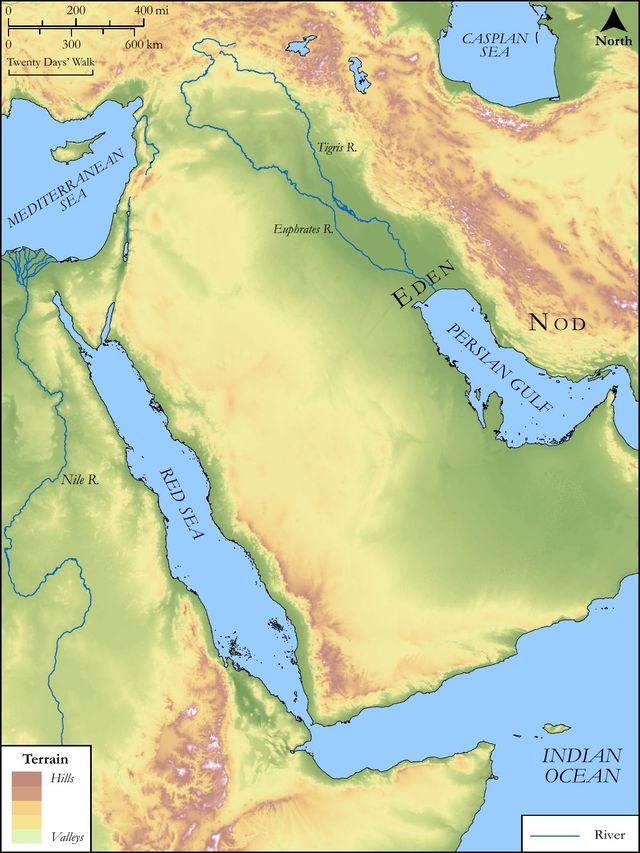
See on the biblical-era maps


Study this verse
Public-domain commentary
Matthew Henry
From his Commentary on the Whole Bible. Henry comments on passages, not single verses — this entry covers Genesis 4:16–18. His three-level outline is real structure in the source text, so it is rendered as structure.
We have here a further account of Cain, and what became of him after he was rejected of God.
I.He tamely submitted to that part of his sentence by which he was hidden from God's face; for (Gen 4:16) he went out from the presence of the Lord, that is, he willingly renounced God and religion, and was content to forego its privileges, so that he might not be under its precepts. He forsook Adam's family and altar, and cast off all pretensions to the fear of God, and never came among good people, nor attended on God's ordinances, any more. Note, Hypocritical professors, that have dissembled and trifled with God Almighty, are justly left to themselves, to do something that is grossly scandalous, and so to throw off that form of godliness to which they have been a reproach, and under colour of which they have denied the power of it. Cain went out now from the presence of the Lord, and we never find that he came into it again, to his comfort. Hell is destruction from the presence of the Lord, Th2 1:9. It is a perpetual banishment from the fountain of all good. This is the choice of sinners; and so shall their doom be, to their eternal confusion.
II.He endeavoured to confront that part of the sentence by which he was made a fugitive and a vagabond; for,
1.He chose his land. He went and dwelt on the east of Eden, somewhere distant from the place where Adam and his religious family resided, distinguishing himself and his accursed generation from the holy seed, his camp from the camp of the saints and the beloved city, Rev 20:9. On the east of Eden, the cherubim were, with the flaming sword, Gen 3:24. There he chose his lot, as if to defy the terrors of the Lord. But his attempt to settle was in vain; for the land he dwelt in was to him the land of Nod (that is, of shaking or trembling), because of the continual restlessness and uneasiness of his own spirit. Note, Those that depart from God cannot find rest any where else. After Cain went out from the presence of the Lord, he never rested. Those that shut themselves out of heaven abandon themselves to a perpetual trembling. "Return therefore to thy rest, O my soul, to thy rest in God; else thou art for ever restless."
2.He built a city for a habitation, Gen 4:17. He was building a city, so some read it, ever building it, but, a curse being upon him and the work of his hands, he could not finish it. Or, as we read it, he built a city, in token of a fixed separation from the church of God, to which he had no thoughts of ever returning. This city was to be the head-quarters of the apostasy. Observe here,
(1.)Cain's defiance of the divine sentence. God said he should be a fugitive and a vagabond. Had he repented and humbled himself, this curse might have been turned into a blessing, as that of the tribe of Levi was, that they should be divided in Jacob and scattered in Israel; but his impenitent unhumbled heart walking contrary to God, and resolving to fix in spite of heaven, that which might have been a blessing was turned into a curse.
(2.)See what was Cain's choice, after he had forsaken God; he pitched upon a settlement in this world, as his rest for ever. Those who looked for the heavenly city chose, while on earth, to dwell in tabernacles; but Cain, as one that minded not that city, built himself one on earth. Those that are cursed of God are apt to seek their settlement and satisfaction here below, Psa 17:14.
(3.)See what method Cain took to defend himself against the terrors with which he was perpetually haunted. He undertook this building, to divert his thoughts from the consideration of his own misery, and to drown the clamours of a guilty conscience with the noise of axes and hammers. Thus many baffle their convictions by thrusting themselves into a hurry of worldly business.
(4.)See how wicked people often get the start of God's people, and out-go them in outward prosperity. Cain and his cursed race dwell in a city, while Adam and his blessed family dwell in tents. We cannot judge of love or hatred by all that is before us, Ecc 9:1, Ecc 9:2.
3.His family also was built up. Here is an account of his posterity, at least the heirs of his family, for seven generations. His son was Enoch, of the same name, but not of the same character, with that holy man that walked with God, Gen 5:22. Good men and bad may bear the same names: but God can distinguish between Judas Iscariot and Judas not Iscariot, Joh 14:22. The names of more of his posterity are mentioned, and but just mentioned; not as those of the holy seed (ch. 5), where we have three verses concerning each, whereas here we have three or four in one verse. They are numbered in haste, as not valued or delighted in, in comparison with God's chosen.
Historical interpretation
Five Centuries of Reception
9 surviving comments on this verse. Each one is dated, so this reads as a timeline rather than a list.
Select a marker to jump to its quote. Markers stagger vertically where authors wrote within a few decades of each other.
The Scripture makes good sense: “Cain left God’s presence and went to live in the land of Nod, opposite Eden.” Nod means “disturbance,” Eden, “the good life.” The good life from which the transgressor was expelled consisted in faith, knowledge, peace. Those wise in their own eyes … are happy to transfer to the disturbance of a tossing sea. They drop from the knowledge of the One who knows no birth to the realm of birth and death. Their opinions are constantly changing.
By means of righteousness we come into God’s presence, as Moses did when he entered the thick cloud where God was. On the other hand, by the practice of evil a person leaves the presence of the Lord. For example, Cain, when he killed his brother, left the Lord’s presence as far as his will was concerned.
After Cain received the punishment and the sign had been added to it … Moses said that “Cain went away from the presence of the Lord and dwelt in the land of Nod, east of Eden.” Cain, therefore, separated himself from his parents and his kin because he saw that they would not intermarry with him.
The land of Nod is so called because it was the land in which Cain wandered about in fear and trembling. But the land also received a second curse when God said, “When you till the earth it shall no longer yield to you its strength.”
There the families
of the two brothers had separated:
Cain went off by himself
and lived in the land of Nod,
a place lower still
than that of Seth and Enosh;
but those who lived on higher ground,
who were called
“the children of God,”
left their own region and came down
to take wives
from the daughters of Cain down below.
(Verse 16.) And he dwelt in the land of Naid. Which the Septuagint translated as Naid, but in Hebrew it is called Nod, meaning 'shaking', that is, unstable and fluctuating, with an uncertain dwelling place. Therefore, it is not the land of Naid, as our common people think, but the divine sentence is fulfilled, that he wandered and fled here and there.
And Cain went out from the presence of the Lord, that is, from the inner parts of those dwellings in which he had been living with his parents until then, and was often accustomed to see Him in angelic form.
And Cain went out from the presence of the Lord and dwelt in the land of Nod to the east of Eden. By the presence of the Lord is usually understood the recognition by which He manifests and is known. Therefore, deservedly, the people who have withdrawn from the grace of divine recognition are said to dwell on earth. For they cannot say with the elect, "Our citizenship is in heaven, from where we also eagerly wait for the Savior, the Lord Jesus Christ" (Philippians 3:20). The Septuagint interpreters translated this passage thus: "Now Cain went out from the presence of the Lord God and dwelt in the land of Naid opposite Eden." Naid, however, is translated as "fugitive," or as we find in the book of Hebrew names, "unstable motion and fluctuation," which some, including Josephus, agree to be the place where Cain dwelt. Furthermore, our interpreter understood not the name of a place, but the significance of the thing itself; because Cain would be always unstable and fluctuating and of uncertain abodes. How much this matches the present state of the Jews, the whole world is a witness. They are also rightly said to dwell opposite Eden. For Eden signifies pleasure or delight: because indeed that faithless people, as much as they turn away from the knowledge of truth and entangle themselves in earthly affairs, so much they live a life contrary to heavenly delights; and because they only thirst for temporal joys, they are adversaries with the dry throats of their hearts to the torrent of divine pleasure by which the righteous are refreshed.
He dwelled in the land as a fugitive to the east of Eden. Eden is interpreted as pleasure or delight, by which name paradise is designated, about which it is said above: "And the Lord God planted a garden of pleasure from the beginning," which ancient interpreters have thus translated: "And the Lord God planted a garden in Eden to the east," from which it is understood that paradise is established to the eastern region of the world. Therefore, Cain dwelled not to the eastern region of paradise, otherwise he would dwell beyond this world, but in the eastern parts of the world, where paradise is nearby, although inaccessible and unknown to mortals. All things that are said literally about the justice or martyrdom of Abel, and about the depravity and condemnation of Cain, mystically testify to the passion of the Lord, the incarnation and persecution, and the destruction of the Jews. For the Lord says to those same Jews: "If you believed Moses, you would perhaps believe me as well; for he wrote about me" (John 5:46). Thus Cain was the firstborn, Abel the second. The people of the Jews were God's first possession, as He Himself said to Moses, "Israel is my son, my firstborn" (Exodus 4:22); the second is the people of the gentiles, for whom especially the Son of God deemed it worthy to be born in the flesh and to die. Abel was a shepherd of sheep, and the Lord said: "I am the good shepherd" (John 10:14). But Cain was a farmer, because the people of the Jews were involved in earthly and temporal affairs, either pursuing these alone or serving the Lord with these in mind, as they carnally understood those things which the prophets spoke mystically about the heavenly promise, saying: "If you are willing and obedient, you shall eat the good of the land" (Isaiah 1:19).
Continue studying Genesis 4:16 across the web’s major study libraries — every link below opens this exact verse, chapter, or book on the destination site.
Read & Compare
 BibleGatewayThis verse in more than 200 translations and 70 languages.
 Bible.comThe YouVersion reader — hundreds of translations, reading plans, and highlights.
 ESV.orgCrossway's official English Standard Version reader.
 NET BibleThe NET translation with 60,000+ translators' notes on every rendering decision.
 STEP BibleTyndale House's free study tool — original text, vocabulary, and scholarly resources.
 BibliaLogos Bible Software's free web reader.
 USCCBThe New American Bible (Revised Edition) with the U.S. bishops' study notes.
Commentaries
 BibleHub CommentariesDozens of classic commentaries on this verse, gathered on one page.
 StudyLightMore than 100 commentary sets — the largest collection on the web.
 BibleRefPlain-English commentary on what this verse means, verse by verse.
 Enduring WordDavid Guzik's free commentary on this chapter, widely used by Bible teachers.
 Bible Study ToolsVerse commentary alongside Greek and Hebrew study aids.
Original Language & Research
- BibleHub InterlinearThe verse word by word — original language, transliteration, and English.
- BibleHub LexiconEvery word's original-language definition and Strong's entry.
 Blue Letter BibleDeep-study tools — Strong's numbers, concordance, and word studies.
 SefariaThe Hebrew text with Rashi and centuries of Jewish commentary.
Sermons, Hymns & Audio


TrulyRandomVerse is not affiliated with these sites and doesn’t control their content. They’re linked because they’re genuinely useful.
Summary
Genesis 4:16 powerfully chronicles Cain's departure from God's immediate presence, marking a pivotal moment of spiritual and physical exile. This verse encapsulates the profound and isolating consequences of unrepentant sin, depicting a life of restless wandering away from divine favor and the true source of peace. It serves as humanity's first major narrative of departure from a place of divine blessing, establishing a foundational biblical theme of sin's alienating effects and the resultant human condition of spiritual homelessness.
Context
ShowHideLiterary Context
This verse immediately follows God's direct confrontation with Cain regarding the murder of his brother, Abel. Having previously warned Cain about the insidious nature of sin crouching at his door in Genesis 4:7, God pronounces a curse upon Cain in Genesis 4:11-12, decreeing that the ground will no longer yield its strength to him and that he will be a "fugitive and a wanderer on the earth." Cain expresses fear that this judgment will make him vulnerable to vengeance, leading the Lord, in an act of profound mercy and sovereign protection, to place a mark upon him to prevent anyone from killing him in Genesis 4:15. Verse 16 then describes Cain's immediate and decisive response to this divine judgment and protection: his physical departure into a life of exile, fulfilling the curse.
Historical & Cultural Context
In Scripture, the "presence of the LORD" is shown as a tangible, localized manifestation, as in Eden where God walked and spoke with man, whether in a sacred space, a specific geographical area, or through direct interaction. To be "cast out" from this presence was the most severe form of punishment, signifying a loss of divine protection, blessing, and access to the source of life and order. Exile was not merely a change of location but a complete disruption of identity, community, and security. The concept of "east" in early Genesis narratives (e.g., Genesis 3:24) often symbolizes a movement away from God's dwelling, blessing, and order, towards increasing alienation, chaos, or judgment. Cain's journey eastward thus carries significant symbolic weight beyond mere geography, reflecting a deeper spiritual trajectory.
Key Themes
ShowHideGenesis 4:16 contributes significantly to several overarching themes within Genesis and the broader biblical narrative. It underscores the consequences of sin, demonstrating how unrepentant rebellion leads to profound separation from God's presence and a life of restless wandering. This verse also highlights the tension between divine justice and mercy, as God's judgment on Cain is tempered by a protective mark. Furthermore, it foreshadows humanity's ongoing struggle with sin and its isolating effects, setting a precedent for subsequent narratives of exile and longing for a true home, such as the expulsion of Adam and Eve from Eden and the later exile of Israel from the promised land, as seen in books like 2 Kings 25. The verse ultimately points to the inherent human longing for a settled existence and true rest, which remains elusive apart from God.
Exposition and Analysis
ShowHideKey Word Analysis
ShowHideThis primitive root signifies "to go out" or "to bring out" in a wide variety of applications. In this context, it denotes a definitive departure, not merely a casual stroll, but an exit from a specific place or state. Coupled with "from the presence of the LORD," it carries the weight of a forced or compelled exodus, emphasizing a severance of connection and a movement into a new, less favorable existence.
Literally meaning "face," this plural noun often refers to the "presence" or "countenance" of a person, especially God. To be "from the presence of the LORD" implies a removal from the direct sight, favor, and perhaps even the manifested glory or immediate sphere of influence of God. It signifies a profound relational and spiritual alienation, a loss of access to divine communion and blessing.
This proper noun is directly related to the Hebrew root for "wandering" or "fugitive." Thus, the "land of Nod" is not merely a geographical location but a symbolic designation that embodies Cain's cursed state as a restless wanderer, as pronounced by God in Genesis 4:12. It represents a life devoid of settled peace, characterized by aimlessness and internal unrest, a direct consequence of his unrepentant sin.
Verse Breakdown
ShowHide"And Cain went out from the presence of the LORD,"
This clause describes Cain's decisive departure. It signifies more than a physical relocation; it is a spiritual banishment, a cutting off from the direct communion, favor, and perhaps the manifested glory that God had maintained with humanity. This separation underscores the devastating impact of sin, which inherently severs relationship with the source of life and blessing, leaving one spiritually adrift and alienated. It echoes the expulsion of Adam and Eve from the Garden in Genesis 3:24, establishing a pattern of sin leading to separation.
"and dwelt in the land of Nod,"
This phrase indicates Cain's new abode. The name "Nod" itself (נוֹד, Nod) literally means "wandering" or "fugitive," directly reflecting the curse God pronounced upon him—that he would be a "fugitive and a vagabond" upon the earth. Thus, Cain's dwelling in Nod is not merely a geographical detail but a symbolic fulfillment of his judgment, portraying a life characterized by aimless existence, internal restlessness, and a lack of true belonging, all born of guilt and alienation from God.
"on the east of Eden."
This final directional marker further emphasizes Cain's increasing distance from God's original dwelling with humanity. Just as humanity was first cast eastward from Eden, Cain's journey further east symbolizes a progressive alienation from the divine center, a deepening separation from the very origin of life, blessing, and order. This detail reinforces the narrative's overarching theme of humanity's departure from God's intended order due to sin, a theme that reverberates throughout the early chapters of Genesis and beyond, foreshadowing humanity's constant struggle with sin and its consequences, as seen later in the tower of Babel narrative in Genesis 11:2.
Literary Devices
ShowHideGenesis 4:16 employs several potent literary devices to convey its theological message. Symbolism is paramount, particularly with the "land of Nod," which is not merely a geographical location but a symbolic representation of Cain's cursed state of perpetual wandering and restless alienation. The name itself, derived from the Hebrew for "wandering," reinforces this meaning. The phrase "from the presence of the LORD" also functions symbolically, signifying a spiritual banishment and loss of divine favor, far more profound than a mere physical relocation. There is also a strong element of Geographical Symbolism, as the movement "on the east of Eden" echoes the eastward expulsion of Adam and Eve in Genesis 3:24, establishing a recurring motif in Genesis where movement eastward signifies increasing distance from God's presence and blessing. This directional detail creates a sense of Foreshadowing, hinting at future narratives of exile and separation from God due to sin, such as the eventual exile of Israel. Finally, there is a subtle Irony in Cain's attempt to escape God's presence, only to find himself fulfilling God's very curse by being forced to wander, unable to escape the consequences of his actions.
Theological and Thematic Connections
ShowHideGenesis 4:16 profoundly illustrates the severe consequences of unrepentant sin and rebellion against God, demonstrating how such actions inevitably lead to spiritual and relational separation from the divine. This verse establishes a recurring biblical motif of exile and banishment from God's presence as a direct result of human disobedience, highlighting the inherent human longing for a settled home and true rest, which is ultimately disrupted by sin. While depicting judgment, the context also subtly underscores God's justice tempered by His mercy, as seen in the protective mark placed on Cain, indicating that even in judgment, God's sovereignty and a measure of his care persist. This narrative serves as a foundational example of humanity's fallen condition and the profound spiritual distance that sin creates between humanity and its Creator.
Reflection and Application
ShowHideCain's narrative in Genesis 4:16 serves as a timeless and sobering warning that unaddressed sin and unrepentant rebellion lead to profound separation from God and a restless, unfulfilled existence. It challenges us to confront our own tendencies towards rebellion and to recognize that true peace, belonging, and rest are found not in fleeing from God's presence or accountability, but in seeking reconciliation and dwelling within His will. This story underscores humanity's deep-seated need for a secure place of rest and belonging that only God can provide. It prompts us to consider where we might be "wandering" in our own lives, seeking satisfaction in places or pursuits that ultimately lead to spiritual emptiness, and to remember that genuine peace is found in drawing near to the Lord, not departing from Him.
Questions for Reflection
ShowHideFAQ
ShowHideWhat does "went out from the presence of the LORD" mean?
ShowHideThis phrase signifies far more than a mere physical relocation; it implies a profound spiritual banishment and a loss of direct communion and favor with God. It suggests a departure from a place where God's immediate attention, blessing, or manifested glory was experienced, leading to a deep spiritual and relational distance. It marks a severance of the intimate relationship humanity once shared with its Creator.
What is the significance of the "land of Nod"?
ShowHideThe "land of Nod" (נוֹד, Nod) is symbolically significant. The Hebrew name literally means "wandering" or "fugitive." Therefore, Nod is not necessarily a fixed geographical location but a symbolic name that perfectly reflects Cain's cursed state as a restless wanderer, illustrating the aimless, unfulfilled, and unsettled existence that results from a life lived apart from God's favor and blessing, a direct fulfillment of God's judgment in Genesis 4:12.
Why is it specified "on the east of Eden"?
ShowHideThis geographical detail carries significant symbolic weight. In Genesis, movement eastward often symbolizes a departure from God's presence, blessing, and order. Just as Adam and Eve were driven eastward from Eden in Genesis 3:24, Cain's further eastward journey symbolizes a progressive alienation from the divine center and the source of life and blessing. It underscores the increasing spiritual distance and the deepening consequences of sin.
Does this verse imply Cain was entirely cut off from God?
ShowHideWhile Cain departed from God's immediate presence and favor, the narrative does not suggest God completely abandoned him. God had just shown profound mercy by placing a protective mark on Cain in Genesis 4:15, ensuring his safety from vengeance. This indicates God's continued, albeit indirect, involvement and sovereignty even over those in rebellion, demonstrating that His mercy can extend even to the unrepentant, though their chosen path leads to separation.
Christ-Centered Fulfillment
ShowHideCain's exile in Genesis 4:16 vividly portrays humanity's fallen condition and the profound spiritual separation from God caused by sin—a state that all humanity shares. This deep alienation highlights the ultimate need for reconciliation and a return to God's presence, a need that no human effort or geographical relocation can satisfy. Jesus Christ uniquely fulfills this need, acting as the ultimate High Priest who brings us near to God. He is the one who reverses the curse of exile, not by merely placing a mark of protection, but by bearing the full weight of sin and its consequences on the cross, thereby opening a new and living way back to the Father. Through His atoning sacrifice, Jesus offers not just a temporary reprieve from wandering, but eternal peace and a true home, inviting all who are weary and burdened to find rest for their souls in Him. By His resurrection and ascension, Christ has gone into the very presence of God, and through faith in Him, believers are brought into that same divine presence, overcoming the spiritual distance that sin creates and establishing a new covenant relationship where God promises to dwell among His people forever. He transforms the "land of Nod" into a pathway to the New Jerusalem, where there is no more curse or separation.