


2 Kings 19:12
- הַהִצִּילוּha·hi·Tzi·lu¿ did they deliverH5337Interrog ¦ V-Hiphil-Perf-3cpVerb Hiphil Perfect 3rd Plural common genderהַ¿הִצִּילוּdid they deliver
- אֹתָם'o·Tam<obj.> themH853DirObjM ¦ 3mpParticle Object Indicatorאֹתָ<obj.>םthem
- אֱלֹהֵי'e·lo·Hei[the] gods ofH430N-mpcNoun Plural Masculine Construct
- הַגּוֹיִםha·go·Yimthe nationsH1471Art ¦ N-mpNoun Plural Masculine Absoluteהַtheגּוֹיִםnations
- אֲשֶׁר'a·SherwhichH834RelParticle Relative
- שִׁחֲתוּshi·cha·Tuthey destroyedH7843V-Piel-Perf-3cpVerb Piel Perfect 3rd Plural common gender
- אֲבוֹתַי'a·vo·Taimy fathersH1N-fpc ¦ 1csNoun Plural Feminine Constructאֲבוֹתַfathersיmy
- אֶת'et<obj.>H853DirObjMParticle Object Indicator
- גּוֹזָןgo·ZanGozanH1470N-properNoun Proper Location
- וְאֶתve·'Etand <obj.>H853Conj-w ¦ DirObjMParticle Object Indicatorוְandאֶת<obj.>
- חָרָןcha·RanHaranH2771N-properNoun Proper Location
- וְרֶצֶףve·Re·tzefand RezephH7530Conj-w ¦ N-properNoun Proper LocationוְandרֶצֶףRezeph
- וּבְנֵיu·ve·neiand [the] people ofH1121Conj-w ¦ N-mpcNoun Plural Masculine Constructוּandבְנֵי[the] people of
- עֶדֶן'E·denEdenH5729N-properNoun Proper Location
- אֲשֶׁר'a·SherwhoH834RelParticle Relative
- בִּתְלַאשָּׂרbit·la·Sar[were] in TelassarH8515Prep-b ¦ N-properNoun Proper Locationבִּ[were] inתְלַאשָּׂרTelassar
English is a literal word-by-word gloss of the Hebrew, not the KJV's wording. Why?
This is the original text the KJV's translators worked from — each Hebrew word with its own literal English meaning in this verse, prepared by scholars at Tyndale House, Cambridge. The KJV translates whole sentences, not word by word, so its wording differs: one Hebrew word can become several English words, and the KJV may choose “the LORD” where the gloss reads “Yahweh”. Both are faithful — they answer different questions. For the KJV's own rendering, switch to the KJV text.
Details
See on the biblical-era map
Study this verse
Public-domain commentary
Matthew Henry
From his Commentary on the Whole Bible. Henry comments on passages, not single verses — this entry covers 2 Kings 19:8–19. His two-level outline is real structure in the source text, so it is rendered as structure.
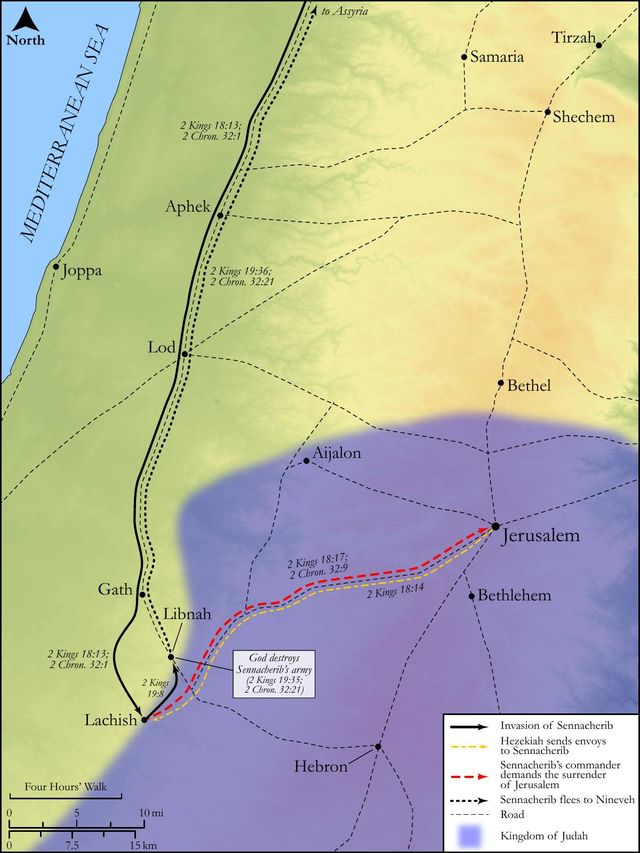
Rabshakeh, having delivered his message and received no answer (whether he took this silence for a consent or a slight does not appear), left his army before Jerusalem, under the command of the other generals, and went himself to attend the king his master for further orders. He found him besieging Libnah, a city that had revolted from Judah, Kg2 8:22. Whether he had taken Lachish or no is not certain; some think he departed from it because he found the taking of it impracticable, Kg2 19:8. However, he was now alarmed with the rumour that the king of the Cushites, who bordered upon the Arabians, was coming out against him with a great army, Kg2 19:9. This made him very desirous to gain Jerusalem with all speed. To take it by force would cost him more time and men than he could well spare, and therefore he renewed his attack upon Hezekiah to persuade him tamely to surrender it. Having found him an easy man once (Kg2 18:14), when he said, That which thou puttest on me I will bear, he hoped again to frighten him into a submission, but in vain. Here,
I.Sennacherib sent a letter to Hezekiah, a railing letter, a blaspheming letter, to persuade him to surrender Jerusalem, because it would be to no purpose for him to think of standing it out. His letter is to the same purport with Rabshakeh's speech; there is nothing new offered in it. Rabshakeh had said to the people, Let not Hezekiah deceive you, Kg2 18:29. Sennacherib writes to Hezekiah, Let not thy God deceive thee, Kg2 18:10. Those that have the God of Jacob for their help, and whose hope is in the Lord their God, need not fear being deceived by him, as the heathen were by their gods. To terrify Hezekiah, and drive him from his anchor, he magnifies himself and his own achievements. See how proudly he boasts,
1.Of the lands he had conquered (Kg2 18:11): All lands, and destroyed utterly! How are the mole-hills of his victories swelled to mountains! So far was he from destroying all lands that at this time the land of Cush, and Tirhakah its king, were a terror to him. What vast hyperboles may one expect in proud men's praises of themselves!
2.Of the gods he had conquered, Kg2 18:12. "Each vanquished nation and its gods, which were so far from being able to deliver them that they fell with them: and shall thy God deliver thee?" 3. Of the kings he had conquered (Kg2 18:13), the king of Hamath and the king of Arpad. Whether he means the prince or the idol, he means to make himself appear greater than either, and therefore very formidable, and the terror of the mighty in the land of the living.
II.Hezekiah encloses this in another letter, a praying letter, a believing letter, and sends it to the King of kings, who judges among the gods. Hezekiah was not so haughty as not to receive the letter, though we may suppose the superscription did not give him his due titles; when he had received it he was not so careless as not to read it; when he had read it he was not in such a passion as to write an answer to it in the same provoking language; but he immediately went up to the temple, presented himself, and then spread the letter before the Lord (Kg2 18:14), not as if God needed to have the letter shown to him (he knew what was in it before Hezekiah did), but hereby he signified that he acknowledged God in all his ways, - that he desired not to aggravate the injuries his enemies did him nor to make them appear worse than they were, but desired they might be set in a true light, - and that he referred himself to God, and his righteous judgment, upon the whole matter. Hereby likewise he would affect himself in the prayer he came to the temple to make; and we have need of all possible helps to quicken us in that duty. In the prayer which Hezekiah prayed over this letter, 1. He adores the God whom Sennacherib had blasphemed (Kg2 18:15), calls him the God of Israel, because Israel was his peculiar people, and the God that dwelt between the cherubim, because there was the peculiar residence of his glory upon earth; but he gives glory to him as the God of the whole earth, and not, as Sennacherib fancied him to be, the God of Israel only, and confined to the temple. "Let them say what they will, thou art sovereign Lord, for thou art the God, the God of gods, sole Lord, even thou alone, universal Lord of all the kingdoms of the earth, and rightful Lord, for thou hast made heaven and earth. Being Creator of all, by an incontestable title thou art owner and ruler of all." 2. He appeals to God concerning the insolence and profaneness of Sennacherib (Kg2 18:16): "Lord, hear; Lord, see. Here it is under his own hand; here it is in black and white." Had Hezekiah only been abused, he would have passed it by; but it is God, the living God, that is reproached, the jealous God. Lord, what wilt thou do for thy great name? 3. He owns Sennacherib's triumphs over the gods of the heathen, but distinguishes between them and the God of Israel (Kg2 18:17, Kg2 18:18): He has indeed cast their gods into the fire; for they were no gods, unable to help either themselves or their worshipers, and therefore no wonder that he has destroyed them; and, in destroying them, though he knew it not, he really served the justice and jealousy of the God of Israel, who has determined to extirpate all the gods of the heathen. But those are deceived who think they can therefore be too hard for him. He is none of the gods whom men's hands have made, but he has himself made all things, Psa 115:3, Psa 115:4. 4. He prays that God will now glorify himself in the defeat of Sennacherib and the deliverance of Jerusalem out of his hands (Kg2 19:19): "Now therefore save us; for if we be conquered, as other lands are, they will say that thou art conquered, as the gods of those lands were: but, Lord, distinguish thyself, by distinguishing us, and let all the world know, and be made to confess, that thou art the Lord God, the self-existent sovereign God, even thou only, and that all pretenders are vanity and a lie." Note, The best pleas in prayer are those which are taken from God's honour; and therefore the Lord's prayer begins with Hallowed be thy name, and concludes with Thine is the glory.
Continue studying 2 Kings 19:12 across the web’s major study libraries — every link below opens this exact verse, chapter, or book on the destination site.
Read & Compare
 BibleGatewayThis verse in more than 200 translations and 70 languages.
 Bible.comThe YouVersion reader — hundreds of translations, reading plans, and highlights.
 ESV.orgCrossway's official English Standard Version reader.
 NET BibleThe NET translation with 60,000+ translators' notes on every rendering decision.
 STEP BibleTyndale House's free study tool — original text, vocabulary, and scholarly resources.
 BibliaLogos Bible Software's free web reader.
 USCCBThe New American Bible (Revised Edition) with the U.S. bishops' study notes.
Commentaries
 BibleHub CommentariesDozens of classic commentaries on this verse, gathered on one page.
 StudyLightMore than 100 commentary sets — the largest collection on the web.
 BibleRefPlain-English commentary on what this verse means, verse by verse.
 Enduring WordDavid Guzik's free commentary on this chapter, widely used by Bible teachers.
 Bible Study ToolsVerse commentary alongside Greek and Hebrew study aids.
Original Language & Research
- BibleHub InterlinearThe verse word by word — original language, transliteration, and English.
- BibleHub LexiconEvery word's original-language definition and Strong's entry.
 Blue Letter BibleDeep-study tools — Strong's numbers, concordance, and word studies.
 SefariaThe Hebrew text with Rashi and centuries of Jewish commentary.
Sermons, Hymns & Audio


TrulyRandomVerse is not affiliated with these sites and doesn’t control their content. They’re linked because they’re genuinely useful.
Summary
Second Kings 19:12 presents a pivotal moment in King Sennacherib of Assyria's intimidating message to King Hezekiah of Judah. This verse, part of a broader taunt, highlights Sennacherib's arrogant challenge to the sovereignty of Yahweh, the God of Israel. By listing nations and peoples whose gods failed to deliver them from Assyrian conquest—Gozan, Haran, Rezeph, and the children of Eden in Thelasar—Sennacherib attempts to demonstrate the futility of Hezekiah's trust in his God, asserting that Yahweh is no different from the impotent deities his fathers have already vanquished.
Context
ShowHideLiterary Context
This verse is deeply embedded within Sennacherib's second, more direct, and highly blasphemous message to King Hezekiah, following the initial siege and tribute demands described in 2 Kings 18:13-16. Having already captured many fortified cities of Judah, Sennacherib is now poised to attack Jerusalem. His message, delivered through his field commander (the Rabshakeh), is designed to psychologically break Hezekiah and the people of Jerusalem, undermining their faith in Yahweh by equating Him with the defeated gods of other nations. The immediate literary context shows Hezekiah's deep distress and his turning to the prophet Isaiah for divine counsel, setting the stage for Yahweh's dramatic intervention later in 2 Kings 19. This taunt is a direct challenge to the covenant relationship between Yahweh and Judah, demanding a divine response that will ultimately vindicate God's name and power.
Historical & Cultural Context
The Assyrian Empire, particularly under Sennacherib (705-681 BCE), was the dominant superpower of the ancient Near East, renowned for its brutal military campaigns and effective psychological warfare. It was common practice for conquering empires to deport conquered peoples and to desecrate or carry off the idols of their gods, thereby demonstrating the supposed superiority of the Assyrian deities (or the Assyrian king's god) over those of the defeated nations. Sennacherib's boast in this verse reflects this imperial ideology, asserting that no god could withstand Assyrian might. The cities listed—Gozan (Tell Halaf, a major Aramean city where exiled Israelites were settled, as noted in 2 Kings 17:6), Haran (a significant city in northern Mesopotamia, known from patriarchal narratives like Genesis 11:31), Rezeph (Resafa, an oasis city in the Syrian desert), and the children of Eden in Thelasar (likely referring to the people of Bit-Adini, residing in Til-Barsip, an important Mesopotamian city)—were all real places that had fallen to Assyrian power, many under Sennacherib's predecessors (his "fathers"). This enumeration reinforced the long-standing and seemingly unstoppable nature of Assyrian conquest.
Key Themes
ShowHideSennacherib's message in 2 Kings 19:12 powerfully contributes to several key themes in 2 Kings and the broader Deuteronomistic History. Firstly, it highlights human arrogance and blasphemy, as Sennacherib, in his pride, directly challenges the unique sovereignty of Yahweh, placing Him on par with impotent idols. This sets up a dramatic confrontation between human might and divine power, a core theme throughout the book, particularly in the unfolding narrative of 2 Kings 19. Secondly, it underscores the futility of idolatry, demonstrating that gods made by human hands are powerless against earthly forces, let alone the living God. This contrasts sharply with the power of Yahweh, who alone can deliver. Finally, it emphasizes the theme of faith versus fear, as Hezekiah and Judah are forced to choose between succumbing to Sennacherib's intimidation or trusting in Yahweh's promises, a trust that is ultimately vindicated by God's miraculous intervention, as seen in 2 Kings 19:35-36.
Exposition and Analysis
ShowHideKey Word Analysis
ShowHideThis Hebrew term (H430), while often referring to the one true God, is used here in the plural to denote the pagan deities of the nations. Sennacherib deliberately uses this term to lump Yahweh in with these powerless idols, attempting to diminish His unique status and power. The implication is that if these gods could not save their worshippers, neither can the God of Judah. The term itself, ʾĕlôhîym, can refer to divine beings in a general sense, but its application here is clearly to the false, impotent deities of the conquered peoples.
This word (H5337), meaning "to snatch away," "to rescue," or "to deliver," emphasizes the act of salvation or liberation from danger or oppression. Sennacherib's rhetorical question asserts that no god has been able to perform this act of rescue against the overwhelming might of the Assyrian army, thereby challenging Yahweh's ability to do so for Judah. The root conveys the idea of pulling or plucking something out of a dangerous situation, an action that Sennacherib claims no other deity has successfully executed against Assyrian might.
This primitive root (H7843) means "to decay," or causatively, "to ruin" (literally or figuratively). In this context, it signifies the complete and utter devastation wrought by the Assyrian forces. Sennacherib highlights the irreversible annihilation of these nations, implying that their gods were utterly incapable of preventing such ruin. The term underscores the Assyrian policy of total conquest and the utter inability of the defeated nations' gods to prevent their people and lands from being utterly laid waste by Sennacherib's predecessors.
Verse Breakdown
ShowHide"Have the gods of the nations delivered them"
This is a powerful rhetorical question posed by Sennacherib, designed to imply a resounding "No!" He challenges the very concept of divine intervention on behalf of conquered peoples, asserting that no deity has proven capable of standing against the Assyrian war machine. It is a direct assault on the efficacy and power of any god other than, implicitly, the Assyrian god Ashur, or perhaps more accurately, the Assyrian king himself, who is seen as the embodiment of unstoppable power.
"which my fathers have destroyed;"
This clause emphasizes the continuity and legacy of Assyrian conquest. Sennacherib is not merely boasting of his own victories but is drawing upon the long, successful history of the Assyrian Empire under his predecessors. This lineage of destruction is meant to convey an unstoppable, generational force, suggesting that what has happened to countless other nations will inevitably happen to Judah. It underscores the Assyrian belief in their manifest destiny to conquer, a destiny seemingly endorsed by the impotence of all other gods.
"[as] Gozan, and Haran, and Rezeph, and the children of Eden which [were] in Thelasar?"
This is an enumeration of specific, well-known locations and peoples that had fallen to Assyrian power. By listing these diverse and distant conquests, Sennacherib aims to prove his point empirically: no matter the people, no matter their god, Assyria has prevailed. The geographical breadth of these conquests—from northern Mesopotamia (Gozan, Haran) to the Syrian desert (Rezeph) and beyond (Eden in Thelasar)—is intended to demonstrate the universal reach and invincibility of Assyrian power, leaving no hope for Judah.
Literary Devices
ShowHideSennacherib's message in this verse is replete with rhetorical force. The primary device is a Rhetorical Question, "Have the gods of the nations delivered them...?", which is not meant to elicit an answer but to assert a self-evident truth from the speaker's perspective: no, they have not. This question is a form of Boasting and Hyperbole, as Sennacherib exaggerates the invincibility of Assyrian power and diminishes the power of all other deities. The listing of conquered cities and peoples—Gozan, Haran, Rezeph, and the children of Eden in Thelasar—is an example of Enumeration, serving to build a cumulative argument and demonstrate the sheer scale of Assyrian dominance. From the perspective of the biblical narrative and the faithful reader, there is profound Irony in Sennacherib's boast, as his perceived invincibility is about to be dramatically overturned by the very God he mocks, setting the stage for Yahweh's glorious vindication.
Theological and Thematic Connections
ShowHideSennacherib's audacious challenge in 2 Kings 19:12 serves as a profound theological statement, albeit one from an ungodly perspective, that ultimately highlights the unique and incomparable nature of Yahweh. His attempt to equate the God of Israel with the impotent, man-made gods of other nations underscores the fundamental biblical truth that Yahweh is utterly distinct from all other deities. Unlike the gods of Gozan or Haran, who were confined to specific territories or peoples and proved powerless against a superior earthly force, Yahweh is the sovereign Creator and Sustainer of all things, unbound by human limitations or geographical boundaries. This verse sets the stage for a divine demonstration of power that will not only silence Sennacherib's blasphemy but also reaffirm Yahweh's covenant faithfulness to His people and His absolute supremacy over all earthly powers and false gods. It is a crucial moment that calls for unwavering trust in God's unique ability to deliver, even when all human hope seems lost.
Reflection and Application
ShowHideSennacherib's boast in 2 Kings 19:12 is a timeless echo of human pride and the world's challenge to divine authority. In our own lives, we often face "Sennacheribs"—overwhelming circumstances, powerful adversaries, or even insidious doubts—that seek to intimidate us and undermine our faith in God's ability to deliver. The world, with its visible power, material wealth, and seemingly unstoppable forces, often attempts to convince us that God is either non-existent, uncaring, or simply not powerful enough to intervene in our reality. This verse, however, read in the context of Hezekiah's response and God's subsequent miraculous deliverance, teaches us to look beyond the immediate threats and the apparent limitations of our circumstances. It calls us to remember that God's power is not relative to human might or past failures; His sovereignty is absolute and His faithfulness unwavering. Our trust should not be in what we can see or control, but in the unseen, all-powerful God who delights in demonstrating His strength in our weakness.
Questions for Reflection
ShowHideFAQ
ShowHideWas Sennacherib's claim about his fathers destroying these nations accurate?
ShowHideYes, Sennacherib's claim was historically accurate. The places listed—Gozan, Haran, Rezeph, and the children of Eden in Thelasar—were indeed real geographical locations that had fallen under Assyrian control, often under the reigns of his predecessors like Tiglath-Pileser III, Shalmaneser V, and Sargon II. Sennacherib was drawing on a well-established history of Assyrian conquest and the consistent failure of local deities to protect their worshippers from the Assyrian war machine. His boast was based on verifiable historical precedent, which made his threat to Hezekiah all the more intimidating. However, his fatal error was in assuming that the God of Israel was just another one of these impotent, localized deities, failing to comprehend the unique nature of Yahweh, the one true God who would ultimately deliver Jerusalem as recorded in 2 Kings 19:35-36.
Christ-Centered Fulfillment
ShowHideSennacherib's arrogant boast in 2 Kings 19:12, challenging the power of Yahweh by equating Him with impotent idols, finds its ultimate Christ-centered fulfillment in the triumph of Jesus over all spiritual and earthly powers. Just as Sennacherib's perceived invincibility was shattered by God's miraculous intervention, so too are the boasts of sin, death, and the devil utterly defeated by Christ. The "gods of the nations" that failed to deliver their people are a foreshadowing of the empty promises of worldly systems and false ideologies that cannot save humanity from its deepest plight. Jesus, the true Lamb of God, who takes away the sin of the world, did not merely deliver a nation from a physical army, but through His sacrificial death and glorious resurrection, He delivered humanity from the bondage of sin and the power of death, a victory that no earthly king or false god could ever achieve. The Apostle Paul affirms this ultimate triumph, stating that Christ disarmed the powers and authorities, making a public spectacle of them, triumphing over them by the cross (Colossians 2:15). He is the unique God-man, the only one who truly "delivers" His people, not from a temporal enemy, but from eternal destruction. His resurrection is the ultimate proof that the "fathers" of sin and death have been "destroyed" by His divine power, establishing His eternal kingdom and demonstrating His unparalleled sovereignty over all creation, fulfilling the promise of a deliverer greater than any earthly king (Hebrews 2:14-15).