


2 Kings 18:33
Bible text: King James Version (1769 Blayney text) · Public domain
Bible text: Berean Standard Bible · Public domain
Bible text: American Standard Version (1901) · Public domain
Bible text: World English Bible, Messianic edition · Public domain
Bible text: Geneva Bible (1599) · Public domain
Bible text: Young's Literal Translation · Public domain
- הַהַצֵּלha·ha·Tzel¿ really <to deliver>H5337Interrog ¦ V-Hiphil-InfAbsVerb Hiphil Infinitive Absoluteהַ¿הַצֵּלreally <to deliver>
- הִצִּילוּhi·Tzi·luhave they deliveredH5337V-Hiphil-Perf-3cpVerb Hiphil Perfect 3rd Plural common gender
- אֱלֹהֵי'e·lo·Hei[the] gods ofH430N-mpcNoun Plural Masculine Construct
- הַגּוֹיִםha·go·Yimthe nationsH1471Art ¦ N-mpNoun Plural Masculine Absoluteהַtheגּוֹיִםnations
- אִישׁ'ishanyoneH376N-msNoun Singular Masculine Absolute
- אֶת'et<obj.>H853DirObjMParticle Object Indicator
- אַרְצוֹ'ar·Tzoits landH776N-fsc ¦ 3msNoun Singular Feminine Constructאַרְצlandוֹits
- מִיַּדmi·Yadfrom [the] hand ofH3027Prep-m ¦ N-cscNoun Singular common gender Constructמִfromיַּד[the] hand of
- מֶלֶךְMe·lekh[the] king ofH4428N-mscNoun Singular Masculine Construct
- אַשּׁוּר'a·ShurAssyriaH804N-properNoun Proper Location
English is a literal word-by-word gloss of the Hebrew, not the KJV's wording. Why?
This is the original text the KJV's translators worked from — each Hebrew word with its own literal English meaning in this verse, prepared by scholars at Tyndale House, Cambridge. The KJV translates whole sentences, not word by word, so its wording differs: one Hebrew word can become several English words, and the KJV may choose “the LORD” where the gloss reads “Yahweh”. Both are faithful — they answer different questions. For the KJV's own rendering, switch to the KJV text.
Details
See on the biblical-era maps
Study this verse
Public-domain commentary
Matthew Henry
From his Commentary on the Whole Bible. Henry comments on passages, not single verses — this entry covers 2 Kings 18:17–37. His three-level outline is real structure in the source text, so it is rendered as structure.
Here is, I. Jerusalem besieged by Sennacherib's army, Kg2 18:17. He sent three of his great generals with a great host against Jerusalem. Is this the great king, the king of Assyria? No, never call him so; he is a base, false, perfidious man, and worthy to be made infamous to all ages; let him never be named with honour that could do such a dishonourable thing as this, to take Hezekiah's money, which he gave him upon condition he should withdraw his army, and then, instead of quitting his country according to the agreement, to advance against his capital city, and not send him his money again either. Those are wicked men indeed, and, let them be ever so great, we will call them so, whose principle it is not to make their promises binding any further than is for their interest. Now Hezekiah had too much reason to repent his treaty with Sennacherib, which made him much the poorer and never the safer.
II.Hezekiah, and his princes and people, railed upon by Rabshakeh, the chief speaker of the three generals, and one that had the most satirical genius. He was no doubt instructed what to say by Sennacherib, who intended hereby to pick a new quarrel with Hezekiah. He had promised, upon the receipt of Hezekiah's money, to withdraw his army, and therefore could not for shame make a forcible attack upon Jerusalem immediately; but he sent Rabshakeh to persuade Hezekiah to surrender it, and, if he should refuse, the refusal would serve him for a pretence (and a very poor one) to besiege it, and, if it hold out, to take it by storm. Rabshakeh had the impudence to desire audience of the king himself at the conduit of the upper pool, without the walls; but Hezekiah had the prudence to decline a personal treaty, and sent three commissioners (the prime ministers of state) to hear what he had to say, but with a charge to them not to answer that fool according to his folly (Kg2 18:36), for they could not convince him, but would certainly provoke him, and Hezekiah had learned of his father David to believe that God would hear when he, as a deaf man, heard not, Psa 38:13-15. One interruption they gave him in his discourse, which was only to desire that he would speak to them now in the Syrian language, and they would consider what he said and report it to the king, and, if they did not give him a satisfactory answer, then he might appeal to the people, by speaking in the Jews' language, Kg2 18:26. This was a reasonable request, and agreeable to the custom of treaties, which is that the plenipotentiaries should settle matters between themselves before any thing be made public; but Hilkiah did not consider what an unreasonable man he had to deal with, else he would not have made this request, for it did but exasperate Rabshakeh, and make him the more rude and boisterous, Kg2 18:27. Against all the rules of decency and honour, instead of treating with the commissioners, he menaces the soldiery, persuades them to desert or mutiny, threatens if they hold out to reduce the to the last extremities of famine, and then goes on with his discourse, the scope of which is to persuade Hezekiah, and his princes and people, to surrender the city. Observe how, in order to do this,
1.He magnifies his master the king of Assyria. Once and again he calls him That great king, the king of Assyria, Kg2 18:19, Kg2 18:28. What an idol did he make of that prince whose creature he was! God is the great King, but Sennacherib was in his eye a little god, and he would possess them with the same veneration for him that he had, and thereby frighten them into a submission to him. But to those who by faith see the King of kings in his power and glory even the king of Assyria looks mean and little. What are the greatest of men when either they come to compare with God or God comes to contend with them? Psa 82:6, Psa 82:7.
2.He endeavours to make them believe that it will be much for their advantage to surrender. If they held out, they must expect no other than to eat their own dung, by reason of the want of provisions, which would be entirely cut off from them by the besiegers; but if they would capitulate, seek his favour with a present and cast themselves upon his mercy, he would give them very good treatment, Kg2 18:31. I wonder with what face Rabshakeh could speak of making an agreement with a present when his master had so lately broken the agreement Hezekiah made with him with that great present, Kg2 18:14. Can those expect to be trusted that have been so grossly perfidious? But, Ad populum phaleras - Gild the chain and the vulgar will let you bind them. He thought to soothe up all with a promise that if they would surrender upon discretion, though they must expect to be prisoners and captives, yet it would really be happy for them to be so. One would wonder he should ever think to prevail by such gross suggestions as these, but that the devil does thus impose upon sinners every day by his temptations. He will needs persuade them,
(1.)That their imprisonment would be to their advantage, for they should eat every man of his own vine (Kg2 18:31); though the property of their estates would be vested in the conquerors, yet they should have the free use of them. But he does not explain it now to them as he would afterwards, that it must be understood just as much, and just as long, as the conqueror pleases.
(2.)That their captivity would be much more to their advantage: I will take you away to a land like your own land; and what the better would they be for that, when they must have nothing in it to call their own?
3.That which he aims at especially is to convince them that it is to no purpose for them to stand it out: What confidence is this wherein thou trustest? So he insults over Hezekiah, Kg2 18:19. To the people he says (Kg2 18:29), "Let not Hezekiah deceive you into your own ruin, for he shall not be able to deliver you; you must either bend or break." It were well if sinners would submit to the force of this argument, in making their peace with God - That it is therefore our wisdom to yield to him, because it is in vain to contend with him: what confidence is that which those trust in who stand it out against him? Are we stronger than he? Or what shall we get by setting briars and thorns before a consuming fire? But Hezekiah was not so helpless and defenceless as Rabshakeh would here represent him. Three things he supposes Hezekiah might trust to, and he endeavours to make out the insufficiency of these: - (1.) His own military preparations: Thou sayest, I have counsel and strength for the war; and we find that so he had, Ch2 32:3. But this Rabshakeh turns off with a slight: "They are but vain words; thou art an unequal match for us," Kg2 18:20. With the greatest haughtiness and disdain imaginable, he challenges him to produce 2000 men of all his people that know how to manage a horse, and will venture to give him 2000 horses if he can. He falsely insinuates that Hezekiah has no men, or none fit to be soldiers, Kg2 18:23. Thus he thinks to run him down with confidence and banter, and will lay him any wager that one captain of the least of his master's servants is able to baffle him and all his forces. (2.) His alliance with Egypt. He supposes that Hezekiah trusts to Egypt for chariots and horsemen (Kg2 18:24), because the king of Israel had done so, and of this confidence he truly says, It is a broken reed (Kg2 18:21), it will not only fail a man when he leans on it and expects it to bear his weight, but it will run into his hand and pierce it, and rend his shoulder, as the prophet further illustrates this similitude, with application to Egypt, Eze 29:6, Eze 29:7. So is the king of Egypt, says he; and truly so had the king of Assyria been to Ahaz, who trusted in him, but he distressed him, and strengthened him not, Ch2 28:20. Those that trust to any arm of flesh will find it no better than a broken reed; but God is the rock of ages. (3.) His interest in God and relation to him. This was indeed the confidence in which Hezekiah trusts, Kg2 18:22. He supported himself by depending on the power and promise of God; with this he encouraged himself and his people (Kg2 18:30): The Lord will surely deliver us, and again Kg2 18:32. This Rabshakeh was sensible was their great stay, and therefore he was most large in his endeavours to shake this, as David's enemies, who used all the arts they had to drive him from his confidence in God (Psa 3:2; Psa 11:1), and thus did Christ's enemies, Mat 27:43. Three things Rabshakeh suggested to discourage their confidence in God, and they were all false: - [1.] That Hezekiah had forfeited God's protection, and thrown himself out of it, by destroying the high places and the altars, Kg2 18:22. Here he measures the God of Israel by the gods of the heathen, who delighted in the multitude of altars and temples, and concludes that Hezekiah has given a great offence to the God of Israel, in confining his people to one altar: thus is one of the best deeds he ever did in his life misconstrued as impious and profane, by one that did not, or would not, know the law of the God of Israel. If that be represented by ignorant and malicious men as evil and a provocation to God which is really good and pleasing to him, we must not think it strange. If this was to be sacrilegious, Hezekiah would ever be so. [2.] That God had given orders for the destruction of Jerusalem at this time (Kg2 18:25): Have I now come up without the Lord? This is all banter and rhodomontade. He did not himself think he had any commission from God to do what he did (by whom should he have it?) but he made this pretence to amuse and terrify the people that were on the wall. If he had any colour at all for what he said, it might be taken from the notice which perhaps he had had, by the writings of the prophets, of the hand of God in the destruction of the ten tribes, and he thought he had as good a warrant for the seizing of Jerusalem as of Samaria. Many that have fought against God have pretended commissions from him. [3.] That if Jehovah, the God of Israel, should undertake to protect them from the king of Assyria, yet he was notable to do it. With this blasphemy he concluded his speech (Kg2 18:33-35), comparing the God of Israel with the gods of the nations whom he had conquered and putting him upon the level with them, and concluding that because they could not defend and deliver their worshippers the God of Israel could not defend and deliver his. See here, First, His pride. When he conquered a city he reckoned himself to have conquered its gods, and valued himself mightily upon it. His high opinion of the idols made him have a high opinion of himself as too hard for them. Secondly, His profaneness. The God of Israel was not a local deity, but the God of the whole earth, the only living and true God, the ancient of days, and had often proved himself to be above all gods; yet he makes no more of him than of the upstart fictitious gods of Hamath and Arpad, unfairly arguing that the gods (as some now say the priests) of all religions are the same, and himself above them all. The tradition of the Jews is that Rabshakeh was an apostate Jew, which made him so ready in the Jews' language; if so, his ignorance of the God of Israel was the less excusable and his enmity the less strange, for apostates are commonly the most bitter and spiteful enemies, witness Julian. A great deal of art and management, it must be owned, there were in this speech of Rabshakeh, but, withal, a great deal of pride, malice, falsehood, and blasphemy. One grain of sincerity would have been worth all this wit and rhetoric.
Lastly, We are told what the commissioners on Hezekiah's part did. 1. They held their peace, not for want of something to say both on God's behalf and Hezekiah's: they might easily and justly have upbraided him with his master's treachery and breach of faith, and have asked him, What religion encourages you to hope that such conduct will prosper? At least they might have given that grave hint which Ahab gave to Benhadad's like insolent demands - Let not him that girdeth on the harness boast as though he had put it off. But the king had commanded them not to answer him, and they observed their instructions. There is a time to keep silence, as well as a time to speak, and there are those to whom to offer any thing religious or rational is to cast pearls before swine. What can be said to a madman? It is probable that their silence made Rabshakeh yet more proud and secure, and so his heart was lifted up and hardened to his destruction. 2. They rent their clothes in detestation of his blasphemy and in grief for the despised afflicted condition of Jerusalem, the reproach of which was a burden to them. 3. They faithfully reported the matter to the king, their master, and told him the words of Rabshakeh, that he might consider what was to be done, what course they should take and what answer they should return to Rabshakeh's summons.
Historical interpretation
Historical reception
1 surviving comment on this verse from the historical church.
As I have already said, Sennacherib is a type of the devil, and this hypothesis is perfectly confirmed by the words that in this passage the Rabshakeh boastfully speaks against God when he makes false promises to the people, trying to take away from [God] the praise of his supreme power and giving assurance of a land of fertile soil and abundant crops in order to persuade them to abandon the region given to them by God and to move to the new dwelling places promised by the Assyrian. With a very similar artifice the accomplices and envoys of the devil endeavor to seduce a simple soul. And for this reason, in the first place, they try to uproot all the opinions that are inspired by divine providence.
Continue studying 2 Kings 18:33 across the web’s major study libraries — every link below opens this exact verse, chapter, or book on the destination site.
Read & Compare
 BibleGatewayThis verse in more than 200 translations and 70 languages.
 Bible.comThe YouVersion reader — hundreds of translations, reading plans, and highlights.
 ESV.orgCrossway's official English Standard Version reader.
 NET BibleThe NET translation with 60,000+ translators' notes on every rendering decision.
 STEP BibleTyndale House's free study tool — original text, vocabulary, and scholarly resources.
 BibliaLogos Bible Software's free web reader.
 USCCBThe New American Bible (Revised Edition) with the U.S. bishops' study notes.
Commentaries
 BibleHub CommentariesDozens of classic commentaries on this verse, gathered on one page.
 StudyLightMore than 100 commentary sets — the largest collection on the web.
 BibleRefPlain-English commentary on what this verse means, verse by verse.
 Enduring WordDavid Guzik's free commentary on this chapter, widely used by Bible teachers.
 Bible Study ToolsVerse commentary alongside Greek and Hebrew study aids.
Original Language & Research
- BibleHub InterlinearThe verse word by word — original language, transliteration, and English.
- BibleHub LexiconEvery word's original-language definition and Strong's entry.
 Blue Letter BibleDeep-study tools — Strong's numbers, concordance, and word studies.
 SefariaThe Hebrew text with Rashi and centuries of Jewish commentary.
Sermons, Hymns & Audio


TrulyRandomVerse is not affiliated with these sites and doesn’t control their content. They’re linked because they’re genuinely useful.
Summary
The verse captures the arrogant challenge issued by the Rabshakeh, the chief spokesman for King Sennacherib of Assyria, to the people of Judah during the Assyrian siege of Jerusalem. This rhetorical question, "Hath any of the gods of the nations delivered at all his land out of the hand of the king of Assyria?", encapsulates Sennacherib's profound contempt for all deities other than his own perceived might, directly questioning the unique power and sovereignty of Judah's God, Yahweh, and setting the stage for a dramatic divine intervention that would decisively vindicate God's name.
Context
ShowHideLiterary Context
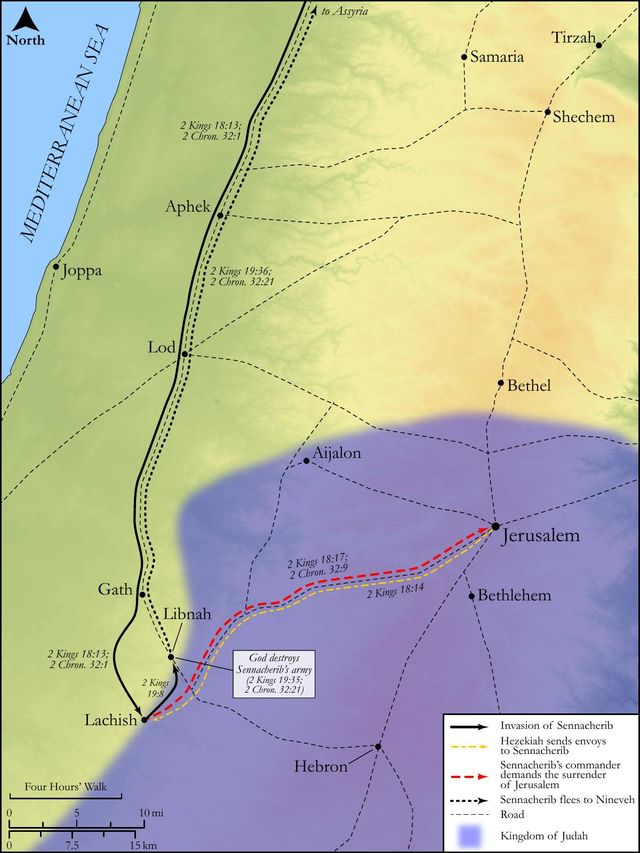
This verse is embedded within a pivotal narrative in 2 Kings 18-19, detailing Sennacherib's invasion of Judah and his siege of Jerusalem, contrasting sharply with King Hezekiah's faithful leadership. Preceding this verse, Hezekiah had attempted to appease Sennacherib with tribute, but the Assyrian king's demands escalated, leading to the direct confrontation outside Jerusalem's walls. The Rabshakeh's speech, delivered in Hebrew 2 Kings 18:26, is a calculated act of psychological warfare designed to demoralize the populace, sow distrust in Hezekiah, and, crucially, undermine their faith in Yahweh. This specific question serves as the climax of his argument, drawing a false equivalence between the true God of Israel and the impotent idols of conquered nations, thereby setting up the ultimate test of divine power that unfolds in the subsequent chapters. The narrative will pivot from this human challenge to God's direct and miraculous response, vindicating His name and demonstrating His unparalleled sovereignty.
Historical & Cultural Context
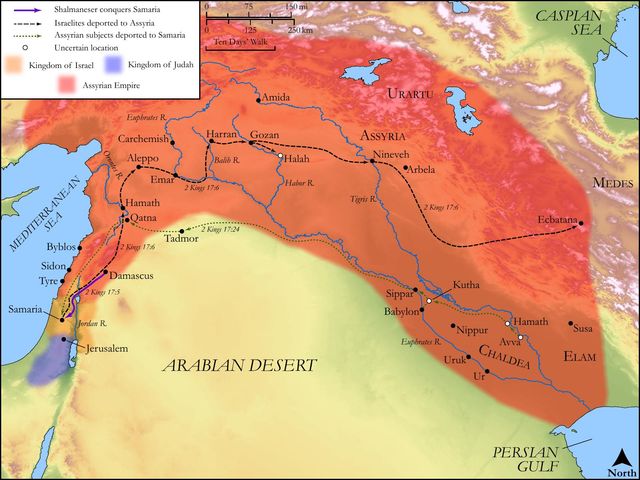
The late 8th century BCE was dominated by the Neo-Assyrian Empire, a formidable superpower known for its brutal military tactics, including siege warfare, mass deportations, and psychological intimidation. Sennacherib (reigned 705-681 BCE) was one of its most powerful rulers, whose campaigns spread terror among the nations of that day. His invasion of Judah in 701 BCE, recorded in the biblical accounts, was a major event. The Rabshakeh, a high-ranking Assyrian official, acted as Sennacherib's mouthpiece, employing common Assyrian propaganda techniques. Culturally, the Assyrians were polytheistic, often incorporating the gods of conquered peoples into their pantheon or demonstrating their superiority by showing their gods' triumph over others. Their worldview was pragmatic: a god's power was measured by its ability to protect its nation from military defeat. This stood in stark contrast to Israel's exclusive monotheism and belief in Yahweh's absolute sovereignty, independent of military outcomes, though often demonstrated through them. The Rabshakeh's challenge was thus a direct assault on the core tenets of Israelite faith.
Key Themes
ShowHideThe immediate challenge posed by the Rabshakeh highlights several overarching themes within 2 Kings and the broader Old Testament. Firstly, it underscores The Challenge to Divine Sovereignty, where human arrogance, embodied by Sennacherib, directly confronts the unique and absolute authority of Yahweh. By equating the God of Israel with the powerless idols of other nations (as referenced in the Rabshakeh's further examples in 2 Kings 18:34-35), he attempts to diminish God's incomparable power. Secondly, the narrative powerfully illustrates Human Hubris vs. Divine Power. Sennacherib's boundless pride and reliance on military might are portrayed as a direct affront to God, setting the stage for a dramatic divine judgment that often follows such arrogance in biblical narratives (e.g., Daniel 4). Finally, the verse implicitly emphasizes The Nature of True vs. False Gods. The "gods of the nations" are shown to be utterly incapable of delivering their worshippers, serving as a stark foil to the living God of Israel, who demonstrates His power to deliver His people even from the most overwhelming threats, as seen in the miraculous deliverance of Jerusalem in 2 Kings 19:35).
Exposition and Analysis
ShowHideKey Word Analysis
ShowHideThis term (H430) is the plural of ʾĕlôah, and while it can refer to the one true God (Yahweh) in many contexts, here it unequivocally refers to the false, foreign deities of the conquered nations. The Rabshakeh deliberately uses this term in a plural construct form (ʾĕlōhê) to lump Yahweh in with these impotent idols, diminishing His unique status. This choice of word highlights the polytheistic worldview of the Assyrians, where divine power is relative and contestable, directly clashing with Israel's monotheistic confession of Yahweh as the one true God.
This term (H1471), often translated "Gentiles" or "peoples," typically refers to non-Israelite nations. In the Old Testament, these nations are frequently associated with idolatry and opposition to Yahweh. The Rabshakeh's reference to "the nations" (haggôyîm, with the definite article and plural) reinforces the idea that their gods, unlike Yahweh, are localized, limited, and ultimately powerless before the might of a superior earthly king like Sennacherib. It also highlights the vast scope of Assyrian conquest, encompassing numerous peoples and their respective deities.
This primitive root (H5337) means "to snatch away," "to rescue," or "to save." In a military context, it signifies providing protection or bringing out of danger. The Rabshakeh's rhetorical question, using the Hiphil perfect form (hiṣṣîl), directly challenges the saving power of these gods. He implies that if these deities were truly powerful, they would have rescued their lands from Assyrian conquest. This word sets up the theological tension: will Yahweh prove Himself to be a deliverer, or will He be just another impotent deity in the Rabshakeh's estimation?
Verse Breakdown
ShowHide"Hath any of the gods of the nations"
This opening phrase poses a direct, rhetorical question, designed to elicit a negative answer from the audience. The Rabshakeh's tone is one of absolute certainty and condescension. By grouping Yahweh with "the gods of the nations," he attempts to strip Him of His unique identity and power, placing Him on the same level as the defeated deities of Hamath, Arpad, Sepharvaim, Hena, and Ivah (mentioned in the subsequent verse). The implication is that if these gods failed, Yahweh will surely fail too.
"delivered at all his land"
This clause specifies the nature of the failure: the inability of these gods to protect their respective territories from the Assyrian war machine. "His land" refers to the specific geographical domain over which each god was purportedly sovereign. The Rabshakeh's argument is pragmatic and empirical: the evidence of Assyrian conquest proves the impotence of these gods. The emphatic phrase "at all" reinforces the utter lack of any successful deliverance, reinforcing the Assyrian claim of invincibility.
"out of the hand of the king of Assyria?"
This concluding phrase identifies the overwhelming force against which these gods proved powerless. "The hand of the king of Assyria" is a powerful metonymy for Sennacherib's military might, oppressive power, and absolute control. It underscores the Assyrian king's self-perception as an unstoppable force, superior to all human and even divine resistance. This challenge is not merely military but profoundly theological, asserting Sennacherib's supremacy over all spiritual powers, setting him up as a rival to Yahweh Himself.
Literary Devices
ShowHideThe verse effectively employs several Literary Devices. Foremost is the Rhetorical Question, designed not for an answer but to make a forceful assertion: no god has delivered their land from Assyria. This technique is a key component of the Rabshakeh's psychological warfare, aiming to demoralize the Judeans by presenting Assyrian invincibility as an undeniable fact. There is also profound Irony at play, especially from the perspective of the biblical narrator and the faithful reader. While the Rabshakeh intends to demonstrate the impotence of all gods, his very question sets the stage for Yahweh to dramatically prove Himself as the one true God who can and will deliver. The Rabshakeh's boast also contains Hyperbole, exaggerating Assyria's unassailable power and the universal failure of all deities, which will be spectacularly disproven by God's intervention. Finally, the verse establishes a stark Contrast between the perceived power of the Assyrian king and the demonstrated impotence of the pagan gods, implicitly setting up the ultimate contrast with the incomparable power of Yahweh.
Theological and Thematic Connections
ShowHideThe Rabshakeh's blasphemous challenge in 2 Kings 18:33 is a direct assault on the core biblical doctrine of God's absolute sovereignty and uniqueness. By equating Yahweh with the lifeless idols of the nations, he attempts to reduce the Creator of the universe to a mere tribal deity, subject to the whims of human empires. This narrative serves as a powerful reminder that God's identity and power are not derived from human perception or military success, but are inherent to His being. It sets the stage for God's dramatic vindication of His own name, demonstrating that He is utterly distinct from and infinitely superior to any created power, whether human or demonic. The story underscores the biblical truth that true deliverance comes only from the Lord, who alone controls the destinies of nations and kings.
Reflection and Application
ShowHideThe ancient challenge of the Rabshakeh resonates deeply in the modern world, where various "Rabshakehs"—secular ideologies, scientific atheism, economic systems, or even overwhelming personal crises—arise to question God's power, presence, and ability to deliver. These voices often present a pragmatic, empirical argument: if God were real or powerful, why do we see so much suffering, injustice, or failure? Like the Assyrian king, they often boast of human ingenuity or worldly might as the ultimate solutions, implicitly or explicitly dismissing divine intervention. This passage calls us to discern these challenges, recognizing that they often stem from a limited, human-centric view of power. It reminds us that our faith is not in a god whose power is contingent on our circumstances or measurable by worldly metrics, but in the incomparable, sovereign Yahweh. The response of King Hezekiah—who tore his clothes, went to the house of the Lord, and prayed (2 Kings 19:1-4)—provides a timeless model for how to respond to such challenges: not with despair or compromise, but with humble reliance on God alone, trusting that His ultimate vindication will defy all human expectations.
Questions for Reflection
ShowHideFAQ
ShowHideWhy did the Rabshakeh speak in Hebrew, and what was its effect?
ShowHideThe Rabshakeh spoke in Hebrew, as explicitly noted in 2 Kings 18:26, despite his own language likely being Aramaic or Assyrian. This was a deliberate and calculated act of psychological warfare. By speaking directly to the people on the wall in their native tongue, he bypassed King Hezekiah and his officials, aiming to demoralize the populace, sow seeds of doubt, and undermine their trust in both their king and their God. The effect was intended to be fear, despair, and ultimately, surrender without further resistance. He wanted to convince them that their God was no different from the gods of other conquered nations and that resistance was futile, thus breaking their will to fight.
What was the ultimate fate of Sennacherib and the Assyrian army after this challenge?
ShowHideDespite the Rabshakeh's boasts, the Assyrian army met a catastrophic end, and Sennacherib himself was ultimately humiliated. After Hezekiah prayed fervently to the Lord, the prophet Isaiah delivered God's message of deliverance. That very night, the angel of the Lord struck down 185,000 Assyrian soldiers (as recorded in 2 Kings 19:35). Sennacherib, disgraced, returned to Nineveh. Years later, while worshipping in the temple of his god Nisroch, he was assassinated by his own sons, Adrammelech and Sharezer (as detailed in 2 Kings 19:36-37). This dramatic divine intervention served as a powerful vindication of Yahweh's sovereignty and a clear refutation of the Rabshakeh's challenge.
How does this ancient challenge to God's power relate to modern forms of idolatry or secularism?
ShowHideThe Rabshakeh's challenge, though ancient, mirrors modern forms of idolatry and secularism by questioning God's relevance and power in the face of human achievements or perceived self-sufficiency. Just as the Rabshakeh elevated Assyrian military might above all divine power, contemporary society often places ultimate trust in human reason, scientific progress, economic prosperity, political systems, or technological advancement as the ultimate "deliverers." These become functional idols when they are relied upon more than God, or when they are seen as the sole arbiters of truth and well-being. The narrative of 2 Kings 18:33 and its aftermath serves as a timeless reminder that any power or ideology that claims ultimate authority or dismisses God's sovereignty will ultimately be exposed as limited and fallible, reinforcing the biblical truth that only God is truly capable of ultimate deliverance and control over all things.
Christ-Centered Fulfillment
ShowHideThe audacious challenge of the Rabshakeh in 2 Kings 18:33, questioning Yahweh's ability to deliver, finds its ultimate and definitive answer in the person and work of Jesus Christ. While the Assyrian king's boast was met with a miraculous, albeit temporary, deliverance of Jerusalem, Christ represents the final and eternal triumph over all "gods of the nations" and all worldly powers. The Rabshakeh's rhetorical question about who can deliver from the hand of an earthly king points forward to the truth that only God can deliver humanity from the ultimate enemies: sin, death, and the power of the devil. Jesus, as the incarnate Son of God, perfectly embodies the sovereign power of Yahweh. He is the one who, through His death and resurrection, disarmed the spiritual rulers and authorities, triumphing over them (Colossians 2:15). He is the Lamb of God who takes away the sin of the world (John 1:29) and the one who upholds the universe by the word of His power (Hebrews 1:3). Every challenge to God's sovereignty, whether from ancient kings or modern ideologies, ultimately crumbles before the reality of Christ's reign, for He is the King of kings and Lord of lords, whose kingdom is eternal and whose deliverance is absolute (Revelation 19:16).