


2 Chronicles 32:3
Bible text: King James Version (1769 Blayney text) · Public domain
Bible text: Berean Standard Bible · Public domain
Bible text: American Standard Version (1901) · Public domain
Bible text: World English Bible, Messianic edition · Public domain
Bible text: Geneva Bible (1599) · Public domain
Bible text: Young's Literal Translation · Public domain
- וַיִּוָּעַץvai·yi·va·'Atzand he took counselH3289Conj-w ¦ V-Niphal-ConsecImperf-3msVerb Niphal Consecutive Imperfect 3rd Singular Masculineוַandיִּוָּעַץhe took counsel
- עִם'imwithH5973PrepPreposition
- שָׂרָיוsa·Ravhis officialsH8269N-mpc ¦ 3msNoun Plural Masculine Constructשָׂרָיofficialsוhis
- וְגִבֹּרָיוve·gi·bo·Ravand his mighty [men]H1368Conj-w ¦ N-mpc ¦ 3msNoun Plural Masculine Constructוְandגִבֹּרָיmighty [men]וhis
- לִסְתּוֹםlis·tOmto stop upH5640Prep-l ¦ V-Qal-InfVerb Qal Infinitive Constructלִtoסְתּוֹםstop up
- אֶת'et<obj.>H853DirObjMParticle Object Indicator
- מֵימֵיmei·Mei[the] waters ofH4325N-mpcNoun Plural Masculine Construct
- הָעֲיָנוֹתha·'a·ya·Notthe springsH5869Art ¦ N-fpNoun Plural Feminine Absoluteהָtheעֲיָנוֹתsprings
- אֲשֶׁר'a·SherwhichH834RelParticle Relative
- מִחוּץmi·Chutz[were] from [the] outsideH2351Prep-m ¦ N-msNoun Singular Masculine Absoluteמִ[were] fromחוּץ[the] outside
- לָעִירla·'Irof the cityH5892Prep-l ¦ N-fsNoun Singular Feminine Absoluteלָof theעִירcity
- וַיַּעְזְרוּהוּVai·ya'·ze·Ru·huand they helped himH5826Conj-w ¦ V-Qal-ConsecImperf-3mp ¦ 3msVerb Qal Consecutive Imperfect 3rd Plural Masculineוַandיַּעְזְרוּthey helpedהוּhim
English is a literal word-by-word gloss of the Hebrew, not the KJV's wording. Why?
This is the original text the KJV's translators worked from — each Hebrew word with its own literal English meaning in this verse, prepared by scholars at Tyndale House, Cambridge. The KJV translates whole sentences, not word by word, so its wording differs: one Hebrew word can become several English words, and the KJV may choose “the LORD” where the gloss reads “Yahweh”. Both are faithful — they answer different questions. For the KJV's own rendering, switch to the KJV text.
Details
See on the biblical-era maps
Study this verse
Public-domain commentary
Matthew Henry
From his Commentary on the Whole Bible. Henry comments on passages, not single verses — this entry covers 2 Chronicles 32:1–8. His two-level outline is real structure in the source text, so it is rendered as structure.
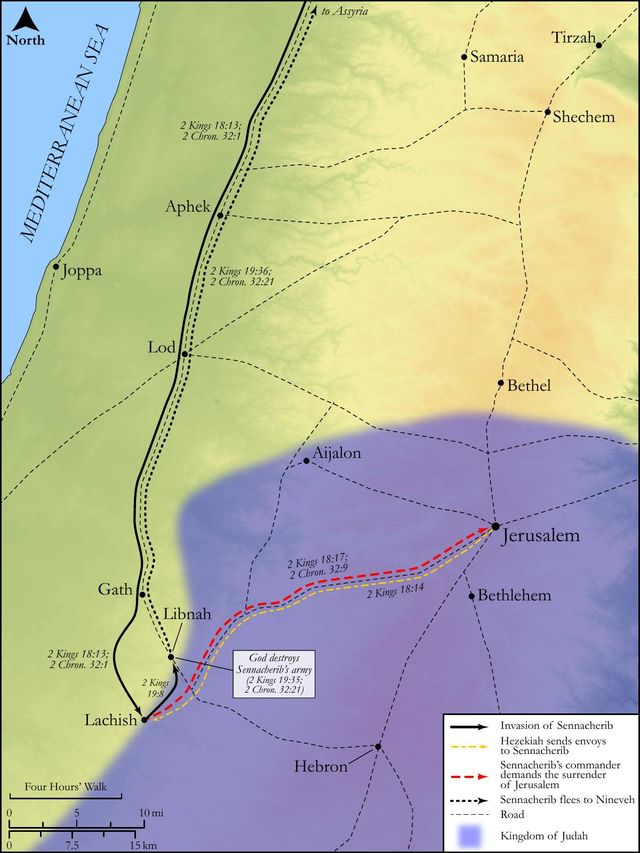
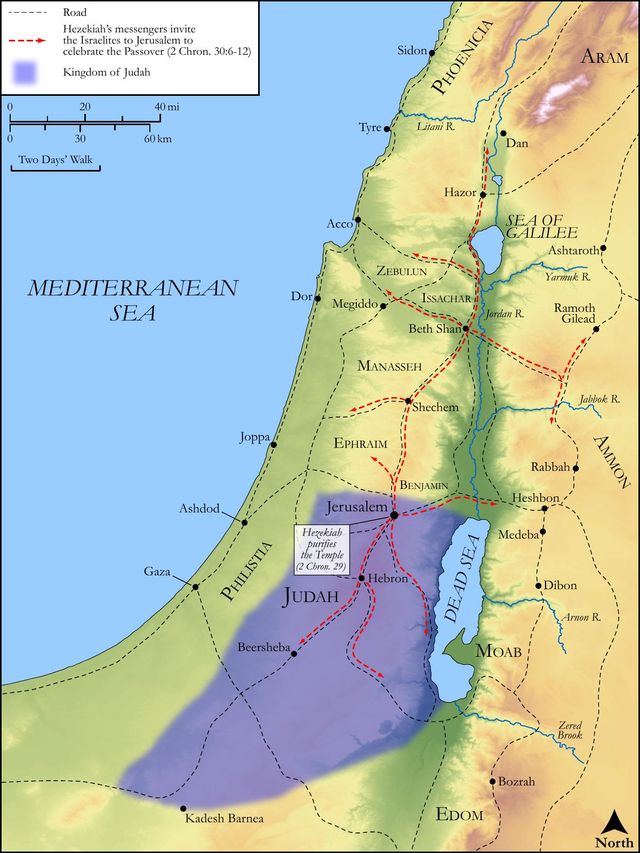
Here is, I. The formidable design of Sennacherib against Hezekiah's kingdom, and the vigorous attempt he made upon it. This Sennacherib was now, as Nebuchadnezzar was afterwards, the terror and scourge and great oppressor of that part of the world. He aimed to raise a boundless monarchy for himself upon the ruins of all his neighbours. His predecessor Shalmaneser had lately made himself master of the kingdom of Israel, and carried the ten tribes captives. Sennacherib thought, in like manner, to win Judah for himself. Pride and ambition put men upon grasping at universal dominion. It is observable that, just about this time, Rome, a city which afterwards came to reign more than any other had done over the kings of the earth, was built by Romulus. Sennacherib invaded Judah immediately after the reformation of it and the re-establishment of religion in it: After these things he entered into Judah, Ch2 32:1. 1. It was well ordered by the divine Providence that he did not give them this disturbance before the reformation was finished and established, as it might then have put a stop to it. 2. Perhaps he intended to chastise Hezekiah for destroying that idolatry to which he himself was devoted. He looked upon Hezekiah as profane in what he had done, and as having thrown himself out of the divine protection. He accordingly considered him as one who might easily be made a prey of. 3. God ordered it at this time that he might have an opportunity of showing himself strong on the behalf of this returning reforming people. He brought this trouble upon them that he might have the honour, and might put on them the honour, of their deliverance. After these things, and the establishment thereof, one would have expected to hear of nothing but perfect peace, and that none durst meddle with a people thus qualified for the divine favour; yet the next news we hear is that a threatening destroying army enters the country, and is ready to lay all waste. We may be in the way of our duty and yet meet with trouble and danger. God orders it so for the trial of our confidence in him and the manifestation of his care concerning us. The little opposition which Sennacherib met with in entering Judah induced him to imagine that all was his own. He thought to win all the fenced cities (Ch2 32:1), and purposed to fight against Jerusalem, Ch2 32:2. See Kg2 18:7, Kg2 18:13.
II.The preparation which Hezekiah prudently made against this storm that threatened him:
He took counsel with his princes what he should do, what measures he should take, Ch2 32:3. With their advice he provided,
1.That the country should give him a cold reception, for he took care that he should find no water in it (and then his army must perish for thirst), or at least that there should be a scarcity of water, by which his army would be weakened and unfitted for service. A powerful army, if it want water but a few days, will be but a heap of dry dust. All hands were set immediately to work to stop up the fountains, and the brook that ran through the midst of the land, turning that (it is probable) into the city by pipes under-ground. Such as this is the policy commonly practised now-a-days of destroying the forage before an invading army.
2.That the city should give him a warm reception. In order to this he repaired the wall, raised towers, and made darts (or, as it is in the margin, swords or weapons) and shields in abundance (Ch2 32:5), and appointed captains, Ch2 32:6. Note, Those that trust God with their safety must yet use proper means for their safety, otherwise they tempt him, and do not trust him. God will provide, but so must we also.
III.The encouragement which he gave to his people to depend upon God in this distress.
He gathered them together in a broad open street, and spoke comfortably to them, Ch2 32:6. He was himself undaunted, being confident the invasion would issue well. He was not like his father, who had much guilt to terrify him and no faith to encourage him, so that, in a time of public danger, his heart was moved, as the trees of the wood are moved with the wind, and then no marvel that the heart of his people was so too, Isa 7:2. With what he said he put life into his people, his captains especially, and spoke to their heart, as the word is.
1.He endeavoured to keep down their fears: "Be strong and courageous; do not think of surrendering the city or capitulating, but resolve to hold it out to the last man; do not think of losing the city, nor of falling into the enemy's hand; there is no danger. Let the soldiers be bold and brave, make good their posts, stand to their arms, and fight manfully, and let the citizens encourage them to do so: Be not afraid nor dismayed for the king of Assyria." The prophet had thus encouraged them from God (Isa 10:24): Be not afraid of the Assyrians; and here the king from him. Now it was that the sinners in Zion were afraid (Isa 33:14), but the righteous dwelt on high (Isa 33:15, Isa 33:16) and meditated on terror so as to conquer it. See Isa 33:18, which refers to what is recorded here.
2.He endeavoured to keep up their faith, in order to the silencing and suppressing of their fears. "Sennacherib has a multitude with him, and yet there are more with us than with him; for we have God with us, and how many do you reckon him for? With our enemy is an arm of flesh, which he trusts to; but with us is the Lord, whose power is irresistible, our God, whose promise is inviolable, a God in covenant with us, to help us, and to fight our battles, not only to help us to fight them, but to fight them for us if he please:" and so he did here. Note, A believing confidence in God will raise us above the prevailing fear of man. He that feareth the fury of the oppressor forgetteth the Lord his Maker, Isa 51:12, Isa 51:13. It is probable that Hezekiah said more to this purport, and that the people rested themselves upon what he said, not merely upon his word, but on the things he said concerning the presence of God with them and his power to relieve them, the belief of which made them easy. Let the good subjects and soldiers of Jesus Christ rest thus upon his word, and boldly say, Since God is for us, who can be against us?
Continue studying 2 Chronicles 32:3 across the web’s major study libraries — every link below opens this exact verse, chapter, or book on the destination site.
Read & Compare
 BibleGatewayThis verse in more than 200 translations and 70 languages.
 Bible.comThe YouVersion reader — hundreds of translations, reading plans, and highlights.
 ESV.orgCrossway's official English Standard Version reader.
 NET BibleThe NET translation with 60,000+ translators' notes on every rendering decision.
 STEP BibleTyndale House's free study tool — original text, vocabulary, and scholarly resources.
 BibliaLogos Bible Software's free web reader.
 USCCBThe New American Bible (Revised Edition) with the U.S. bishops' study notes.
Commentaries
 BibleHub CommentariesDozens of classic commentaries on this verse, gathered on one page.
 StudyLightMore than 100 commentary sets — the largest collection on the web.
 BibleRefPlain-English commentary on what this verse means, verse by verse.
 Enduring WordDavid Guzik's free commentary on this chapter, widely used by Bible teachers.
 Bible Study ToolsVerse commentary alongside Greek and Hebrew study aids.
Original Language & Research
- BibleHub InterlinearThe verse word by word — original language, transliteration, and English.
- BibleHub LexiconEvery word's original-language definition and Strong's entry.
 Blue Letter BibleDeep-study tools — Strong's numbers, concordance, and word studies.
 SefariaThe Hebrew text with Rashi and centuries of Jewish commentary.
Sermons, Hymns & Audio


TrulyRandomVerse is not affiliated with these sites and doesn’t control their content. They’re linked because they’re genuinely useful.
Summary
King Hezekiah of Judah, facing the imminent and formidable threat of the Assyrian invasion led by Sennacherib, demonstrated exceptional strategic foresight and collaborative leadership. This verse meticulously details his proactive and vital measure of consulting with his high-ranking officials and military commanders to block the natural water sources located outside Jerusalem. This crucial defensive action served the dual purpose of denying the advancing Assyrian forces a critical supply of water, thereby hindering their capacity for a prolonged siege, while simultaneously securing the city's own essential water access. This diligent preparation was an indispensable component of Judah's defense, showcasing a blend of human wisdom and responsible stewardship in the face of a grave national crisis.
Context
ShowHideLiterary Context
This verse is strategically placed within the narrative of 2 Chronicles 32, immediately following the ominous declaration of Sennacherib's invasion and his successful capture of Judah's fortified cities in 2 Chronicles 32:1. Hezekiah's actions in verse 3 represent the initial, practical human response to this direct and existential threat to Jerusalem. These defensive preparations logically precede the more extensive fortification efforts detailed in 2 Chronicles 32:5 and, significantly, the king's profound spiritual encouragement to his people to place their trust solely in the Lord for deliverance, as articulated in 2 Chronicles 32:7-8. The narrative structure of this chapter masterfully weaves together themes of human responsibility and divine sovereignty, illustrating that diligent human effort and wise planning are often a necessary complement to, and sometimes a prerequisite for, God's miraculous intervention and ultimate salvation.
Historical & Cultural Context
The late 8th century BC was characterized by the overwhelming dominance of the Neo-Assyrian Empire over the nations round about. Sennacherib's campaign against Judah, dated to approximately 701 BC, was a punitive expedition aimed at reasserting control over rebellious tributaries, including the kingdom of Judah. Siege warfare was the predominant military strategy of the era, and the control of water sources was absolutely paramount for the survival and operational capacity of both besiegers and besieged. Jerusalem, strategically located on a defensible ridge, relied heavily on the Gihon Spring, which, critically, lay outside the city's primary walls, rendering it vulnerable to an attacking force. Hezekiah's decisive actions in diverting and blocking these external water sources reflect a sophisticated understanding of ancient military logistics and siegecraft, where denying vital resources to the enemy was as crucial as strengthening one's own fortifications. This tactical maneuver was a common and effective practice in siege warfare, designed to weaken an enemy's resolve and capacity for prolonged engagement.
Key Themes
ShowHideThis verse powerfully encapsulates several pivotal themes that resonate throughout the broader narrative of 2 Chronicles 32. Firstly, Strategic Preparedness is vividly demonstrated by Hezekiah's proactive and intelligent planning. His decision to cut off external water sources while simultaneously ensuring an internal supply for Jerusalem—a monumental project that culminated in the engineering marvel known as Hezekiah's Tunnel—evinces remarkable foresight in anticipating the enemy's critical needs and vulnerabilities. Secondly, Collaborative Leadership is underscored by the phrase "He took counsel with his princes and his mighty men." This shows Hezekiah taking counsel: he did not act unilaterally but engaged his most trusted advisors and military commanders. This collaborative approach fostered unity, shared responsibility, and collective wisdom, which were essential for the successful execution of such a large-scale and critically important defensive project. Thirdly, the verse emphasizes the critical importance of Resource Management in Crisis, particularly water, as a strategic asset during ancient warfare. Protecting the city's life-sustaining water supply and denying it to the enemy was not merely a tactical advantage but a matter of sheer survival, showcasing the practical wisdom applied in a desperate and existential situation.
Exposition and Analysis
ShowHideKey Word Analysis
ShowHideThis verb (H3289) signifies a deliberate act of consultation, strategic planning, and seeking expert advice. It implies that Hezekiah's decision was not impulsive or arbitrary, but rather a well-considered and collaborative process involving his most trusted and capable advisors. The emphasis is on wisdom derived from collective deliberation, essential for effective leadership in a crisis. This term highlights the king's prudence in not relying solely on his own judgment but valuing the input of his experienced leaders.
This word (H5640) means to block, close up, or seal off. Its usage here indicates a thorough and effective sealing off of the water sources. It suggests a comprehensive and decisive action, not merely a partial obstruction, ensuring that the Assyrians would be completely deprived of these vital supplies. The verb implies a permanent and unyielding obstruction, reflecting the gravity of the threat and the determination of the Judean defense.
Referring to natural springs (H5869), these were critical and often irreplaceable water sources in ancient times, especially in arid regions. The specific mention of "fountains" highlights the strategic importance of these particular locations for sustaining life and military operations. As the "eye of the landscape," these springs were visible and vital points. Hezekiah's focus on these external sources demonstrates a precise understanding of the enemy's logistical needs and the vulnerability they presented to the city.
Verse Breakdown
ShowHide"He took counsel with his princes and his mighty men"
This opening clause immediately establishes King Hezekiah's leadership approach, portraying him as a wise and collaborative ruler. It emphasizes his prudence in seeking advice from his most capable civil administrators ("princes") and experienced military commanders ("mighty men"). This consultation would have involved thorough strategic discussions about the impending siege, assessing the vulnerabilities, and determining the most effective defensive measures, demonstrating a shared responsibility in governance.
"to stop the waters of the fountains which [were] without the city"
This segment clearly articulates the specific strategic objective of the consultation. The primary goal was to deny the vast and formidable invading Assyrian army access to the natural water sources located outside Jerusalem's defensive walls. This action was absolutely crucial for weakening the enemy by depriving them of a sustainable water supply, thereby severely hindering their ability to conduct a prolonged and effective siege. Implicit in this action is the simultaneous, urgent effort to secure and preserve water for Jerusalem's own inhabitants, ensuring their survival within the besieged city.
"and they did help him"
This concluding phrase serves as a powerful affirmation of the successful execution of the plan and, more importantly, highlights the unity of purpose and effective collaboration among Hezekiah and his advisors. It signifies that the counsel taken was not merely theoretical but led to tangible and effective results. This collective effort underscores the practical outcome of their wise planning and diligent work, demonstrating the unified resolve of Judah's leadership in preparing for the formidable Assyrian assault.
Literary Devices
ShowHideThe verse employs several potent literary devices to convey its profound message and underscore the gravity of the situation. Foresight is prominently displayed in Hezekiah's proactive measures, which were initiated well before the full intensity of the siege tightened around Jerusalem. This demonstrates a strategic mind that anticipates threats and acts decisively rather than merely reacting to them. The passage also utilizes Strategic Imagery, painting a vivid mental picture of ancient military planning and the critical control of vital resources, particularly water, in the context of ancient warfare. This imagery underscores the life-or-death stakes involved. Furthermore, a strong Collaborative Motif is central to the verse, emphasizing the unity, shared responsibility, and collective wisdom that existed between the king and his most trusted advisors. This internal cohesion and unified action stand in stark contrast to the impending external threat, powerfully highlighting the strength derived from internal solidarity and coordinated effort in the face of overwhelming adversity.
Theological and Thematic Connections
ShowHideHezekiah's actions in 2 Chronicles 32:3 offer a profound theological insight: human wisdom, diligent planning, and proactive effort are not antithetical to faith in God, but rather often serve as the very means through which divine providence operates. Hezekiah did not passively await God's intervention; instead, he responsibly exercised the wisdom, resources, and leadership God had entrusted to him to prepare for the impending crisis. This verse beautifully illustrates a balanced biblical perspective where human responsibility and divine sovereignty work in harmonious concert. God frequently blesses and utilizes human ingenuity, hard work, and strategic foresight, transforming practical preparations into instruments of His ultimate deliverance. This diligent preparation, far from being a sign of doubt or a lack of faith, was an act of responsible stewardship and a testament to a robust faith that understands God works through both miraculous intervention and the diligent efforts of His people.
Reflection and Application
ShowHideHezekiah's strategic foresight and collaborative leadership, as depicted in 2 Chronicles 32:3, offer enduring and profound lessons for believers navigating the complexities of contemporary life. In a world perpetually fraught with challenges—whether they manifest as personal struggles, communal crises, or spiritual battles—this verse powerfully encourages us to embrace a posture of proactive wisdom and diligent preparation. It serves as a vital reminder that while our ultimate and unshakeable trust must rest in God's sovereign power and unfailing provision, this profound faith does not negate, but rather complements, the imperative for practical action, thoughtful planning, and responsible stewardship of the gifts, resources, and opportunities God has graciously bestowed upon us. We are called to actively seek wise counsel, to humbly collaborate with others within our families, communities, and churches, and to diligently identify, protect, and manage what is truly vital for our spiritual vitality and physical well-being. Hezekiah's exemplary leadership teaches us that genuine faith is not a passive resignation to fate but an active, engaged, and responsible participation in the realities of life, all the while trusting implicitly that God will powerfully work through our dedicated efforts.
Questions for Reflection
ShowHideFAQ
ShowHideWas Hezekiah's action a sign of a lack of faith in God?
ShowHideNo, Hezekiah's actions were not a sign of a lack of faith but rather a profound demonstration of practical wisdom, responsible stewardship, and a mature understanding of how God often works through human means. The broader biblical narrative consistently portrays Hezekiah as a king of deep and abiding faith, as evidenced by his fervent and desperate prayer in 2 Kings 19:14-19 when faced with Sennacherib's threats, and his powerful encouragement to his people to rely steadfastly on God (see 2 Chronicles 32:7-8). God often chooses to work in partnership with human effort and preparation. Hezekiah's diligent efforts to secure Jerusalem's water supply and fortify its defenses were not an alternative to his spiritual reliance but rather a complementary expression of a holistic approach to leadership that seamlessly integrates both profound faith and astute practical wisdom.
How effective was this strategy of stopping the water sources?
ShowHideThis strategy was highly effective and proved to be an absolutely crucial component of Jerusalem's successful defense against the Assyrian siege. By denying the vast and thirsty Assyrian army easy access to external water, Hezekiah significantly hampered their ability to sustain a prolonged siege, especially given the arid climate of Judah. Simultaneously, Hezekiah ensured Jerusalem's internal water supply, most notably through the construction of the famous Hezekiah's Tunnel, which ingeniously diverted the Gihon Spring's water directly into the city, securing a vital resource for the besieged population. This brilliant strategic move, combined with the city's formidable fortifications, contributed immensely to the eventual failure of Sennacherib's siege, culminating in God's miraculous and decisive intervention that decimated the Assyrian army (see 2 Kings 19:35-36).
Christ-Centered Fulfillment
ShowHideHezekiah's strategic wisdom and diligent preparation in securing Jerusalem's water supply, while a remarkable act of human ingenuity and leadership, ultimately point to a far greater King and a more profound, eternal source of provision in Jesus Christ. Hezekiah sought to protect his people from a physical enemy by cutting off external, vulnerable water sources, but Christ is the true "fountain of living waters" (Jeremiah 2:13 foreshadowing His coming) who offers eternal life to all who believe, a spiritual supply that never runs dry (John 4:10-14). While Hezekiah's counsel with his princes aimed at earthly survival and physical security, Christ's perfect wisdom and divine counsel lead to salvation, spiritual flourishing, and eternal security (1 Corinthians 1:30). He is the ultimate protector, not merely against physical armies or temporary sieges, but against the spiritual forces of darkness, the power of sin, and the ultimate enemy, death. Through His sacrificial death on the cross and triumphant resurrection, Christ secured for His people an unassailable spiritual defense, providing a "wellspring of water springing up into everlasting life" within them (John 7:38 and John 4:14). In Christ, we find not just temporary relief from a physical siege, but ultimate deliverance, eternal life, and an everlasting inheritance, all secured by the perfect counsel, mighty work, and sacrificial love of the Lamb of God who takes away the sin of the world (John 1:29).