


2 Chronicles 32:2
Bible text: King James Version (1769 Blayney text) · Public domain
Bible text: Berean Standard Bible · Public domain
Bible text: American Standard Version (1901) · Public domain
Bible text: World English Bible, Messianic edition · Public domain
Bible text: Geneva Bible (1599) · Public domain
Bible text: Young's Literal Translation · Public domain
- וַיַּרְאvai·yaR'and he sawH7200Conj-w ¦ V-Qal-ConsecImperf-3msVerb Qal Consecutive Imperfect 3rd Singular Masculineוַandיַּרְאhe saw
- יְחִזְקִיָּהוּye·chiz·ki·Ya·huHezekiahH2396N-proper-mNoun Proper Masculine
- כִּיkithatH3588PrtParticle Conditional
- בָאva'he had comeH935V-Qal-Perf-3msVerb Qal Perfect 3rd Singular Masculine
- סַנְחֵרִיבsan·che·RivSennacheribH5576N-proper-mNoun Proper Masculine
- וּפָנָיוu·fa·Navand his faceH6440Conj-w ¦ N-mpc ¦ 3msNoun Plural Masculine Constructוּandפָנָיfaceוhis
- לַמִּלְחָמָהla·mil·cha·Mah[was] for warH4421Prep-l ¦ N-fsNoun Singular Feminine Absoluteלַ[was] forמִּלְחָמָהwar
- עַל'alonH5921PrepPreposition
- יְרוּשָׁלִָםye·ru·sha·LimJerusalemH3389N-properNoun Proper Location
English is a literal word-by-word gloss of the Hebrew, not the KJV's wording. Why?
This is the original text the KJV's translators worked from — each Hebrew word with its own literal English meaning in this verse, prepared by scholars at Tyndale House, Cambridge. The KJV translates whole sentences, not word by word, so its wording differs: one Hebrew word can become several English words, and the KJV may choose “the LORD” where the gloss reads “Yahweh”. Both are faithful — they answer different questions. For the KJV's own rendering, switch to the KJV text.
Details
See on the biblical-era maps
Study this verse
Public-domain commentary
Matthew Henry
From his Commentary on the Whole Bible. Henry comments on passages, not single verses — this entry covers 2 Chronicles 32:1–8. His two-level outline is real structure in the source text, so it is rendered as structure.
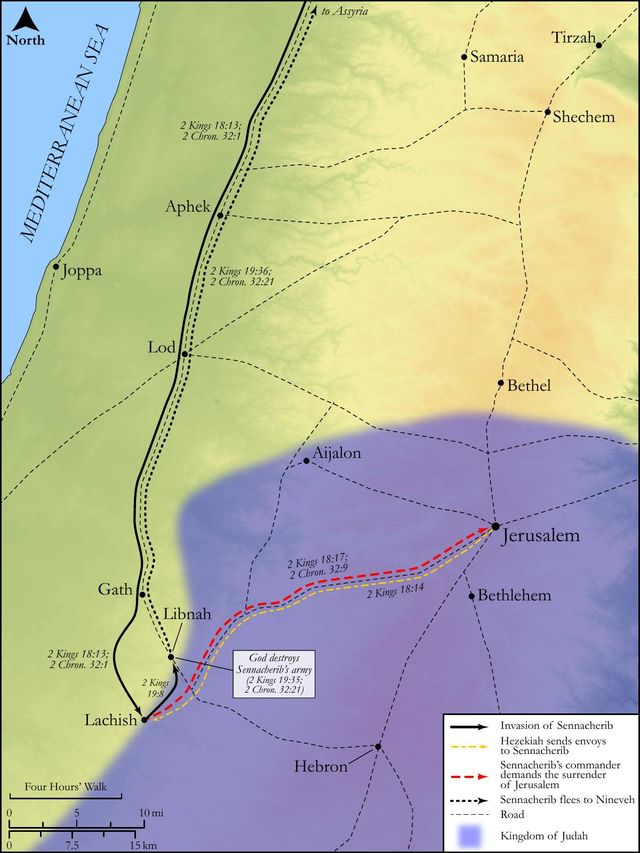
Here is, I. The formidable design of Sennacherib against Hezekiah's kingdom, and the vigorous attempt he made upon it. This Sennacherib was now, as Nebuchadnezzar was afterwards, the terror and scourge and great oppressor of that part of the world. He aimed to raise a boundless monarchy for himself upon the ruins of all his neighbours. His predecessor Shalmaneser had lately made himself master of the kingdom of Israel, and carried the ten tribes captives. Sennacherib thought, in like manner, to win Judah for himself. Pride and ambition put men upon grasping at universal dominion. It is observable that, just about this time, Rome, a city which afterwards came to reign more than any other had done over the kings of the earth, was built by Romulus. Sennacherib invaded Judah immediately after the reformation of it and the re-establishment of religion in it: After these things he entered into Judah, Ch2 32:1. 1. It was well ordered by the divine Providence that he did not give them this disturbance before the reformation was finished and established, as it might then have put a stop to it. 2. Perhaps he intended to chastise Hezekiah for destroying that idolatry to which he himself was devoted. He looked upon Hezekiah as profane in what he had done, and as having thrown himself out of the divine protection. He accordingly considered him as one who might easily be made a prey of. 3. God ordered it at this time that he might have an opportunity of showing himself strong on the behalf of this returning reforming people. He brought this trouble upon them that he might have the honour, and might put on them the honour, of their deliverance. After these things, and the establishment thereof, one would have expected to hear of nothing but perfect peace, and that none durst meddle with a people thus qualified for the divine favour; yet the next news we hear is that a threatening destroying army enters the country, and is ready to lay all waste. We may be in the way of our duty and yet meet with trouble and danger. God orders it so for the trial of our confidence in him and the manifestation of his care concerning us. The little opposition which Sennacherib met with in entering Judah induced him to imagine that all was his own. He thought to win all the fenced cities (Ch2 32:1), and purposed to fight against Jerusalem, Ch2 32:2. See Kg2 18:7, Kg2 18:13.
II.The preparation which Hezekiah prudently made against this storm that threatened him:
He took counsel with his princes what he should do, what measures he should take, Ch2 32:3. With their advice he provided,
1.That the country should give him a cold reception, for he took care that he should find no water in it (and then his army must perish for thirst), or at least that there should be a scarcity of water, by which his army would be weakened and unfitted for service. A powerful army, if it want water but a few days, will be but a heap of dry dust. All hands were set immediately to work to stop up the fountains, and the brook that ran through the midst of the land, turning that (it is probable) into the city by pipes under-ground. Such as this is the policy commonly practised now-a-days of destroying the forage before an invading army.
2.That the city should give him a warm reception. In order to this he repaired the wall, raised towers, and made darts (or, as it is in the margin, swords or weapons) and shields in abundance (Ch2 32:5), and appointed captains, Ch2 32:6. Note, Those that trust God with their safety must yet use proper means for their safety, otherwise they tempt him, and do not trust him. God will provide, but so must we also.
III.The encouragement which he gave to his people to depend upon God in this distress.
He gathered them together in a broad open street, and spoke comfortably to them, Ch2 32:6. He was himself undaunted, being confident the invasion would issue well. He was not like his father, who had much guilt to terrify him and no faith to encourage him, so that, in a time of public danger, his heart was moved, as the trees of the wood are moved with the wind, and then no marvel that the heart of his people was so too, Isa 7:2. With what he said he put life into his people, his captains especially, and spoke to their heart, as the word is.
1.He endeavoured to keep down their fears: "Be strong and courageous; do not think of surrendering the city or capitulating, but resolve to hold it out to the last man; do not think of losing the city, nor of falling into the enemy's hand; there is no danger. Let the soldiers be bold and brave, make good their posts, stand to their arms, and fight manfully, and let the citizens encourage them to do so: Be not afraid nor dismayed for the king of Assyria." The prophet had thus encouraged them from God (Isa 10:24): Be not afraid of the Assyrians; and here the king from him. Now it was that the sinners in Zion were afraid (Isa 33:14), but the righteous dwelt on high (Isa 33:15, Isa 33:16) and meditated on terror so as to conquer it. See Isa 33:18, which refers to what is recorded here.
2.He endeavoured to keep up their faith, in order to the silencing and suppressing of their fears. "Sennacherib has a multitude with him, and yet there are more with us than with him; for we have God with us, and how many do you reckon him for? With our enemy is an arm of flesh, which he trusts to; but with us is the Lord, whose power is irresistible, our God, whose promise is inviolable, a God in covenant with us, to help us, and to fight our battles, not only to help us to fight them, but to fight them for us if he please:" and so he did here. Note, A believing confidence in God will raise us above the prevailing fear of man. He that feareth the fury of the oppressor forgetteth the Lord his Maker, Isa 51:12, Isa 51:13. It is probable that Hezekiah said more to this purport, and that the people rested themselves upon what he said, not merely upon his word, but on the things he said concerning the presence of God with them and his power to relieve them, the belief of which made them easy. Let the good subjects and soldiers of Jesus Christ rest thus upon his word, and boldly say, Since God is for us, who can be against us?
Continue studying 2 Chronicles 32:2 across the web’s major study libraries — every link below opens this exact verse, chapter, or book on the destination site.
Read & Compare
 BibleGatewayThis verse in more than 200 translations and 70 languages.
 Bible.comThe YouVersion reader — hundreds of translations, reading plans, and highlights.
 ESV.orgCrossway's official English Standard Version reader.
 NET BibleThe NET translation with 60,000+ translators' notes on every rendering decision.
 STEP BibleTyndale House's free study tool — original text, vocabulary, and scholarly resources.
 BibliaLogos Bible Software's free web reader.
 USCCBThe New American Bible (Revised Edition) with the U.S. bishops' study notes.
Commentaries
 BibleHub CommentariesDozens of classic commentaries on this verse, gathered on one page.
 StudyLightMore than 100 commentary sets — the largest collection on the web.
 BibleRefPlain-English commentary on what this verse means, verse by verse.
 Enduring WordDavid Guzik's free commentary on this chapter, widely used by Bible teachers.
 Bible Study ToolsVerse commentary alongside Greek and Hebrew study aids.
Original Language & Research
- BibleHub InterlinearThe verse word by word — original language, transliteration, and English.
- BibleHub LexiconEvery word's original-language definition and Strong's entry.
 Blue Letter BibleDeep-study tools — Strong's numbers, concordance, and word studies.
 SefariaThe Hebrew text with Rashi and centuries of Jewish commentary.
Sermons, Hymns & Audio


TrulyRandomVerse is not affiliated with these sites and doesn’t control their content. They’re linked because they’re genuinely useful.
Summary
King Hezekiah of Judah confronts the grim reality of the impending Assyrian invasion led by Sennacherib. Having already subdued many fortified cities throughout Judah, Sennacherib's unwavering intention to besiege and conquer Jerusalem becomes undeniably clear to Hezekiah, setting the stage for a dramatic and divinely-orchestrated confrontation between overwhelming human might and God's miraculous intervention. This verse powerfully underscores the immediate and tangible nature of the threat, compelling Hezekiah to initiate both strategic preparations and a profound spiritual response in the face of seemingly insurmountable odds.
Context
ShowHideLiterary Context
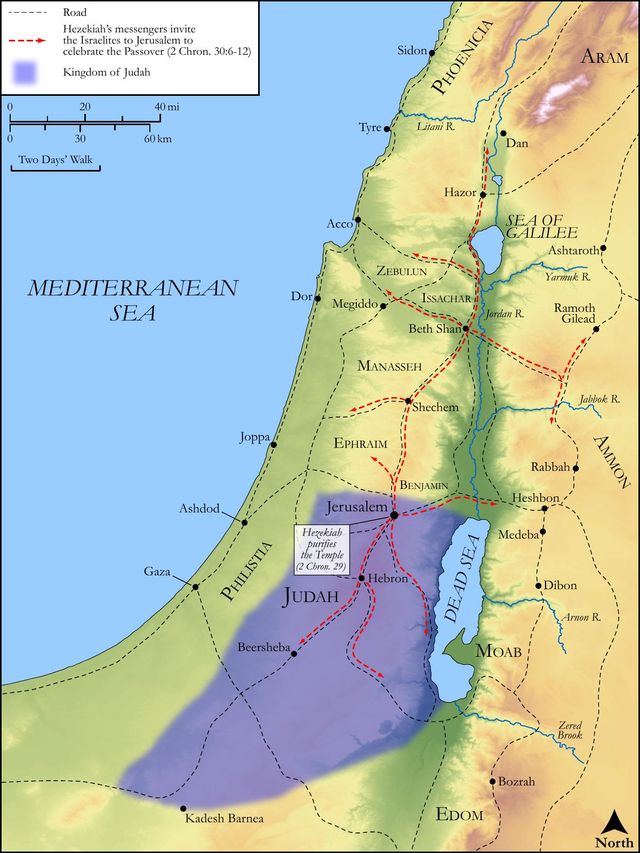
This verse immediately follows 2 Chronicles 32:1, which succinctly states that "after these things, and the establishment thereof, Sennacherib king of Assyria came, and entered into Judah, and encamped against the fenced cities, and thought to win them for himself." Thus, 2 Chronicles 32:2 describes Hezekiah's personal observation and acute recognition of a threat that has already begun to materialize and intensify. The preceding chapters (2 Chronicles 29-31) meticulously detail King Hezekiah's extensive religious reforms, including the cleansing and rededication of the Temple, the restoration of the Passover celebration, and the re-establishment of the Levitical service. This period of profound spiritual revival and national repentance provides a stark and poignant contrast to the formidable military crisis that now looms, highlighting that even a righteous king and a reformed nation are not immune to severe external challenges. The narrative then progresses to vividly describe Hezekiah's proactive defensive preparations, his defiant message of faith to the people, Sennacherib's blasphemous taunts and psychological warfare, and ultimately, God's miraculous and decisive deliverance of Jerusalem, culminating in Sennacherib's ignominious retreat and subsequent death (2 Chronicles 32:3-23). This significant historical episode is also recounted in parallel accounts found in 2 Kings 18-19 and Isaiah 36-37.
Historical & Cultural Context
The late 8th century BCE was unequivocally dominated by the Neo-Assyrian Empire, an unparalleled military superpower renowned for its ruthless efficiency, brutal siege tactics, mass deportations, and sophisticated psychological warfare. Sennacherib, who reigned from 705-681 BCE, was one of Assyria's most formidable and ambitious kings, whose own royal annals boast of widespread conquests and the subjugation of numerous tributary kings. His meticulously documented campaign against Judah in 701 BCE was part of a broader, strategic effort to reassert absolute Assyrian control over rebellious tributaries, particularly those that had withheld tribute and sought alliances with regional rivals like Egypt. Judah, under King Hezekiah, had indeed ceased paying tribute to Assyria and had engaged in diplomatic overtures with Egypt, thereby provoking Sennacherib's wrath and military response. Jerusalem, while a significant and strategically located city, was not militarily comparable in sheer scale to Assyrian strongholds like Nineveh or Babylonian metropolises, yet its symbolic importance as the capital of Judah and, crucially, the site of God's Temple, made it a prime and indispensable target for Assyrian conquest. The standard Assyrian military approach involved overwhelming force, cutting off vital water supplies, and employing advanced siege ramps and battering rams, as chillingly evidenced by archaeological finds such as the Lachish reliefs, which graphically depict the brutal Assyrian conquest of the Judean city of Lachish, serving as a stark and terrifying precedent for what awaited Jerusalem. Hezekiah's "seeing" of Sennacherib's advance was therefore far more than a mere visual observation; it was an acute and terrifying awareness of a sophisticated, devastating, and seemingly unstoppable military machine bearing down upon his kingdom's very heart.
Key Themes
ShowHide2 Chronicles 32:2 introduces and reinforces several critical themes that permeate not only this chapter but also the broader historical and theological narrative of Judah. Firstly, it starkly highlights the imminence of threat and the undeniable reality of external adversaries, even for God's chosen people and a nation undergoing spiritual revival. Hezekiah's clear and unclouded perception of Sennacherib's "purpose to fight" underscores the unavoidable and tangible nature of the impending conflict, demonstrating that faithfulness does not guarantee immunity from hardship. Secondly, the verse subtly yet powerfully introduces the theme of human preparation coupled with divine reliance. Hezekiah's immediate recognition of the danger directly precedes his proactive and strategic measures to strengthen Jerusalem's defenses (2 Chronicles 32:3-6), yet the ultimate and miraculous deliverance comes solely through God's intervention, emphasizing that human effort, no matter how diligent, must always be coupled with absolute and unwavering trust in God's sovereign power and faithfulness, a truth powerfully articulated by Hezekiah himself in 2 Chronicles 32:7-8. Thirdly, it meticulously sets the stage for the overarching theme of God's sovereignty and unwavering faithfulness in protecting His covenant people and His holy city, even when they face seemingly insurmountable odds and overwhelming human might. This narrative serves as a profound and enduring testament to the truth that "the Lord saves by many or by few" (1 Samuel 14:6). Finally, the verse contributes to the Chronicler's overarching theological theme of retribution and divine justice, where the immense pride, arrogance, and blasphemy of Sennacherib are ultimately met with God's swift and decisive judgment, demonstrating that no earthly power can ultimately thwart the divine will.
Exposition and Analysis
ShowHideKey Word Analysis
ShowHideThis Hebrew verb (H7200) denotes more than mere physical sight; it signifies a deep, insightful perception, understanding, and discerning recognition of a situation. Hezekiah did not simply observe Sennacherib's army; he "saw" the full, grave implications of their presence and their hostile, conquering intent. This implies a clear, unclouded comprehension of a dire reality, which is crucial for a leader who must make appropriate and timely responses in a crisis. It speaks to a discerning awareness that moves beyond superficial observation to grasp the underlying truth.
While the KJV translates this as "purposed," the underlying Hebrew word (H6440) literally means "face" or "presence." In this context, with a prepositional prefix, it conveys the idea of setting one's face toward something, indicating a fixed, deliberate, and unyielding intention or resolve. Sennacherib's "face was set" toward Jerusalem for battle. This signifies not a casual skirmish or a mere show of force, but a determined and calculated plan for full-scale military engagement aimed at absolute conquest. It leaves no doubt about the Assyrian king's aggressive and unyielding objective.
This noun (H4421), derived from a root meaning "to fight," refers to a battle, engagement, or generally, warfare. When combined with "purposed," it emphasizes the concrete and violent nature of Sennacherib's intention. It signifies a full-scale, aggressive military conflict, not a negotiation or a minor skirmish. The choice of this word underscores the gravity of the threat: Sennacherib was not merely passing through or demanding tribute; he was coming for war, for the complete subjugation and destruction of Jerusalem.
Verse Breakdown
ShowHide"And when Hezekiah saw"
This opening phrase immediately places the focus squarely on King Hezekiah's personal awareness and his subsequent response. The temporal "when" establishes a direct cause-and-effect relationship: his observation directly triggers the events that follow. His "seeing" is not passive; it is an active, discerning recognition of the unfolding, grave threat, which is absolutely crucial for a leader burdened with the immense responsibility of making critical decisions for his nation. It conveys a sense of urgency and the profound weight of the situation resting upon the king's shoulders.
"that Sennacherib was come"
This clause confirms the undeniable physical presence of the formidable Assyrian king and his military forces within Judah. Sennacherib's arrival in Judah, already mentioned in 2 Chronicles 32:1 as encamping against fortified cities, now becomes a direct, undeniable reality specifically concerning Jerusalem. It signifies the culmination of the Assyrian campaign, with the enemy reaching the very gates of the capital, transforming what might have been a distant, abstract threat into an immediate, tangible, and terrifying danger.
"and that he was purposed to fight against Jerusalem"
This final and most critical clause reveals the specific, ultimate, and hostile objective of Sennacherib's presence: the complete conquest of Jerusalem. The phrase "purposed to fight" leaves absolutely no ambiguity about his aggressive and destructive intent. It was not merely a passage through Judah, a demand for renewed tribute, or a show of force, but a direct, full-scale military assault aimed at the capital city—the very heart of Judah, the seat of the Davidic dynasty, and the symbolic dwelling place of God. This clear and unambiguous intention necessitates a decisive, immediate, and ultimately faith-filled response from Hezekiah and the people of Judah.
Literary Devices
ShowHideThe verse, though concise, masterfully employs several literary devices to convey its profound message and set the narrative's tone. Foreshadowing is prominently evident as Hezekiah's acute perception of Sennacherib's hostile and determined intent immediately sets the stage for the dramatic and climactic siege of Jerusalem and the subsequent miraculous divine deliverance that will follow. The simple yet powerful statement of Sennacherib's "purpose to fight" against Jerusalem creates an immediate sense of tension, urgency, and anticipation of the monumental conflict to come. There is also a subtle but significant use of Contrast woven into the narrative, highlighting the vast disparity between the overwhelming human perception of Assyrian military might and the underlying divine reality of ultimate control, a contrast that will become fully and gloriously apparent in the subsequent verses where God intervenes decisively. Furthermore, the verse functions as a moment of Anagnorisis (recognition or discovery) for Hezekiah, a critical turning point where the king fully grasps the immense gravity and precise nature of the existential threat, moving from a general awareness of Assyrian aggression to a specific and terrifying understanding of the direct, impending assault on Jerusalem. This profound realization serves as the indispensable catalyst for his subsequent strategic defensive actions and, more importantly, his profound spiritual reliance on God.
Theological and Thematic Connections
ShowHide2 Chronicles 32:2 serves as a crucial theological pivot, profoundly emphasizing that even a nation recently reformed and led by a righteous king like Hezekiah is not exempt from severe trials, external pressures, or direct confrontations with powerful adversaries. It starkly highlights the enduring reality of spiritual warfare and the constant presence of forces that "purpose to fight" against God's people, His divine purposes, and His established kingdom. The verse underscores the paramount importance of discerning the true nature of threats—whether they manifest as physical armies, spiritual attacks, insidious societal pressures, personal crises, or direct ideological opposition to faith—and the danger of living in denial or complacency. Theologically, it meticulously sets the stage for a profound and dramatic demonstration of God's absolute sovereignty and His unwavering commitment to His covenant promises, even when human strength, strategic planning, and military might seem utterly inadequate against overwhelming odds. It serves as a timeless reminder that while human leaders must be vigilant, proactive, and responsible in their preparations, ultimate security, deliverance, and victory rest solely and completely in the mighty hands of the Almighty God.
Reflection and Application
ShowHideFor believers today, 2 Chronicles 32:2 offers a profound and immensely practical lesson in spiritual discernment and courageous, faith-filled response. Just as King Hezekiah "saw" the clear and present danger posed by the formidable Sennacherib, we are called to be acutely aware and discerning of the various challenges and adversaries we face in our own lives—whether they manifest as overt spiritual attacks, subtle societal pressures that compromise faith, deeply personal crises, or direct opposition to the gospel and the values of God's kingdom. This verse powerfully encourages us not to be naive, complacent, or passive in the face of such threats, but rather to recognize their true nature, their underlying intent, and their potential impact. Hezekiah's clear-eyed and realistic assessment of the situation was the necessary first step before he could implement strategic defensive measures and, crucially, turn to God in earnest prayer and unwavering trust. Similarly, our recognition of challenges should lead us not to despair or fear, but to strategic, Spirit-led action coupled with absolute and unwavering reliance on divine strength, wisdom, and protection. It serves as a timeless reminder that even when the enemy's "purpose to fight" seems overwhelmingly powerful and insurmountable, our ultimate hope, defense, and deliverance lie solely in the God who fights for us, as Hezekiah later declared with profound conviction in 2 Chronicles 32:7-8.
Questions for Reflection
ShowHideFAQ
ShowHideWhat was the significance of Sennacherib's "purposed to fight against Jerusalem"?
ShowHideThe significance of Sennacherib's explicit "purpose to fight against Jerusalem" was profoundly multifaceted and carried immense theological weight. Firstly, it represented the ultimate and decisive objective of the Assyrian campaign. Having already conquered numerous fortified cities throughout Judah (as explicitly noted in 2 Chronicles 32:1), Jerusalem stood as the capital, the seat of the Davidic king, and, most importantly, the sacred location of the Temple, symbolizing God's very presence among His covenant people. Its capture would have been a catastrophic blow to Judah's sovereignty, a devastating end to the Davidic dynasty, and a profound theological crisis for the people, potentially leading to the utter collapse of the covenant promises. Secondly, Sennacherib's direct and unwavering focus on Jerusalem, rather than merely demanding tribute or a renewed oath of allegiance, indicated his absolute intent to completely subjugate Judah and eliminate any lingering resistance, likely in response to Hezekiah's earlier rebellion against Assyrian overlordship. This was a campaign of total conquest. Finally, and most crucially from a biblical perspective, this specific and audacious purpose set the stage for one of the most dramatic and powerful demonstrations of divine intervention in Old Testament history, as God Himself would ultimately and miraculously defend His holy city against the formidable and seemingly unstoppable Assyrian army, as vividly recounted in 2 Chronicles 32:21-22.
Christ-Centered Fulfillment
ShowHideWhile 2 Chronicles 32:2 describes a specific historical military threat against ancient Jerusalem, it powerfully foreshadows the ultimate spiritual battle and the triumphant victory of God's eternal King. Hezekiah, as a righteous king who demonstrates unwavering trust in the Lord amidst overwhelming odds, serves as a compelling type of Christ, who would face the ultimate "Sennacherib"—Satan, the relentless accuser and adversary, who is eternally "purposed to fight" against God's people, His divine kingdom, and His redemptive plan for humanity. Just as Sennacherib sought to conquer and destroy Jerusalem, Satan seeks to conquer human souls, to enslave humanity to sin, and to undermine God's sovereign will and redemptive purposes. However, the miraculous victory secured by God through Hezekiah's faith points to the far greater, more decisive, and eternal victory achieved by Jesus Christ. Through His sacrificial death on the cross and His glorious resurrection, Christ decisively disarmed the spiritual forces of evil, triumphing over them publicly and completely (Colossians 2:15). He is the true King who, through His perfect sacrifice, has taken away the sin of the world (John 1:29) and utterly defeated death itself, thereby freeing all those who were held in its bondage and fear (Hebrews 2:14-15). The historical deliverance of Jerusalem from Sennacherib's physical threat thus anticipates the spiritual and eternal deliverance of all who believe in Christ from the dominion of sin, death, and the devil, establishing an eternal kingdom that no enemy, no matter how powerful or how resolutely "purposed to fight," can ever conquer or diminish (Revelation 11:15).