


2 Kings 12:17
Bible text: King James Version (1769 Blayney text) · Public domain
Bible text: Berean Standard Bible · Public domain
Bible text: American Standard Version (1901) · Public domain
Bible text: World English Bible, Messianic edition · Public domain
Bible text: Geneva Bible (1599) · Public domain
Bible text: Young's Literal Translation · Public domain
- אָז'azthenH227AdvAdverb
- יַעֲלֶהya·'a·Lehhe went upH5927V-Qal-Imperf-3msVerb Qal Imperfect 3rd Singular Masculine
- חֲזָאֵלcha·za·'ElHazaelH2371N-proper-mNoun Proper Masculine
- מֶלֶךְMe·lekh[the] king ofH4428N-mscNoun Singular Masculine Construct
- אֲרָם'a·RamAramH758N-properNoun Proper Location
- וַיִּלָּחֶםvai·yi·La·chemand he foughtH3898Conj-w ¦ V-Niphal-ConsecImperf-3msVerb Niphal Consecutive Imperfect 3rd Singular Masculineוַandיִּלָּחֶםhe fought
- עַל'alonH5921PrepPreposition
- גַּתgatGathH1661N-properNoun Proper Location
- וַיִּלְכְּדָהּvai·yil·ke·Dahand he captured itH3920Conj-w ¦ V-Qal-ConsecImperf-3ms ¦ 3fsVerb Qal Consecutive Imperfect 3rd Singular Masculineוַandיִּלְכְּדָhe capturedהּit
- וַיָּשֶׂםvai·Ya·semand he setH7760Conj-w ¦ V-Qal-ConsecImperf-3msVerb Qal Consecutive Imperfect 3rd Singular Masculineוַandיָּשֶׂםhe set
- חֲזָאֵלcha·za·'ElHazaelH2371N-proper-mNoun Proper Masculine
- פָּנָיוpa·Navhis faceH6440N-mpc ¦ 3msNoun Plural Masculine Constructפָּנָיfaceוhis
- לַעֲלוֹתla·'a·Lotto go upH5927Prep-l ¦ V-Qal-InfVerb Qal Infinitive Constructלַtoעֲלוֹתgo up
- עַל'alonH5921PrepPreposition
- יְרוּשָׁלִָםye·ru·sha·LimJerusalemH3389N-properNoun Proper Location
English is a literal word-by-word gloss of the Hebrew, not the KJV's wording. Why?
This is the original text the KJV's translators worked from — each Hebrew word with its own literal English meaning in this verse, prepared by scholars at Tyndale House, Cambridge. The KJV translates whole sentences, not word by word, so its wording differs: one Hebrew word can become several English words, and the KJV may choose “the LORD” where the gloss reads “Yahweh”. Both are faithful — they answer different questions. For the KJV's own rendering, switch to the KJV text.
Details
See on the biblical-era map
Study this verse
Public-domain commentary
Matthew Henry
From his Commentary on the Whole Bible. Henry comments on passages, not single verses — this entry covers 2 Kings 12:17–21. His two-level outline is real structure in the source text, so it is rendered as structure.
When Joash had revolted from God and become both an idolater and a persecutor the hand of the Lord went out against him, and his last state was worse than his first.
I.His wealth and honour became an easy prey to his neighbours.
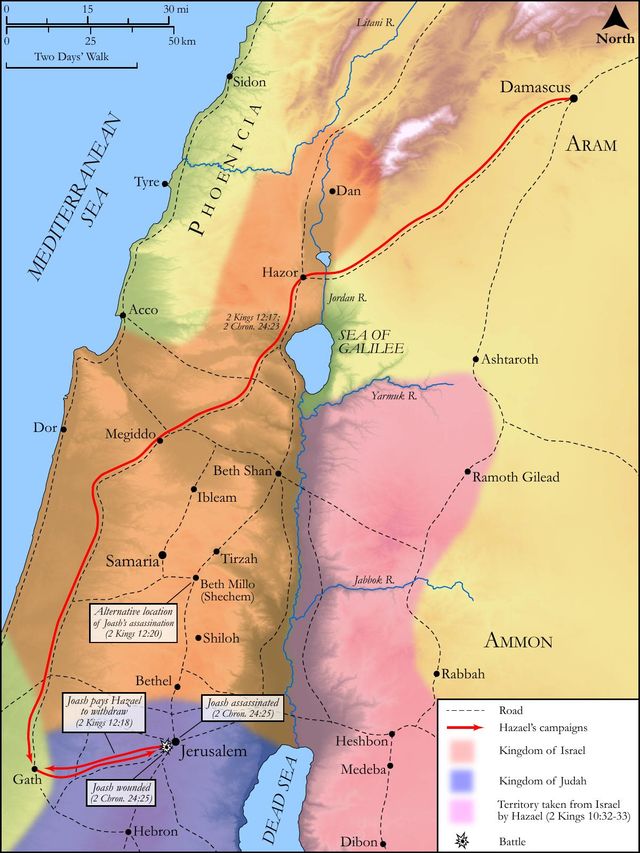
Hazael, when he had chastised Israel (Kg2 10:32), threatened Judah and Jerusalem likewise, took Gath, a strong city (Kg2 12:17), and thence intended to march with his forces against Jerusalem, the royal city, the holy city, but whose defence, on account of its sinfulness, had departed. Joash had neither spirit nor strength to make head against him, but gave him all the hallowed things, and all the gold that was found both in his exchequer and in the treasures of the temple (Kg2 12:18), to bribe him to march another way. If it were lawful to do this for the public safety, better part with the gold of the temple than expose the temple itself; yet,
1.If he had not forsaken God, and forfeited his protection, his affairs would not have been brought to this extremity, but he might have forced Hazael to retire.
2.He diminished himself, and made himself very mean, lost the honour of a prince and a soldier, and of an Israelite too, in alienating the dedicated things.
3.He impoverished himself and his kingdom. And,
4.He tempted Hazael to come again, when he could carry home so rich a booty without striking a stroke. And it had this effect, for the next year the host of Syria came up against Jerusalem, destroyed the prince, and plundered the city, Ch2 24:23, Ch2 24:24.
II.His life became an easy prey to his own servants.
They conspired against him and slew him (Kg2 12:20, Kg2 12:21), not aiming at his kingdom, for they opposed not his son's succeeding him, but to be avenged on him for some crime he had committed; and we are told in Chronicles that his murdering the prophet, Jehoiada's son, was the provocation. In this, how unrighteous soever they were (vengeance was not theirs, nor did it belong to them to repay), God was righteous; and this was not the only time that he let even kings know that it was at their peril if they touched his anointed and did his prophets any harm, and that, when he comes to make inquisition for blood, the blood of prophets will run the account very high. Thus fell Joash, who began in the spirit and ended in the flesh. God usually sets marks of his displeasure upon apostates, even in this life; for they, of all sinners, do most reproach the Lord.
Continue studying 2 Kings 12:17 across the web’s major study libraries — every link below opens this exact verse, chapter, or book on the destination site.
Read & Compare
 BibleGatewayThis verse in more than 200 translations and 70 languages.
 Bible.comThe YouVersion reader — hundreds of translations, reading plans, and highlights.
 ESV.orgCrossway's official English Standard Version reader.
 NET BibleThe NET translation with 60,000+ translators' notes on every rendering decision.
 STEP BibleTyndale House's free study tool — original text, vocabulary, and scholarly resources.
 BibliaLogos Bible Software's free web reader.
 USCCBThe New American Bible (Revised Edition) with the U.S. bishops' study notes.
Commentaries
 BibleHub CommentariesDozens of classic commentaries on this verse, gathered on one page.
 StudyLightMore than 100 commentary sets — the largest collection on the web.
 BibleRefPlain-English commentary on what this verse means, verse by verse.
 Enduring WordDavid Guzik's free commentary on this chapter, widely used by Bible teachers.
 Bible Study ToolsVerse commentary alongside Greek and Hebrew study aids.
Original Language & Research
- BibleHub InterlinearThe verse word by word — original language, transliteration, and English.
- BibleHub LexiconEvery word's original-language definition and Strong's entry.
 Blue Letter BibleDeep-study tools — Strong's numbers, concordance, and word studies.
 SefariaThe Hebrew text with Rashi and centuries of Jewish commentary.
Sermons, Hymns & Audio


TrulyRandomVerse is not affiliated with these sites and doesn’t control their content. They’re linked because they’re genuinely useful.
Summary
Second Kings 12:17 presents a critical and foreboding moment during the reign of King Joash of Judah, vividly portraying the relentless military expansion of Hazael, the powerful king of Aram (Syria). Having already demonstrated his formidable might by successfully besieging and capturing the strategically vital Philistine city of Gath, Hazael's immediate and unwavering resolve to march upon Jerusalem signaled an imminent and grave existential threat to the capital of Judah, thereby exposing the kingdom's vulnerable geopolitical standing and its susceptibility to the aggressive ambitions of dominant regional adversaries.
Context
ShowHideLiterary Context
This verse is strategically placed within the broader narrative detailing the reign of King Joash of Judah, a period predominantly marked by his commendable efforts to repair and restore the dilapidated Temple in Jerusalem, as extensively chronicled in 2 Kings 12:4-16. The preceding verses meticulously highlight Joash's piety and his dedicated commitment to the sanctity of the Lord's house, making the sudden, aggressive appearance of Hazael's military campaign a stark and unsettling contrast. This abrupt shift introduces an immediate and severe challenge to the kingdom's hard-won stability. The verse directly follows the triumphant account of the Temple's successful restoration, thereby setting a dramatic stage for the subsequent events described in 2 Kings 12:18, where Joash is compelled to strip the Temple and royal palace of their treasures to appease the Syrian king. This narrative sequence powerfully underscores the precarious security of Judah, even under the leadership of a righteous king, when confronted by an overwhelming external power.
Historical & Cultural Context
Hazael was a profoundly influential and ruthless king of Aram-Damascus, whose dramatic ascent to power and the devastation he would unleash upon Israel were prophetically foretold by the prophet Elisha himself in 2 Kings 8:12-13. Indeed, Hazael had already inflicted severe and widespread damage upon the northern kingdom of Israel, thereby fulfilling Elisha's ominous prophecy. Gath, one of the five primary Philistine city-states, held immense strategic importance due to its location on the western periphery of Judah's territory, effectively controlling vital trade routes and serving as a crucial buffer against potential coastal incursions. Its swift conquest by Hazael not only showcased his formidable military prowess but also established a crucial forward operating base for his subsequent expansionist ambitions. Jerusalem, as the revered capital of Judah and the sacred site of the Temple, represented the very heart of the Davidic kingdom and the spiritual epicenter of Israelite faith. Consequently, a direct threat to Jerusalem was not merely a military or political concern but carried profound theological implications, challenging the deeply held belief in divine protection over the city and the enduring Davidic dynasty.
Key Themes
ShowHideThis pivotal verse significantly contributes to several overarching themes prevalent throughout the book of 2 Kings and the broader Deuteronomistic History. Firstly, it powerfully underscores the vulnerability of God's chosen people and their earthly kingdoms to formidable external forces, even during periods of significant internal spiritual reform, as exemplified by Joash's diligent temple repairs. This serves as a poignant reminder that divine protection is not an automatic guarantee but is often contingent upon unwavering faithfulness and profound trust in God, while also reflecting God's sovereign prerogative to utilize foreign nations as instruments, whether for the purpose of judgment, discipline, or the testing of His people's resolve, as echoed in Isaiah 10:5-6. Secondly, the passage vividly highlights the inherent nature of external threats and the persistent geopolitical pressures that perpetually assailed both Judah and Israel. Hazael's determined and relentless advance embodies a formidable and unyielding opposition. Lastly, the narrative implicitly yet powerfully raises profound questions concerning divine sovereignty and human response when confronted with such overwhelming threats, foreshadowing Joash's difficult and pragmatic decision to appease Hazael rather than relying solely on military defense or immediate divine intervention, a recurring and often tragic pattern observed throughout the tumultuous history of the divided monarchy.
Exposition and Analysis
ShowHideKey Word Analysis
ShowHideA profoundly significant figure in the geopolitical landscape of Israel and Judah during the 9th century BCE, Hazael was a usurper who violently seized the throne of Aram-Damascus. His reign was notoriously characterized by aggressive military expansion, particularly against the northern kingdom of Israel and the southern kingdom of Judah, thereby fulfilling the chilling prophecy delivered by Elisha in 2 Kings 8:12-13. His name, meaning "God has seen," stands in ironic contrast to his role as a relentless instrument of divine judgment against God's own people. His actions in this verse underscore the profound power of external nations as unwitting agents within God's broader, unfolding historical plan.
One of the five principal cities of the Philistines, Gath was strategically positioned on the crucial border between Philistia and Judah. Its capture by Hazael represented a monumental military achievement, unequivocally demonstrating his overwhelming strength and providing him with an invaluable staging ground located perilously close to Jerusalem. Historically, Gath was a powerful and often formidable city, famously home to the giant Goliath (1 Samuel 17:4) and a frequent nexus of conflict or a place of refuge in the narratives concerning David and the subsequent kings. Its fall to Hazael signifies a dramatic and significant shift in the prevailing regional power dynamics.
This is a potent and deeply evocative Hebrew idiom, combining the verb sûwm (H7760, "to put" or "to set") with the noun pânîym (H6440, "face"). When used together, as here, it signifies an unyielding, resolute, and unwavering determination to achieve a specific, often difficult, goal. It conveys an unswerving commitment, implying that Hazael's decision to advance on Jerusalem was not a fleeting thought but a fixed and irreversible resolve. The phrase powerfully emphasizes the intentionality and directness of his hostile intent, leaving absolutely no doubt about the imminent and grave danger confronting Jerusalem. This idiom is employed elsewhere in scripture to denote profound resolve, such as when the prophet Jeremiah "set his face" toward Egypt (Jeremiah 42:15) or, most notably, when Jesus "set his face" to go to Jerusalem, fully aware of the suffering awaiting Him (Luke 9:51).
Verse Breakdown
ShowHide"Then Hazael king of Syria went up, and fought against Gath, and took it:"
This opening clause powerfully establishes Hazael's undisputed military dominance and his aggressive, expansionist agenda. The phrase "went up" is often used in military contexts to denote an advance or ascent, particularly for a campaign. His direct engagement "fought against Gath" confirms a deliberate, well-executed, and ultimately successful siege. The decisive phrase "and took it" signifies a complete and total conquest, highlighting his formidable power and the dramatic fall of a historically significant Philistine stronghold. This strategic victory positions him both geographically and militarily closer to Judah's vulnerable capital.
"and Hazael set his face to go up to Jerusalem."
This second, equally potent clause unveils Hazael's ultimate objective and his unwavering, unyielding resolve. The deliberate repetition of "Hazael" serves to emphasize his personal agency, singular focus, and determined intent. The vivid idiom "set his face" powerfully conveys his fixed and irreversible intention, indicating that Jerusalem was not merely a potential target but his next, predetermined, and inevitable objective. "To go up to Jerusalem" unequivocally signifies a direct, imminent, and full-scale military campaign against the capital city of Judah, thereby posing an immediate and existential threat to the revered Davidic dynasty and the sacred Temple.
Literary Devices
ShowHideThe verse masterfully employs several effective literary devices to convey its profound message and heighten its dramatic impact. Foreshadowing is prominently featured, as Hazael's decisive conquest of Gath and his grimly determined march on Jerusalem immediately set the stage for the desperate and humiliating measures King Joash will be forced to undertake in the subsequent verse, 2 Kings 12:18, where he is compelled to strip the Temple and royal palace of their most precious treasures to appease the formidable Syrian king. There is a profound sense of Irony in the narrative's precise placement: immediately following the detailed and positive account of King Joash's successful and pious efforts to repair and restore the Temple, an overwhelming external threat emerges that directly imperils the very sanctuary he labored so diligently to preserve and honor. The deliberate Repetition of "Hazael" serves to emphasize his singular, unyielding, and determined agency in this aggressive expansionist campaign, highlighting his personal resolve. Furthermore, the powerful use of the vivid Idiom "set his face" profoundly conveys Hazael's unswerving and resolute intent, making his hostile objective unequivocally clear to the reader and dramatically heightening the pervasive sense of impending doom for Jerusalem.
Theological and Thematic Connections
ShowHideThis verse, depicting the formidable Hazael's relentless advance on Jerusalem, serves as a powerful and enduring reminder of God's absolute sovereignty over all nations and their leaders, even those who act with seemingly autonomous and hostile intent. While Hazael's actions appear to be purely geopolitical and driven by earthly ambition, the biblical narrative consistently portrays such foreign aggressors as instruments, often unwitting, in God's hands. They may be used for purposes of judgment, discipline, or to profoundly test the faith and resolve of His people. The inherent vulnerability of Judah, even under a king like Joash who was earnestly dedicated to the sacred task of Temple restoration, underscores a crucial theological truth: true and lasting security does not lie solely in physical defenses, military might, or even meticulous religious rituals, but rather in a deeper, unwavering reliance on God's divine protection and His unfailing faithfulness. This incident powerfully highlights the recurring biblical theme that God is fully capable of using unexpected and powerful adversaries to achieve His overarching purposes, sometimes to humble His people, to call them to deeper repentance, or to cultivate a more profound trust in His providential care.
Reflection and Application
ShowHideThe narrative of Hazael's aggressive advance on Jerusalem, occurring despite King Joash's commendable efforts to restore the Temple, offers profound and timeless lessons for believers today. It vividly illustrates that even when we are diligently engaged in "good works" or earnestly pursuing spiritual restoration within our own lives, families, or communities, formidable external threats and unexpected opposition can suddenly and unexpectedly arise. This verse calls us to cultivate a posture of constant spiritual vigilance, recognizing that our peace, security, and well-being are not guaranteed by our own efforts, favorable circumstances, or even our piety, but ultimately rest securely in God's sovereign and protective hand. When confronted with overwhelming challenges or "Hazael-like" threats in our lives—be they spiritual attacks, financial crises, health struggles, relational conflicts, or societal pressures—this passage profoundly encourages us to humbly acknowledge our inherent vulnerability and to place our ultimate, unwavering trust not in our own strength, wisdom, or material resources, but solely in the Lord. It serves as a powerful reminder that God is fully able to protect, deliver, or even strategically use such trials and adversaries to refine our faith, deepen our dependence on Him, and conform us more closely to the image of Christ. Our response to such determined opposition ultimately reveals where our true hope and ultimate security truly lie.
Questions for Reflection
ShowHideFAQ
ShowHideWho was Hazael and why was he such a significant threat?
ShowHideHazael was a powerful and ruthless king of Aram-Damascus (Syria) who ascended to power through a violent usurpation. His reign, spanning approximately 842-800 BCE, was notoriously marked by aggressive military expansion and devastating campaigns. He proved to be a formidable adversary to both the northern kingdom of Israel and the southern kingdom of Judah, having inflicted significant defeats upon Israel, as chillingly prophesied by Elisha in 2 Kings 8:12-13. His threat to Judah was particularly significant because he had already demonstrated his overwhelming military might by conquering Gath, a major Philistine city, and his determined march on Jerusalem signaled an imminent siege of Judah's capital, its religious center, and the very heart of the Davidic dynasty.
What was the significance of Gath in this context?
ShowHideGath was one of the five major Philistine city-states, strategically located on the western border of Judah, making it a crucial point of control for trade routes and a buffer against coastal incursions. Its capture by Hazael was highly significant for several compelling reasons: it unequivocally demonstrated his overwhelming military strength, as Gath was a notoriously well-fortified city; it provided Hazael with a crucial forward operating base situated much closer to Jerusalem, thereby enabling a direct and rapid advance on the capital; and it clearly showed the vast extent of his territorial ambitions, pushing his control further south and west into areas traditionally contested by both Israel and Judah. The dramatic fall of Gath therefore underscored the immediate, tangible, and severe nature of the threat to Jerusalem.
How did Judah and King Joash respond to Hazael's advance on Jerusalem?
ShowHideThe immediate response of King Joash to Hazael's determined and imminent advance is meticulously detailed in the very next verse, 2 Kings 12:18. Faced with an overwhelming and seemingly unstoppable military force, Joash made the pragmatic, albeit humiliating, choice of appeasement rather than engaging in direct military confrontation. He gathered all the sacred objects and treasures that his predecessors had dedicated, along with all the gold found in the treasuries of the Temple of the Lord and the royal palace, and sent them as a substantial tribute to Hazael. This desperate act of appeasement successfully averted a full-scale siege of Jerusalem, causing Hazael to withdraw his forces.
Christ-Centered Fulfillment
ShowHideThe narrative of Hazael's determined and menacing advance on Jerusalem in 2 Kings 12:17 profoundly foreshadows the ultimate vulnerability and impermanence of all earthly kingdoms, thereby highlighting humanity's desperate need for a King and a Kingdom that cannot be shaken or conquered. While Jerusalem, the revered city of David and the sacred dwelling place of God's Temple, was repeatedly threatened, besieged, and eventually conquered by various earthly powers, its struggles ultimately point to a deeper, eternal spiritual reality. In Christ, we discover the true and unshakable Jerusalem, which the author of Hebrews describes as the "city of the living God, the heavenly Jerusalem" (Hebrews 12:22). Jesus, the Lamb of God, is the ultimate Temple, whose physical body was destroyed yet gloriously raised in three days, offering a perfect, once-for-all, and eternal sacrifice for sin (John 2:19-21). The relentless threats faced by the earthly kingdom of Judah, and their reliance on temporary material appeasement to avert disaster, powerfully highlight the inherent inadequacy of human solutions to humanity's deepest spiritual problems. Christ, however, faced the ultimate enemies—sin, death, and the spiritual forces of darkness—not by appeasement or compromise, but by decisive and triumphant victory on the cross, thereby disarming the spiritual powers and authorities and making a public spectacle of them (Colossians 2:15). His kingdom is emphatically not of this world, and thus, it cannot be threatened, conquered, or overthrown by any earthly force or adversary (John 18:36). Believers, as citizens of this heavenly and eternal kingdom, find their ultimate security, protection, and everlasting hope in Christ, whose reign is eternal and whose victory over all adversaries is absolute and final (Revelation 11:15).