


2 Kings 12:20
Bible text: King James Version (1769 Blayney text) · Public domain
Bible text: Berean Standard Bible · Public domain
Bible text: American Standard Version (1901) · Public domain
Bible text: World English Bible, Messianic edition · Public domain
Bible text: Geneva Bible (1599) · Public domain
Bible text: Young's Literal Translation · Public domain
- וַיָּקֻמוּvai·ya·Ku·muand they aroseH6965Conj-w ¦ V-Qal-ConsecImperf-3mpVerb Qal Consecutive Imperfect 3rd Plural Masculineוַandיָּקֻמוּthey arose
- עֲבָדָיו'a·va·Davhis servantsH5650N-mpc ¦ 3msNoun Plural Masculine Constructעֲבָדָיservantsוhis
- וַיִּקְשְׁרוּvai·yik·she·ruand they conspiredH7194Conj-w ¦ V-Qal-ConsecImperf-3mpVerb Qal Consecutive Imperfect 3rd Plural Masculineוַandיִּקְשְׁרוּthey conspired
- קָשֶׁרKa·shera conspiracyH7195N-msNoun Singular Masculine Absolute
- וַיַּכּוּvai·ya·Kuand they struck downH5221Conj-w ¦ V-Hiphil-ConsecImperf-3mpVerb Hiphil Consecutive Imperfect 3rd Plural Masculineוַandיַּכּוּthey struck down
- אֶת'et<obj.>H853DirObjMParticle Object Indicator
- יוֹאָשׁyo·'AshJoashH3101N-proper-mNoun Proper Masculine
- בֵּיתbeitBeth-H1037N-mscNoun Singular Masculine Construct
- מִלֹּאmi·Lo'MilloH1037N-msNoun Singular Masculine Absolute
- הַיּוֹרֵדhai·yo·Redwhich goes downH3381Art ¦ V-Qal-Prtcpl-msVerb Qal Participle Singular Masculine Absoluteהַwhichיּוֹרֵדgoes down
- סִלָּאsi·La'SillaH5538N-properNoun Proper Location
English is a literal word-by-word gloss of the Hebrew, not the KJV's wording. Why?
This is the original text the KJV's translators worked from — each Hebrew word with its own literal English meaning in this verse, prepared by scholars at Tyndale House, Cambridge. The KJV translates whole sentences, not word by word, so its wording differs: one Hebrew word can become several English words, and the KJV may choose “the LORD” where the gloss reads “Yahweh”. Both are faithful — they answer different questions. For the KJV's own rendering, switch to the KJV text.
Details
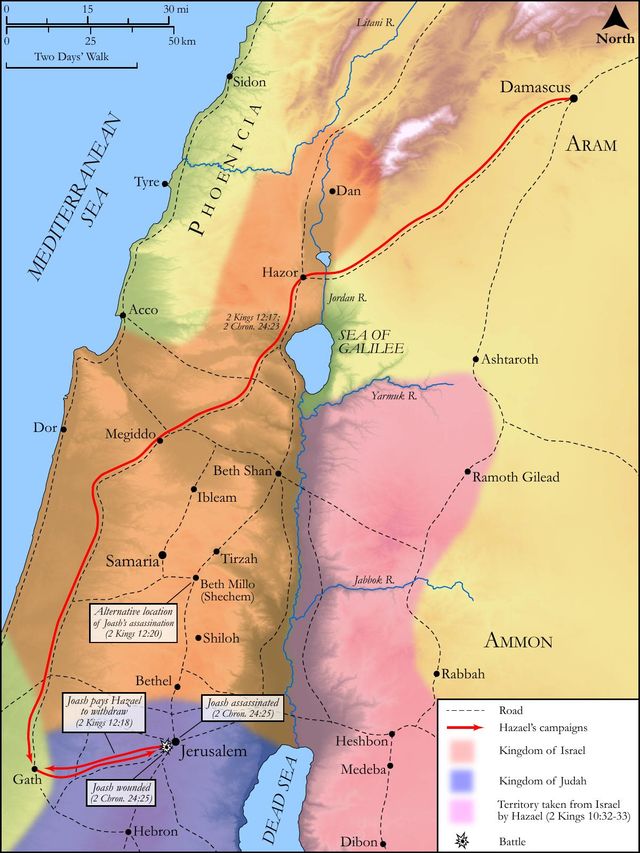
See on the biblical-era map
Study this verse
Public-domain commentary
Matthew Henry
From his Commentary on the Whole Bible. Henry comments on passages, not single verses — this entry covers 2 Kings 12:17–21. His two-level outline is real structure in the source text, so it is rendered as structure.
When Joash had revolted from God and become both an idolater and a persecutor the hand of the Lord went out against him, and his last state was worse than his first.
I.His wealth and honour became an easy prey to his neighbours.
Hazael, when he had chastised Israel (Kg2 10:32), threatened Judah and Jerusalem likewise, took Gath, a strong city (Kg2 12:17), and thence intended to march with his forces against Jerusalem, the royal city, the holy city, but whose defence, on account of its sinfulness, had departed. Joash had neither spirit nor strength to make head against him, but gave him all the hallowed things, and all the gold that was found both in his exchequer and in the treasures of the temple (Kg2 12:18), to bribe him to march another way. If it were lawful to do this for the public safety, better part with the gold of the temple than expose the temple itself; yet,
1.If he had not forsaken God, and forfeited his protection, his affairs would not have been brought to this extremity, but he might have forced Hazael to retire.
2.He diminished himself, and made himself very mean, lost the honour of a prince and a soldier, and of an Israelite too, in alienating the dedicated things.
3.He impoverished himself and his kingdom. And,
4.He tempted Hazael to come again, when he could carry home so rich a booty without striking a stroke. And it had this effect, for the next year the host of Syria came up against Jerusalem, destroyed the prince, and plundered the city, Ch2 24:23, Ch2 24:24.
II.His life became an easy prey to his own servants.
They conspired against him and slew him (Kg2 12:20, Kg2 12:21), not aiming at his kingdom, for they opposed not his son's succeeding him, but to be avenged on him for some crime he had committed; and we are told in Chronicles that his murdering the prophet, Jehoiada's son, was the provocation. In this, how unrighteous soever they were (vengeance was not theirs, nor did it belong to them to repay), God was righteous; and this was not the only time that he let even kings know that it was at their peril if they touched his anointed and did his prophets any harm, and that, when he comes to make inquisition for blood, the blood of prophets will run the account very high. Thus fell Joash, who began in the spirit and ended in the flesh. God usually sets marks of his displeasure upon apostates, even in this life; for they, of all sinners, do most reproach the Lord.
Historical interpretation
Historical reception
1 surviving comment on this verse from the historical church.
“His servants arose, devised a conspiracy and killed Joash in the house of Millo, on the way that goes down to Silla.” When he reached the age of 130 years, the priest Jehoiada died. Joash, being persuaded by the advice of some of his princes, abandoned the true religion which he had piously served when Jehoiada was alive, and restored the idolatry introduced by the women of Sidon, which he had gloriously banished with the help of the high priest himself. And while Zechariah, son of Jehoiada, attempted to prevent [that impiety] with all his might, and being inflamed with the divine spirit and standing between the temple and the altar, reproached the king and his princes, he was stoned to death in the hall itself of the house of God. And that was an act of extreme cruelty on the part of Joash, and every person’s mind was disturbed because he, being oblivious of the benefits received from Jehoiada, allowed that the son of that very holy man was treated with such brutality before him and even incited [the crowd to stone him]. And [Zechariah], calling God as the witness of his innocence and his avenger, said, “May the Lord see and avenge.” The holy man foresaw the calamities that would shortly befall the king and his kingdom. One year later the Syrians invaded Judah and plundered the land so that Joash, in order to save his life, was forced to deprive himself of the goods of the royal house and of the temple but was, nevertheless, shamefully ill treated by his enemies; and eventually he fell ill and lay in bed. While Joash was ill in his own bed, he was the victim of a plot of his servants, who stabbed him to death.
Continue studying 2 Kings 12:20 across the web’s major study libraries — every link below opens this exact verse, chapter, or book on the destination site.
Read & Compare
 BibleGatewayThis verse in more than 200 translations and 70 languages.
 Bible.comThe YouVersion reader — hundreds of translations, reading plans, and highlights.
 ESV.orgCrossway's official English Standard Version reader.
 NET BibleThe NET translation with 60,000+ translators' notes on every rendering decision.
 STEP BibleTyndale House's free study tool — original text, vocabulary, and scholarly resources.
 BibliaLogos Bible Software's free web reader.
 USCCBThe New American Bible (Revised Edition) with the U.S. bishops' study notes.
Commentaries
 BibleHub CommentariesDozens of classic commentaries on this verse, gathered on one page.
 StudyLightMore than 100 commentary sets — the largest collection on the web.
 BibleRefPlain-English commentary on what this verse means, verse by verse.
 Enduring WordDavid Guzik's free commentary on this chapter, widely used by Bible teachers.
 Bible Study ToolsVerse commentary alongside Greek and Hebrew study aids.
Original Language & Research
- BibleHub InterlinearThe verse word by word — original language, transliteration, and English.
- BibleHub LexiconEvery word's original-language definition and Strong's entry.
 Blue Letter BibleDeep-study tools — Strong's numbers, concordance, and word studies.
 SefariaThe Hebrew text with Rashi and centuries of Jewish commentary.
Sermons, Hymns & Audio


TrulyRandomVerse is not affiliated with these sites and doesn’t control their content. They’re linked because they’re genuinely useful.
Summary
2 Kings 12:20 records the tragic and violent assassination of King Joash of Judah by his own servants. This pivotal event marks the abrupt and ignominious end of a reign that began with great promise under the faithful guidance of the high priest Jehoiada but ultimately devolved into apostasy, idolatry, and cruelty after Jehoiada's death. The verse highlights the severe consequences of Joash's unfaithfulness to God, serving as a stark reminder of divine judgment and the profound accountability of even the most powerful leaders before the Lord.
Context
ShowHideLiterary Context
This verse brings the narrative of King Joash's reign in 2 Kings toward its grim close, picking up after his initial, promising start. His story began dramatically in 2 Kings 11 with his miraculous rescue from the murderous purge of Queen Athaliah and his subsequent coronation by the high priest Jehoiada. Chapter 12 initially portrays Joash as a righteous king, diligently overseeing the repair and restoration of the Temple of the Lord, a significant undertaking detailed in 2 Kings 12:4-16. However, the parallel account in 2 Chronicles 24 provides crucial additional details, revealing a dramatic shift in Joash's character after Jehoiada's death. It explicitly states that Joash turned away from God, listened to corrupt officials, and even sanctioned the murder of Zechariah, Jehoiada's son, who rebuked him for his apostasy (2 Chronicles 24:17-22). The immediate preceding verses in 2 Kings 12 describe Joash's defeat by the Arameans and his subsequent illness, setting the stage for the internal coup. Thus, 2 Kings 12:20 is not an isolated event but the culmination of Joash's spiritual decline and the divine judgment that followed his profound unfaithfulness.
Historical & Cultural Context
King Joash (also known as Jehoash) reigned in Judah for 40 years, approximately from 835 to 796 BC. He ascended the throne at the tender age of seven, having been hidden for six years from the murderous Queen Athaliah, his grandmother, who sought to exterminate the royal line (2 Kings 11:1-3). His early reign was marked by a significant revival of Yahweh worship and extensive Temple restoration efforts, largely due to the powerful and righteous influence of Jehoiada, the high priest. The "house of Millo" refers to a prominent fortified structure or complex within Jerusalem, likely part of the city's defenses, possibly a citadel or rampart, known from other biblical texts (e.g., 2 Samuel 5:9 and 1 Kings 9:15). "Silla" is a more obscure geographical reference, possibly indicating a specific path, descent, or gate near the Millo, perhaps a well-known landmark within the royal or defensive precincts. The specificity of the location suggests that the assassination, though a conspiracy, occurred in a well-known, perhaps even public, part of the royal complex, underscoring the audacity and internal nature of the coup. Assassinations of kings by their own servants, military leaders, or disgruntled factions were not uncommon in Israel and Judah, as when Zimri conspired against Elah and slew him, often driven by political ambition, discontent, or perceived weakness in leadership.
Key Themes
ShowHideThe narrative of Joash's reign, culminating in this verse, powerfully illustrates several recurring biblical themes. Foremost is the consequences of apostasy, demonstrating that even a king who begins with faithfulness can fall dramatically when he abandons God and godly counsel. Joash's turning away from the Lord after Jehoiada's death directly precipitates his downfall, emphasizing the principle that "righteousness exalts a nation, but sin is a reproach to any people" (Proverbs 14:34). This event also underscores the theme of divine judgment, as the assassination, though carried out by human agents, is presented in the broader biblical narrative (especially 2 Chronicles 24:22-24) as a direct consequence of Joash's unfaithfulness and particularly his shedding of innocent blood. Furthermore, the account highlights the accountability of leadership, showing that even kings are not above God's law and are held responsible for their actions, especially their spiritual leadership over the nation. Finally, the conspiracy itself speaks to the dark theme of human treachery and betrayal, revealing how ambition, discontent, and a lack of moral compass can lead to violent and destructive ends, particularly in the corridors of power.
Exposition and Analysis
ShowHideKey Word Analysis
ShowHideThis term (H5650) refers to bondmen, servants, or those in subservient positions. In a royal context, these would be trusted officials, courtiers, or members of the king's personal staff. The fact that the conspiracy was initiated by "his servants" underscores the profound betrayal and internal rot within Joash's court. It highlights the vulnerability of even powerful rulers to those closest to them, especially when trust is eroded by perceived injustice or weakness.
This noun (H7195) denotes an "unlawful alliance," a "confederacy," or "treason." It implies a deliberate, organized, and often secret agreement among individuals to overthrow an authority or achieve a nefarious goal. The use of this word emphasizes that Joash's death was not a random act of violence but a premeditated and coordinated effort by those closest to him, highlighting the depth of betrayal and the internal instability that had plagued his reign.
This primitive root (H5221) means "to strike," "to hit," or "to kill." The specific verbal form used here (a Hiphil perfect, vayyakku) often denotes a violent and decisive striking, leading to death. The directness of the verb conveys the brutal and final nature of the act. It is not merely that Joash died, but that he was violently "struck down" or "murdered," underscoring the severity and finality of the judgment against him.
Verse Breakdown
ShowHide"And his servants arose, and made a conspiracy,"
This clause immediately establishes the agency and the nature of the act. "His servants" indicates an internal betrayal, suggesting deep-seated discontent or ambition within the royal household. The phrase "arose" (וַיָּקֻמוּ, vayyaqumu, from H6965 qûwm) implies a decisive and active movement, not a passive event, signifying their resolve. The "conspiracy" (קֶשֶׁר, qesher, H7195) signifies a deliberate, organized plot, underscoring the premeditated nature of the regicide. This was not a spontaneous uprising but a carefully planned coup.
"and slew Joash"
This is the stark, central action of the verse. It directly states the outcome of the conspiracy: the murder of the king. The use of "slew" (וַיַּכּוּ, vayyakku, from H5221 nâkâh) emphasizes the violent and decisive nature of his death, leaving no ambiguity about the regicide. This act brings a violent and ignominious end to a reign that had tragically veered from its initial righteous path.
"in the house of Millo, which goeth down to Silla."
This specific geographical detail grounds the event in a tangible location within Jerusalem. The "house of Millo" (H1037 Bêyth Millôwʼ, from H1004 bayith "house" and H4407 millôwʼ "rampart") was a known fortified area or citadel, suggesting that the assassination occurred within the royal complex or a strategically important defensive structure. "Silla" (H5538 Çillâʼ), possibly an embankment or a specific path/descent (from H3381 yârad "goeth down") associated with the Millo, further pinpoints the location. The precision of the location adds historical veracity to the account and indicates that the event was a known, perhaps even public, act within the royal precincts, not a hidden crime.
Literary Devices
ShowHideThe verse employs several literary devices to convey its powerful message. Irony is profoundly present, as Joash, who was miraculously saved from death as an infant and placed on the throne by the faithful Jehoiada, is ultimately brought to a violent end by his own trusted servants. This contrasts sharply with his promising beginning and highlights the tragic trajectory of his reign. The narrative also utilizes specificity of detail by naming "the house of Millo" and "Silla," which lends a sense of historical authenticity and realism to the account, making the event tangible and memorable. Furthermore, the verse functions as a powerful moment of divine judgment within the broader narrative. While human agents carry out the act, the preceding context, especially in 2 Chronicles, frames Joash's death as a direct consequence of his apostasy and the murder of Zechariah, Jehoiada's son. This implies a cause-and-effect structure, where Joash's unfaithfulness directly leads to his violent demise, serving as a cautionary tale for future kings and readers about the inevitable consequences of abandoning God's covenant.
Theological and Thematic Connections
ShowHideThe assassination of King Joash in 2 Kings 12:20 serves as a profound theological statement on the consequences of spiritual declension and the unwavering principle of divine justice. Joash's story is a tragic illustration that a good beginning does not guarantee a good end; sustained faithfulness and adherence to God's covenant are paramount for leaders and individuals alike. His turning away from the Lord after the death of his mentor, Jehoiada, led to idolatry and even the murder of a prophet, Zechariah. This act of regicide, though carried out by human hands, is presented as a direct consequence of his sin, a form of divine judgment for his apostasy and the shedding of innocent blood. It underscores that no one, not even a king, is exempt from God's moral law and the repercussions of unrighteousness. The narrative highlights the importance of consistent obedience, the necessity of godly counsel, and the severe spiritual and temporal consequences of abandoning the Lord.
Reflection and Application
ShowHideThe tragic end of King Joash in 2 Kings 12:20 offers enduring spiritual lessons for believers today. His story is a powerful reminder that initial zeal and promising beginnings are not sufficient; sustained faithfulness, perseverance in obedience, and a lifelong commitment to God's truth are essential for spiritual vitality and enduring fruitfulness. Joash's downfall illustrates the critical importance of godly influence and accountability. Once Jehoiada, his spiritual mentor and moral compass, passed away, Joash quickly succumbed to corrupt counsel and abandoned the Lord, demonstrating how easily even those in positions of power can be led astray without consistent spiritual grounding and wise guidance. This narrative calls us to continually examine our hearts, remain vigilant against the subtle allure of sin and compromise, and actively seek out and submit to wise, biblical counsel throughout our lives. It also underscores the sobering reality that our choices, especially those in leadership, have far-reaching consequences, not only for ourselves but for those we influence and even for the spiritual health of our communities. Ultimately, Joash's story is a solemn warning to cultivate a deep, personal, and unwavering walk with God, ensuring that our faith is rooted in Christ alone, independent of external circumstances or human mentors.
Questions for Reflection
ShowHideFAQ
ShowHideWas Joash's assassination truly divine judgment, or merely a political coup?
ShowHideWhile the assassination of Joash was indeed carried out by human agents motivated by political discontent or personal grievances, the broader biblical narrative, particularly in 2 Chronicles 24, presents it as a clear and undeniable act of divine judgment. After the death of Jehoiada, Joash turned away from the Lord, embraced idolatry, and most significantly, allowed the murder of Zechariah, Jehoiada's son, who rebuked him for his apostasy (2 Chronicles 24:17-22). Zechariah's dying words, "The Lord look upon it, and require it," are immediately followed by an Aramean invasion and Joash's subsequent illness, culminating in his assassination. The biblical authors frequently interpret historical events through a theological lens, seeing God's sovereign hand at work in the rise and fall of kings and nations, especially in response to their faithfulness or unfaithfulness to the covenant. Therefore, while human actors were involved, the biblical perspective is that God "required" Joash's sin, using the conspiracy as an instrument of His righteous judgment.
Christ-Centered Fulfillment
ShowHideThe tragic narrative of King Joash, culminating in his assassination, stands in stark and profound contrast to the perfect reign and ultimate destiny of Jesus Christ. Joash, though beginning his reign under godly influence, ultimately succumbed to unfaithfulness, leading to his violent overthrow by his own servants—a consequence of his own sin and apostasy. This highlights the inherent fallibility of human kings and the devastating consequences of sin. In contrast, Jesus is the perfectly faithful King, the true Son of David, whose reign is eternal, righteous, and unshakeable (Luke 1:32-33). While Joash was betrayed by his servants due to his own unrighteousness, Christ was also betrayed by one of His own, Judas Iscariot (Matthew 26:47-50), but this betrayal was not a consequence of His sin, for He knew no sin (2 Corinthians 5:21). Rather, it was a preordained act that led to His sacrificial death for the sins of humanity (Isaiah 53:5-6), fulfilling God's redemptive plan. Joash's death was a judgment upon him for his unrighteousness; Christ's death was a judgment for us, absorbing the wrath we deserved and offering propitiation for our sins (Romans 5:8 and 1 John 2:2). Unlike Joash, who died in a fortified palace as a result of a human conspiracy, Christ willingly laid down His life outside the city gates, demonstrating perfect obedience to His Father's will and conquering sin and death through His resurrection (Philippians 2:8-11). Ultimately, Joash's story underscores the profound human need for a King who is not only righteous but also perfectly faithful, sovereign, and incapable of falling—a King found only in Jesus, who reigns forever and ever (Revelation 11:15).