


2 Kings 12:19
Bible text: King James Version (1769 Blayney text) · Public domain
Bible text: Berean Standard Bible · Public domain
Bible text: American Standard Version (1901) · Public domain
Bible text: World English Bible, Messianic edition · Public domain
Bible text: Geneva Bible (1599) · Public domain
Bible text: Young's Literal Translation · Public domain
- וְיֶתֶרve·Ye·terand [the] rest ofH3499Conj-w ¦ N-mscNoun Singular Masculine Constructוְandיֶתֶר[the] rest of
- דִּבְרֵיdiv·Rei[the] matters ofH1697N-mpcNoun Plural Masculine Construct
- יוֹאָשׁyo·'AshJoashH3101N-proper-mNoun Proper Masculine
- וְכָלve·kholand allH3605Conj-w ¦ N-msNoun Singular Masculine Absoluteוְandכָלall
- אֲשֶׁר'a·SherthatH834RelParticle Relative
- עָשָׂה'a·Sahhe didH6213V-Qal-Perf-3msVerb Qal Perfect 3rd Singular Masculine
- הֲלוֹאha·lo'¿ notH3808Interrog ¦ NegParticle Negativeהֲ¿לוֹאnot
- הֵםhem[are] theyH1992Pro-3mpPronoun Personal 3rd Plural Masculine
- כְּתוּבִיםke·tu·VimwrittenH3789V-Qal-PassPrtcpl-mpVerb Qal Participle Passive Plural Masculine Absolute
- עַל'alonH5921PrepPreposition
- סֵפֶרSe·fer[the] scroll ofH5612N-mscNoun Singular Masculine Construct
- דִּבְרֵיdiv·Rei[the] matters ofH1697N-mpcNoun Plural Masculine Construct
- הַיָּמִיםhai·ya·Mimthe daysH3117Art ¦ N-mpNoun Plural Masculine Absoluteהַtheיָּמִיםdays
- לְמַלְכֵיle·mal·Kheiof [the] kings ofH4428Prep-l ¦ N-mpcNoun Plural Masculine Constructלְofמַלְכֵי[the] kings of
- יְהוּדָהye·hu·DahJudahH3063N-properNoun Proper Location
English is a literal word-by-word gloss of the Hebrew, not the KJV's wording. Why?
This is the original text the KJV's translators worked from — each Hebrew word with its own literal English meaning in this verse, prepared by scholars at Tyndale House, Cambridge. The KJV translates whole sentences, not word by word, so its wording differs: one Hebrew word can become several English words, and the KJV may choose “the LORD” where the gloss reads “Yahweh”. Both are faithful — they answer different questions. For the KJV's own rendering, switch to the KJV text.
Details
See on the biblical-era map
Study this verse
Public-domain commentary
Matthew Henry
From his Commentary on the Whole Bible. Henry comments on passages, not single verses — this entry covers 2 Kings 12:17–21. His two-level outline is real structure in the source text, so it is rendered as structure.
When Joash had revolted from God and become both an idolater and a persecutor the hand of the Lord went out against him, and his last state was worse than his first.
I.His wealth and honour became an easy prey to his neighbours.
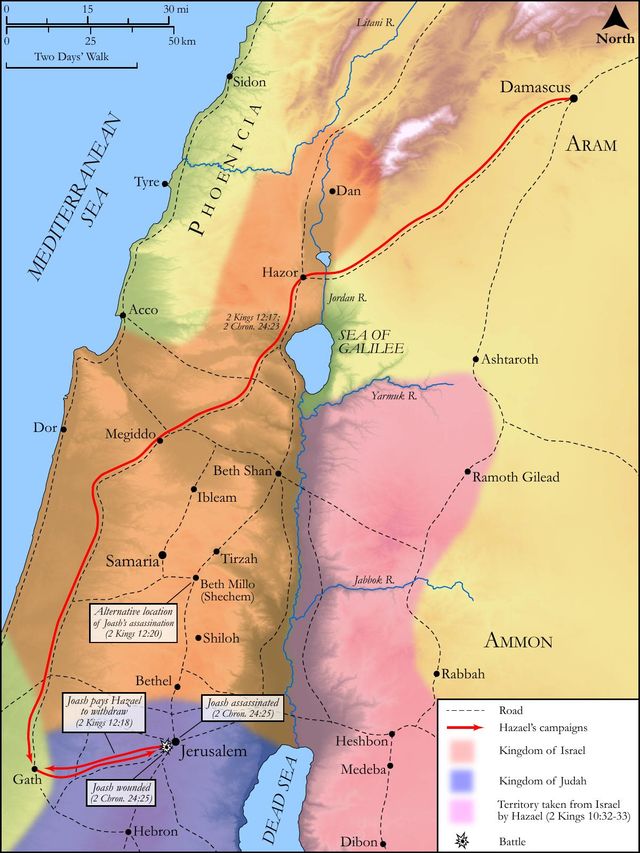
Hazael, when he had chastised Israel (Kg2 10:32), threatened Judah and Jerusalem likewise, took Gath, a strong city (Kg2 12:17), and thence intended to march with his forces against Jerusalem, the royal city, the holy city, but whose defence, on account of its sinfulness, had departed. Joash had neither spirit nor strength to make head against him, but gave him all the hallowed things, and all the gold that was found both in his exchequer and in the treasures of the temple (Kg2 12:18), to bribe him to march another way. If it were lawful to do this for the public safety, better part with the gold of the temple than expose the temple itself; yet,
1.If he had not forsaken God, and forfeited his protection, his affairs would not have been brought to this extremity, but he might have forced Hazael to retire.
2.He diminished himself, and made himself very mean, lost the honour of a prince and a soldier, and of an Israelite too, in alienating the dedicated things.
3.He impoverished himself and his kingdom. And,
4.He tempted Hazael to come again, when he could carry home so rich a booty without striking a stroke. And it had this effect, for the next year the host of Syria came up against Jerusalem, destroyed the prince, and plundered the city, Ch2 24:23, Ch2 24:24.
II.His life became an easy prey to his own servants.
They conspired against him and slew him (Kg2 12:20, Kg2 12:21), not aiming at his kingdom, for they opposed not his son's succeeding him, but to be avenged on him for some crime he had committed; and we are told in Chronicles that his murdering the prophet, Jehoiada's son, was the provocation. In this, how unrighteous soever they were (vengeance was not theirs, nor did it belong to them to repay), God was righteous; and this was not the only time that he let even kings know that it was at their peril if they touched his anointed and did his prophets any harm, and that, when he comes to make inquisition for blood, the blood of prophets will run the account very high. Thus fell Joash, who began in the spirit and ended in the flesh. God usually sets marks of his displeasure upon apostates, even in this life; for they, of all sinners, do most reproach the Lord.
Historical interpretation
Historical reception
1 surviving comment on this verse from the historical church.
“His servants arose, devised a conspiracy and killed Joash in the house of Millo, on the way that goes down to Silla.” When he reached the age of 130 years, the priest Jehoiada died. Joash, being persuaded by the advice of some of his princes, abandoned the true religion which he had piously served when Jehoiada was alive, and restored the idolatry introduced by the women of Sidon, which he had gloriously banished with the help of the high priest himself. And while Zechariah, son of Jehoiada, attempted to prevent [that impiety] with all his might, and being inflamed with the divine spirit and standing between the temple and the altar, reproached the king and his princes, he was stoned to death in the hall itself of the house of God. And that was an act of extreme cruelty on the part of Joash, and every person’s mind was disturbed because he, being oblivious of the benefits received from Jehoiada, allowed that the son of that very holy man was treated with such brutality before him and even incited [the crowd to stone him]. And [Zechariah], calling God as the witness of his innocence and his avenger, said, “May the Lord see and avenge.” The holy man foresaw the calamities that would shortly befall the king and his kingdom. One year later the Syrians invaded Judah and plundered the land so that Joash, in order to save his life, was forced to deprive himself of the goods of the royal house and of the temple but was, nevertheless, shamefully ill treated by his enemies; and eventually he fell ill and lay in bed. While Joash was ill in his own bed, he was the victim of a plot of his servants, who stabbed him to death.
Continue studying 2 Kings 12:19 across the web’s major study libraries — every link below opens this exact verse, chapter, or book on the destination site.
Read & Compare
 BibleGatewayThis verse in more than 200 translations and 70 languages.
 Bible.comThe YouVersion reader — hundreds of translations, reading plans, and highlights.
 ESV.orgCrossway's official English Standard Version reader.
 NET BibleThe NET translation with 60,000+ translators' notes on every rendering decision.
 STEP BibleTyndale House's free study tool — original text, vocabulary, and scholarly resources.
 BibliaLogos Bible Software's free web reader.
 USCCBThe New American Bible (Revised Edition) with the U.S. bishops' study notes.
Commentaries
 BibleHub CommentariesDozens of classic commentaries on this verse, gathered on one page.
 StudyLightMore than 100 commentary sets — the largest collection on the web.
 BibleRefPlain-English commentary on what this verse means, verse by verse.
 Enduring WordDavid Guzik's free commentary on this chapter, widely used by Bible teachers.
 Bible Study ToolsVerse commentary alongside Greek and Hebrew study aids.
Original Language & Research
- BibleHub InterlinearThe verse word by word — original language, transliteration, and English.
- BibleHub LexiconEvery word's original-language definition and Strong's entry.
 Blue Letter BibleDeep-study tools — Strong's numbers, concordance, and word studies.
 SefariaThe Hebrew text with Rashi and centuries of Jewish commentary.
Sermons, Hymns & Audio


TrulyRandomVerse is not affiliated with these sites and doesn’t control their content. They’re linked because they’re genuinely useful.
Summary
Second Kings 12:19 opens the conventional editorial conclusion to the narrative of King Joash's reign in Judah, directing the reader to external, more comprehensive historical records for further details of his "acts" and "all that he did." This formulaic statement underscores the biblical author's theological selectivity, emphasizing that while the scriptural account is historically grounded and verifiable, its primary purpose is not to provide an exhaustive national history but rather to highlight events that reveal God's covenantal dealings with His people and the consequences of their faithfulness or unfaithfulness.
Context
ShowHideLiterary Context
This verse serves as a customary concluding formula for the account of King Joash (also known as Jehoash), immediately preceding the brief mention of his assassination by his servants. It is a consistent literary device employed throughout the Books of Kings for nearly every monarch, signaling that the inspired author has presented the divinely ordained summary of the king's reign and refers the reader to the official state annals for additional information. The preceding narrative in 2 Kings 11-12 details Joash's miraculous preservation from Athaliah's purge as an infant, his enthronement at the age of seven under the guidance of the high priest Jehoiada, and his initial faithfulness, particularly in the significant temple repair project described in 2 Kings 12:4-16. However, the broader biblical narrative, especially in 2 Chronicles 24, reveals Joash's tragic apostasy after Jehoiada's death, leading to Judah's decline and his eventual downfall, which this concluding note implicitly covers by referring to the full scope of his "acts."
Historical & Cultural Context
The practice of meticulously maintaining official royal annals was a widespread and crucial administrative function in the courts of kings, in Israel and Judah as in the court of Ahasuerus. The kings of that day employed scribes whose duty it was to record the significant events, policies, military campaigns, and administrative decisions of their monarchs. These "chronicles" were state-sponsored historical documents, distinct from the inspired biblical texts, though the biblical authors often drew upon them as verifiable source material. The explicit reference to "the book of the chronicles of the kings of Judah" indicates that the southern kingdom, like other monarchies of the time, diligently preserved its royal records. This practice provided a tangible, verifiable historical backdrop for the biblical narrative, demonstrating that the events described were rooted in actual historical occurrences and were not mere legends or myths, thereby lending credibility to the scriptural account.
Key Themes
ShowHideThough seemingly an administrative detail, this verse contributes significantly to several overarching themes within the Books of Kings and the broader biblical narrative. Firstly, it powerfully reinforces the historical veracity and reliability of Scripture, asserting that the biblical account is grounded in verifiable historical records, even if those records are not entirely preserved for us today. This grounds the theological claims of the Bible in the reality of human history. Secondly, it highlights the theological selectivity and purpose of the biblical narrative. The inspired authors of Kings were not writing exhaustive national histories but rather theological histories, focusing on those aspects of a king's reign that illuminated their covenant relationship with God and the consequences of their obedience or disobedience. For example, Joash's early faithfulness and later apostasy are emphasized because they serve as a powerful lesson on the importance of sustained devotion to the Lord, as seen in the detailed account of his departure from God's ways in 2 Chronicles 24:17-22. Finally, the consistent reference to these chronicles subtly points to God's meticulous oversight of human history, suggesting that even the seemingly mundane details of royal reigns are known and, in some sense, preserved under His sovereign hand, ensuring that His redemptive plan unfolds precisely as intended.
Exposition and Analysis
ShowHideKey Word Analysis
ShowHideDerived from dâbâr, this word refers to a "word," "matter," or "thing." In this context, it signifies the comprehensive scope of a king's activities and accomplishments during his reign, encompassing not only significant political or military achievements but also the daily affairs, policies, and character of the monarch. The phrase "all that he did" further emphasizes the totality of Joash's public and private life as king, indicating that the biblical account is a summary, not an exhaustive record.
From çêpher, this term properly denotes "writing" or a "document," and by implication, a "book." Here, it specifically refers to the written compilation of official, state-kept annals or daily records. This highlights that the "chronicles" were formal, inscribed documents, meticulously maintained by royal scribes, serving as the official administrative records of the monarchy.
While the full phrase "book of the chronicles" uses dâbâr (matters) and yôwm (days), yôwm specifically refers to "a day" or "a space of time," often used adverbially. In the context of "chronicles of the kings," yôwm indicates a record of "the matters of the days" or "the events of the times." This emphasizes that these were daily or ongoing records, documenting events as they occurred throughout the king's reign, providing a continuous historical account.
Verse Breakdown
ShowHide"And the rest of the acts of Joash, and all that he did"
This opening clause serves as a clear and deliberate indication that the biblical account of Joash's reign is not exhaustive. It explicitly acknowledges the existence of a larger body of information concerning his rule, encompassing the full range of his deeds, policies, and life choices, beyond what the inspired author has chosen to include in the narrative of Kings. This phrase highlights the biblical text's selective nature, focusing on the theologically significant aspects of Joash's reign rather than providing a comprehensive historical biography.
"[are] they not written"
This is a powerful rhetorical question, functioning not as an inquiry seeking information but as an emphatic affirmation. It asserts with certainty that the information is indeed recorded and accessible elsewhere. This literary device directs the reader's attention to the existence of external, verifiable historical documents, thereby lending credibility and historical grounding to the biblical narrative. It implies that the biblical author is well aware of these records and is confident in their contents, inviting readers to consult them if they desire more comprehensive details.
"in the book of the chronicles of the kings of Judah?"
This final clause precisely identifies the source of the additional information: the official state annals of the Judean monarchy. By explicitly naming these "chronicles," the biblical author grounds the narrative in historical reality, demonstrating its basis in documented history rather than mythical tradition. This practice reinforces the historical reliability of the biblical account and distinguishes these ancient royal annals from the canonical biblical books of 1 and 2 Chronicles, though the latter likely utilized the former as source material.
Literary Devices
ShowHideThe verse primarily employs a Formulaic Closing common throughout the Books of Kings, which serves as a consistent structural marker for the end of a king's reign. This formula typically includes the king's death, burial, succession, and a reference to external historical records, providing a predictable rhythm to the narrative. The phrase "[are] they not written" is a powerful Rhetorical Question, which functions not as an inquiry but as an emphatic assertion, affirming the existence and accessibility of the mentioned historical records. This device strengthens the sense of historical veracity and invites the reader to trust the historical claims of the biblical text. Furthermore, the verse demonstrates Intertextuality or Referentiality, as it explicitly points beyond itself to an external body of literature ("the book of the chronicles"), thereby establishing a connection between the inspired biblical narrative and the royal records kept in the courts of the kings. This also implies a deliberate Ellipsis or Conciseness in the biblical narrative, as it chooses to summarize rather than exhaustively detail every aspect of a king's reign, prioritizing theological lessons and God's redemptive plan over comprehensive historical reporting.
Theological and Thematic Connections
ShowHideThis seemingly administrative verse carries profound theological weight. It underscores the Bible's unwavering commitment to historical truth, demonstrating that the inspired narrative is not a collection of fables but an account rooted in real events and verifiable records. This commitment to historical accuracy serves as a foundational pillar for the theological claims of Scripture, affirming that God acts decisively within human history, not outside of it. The consistent reference to external chronicles throughout Kings highlights God's sovereignty over all of history, including the meticulous record-keeping of human governments. While these human records are incomplete and often biased, they nonetheless bear witness to a divine hand that orchestrates events and ensures that the essential story of His covenant people is preserved, both in human annals and, more importantly, in His inspired Word. The verse also implicitly teaches about the selective nature of divine revelation; God reveals what is necessary for our salvation and spiritual instruction, not every exhaustive detail of human existence.
Reflection and Application
ShowHideThe brief, administrative note in 2 Kings 12:19 offers a quiet but profound assurance to the modern reader: the biblical narrative is profoundly rooted in historical reality. This should bolster our confidence in the trustworthiness of God's Word, reminding us that the God who inspired these accounts is the God of history, meticulously overseeing all events, from the grand narratives of kings to the minute details of individual lives. Just as Joash's "acts" were recorded in earthly chronicles, so too are our lives being lived out before an omniscient God, whose "books" contain every thought, word, and deed. This truth should inspire both reverence and responsibility. It calls us to live lives worthy of the Gospel, knowing that our choices, both public and private, contribute to a spiritual record that holds eternal significance. Our lives are not random occurrences; they are part of God's grand, unfolding narrative, and our faithfulness, or lack thereof, has lasting consequences, not only for ourselves but for the testimony we bear for Him.
Questions for Reflection
ShowHideFAQ
ShowHideWhat is "the book of the chronicles of the kings of Judah"?
ShowHide"The book of the chronicles of the kings of Judah" refers to the official, state-maintained royal annals or historical records of the Kingdom of Judah. These were administrative documents compiled by royal scribes, detailing the significant events, policies, and deeds of each king during their reign. They were distinct from the canonical biblical books of 1 and 2 Chronicles, though the biblical authors of Chronicles likely utilized these very royal annals as source material for their inspired writings. The reference in 2 Kings 12:19 indicates that the biblical author was aware of and relied upon these external historical records, underscoring the historical grounding of the biblical narrative.
Why does the Bible frequently refer to these external historical books?
ShowHideThe Bible refers to these external historical books for several key reasons. Firstly, it serves to affirm the historical reliability and veracity of the biblical narrative, demonstrating that the events described are rooted in actual historical occurrences and were not fabricated. The authors were not writing mythology but recounting real history. Secondly, it highlights the theological selectivity of the biblical account. The inspired authors chose to include only those details necessary to convey God's message and His dealings with humanity, referring readers to more comprehensive secular records for additional historical data. This shows that the Bible's purpose is not to be an exhaustive history book but a divinely inspired theological narrative. Finally, it implicitly acknowledges God's sovereignty over all of history, including the meticulous record-keeping of human kingdoms, suggesting that even these secular archives served a purpose in preserving the historical context for God's unfolding plan. This practice is seen throughout Kings, for example, in references to the "book of the chronicles of the kings of Israel" for northern kingdom rulers like Jeroboam (1 Kings 14:19).
Christ-Centered Fulfillment
ShowHideWhile 2 Kings 12:19 points to the earthly chronicles of King Joash, it subtly directs our gaze toward the ultimate "chronicle" of God's redemptive history, which finds its climactic fulfillment in Jesus Christ. The "acts" of Joash, like all human kings, were imperfect and ultimately led to his downfall, illustrating humanity's inherent inability to achieve lasting righteousness or secure true salvation. In stark contrast, the "acts" of Jesus are perfect, eternally significant, and foundational to our redemption. He is the true King whose life, death, and resurrection constitute the central, pivotal events of all history, recorded not merely in human annals but in the divinely inspired Gospels (Luke 1:1-4), which bear witness to His saving work. He is the one whose every "act" was in perfect obedience to the Father, fulfilling all righteousness and securing our redemption through His atoning sacrifice (Philippians 2:8). The ultimate "book of chronicles" that truly matters is the Lamb's Book of Life, in which the names of those redeemed by Christ are eternally inscribed. Thus, Joash's earthly record, though historically significant, pales in comparison to the eternal record of Christ's perfect work, which offers hope, forgiveness, and salvation to all who believe, ushering in a kingdom that will never end (Daniel 7:14).