


2 Kings 8:23
Bible text: King James Version (1769 Blayney text) · Public domain
Bible text: Berean Standard Bible · Public domain
Bible text: American Standard Version (1901) · Public domain
Bible text: World English Bible, Messianic edition · Public domain
Bible text: Geneva Bible (1599) · Public domain
Bible text: Young's Literal Translation · Public domain
- וְיֶתֶרve·Ye·terand [the] rest ofH3499Conj-w ¦ N-mscNoun Singular Masculine Constructוְandיֶתֶר[the] rest of
- דִּבְרֵיdiv·Rei[the] matters ofH1697N-mpcNoun Plural Masculine Construct
- יוֹרָםyo·RamJoramH3141N-proper-mNoun Proper Masculine
- וְכָלve·kholand allH3605Conj-w ¦ N-msNoun Singular Masculine Absoluteוְandכָלall
- אֲשֶׁר'a·SherthatH834RelParticle Relative
- עָשָׂה'a·Sahhe didH6213V-Qal-Perf-3msVerb Qal Perfect 3rd Singular Masculine
- הֲלוֹאha·lo'¿ notH3808Interrog ¦ NegParticle Negativeהֲ¿לוֹאnot
- הֵםhem[are] theyH1992Pro-3mpPronoun Personal 3rd Plural Masculine
- כְּתוּבִיםke·tu·VimwrittenH3789V-Qal-PassPrtcpl-mpVerb Qal Participle Passive Plural Masculine Absolute
- עַל'alonH5921PrepPreposition
- סֵפֶרSe·fer[the] scroll ofH5612N-mscNoun Singular Masculine Construct
- דִּבְרֵיdiv·Rei[the] matters ofH1697N-mpcNoun Title Plural Masculine Construct
- הַיָּמִיםhai·ya·Mimthe daysH3117Art ¦ N-mpNoun Plural Masculine Absoluteהַtheיָּמִיםdays
- לְמַלְכֵיle·mal·Kheiof [the] kings ofH4428Prep-l ¦ N-mpcNoun Plural Masculine Constructלְofמַלְכֵי[the] kings of
- יְהוּדָהye·hu·DahJudahH3063N-properNoun Proper Location
English is a literal word-by-word gloss of the Hebrew, not the KJV's wording. Why?
This is the original text the KJV's translators worked from — each Hebrew word with its own literal English meaning in this verse, prepared by scholars at Tyndale House, Cambridge. The KJV translates whole sentences, not word by word, so its wording differs: one Hebrew word can become several English words, and the KJV may choose “the LORD” where the gloss reads “Yahweh”. Both are faithful — they answer different questions. For the KJV's own rendering, switch to the KJV text.
Details
See on the biblical-era maps
Study this verse
Public-domain commentary
Matthew Henry
From his Commentary on the Whole Bible. Henry comments on passages, not single verses — this entry covers 2 Kings 8:16–24. His two-level outline is real structure in the source text, so it is rendered as structure.
We have here a brief account of the life and reign of Jehoram (or Joram), one of the worst of the kings of Judah, but the son and successor of Jehoshaphat, one of the best. Note, 1. Parents cannot give grace to their children. Many that have themselves been godly have had the grief and shame of seeing those that came forth out of their bowels wicked and vile. Let not the families that are thus afflicted think it strange. 2. If the children of good parents prove wicked, commonly they are worse than others. The unclean spirit brings in seven others more wicked than himself, Luk 11:26. 3. A nation is sometimes justly punished with the miseries of a bad reign for not improving the blessings and advantages of a good one.
Concerning this Jehoram observe,
I.The general idea here given of his wickedness (Kg2 8:18):
He did as the house of Ahab, and worse he could not do. His character is taken from the bad example he followed, for men are according to the company they converse with and the copies they write after. No mistake is more fatal to young people than a mistake in the choice of those whom they would recommend themselves to and take their measures from, and whose good opinion they value themselves by. Jehoram chose the house of Ahab for his pattern rather than his father's house, and this choice was his ruin. We have a particular account of his wickedness (2 Chr. 21), murder, idolatry, persecution, everything that was bad.
II.The occasions of his wickedness.
His father was a very good man, and no doubt took care to have him taught the good knowledge of the Lord, but,
1.It is certain he did ill to marry him to the daughter of Ahab; no good could come of an alliance with an idolatrous family, but all mischief with such a daughter of such a mother as Athaliah the daughter of Jezebel. The degeneracy of the old world took rise from the unequal yoking of professors with profane. Those that are ill-matched are already half-ruined.
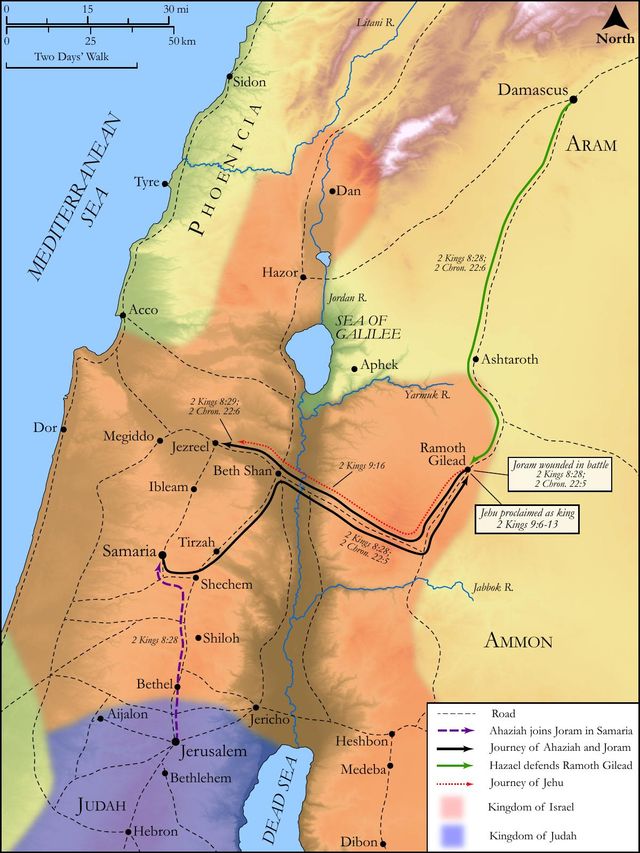
2.I doubt he did not do well to make him king in his own life-time. It is said here (Kg2 8:16) that he began to reign, Jehoshaphat being then king; hereby he gratified his pride (than which nothing is more pernicious to young people), indulged him in his ambition, in hopes to reform him by humouring him, and so brought a curse upon his family, as Eli did, whose sons made themselves vile and he restrained them not. Jehoshaphat had made this wicked son of his viceroy once when he went with Ahab to Ramoth-Gilead, from which Jehoshaphat's seventeenth year (Kg1 22:51) is made Jehoram's second (Kg2 1:17), but afterwards, in his twenty-second year, he made him partner in his government, and thence Joram's eight years are to be dated, three years before his father's death. It has been hurtful to many young men to come too soon to their estates. Samuel got nothing by making his sons judges.
III.The rebukes of Providence which he was under for his wickedness.
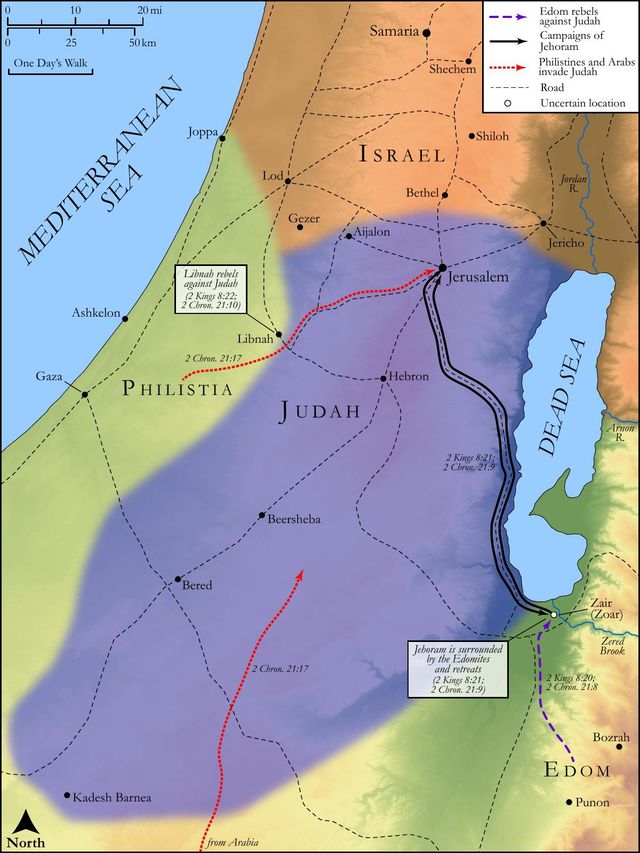
1.The Edomites revolted, who had been under the government of the kings of Judah ever since David's time, about 150 years, Kg2 8:20. He attempted to reduce them, and gave them a defeat (Kg2 8:21), but he could not improve the advantage he had got, so as to recover his dominion over them: Yet Edom revolted (Kg2 8:22), and the Edomites were, after this, bitter enemies to the Jews, as appears by the prophecy of Obadiah and Psa 137:7. Now Isaac's prophecy was fulfilled, that this Esau the elder should serve Jacob the younger; yet, in process of time, he should break that yoke from off his neck, Gen 27:40.
2.Libnah revolted. This was a city in Judah, in the heart of his country, a priests' city; the inhabitants of this city shook off his government because he had forsaken God, and would have compelled them to do so too, Ch2 21:10, Ch2 21:11. In order that they might preserve their religion they set up for a free state. Perhaps other cities did the same.
3.His reign was short. God cut him off in the midst of his days, when he was but forty years old, and had reigned but eight years. Bloody and deceitful men shall not live out half their days.
IV.The gracious care of Providence for the keeping up of the kingdom of Judah, and the house of David, notwithstanding the apostasies and calamities of Jehoram's reign (Kg2 8:19): Yet the Lord would not destroy Judah. He could easily have done it; he might justly have done it; it would have been no loss to him to have done it; yet he would not do it, for David's sake, not for the sake of any merit of his which could challenge this favour to his family as a debt, but for the sake of a promise made to him that he should always have a lamp (that is, a succession of kings from one generation to another, by which his name should be kept bright and illustrious, as a lamp is kept burning by a constant fresh supply of oil), that his family should never be extinct till it terminated in the Messiah, that Son of David on whom was to be hung all the glory of his Father's house and in whose everlasting kingdom that promise to David is fulfilled (Psa 132:17), I have ordained a lamp for my anointed.
V.The conclusion of this impious and inglorious reign, Kg2 8:23, Kg2 8:24.
Nothing peculiar is here said of him; but we are told (Ch2 21:19, Ch2 21:20) that he died of sore diseases and died without being desired.
Continue studying 2 Kings 8:23 across the web’s major study libraries — every link below opens this exact verse, chapter, or book on the destination site.
Read & Compare
 BibleGatewayThis verse in more than 200 translations and 70 languages.
 Bible.comThe YouVersion reader — hundreds of translations, reading plans, and highlights.
 ESV.orgCrossway's official English Standard Version reader.
 NET BibleThe NET translation with 60,000+ translators' notes on every rendering decision.
 STEP BibleTyndale House's free study tool — original text, vocabulary, and scholarly resources.
 BibliaLogos Bible Software's free web reader.
 USCCBThe New American Bible (Revised Edition) with the U.S. bishops' study notes.
Commentaries
 BibleHub CommentariesDozens of classic commentaries on this verse, gathered on one page.
 StudyLightMore than 100 commentary sets — the largest collection on the web.
 BibleRefPlain-English commentary on what this verse means, verse by verse.
 Enduring WordDavid Guzik's free commentary on this chapter, widely used by Bible teachers.
 Bible Study ToolsVerse commentary alongside Greek and Hebrew study aids.
Original Language & Research
- BibleHub InterlinearThe verse word by word — original language, transliteration, and English.
- BibleHub LexiconEvery word's original-language definition and Strong's entry.
 Blue Letter BibleDeep-study tools — Strong's numbers, concordance, and word studies.
 SefariaThe Hebrew text with Rashi and centuries of Jewish commentary.
Sermons, Hymns & Audio


TrulyRandomVerse is not affiliated with these sites and doesn’t control their content. They’re linked because they’re genuinely useful.
Summary
2 Kings 8:23 brings the account of King Joram of Judah toward its close with a standard editorial formula found throughout the Books of Kings. This verse functions as a historical marker, signaling the biblical author's transition from a selective narrative concerning Joram's reign and directing the reader to external, comprehensive state annals for further details. Implicitly, this formula underscores the historicity of the biblical account while also subtly pointing to the divine record-keeping of all human actions, even those of a wicked king whose deeds were largely displeasing to God.
Context
ShowHideLiterary Context
This verse serves as the concluding formula for Joram's eight-year reign over Judah, a period detailed in 2 Kings 8:16-24. The preceding verses characterize Joram as a profoundly wicked king who "walked in the way of the kings of Israel, as did the house of Ahab" (2 Kings 8:18), primarily due to his marriage to Athaliah, Ahab's daughter. Despite Joram's apostasy, the narrative highlights God's unwavering covenant faithfulness to David, stating that the Lord "would not destroy Judah for the sake of David his servant, as he promised him to give him a lamp always through his sons" (2 Kings 8:19). Immediately following this concluding formula, the narrative seamlessly transitions to the reign of Joram's son, Ahaziah, in 2 Kings 8:24.
Historical & Cultural Context
King Joram of Judah reigned from approximately 848-841 BC. His marriage to Athaliah, a princess from the idolatrous Northern Kingdom of Israel, was a politically motivated alliance that had catastrophic spiritual repercussions for Judah, introducing and entrenching Baal worship and other abominations. The practice of meticulously maintaining royal annals was a common and indispensable feature of the courts of kings, in Israel and Judah as in the court of Ahasuerus, where the book of records of the chronicles was read before the king. Royal scribes were employed to record daily events, royal decrees, military campaigns, and administrative details. These "chronicles" served as official state archives, providing a comprehensive historical record for the kingdom, affirming the legitimacy of the reigning monarch, and preserving national memory. The biblical authors, by referencing these external records, acknowledge their existence and utilize them as a verifiable source, thereby demonstrating the historical grounding of their narrative.
Key Themes
ShowHideThough formulaic, this verse significantly contributes to several overarching themes within the Books of Kings. Firstly, it reinforces the theme of Divine Judgment and Consequences, as Joram's evil reign led to significant national losses for Judah, including the successful revolt of Edom (2 Kings 8:20-22) and the rebellion of Libnah. Secondly, it subtly yet powerfully highlights God's Enduring Covenant Faithfulness, demonstrating that despite Joram's profound wickedness, God preserved the Davidic line in accordance with His unconditional promise to David (2 Samuel 7:12-16). Finally, the explicit reference to the "book of the chronicles" underscores the Historicity and Verifiability of Scripture, demonstrating that the biblical narrative is not a mythical or legendary account but is deeply rooted in actual historical events and verifiable records, even if the biblical authors selectively present information for their theological purposes.
Exposition and Analysis
ShowHideKey Word Analysis
ShowHideMeaning "an overhanging, i.e. (by implication) an excess, superiority, remainder; also a small rope (as hanging free); abundant, cord, exceeding, excellancy(-ent), what they leave, that hath left, plentifully, remnant, residue, rest, string, with." In this context, "rest" refers to the remaining or residue of Joram's actions, indicating that the biblical account is not exhaustive but points to more extensive records.
Meaning "a word; by implication, a matter (as spoken of) or thing; adverbially, a cause; act, advice, affair, answer, [idiom] any such (thing), because of, book, business, care, case, cause, certain rate, [phrase] chronicles, commandment, [idiom] commune(-ication), [phrase] concern(-ing), [phrase] confer, counsel, [phrase] dearth, decree, deed, [idiom] disease, due, duty, effect, [phrase] eloquent, errand, (evil favoured-) ness, [phrase] glory, [phrase] harm, hurt, [phrase] iniquity, [phrase] judgment, language, [phrase] lying, manner, matter, message, (no) thing, oracle, [idiom] ought, [idiom] parts, [phrase] pertaining, [phrase] please, portion, [phrase] power, promise, provision, purpose, question, rate, reason, report, request, [idiom] (as hast) said, sake, saying, sentence, [phrase] sign, [phrase] so, some (uncleanness), somewhat to say, [phrase] song, speech, [idiom] spoken, talk, task, [phrase] that, [idiom] there done, thing (concerning), thought, [phrase] thus, tidings, what(-soever), [phrase] wherewith, which, word, work." Here, "acts" refers to the deeds, affairs, and events of Joram's reign, encompassing his entire administration and actions.
Meaning "properly, writing (the art or a document); by implication, a book; bill, book, evidence, [idiom] learn(-ed) (-ing), letter, register, scroll." This term specifically denotes a written document, scroll, or register, referring to the official state archives where the detailed history of the kings was recorded.
Verse Breakdown
ShowHide"And the rest of the acts of Joram, and all that he did"
This opening clause functions as a comprehensive summary statement, encapsulating the entirety of King Joram's reign and all his deeds, both those explicitly mentioned in the biblical narrative and those not. It signals the biblical author's conclusion of the detailed account of this particular king, implying that while the biblical text provides the theologically significant narrative, a fuller, more exhaustive civil history exists elsewhere.
"[are] they not written"
This phrase is a rhetorical question, a common and effective stylistic feature in Hebrew narrative. It is not an inquiry seeking information, but rather a strong, emphatic affirmation that the information is indeed recorded and readily accessible. This rhetorical device lends authority and credibility to the biblical narrative by pointing to external, verifiable sources, assuring the reader that the account is grounded in historical fact.
"in the book of the chronicles of the kings of Judah?"
This final phrase precisely identifies the external archive where further, more comprehensive details of Joram's reign could be found. It underscores the meticulous system of record-keeping within the Judean monarchy and highlights the biblical author's reliance on and acknowledgment of these historical archives, thereby lending significant credibility and historical weight to the biblical account.
Literary Devices
ShowHideThe verse primarily employs Formulaic Language, a recurring editorial device used consistently throughout the Books of Kings. This standardized phrase signals the conclusion of a king's reign and serves as a bibliographic reference, directing the reader to external, non-canonical historical annals. This formula provides structural coherence to the narrative, marks clear transitions between reigns, and powerfully reinforces the historical grounding of the biblical account. Additionally, the phrase "[are] they not written?" functions as a Rhetorical Question. This device is employed not to elicit an answer, but to make an emphatic assertion, confirming that the information is indeed recorded and available for verification. This adds a layer of authority and certainty to the reference, assuring the reader of the verifiability of the historical claims. Implicitly, the verse also demonstrates Intertextuality by referencing external, non-canonical historical documents, acknowledging that the biblical narrative exists within a broader historical context and interacts with other forms of ancient record-keeping.
Theological and Thematic Connections
ShowHideThe formulaic reference to the "book of the chronicles" transcends mere historical detail, carrying profound theological implications. It serves as a powerful reminder that all human actions, whether of powerful kings or ordinary individuals, are observed and recorded. This concept points directly to God's omniscience and His meticulous knowledge of history, implying that nothing is hidden from Him. While human scribes kept earthly chronicles, there is a divine ledger where every deed, word, and intention is known and remembered by God, ultimately leading to accountability. This truth serves as a sober reminder of our responsibility before a holy God, whose comprehensive knowledge encompasses all of history and every individual life, ensuring that justice will ultimately prevail.
Reflection and Application
ShowHideThe seemingly dry historical note in 2 Kings 8:23 offers a profound invitation to reflect on the "chronicle" of our own lives. Just as Joram's actions were meticulously recorded, so too are ours, not merely in human memory or historical documents, but in the divine record. This truth should not evoke paralyzing fear in the believer, but rather a deep sense of accountability, purpose, and motivation. It encourages us to live intentionally, knowing that every choice, every word, and every deed contributes to the unfolding narrative of our existence before God. What story are we writing with our lives? Is it a chronicle of faithfulness and obedience, marked by a pursuit of God's glory, or one characterized by compromise, self-interest, and spiritual apathy? This verse challenges us to consider our legacy, not merely in earthly terms, but in light of eternity, striving to live in a way that honors God and reflects His character, building a "chronicle" that brings Him enduring glory.
Questions for Reflection
ShowHideFAQ
ShowHideAre the "book of the chronicles" mentioned in Kings the same as the biblical books of 1 & 2 Chronicles?
ShowHideNo, they are distinct. The "book of the chronicles of the kings of Judah" (or Israel) refers to the official, non-canonical state annals kept by royal scribes in ancient Israel and Judah. These were primary historical records, often serving as source material for the biblical authors of Kings. They contained comprehensive details of royal administration, military campaigns, and daily events. In contrast, the biblical books of 1 Chronicles and 2 Chronicles, while also historical, are theological retellings of Israel's history from a different perspective, often focusing on the Davidic covenant, the temple, and the southern kingdom of Judah. They were compiled much later, likely after the Babylonian exile, and present a theological interpretation of history rather than a mere factual record, often highlighting lessons for a post-exilic audience.
Christ-Centered Fulfillment
ShowHideWhile 2 Kings 8:23 points to the earthly chronicles of a flawed king whose actions were largely characterized by wickedness and apostasy, it implicitly foreshadows the ultimate, perfect record kept by God concerning all humanity, culminating in the person and work of Jesus Christ. Joram's "acts" led to judgment and loss. In stark contrast, Jesus's "acts" constitute a perfect chronicle of obedience, righteousness, and self-sacrifice, fulfilling every divine requirement. He is the true and eternal King in the line of David, perfectly fulfilling God's covenant promise to establish a "lamp" for David's house forever (Luke 1:32-33). Our own "chronicles" of sin, which stand condemned before God's perfect standard, are dealt with through Christ's atoning work on the cross. His death and resurrection are the ultimate, decisive "acts" that reconcile humanity to God, allowing our names to be written not in a book of judgment, but in the Lamb's Book of Life. Thus, the seemingly mundane historical reference in Kings ultimately points to the comprehensive and redemptive work of the Messiah, who perfectly fulfills all righteousness and offers eternal life to all whose faith is recorded in Him (John 3:16).