


2 Chronicles 21:11
Bible text: King James Version (1769 Blayney text) · Public domain
Bible text: King James Version with Strong's numbers · Public domain
Bible text: Berean Standard Bible · Public domain
Bible text: American Standard Version (1901) · Public domain
Bible text: World English Bible, Messianic edition · Public domain
Bible text: Geneva Bible (1599) · Public domain
Bible text: Young's Literal Translation · Public domain
- גַּםgamalsoH1571AdvAdverb
- הוּאhu'heH1931Pro-3msPronoun Personal 3rd Singular Masculine
- עָשָׂה'a·sahhe madeH6213V-Qal-Perf-3msVerb Qal Perfect 3rd Singular Masculine
- בָמוֹתva·Mothigh placesH1116N-fpNoun Plural Feminine Absolute
- בְּהָרֵיbe·ha·Reiin [the] mountains ofH2022Prep-b ¦ N-mpcNoun Plural Masculine Constructבְּinהָרֵי[the] mountains of
- יְהוּדָהye·hu·DahJudahH3063N-properNoun Proper Location
- וַיֶּזֶןvai·Ye·zenand he made prostitute [themselves]H2181Conj-w ¦ V-Hiphil-ConsecImperf-3msVerb Hiphil Consecutive Imperfect 3rd Singular Masculineוַandיֶּזֶןhe made prostitute [themselves]
- אֶת'et<obj.>H853DirObjMParticle Object Indicator
- יֹשְׁבֵיyo·she·Vei[the] inhabitants ofH3427V-Qal-Prtcpl-mpVerb Qal Participle Plural Masculine Construct
- יְרוּשָׁלִַםye·ru·sha·LimJerusalemH3389N-properNoun Proper Location
- וַיַּדַּחvai·ya·Dachand he thrust asideH5080Conj-w ¦ V-Hiphil-ConsecImperf-3msVerb Hiphil Consecutive Imperfect 3rd Singular Masculineוַandיַּדַּחhe thrust aside
- אֶת'et<obj.>H853DirObjMParticle Object Indicator
- יְהוּדָהye·hu·DahJudahH3063N-properNoun Proper Location
English is a literal word-by-word gloss of the Hebrew, not the KJV's wording. Why?
This is the original text the KJV's translators worked from — each Hebrew word with its own literal English meaning in this verse, prepared by scholars at Tyndale House, Cambridge. The KJV translates whole sentences, not word by word, so its wording differs: one Hebrew word can become several English words, and the KJV may choose “the LORD” where the gloss reads “Yahweh”. Both are faithful — they answer different questions. For the KJV's own rendering, switch to the KJV text.
Details
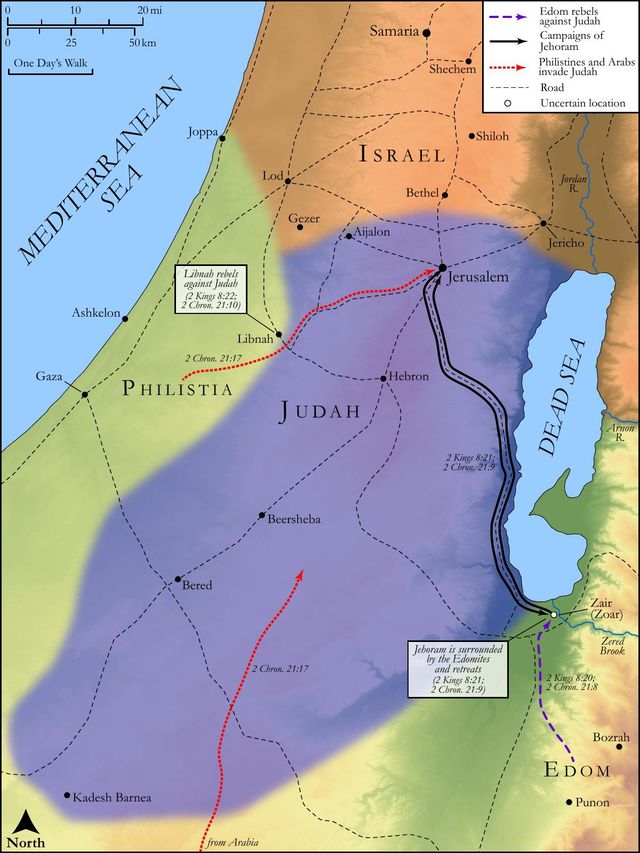
See on the biblical-era map
Study this verse
Public-domain commentary
Matthew Henry
From his Commentary on the Whole Bible. Henry comments on passages, not single verses — this entry covers 2 Chronicles 21:1–11. His two-level outline is real structure in the source text, so it is rendered as structure.
We find here,
I.That Jehoshaphat was a very careful indulgent father to Jehoram.
He had many sons, who are here named (Ch2 21:2), and it is said (Ch2 21:13) that they were better than Jehoram, had a great deal more wisdom and virtue, and lived up to their education, which he went counter to. They were very hopeful, and any of them more fit for the crown than he; and yet, because he was the first-born (Ch2 21:3), his father secured the kingdom to him, and portioned his brethren and disposed of them so as that they would be easy and give him no disturbance; as Abraham, when he made Isaac his heir, dismissed his other children with gifts. Herein Jehoshaphat was very kind and fair to his son, which might have obliged him to be respectful to him, and tread in the steps of so good a father. But it is no new thing for the children that have been most indulged by their parents to be least dutiful to them. Whether in doing this he acted wisely and well for his people, and was just to them, I cannot say. His birthright entitled him to a double portion of his father's estate, Deu 21:17. But if he appeared utterly unfit for government (the end of which is the good of the people), and likely to undo all that his father had done, it would have been better perhaps to have set him aside, and taken the next that was hopeful, and not inclined as he was to idolatry. Power is a sacred thing, with which men may either do much good or much hurt; and therefore Detur digniori - Let him that deserves it have it. Salus populi suprema lex - The security of the people is the first consideration.
II.That Jehoram was a most barbarous brother to his father's sons.
As soon as he had settled himself in the throne he slew all his brethren with the sword, either by false accusation, under colour of law, or rather by assassination. By some wicked hand or other he got them all murdered, pretending (it is likely) that he could not think himself safe in the government till they were taken out of the way. Those that mean ill themselves are commonly, without cause, jealous of those about them. The wicked fear where no fear is, or pretend to do so, in order to conceal their malice. Jehoram, it is likely, hated his brethren and slew them for the same reason that Cain hated Abel and slew him, because their piety condemned his impiety and won them that esteem with the people which he had lost. With them he slew divers of the princes of Israel, who adhered to them, or were likely to avenge their death. The princes of Judah, those who had taught the good knowledge of the Lord (Ch2 17:7), are here called princes of Israel, as before fathers of Israel (Ch2 19:8), because they were Israelites indeed, men of integrity. The sword which the good father had put into their hands this wicked son sheathed in their bowels. Woe unto him that thus foundeth a kingdom in blood (Hab 2:12); it will prove a foundation that will sink the superstructure.
III.That Jehoram was a most wicked king, who corrupted and debauched his kingdom, and ruined the reformation that his good father and grandfather had carried on: He walked in the way of the house of Ahab (Ch2 21:6), made high places, which the people were of themselves too forward to make, and did his utmost to set up idolatry again, Ch2 21:11.
1.As for the inhabitants of Jerusalem, where he kept his court, he easily drew them into his spiritual whoredom: He caused them to commit fornication, seducing them to eat things sacrificed to idols, Rev 2:20.
2.The country people seem to have been brought to it with more difficulty; but those that would not be corrupted by flatteries were driven by force to partake in his abominable idolatries: He compelled Judah thereto. He used that power for the destruction of the church which was given him for the edification of it.
IV.That when he forsook God and his worship his subjects withdrew from their allegiance to him.
1.Some of the provinces abroad that were tributaries to him did so. The Edomites revolted (Ch2 21:8), and, though he chastised them (Ch2 21:9), yet he could not reduce them, Ch2 21:10.
2.One of the cities of his own kingdom did so. Libnah revolted (Ch2 21:10) and set up for a free state, as of old it had a king of its own, Jos 12:15. And the reason is here given, not only why God permitted it, but why they did it; they shook off his government because he had forsaken the Lord God of his fathers, had become an idolater and a worshipper of false gods, and they could not continue subject to him without some danger of being themselves also drawn away from God and their duty. While he adhered to God they adhered to him; but, when he cast God off, they cast him off. Whether this reason will justify them in their revolt of no, it will justify God's providence which ordered it so.
V.That yet God was tender of his covenant with the house of David, and therefore would not destroy the royal family, though it was so wretchedly corrupted and degenerated, Ch2 21:7. These things we had before, Kg2 8:19-22. The tenour of the covenant was that David's seed should be visited for their transgressions, but the covenant should never be broken, Psa 89:30, etc.
Continue studying 2 Chronicles 21:11 across the web’s major study libraries — every link below opens this exact verse, chapter, or book on the destination site.
Read & Compare
 BibleGatewayThis verse in more than 200 translations and 70 languages.
 Bible.comThe YouVersion reader — hundreds of translations, reading plans, and highlights.
 ESV.orgCrossway's official English Standard Version reader.
 NET BibleThe NET translation with 60,000+ translators' notes on every rendering decision.
 STEP BibleTyndale House's free study tool — original text, vocabulary, and scholarly resources.
 BibliaLogos Bible Software's free web reader.
 USCCBThe New American Bible (Revised Edition) with the U.S. bishops' study notes.
Commentaries
 BibleHub CommentariesDozens of classic commentaries on this verse, gathered on one page.
 StudyLightMore than 100 commentary sets — the largest collection on the web.
 BibleRefPlain-English commentary on what this verse means, verse by verse.
 Enduring WordDavid Guzik's free commentary on this chapter, widely used by Bible teachers.
 Bible Study ToolsVerse commentary alongside Greek and Hebrew study aids.
Original Language & Research
- BibleHub InterlinearThe verse word by word — original language, transliteration, and English.
- BibleHub LexiconEvery word's original-language definition and Strong's entry.
 Blue Letter BibleDeep-study tools — Strong's numbers, concordance, and word studies.
 SefariaThe Hebrew text with Rashi and centuries of Jewish commentary.
Sermons, Hymns & Audio


TrulyRandomVerse is not affiliated with these sites and doesn’t control their content. They’re linked because they’re genuinely useful.
Summary
2 Chronicles 21:11 powerfully depicts King Jehoram's profound spiritual rebellion and its devastating consequences for Judah. Far from merely tolerating existing pagan practices, Jehoram actively established illicit worship sites, known as "high places," throughout the kingdom. He aggressively coerced the inhabitants of Jerusalem and the broader populace of Judah into spiritual unfaithfulness, metaphorically described as "fornication." This verse starkly highlights his radical deviation from the covenant with Yahweh and the righteous legacy of his father Jehoshaphat, thereby setting the stage for the severe divine judgment that would soon befall his reign and the nation.
Context
ShowHideLiterary Context
This verse is strategically placed within the chronicler's account of King Jehoram's reign, immediately following his brutal consolidation of power through the murder of his brothers 2 Chronicles 21:4. It marks a critical turning point in Judah's spiritual trajectory, shifting from the relative faithfulness seen under Jehoshaphat to outright apostasy. The chronicler meticulously emphasizes Jehoram's active role in leading the nation astray, drawing a sharp contrast with the reforms and devotion of his father 2 Chronicles 17:3-6 and grandfather Asa. The narrative flow of 2 Chronicles consistently highlights the direct correlation between the king's righteousness (or lack thereof) and the nation's spiritual and political fortunes, foreshadowing the divine judgment that would soon befall Jehoram and Judah, culminating in the invasion by the Philistines and Arabs and Jehoram's ignominious death 2 Chronicles 21:16-20.
Historical & Cultural Context
Jehoram reigned over Judah from approximately 848 to 841 BC. His reign was heavily influenced by his marriage to Athaliah, the daughter of King Ahab and Jezebel of Israel, who were infamous for their zealous promotion of Baal worship. The "high places" (Hebrew: bâmôt) were elevated cultic sites, often situated on hills or mountains, used for religious worship. While some may have initially been dedicated to Yahweh, they frequently incorporated pagan elements or were entirely devoted to foreign deities like Baal and Asherah. God had explicitly commanded Israel to destroy all such sites upon entering the Promised Land Deuteronomy 12:2-4, as they were centers of idolatry, syncretism, and often associated with immoral practices. Jehoram's construction and promotion of these high places represented a deliberate and defiant rejection of the Mosaic covenant and a full embrace of the Canaanite religious practices that God had strictly forbidden.
Key Themes
ShowHideThis verse powerfully contributes to several central themes in 2 Chronicles. Firstly, it underscores the theme of apostasy and idolatry, vividly demonstrating how a nation can be led away from God through the corrupting influence of ungodly leadership. Jehoram's actions were not passive tolerance but active coercion, forcing Judah into widespread spiritual rebellion. Secondly, it highlights the devastating impact of corrupt leadership. The chronicler consistently links the spiritual state of the nation to the character of its king, showing how Jehoram's personal unfaithfulness directly led to national sin and subsequent divine judgment. Thirdly, the concept of "spiritual fornication" emphasizes the theme of covenant disloyalty. Just as a marriage covenant demands exclusive faithfulness, God's covenant with Israel required exclusive devotion to Him. Turning to other gods was considered a profound betrayal, akin to adultery, a theme vividly explored in prophetic books like Hosea and Jeremiah. This verse sets the stage for the chronicler's recurring message: faithfulness to God brings blessing, while apostasy brings judgment.
Exposition and Analysis
ShowHideKey Word Analysis
ShowHideFrom an unused root meaning "to be high," bâmâh refers to an elevation or an elevated cultic site. These were often hills or artificial mounds used for religious worship. While some bâmôt may have initially been used for Yahweh worship, they were consistently condemned by the prophets and historical writers because they fostered syncretism, incorporated pagan rituals, and violated God's command for centralized worship at the Temple in Jerusalem. Jehoram's act of "making" them signifies a deliberate, organized reintroduction of forbidden worship, not merely a failure to remove existing ones.
This primitive root, meaning "to be highly-fed and therefore wanton," literally means "to commit adultery" or "to be a harlot." In the Old Testament, particularly in prophetic literature, zânâh is overwhelmingly used metaphorically to describe Israel's spiritual unfaithfulness to Yahweh through idolatry and the worship of foreign gods. It portrays the covenant relationship between God and Israel as a marriage, where turning to other gods is a profound act of spiritual adultery, a betrayal of exclusive devotion.
This primitive root means "to push off," "to expel," "to mislead," or "to force." In this context, it signifies that Jehoram did not merely allow or encourage idolatry but actively drove, pushed, or forced the inhabitants of Judah into spiritual unfaithfulness. It implies a coercive and aggressive imposition of his wicked practices upon the nation, highlighting his profound misuse of royal authority to lead his people astray from the covenant with Yahweh.
Verse Breakdown
ShowHide"Moreover he made high places in the mountains of Judah"
This clause describes Jehoram's direct and proactive role in establishing centers of idolatrous worship. The phrase "mountains of Judah" indicates a widespread proliferation of these forbidden sites throughout the kingdom, suggesting a systematic effort to reintroduce paganism, a stark reversal of the reforms undertaken by his father Jehoshaphat and grandfather Asa. This was a deliberate act of defiance against God's commands.
"and caused the inhabitants of Jerusalem to commit fornication"
Here, the focus narrows to the capital city, Jerusalem, emphasizing the spiritual defilement that permeated even the heart of the kingdom. The phrase "caused...to commit fornication" highlights Jehoram's active instigation of spiritual unfaithfulness. As discussed, "fornication" is a powerful metaphor for idolatry, portraying the people's turning away from Yahweh as a betrayal of their covenant relationship, a spiritual adultery against the one true God.
"and compelled Judah [thereto]"
This final clause broadens the scope to include the entire kingdom of Judah, reinforcing the pervasive nature of Jehoram's corrupting influence. The word "compelled" (from nâdach) indicates that his actions were not merely passive permission but an aggressive, forceful urging or driving of the people into their apostasy. This suggests a top-down imposition of idolatry, where the king's authority was used to actively push the nation into sin, leaving little room for resistance and demonstrating the depth of his wickedness.
Literary Devices
ShowHideThe verse employs several potent literary devices to convey Jehoram's wickedness and its pervasive impact. The most prominent is Metaphor, specifically the use of "fornication" to describe spiritual unfaithfulness. This powerful imagery likens Israel's covenant relationship with God to a marriage, making their turning to other gods an act of adultery, emphasizing the profound betrayal and broken trust inherent in idolatry. There is also a strong sense of Contrast implicit in the chronicler's narrative, as Jehoram's actions stand in stark opposition to the righteous reigns of his predecessors, particularly Jehoshaphat, highlighting the depth of his apostasy and the tragic decline of the kingdom. The phrasing "caused... and compelled" suggests a form of Intensification or strong emphasis, underscoring the king's active and aggressive role in leading the nation astray, rather than merely allowing sin to flourish. Finally, the mention of "Jerusalem" and "Judah" can be seen as Synecdoche, where the parts (the capital city and the broader kingdom) represent the whole nation, indicating the widespread and comprehensive nature of the spiritual corruption.
Theological and Thematic Connections
ShowHide2 Chronicles 21:11 serves as a stark reminder of the profound consequences of covenant unfaithfulness and the immense responsibility of leadership. Theologically, it underscores God's unwavering expectation of exclusive worship from His people, viewing any deviation as a betrayal of the sacred covenant relationship, akin to spiritual adultery. It highlights the insidious nature of idolatry, which often begins with subtle compromises but can quickly escalate to widespread, state-sponsored apostasy. The verse also implicitly teaches about divine sovereignty and justice; such blatant disregard for God's commands inevitably invites His righteous judgment. The chronicler's emphasis on Jehoram's active role ("made," "caused," "compelled") illustrates that sin is not merely passive omission but often an active, destructive force, particularly when wielded by those in authority. This passage reinforces the biblical truth that true prosperity and stability for a nation are rooted in its faithfulness to God.
Reflection and Application
ShowHideThis ancient account of King Jehoram's reign offers profound lessons for contemporary believers and leaders. It challenges us to examine our own lives for "high places"—any area where we might be tempted to give ultimate allegiance or devotion to something other than God, whether it be wealth, power, reputation, comfort, or even good causes that subtly usurp God's rightful place. The concept of "spiritual fornication" warns against syncretism, where we attempt to blend Christian faith with worldly values or practices that contradict God's truth, thereby diluting the purity of our devotion. For those in positions of leadership—whether in families, churches, businesses, or government—Jehoram's example is a sober reminder of the immense spiritual influence one wields. Our choices, whether for righteousness or rebellion, inevitably impact those under our care, and we are accountable for how we lead. Ultimately, this verse calls us to unwavering faithfulness to God alone, even when societal pressures or influential voices "compel" us toward compromise. Our ultimate allegiance must always be to the King of Kings, ensuring our worship and devotion remain undivided.
Questions for Reflection
ShowHideFAQ
ShowHideWhat were "high places" and why were they considered bad?
ShowHide"High places" (Hebrew: bâmôt) were elevated sites, often on hills or mountains, used for religious worship. While some may have initially been used for Yahweh worship, they were primarily condemned because they fostered syncretism (mixing Yahweh worship with pagan practices), violated God's command for centralized worship at the Temple in Jerusalem Deuteronomy 12:5-7, and were frequently associated with the worship of foreign deities like Baal and Asherah, often involving immoral rituals. Their existence represented a direct challenge to God's exclusive claim on Israel's worship and a constant temptation to idolatry.
What does it mean that Jehoram "caused the inhabitants of Jerusalem to commit fornication"?
ShowHideIn this context, "fornication" is a powerful metaphor for spiritual unfaithfulness or idolatry. Just as a wife is to be exclusively faithful to her husband in a marriage covenant, Israel was bound by covenant to be exclusively faithful to Yahweh. When they turned to worship other gods or engaged in syncretistic practices, it was considered a profound act of spiritual adultery or "fornication." Jehoram actively promoted and enforced this spiritual betrayal, leading the people away from their covenant obligations to the one true God. This imagery is common in prophetic books, such as Hosea and Jeremiah.
How was Jehoram's reign different from his father Jehoshaphat's?
ShowHideJehoram's reign was a stark contrast to that of his father, Jehoshaphat. Jehoshaphat "sought the Lord with all his heart" 2 Chronicles 17:4 and initiated significant religious reforms, sending officials to teach the Law throughout Judah and removing some of the high places (though not all). In contrast, Jehoram actively reversed these reforms, building new high places, promoting pagan worship, and even coercing the people into idolatry. His reign was marked by violence (murdering his brothers), apostasy, and ultimately divine judgment, leading to the invasion of Judah and his own painful death, while Jehoshaphat's reign was characterized by seeking God and experiencing divine blessing and military success.
Christ-Centered Fulfillment
ShowHideThe egregious spiritual rebellion of King Jehoram, as depicted in 2 Chronicles 21:11, powerfully highlights humanity's persistent propensity for idolatry and the devastating consequences of unfaithful leadership. This narrative, steeped in the Old Covenant's demands for exclusive devotion to Yahweh, ultimately points to the profound need for a perfect King and a new covenant. Unlike Jehoram, who led his people into spiritual "fornication" and judgment, Jesus Christ is the perfectly faithful King, the true Son of David, who leads His people not into sin but into righteousness. He is the ultimate fulfillment of the Temple, rendering all "high places" obsolete because in Him, God's presence dwells fully among humanity John 1:14. Moreover, Christ's sacrificial death on the cross serves as the definitive atonement for all forms of spiritual "fornication" and idolatry, cleansing His people from their unfaithfulness and reconciling them to God Hebrews 9:11-14. Through His shed blood, He establishes a new covenant, calling His church to be a pure and faithful bride, wholly devoted to Him Ephesians 5:25-27; Revelation 19:7-9. Thus, Jehoram's failure underscores the absolute necessity and glorious sufficiency of Christ, who alone can truly deliver His people from the grip of sin and lead them in perfect faithfulness to God.