


1 Kings 11:7
Bible text: King James Version (1769 Blayney text) · Public domain
Bible text: King James Version with Strong's numbers · Public domain
Bible text: Berean Standard Bible · Public domain
Bible text: American Standard Version (1901) · Public domain
Bible text: World English Bible, Messianic edition · Public domain
Bible text: Geneva Bible (1599) · Public domain
Bible text: Young's Literal Translation · Public domain
- אָז'azthenH227AdvAdverb
- יִבְנֶהyiv·Nehhe builtH1129V-Qal-Imperf-3msVerb Qal Imperfect 3rd Singular Masculine
- שְׁלֹמֹהshe·lo·MohSolomonH8010N-proper-mNoun Proper Masculine
- בָּמָהba·Maha high placeH1116N-fsNoun Singular Feminine Absolute
- לִכְמוֹשׁlikh·mo·Voshfor ChemoshH3645Prep-l ¦ N-properNoun Proper TitleלִforכְמוֹשׁChemosh
- שִׁקֻּץshi·Kutz[the] detestable thing ofH8251N-mscNoun Singular Masculine Construct
- מוֹאָבmo·'AvMoabH4124N-properNoun Proper Location
- בָּהָרba·Haron the mountainH2022Prep-b ¦ N-msNoun Singular Masculine Absoluteבָּon theהָרmountain
- אֲשֶׁר'a·SherwhichH834RelParticle Relative
- עַל'al[is] onH5921PrepPreposition
- פְּנֵיpe·Nei[the] face ofH6440N-mpcNoun Plural Masculine Construct
- יְרוּשָׁלִָםye·ru·sha·LimJerusalemH3389N-properNoun Proper Location
- וּלְמֹלֶךְu·le·Mo·lekhand for MolechH4432Conj-w ¦ Prep-l ¦ N-properNoun Proper TitleוּandלְforמֹלֶךְMolech
- שִׁקֻּץshi·Kutz[the] detestable thing ofH8251N-mscNoun Singular Masculine Construct
- בְּנֵיbe·Nei[the] people ofH1121N-mpcNoun Plural Masculine Construct
- עַמּוֹןa·MonAmmonH5983N-proper-mNoun Proper Masculine
English is a literal word-by-word gloss of the Hebrew, not the KJV's wording. Why?
This is the original text the KJV's translators worked from — each Hebrew word with its own literal English meaning in this verse, prepared by scholars at Tyndale House, Cambridge. The KJV translates whole sentences, not word by word, so its wording differs: one Hebrew word can become several English words, and the KJV may choose “the LORD” where the gloss reads “Yahweh”. Both are faithful — they answer different questions. For the KJV's own rendering, switch to the KJV text.
Details
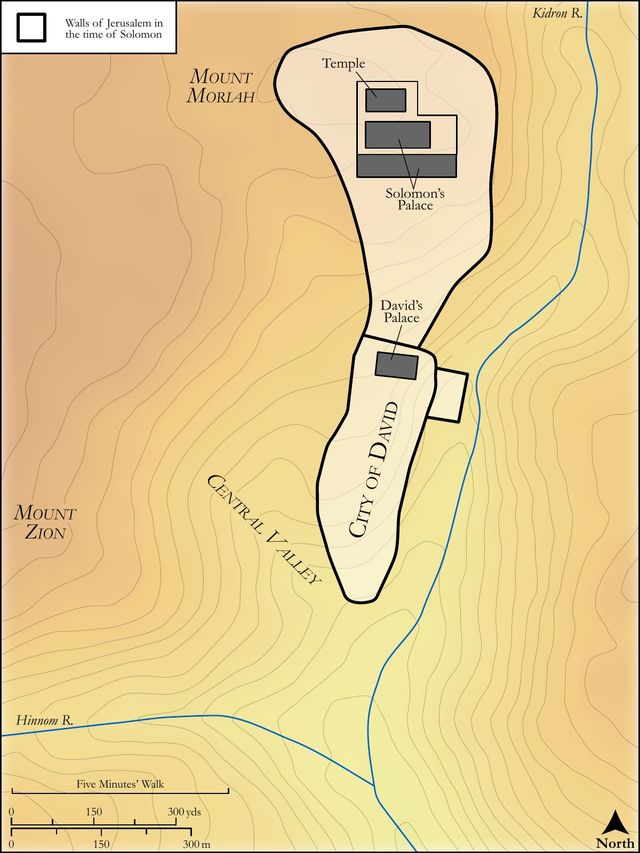
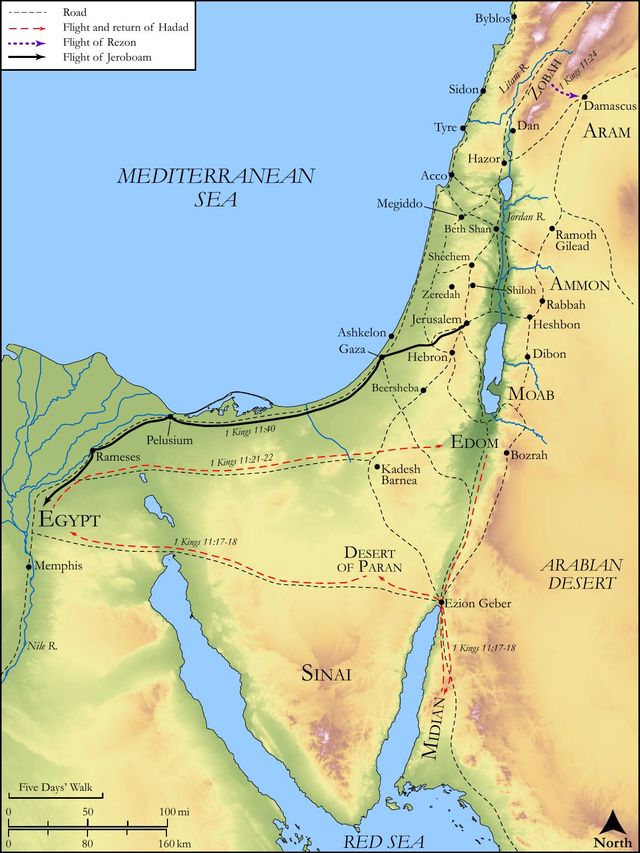
See on the biblical-era maps
Study this verse
Public-domain commentary
Matthew Henry
From his Commentary on the Whole Bible. Henry comments on passages, not single verses — this entry covers 1 Kings 11:1–8. His three-level outline is real structure in the source text, so it is rendered as structure.
This is a sad story, and very surprising, of Solomon's defection and degeneracy.
I.Let us enquire into the occasions and particulars of it.
Shall Solomon fall, that was the beauty of Israel, and so great a blessing of his generation? Yes, it is too true, and the scripture is faithful in relating it, and repeating it, and referring to it long after, Neh 13:26. There was no king like Solomon who was beloved of his God, yet even him did outlandish women cause to sin. There is the summary of his apostasy; it was the woman that deceived him, and was first in the transgression.
1.He doted on strange women, many strange women. Here his revolt began.
(1.)He gave himself to women, which his mother had particularly cautioned him against. Pro 31:3, Give not thy strength unto women (perhaps alluding to Samson, who lost his strength by giving information of it to a woman), for it is that which, as much as any thing, destroys kings. His father David's fall began with the lusts of the flesh, which he should have taken warning by. The love of women has cast down many wounded (Pro 7:26) and many (says bishop Hall) have had their head broken by their own rib.
(2.)He took many women, so many that, at last, they amounted to 700 wives and 300 concubines, 1000 in all, and not one good one among them, as he himself owns in his penitential sermon (Ecc 7:28), for no woman of established virtue would be one of such a set. God had, by his law, particularly forbidden the kings to multiply either horses or wives, Deu 17:16, Deu 17:17. How he broke the former law, in multiplying horses, and having them out of Egypt too (which was expressly prohibited in that law) we read Kg1 10:29, and here we are told how he broke the latter (which proved of more fatal consequence) in multiplying wives. Note, Less sins, made gold with, open the door to greater. David had multiplied wives too much, and perhaps that made Solomon presume it lawful. Note, If those that are in reputation for religion in any thing set a bad example, they know not what a deal of mischief they may do by it, particularly to their own children. One bad act of a good man may be of more pernicious consequence to others than twenty of a wicked man. Probably Solomon, when he began to multiply wives, intended not to exceed his father's number. But the way of sin is down-hill; those that have got into it cannot easily stop themselves. Divine wisdom has appointed one woman for one man, did so at first; and those who do not think one enough will not think two or three enough. Unbridled lust will be unbounded, and the loosened hind will wander endlessly. But this was not all:
(3.)They were strange women, Moabites, Ammonites, etc., of the nations which God had particularly forbidden them to intermarry with, Kg1 11:2. Some think it was in policy that he married these foreigners, by them to get intelligence of the state of those countries. I rather fear it was because the daughters of Israel were too grave and modest for him, and those foreigners pleased him with the looseness and wantonness of their dress, and air, and conversation. Or, perhaps, it was looked upon as a piece of state to have his seraglio, as his other treasures, replenished with that which was far-fetched; as if that were too great an honour for the best of his subjects which would really have been a disgrace to the meanest of them - to be his mistresses. And,
(4.)To complete the mischief, Solomon clave unto these in love, Kg1 11:2. He not only kept them, but was extravagantly fond of them, set his heart upon them, spent his time among them, thought every thing well they said and did, and despised Pharaoh's daughter, his rightful wife, who had been dear to him, and all the ladies of Israel, in comparison of them. Solomon was master of a great deal of knowledge, but to what purpose, when he had no better a government of his appetites?
2.He was drawn by them to the worship of strange gods, as Israel to Baal-peor by the daughters of Moab. This was the bad consequence of his multiplying wives. We have reason to think it impaired his health, and hastened upon him the decays of age; it exhausted his treasure, which, though vast indeed, would be found little enough to maintain the pride and vanity of all these women; perhaps it occasioned him, in his latter end, to neglect his business, by which he lost his supplies from abroad, and was forced, for the keeping up of his grandeur, to burden his subjects with those taxes which they complained of, Kg1 12:4. But none of these consequences were so bad as this: His wives turned away his heart after other gods, Kg1 11:3, Kg1 11:4.
(1.)He grew cool and indifferent in his own religion and remiss in the service of the God of Israel: His heart was not perfect with the Lord his God (Kg1 11:4), nor did he follow him fully (Kg1 11:6), like David. We cannot suppose that he quite cast off the worship of God, much less that he restrained or hindered it (the temple-service went on as usual); but he grew less frequent, and less serious, in his ascent to the house of the Lord and his attendance on his altar. He left his first love, lost his zeal for God, and did not persevere to the end as he had begun; therefore it is said he was not perfect, because he was not constant; and he followed not God fully, because he turned from following him, and did not continue to the end. His father David had many faults, but he never neglected the worship of God, nor grew remiss in that, as Solomon did (his wives using all their arts to divert him from it), and there began his apostasy.
(2.)He tolerated and maintained his wives in their idolatry and made no scruple of joining with them in it. Pharaoh's daughter was proselyted (as is supposed) to the Jews' religion, but, when he began to grow careless in the worship of God himself, he used no means to convert his other wives to it; in complaisance to them, he built chapels for their gods (Kg1 11:7, Kg1 11:8), maintained their priests, and occasionally did himself attend their altars, making a jest of it, asking, "What harm is there in it? Are not all religions alike?" which (says bishop Patrick) has been the disease of some great wits. When he humoured one thus, the rest would take it ill if he did not, in like manner, gratify them, so that he did it for all his wives (Kg1 11:8), and at last came to such a degree of impiety that he set up a high place for Chemosh in the hill that is before Jerusalem, the mount of Olives, as if to confront the temple which he himself had built. These high places continued here, not utterly demolished, till Josiah's time, Kg2 23:13. This is the account here given of Solomon's apostasy.
II.Let us now pause awhile, and lament Solomon's fall; and we may justly stand and wonder at it.
How has the gold become dim! How has the most fine gold changed! Be astonished, O heavens! at this, and be horribly afraid, as the prophet exclaims in a like case, Jer 2:12.
1.How strange,
(1.)That Solomon, in his old age, should be ensnared with fleshly lusts, youthful lusts. As we must never presume upon the strength of our resolutions, so neither upon the weakness of our corruptions, so as to be secure and off our guard.
(2.)That so wise a man as Solomon was, so famed for a quick understanding and sound judgment, should suffer himself to be made such a fool of by these foolish women.
(3.)That one who had so often and so plainly warned others of the danger of the love of women should himself be so wretchedly bewitched with it; it is easier to see a mischief, and to show it to others, than to shun it ourselves.
(4.)That so good a man, so zealous for the worship of God, who had been so conversant with divine things, and who prayed that excellent prayer at the dedication of the temple, should do these sinful things. Is this Solomon? Have all his wisdom and devotion come to this at last? Never was gallant ship so wrecked; never was crown so profaned.
2.What shall we say to all this? Why God permitted it it is not for us to enquire; his way is in the sea and his path in the great waters; he knew how to bring glory to himself out of it. God foresaw it when he said concerning him that should build the temple, If he commit iniquity, etc., Sa2 7:14. But it concerns us to enquire what good use we may make of it.
(1.)Let him that thinks he stands take heed lest he fall. We see how weak we are of ourselves, without the grace of God; let us therefore live in a constant dependence on that grace.
(2.)See the danger of a prosperous condition, and how hard it is to overcome the temptations of it. Solomon, like Jeshurun, waxed fat and then kicked. The food convenient, which Agur prayed for, is safer and better than the food abundant, which Solomon was even surfeited with.
(3.)See what need those have to stand upon their guard who have made a great profession of religion, and shown themselves forward and zealous in devotion, because the devil will set upon them most violently, and, if they misbehave, the reproach is the greater. It is the evening that commends the day; let us therefore fear, lest, having run well, we seem to come short.
Historical interpretation
Historical reception
1 surviving comment on this verse from the historical church.
Solomon was in his time David’s son, a great man, through whom many holy precepts and healthful admonitions and divine mysteries have been wrought by the Holy Spirit in the Scriptures. Solomon himself was a lover of women and was rejected by God: and this lust was so great a snare to him that he was induced by women even to sacrifice to idols, as Scripture witnesses concerning him. But if, by his fall, what was delivered through him were blotted out, it would be judged that he had himself delivered these precepts and not that they were delivered through him. The mercy of God, therefore, and his Spirit, excellently wrought that whatever of good was declared through Solomon, might be attributed to God; and the man’s sin, to the man. What marvel that Solomon fell among God’s people? Did not Adam fall in paradise? Did not an angel fall from heaven and become the devil? We are thereby taught that no hope must be placed in any human being.
Continue studying 1 Kings 11:7 across the web’s major study libraries — every link below opens this exact verse, chapter, or book on the destination site.
Read & Compare
 BibleGatewayThis verse in more than 200 translations and 70 languages.
 Bible.comThe YouVersion reader — hundreds of translations, reading plans, and highlights.
 ESV.orgCrossway's official English Standard Version reader.
 NET BibleThe NET translation with 60,000+ translators' notes on every rendering decision.
 STEP BibleTyndale House's free study tool — original text, vocabulary, and scholarly resources.
 BibliaLogos Bible Software's free web reader.
 USCCBThe New American Bible (Revised Edition) with the U.S. bishops' study notes.
Commentaries
 BibleHub CommentariesDozens of classic commentaries on this verse, gathered on one page.
 StudyLightMore than 100 commentary sets — the largest collection on the web.
 BibleRefPlain-English commentary on what this verse means, verse by verse.
 Enduring WordDavid Guzik's free commentary on this chapter, widely used by Bible teachers.
 Bible Study ToolsVerse commentary alongside Greek and Hebrew study aids.
Original Language & Research
- BibleHub InterlinearThe verse word by word — original language, transliteration, and English.
- BibleHub LexiconEvery word's original-language definition and Strong's entry.
 Blue Letter BibleDeep-study tools — Strong's numbers, concordance, and word studies.
 SefariaThe Hebrew text with Rashi and centuries of Jewish commentary.
Sermons, Hymns & Audio


TrulyRandomVerse is not affiliated with these sites and doesn’t control their content. They’re linked because they’re genuinely useful.
Summary
1 Kings 11:7 marks a tragic and pivotal moment in the reign of King Solomon, detailing his overt and public acts of apostasy by constructing pagan altars for the foreign deities Chemosh and Molech. This verse stands as a stark testament to the devastating consequences of spiritual compromise and disobedience, even for a leader once so profoundly blessed with divine wisdom and unparalleled wealth, revealing the insidious nature of idolatry that can corrupt even the most devout hearts and lead to national decline.
Context
ShowHideLiterary Context
This verse serves as the culmination of Solomon's spiritual decline, directly following the detailed account of his accumulating numerous foreign wives and concubines, as explicitly stated in 1 Kings 11:1-3. The narrative explicitly attributes his turning away from God to the influence of these women, noting that they "turned away his heart after other gods" as recorded in 1 Kings 11:4. This profound unfaithfulness provokes God's righteous anger and leads to a solemn pronouncement of judgment against Solomon and his kingdom, a judgment foreshadowed in 1 Kings 11:9-13. The construction of these high places for pagan deities is not merely a private sin but a concrete, public manifestation of his covenant violation, directly contravening the first two commandments against idolatry found in Exodus 20:3-5. This egregious act sets the tragic stage for the prophesied division of the united kingdom, a central and devastating theme that unfolds in the subsequent chapters of 1 Kings.
Historical & Cultural Context
The "high place" (Hebrew: bâmâh) refers to elevated sites, often natural hills or artificial mounds, that were commonly used for pagan worship among the nations round about. These cultic centers typically featured altars, sacred stones (massebot), and Asherah poles, and were frequently associated with abhorrent practices such as fertility rites, cultic prostitution, and even child sacrifice. That Solomon built these "in the hill that is before Jerusalem" – widely identified as the Mount of Olives – was not merely a private transgression but a public and audacious affront to Yahweh. It placed detestable altars directly opposite the holy city and the magnificent Temple he had built for the one true God, symbolizing a direct challenge to Yahweh's exclusive sovereignty and a defilement of the sacred landscape. Chemosh was the national god of Moab, and Molech was the national god of Ammon, both neighboring nations with whom Israel had a complex and often hostile history. Their religious practices were explicitly and repeatedly forbidden by God, as seen in passages like Leviticus 18:21 regarding the offering of children to Molech.
Key Themes
ShowHideThis verse powerfully underscores several critical theological and narrative themes within the broader biblical narrative. Firstly, it highlights the peril of idolatry and apostasy, demonstrating how even the wisest and most blessed individual, like Solomon, can succumb to the worship of false gods, leading to profound spiritual and national decline. Solomon's actions serve as a stark and enduring warning against spiritual compromise and the deceptive allure of syncretism. Secondly, it vividly illustrates the severe consequences of disobedience to God's covenant. This act of rebellion directly precipitates God's judgment and the prophesied division of the united kingdom of Israel, as explicitly stated in 1 Kings 11:11, serving as a potent reminder of the far-reaching ripple effects of unfaithfulness. Finally, the verse implicitly emphasizes the corrupting influence of unholy alliances. Despite God's clear and repeated warnings against intermarriage with idolatrous nations, as found in Deuteronomy 7:3-4, Solomon's foreign wives led him astray, illustrating how external influences can erode one's commitment to the Lord and lead to spiritual ruin.
Exposition and Analysis
ShowHideKey Word Analysis
ShowHideFrom an unused root meaning "to be high," this term refers to an elevation, an elevated cultic site, often a natural hill or an artificial mound, used for religious worship. While occasionally used for Yahweh worship (though not preferred by God), in this context, it unequivocally denotes a pagan shrine. The construction of a bâmâh for foreign gods was a direct violation of God's command for centralized worship and exclusive devotion to Him.
From an unused root meaning "to subdue," this refers to "the powerful." Kemosh was the national god of the Moabites, often associated with warfare and fertility. Worship of Chemosh sometimes involved human sacrifice, though it was less explicitly defined than Molech's practices. His inclusion here signifies Solomon's comprehensive embrace of the idolatry of Israel's traditional enemies.
From a root meaning "to rule" or "king," Molek (i.e., king) was the chief deity of the Ammonites. This deity is infamous for cultic practices that explicitly involved child sacrifice by fire. The worship of Molech was one of the most abhorrent practices among the nations from God's perspective, representing the ultimate defilement and spiritual perversion.
From a root meaning "to be disgusting," this strong theological term describes something utterly detestable, morally repugnant, and spiritually defiling in God's sight, especially idolatrous practices or, concretely, an idol. Its application to Chemosh and Molech underscores God's profound revulsion towards these pagan deities and their associated practices, marking them as antithetical to His holy character and covenant demands.
Verse Breakdown
ShowHide"Then did Solomon build an high place"
This clause highlights Solomon's active, deliberate, and personal role in establishing idolatry. It is not a passive allowance or a mere toleration, but an intentional act of construction, signifying a profound and personal turning away from the Lord. The verb "build" (בָּנָה, bânâh) is the same verb used for his construction of the magnificent Temple for Yahweh, creating a stark, tragic, and deeply ironic contrast.
"for Chemosh, the abomination of Moab"
This specifies the first pagan deity Solomon honored. Chemosh, explicitly identified as "the abomination of Moab," immediately links the god to its national origin and, more importantly, to God's explicit judgment and condemnation of it. This demonstrates Solomon's flagrant disregard for the divine prohibition against adopting the detestable practices of surrounding nations.
"in the hill that [is] before Jerusalem"
This geographical detail is profoundly significant and laden with irony. The "hill before Jerusalem" is widely understood to be the Mount of Olives, which directly faced the Temple Mount. Placing these pagan altars in such a prominent and provocative location was a blatant and public act of defiance against Yahweh, defiling the very landscape surrounding His holy city and His dwelling place, the Temple.
"and for Molech, the abomination of the children of Ammon"
The addition of Molech further deepens the gravity and horror of Solomon's sin. Molech, the "abomination of the children of Ammon," was particularly heinous due to the practice of child sacrifice. Solomon's patronage of such a cult demonstrates the depth of his spiritual degradation and the extent to which his heart had been led astray by his foreign wives.
Literary Devices
ShowHideThe verse employs several powerful Literary Devices to convey its tragic and condemnatory message. Juxtaposition is central, creating a stark contrast between Solomon, the divinely appointed king renowned for building the magnificent Temple for Yahweh, and Solomon, the apostate king who now builds "high places" for detestable pagan gods. This stark contrast underscores the profound depth of his fall from grace. The precise geographical detail, "in the hill that is before Jerusalem," creates a powerful Spatial Irony, placing altars of "abomination" in direct visual and symbolic opposition to the sacred Temple, thereby symbolizing the spiritual conflict within the kingdom and, more acutely, within Solomon's own heart. The potent Repetition of the term "abomination" (Hebrew: shiqqûwts) emphasizes God's intense revulsion and unwavering condemnation of these foreign deities and their associated idolatrous practices. Furthermore, the verse serves as a potent form of Foreshadowing, as Solomon's egregious apostasy directly precipitates the division of his kingdom, a major and tragic theme that unfolds in the subsequent narrative of 1 Kings.
Theological and Thematic Connections
ShowHideSolomon's tragic fall in 1 Kings 11:7 serves as a profound theological statement on the insidious nature of idolatry and the unwavering holiness of God. It demonstrates that even immense wisdom and unparalleled divine blessing do not inoculate one against spiritual compromise if the heart is not diligently guarded and wholly devoted to God. The building of these high places for Chemosh and Molech was not merely a lapse in judgment but a direct, public, and egregious violation of God's covenant, which demanded exclusive worship and absolute fidelity from His people. This act underscores God's utter detestation of anything that competes for His rightful place in the human heart, revealing His fierce jealousy for His people's undivided devotion. It teaches that idolatry, whether ancient pagan worship or modern forms of misplaced allegiance, is an "abomination" because it diminishes God's glory, distorts human flourishing, and ultimately leads to spiritual death and judgment.
Reflection and Application
ShowHideSolomon's descent into idolatry, culminating in the public construction of pagan altars, offers a sobering and timeless lesson for all believers across generations. His story powerfully reminds us that spiritual compromise is often a gradual and insidious process, beginning with seemingly small deviations from God's clear commands, such as forming unholy alliances, and culminating in overt rebellion and public apostasy. This narrative challenges us to diligently guard our hearts with utmost vigilance, recognizing that the battle for our ultimate allegiance is constant, subtle, and waged daily. In a contemporary context, "high places" and "abominations" might manifest as anything that subtly or overtly competes for our ultimate devotion: wealth, career, personal ambition, social status, entertainment, or even relationships, if they lead us away from God's truth and His supreme authority. Solomon's fall underscores that God's standard for exclusive worship remains unchanging, and our spiritual choices have profound ripple effects, not only on our own lives but also on our families, communities, and future generations. We are therefore called to cultivate a heart of undivided loyalty, continuously examining our affections and priorities to ensure that God alone holds the supreme and rightful place in our lives, guarding against any idol that seeks to usurp His throne.
Questions for Reflection
ShowHideFAQ
ShowHideWhy is building a "high place" so significant, and why was it considered an "abomination"?
ShowHideBuilding a "high place" (Hebrew: bâmâh) for pagan deities was profoundly significant because it represented a direct and public violation of God's covenant with Israel. God had commanded His people to worship Him exclusively and in a centralized location (first the Tabernacle, then the Temple in Jerusalem), explicitly forbidding the adoption of the idolatrous practices of surrounding nations. These "high places" were often centers of polytheistic worship, fertility cults, and even horrific rituals like child sacrifice. For Solomon, who had built the magnificent Temple for Yahweh, to then erect altars to Chemosh and Molech on the hill directly facing Jerusalem was an act of profound spiritual rebellion and public defiance. It was considered an "abomination" (Hebrew: shiqqûwts) because it was utterly detestable to God, representing a betrayal of His holiness, a defilement of the land He had given His people, and a perversion of true worship. God's character demands exclusive devotion, and anything that competes with Him for ultimate allegiance is an affront to His nature and His covenant.
Who were Chemosh and Molech, and what made their worship so offensive to God?
ShowHideChemosh was the national god of Moab, and Molech was the national god of Ammon. Both were prominent deities among the nations round about, and their worship was deeply embedded in the life of Israel's neighbors. What made their worship particularly offensive to God, to the point of being called "abominations" (Hebrew: shiqqûwts), was the nature of their cultic practices. While details vary, the worship of Chemosh sometimes involved human sacrifice. However, Molech worship was infamous for its explicit and widespread practice of child sacrifice, where infants were offered by fire as burnt offerings to the deity. This practice was unequivocally condemned by God in the strongest terms, as seen in passages like Leviticus 18:21 and Deuteronomy 18:10. Such acts were seen as the ultimate defilement of God's people and His land, directly contradicting His commands regarding the sanctity of human life and the purity of worship. Solomon's embrace of these cults demonstrated a profound spiritual blindness and a complete disregard for God's holy character.
Christ-Centered Fulfillment
ShowHideSolomon's tragic fall in 1 Kings 11:7 starkly highlights the desperate need for a perfect King, one who would not succumb to the temptations of the flesh or the lure of idolatry. Solomon, despite his unparalleled wisdom and divine favor, ultimately failed to guard his heart, leading his nation into spiritual compromise and setting the stage for its division. This narrative points us forward to Jesus Christ, the true and greater Son of David, who perfectly fulfills the role of King, Priest, and Prophet. Unlike Solomon, who built high places for "abominations," Jesus is the very Temple of God in whom the fullness of God dwells, and He never compromised His devotion to the Father. He faced every temptation, including those related to power and glory, yet remained without sin. While Solomon's wisdom eventually gave way to foolishness and idolatry, Jesus is the Wisdom of God incarnate, who perfectly embodies divine truth and never leads His people astray. Through His perfect obedience and ultimate sacrifice on the cross, Jesus takes away the sin of the world, including the "abomination" of idolatry, offering true reconciliation and a new covenant where hearts are transformed to worship God alone. He is the one of whom it can truly be said, "something greater than Solomon is here," for He is the King who reigns eternally in righteousness, leading His people in true worship and never turning His heart from the Father.