


1 Kings 10:29
- וַתַּעֲלֶהVa·ta·'a·lehand it came upH5927Conj-w ¦ V-Qal-ConsecImperf-3fsVerb Qal Consecutive Imperfect 3rd Singular Feminineוַandתַּעֲלֶהit came up
- וַתֵּצֵאva·te·Tze'and it came outH3318Conj-w ¦ V-Qal-ConsecImperf-3fsVerb Qal Consecutive Imperfect 3rd Singular Feminineוַandתֵּצֵאit came out
- מֶרְכָּבָהmer·ka·Vaha chariotH4818N-fsNoun Singular Feminine Absolute
- מִמִּצְרַיִםmi·mitz·Ra·yimfrom EgyptH4714Prep-m ¦ N-properNoun Proper LocationמִfromמִּצְרַיִםEgypt
- בְּשֵׁשׁbe·Sheshfor sixH8337Prep-b ¦ N-cscNoun Singular common gender Constructבְּforשֵׁשׁsix
- מֵאוֹתme·'othundred<s>H3967N-fpNoun Plural Feminine Absolute
- כֶּסֶףKe·sefsilverH3701N-msNoun Singular Masculine Absolute
- וְסוּסve·Susand a horseH5483Conj-w ¦ N-msNoun Singular Masculine Absoluteוְandסוּסa horse
- בַּחֲמִשִּׁיםba·cha·mi·Shimfor fiftyH2572Prep-b ¦ N-mpNoun Plural Masculine Absoluteבַּforחֲמִשִּׁיםfifty
- וּמֵאָהu·me·'Ahand one hundredH3967Conj-w ¦ N-fsNoun Singular Feminine Absoluteוּandמֵאָהone hundred
- וְכֵןVe·khenand thusH3651Conj-w ¦ AdvAdverbוְandכֵןthus
- לְכָלle·kholto allH3605Prep-l ¦ N-mscNoun Singular Masculine Constructלְtoכָלall
- מַלְכֵיmal·Khei[the] kings ofH4428N-mpcNoun Plural Masculine Construct
- הַחִתִּיםha·chi·Timthe HittitesH2850Art ¦ N-mpNoun Gentilic Plural Masculine AbsoluteהַtheחִתִּיםHittites
- וּלְמַלְכֵיu·le·mal·Kheiand to [the] kings ofH4428Conj-w ¦ Prep-l ¦ N-mpcNoun Plural Masculine Constructוּandלְtoמַלְכֵי[the] kings of
- אֲרָם'a·RamAramH758N-properNoun Proper Location
- בְּיָדָםbe·ya·Damby their handH3027Prep-b ¦ N-csc ¦ 3mpNoun Singular common gender Constructבְּbyיָדָhandםtheir
- יֹצִאוּyo·Tzi·'uthey brought [them] outH3318V-Hiphil-Imperf-3mpVerb Hiphil Imperfect 3rd Plural Masculine
English is a literal word-by-word gloss of the Hebrew, not the KJV's wording. Why?
This is the original text the KJV's translators worked from — each Hebrew word with its own literal English meaning in this verse, prepared by scholars at Tyndale House, Cambridge. The KJV translates whole sentences, not word by word, so its wording differs: one Hebrew word can become several English words, and the KJV may choose “the LORD” where the gloss reads “Yahweh”. Both are faithful — they answer different questions. For the KJV's own rendering, switch to the KJV text.
Details
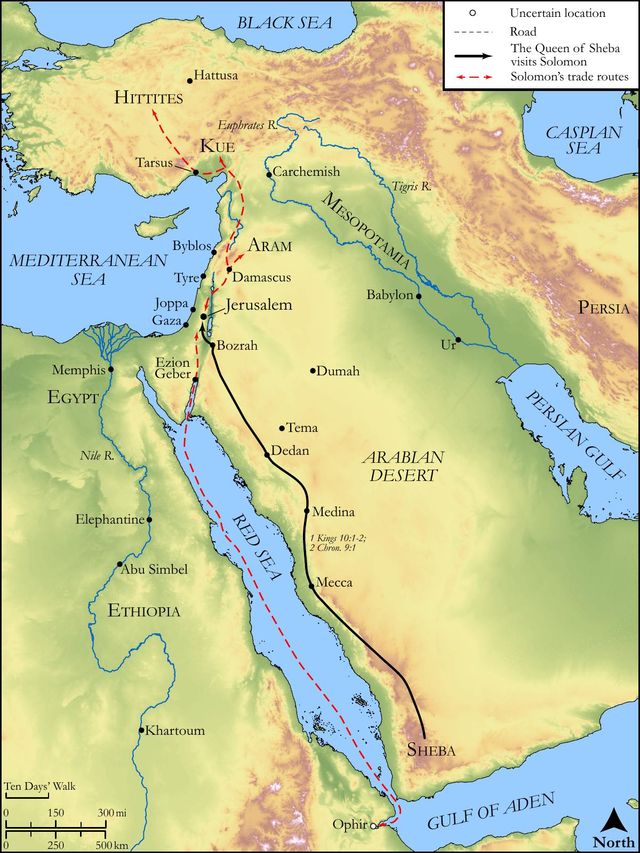
See on the biblical-era map

Study this verse
Public-domain commentary
Matthew Henry
From his Commentary on the Whole Bible. Henry comments on passages, not single verses — this entry covers 1 Kings 10:14–29. His three-level outline is real structure in the source text, so it is rendered as structure.
We have here a further account of Solomon's prosperity.
I.How he increased his wealth.
Though he had much, he still coveted to have more, being willing to try the utmost the things of this world could do to make men happy.
1.Besides the gold that came from Ophir (Kg1 9:28), he brought so much into his country from other places that the whole amounted, every year, to 666 talents (Kg1 10:14), an ominous number, compare Rev 13:18, and Ezr 2:13.
2.He received a great deal in customs from the merchants, and in land-taxes from the countries his father had conquered and made tributaries to Israel, Kg1 10:15.
3.He was Hiram's partner in a Tharshish fleet, of and for Tyre, which imported once in three years, not only gold, and silver, and ivory, substantial goods and serviceable, but apes to play with and peacocks to please the eye with their feathers, Kg1 10:22. I wish this may not be an evidence that Solomon and his people, being overcharged with prosperity, by this time grew childish and wanton.
4.He had presents made him, every year, from the neighbouring princes and great men, to engage the continuance of his friendship, not so much because they feared him or were jealous of him as because they loved him and admired his wisdom, had often occasion to consult him as an oracle, and sent him these presents by way of recompence for his advice in politics, and (whether it became his grandeur and generosity or no we will not enquire) he took all that came, even garments and spices, horses and mules, Kg1 10:24, Kg1 10:25.
5.He traded to Egypt for horses and linen-yarn (or, as some read it, linen-cloth), the staple commodities of that country, and had his own merchants or factors whom he employed in this traffic and who were accountable to him, Kg1 10:28, Kg1 10:28. The custom to be paid to the king of Egypt for exported chariots and horses out of Egypt was very high, but (as bishop Patrick understands it) Solomon, having married his daughter, got him to compound for the customs, so that he could bring them up cheaper than his neighbours, which obliged them to buy them of him, which he was wise enough no doubt to make his advantage of. This puts an honour upon the trading part of a nation, and sets a tradesman not so much below a gentleman as some place him, that Solomon, one of the greatest men that ever was, thought it no disparagement to him to deal in trade. In all labour there is profit.
II.What use he made of his wealth.
He did not hoard it up in his coffers, that he might have it to look upon and leave behind him. He has, in his Ecclesiastes, so much exposed the folly of hoarding that we cannot suppose he would himself be guilty of it. No, God that had given him riches, and wealth, and honour, gave him also power to eat thereof, and to take his portion, Ecc 5:19.
1.He laid out his gold in fine things for himself, which he might the better be allowed to do when he had before laid out so much in fine things for the house of God.
(1.)He made 200 targets, and 300 shields, of beaten gold (Kg1 10:16, Kg1 10:17), not for service, but for state, to be carried before him when he appeared in pomp. With us, magistrates have swords and maces carried before them, as the Romans had their rods and axes, in token of their power to correct and punish the bad, to whom they are to be a terror. But Solomon had shields and targets carried before him, to signify that he took more pleasure in using his power for the defence and protection of the good, to whom he would be a praise. Magistrates are shields of the earth.
(2.)He made a stately throne, on which he sat, to give laws to his subjects, audience to ambassadors, and judgment upon appeals, Kg1 10:18-20. It was made of ivory, or elephants' teeth, which was very rich; and yet, as if he had so much gold that he knew not what to do with it, he overlaid that with gold, the best gold. Yet some think he did not cover the ivory all over, but here and there. He rolled it, flowered it, or inlaid it, with gold. The stays or arms of this stately chair were supported by the images of lions in gold; so were the steps and paces by which he went up to it, to be a memorandum to him of that courage and resolution wherewith he ought to execute judgment, not fearing the face of man. The righteous, in that post, is bold as a lion.
(3.)He made all his drinking vessels, and all the furniture of his table, even at his country seat, of pure gold, Kg1 10:21. He did not grudge himself what he had, but took the credit and comfort of it, such as it was. That is good that does us good.
2.He made it circulate among his subjects, so that the kingdom was as rich as the king; for he had no separate interests of his own to consult, but sought the welfare of his people. Those princes are not governed by Solomon's maxims who think it policy to keep their subjects poor. Solomon was herein a type of Christ, who is not only rich himself, but enriches all that are his. Solomon was instrumental to bring so much gold into the country, and disperse it, that silver was nothing accounted of, Kg1 10:21. There was such plenty of it in Jerusalem that it was as the stones; and cedars, that used to be great rarities, were as common as sycamore trees, Kg1 10:27. Such is the nature of worldly wealth, plenty of it makes it the less valuable; much more should the enjoyment of spiritual riches lessen our esteem of all earthly possessions. If gold in abundance would make silver to seem so despicable, shall not wisdom, and grace, and the foretastes of heaven, which are far better than gold, make earthly wealth seem much more despicable?
Lastly, Well, thus rich, thus great, was Solomon, and thus did he exceed all the kings of the earth, Kg1 10:23. Now let us remember, 1. That this was he who, when he was setting out in the world, did not ask for the wealth and honour of it, but asked for a wise and understanding heart. The more moderate our desires are towards earthly things the better qualified we are for the enjoyment of them and the more likely to have them. See, in Solomon's greatness, the performance of God's promise (Kg1 3:13), and let it encourage us to seek first the righteousness of God's kingdom. 2. That this was he who, having tasted all these enjoyments, wrote a whole book to show the vanity of all worldly things and the vexation of spirit that attends them, their insufficiency to make us happy and the folly of setting our hearts upon them, and to recommend to us the practice of serious godliness, as that which is the whole of man, and will do infinitely more towards the making of us easy and happy than all the wealth and power that he was master of, and which, through the grace of God, is within our reach, when the thousandth part of Solomon's greatness is a thousand times more than we can ever be so vain as to promise ourselves in this world.
Continue studying 1 Kings 10:29 across the web’s major study libraries — every link below opens this exact verse, chapter, or book on the destination site.
Read & Compare
 BibleGatewayThis verse in more than 200 translations and 70 languages.
 Bible.comThe YouVersion reader — hundreds of translations, reading plans, and highlights.
 ESV.orgCrossway's official English Standard Version reader.
 NET BibleThe NET translation with 60,000+ translators' notes on every rendering decision.
 STEP BibleTyndale House's free study tool — original text, vocabulary, and scholarly resources.
 BibliaLogos Bible Software's free web reader.
 USCCBThe New American Bible (Revised Edition) with the U.S. bishops' study notes.
Commentaries
 BibleHub CommentariesDozens of classic commentaries on this verse, gathered on one page.
 StudyLightMore than 100 commentary sets — the largest collection on the web.
 BibleRefPlain-English commentary on what this verse means, verse by verse.
 Enduring WordDavid Guzik's free commentary on this chapter, widely used by Bible teachers.
 Bible Study ToolsVerse commentary alongside Greek and Hebrew study aids.
Original Language & Research
- BibleHub InterlinearThe verse word by word — original language, transliteration, and English.
- BibleHub LexiconEvery word's original-language definition and Strong's entry.
 Blue Letter BibleDeep-study tools — Strong's numbers, concordance, and word studies.
 SefariaThe Hebrew text with Rashi and centuries of Jewish commentary.
Sermons, Hymns & Audio


TrulyRandomVerse is not affiliated with these sites and doesn’t control their content. They’re linked because they’re genuinely useful.
Summary
1 Kings 10:29 offers a precise economic and military insight into King Solomon's reign, detailing his extensive and lucrative trade in chariots and horses with Egypt. This verse highlights not only Solomon's immense wealth and his kingdom's military strength but also his strategic position as a dominant intermediary in the ancient Near Eastern arms market, facilitating the re-export of these vital commodities to neighboring kings of the Hittites and Syria. It underscores the unparalleled prosperity, diplomatic influence, and geopolitical power that marked the zenith of his rule.
Context
ShowHideLiterary Context
This verse is deeply embedded within the broader narrative of 1 Kings 9-10, which meticulously chronicles the unprecedented splendor, profound wisdom, and vast economic prosperity of King Solomon's reign. It directly follows 1 Kings 10:28, which initially introduces Solomon's acquisition of horses from Egypt and Kue (Cilicia), setting the stage for the detailed economic specifics provided in verse 29. The preceding chapters and verses paint a vivid picture of a kingdom at its material and political apex, showcasing the Queen of Sheba's awe-struck visit, Solomon's vast gold reserves, his magnificent ivory throne, and his extensive naval fleet. Verse 29 specifically elaborates on the mechanism, scale, and reach of his military trade, demonstrating how his accumulated wealth translated into formidable regional power and far-reaching influence.
Historical & Cultural Context
In the ancient Near East, chariots represented the apex of military technology, functioning as the primary offensive weapons on battlefields, much like modern armored vehicles. Egypt, with its fertile Nile delta and sophisticated agricultural practices, was renowned for its superior horse breeding and advanced chariot manufacturing capabilities, making its military assets highly coveted across the region. Solomon's unique ability to procure these items directly from Egypt, likely bolstered by his strategic marriage alliance with Pharaoh's daughter (1 Kings 3:1), signifies his strong diplomatic ties and considerable economic leverage. The Hittites, a formidable empire to the north, and the various Aramean (Syrian) kingdoms were significant regional powers, frequently engaged in warfare. Solomon's pivotal role as a supplier to these nations underscores Israel's strategic geographical position as a major trading hub, controlling vital trade routes and extending its influence far beyond its immediate borders.
Key Themes
ShowHide1 Kings 10:29 contributes significantly to several overarching themes within the book of Kings and the broader Deuteronomistic History. First, it powerfully illustrates Solomon's immense wealth and power, showcasing the sheer scale of his economic activities and military might, a theme also prominent in 1 Kings 4:26. Second, it exemplifies international commerce and diplomacy, demonstrating how Israel was deeply integrated into the regional geopolitical and economic landscape through sophisticated trade networks and strategic alliances. Third, and perhaps most subtly, while appearing to celebrate worldly success, this verse introduces a critical spiritual implication by revealing Solomon's accumulation of horses, which directly contradicted the Mosaic law given to future kings in Deuteronomy 17:16. This subtle yet profound deviation foreshadows the spiritual compromises and eventual decline that would mark Solomon's later reign, as reliance on human strength and material wealth gradually overshadowed his initial devotion and obedience to God.
Exposition and Analysis
ShowHideKey Word Analysis
ShowHideThis term (H4818) refers to a wheeled vehicle, primarily used for warfare, often drawn by two or more horses. In the ancient Near East, chariots were the pinnacle of military technology, symbolizing speed, power, and an elite fighting force. Their acquisition and deployment were a clear indicator of a kingdom's wealth and military might. Solomon's vast number of chariots, as noted here and elsewhere, underscored his formidable military presence and his status as a major regional power.
As the source of these highly prized chariots and horses, Egypt (H4714) was renowned for its advanced military technology, superior horse breeding, and strategic position. Its role in this extensive trade highlights its status as a dominant regional power and Solomon's strong diplomatic and economic ties with this ancient civilization. Importing from Egypt was a sign of prestige and access to the best available military assets, reinforcing Israel's position in the geopolitical landscape.
This term (H3701) refers to the precious metal, which served as the primary form of currency and a measure of wealth in the ancient world. The specific prices—six hundred shekels of silver for a chariot and one hundred and fifty for a horse—underscore the exceptionally high value of these commodities. These significant sums emphasize the vast scale of Solomon's wealth and the immense financial resources he commanded to engage in such extensive trade, both for his own kingdom's military and for lucrative re-export.
Verse Breakdown
ShowHide"And a chariot came up and went out of Egypt for six hundred [shekels] of silver"
This initial clause establishes the origin of the goods (Egypt), the primary commodity (a chariot), and its precise cost (600 shekels of silver). The phrase "came up and went out" suggests the established trade route, likely a well-traveled land route from Egypt into Israel, indicating a regular and organized import operation. The high price underscores the premium value placed on this advanced military asset.
"and an horse for an hundred and fifty"
This part of the verse specifies the individual cost of a single horse, which was exactly one-quarter the price of a complete chariot. This detail provides further insight into the specific economics of the trade, highlighting the significant individual value of these animals, which were essential for both drawing chariots and potentially for cavalry units.
"and so for all the kings of the Hittites, and for the kings of Syria, did they bring [them] out by their means"
This crucial concluding phrase reveals Solomon's sophisticated role as a regional middleman or intermediary. His merchants, referred to as "they" or "by their means" (implying their agency and established trade networks), were not merely acquiring these goods for Israel's own military but were actively re-exporting them to other regional powers. This demonstrates Solomon's control over lucrative trade networks and his significant economic and political influence over neighboring kingdoms like the Hittites (a major power north of Israel) and the various Aramean (Syrian) states, solidifying his kingdom's strategic dominance.
Literary Devices
ShowHideThe passage employs several literary devices to convey Solomon's extraordinary status and the nature of his reign. Enumeration and Specificity are prominently featured in the precise listing of prices (600 shekels for a chariot, 150 for a horse) and the explicit naming of the trading partners (Hittites, Syria). This meticulous detail lends an air of historical accuracy and emphasizes the concrete, verifiable nature of Solomon's vast commercial and military enterprises. Symbolism is also profoundly at play, as chariots and horses were potent symbols of military might, national security, and royal power in the ancient world. Solomon's accumulation and subsequent distribution of these assets powerfully symbolize his unparalleled earthly dominion and immense wealth. Furthermore, for a discerning reader familiar with the Deuteronomic law, this verse carries a subtle yet profound element of Foreshadowing. The king's multiplication of horses directly contravened the divine command in Deuteronomy 17:16, which warned against reliance on worldly military strength and foreign alliances. Thus, what appears to be a testament to Solomon's success simultaneously hints at the seeds of his future spiritual deviation and the eventual decline of his kingdom.
Theological and Thematic Connections
ShowHide1 Kings 10:29, while seemingly a straightforward economic report, carries significant theological weight. It vividly portrays the peak of Solomon's worldly glory, wealth, and strategic power. However, this very success, particularly the accumulation of horses and the extensive international trade, stands in stark contrast to the divine blueprint for Israel's kings. The Deuteronomic law explicitly warned against a king multiplying horses for himself, lest he lead the people back to Egypt (a symbol of bondage and reliance on worldly power) or trust in military might rather than the Lord (Deuteronomy 17:16). Solomon's actions, though seemingly shrewd from a geopolitical perspective, represent a subtle shift from absolute trust in God to reliance on human strength and material resources. This theme resonates throughout Scripture, cautioning against the dangers of placing confidence in anything other than God.
Reflection and Application
ShowHideThe detailed account of Solomon's chariot and horse trade in 1 Kings 10:29 offers profound insights for contemporary believers, even though the specific commodities are archaic. This verse challenges us to consider the source and purpose of our own "wealth" and "power." Solomon was blessed with unprecedented resources and wisdom, yet his accumulation of military might and material possessions, particularly in defiance of God's explicit command, ultimately led to spiritual compromise and the fragmentation of his kingdom. This serves as a potent reminder that true security and lasting prosperity are not found in worldly assets, military strength, or shrewd economic dealings, but in unwavering trust in God. We are called to be faithful stewards of the resources, talents, and opportunities God provides, ensuring that our pursuits align with His purposes and bring Him glory, rather than feeding personal ambition or worldly security. The passage prompts us to examine what "chariots" or sources of worldly strength we might be tempted to rely upon today—be it financial stability, professional success, social influence, or even personal abilities—instead of placing our ultimate dependence on the Lord.
Questions for Reflection
ShowHideFAQ
ShowHideWhy was Solomon's extensive trade in chariots and horses from Egypt considered problematic, given his immense wealth and power?
ShowHideWhile Solomon's trade showcased his wealth and strategic acumen, it was problematic because it directly violated a specific divine command given to future kings of Israel in Deuteronomy 17:16. This law prohibited kings from multiplying horses for themselves, especially by returning to Egypt, for two primary reasons: first, it symbolized a reliance on military strength and worldly power rather than on God for security; and second, it risked leading the people back into Egyptian influence or even idolatry. Solomon's actions, therefore, represented a shift from divine dependence to human self-sufficiency, foreshadowing his later spiritual decline and the eventual fracturing of his kingdom.
What was the significance of chariots in ancient warfare, and why were they so expensive?
ShowHideChariots were the most advanced and formidable military technology of the ancient world, often described as the "tanks" of their time. They provided speed, mobility, and a powerful offensive capability, allowing for rapid deployment and shock tactics on the battlefield. Their construction was complex, requiring skilled artisans, high-quality wood, and metalwork. Furthermore, they required specially trained horses, which were also very costly to acquire and maintain. The combination of advanced technology, skilled labor, and expensive animals made chariots incredibly valuable and a clear indicator of a nation's military and economic might.
Who were the Hittites and Syrians, and what does Solomon's trade with them reveal about his regional influence?
ShowHideThe Hittites were a powerful empire to the north of Israel, known for their military prowess and iron production, often interacting with the major powers of the ancient Near East. "Syria" (or Aram) refers to various Aramean kingdoms located northeast of Israel, frequently in conflict with or allied with regional powers. Solomon's role as an intermediary, supplying these significant regional players with highly sought-after chariots and horses, demonstrates his unparalleled economic dominance and strategic geopolitical influence. It shows that he controlled key trade routes and had the capacity to act as a major arms dealer, leveraging his wealth and diplomatic ties to maintain a powerful position in the ancient Near East.
Christ-Centered Fulfillment
ShowHideThe narrative of Solomon's vast wealth, military might, and international trade, as seen in 1 Kings 10:29, ultimately points to the superior and eternal reign of Jesus Christ. Solomon, in all his earthly glory, amassed "chariots" and horses, symbolizing worldly power and reliance on human strength, directly contravening God's command for His king. His kingdom, built on gold and military might, eventually fractured and fell due to his spiritual compromises and idolatry. In stark contrast, Jesus, the true King of Israel, explicitly rejected worldly power and military might. He did not come riding on a warhorse or in a chariot, but humbly on a donkey, fulfilling prophecy and signifying His peaceful, spiritual kingdom (Matthew 21:5). While Solomon sought to multiply his wealth and military assets, Christ emptied Himself, taking the form of a servant, and became obedient to death on a cross (Philippians 2:6-8). The true riches of Christ's kingdom are not silver and gold, but spiritual blessings, righteousness, peace, and joy in the Holy Spirit (Romans 14:17). Solomon's failure to perfectly uphold God's law, despite his wisdom and prosperity, underscores the need for a perfect King, one who would perfectly fulfill all righteousness. Jesus is that King, whose kingdom is "not of this world" (John 18:36), and whose reign is eternal, built not on chariots and horses, but on sacrificial love, divine authority, and the power of God, bringing true and lasting peace to all who trust in Him.