


Hosea 12:10
Bible text: King James Version (1769 Blayney text) · Public domain
Bible text: King James Version with Strong's numbers · Public domain
Bible text: Berean Standard Bible · Public domain
Bible text: American Standard Version (1901) · Public domain
Bible text: World English Bible, Messianic edition · Public domain
Bible text: Geneva Bible (1599) · Public domain
Bible text: Young's Literal Translation · Public domain
- וְדִבַּרְתִּיve·di·Bar·tiand I spokeH1696Conj-w ¦ V-Piel-ConsecPerf-1csVerb Piel Consecutive Perfect 1st Singular common genderוְandדִבַּרְתִּיI spoke
- עַל'altoH5921PrepPreposition
- הַנְּבִיאִיםha·ne·vi·'Imthe prophetsH5030Art ¦ N-mpNoun Plural Masculine Absoluteהַtheנְּבִיאִיםprophets
- וְאָנֹכִיve·'a·no·Khiand IH595Conj-w ¦ Pro-1csPronoun Personal 1st Singular common genderוְandאָנֹכִיI
- חָזוֹןcha·Zonvision[s]H2377N-msNoun Singular Masculine Absolute
- הִרְבֵּיתִיhir·Bei·tiI multipliedH7235V-Hiphil-Perf-1csVerb Hiphil Perfect 1st Singular common gender
- וּבְיַדu·ve·Yadand by [the] hand ofH3027Conj-w ¦ Prep-b ¦ N-cscNoun Singular common gender Constructוּandבְbyיַד[the] hand of
- הַנְּבִיאִיםha·ne·vi·'Imthe prophetsH5030Art ¦ N-mpNoun Plural Masculine Absoluteהַtheנְּבִיאִיםprophets
- אֲדַמֶּה'a·da·MehI gave parablesH1819V-Piel-Imperf-1csVerb Piel Imperfect 1st Singular common gender
English is a literal word-by-word gloss of the Hebrew, not the KJV's wording. Why?
This is the original text the KJV's translators worked from — each Hebrew word with its own literal English meaning in this verse, prepared by scholars at Tyndale House, Cambridge. The KJV translates whole sentences, not word by word, so its wording differs: one Hebrew word can become several English words, and the KJV may choose “the LORD” where the gloss reads “Yahweh”. Both are faithful — they answer different questions. For the KJV's own rendering, switch to the KJV text.
Details
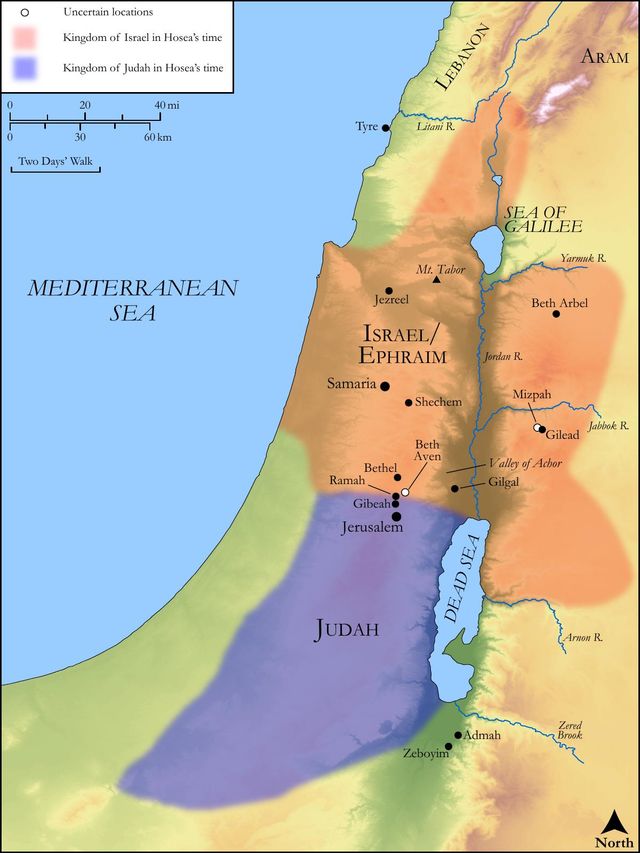
See on the biblical-era map
Study this verse
Public-domain commentary
Matthew Henry
From his Commentary on the Whole Bible. Henry comments on passages, not single verses — this entry covers Hosea 12:7–14. His four-level outline is real structure in the source text, so it is rendered as structure.
Here are intermixed, in these verses,
I.Reproofs for sin.
When God is coming forth to contend with a people, that he may demonstrate his own righteousness, he will demonstrate their unrighteousness. Ephraim was called to turn to his God and keep judgment (Hos 12:6); now, to show that he had need of that call, he is charged with turning from his God by idolatry, and breaking the laws of justice and judgment.
1.He is here charged with injustice against the precepts of the second table, Hos 12:7, Hos 12:8. Here observe,
(1.)What the sin is wherewith he is charged: He is a merchant. The margin reads it as a proper name, He is Canaan, or a Canaanite, unworthy to be denominated from Jacob and Israel, and worthy to be cast out with a curse from this good land, as the Canaanites were. See Amo 9:7. But Canaan sometimes signifies a merchant, and therefore is most likely to do so here, where Ephraim is charged with deceit in trade. Though God had given his people a land flowing with milk and honey, yet he did not forbid them to enrich themselves by merchandise, and they succeeded the Canaanites in that as well as in their husbandry; they sucked the abundance of the seas and the treasures hidden in the sand, Deu 33:19. And, if they had been fair merchants, it would have been no reproach at all to them, but an honour and a blessing. But he is such a merchant as the Canaanites were, who were honest only with good looking to, and, if they could, cheated all they dealt with. Ephraim does so; he deceives and thereby oppresses. Note, There is oppression by fraud as well as oppression by force. It is not only princes, lords, and masters, that oppress their subjects, tenants, and servants, but merchants and traders are often guilty of oppressing those they deal with, when they impose upon their ignorance, or take advantage of their necessity, to make hard bargains with them, or are rigorous and severe in exacting their debts. Ephraim cheated,
[1.]With a great deal of art and cunning: The balances of deceit are in his hand. He uses balances, and delivers his goods by weight and measure, as if he would be very exact, but they are balances of deceit, false weights and false measures, and thus, under colour of doing right, he does the greatest wrong. Note, God has his eye upon merchants and traders, when they are weighing their goods and paying their money, whether they do honestly or deceitfully. He observes what balances they have in their hand, and how they hold them; and, though those they deal with may not be aware of that sleight of hand with which they make them balances of deceit, God sees it, and knows it. Trades by the wit of man are made mysteries, but it is a pity that by the sin of man they should ever be made mysteries of iniquity.
[2.]With a great deal of pleasure and pride: He loves to oppress. To oppress is bad enough, but to love to do so is much worse. His conscience does not check and reprove him for it, as it ought to do; if it did, though he committed the sin, he could not delight in it; but his corruptions are so strong, and have so triumphed over his convictions, that he not only loves the gain of oppression, but he loves to oppress, sins for sinning-sake, and takes a pleasure in out-witting and over-reaching those that suspect him not.
(2.)How he justifies himself in this sin, Hos 12:8. Wicked men will have something to say for themselves now when they are told of their faults, some frivolous turn-off or other wherewith to evade the convictions of the word. Ephraim stands indicted for a common cheat. Now see what he pleads to the indictment. He does not deny the charge, nor plead, Not guilty, yet does not make a penitent confession of it and ask pardon, but insists upon his own justification. Suppose it were so that he did use balances of deceit, yet,
[1.]He pleads that he had got a good estate. Let the prophet say what he pleased of his deceit, of the sin of it and the curse of God that attended it, he could not be convinced there was any harm or danger in it, for this he was sure of that he had thriven in it: "Yet I have become rich, I have found me out substance. Whatever you make of it, I have made a good hand of it." Note, Carnal hearts are often confirmed in a good opinion of their evil ways by their worldly prosperity and success in those ways. But it is a great mistake. Every word in what Ephraim says here proclaims his folly. First, It is folly to call the riches of this world substance, for they are things that are not, Pro 23:5. Secondly, It is folly to think that we have them of ourselves, to say (as some read it), I have made myself rich; what substance I have is owing purely to my ingenuity and industry - I have found it; my might and the power of my hand have gotten me this wealth. Thirdly, It is folly to think that what we have is for ourselves. I have found me out substance, as if we had it for our own proper use and behoof, whereas we hold it in trust, only as stewards. Fourthly, It is folly to think that riches are things to be gloried in, and to say with exultation, I have become rich. Riches are not the honours of the soul, are not peculiar to the best men, nor sure to us; and therefore let not the rich man glory in his riches, Jam 1:9, Jam 1:10. Fifthly, It is folly to think that growing rich in a sinful way makes us innocent, or will make us safe, or may make us easy, in that way; for the prosperity of fools deceives and destroys them. See Isa 47:10; Pro 1:32.
[2.]He pleads that he had kept a good reputation. It is common for sinners, when they are justly reproved by their ministers, to appeal to their neighbours, and because they know no ill of them, or will say none, or think well of what the prophets charge them with as bad, fly in the face of their reprovers: In all my labours (says Ephraim) they shall find no iniquity in me that were sin. Note, Carnal hearts are apt to build a good opinion of themselves upon the fair character they have among their neighbours. Ephraim was very secure; for, First, All his neighbours knew him to be diligent in his business; they had an eye upon all his labours, and commended him for them. Men will praise thee when thou doest well for thyself. Secondly, None of them knew him to be deceitful in his business. He acted with so much policy that nobody could say to the contrary but that he acted with integrity. For either, 1. He concealed the fraud, so that none discovered it: "Whatever iniquity there is, they shall find none;" as if no iniquity were displeasing to God, and damning to the soul, but that which is open and scandalous before men. What will it avail us that men shall find no iniquity in us, when God finds a great deal, and will bring every secret work, even secret frauds, into judgment? Or, 2. He excused the fraud, so that none condemned it: "They shall find no iniquity in me that were sin, nothing very bad, nothing but what is very excusable, only some venial sins, sins not worth speaking of," which they think God will make nothing of because they do not. It is a fashionable iniquity; it is customary; it is what every body does; it is pleasant; it is gainful; and this, they think, is no iniquity that is sin; nobody will think the worse of them for it. But God sees not as man sees; he judges not as man judges.
2.He is here charged with idolatry, against the precepts of the first table, with that iniquity which is in a special manner vanity, the making and worshipping of images, which are vanities (Hos 12:11): Surely they are vanity; they do not profit, but deceive. Now the prophet mentions two places notorious for idolatry: - (1.) Gilead on the other side Jordan, which had been branded for it before (Hos 6:8): Is there iniquity in Gilead? It is a thing to be wondered at; it is a thing to be sadly lamented. What! iniquity in Gilead? idolatry there? Gilead was a fruitful pleasant country (pleasant to a proverb, Jer 22:6), and does it so ill requite the Lord? It was a frontier-country, and lay much exposed to the insults of enemies, and therefore stood in special need of the divine protection; what! and yet by iniquity throw itself out of that protection? Is there iniquity in Gilead? Yea, (2.) And in Gilgal too; there they sacrifice bullocks (Hos 9:15), and there their altars which they have set up, either to strange gods in opposition to his own appointed altar, are as thick as heaps of manure in the furrows of the field that is to be sown, Hos 8:11. Is there iniquity in Gilead only? so some. Is it only in those remote parts of the nation that people are so superstitious, where they border upon other nations? No; they are as bad at Gilgal. In Gilead God protected Jacob their father (of whom he had been speaking) from the rage of Laban; and will you there commit iniquity?
II.Here are threatenings of wrath for sin.
Some make that to be so (Hos 12:9), I will make thee to dwell in tabernacles as in the days of the appointed time, that is, I will bring thee into such a condition as the Israelites were in when they dwelt in tents and wandered for forty years; that was the time appointed in the wilderness. Ephraim forgot that God brought him out of Egypt and brought him up to be what he was, and was proud of his wealth, and took sinful courses to increase it; and therefore God threatens to bring him to a tabernacle-state again, to a poor, mean, desolate, unsettled condition. Note, It is just with God, when men have by their sins turned their tents into houses, by his judgments to turn their houses into tents again. However, that is certainly a threatening (Hos 12:14), Ephraim provoked him to anger most bitterly. See how men are deceived in their opinion of themselves, and how they will one day be undeceived. Ephraim thought that there was no iniquity in him that deserved to be called sin (Hos 12:8); but God told him that there was that in him which was sin, and would be found so if he did not repent and reform; for,
1.It was extremely offensive to his God: Ephraim provoked him to anger most bitterly with his iniquities, which were so distasteful to God, and to him too would be bitterness in the latter end. He was so wilful in sinning against his knowledge and convictions that any one might see, and say, that he designed no other than to provoke God in the highest degree.
2.It would certainly be destructive to himself; that cannot be otherwise which provokes God against him, and kindles the fire of his wrath. Therefore,
(1.)He shall take away his forfeited life: He shall leave his blood upon him, that is, he shall not hold him guiltless, but bring upon him that death which is the wages of sin. His blood shall be upon his own head (Sa2 1:16), for his own iniquity has testified against him and he alone shall bear it. Note, When sinners perish their blood is left upon them.
(2.)He shall take away his forfeited honour: His reproach shall his Lord return upon him. God is his Lord; he had by idolatry and other sins reproached the Lord, and done dishonour to him, and to his name and family, and had given occasion to others to reproach him; and now God will return the reproach upon him, according to the word he has spoken, that those who despise him shall be lightly esteemed. Note, Shameful sins shall have shameful punishments. If Ephraim put contempt on his God, he shall be so reduced that all his neighbours shall look with contempt upon him.
III.Here are memorials of former mercy, which come in to convict them of base ingratitude in revolting from God. Let them blush to remember,
1.That God had raised them from meanness. When Ephraim had become rich, and was proud of that, he forgot that which God (that he might not forget it) obliged them every year to acknowledge (Deu 26:5), A Syrian ready to perish was my father. But God here puts them in mind of it, Hos 12:12. Let them remember, not only the honours of their father Jacob, what a mighty prince he was with God, Hos 12:3 (an honour which they had no share in while they were in rebellion against God), but what a poor servant he was to Laban, which was sufficient to mortify those that were puffed up with the estates they had raised. Jacob fled into Syria from a malicious brother, and there served a covetous uncle for a wife, and for a wife he kept sheep, because he had not estate to endow a wife with. Jacob was poor, and low, and a fugitive; therefore his posterity ought not to be proud. He was a plain man, dwelling in tents, and keeping sheep; therefore balances of deceit ill became them. He served for a wife that was not a Canaanitess, as Esau's wives were; therefore it was a shame for them to degenerate into Canaanites, and mingle with the nations. God wonderfully preserved him in his flight and preserved him in his service, so that he multiplied exceedingly, and from that root in a dry ground sprang an illustrious nation, that bore his name, which magnifies the goodness of God both to him and them and leaves them under the stain of base ingratitude to that God who was their founder and benefactor.
2.That God had rescued them from misery, had raised them to what they were, not only out of poverty, but out of slavery (Hos 12:13), which laid them under much stronger obligations to serve him and under a yet deeper guilt in serving other gods.
(1.)God brought Israel out of Egypt on purpose that they might serve him, and by redeeming them out of bondage acquired a special title to them and to their service.
(2.)He preserved them, as sheep are kept by the shepherd's care. He preserved them from Pharaoh's rage at the sea, even at the Red Sea, protected them from all the perils of the wilderness, and provided for them.
(3.)He did this by a prophet, Moses, who, though he is called king in Jeshurun (Deu 33:5), yet did what he did for Israel as a prophet, by direction from God and by the power of his word. The ensign of his authority was not a royal sceptre, but the rod of God; with that he summoned both Egypt's plagues and Israel's blessings. Moses, as a prophet, was a type of Christ (Act 3:22), and it is by Christ as a prophet that we are brought out of the Egypt of sin and Satan by the power of his truth. Now this shows how very unworthy and ungrateful this people were,
[1.]In rejecting their God, who had brought them out of Egypt, which, in the preface to the commandments, is particularly mentioned as a reason for the first, why they should have no other gods before him.
[2.]In despising and persecuting his prophets, whom they should have loved and valued, and have studied to answer God's end in sending them, for the sake of that prophet by whom God had brought them out of Egypt and preserved them in the wilderness. Note, The benefit we have had by the word of God greatly aggravates our sin and folly if we put any slight upon the word of God.
3.That God had taken care of their education as they grew up. This instance of God's goodness we have, Hos 12:10. As by a prophet he delivered them, so by prophets he still continued to speak to them. Man, who is formed out of the earth, is fed out of the earth; so that nation, that was formed by prophecy, by prophecy was fed and taught; beginning at Moses, and so going on to all the prophets through the several ages of that church, we find that divine revelation was all along their tuition.
(1.)They had prophets raised up among themselves (Amo 2:11), a succession of them, were scarcely ever without a Spirit of prophecy among them more or less, from Moses to Malachi.
(2.)These prophets were seers; they had visions, and dreams, in which God discovered his mind to them immediately, with a full assurance that it was his mind, Num 12:6.
(3.)These visions were multiplied; God spoke not only once, yea, twice, but many a time; if one vision was not regarded, he sent another. The prophets had variety of visions, and frequent repetitions of the same.
(4.)God spoke to them by the prophets. What the prophets received from the Lord they plainly and faithfully delivered to them. The people at Mount Sinai begged that God would speak to them by men like themselves, and he did so.
(5.)In speaking to them by the prophets he used similitudes, to make the messages he sent by them intelligible, more affecting, and more likely to be remembered. The visions they saw were often similitudes, and their discourses were embellished with very apt comparisons. And, as God by his prophets, so by his Son, he used similitudes, for he opened his mouth in parables. Note, God keeps an account, whether we do or no, of the sermons we hear; and those that have long enjoyed the means of grace in purity, plenty, and power, that have been frequently, faithfully, and familiarly, told the mind of God, will have a great deal to answer for another day if they persist in a course of iniquity.
IV.Here are intimations of further mercy, and this remembered too in the midst of sin and wrath (as some understand Hos 12:9):
"I that am the Lord thy God from the land of Egypt, who then and there took thee to be my people, and have approved myself thy God ever since, in a constant series of merciful providences, have yet a kindness for thee, bad as thou art; and I will make thee to dwell in tabernacles, not as in the wilderness, but as in the days of the solemn feast," the feast of tabernacles, which was celebrated with great joy, Lev 23:40.
1.They shall be made to see, by the grace of God, that though they are rich, and have found out substance, yet they are but in a tabernacle-state, and have in their worldly wealth no continuing city.
2.They shall yet have cause to rejoice in God, and have opportunity to do it in public ordinances. The feast of tabernacles was the first solemn feast the Jews kept after their return out of Babylon, Ezr 3:4.
3.This, as other promises, was to have its full accomplishment in the grace of the gospel, which provides tabernacles for believers in their way to heaven, and furnishes them with matter of joy, holy joy, joy in God, such as was in the feast of tabernacles, Zac 14:18, Zac 14:19.
Historical interpretation
Two Centuries of Reception
4 surviving comments on this verse. Each one is dated, so this reads as a timeline rather than a list.
Select a marker to jump to its quote. Markers stagger vertically where authors wrote within a few decades of each other.
Stephen, teaching these truths, when he was yet on earth, saw the glory of God and Jesus on his right hand, and he exclaimed, “Behold, I see the heavens opened, and the Son of man standing on the right hand of God.” When he said these words, he was stoned. Thus did he fulfill the perfect teaching, reflecting in every respect the one who led to martyrdom and praying for those who were slaying him in these words: “Lord, lay not this sin to their charge.” Thus were they made holy who came to recognize one and the same God through various dispensations, who from beginning to end was present with humanity in various dispensations, just as had been declared by the prophet Hosea: “I have multiplied visions, and used similitudes by the hands of the prophets.”
Thus, therefore, was God revealed; for God the Father is shining forth through all these works, the Spirit indeed working, and the Son ministering, while the Father was approving and human salvation being accomplished. As he also declares through Hosea the prophet, “I,” he says, “have multiplied visions and have used similitudes by the ministry of the prophets.” But the apostle further expounded this very passage when he said, “Now there are diversities of gifts, but the same Spirit; and there are differences of ministrations, but the same Lord; and there are diversities of operations, but it is the same God who worked all in all. The manifestation of the Spirit is given to every one to profit thereby.” He who works all things in all is God. As to what nature he is and how great he is, God remains invisible and indescribable to all creatures that have been made by him. But he is by no means unknown. For all things learn through his Word that there is one God the Father, who contains all things, and who grants existence to all. This is written in the Gospel: “No man has seen God at any time, except the only-begotten Father, who is in the bosom of the Father; he has declared him.”
How is it, then, that John says, “No one has ever seen God”? He says this so that you may know that he is speaking of a clear knowledge and a perfect comprehension of God. All the cases cited were instances of God’s condescension and accommodation. That no one of those prophets saw God’s essence in its pure state is clear from the fact that each one saw him in a different way. God is a simple being; he is not composed of parts; he is without form or figure. But all these prophets saw different forms and figures. God proved this very thing through the mouth of another prophet. And he persuaded those other prophets that they did not see his essence in its exact nature when he said, “I have multiplied visions, and by the ministries of the prophets I was represented.” What God was saying was, “I did not show my very essence, but I came down in condescension and accommodated myself to the weakness of their eyes.” However, John does not say only of humanity that “no one has ever seen God.” This was proved by what I have said—I mean by the prophetic utterance that states, “I have multiplied visions, and by the ministries of the prophets I was represented.”
"And I am the Lord your God who brought you out of the land of Egypt; I will make you dwell in tabernacles as in the days of the feast. And I spoke to the prophets, and I multiplied visions, and by the hand of the prophets I was likened." LXX: "But I am the Lord your God, who brought you out of the land of Egypt; I will still make you dwell in tabernacles, as in the days of solemnity, and I will speak to the prophets, and I have multiplied visions, and by the hands of the prophets I am likened." You have indeed sinned so greatly, that you rejoiced in wickedness, and thought a multitude of sins to be riches, and said: I have become rich, I have found an idol for myself: all my labors will not be able to find my sins. But I am the Lord thy God, who brought thee out of the land of Egypt (Exod. V), when thou didst serve Pharaoh and was making cities of clay and palaces, yet I give you a place of penitence and by the greatness of my promises I urge you to return to me, and yet I will cause you to dwell in tabernacles as in the days of the festival. The day of the festival is called 'Scenopegia,' the fifteenth day of the seventh month, when the children of Israel came out of Egypt. As, he said, at that time I freed you from Egypt and you lived in tabernacles on your way to the holy land and hastened to go to the place of the temple, so also now I will lead you out of tribulation and distress and impending captivity, if you do what I have commanded. For I am the one who, through all the prophets and various forms of visions, has been likened to human beings, and I have challenged you to repent. Is it not of a human likeness when Moses, lifting his hands on high, prays for Jesus to vanquish Amalec (Exod. XVII), and the sacraments of the cross are shown in him? Isn't God likened to the hands of the prophets, since Jonah is in the depths for three days and nights to signify the Lord's resurrection from the underworld on the third day? However, we read multiplied visions in all the prophets, when Ezekiel sees the Lord sitting as a charioteer above the Cherubim (Ezek. 17). And Isaiah says, "I saw the Lord seated on a high and lofty throne and elevated, and two Seraphim around him crying out to each other holy, holy, holy is the Lord God Sabaoth" (Isai. 6:1,2). And Habakkuk stood upon his watch-tower (or "cell"), and behold he beheld Christ's horns in his hands, wherein his strength lay hidden (Hab 3). Hence the Psalmist cries out: "I will hear what the Lord God will speak in me" (Ps 84:9). But in order that we may know that every prophecy in Holy Writ is called a vision, "And all the people saw the voice of the Lord" (Ex 20:18): wherefore also the prophets were called seers. To those also who have been led astray by heretics, it is said that they should return to the Lord, who prefers the repentance of a sinner to their death (Ezekiel 18); for it is he who brought them out of the land of Egypt, that is, out of the darkness and error of the Gentiles. And that they may not be slow to return, mindful of their sins: "I will still cause you to dwell in tabernacles," he says, "as in the days of the festival"; that what baptism effects, penance may effect also, and they may dwell in the tabernacles of the Saviour, that is, in the churches, of which it is said: "Planted in the house of the Lord, they shall flourish in the courts of the house of our God" (Ps. xcii. 14). And lest the heresiarchs and leaders of error should be able to say that God did not speak through them, he said: 'I am the one who spoke to the prophets, not to your teachers, and I have multiplied visions and have been portrayed by my prophets who are established in the Church.'
Continue studying Hosea 12:10 across the web’s major study libraries — every link below opens this exact verse, chapter, or book on the destination site.
Read & Compare
 BibleGatewayThis verse in more than 200 translations and 70 languages.
 Bible.comThe YouVersion reader — hundreds of translations, reading plans, and highlights.
 ESV.orgCrossway's official English Standard Version reader.
 NET BibleThe NET translation with 60,000+ translators' notes on every rendering decision.
 STEP BibleTyndale House's free study tool — original text, vocabulary, and scholarly resources.
 BibliaLogos Bible Software's free web reader.
 USCCBThe New American Bible (Revised Edition) with the U.S. bishops' study notes.
Commentaries
 BibleHub CommentariesDozens of classic commentaries on this verse, gathered on one page.
 StudyLightMore than 100 commentary sets — the largest collection on the web.
 BibleRefPlain-English commentary on what this verse means, verse by verse.
 Enduring WordDavid Guzik's free commentary on this chapter, widely used by Bible teachers.
 Bible Study ToolsVerse commentary alongside Greek and Hebrew study aids.
Original Language & Research
- BibleHub InterlinearThe verse word by word — original language, transliteration, and English.
- BibleHub LexiconEvery word's original-language definition and Strong's entry.
 Blue Letter BibleDeep-study tools — Strong's numbers, concordance, and word studies.
 SefariaThe Hebrew text with Rashi and centuries of Jewish commentary.
Sermons, Hymns & Audio


TrulyRandomVerse is not affiliated with these sites and doesn’t control their content. They’re linked because they’re genuinely useful.
Summary
Hosea 12:10 powerfully asserts God's consistent and multifaceted communication with His people, Israel, throughout their history. Despite Israel's persistent unfaithfulness and spiritual rebellion, the Lord never ceased to reveal His will, issue warnings, and extend promises through His chosen messengers. This verse underscores the divine initiative in revelation, emphasizing the abundance and variety of methods God employed—direct speech, supernatural visions, and symbolic actions—all delivered through the dedicated ministry of the prophets, thereby leaving Israel without excuse for their disobedience.
Context
ShowHideLiterary Context
Hosea 12 is part of a larger prophetic indictment against the Northern Kingdom of Israel, often referred to as Ephraim, for their covenant unfaithfulness. The chapter immediately preceding this verse (Hosea 12:1-9) recounts Israel's historical treachery, drawing a stark parallel between their current apostasy and the deceitful nature of their patriarch, Jacob. The prophet reminds Israel that even Jacob, who "struggled with God and prevailed" Hosea 12:3-4, was a fugitive and a servant, emphasizing that Israel's current pride and self-reliance are misplaced. Verse 10 serves as a divine defense, demonstrating that God had always provided abundant guidance and warnings, making Israel's continued rebellion inexcusable. It sets the stage for further declarations of judgment and God's enduring call to repentance in the subsequent verses of the chapter and book.
Historical & Cultural Context
Hosea ministered to the Northern Kingdom during the 8th century BCE, a period marked by significant political instability, moral decay, and rampant idolatry. Successive kings were assassinated, and Israel vacillated between alliances with Egypt and Assyria, rather than trusting in the Lord. Culturally, the worship of Baal and other Canaanite deities had deeply infiltrated Israelite society, leading to spiritual adultery and a departure from the Mosaic covenant. The people had forgotten their identity as God's chosen nation, redeemed from slavery in Egypt. In this tumultuous environment, God raised up prophets like Hosea to deliver His messages of warning, judgment, and calls to return, often using the very cultural practices and historical events of Israel to illustrate their sin and God's steadfast love. The "ministry of the prophets" was God's primary means of engaging with His covenant people in real-time, addressing their specific historical and cultural sins.
Key Themes
ShowHideHosea 12:10 contributes significantly to several overarching themes within the book of Hosea and broader biblical theology. A primary theme is Divine Communication, highlighting God's active, persistent, and varied engagement with humanity. He is not a distant deity but one who continually seeks to reveal Himself and His will, demonstrating His desire for relationship and obedience. This verse also underscores the crucial Ministry of Prophets as God's chosen spokesmen, entrusted with delivering divine messages, warnings, and calls to repentance. The specific methods mentioned—"spoken by the prophets," "multiplied visions," and "used similitudes"—emphasize the Varied Methods of Revelation God employed, adapting His communication to ensure His truth was understood. For instance, Hosea's own marriage to Gomer served as a profound "similitude" illustrating Israel's spiritual unfaithfulness and God's enduring love, as seen in Hosea 1:2-3. Finally, by detailing the extensive and clear ways God communicated, the verse implicitly stresses Human Accountability. Israel could not claim ignorance; they had received abundant light and instruction, making their disobedience a deliberate act of rebellion against a speaking God. This theme is echoed throughout the prophetic literature, such as in Amos 3:7, where God declares He does nothing without revealing His plan to His servants the prophets.
Exposition and Analysis
ShowHideKey Word Analysis
ShowHideThis primitive root signifies not merely uttering words, but often implies arranging or ordering, suggesting authoritative and deliberate communication. When God "speaks" by the prophets, it refers to direct, verbal pronouncements, commands, declarations, and teachings, carrying the weight of divine authority and purpose. It highlights the intentionality and clarity of God's message.
This root means "to increase" or "to make great," indicating an abundance or frequency. Here, it emphasizes the sheer volume and continuous nature of God's revelation. God did not speak once or twice, but repeatedly and extensively, providing ample opportunity for Israel to hear and respond. This multiplication underscores His patience and persistent pursuit of His people.
Derived from a word meaning "to see," this term refers to a "sight (mentally)," encompassing dreams, revelations, or oracles. Visions are a supernatural mode of communication where God directly imparts insight, often symbolically, into His plans, judgments, or future events. They provided a distinct, often vivid, form of divine revelation, as seen in the ministries of prophets like Isaiah Isaiah 1:1 and Ezekiel Ezekiel 1:1.
This root means "to compare," "to resemble," or "to liken." In this context, it refers to parables, allegories, symbolic actions, or likenesses used to convey spiritual truth. These "similitudes" made abstract divine messages tangible and memorable, often requiring the prophet to embody the message through their own life or actions, as Hosea's marriage to Gomer exemplified.
Verse Breakdown
ShowHide"I have also spoken by the prophets,"
This clause establishes God as the primary speaker and the prophets as His chosen conduits. It highlights the direct, verbal nature of divine communication, where God's messages were articulated through human intermediaries. The prophets were not merely offering their own insights but were delivering the very words of the Lord.
"and I have multiplied visions,"
This phrase emphasizes the abundance and variety of God's revelation. Beyond direct verbal pronouncements, God also communicated through supernatural "visions"—mental sights, dreams, or trances—which provided profound, often symbolic, insights into His will and future actions. The term "multiplied" underscores the frequent and extensive nature of these divine disclosures.
"and used similitudes,"
This part of the verse points to another distinct method of divine communication: the use of comparisons, parables, allegories, and symbolic actions. God employed tangible, relatable examples or enacted object lessons to make spiritual truths clearer and more impactful, allowing His people to grasp complex theological concepts through vivid imagery and real-life parallels.
"by the ministry of the prophets."
This concluding phrase acts as a powerful summation, reiterating that all these diverse forms of divine communication—spoken words, visions, and similitudes—were consistently delivered through the dedicated service and instrumentality of the prophets. It underscores their indispensable role as God's messengers and the consistent channel of His revelation to Israel.
Literary Devices
ShowHideHosea 12:10 employs several literary devices to convey its profound message. Parallelism is evident in the successive clauses, where God's various methods of communication are listed in a complementary fashion: "spoken by the prophets," "multiplied visions," and "used similitudes." This creates a rhythmic flow and emphasizes the comprehensive nature of God's revelation. The repetition of "by the prophets" at the beginning and end of the verse forms an inclusio, framing the diverse methods of communication within the consistent Ministry of the Prophets. This structural device highlights their central and indispensable role as God's agents. Furthermore, the use of "similitudes" itself points to the broader literary and rhetorical strategy of Figurative Language and Symbolism prevalent throughout prophetic literature. By employing parables, allegories, and symbolic actions, God made abstract spiritual truths concrete and memorable, ensuring His message resonated deeply with His audience.
Theological and Thematic Connections
ShowHideHosea 12:10 profoundly shapes our understanding of God's character as a communicating God. It reveals a God who is not silent or distant, but one who actively engages with His creation, desiring to be known and understood. His persistent and varied revelation, even in the face of Israel's persistent rebellion, testifies to His enduring love, patience, and unwavering commitment to His covenant. The verse underscores the divine initiative in salvation history, where God consistently reaches out to humanity, providing ample light and guidance, thereby establishing a basis for human accountability. It also highlights the crucial role of divine revelation as the foundation for true knowledge of God and obedience to His will.
Reflection and Application
ShowHideHosea 12:10 serves as a powerful reminder that God is a speaking God, and His desire to communicate with humanity is foundational to His character. While the era of direct prophetic visions and similitudes in the same manner as the Old Testament prophets has concluded with the completion of the biblical canon, God continues to speak authoritatively through His inspired Word, the Bible. This verse challenges us to consider our posture towards divine revelation. Do we actively listen for God's voice? Are we diligent in studying His Word, recognizing it as the primary means by which He reveals His will, His character, and His purposes for our lives? Just as ancient Israel was held accountable for the abundant revelation they received, so too are we responsible for responding in faith and obedience to the truth God has given us. Our spiritual growth and walk with God are directly tied to our engagement with His revealed truth, which guides, corrects, and nourishes our souls.
Questions for Reflection
ShowHideFAQ
ShowHideWhat does "used similitudes" mean in Hosea 12:10?
ShowHideThe phrase "used similitudes" (Hebrew: dâmâh) refers to God's method of communicating through comparisons, parables, allegories, and symbolic actions. It means God used tangible, relatable examples or enacted object lessons to convey spiritual truths. For instance, the prophet Hosea's own marriage to Gomer, a harlot, was a powerful "similitude" that illustrated Israel's spiritual unfaithfulness to God and God's enduring, redemptive love for them, as detailed in Hosea 1. Other prophets also performed symbolic acts, like Jeremiah burying a linen belt Jeremiah 13:1-11, or Ezekiel lying on his side for days Ezekiel 4:1-8, to make God's messages vivid and impactful. This method made abstract divine messages concrete and memorable for the people.
Why did God use so many different methods of communication with Israel?
ShowHideGod's use of "multiplied visions" and "similitudes" in addition to direct verbal pronouncements demonstrates His profound desire to ensure His message was received and understood by His people. Different people learn and comprehend in different ways. By employing a variety of methods—auditory (spoken word), visual (visions), and experiential/symbolic (similitudes)—God maximized the clarity and impact of His revelation. This multifaceted approach underscores His patience, His comprehensive nature, and His unwavering commitment to His covenant with Israel, leaving them without excuse for their unfaithfulness. It also highlights the richness and depth of divine communication, adapting to the human capacity for understanding.
Christ-Centered Fulfillment
ShowHideHosea 12:10, with its emphasis on God's multifaceted revelation through the prophets, finds its ultimate and most glorious fulfillment in the person and work of Jesus Christ. While God "spoke by the prophets" in various ways in the Old Testament, Hebrews 1:1-2 declares that "in these last days he has spoken to us by his Son." Jesus is not merely a prophet among prophets; He is the Word made flesh John 1:14, the perfect embodiment and culmination of all divine revelation. The "visions" and "similitudes" of the Old Testament pointed forward to Him, the one who perfectly reveals the Father John 14:9. His parables were the ultimate "similitudes," making profound spiritual truths accessible, and His life, death, and resurrection are the ultimate prophetic acts, fulfilling all that the Law and the Prophets foretold Luke 24:44. In Christ, God's communication is no longer fragmented or partial but complete and final, offering humanity the full and perfect knowledge of God and the way of salvation.