


Ezekiel 1:1
Bible text: King James Version (1769 Blayney text) · Public domain
Bible text: King James Version with Strong's numbers · Public domain
Bible text: Berean Standard Bible · Public domain
Bible text: American Standard Version (1901) · Public domain
Bible text: World English Bible, Messianic edition · Public domain
Bible text: Geneva Bible (1599) · Public domain
Bible text: Young's Literal Translation · Public domain
- וַיְהִיvay·Hiand it wasH1961Conj-w ¦ V-Qal-ConsecImperf-3msVerb Qal Consecutive Imperfect 3rd Singular Masculineוַandיְהִיit was
- בִּשְׁלֹשִׁיםbish·lo·Shimin thirtyH7970Prep-b ¦ Adj-mpAdjective Numerical Plural Masculine Absoluteבִּinשְׁלֹשִׁיםthirty
- שָׁנָהsha·NahyearH8141N-fsNoun Singular Feminine Absolute
- בָּרְבִיעִיba·re·vi·'Iin the fourth [month]H7243Prep-b ¦ Adj-msAdjective Numerical Position Singular Masculine Absoluteבָּin theרְבִיעִיfourth [month]
- בַּחֲמִשָּׁהba·cha·mi·Shahon [day] fiveH2568Prep-b ¦ Adj-csAdjective Numerical Singular common gender Absoluteבַּonחֲמִשָּׁה[day] five
- לַחֹדֶשׁla·Cho·deshof the monthH2320Prep-l ¦ N-msNoun Singular Masculine Absoluteלַof theחֹדֶשׁmonth
- וַאֲנִיva·'a·Niand IH589Conj-w ¦ Pro-1csPronoun Personal 1st Singular common genderוַandאֲנִיI
- בְתוֹךְve·tokh[was] in amongH8432Prep-b ¦ N-mscNoun Singular Masculine Constructבְ[was] inתוֹךְamong
- הַגּוֹלָהha·go·Lahthe exile[s]H1473Art ¦ N-fsNoun Singular Feminine Absoluteהַtheגּוֹלָהexile[s]
- עַל'alatH5921PrepPreposition
- נְהַרne·har[the] river ofH5104N-mscNoun Singular Masculine Construct
- כְּבָרke·VarKebarH3529N-properNoun Proper Location
- נִפְתְּחוּnif·te·Chuthey were openedH6605V-Niphal-Perf-3cpVerb Niphal Perfect 3rd Plural common gender
- הַשָּׁמַיִםha·sha·Ma·yimthe heavensH8064Art ¦ N-mpNoun Plural Masculine Absoluteהַtheשָּׁמַיִםheavens
- וָאֶרְאֶהva·'er·'Ehand I sawH7200Conj-w ¦ V-Qal-ConsecImperf-1csVerb Qal Consecutive Imperfect 1st Singular common genderוָandאֶרְאֶהI saw
- מַרְאוֹתmar·'otvisions ofH4759N-fpcNoun Plural Feminine Construct
- אֱלֹהִים'E·lo·HimGodH430N-mpNoun Plural Masculine Absolute
English is a literal word-by-word gloss of the Hebrew, not the KJV's wording. Why?
This is the original text the KJV's translators worked from — each Hebrew word with its own literal English meaning in this verse, prepared by scholars at Tyndale House, Cambridge. The KJV translates whole sentences, not word by word, so its wording differs: one Hebrew word can become several English words, and the KJV may choose “the LORD” where the gloss reads “Yahweh”. Both are faithful — they answer different questions. For the KJV's own rendering, switch to the KJV text.
Details
See on the biblical-era map
Study this verse
Historical interpretation
Four Centuries of Reception
14 surviving comments on this verse. Each one is dated, so this reads as a timeline rather than a list.
Select a marker to jump to its quote. Markers stagger vertically where authors wrote within a few decades of each other.
It was not enough for one heaven to be opened; a greater number was opened, so that the angels descended not from one, but from all the heavens on those who were to be saved.
We believe that the Spirit is present everywhere, while the rest of the bodiless powers are circumscribed by place.
What would you say of Isaiah or Ezekiel, who was an eyewitness of very great mysteries, and of the other prophets: for one of these saw the Lord of Sabaoth sitting on the throne of glory and encircled and praised by the six-winged seraphim, and was himself purged by the live coal and equipped for his prophetic office; and the other describes the cherubic chariot of God, and the throne on them, and the firmament over it, and him that showed himself in the firmament, and voices and forces and deeds. And whether this was an appearance by day, only visible to saints, or an unerring vision of the night, or an impression on the mind holding converse with the future as if it were the present or some other ineffable form of prophecy, I cannot say; the God of the prophets knows, and they know who are thus inspired.
You must understand that the heavens were opened not by the firmament being divided but by the faith of the believer, for the one to whom these things are heavenly is the one to whom mysteries are disclosed. At the baptism of the Savior, when the Holy Spirit descended on him in the form of a dove, we read that “the heavens were opened.”
Truly our Lord and Savior Jesus Christ is prefigured, who came to baptism at the age of thirty years, which in a man is the perfect age.
The Prophet Ezekiel was led captive with Joachin king of Judah to Babylon, and he prophesied there to those who were captives with him, to those repenting that they had willingly handed over the prophecy of Jeremiah to enemies, and yet saw the city Jerusalem to stand, which he had predicted would fall. And in his thirtieth year of age, and in the fifth year of the captivity, he began to speak to his fellow captives. And at the same time, though later, this one in Chaldea and Jeremiah in Judea prophesied. His style is neither greatly eloquent nor excessively rustic, but properly proportioned between both. And he was a priest, as also was Jeremiah, the beginning and ending of the book being wrapped in great obscurities. But also the common edition of him does not differ much from the Hebrew one. Because of that I greatly wonder what was the cause, that when we have the same translators in all the books, in some they translated the same things, in others, different things. Therefore, read this also according to our translation because, by being written in words with spaces, it gives a clearer meaning to readers. And if my friends also mock this, say to them that no one restrains them from writing. But I do not respect him who follows them, which is more clearly said in Greek, as they are called insult-swallowers (φαγολοιδοροι).
(Chapter 1, Verse 1) And it came to pass in the thirtieth year, in the fourth month, on the fifth day of the month. The thirtieth year is not, as many think, the age of the prophet, nor the Year of Jubilee, which is the year of remission; but from the twelfth year of King Josiah of Judah, when the book of Deuteronomy was found in the temple of God, until the fifth year of the captivity of Joachin, also known as Jeconiah, when he was led with his mother to Babylon, along with Daniel and the three young men, and Ezekiel (who was among the first captives of the tribe of Judah) when the wrath of God was poured out on Jerusalem (2 Kings 22; 2 Chronicles 34; 2 Kings 24). But according to the mystical interpretation, the Lord and Savior is prefigured, who came to baptism at the age of thirty (Luke 3), which is the age of perfection in man. Therefore, in the book of Numbers, according to the Hebrews and not as contained in the Septuagint, the priests begin to minister in the tabernacle at the age of thirty and not at the age of twenty-five (Numbers 4). In this sign, Joseph also preceded when he distributed grain to the hungry people in Egypt (Genesis 41), and John the Baptist came to the banks of the Jordan and preached the baptism of repentance (Luke 3). And what is written, in the fourth, the sentence is pending, it is understood in the month. For immediately it follows, in the fifth month. And to make it more clear, they added Seventy before.
[Daniel 10:4] "And in the twenty-fourth day of the first month, I was beside the great river which is the Tigris." Ezekiel also had seen a great vision beside a river, the Chebar (Ezekiel 1:1). And it was by the stream of the Jordan that the heavens were opened to the gaze of our Lord and Savior and also to John the Baptist (Matthew 3:1-17). Therefore those critics should leave off their foolish objections who raise questions about the presence of shadows and symbols in a matter of historical truth and attempt to destroy the truth itself by imagining that they should employ allegorical methods to destroy the historicity of rivers and trees and of Paradise.
He said that the heavens were open, not in reality or in deed but through spiritual contemplation.
Now indeed if it is asked whether something mystical might be indicated in the very expression of that age itself, it is not absurd that the prophet should show the Lord, whom he announces in words, also by the very time of his own age. In the thirtieth year of the prophet Ezekiel the heavens were opened, and he saw visions of the Lord beside the river Chebar, because in approximately the thirtieth year of His age the Lord came to the river Jordan. There therefore the heavens were opened, because the Spirit descended in a dove; a voice also sounded from heaven, saying: "This is my beloved Son, in whom I am well pleased."
Now what is said about his receiving the spirit of prophecy in the thirtieth year indicates something we should consider, namely that according to the use of reason, the word of teaching is not available except at a mature age. Hence the Lord Himself at the twelfth year of His age, sitting in the temple among the teachers, wished to be found not teaching but questioning. For so that men would not dare to preach at a weak age, He who through His divinity always teaches the angels in heaven deigned to question men on earth in the twelfth year of His age. For since He Himself is the wisdom of God, the angels live by seeing Him, by which they are satisfied with eternal blessedness. Moses also admonishes this under the mystery of allegory, saying: "You shall not plow with the firstborn of an ox." For we understand the firstborn of an ox to be good work in the weak age of our first time. Yet in this we must not plow, because when the times of our adolescence or youth are first, we must still refrain from preaching, so that the plowshare of our tongue does not dare to break up the soil of another's heart. For as long as we are weak, we ought to contain ourselves within ourselves, lest while we show forth tender goods too quickly, we lose them, because even planted saplings, if they have not first been rooted in the earth, wither more quickly when touched by hand; but if they have once fixed their root, the hand touches them, and yet does no harm; winds push against them, yet those pushing do not injure them. And constructed walls, if pushed, collapse, unless they have first been dried of their moisture. Therefore the mind, as long as it has not been perfectly dried from the moisture of its depravity, ought not to be touched by the hand of another's tongue, lest before it fully perceives, it lose its solidity, lest when pushed it fall, lest like a sapling without roots, while it is shaken more than it can bear, it wither. Therefore only those things that are firm should be shown as an example. For the mind must first grow strong, and afterward be displayed for the benefit of neighbors, when now it neither falls down when lifted up by praise, nor wastes away when struck by blame. For even though it is said to Timothy: "Command these things and teach; let no one despise your youth," it should be known that in sacred speech sometimes adolescence is called youth. Hence it is written: "Rejoice, young man, in your youth." Therefore the prophet, to show of what authority he is in preaching, is described as being of a mature age, so that life and spirit and all things that are fitting for preaching may be seen to accord with him.
Neither should anyone be troubled against these things by the fact that Jeremiah and Daniel received the spirit of prophecy as boys, since miracles are not to be taken as examples for regular practice. For the Almighty God both makes the tongues of infants eloquent and perfects praise from the mouths of infants and nursing children. But it is one thing what we learn from the use and discipline of teaching, another what we know from a miracle.
But the first question arises for us: why did he who had said nothing yet begin thus, saying: "And it came to pass in the thirtieth year"? For "and" is a word of conjunction, and we know that a subsequent word is not joined except to a preceding word. Therefore, he who had said nothing—why does he say "And it came to pass," when there is no word to which he might subjoin what he begins? In this matter it must be observed that just as we perceive corporeal things, so the senses of the prophets perceive spiritual things, and those things are present to them which seem absent to our ignorance. Whence it happens that in the minds of the prophets interior things are so joined to exterior things that they see both at once, and in them there occurs simultaneously both the word which they hear within and that which they speak outwardly. Therefore the reason is clear why he who had said nothing began saying: "And it came to pass in the thirtieth year"—because he joined this word which he brought forth outwardly to that word which he had heard within. Therefore he continued the words which he brought forth to the inner vision, and for this reason he begins saying: "And it came to pass." For he subjoins what he begins to speak outwardly, as if that which he sees within were also outside.
The custom of prophetic speech is to first describe the person, time, and place, and afterward begin to speak the mysteries of prophecy, so that in order to demonstrate the truth more solidly, it first fixes the root of the history, and then brings forth the fruits of the spirit through signs and allegories. Ezekiel therefore indicates the time of his age, saying: "And it came to pass in the thirtieth year, in the fourth month, on the fifth of the month." Also announcing the place, he adds: "When I was in the midst of the captives by the river Chobar, the heavens were opened, and I saw visions of God."
But the Hebrew words themselves are also very useful to us for interpreting the mystery. For Chobar is interpreted as heaviness or weight; Ezekiel as the strength of God; Buzi as despised or contempt; the Chaldeans as those who capture or as demons. Therefore Ezekiel came to the river Chobar; for since Chobar is called heaviness or weight, what is fittingly designated by the river Chobar except the human race? Which flows from birth to death, and is heavy to itself from the sins which it both commits and carries, because, as it is written: "Iniquity sits upon a talent of lead." For every sin is heavy, because it does not permit the soul to be lifted up to heavenly things. Hence it is also said through the Psalmist: "Sons of men, how long will you be heavy of heart?" But it is written of the Lord that he himself is the power of God and the wisdom of God. Therefore Ezekiel came to the river Chobar, because the strength of God through the mystery of his incarnation deigned to draw near to the human race bearing the burdens of its sins, which from its birth daily flows toward death, as it is said of him through the Psalmist: "And he shall be like a tree which is planted by the streams of waters." Indeed, he was planted by the streams of waters, because he was incarnate near the falls of the flowing peoples. Now we said that Ezekiel is interpreted as the strength of God, but Buzi as despised. But Ezekiel is the son of Buzi, because the only-begotten of God deigned to be incarnate from that people whom the Lord despised on account of the fault of their unfaithfulness. Therefore the strength of God is born from contempt or being despised, because our Redeemer deigned to assume humanity from a faithless and despised people. But he came into the land of the Chaldeans. The Chaldeans, as we said, are interpreted as those who capture or as demons. For the wicked, because they both commit iniquities themselves and by persuading draw others to iniquity, are certainly those who capture. They are also rightly interpreted as demons, because those who by persuading draw others to iniquity take upon themselves in their own persons the ministry of demons toward iniquity, although they are not demons by nature. Therefore the strength of God came into the land of the Chaldeans, because the Only-begotten of the Father appeared among those who had flowed toward sin in themselves and were drawing others captive to sins.
Continue studying Ezekiel 1:1 across the web’s major study libraries — every link below opens this exact verse, chapter, or book on the destination site.
Read & Compare
 BibleGatewayThis verse in more than 200 translations and 70 languages.
 Bible.comThe YouVersion reader — hundreds of translations, reading plans, and highlights.
 ESV.orgCrossway's official English Standard Version reader.
 NET BibleThe NET translation with 60,000+ translators' notes on every rendering decision.
 STEP BibleTyndale House's free study tool — original text, vocabulary, and scholarly resources.
 BibliaLogos Bible Software's free web reader.
 USCCBThe New American Bible (Revised Edition) with the U.S. bishops' study notes.
Commentaries
 BibleHub CommentariesDozens of classic commentaries on this verse, gathered on one page.
 StudyLightMore than 100 commentary sets — the largest collection on the web.
 BibleRefPlain-English commentary on what this verse means, verse by verse.
 Enduring WordDavid Guzik's free commentary on this chapter, widely used by Bible teachers.
 Bible Study ToolsVerse commentary alongside Greek and Hebrew study aids.
Original Language & Research
- BibleHub InterlinearThe verse word by word — original language, transliteration, and English.
- BibleHub LexiconEvery word's original-language definition and Strong's entry.
 Blue Letter BibleDeep-study tools — Strong's numbers, concordance, and word studies.
 SefariaThe Hebrew text with Rashi and centuries of Jewish commentary.
Sermons, Hymns & Audio


TrulyRandomVerse is not affiliated with these sites and doesn’t control their content. They’re linked because they’re genuinely useful.
Summary
Ezekiel 1:1 dramatically inaugurates the prophet Ezekiel's ministry by precisely situating his initial, profound encounter with God within a specific historical and geographical context of the Babylonian exile. This foundational verse records the moment the heavens were supernaturally opened, granting him extraordinary visions of God, thereby establishing the divine origin, authoritative nature, and unparalleled scope of the revelations that unfold throughout the entire book, offering both judgment and hope to a displaced and despairing people.
Context
ShowHideLiterary Context
This verse serves as the immediate and crucial prologue to the entire book of Ezekiel, setting the stage for the prophet's extraordinary visions and messages. Its precise chronological and geographical details ground the subsequent, often surreal and highly symbolic imagery—beginning with the elaborate description of God's chariot-throne in Ezekiel 1:4-28—in a tangible, historical reality. This opening immediately signals a departure from the typical prophetic formula ("The word of the Lord came to...") to a direct, visual, and overwhelming encounter with the divine, emphasizing that these revelations are not mere dreams or human imaginings but divinely initiated, objective experiences with profound theological implications for the exilic community. It establishes the authoritative source and nature of Ezekiel's prophetic ministry from its very first words.
Historical & Cultural Context
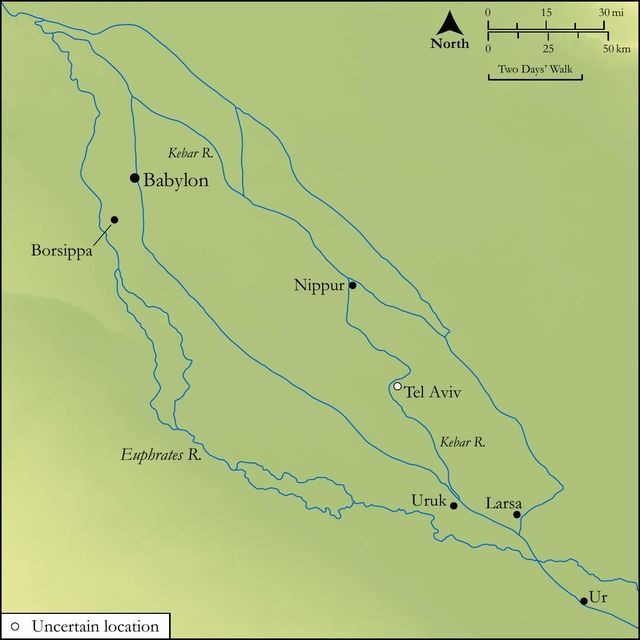
The "thirtieth year" is widely understood to refer to Ezekiel's age, the traditional age for priests to commence their full service in the Temple (compare Numbers 4:3). However, instead of serving in the sacred precincts of Jerusalem, Ezekiel finds himself "among the captives by the river of Chebar," an irrigation canal near the city of Nippur in Babylonia. This places him firmly within the second wave of Jewish exiles, deported by Nebuchadnezzar in 597 BC, alongside King Jehoiachin and other prominent citizens, as detailed in 2 Kings 24:14-16. This period was characterized by immense national trauma, the destruction of the Temple, and a profound crisis of faith, as the people grappled with the question of God's presence, power, and faithfulness outside of their homeland. Ezekiel's call in exile powerfully counters the prevailing despair, demonstrating that God's presence is not confined to Jerusalem but extends to His people wherever they are.
Key Themes
ShowHideEzekiel 1:1 introduces several foundational themes that permeate the entire book. Firstly, it highlights Divine Initiative and Revelation, emphasizing that God sovereignly breaks into human history, revealing Himself to His chosen prophet even in a foreign land. The phrase "the heavens were opened, and I saw visions of God" underscores that this is an uninitiated, sovereign act of God, not a human quest. Secondly, the verse powerfully establishes God's Presence in Exile, demonstrating that God's glory and authority are not limited to the Temple in Jerusalem but extend to His people wherever they are, even in judgment and captivity. This offered a crucial message of both hope and accountability to the despondent exiles. Finally, it marks the beginning of Prophetic Commissioning, as Ezekiel's profound spiritual experience validates his divine message and prepares him for the challenging task of speaking God's word to a rebellious people, a theme further developed and emphasized in Ezekiel 2:3-7.
Exposition and Analysis
ShowHideKey Word Analysis
ShowHideThis term refers to "exile; concretely and collectively exiles; (carried away), captive(-ity), removing." Its use here immediately grounds Ezekiel's experience in the harsh reality of the Babylonian deportation. It signifies not just a physical displacement but a profound national and spiritual crisis for the people of Judah, who were forcibly removed from their homeland and the Temple, the perceived center of God's presence. Ezekiel's identity as "among the captives" underscores that God's revelation is given precisely to those in a state of loss and despair, demonstrating His commitment to His covenant people even in judgment.
Derived from an unused root meaning "to be lofty," this word refers to "the sky (as aloft; the dual perhaps alluding to the visible arch in which the clouds move, as well as to the higher ether where the celestial bodies revolve); air, heaven(-s)." The phrase "the heavens were opened" signifies a supernatural intervention, a tearing of the veil between the earthly and divine realms. It implies a direct, unhindered access to God's presence and a revelation of heavenly realities not normally perceived by humans. This opening is a prerequisite for the "visions of God" that follow, indicating a unique and momentous divine encounter.
This feminine noun, from a root meaning "to see," denotes "a vision; also (causatively) a mirror." In this context, it specifically refers to a divinely granted perception of spiritual realities, distinguishing it from ordinary sight or human imagination. The plural form, "visions of God," suggests a series or multiplicity of divine manifestations, emphasizing the profound and multifaceted nature of Ezekiel's encounter with the Almighty. These were not subjective experiences but objective, revelatory encounters with the living God, providing divine insight and authority for his prophetic message.
Verse Breakdown
ShowHide"Now it came to pass in the thirtieth year, in the fourth [month], in the fifth [day] of the month"
This precise chronological dating immediately establishes the specific time of Ezekiel's prophetic call and the commencement of his ministry. The "thirtieth year" is widely understood as Ezekiel's age, marking the traditional commencement of priestly service, which adds a layer of poignancy to his call in exile, as he is unable to fulfill his priestly duties in Jerusalem. The exact month and day further underscore the historicity and divine intentionality of this event, signaling a momentous occasion in the life of the prophet and the exilic community, emphasizing God's sovereign timing.
"as I [was] among the captives by the river of Chebar"
This clause provides the geographical and social setting for the divine encounter. Ezekiel is identified as one of the "captives" (exiles), emphasizing his shared plight with his people, highlighting his solidarity with their suffering. The "river of Chebar" (a large irrigation canal near Nippur in Babylonia) signifies a foreign, non-sacred space, challenging the conventional understanding that God would only reveal Himself in the Temple in Jerusalem. This detail powerfully conveys God's omnipresence and His willingness to meet His people even in the land of their captivity, demonstrating His faithfulness beyond geographical boundaries.
"[that] the heavens were opened, and I saw visions of God"
This climactic phrase describes the supernatural event that initiates Ezekiel's prophetic ministry. The passive voice "the heavens were opened" highlights God's sovereign initiative; it was not Ezekiel's doing but a divine act, a direct intervention into the earthly realm. This opening of the heavens signifies a direct, unhindered access to the divine realm, a tearing of the veil between the spiritual and physical. The subsequent declaration, "and I saw visions of God," confirms that Ezekiel was granted extraordinary, divinely-originated insights into the nature and glory of God, setting the stage for the profound revelations that comprise the rest of the book and validating his prophetic authority.
Literary Devices
ShowHideEzekiel 1:1 employs several significant literary devices that enhance its impact and communicate its profound theological message. The most prominent is Precise Dating, which grounds the supernatural events in a concrete historical timeline. The unusually specific mention of "the thirtieth year, in the fourth month, in the fifth day of the month" lends immediate credibility and authority to Ezekiel's subsequent prophecies, emphasizing the divine punctuality and the momentous nature of this revelation. Another powerful device is Juxtaposition, contrasting Ezekiel's mundane, exiled status ("among the captives by the river of Chebar") with the extraordinary, divine intervention ("the heavens were opened, and I saw visions of God"). This stark contrast highlights God's sovereign power to transcend human limitations and reveal Himself in unexpected, even desolate, circumstances. Finally, the phrase "the heavens were opened" functions as potent Symbolism, representing a breaking through of the divine into the human realm, signifying direct access to God's presence and a profound spiritual revelation. This imagery foreshadows the many subsequent visions that will unfold, all originating from this initial, dramatic unveiling of God's glory.
Theological and Thematic Connections
ShowHideEzekiel 1:1 lays a crucial theological foundation for understanding God's nature and His relationship with His people, even in judgment. It powerfully asserts God's omnipresence and sovereignty, demonstrating that His presence is not confined to the Temple or the land of Judah, but extends even into the heart of pagan Babylon. This revelation offered both comfort and challenge to the exiles: comfort in knowing God had not abandoned them, and challenge in understanding that their sin had led them to a place where God's glory could manifest outside of traditional sacred spaces. The opening of the heavens signifies a direct, unmediated divine initiative, emphasizing that God actively seeks to communicate with His people, providing guidance and hope even amidst their despair and confusion regarding His covenant faithfulness. This initial vision validates Ezekiel's prophetic authority and underscores that God's plan for Israel continues, even in exile.
Reflection and Application
ShowHideEzekiel 1:1 offers profound encouragement and challenge for believers today, reminding us that God is not limited by our circumstances, our location, or even our failures. Just as Ezekiel, a priest, found himself in exile and unable to perform his traditional duties, yet God met him there with a glorious vision, so too can God break through into our lives in unexpected places and times of our deepest need or spiritual "exile." This verse invites us to cultivate an expectant heart, believing that God can "open the heavens" in our own lives, revealing His presence, purpose, and guidance when we least expect it. It challenges us to look beyond our immediate, often difficult, realities and recognize that God's sovereign hand is at work, ready to communicate His truth and vision for our lives, even when our circumstances seem bleak or our spiritual path unclear. We are called to be receptive to His divine initiative, knowing that His revelations often come not in comfort, but in crisis, preparing us for His unique calling and empowering us to live faithfully wherever we are.
Questions for Reflection
ShowHideFAQ
ShowHideWhy is the "thirtieth year" significant in Ezekiel 1:1?
ShowHideThe "thirtieth year" is widely interpreted by scholars as referring to Ezekiel's age, marking the traditional age at which priests were to begin their full-time service in the tabernacle or temple, as specified in Numbers 4:3. This detail is profoundly significant because it highlights the immense disruption caused by the exile. Instead of beginning his priestly duties in the sacred Temple in Jerusalem, Ezekiel, a priest by lineage, receives his prophetic calling and glorious visions in a foreign land, among the captives. This emphasizes that God's call and presence transcend the physical location of the Temple and traditional religious structures, meeting His servant precisely where he is, even in a state of displacement and unfulfilled vocational expectation. It underscores God's sovereignty and His ability to initiate His purposes regardless of human circumstances or perceived limitations.
Christ-Centered Fulfillment
ShowHideEzekiel 1:1, with its dramatic declaration that "the heavens were opened, and I saw visions of God," finds its ultimate Christ-centered fulfillment in the person and ministry of Jesus Christ. While Ezekiel's vision was a temporary, prophetic unveiling of God's glory to a chosen prophet, Jesus embodies the permanent, complete, and ultimate opening of the heavens to humanity. At His baptism, as recorded in Matthew 3:16, the heavens were literally "opened unto him," and the Spirit of God descended upon Him, followed by the Father's affirming voice. This pivotal moment signifies that in Christ, the barrier between God and humanity is permanently broken, and the divine presence is fully manifested. Jesus Himself is the "vision of God" (compare John 1:18 and Colossians 1:15), the ultimate revelation of the Father's glory, character, and redemptive purpose. Furthermore, Jesus promised His disciples that they would see "heaven open, and the angels of God ascending and descending upon the Son of Man" (John 1:51), indicating that through Him, humanity gains unprecedented access to the divine realm and experiences God's ongoing revelation and ministry. Thus, Ezekiel's initial glimpse of God's glory in a foreign land foreshadows the complete and accessible revelation of God's presence and power found in Christ, who perfectly bridges the gap between heaven and earth, making God fully known.