


Acts 10:11
- καὶkaiandG2532CONJConjunction
- θεωρεῖtheōreihe beholdsG2334V-PAI-3SVerb Present Active Indicative 3rd Singular
- τὸνton<the>G3588T-ASMDefinite article Accusative Singular Masculine
- οὐρανὸνouranonheavenG3772N-ASMNoun Accusative Singular Masculine
- ἀνεῳγμένονaneōgmenonopenedG455V-2RPP-ASMVerb 2nd Perfect Passive Participle Accusative Singular Masculine
- καὶkaiandG2532CONJConjunction
- καταβαῖνονkatabainondescendingG2597V-PAP-ASNVerb Present Active Participle Accusative Singular Neuter
- ἐπ᾽ep᾽ontoG1909PREPPreposition
- αὐτὸνautonhimG846P-ASMPersonal pronoun Accusative Singular Masculine
- σκεῦόςskeuosa vesselG4632N-ASNNoun Accusative Singular Neuter
- τιticertainG5100X-ASNIndefinite pronoun Accusative Singular Neuter
- ὡςhōsasG5613PRTParticle or Disjunctive
- ὀθόνηνothonēna sheetG3607N-ASFNoun Accusative Singular Feminine
- μεγάληνmegalēngreatG3173A-ASFAdjective Accusative Singular Feminine
- τέσσαρσινtessarsinby fourG5064A-DPFAdjective Dative Plural Feminine
- ἀρχαῖςarchaiscornersG746N-DPFNoun Dative Plural Feminine
- δεδεμένονdedemenonboundG1210V-RPP-ASNVerb Perfect Passive Participle Accusative Singular Neuter
- καὶkaiandG2532CONJConjunction
- καθιέμενονkathiemenonbeing let downG2524V-PPP-ASNVerb Present Passive Participle Accusative Singular Neuter
- ἐπὶepiuponG1909PREPPreposition
- τῆςtēstheG3588T-GSFDefinite article Genitive Singular Feminine
- γῆς·gēsearthG1093N-GSFNoun Genitive Singular Feminine
English is a literal word-by-word gloss of the Greek, not the KJV's wording. Why?
This is the original text the KJV's translators worked from — each Greek word with its own literal English meaning in this verse, prepared by scholars at Tyndale House, Cambridge. The KJV translates whole sentences, not word by word, so its wording differs: one Greek word can become several English words, and the KJV may choose “charity” where the gloss reads “love”. Both are faithful — they answer different questions. For the KJV's own rendering, switch to the KJV text.
Details
See on the biblical-era map
Study this verse
Public-domain commentary
Matthew Henry
From his Commentary on the Whole Bible. Henry comments on passages, not single verses — this entry covers Acts 10:9–18. His three-level outline is real structure in the source text, so it is rendered as structure.
Cornelius had received positive orders from heaven to send for Peter, whom otherwise he had not heard of, or at least not heeded; but here is another difficulty that lies in the way of bringing them together - the question is whether Peter will come to Cornelius when he is sent for; not as if he thought it below him to come at a beck, or as if he were afraid to preach his doctrine to a polite man as Cornelius was: but it sticks at a point of conscience. Cornelius is a very worthy man, and has many good qualities, but he is a Gentile, he is not circumcised; and, because God in his law had forbidden his people to associate with idolatrous nations, they would not keep company with any but those of their own religion, though they were ever so deserving, and they carried the matter so far that they made even the involuntary touch of a Gentile to contract a ceremonial pollution, Joh 18:28. Peter had not got over this stingy bigoted notion of his countrymen, and therefore will be shy of coming to Cornelius. Now, to remove this difficulty, he has a vision here, to prepare him to receive the message sent him by Cornelius, as Ananias had to prepare him to go to Paul. The scriptures of the Old Testament had spoken plainly of the bringing in of the Gentiles into the church. Christ had given plain intimations of it when he ordered them to teach all nations; and yet even Peter himself, who knew so much of his Master's mind, could not understand it, till it was here revealed by vision, that the Gentiles should be fellow-heirs, Eph 3:6. Now here observe,
I.The circumstances of this vision.
1.It was when the messengers sent from Cornelius were now nigh the city, Act 10:9. Peter knew nothing of their approach, and they knew nothing of his praying; but he that knew both him and them was preparing things for the interview, and facilitating the end of their negotiation. To all God's purposes there is a time, a proper time; and he is pleased often to bring things to the minds of his ministers, which they had not thought of, just then when they have occasion to use them.
2.It was when Peter went up upon the house-top to pray, about noon.
(1.)Peter was much in prayer, much in secret prayer, though he had a great deal of public work upon his hands.
(2.)He prayed about the sixth hour, according to David's example, who, not only morning and evening, but at noon, addressed himself to God by prayer, Psa 55:17. From morning to night we should think to be too long to be without meat; yet who thinks it is too long to be without prayer?
(3.)He prayed upon the house-top; thither he retired for privacy, where he could neither hear nor be heard, and so might avoid both distraction and ostentation. There, upon the roof of the house, he had a full view of the heavens, which might assist his pious adoration of the God he prayed to; and there he had also a full view of the city and country, which might assist his pious compassion of the people he prayed for.
(4.)He had this vision immediately after he had prayed, as an answer to his prayer for the spreading of the gospel, and because the ascent of the heart to God in prayer is an excellent preparative to receive the discoveries of the divine grace and favour.
3.It was when he became very hungry, and was waiting for his dinner (Act 10:10); probably he had not that day eaten before, though doubtless he had prayed before; and now he would have eaten, ēthele geusasthai - he would have tasted, which intimates his great moderation and temperance in eating. When he was very hungry, yet he would be content with a little, with a taste, and would not fly upon the spoil. Now this hunger was a proper inlet to the vision about meats, as Christ's hunger in the wilderness was to Satan's temptation to turn stones into bread.
II.The vision itself, which was not so plain as that to Cornelius, but more figurative and enigmatical, to make the deeper impression.
1.He fell into a trance or ecstasy, not of terror, but of contemplation, with which he was so entirely swallowed up as not only not to be regardful, but not to be sensible, of external things. He quite lost himself to this world, and so had his mind entirely free for converse with divine things; as Adam in innocency, when the deep sleep fell upon him. The more clear we get of the world, the more near we get to heaven: whether Peter was now in the body or out of the body he could not himself tell, much less can we, Co2 12:2, Co2 12:3. See Gen 15:12; Act 22:17.
2.He saw heaven opened, that he might be sure that his authority to go to Cornelius was indeed from heaven - that it was a divine light which altered his sentiments, and a divine power which gave him his commission. The opening of the heavens signified the opening of a mystery that had been hid, Rom 16:25.
3.He saw a great sheet full of all manner of living creatures, which descended from heaven, and was let down to him to the earth, that is, to the roof of the house where he now was. Here were not only beasts of the earth, but fowls of the air, which might have flown away, laid at his feet; and not only tame beasts, but wild. Here were no fishes of the sea, because there were none of them in particular unclean, but whatever had fins and scales was allowed to be eaten. Some make this sheet, thus filled, to represent the church of Christ. It comes down from heaven, from heaven opened, not only to send it down (Rev 21:2), but to receive souls sent up from it. It is knit at the four corners, to receive those from all parts of the world that are willing to be added to it; and to retain and keep those safe that are taken into it, that they may not fall out; and in this we find some of all countries, nations, and languages, without any distinction of Greek or Jew, or any disadvantage put upon Barbarian or Scythian, Col 3:11. The net of the gospel encloses all, both bad and good, those that before were clean and unclean. Or it may be applied to the bounty of the divine Providence, which, antecedently to the prohibitions of the ceremonial law, had given to man a liberty to use all the creatures, to which by the cancelling of that law we are now restored. By this vision we are taught to see all the benefit and service we have from the inferior creatures coming down to us from heaven; it is the gift of God who made them, made them fit for us, and then gave to man a right to them, and dominion over them. Lord, what is man that he should be thus magnified! Psa 8:4-8. How should it double our comfort in the creatures, and our obligations to serve God in the use of them, to see them thus let down to us out of heaven!
4.He was ordered by a voice from heaven to make use of this plenty and variety which God had sent him (Act 10:13): "Rise, Peter, kill and eat: without putting any difference between clean and unclean, take which thou hast most mind to." The distinction of meats which the law made was intended to put a difference between Jew and Gentile, that it might be difficult to them to dine and sup with a Gentile, because they would have that set before them which they were not allowed to eat; and now the taking off of that prohibition was a plain allowance to converse with the Gentiles, and to be free and familiar with them. Now they might fare as they fared, and therefore might eat with them, and be fellow-commoners with them.
5.He stuck to his principles, and would by no means hearken to the motion, though he was hungry (Act 10:14): Not so, Lord. Though hunger will break through stone walls, God's laws should be to us a stronger fence than stone walls, and not so easily broken through. And he will adhere to God's laws, though he has a countermand by a voice from heaven, not knowing at first but that Kill, and eat, was a command of trial whether he would adhere to the more sure word, the written law; and if so his answer had been very good, Not so, Lord. Temptations to eat forbidden fruit must not be parleyed with, but peremptorily rejected; we must startle at the thought of it: Not so, Lord. The reason he gives is, "For I have never eaten any thing that is common or unclean; hitherto I have kept my integrity in this matter, and will still keep it." If God, by his grace, has preserved us from gross sin unto this day, we should use this as an argument with ourselves to abstain from all appearance of evil. So strict were the pious Jews in this matter, that the seven brethren, those glorious martyrs under Antiochus, choose rather to be tortured to death in the most cruel manner that ever was than to eat swine's flesh, because it was forbidden by the law. No wonder then that Peter says it with so much pleasure, that his conscience could witness for him that he had never gratified his appetite with any forbidden food.
6.God, by a second voice from heaven, proclaimed the repeal of the law in this case (Act 10:15): What God hath cleansed, that call thou not common. He that made the law might alter it when he pleased, and reduce the matter to its first state. God had, for reasons suited to the Old Testament dispensation, restrained the Jews from eating such and such meats, to which, while that dispensation lasted, they were obliged in conscience to submit; but he has now, for reasons suited to the New Testament dispensation, taken off that restraint, and set the matter at large - has cleansed that which was before polluted to us, and we ought to make use of, and stand fast in, the liberty wherewith Christ has made us free, and not call that common or unclean which God has now declared clean. Note, We ought to welcome it as a great mercy that by the gospel of Christ we are freed from the distinction of meats, which was made by the law of Moses, and that now every creature of God is good, and nothing to be refused; not so much because hereby we gain the use of swine's flesh, hares, rabbits, and other pleasant and wholesome food for our bodies, but chiefly because conscience is hereby freed from a yoke in things of this nature, that we might serve God without fear. Though the gospel has made duties which were not so by the law of nature, yet it has not, like the law of Moses, made sins that were not so. Those who command to abstain from some kinds of meat at some times of the year, and place religion in it, call that common which God hath cleansed, and in that error, more than in any truth, are the successors of Peter.
7.This was done thrice, Act 10:16. The sheet was drawn up a little way, and let down again the second time, and so the third time, with the same call to him, to kill, and eat, and the same reason, that what God hath cleansed we must not call common; but whether Peter's refusal was repeated the second and third time is not certain; surely it was not, when his objection had the first time received such a satisfactory answer. The trebling of Peter's vision, like the doubling of Pharaoh's dream, was to show that the thing was certain, and engage him to take so much the more notice of it. The instructions given us in the things of God, whether by the ear in the preaching of the word, or by the eye in sacraments, need to be often repeated; precept must be upon precept, and line upon line. But at last the vessel was received up into heaven. Those who make this vessel to represent the church, including both Jews and Gentiles, as this did both clean and unclean creatures, make this very aptly to signify the admission of the believing Gentiles into the church, and into heaven too, into the Jerusalem above. Christ has opened the kingdom of heaven to all believers, and there we shall find, besides those that are sealed out of all the tribes of Israel, an innumerable company out of every nation (Rev 7:9); but they are such as God has cleansed.
III.The providence which very opportunely explained this vision, and gave Peter to understand the intention of it, Act 10:17, Act 10:18.
1.What Christ did, Peter knew not just then (Joh 13:7): He doubted within himself what this vision which he had seen should mean. He had no reason to doubt the truth of it, that it was a heavenly vision; all his doubt was concerning the meaning of it. Note, Christ reveals himself to his people by degrees, and not all at once; and leaves them to doubt awhile, to ruminate upon a thing, and debate it to and fro in their own minds, before he clears it up to them.
2.Yet he was made to know presently, for the men who were sent from Cornelius were just now come to the house, and were at the gate enquiring whether Peter lodged there; and by their errand it will appear what was the meaning of this vision. Note, God knows what services are before us, and therefore how to prepare us; and we then better know the meaning of what he has taught us when we find what occasion we have to make use of it.
Historical interpretation
Three Centuries of Reception
7 surviving comments on this verse. Each one is dated, so this reads as a timeline rather than a list.
Select a marker to jump to its quote. Markers stagger vertically where authors wrote within a few decades of each other.
The earth then, this is what the linen sheet denotes, and the wild beasts in it, are they of the Gentiles, and the command, "Kill and eat," denotes that he must go to them also; and that this thing is thrice done, denotes baptism.
To me it seems that this also denotes the Gospel (or, "the Preaching"). That the thing taking place was of God the circumstances made evident, namely, both that he sees it descending from above, and that he is in a trance; and, that the voice comes from thence, and the thrice confessing that the creatures there were unclean, and its coming from thence, and being drawn back thither - all this is a mighty token of the cleanness imparted to them.
"And saw heaven opened, and, knit at the four corners, a certain vessel descending unto him, as it had been a great sheet, and let down to the earth: wherein were all manner of fourfooted beasts of the earth, and wild beasts, and creeping things, and fowls of the air." What is this? It is a symbol of the whole world. The man was uncircumcised: and - for he had nothing in common with the Jews - they would all accuse him as a transgressor: "thou wentest in to men uncircumcised, and didst eat with them."
So, by the grace of the blessed Trinity, the whole earth from its four corners is called to the faith. According to this reckoning, when four is taken three times, the apostolic number, twelve, is consecrated as symbolizing the salvation of the whole world from its four corners in the grace of the Trinity. This number was also indicated by the vessel full of all kinds of animals, as it were of all nations, shown to Peter. For this vessel, let down from the heavens by the four corners, was lowered and taken up three different times, so that the four became twelve. On that account, perhaps, when twelve days had elapsed after the birth of Christ, the magi, the firstfruits of the Gentiles, came to see and to adore Christ and thus merited, not only to insure their own salvation, but also to prefigure that of all Gentiles.
Enjoying his office, the celestial keeper of the keys sees heaven opened. From there an image of a vessel is let down, so that there might be a vision on earth that all things can be taken by the body of Peter, who makes into food for the church whatever he takes to be eaten. The vision is brought before him, let down by its four sides: it is one image of the church, which rises from the four parts of the world and spreads the eloquence of the same number of heralds [evangelists], keeping together every kind of bird and domestic beast, of wild animal and reptile: these [animals] are connected to humans on account of their merits and vices. It is therefore clear that the Creator bids the Gentiles to be poured into the bowels of the church, as he instructs [Peter], “Kill and eat, take away what they are and make them like yourself.” He who is turned about is considered changed. Saul perished at length because Paul began to live.
And a certain vessel descended as it were a great sheet. That vessel signifies the Church endowed with incorruptible faith. For a moth does not consume linen, which corrupts other garments. Therefore, whoever wishes to belong to the mystery of the Catholic Church, let him exclude from his heart the corruption of evil thoughts, and thus be incorruptibly firm in faith, so that he is not gnawed in mind by wicked thoughts as if by moths. Alternatively: The moth is a heretic, wishing to corrupt the garment of the Lord but not being able by the dispensation of the Lord. This was also prefigured in the tunic of the Lord which the soldiers did not dare to tear.
Submitted by heaven to earth at four corners. The four corners, by which the sheet was hanging, designate the four regions of the world to which the Church extends. For she is indeed the city of our God in His holy mountain, expanding the rejoicings of all the earth. For what is submitted from heaven indicates that it is preserved and increased by the grace of the Holy Spirit alone. Whence John says in the Apocalypse: I saw the holy city, the new Jerusalem, coming down out of heaven from God (Rev. 21). The four corners can also prefigure the evangelists, through whom the Church is imbued and exalted by heavenly grace.
Continue studying Acts 10:11 across the web’s major study libraries — every link below opens this exact verse, chapter, or book on the destination site.
Read & Compare
 BibleGatewayThis verse in more than 200 translations and 70 languages.
 Bible.comThe YouVersion reader — hundreds of translations, reading plans, and highlights.
 ESV.orgCrossway's official English Standard Version reader.
 NET BibleThe NET translation with 60,000+ translators' notes on every rendering decision.
 STEP BibleTyndale House's free study tool — original text, vocabulary, and scholarly resources.
 BibliaLogos Bible Software's free web reader.
 USCCBThe New American Bible (Revised Edition) with the U.S. bishops' study notes.
Commentaries
 BibleHub CommentariesDozens of classic commentaries on this verse, gathered on one page.
 StudyLightMore than 100 commentary sets — the largest collection on the web.
 BibleRefPlain-English commentary on what this verse means, verse by verse.
 Enduring WordDavid Guzik's free commentary on this chapter, widely used by Bible teachers.
 Bible Study ToolsVerse commentary alongside Greek and Hebrew study aids.
Original Language & Research
- BibleHub InterlinearThe verse word by word — original language, transliteration, and English.
- BibleHub LexiconEvery word's original-language definition and Strong's entry.
 Blue Letter BibleDeep-study tools — Strong's numbers, concordance, and word studies.
 CNTR CollationThe earliest Greek manuscripts of this verse, collated letter by letter.
Sermons, Hymns & Audio


TrulyRandomVerse is not affiliated with these sites and doesn’t control their content. They’re linked because they’re genuinely useful.
Summary
Acts 10:11 marks the dramatic commencement of Peter's pivotal vision in Joppa, a divinely orchestrated event that would fundamentally reshape the early church's understanding of God's redemptive plan. As Peter prayed on a housetop, he witnessed the heavens opening and a large, sheet-like vessel descending from above, signaling a profound revelation designed to break down long-standing barriers between Jew and Gentile and usher in a new era of Gospel universal reach.
Context
ShowHideLiterary Context
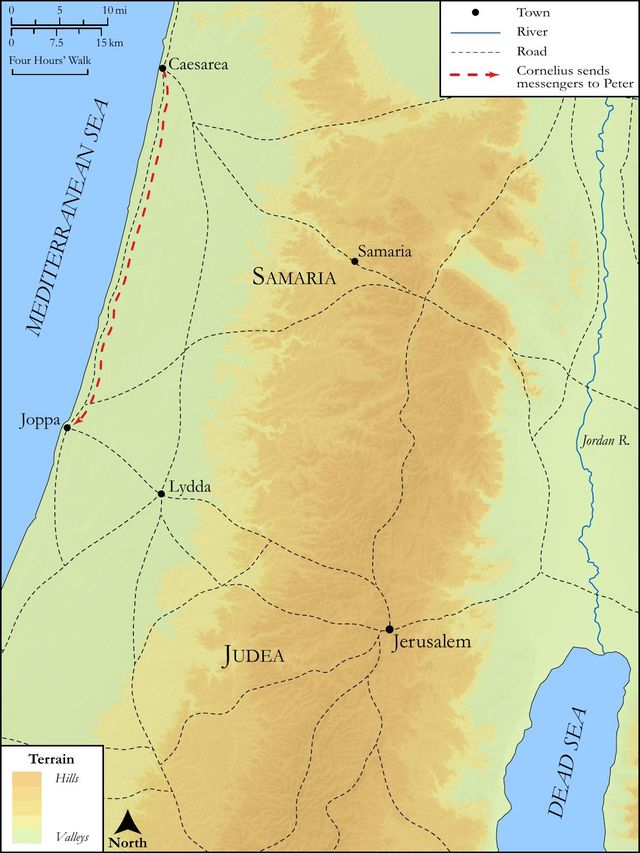
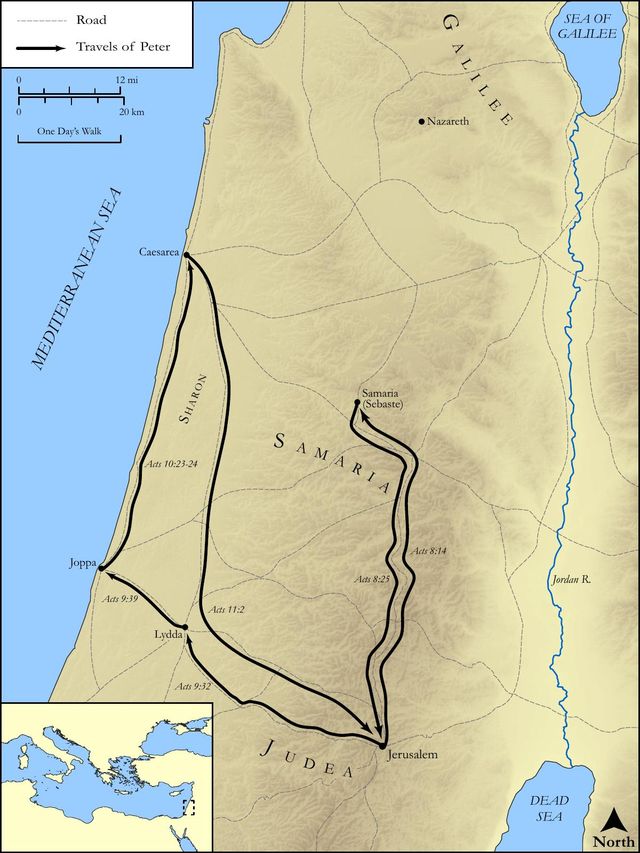
This verse is the immediate prelude to one of the most significant turning points in the book of Acts. Peter, having concluded a period of ministry that included healing Aeneas in Lydda and raising Tabitha in Joppa (Acts 9:32-43), is now staying with Simon the tanner, a detail itself subtly subversive to strict Jewish custom. The preceding verses (Acts 10:9-10) establish Peter's state of prayer and hunger, setting the stage for a vision that initially appears to be about food but quickly transcends mere dietary concerns. Crucially, this vision unfolds in parallel with a complementary divine encounter for Cornelius, a devout Gentile centurion in Caesarea (Acts 10:1-8), highlighting God's simultaneous work to bring these two individuals together for a groundbreaking encounter.
Historical & Cultural Context
First-century Jewish society was deeply structured by the Mosaic Law, which included strict dietary regulations (kashrut) detailed in passages like Leviticus 11 and Deuteronomy 14. These laws, alongside other purity codes, fostered a distinct separation between Jews and Gentiles. Jews typically avoided social interaction, particularly shared meals, with Gentiles, whom they considered "unclean." Peter, as a devout Jew, would have adhered to these customs. Joppa, a coastal city and port, was a crossroads of cultures, making it a fitting location for God to initiate a vision that would challenge these deeply ingrained cultural and religious norms and pave the way for the Gospel's expansion beyond its Jewish origins.
Key Themes
ShowHideActs 10:11 introduces several overarching themes crucial to the narrative of Acts. The primary theme is Divine Revelation, as God directly intervenes to communicate His will to Peter, signifying a message of immense theological importance. The "heaven opened" motif is a powerful biblical symbol of direct divine communication and intervention, seen in other significant moments like Ezekiel's prophetic visions or Jesus' baptism. This revelation serves as a Preparation for a New Understanding, specifically concerning the inclusion of Gentiles into the covenant community. The imagery of the "great sheet knit at the four corners, and let down to the earth" powerfully foreshadows the Universality of the Gospel and God's redemptive plan, which extends to all peoples, breaking down the traditional barriers between Jew and Gentile.
Exposition and Analysis
ShowHideKey Word Analysis
ShowHideThis verb signifies not merely a casual glance but a deliberate, discerning observation, often implying an intensive or experiential beholding. Peter is not just seeing an image; he is perceiving a divine reality, acknowledging its profound significance. This emphasizes the objective reality and divine origin of the vision, distinguishing it from a mere dream or hallucination.
This term is broad, referring to any implement, container, or apparatus. In this context, it describes the "great sheet" as the divinely appointed means or instrument through which God presents the symbolic contents to Peter. The choice of "vessel" highlights its purpose as a carrier, designed to hold and deliver a specific message or collection of items, underscoring the divine intention behind what is being shown.
While literally meaning "soil" or "ground," gē also encompasses a region, land, or the entire terrestrial globe, including its inhabitants. The sheet being "let down to the earth" signifies the universal scope and practical application of the vision. It implies that the divine message is not confined to the heavens but is intended for all humanity, bringing the implications of God's cleansing power and inclusive grace directly into the human realm.
Verse Breakdown
ShowHide"And saw heaven opened"
This phrase immediately establishes the supernatural nature of the event. The "opening of heaven" is a biblical motif signifying a direct, unmediated divine revelation, a moment when the spiritual realm intersects with the physical, indicating that God is about to communicate a message of profound importance and authority.
"and a certain vessel descending unto him"
Following the opening of heaven, Peter's attention is drawn to a specific object, a "vessel," which serves as the medium for the divine communication. Its descent "unto him" emphasizes that this revelation is personal and directed specifically at Peter, preparing him for the crucial role he is about to play.
"as it had been a great sheet"
The "vessel" is further described as resembling a "great sheet," likely a large piece of linen or cloth. The term "great" (G3173, mégas) suggests its considerable size, implying it could contain a multitude of items, underscoring the comprehensive nature of the revelation to follow. The material, likely linen, could suggest purity or the sacred, setting a solemn tone.
"knit at the four corners"
The sheet is described as being "knit" or bound securely at its four corners, forming a kind of pouch or container. This detail implies stability and containment. The "four corners" often symbolize the four cardinal directions, representing the entirety of the earth or the universality of its contents, hinting at the global reach of the Gospel message.
"and let down to the earth"
The final action of the verse, the sheet's descent "to the earth," signifies the practical, tangible reality of the vision. It is not a distant, abstract concept but something brought directly into Peter's immediate reality, emphasizing that God's message has direct implications for human life and the world.
Literary Devices
ShowHideActs 10:11 is rich in Imagery, painting a vivid picture of the heavens parting and a large, bound sheet descending. This visual spectacle immediately grabs the reader's attention and underscores the extraordinary nature of Peter's experience. The "great sheet knit at the four corners" functions as potent Symbolism. The sheet itself, as a container, symbolizes the scope of God's redemptive plan, encompassing all things and all peoples. Its "four corners" universally represent the entire world, signaling that the message contained within (the clean and unclean animals) and the subsequent theological implications are for all humanity, transcending geographical or ethnic boundaries. The entire verse serves as powerful Foreshadowing, setting the stage for the dramatic revelation in the subsequent verses that God has cleansed what was once considered unclean, directly paving the way for the inclusion of Gentiles into the Christian community and the dismantling of the Jewish-Gentile divide.
Theological and Thematic Connections
ShowHideActs 10:11 serves as the dramatic opening to a profound theological paradigm shift within early Christianity. The vision of the heavens opening and the sheet descending is a divine declaration that God's redemptive work is not confined to one nation or one set of laws, but is expansive and inclusive. It challenges the deeply entrenched Jewish understanding of clean and unclean, preparing Peter to embrace a radical new truth: that God shows no partiality and that salvation in Christ is for all who believe, regardless of their ethnic or cultural background. This verse initiates the dismantling of barriers that had historically separated humanity, signaling the universal reach of God's grace and the breaking down of ceremonial distinctions that no longer held sway in the new covenant.
Reflection and Application
ShowHideActs 10:11 is a powerful reminder that God often challenges our preconceived notions and comfortable boundaries to expand our understanding of His boundless love and inclusive plan. Just as Peter, a devout Jew, was forced to confront centuries of tradition and prejudice, so too are believers today called to examine their own biases—whether cultural, social, or theological—that might hinder the full expression of the Gospel's universality. This verse encourages an openness to divine revelation, recognizing that God's ways are higher than our ways, and His truth may often disrupt our established comfort zones. It calls us to embrace the universal reach of the Kingdom of God, actively seeking to break down barriers and extend grace to all people, reflecting God's heart for every tribe, tongue, people, and nation. We are invited to participate in God's ongoing work of reconciliation, ensuring that the church truly reflects the diverse body of Christ.
Questions for Reflection
ShowHideFAQ
ShowHideWhat is the significance of "heaven opened" in this verse?
ShowHideThe phrase "heaven opened" (Greek: ouranos anoigō) is a profound theological motif throughout the Bible, signifying a direct and unmediated divine intervention or revelation. It indicates that what Peter is about to experience is not a mere dream, hallucination, or human imagination, but a direct communication from the divine realm. It underscores the immense importance and authority of the message that follows, marking a pivotal moment when God is actively revealing His will and initiating a new phase in His redemptive plan, as seen in other biblical instances like Ezekiel's vision of God's glory or Jesus' baptism.
Why was a "sheet" used as the vessel for this vision?
ShowHideThe choice of a "great sheet" (Greek: othónē megalē) is highly symbolic. As a large piece of cloth, it could contain a wide variety of animals, both "clean" and "unclean" according to Jewish dietary laws, which are revealed in the subsequent verses (Acts 10:12-14). The sheet's descent "knit at the four corners" suggests a universal scope, representing all parts of the earth and all peoples. It serves as a visual metaphor for the entire created order, particularly humanity, which God is now declaring cleansed and acceptable through Christ, thereby extending salvation beyond the confines of Jewish law and tradition.
Christ-Centered Fulfillment
ShowHideActs 10:11, with its dramatic imagery of heaven opening and a great sheet descending to earth, finds its ultimate fulfillment in the person and work of Jesus Christ. The "heaven opened" motif points directly to Christ as the ultimate revelation of God, for in Him, God has spoken His final and complete word to humanity (Hebrews 1:1-3). The sheet, laden with animals previously deemed "unclean" under the Mosaic Law, powerfully foreshadows Christ's abolition of ceremonial distinctions and His declaration that all foods are clean (Mark 7:19). More profoundly, this vision anticipates the breaking down of the "dividing wall of hostility" between Jew and Gentile through Christ's sacrifice on the cross (Ephesians 2:14). Through His atoning blood, Christ cleanses not only foods but also people, making all who believe in Him, regardless of their background, "clean" and acceptable to God. This vision, therefore, is a direct theological precursor to the Great Commission, where Christ commands His followers to make disciples of "all nations" (Matthew 28:19-20), revealing that His redemptive work on the cross was for the entire world, bringing salvation and unity to all corners of the earth, symbolized by the sheet "let down to the earth" from heaven.