


Acts 10:12
- ἐνeninG1722PREPPreposition
- ᾧhōwhichG3739R-DSNRelative pronoun Dative Singular Neuter
- ὑπῆρχενhupērchenwereG5225V-IAI-3SVerb Imperfect Active Indicative 3rd Singular
- πάνταpantaallG3956A-NPNAdjective Nominative Plural Neuter
- τὰtatheG3588T-NPNDefinite article Nominative Plural Neuter
- τετράποδαtetrapodaquadrupedsG5074A-NPNAdjective Nominative Plural Neuter
- καὶkaiandG2532CONJConjunction
- τὰtatheG3588T-NPNDefinite article Nominative Plural Neuter
- θηρίαthēriabeastsG2342N-NPNNoun Nominative Plural Neuter
- καὶkaiandG2532CONJConjunction
- τὰtatheG3588T-NPNDefinite article Nominative Plural Neuter
- ἑρπετὰherpetacreeping thingsG2062N-NPNNoun Nominative Plural Neuter
- τῆςtēsof theG3588T-GSFDefinite article Genitive Singular Feminine
- γῆςgēsearthG1093N-GSFNoun Genitive Singular Feminine
- καὶkaiandG2532CONJConjunction
- τὰta<the>G3588T-NPNDefinite article Nominative Plural Neuter
- πετεινὰpeteinabirdsG4071N-NPNNoun Nominative Plural Neuter
- τοῦtou<the>G3588T-GSMDefinite article Genitive Singular Masculine
- οὐρανοῦouranouof heavenG3772N-GSMNoun Genitive Singular Masculine
English is a literal word-by-word gloss of the Greek, not the KJV's wording. Why?
This is the original text the KJV's translators worked from — each Greek word with its own literal English meaning in this verse, prepared by scholars at Tyndale House, Cambridge. The KJV translates whole sentences, not word by word, so its wording differs: one Greek word can become several English words, and the KJV may choose “charity” where the gloss reads “love”. Both are faithful — they answer different questions. For the KJV's own rendering, switch to the KJV text.
Details
See on the biblical-era map
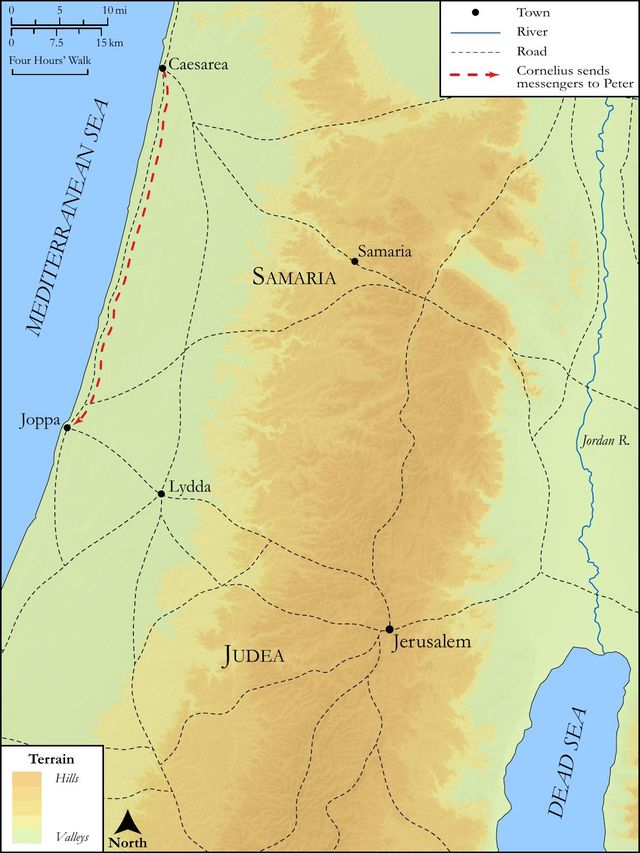
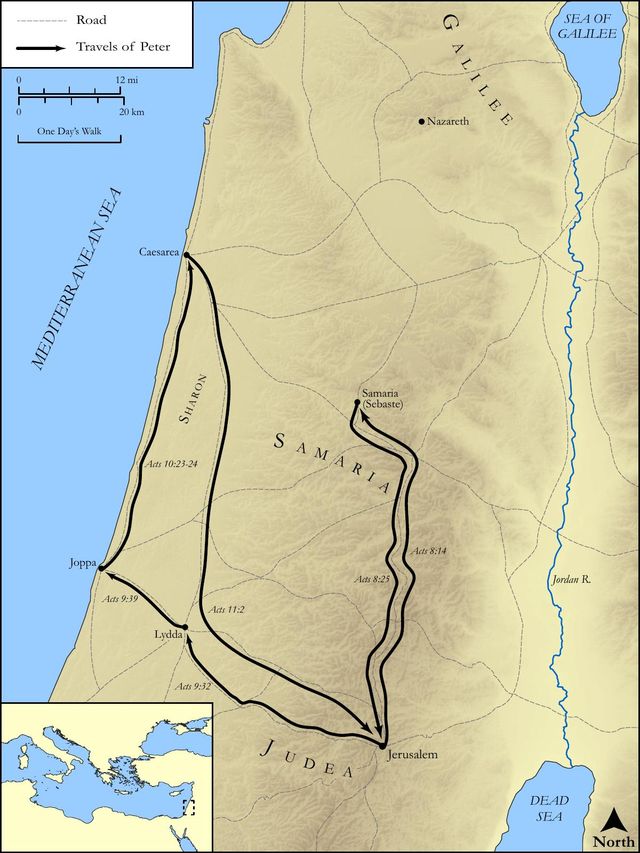
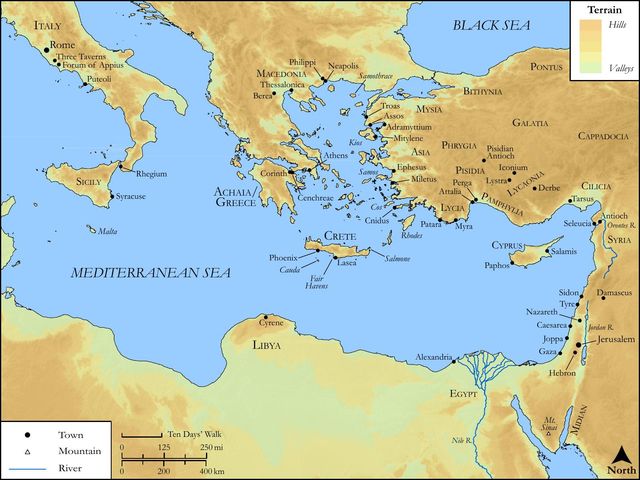
Study this verse
Public-domain commentary
Matthew Henry
From his Commentary on the Whole Bible. Henry comments on passages, not single verses — this entry covers Acts 10:9–18. His three-level outline is real structure in the source text, so it is rendered as structure.
Cornelius had received positive orders from heaven to send for Peter, whom otherwise he had not heard of, or at least not heeded; but here is another difficulty that lies in the way of bringing them together - the question is whether Peter will come to Cornelius when he is sent for; not as if he thought it below him to come at a beck, or as if he were afraid to preach his doctrine to a polite man as Cornelius was: but it sticks at a point of conscience. Cornelius is a very worthy man, and has many good qualities, but he is a Gentile, he is not circumcised; and, because God in his law had forbidden his people to associate with idolatrous nations, they would not keep company with any but those of their own religion, though they were ever so deserving, and they carried the matter so far that they made even the involuntary touch of a Gentile to contract a ceremonial pollution, Joh 18:28. Peter had not got over this stingy bigoted notion of his countrymen, and therefore will be shy of coming to Cornelius. Now, to remove this difficulty, he has a vision here, to prepare him to receive the message sent him by Cornelius, as Ananias had to prepare him to go to Paul. The scriptures of the Old Testament had spoken plainly of the bringing in of the Gentiles into the church. Christ had given plain intimations of it when he ordered them to teach all nations; and yet even Peter himself, who knew so much of his Master's mind, could not understand it, till it was here revealed by vision, that the Gentiles should be fellow-heirs, Eph 3:6. Now here observe,
I.The circumstances of this vision.
1.It was when the messengers sent from Cornelius were now nigh the city, Act 10:9. Peter knew nothing of their approach, and they knew nothing of his praying; but he that knew both him and them was preparing things for the interview, and facilitating the end of their negotiation. To all God's purposes there is a time, a proper time; and he is pleased often to bring things to the minds of his ministers, which they had not thought of, just then when they have occasion to use them.
2.It was when Peter went up upon the house-top to pray, about noon.
(1.)Peter was much in prayer, much in secret prayer, though he had a great deal of public work upon his hands.
(2.)He prayed about the sixth hour, according to David's example, who, not only morning and evening, but at noon, addressed himself to God by prayer, Psa 55:17. From morning to night we should think to be too long to be without meat; yet who thinks it is too long to be without prayer?
(3.)He prayed upon the house-top; thither he retired for privacy, where he could neither hear nor be heard, and so might avoid both distraction and ostentation. There, upon the roof of the house, he had a full view of the heavens, which might assist his pious adoration of the God he prayed to; and there he had also a full view of the city and country, which might assist his pious compassion of the people he prayed for.
(4.)He had this vision immediately after he had prayed, as an answer to his prayer for the spreading of the gospel, and because the ascent of the heart to God in prayer is an excellent preparative to receive the discoveries of the divine grace and favour.
3.It was when he became very hungry, and was waiting for his dinner (Act 10:10); probably he had not that day eaten before, though doubtless he had prayed before; and now he would have eaten, ēthele geusasthai - he would have tasted, which intimates his great moderation and temperance in eating. When he was very hungry, yet he would be content with a little, with a taste, and would not fly upon the spoil. Now this hunger was a proper inlet to the vision about meats, as Christ's hunger in the wilderness was to Satan's temptation to turn stones into bread.
II.The vision itself, which was not so plain as that to Cornelius, but more figurative and enigmatical, to make the deeper impression.
1.He fell into a trance or ecstasy, not of terror, but of contemplation, with which he was so entirely swallowed up as not only not to be regardful, but not to be sensible, of external things. He quite lost himself to this world, and so had his mind entirely free for converse with divine things; as Adam in innocency, when the deep sleep fell upon him. The more clear we get of the world, the more near we get to heaven: whether Peter was now in the body or out of the body he could not himself tell, much less can we, Co2 12:2, Co2 12:3. See Gen 15:12; Act 22:17.
2.He saw heaven opened, that he might be sure that his authority to go to Cornelius was indeed from heaven - that it was a divine light which altered his sentiments, and a divine power which gave him his commission. The opening of the heavens signified the opening of a mystery that had been hid, Rom 16:25.
3.He saw a great sheet full of all manner of living creatures, which descended from heaven, and was let down to him to the earth, that is, to the roof of the house where he now was. Here were not only beasts of the earth, but fowls of the air, which might have flown away, laid at his feet; and not only tame beasts, but wild. Here were no fishes of the sea, because there were none of them in particular unclean, but whatever had fins and scales was allowed to be eaten. Some make this sheet, thus filled, to represent the church of Christ. It comes down from heaven, from heaven opened, not only to send it down (Rev 21:2), but to receive souls sent up from it. It is knit at the four corners, to receive those from all parts of the world that are willing to be added to it; and to retain and keep those safe that are taken into it, that they may not fall out; and in this we find some of all countries, nations, and languages, without any distinction of Greek or Jew, or any disadvantage put upon Barbarian or Scythian, Col 3:11. The net of the gospel encloses all, both bad and good, those that before were clean and unclean. Or it may be applied to the bounty of the divine Providence, which, antecedently to the prohibitions of the ceremonial law, had given to man a liberty to use all the creatures, to which by the cancelling of that law we are now restored. By this vision we are taught to see all the benefit and service we have from the inferior creatures coming down to us from heaven; it is the gift of God who made them, made them fit for us, and then gave to man a right to them, and dominion over them. Lord, what is man that he should be thus magnified! Psa 8:4-8. How should it double our comfort in the creatures, and our obligations to serve God in the use of them, to see them thus let down to us out of heaven!
4.He was ordered by a voice from heaven to make use of this plenty and variety which God had sent him (Act 10:13): "Rise, Peter, kill and eat: without putting any difference between clean and unclean, take which thou hast most mind to." The distinction of meats which the law made was intended to put a difference between Jew and Gentile, that it might be difficult to them to dine and sup with a Gentile, because they would have that set before them which they were not allowed to eat; and now the taking off of that prohibition was a plain allowance to converse with the Gentiles, and to be free and familiar with them. Now they might fare as they fared, and therefore might eat with them, and be fellow-commoners with them.
5.He stuck to his principles, and would by no means hearken to the motion, though he was hungry (Act 10:14): Not so, Lord. Though hunger will break through stone walls, God's laws should be to us a stronger fence than stone walls, and not so easily broken through. And he will adhere to God's laws, though he has a countermand by a voice from heaven, not knowing at first but that Kill, and eat, was a command of trial whether he would adhere to the more sure word, the written law; and if so his answer had been very good, Not so, Lord. Temptations to eat forbidden fruit must not be parleyed with, but peremptorily rejected; we must startle at the thought of it: Not so, Lord. The reason he gives is, "For I have never eaten any thing that is common or unclean; hitherto I have kept my integrity in this matter, and will still keep it." If God, by his grace, has preserved us from gross sin unto this day, we should use this as an argument with ourselves to abstain from all appearance of evil. So strict were the pious Jews in this matter, that the seven brethren, those glorious martyrs under Antiochus, choose rather to be tortured to death in the most cruel manner that ever was than to eat swine's flesh, because it was forbidden by the law. No wonder then that Peter says it with so much pleasure, that his conscience could witness for him that he had never gratified his appetite with any forbidden food.
6.God, by a second voice from heaven, proclaimed the repeal of the law in this case (Act 10:15): What God hath cleansed, that call thou not common. He that made the law might alter it when he pleased, and reduce the matter to its first state. God had, for reasons suited to the Old Testament dispensation, restrained the Jews from eating such and such meats, to which, while that dispensation lasted, they were obliged in conscience to submit; but he has now, for reasons suited to the New Testament dispensation, taken off that restraint, and set the matter at large - has cleansed that which was before polluted to us, and we ought to make use of, and stand fast in, the liberty wherewith Christ has made us free, and not call that common or unclean which God has now declared clean. Note, We ought to welcome it as a great mercy that by the gospel of Christ we are freed from the distinction of meats, which was made by the law of Moses, and that now every creature of God is good, and nothing to be refused; not so much because hereby we gain the use of swine's flesh, hares, rabbits, and other pleasant and wholesome food for our bodies, but chiefly because conscience is hereby freed from a yoke in things of this nature, that we might serve God without fear. Though the gospel has made duties which were not so by the law of nature, yet it has not, like the law of Moses, made sins that were not so. Those who command to abstain from some kinds of meat at some times of the year, and place religion in it, call that common which God hath cleansed, and in that error, more than in any truth, are the successors of Peter.
7.This was done thrice, Act 10:16. The sheet was drawn up a little way, and let down again the second time, and so the third time, with the same call to him, to kill, and eat, and the same reason, that what God hath cleansed we must not call common; but whether Peter's refusal was repeated the second and third time is not certain; surely it was not, when his objection had the first time received such a satisfactory answer. The trebling of Peter's vision, like the doubling of Pharaoh's dream, was to show that the thing was certain, and engage him to take so much the more notice of it. The instructions given us in the things of God, whether by the ear in the preaching of the word, or by the eye in sacraments, need to be often repeated; precept must be upon precept, and line upon line. But at last the vessel was received up into heaven. Those who make this vessel to represent the church, including both Jews and Gentiles, as this did both clean and unclean creatures, make this very aptly to signify the admission of the believing Gentiles into the church, and into heaven too, into the Jerusalem above. Christ has opened the kingdom of heaven to all believers, and there we shall find, besides those that are sealed out of all the tribes of Israel, an innumerable company out of every nation (Rev 7:9); but they are such as God has cleansed.
III.The providence which very opportunely explained this vision, and gave Peter to understand the intention of it, Act 10:17, Act 10:18.
1.What Christ did, Peter knew not just then (Joh 13:7): He doubted within himself what this vision which he had seen should mean. He had no reason to doubt the truth of it, that it was a heavenly vision; all his doubt was concerning the meaning of it. Note, Christ reveals himself to his people by degrees, and not all at once; and leaves them to doubt awhile, to ruminate upon a thing, and debate it to and fro in their own minds, before he clears it up to them.
2.Yet he was made to know presently, for the men who were sent from Cornelius were just now come to the house, and were at the gate enquiring whether Peter lodged there; and by their errand it will appear what was the meaning of this vision. Note, God knows what services are before us, and therefore how to prepare us; and we then better know the meaning of what he has taught us when we find what occasion we have to make use of it.
Historical interpretation
Three Centuries of Reception
4 surviving comments on this verse. Each one is dated, so this reads as a timeline rather than a list.
Select a marker to jump to its quote. Markers stagger vertically where authors wrote within a few decades of each other.
The earth then, this is what the linen sheet denotes, and the wild beasts in it, are they of the Gentiles, and the command, "Kill and eat," denotes that he must go to them also; and that this thing is thrice done, denotes baptism.
To me it seems that this also denotes the Gospel (or, "the Preaching"). That the thing taking place was of God the circumstances made evident, namely, both that he sees it descending from above, and that he is in a trance; and, that the voice comes from thence, and the thrice confessing that the creatures there were unclean, and its coming from thence, and being drawn back thither - all this is a mighty token of the cleanness imparted to them.
"And saw heaven opened, and, knit at the four corners, a certain vessel descending unto him, as it had been a great sheet, and let down to the earth: wherein were all manner of fourfooted beasts of the earth, and wild beasts, and creeping things, and fowls of the air." What is this? It is a symbol of the whole world. The man was uncircumcised: and - for he had nothing in common with the Jews - they would all accuse him as a transgressor: "thou wentest in to men uncircumcised, and didst eat with them."
In which were all kinds of four-footed creatures and reptiles of the earth, and birds of the air. Those animals are all the nations impure by errors, but cleansed by the thrice immersion, that is, by the mystery of the Holy Trinity in baptism, which, leaving the image of man, took on the forms of beasts and serpents. Thus it is said to Herod because of his deceitful wickedness: Go tell that fox (Luke 13). And to the Pharisees: Brood of vipers (Luke 3). And to the lustful: Horses maddened in pursuit of mares (Jer. 5). And of the shameless: Do not give what is holy to the dogs (Matt. 7). And of the voluptuous: Do not throw your pearls before swine (ibid.). And of the proud and deceitful: The foxes have holes, and the birds of the air have nests (Matt. 8). And generally of all: And man being in honor, that is, made in the image of God, did not understand, was compared to senseless animals (Ps. 49). But Solomon shows the true man, that is, incorrupt: Fear God and keep His commandments, for this is the whole duty of man (Eccl. 12).
Continue studying Acts 10:12 across the web’s major study libraries — every link below opens this exact verse, chapter, or book on the destination site.
Read & Compare
 BibleGatewayThis verse in more than 200 translations and 70 languages.
 Bible.comThe YouVersion reader — hundreds of translations, reading plans, and highlights.
 ESV.orgCrossway's official English Standard Version reader.
 NET BibleThe NET translation with 60,000+ translators' notes on every rendering decision.
 STEP BibleTyndale House's free study tool — original text, vocabulary, and scholarly resources.
 BibliaLogos Bible Software's free web reader.
 USCCBThe New American Bible (Revised Edition) with the U.S. bishops' study notes.
Commentaries
 BibleHub CommentariesDozens of classic commentaries on this verse, gathered on one page.
 StudyLightMore than 100 commentary sets — the largest collection on the web.
 BibleRefPlain-English commentary on what this verse means, verse by verse.
 Enduring WordDavid Guzik's free commentary on this chapter, widely used by Bible teachers.
 Bible Study ToolsVerse commentary alongside Greek and Hebrew study aids.
Original Language & Research
- BibleHub InterlinearThe verse word by word — original language, transliteration, and English.
- BibleHub LexiconEvery word's original-language definition and Strong's entry.
 Blue Letter BibleDeep-study tools — Strong's numbers, concordance, and word studies.
 CNTR CollationThe earliest Greek manuscripts of this verse, collated letter by letter.
Sermons, Hymns & Audio


TrulyRandomVerse is not affiliated with these sites and doesn’t control their content. They’re linked because they’re genuinely useful.
Summary
Acts 10:12 describes the contents of the sheet Peter saw descending from heaven in his pivotal vision: a comprehensive collection of all types of animals, including four-footed beasts, wild animals, creeping things, and birds of the air. This detailed inventory sets the stage for God's radical declaration that follows, challenging Peter's deeply ingrained Jewish dietary laws and, by extension, his understanding of who is "clean" or "unclean" in the eyes of God, thereby paving the way for the inclusion of Gentiles into the nascent Christian community.
Context
ShowHideLiterary Context
Acts 10:12 is a crucial detail within the broader narrative of Peter's vision in Joppa, as recorded in Acts 10:9-16. The vision occurs while Peter is praying on the rooftop of Simon the tanner's house, a significant detail given Simon's profession involved contact with animal hides, which was considered unclean by strict Jewish standards. The preceding verse, Acts 10:11, introduces the "great sheet" or "vessel" descending, and verse 12 then elaborates on its contents. This vivid description of diverse animals immediately precedes God's command to Peter to "Rise, Peter; kill, and eat" (Acts 10:13), and Peter's subsequent refusal based on his adherence to Jewish dietary laws. The repetition of the vision three times (Acts 10:16) underscores its profound importance and God's intent for Peter to grasp its radical implications.
Historical & Cultural Context
For a devout Jew like Peter, the distinction between "clean" and "unclean" animals was foundational to his religious identity and daily life, as prescribed by the Mosaic Law in passages such as Leviticus 11 and Deuteronomy 14. These laws not only dictated what could be eaten but also influenced social interactions, as contact with unclean things or people could render a Jew ritually impure. The city of Joppa, a coastal town, was a port city with a diverse population, making it a fitting backdrop for a vision that would challenge Jewish exclusivity. Peter's initial reluctance to associate with Gentiles, as evidenced later in Acts 10:28, highlights the deeply ingrained cultural and religious barriers that God was now actively dismantling through this divine revelation.
Key Themes
ShowHideActs 10:12 contributes significantly to several overarching themes in the book of Acts and broader biblical theology. Firstly, it signals a Divine Revelation and Paradigm Shift, indicating that God is initiating a new phase in His redemptive plan, moving beyond the strictures of the Old Covenant ceremonial laws. Secondly, the explicit listing of animals, both clean and unclean, directly foreshadows the Overturning of Dietary Laws, a concept later affirmed by God's direct declaration in Acts 10:15 and echoed in Jesus' earlier teachings on purity in Mark 7:19. Most profoundly, the vision serves as a powerful metaphor for the Inclusion of Gentiles into the community of faith. The abolition of the clean/unclean distinction for animals directly parallels the breaking down of barriers between Jew and Gentile, emphasizing that no person is to be considered "common or unclean" by God's people, a truth central to the expansion of the Gospel to "the uttermost part of the earth" as commanded in Acts 1:8.
Exposition and Analysis
ShowHideKey Word Analysis
ShowHideMeaning "all, any, every, the whole." In this context, it emphasizes the comprehensive and exhaustive nature of the animal collection. It signifies that no type of animal was excluded from the sheet, deliberately including those considered "unclean" under Mosaic Law, thereby setting up the radical nature of God's subsequent command.
Meaning "a quadruped." This term specifically refers to land animals that walk on four feet. Within the Mosaic Law, this category included both clean animals (like cattle and sheep) and many unclean ones (like pigs and camels), making its inclusion crucial to the vision's challenge to Peter's understanding of purity.
Referring to "a reptile, i.e. (by Hebraism) a small animal." This category, often associated with snakes, lizards, and other small, ground-dwelling creatures, was almost entirely considered unclean under the Mosaic Law (e.g., Leviticus 11:29-30). Its explicit mention underscores the vision's deliberate inclusion of the most ritually defiling creatures, directly confronting Peter's deeply ingrained prohibitions.
Verse Breakdown
ShowHide"Wherein were all manner of fourfooted beasts of the earth"
This initial phrase establishes the comprehensive nature of the vision's contents. The "fourfooted beasts" refer to land animals, encompassing both domesticated and wild quadrupeds. The use of "all manner" (Greek: pâs) signifies that the sheet contained every conceivable type, including those Peter would have considered ritually unclean according to Jewish dietary laws. This immediately sets up a theological tension for Peter.
"and wild beasts"
This clause further specifies the diversity, distinguishing untamed animals from potentially domesticated "fourfooted beasts." "Wild beasts" (Greek: thēríon) often carried connotations of danger or ferocity, but here they simply expand the scope of the animal kingdom presented, ensuring that no category of land animal is omitted from the divine decree that is about to be issued.
"and creeping things"
This category refers to small animals that move by creeping or crawling, such as reptiles and insects. Under the Mosaic Law (e.g., Leviticus 11:29-30), these were almost universally considered unclean and forbidden for consumption or even touch. Their inclusion is particularly striking, as it represents the epitome of ritual impurity for a devout Jew like Peter, directly challenging his deeply held convictions.
"and fowls of the air"
This final clause completes the picture, encompassing all flying creatures. While some birds were clean under the Law, many were explicitly unclean (e.g., birds of prey, Leviticus 11:13-19). By including "fowls of the air" alongside land animals and creeping things, the vision presents a complete representation of all animal life, signaling God's intention to declare all of creation, and by extension all humanity, as "clean" and acceptable for His purposes.
Literary Devices
ShowHideActs 10:12 employs several potent literary devices. The most prominent is Merism, a rhetorical device where two contrasting or comprehensive parts are used to represent a whole. By listing "fourfooted beasts," "wild beasts," "creeping things," and "fowls of the air," Luke effectively communicates the totality of the animal kingdom, encompassing all categories of creatures, both those considered clean and unclean under the Mosaic Law. This exhaustive inventory underscores the radical nature of God's subsequent declaration. Furthermore, the entire vision functions as Symbolism, where the literal animals on the sheet serve as a powerful metaphor. The "unclean" animals symbolize the Gentiles, who were considered "unclean" or "common" by Jewish standards, while the "clean" animals represent the Jews. The divine command to "kill and eat" (implied by the contents of the sheet) and the subsequent declaration "What God hath cleansed, that call not thou common" (Acts 10:15) symbolically convey God's intention to abolish the distinctions between Jew and Gentile, opening the way for the Gospel to be preached to all nations without requiring adherence to the ceremonial law. The Repetition of the vision three times (implied by the narrative flow leading up to Acts 10:16) further emphasizes its divine origin and critical importance, ensuring Peter fully grasps its profound implications.
Theological and Thematic Connections
ShowHideActs 10:12 is a foundational text for understanding the expansion of the early church beyond its Jewish origins. The detailed listing of animals, particularly the inclusion of those considered unclean, serves as a powerful visual aid for Peter to grasp God's radical redefinition of purity and inclusion under the New Covenant. This vision signals the end of the ceremonial aspects of the Mosaic Law, particularly dietary restrictions, and, more significantly, foreshadows the breaking down of ethnic and social barriers within the nascent Christian community. God is demonstrating that His grace and salvation are not confined to one people group but are extended to all humanity, making all people "clean" and acceptable through faith in Christ. This profound theological shift paves the way for the universal mission of the church.
Reflection and Application
ShowHideActs 10:12, as part of Peter's pivotal vision, calls believers today to critically examine their own biases and preconceived notions, particularly concerning who is "in" and who is "out" in God's kingdom. Just as Peter had to unlearn deeply ingrained cultural and religious distinctions regarding clean and unclean animals, we are challenged to recognize and dismantle any walls we might consciously or unconsciously erect between ourselves and others whom God seeks to embrace. This verse reminds us that God's grace transcends human categories and that the Gospel is for all people, regardless of their background, ethnicity, social status, or past. It compels us to cultivate an universal reach, reflecting God's heart for all humanity. Our mission is to share the liberating message of Christ, knowing that God has declared all who come to Him through faith as clean and welcomed into His family.
Questions for Reflection
ShowHideFAQ
ShowHideWhat was the primary purpose of Peter's vision in Acts 10, specifically the animals in verse 12?
ShowHideThe primary purpose of Peter's vision, including the detailed listing of animals in Acts 10:12, was twofold. Firstly, it served to abolish the Old Covenant dietary laws, declaring all foods clean for consumption, as explicitly stated by God in Acts 10:15. More profoundly, the vision was a powerful symbolic lesson preparing Peter to accept and minister to Gentiles without requiring them to convert to Judaism or adhere to its ceremonial laws. The "unclean" animals represented Gentiles, whom God was now declaring "clean" and acceptable for salvation through Christ, thereby opening the door for the Gospel to be preached to all nations, fulfilling the Great Commission found in Matthew 28:19.
Christ-Centered Fulfillment
ShowHideActs 10:12, with its vivid depiction of all manner of animals, finds its ultimate Christ-centered fulfillment in the person and work of Jesus Christ, who is the true fulfillment of the Law and the one who breaks down all dividing walls. The distinction between clean and unclean, so central to the Old Covenant, was a shadow pointing to the need for ultimate purity and the separation from sin. Jesus, through His perfect life, atoning death, and resurrection, became the ultimate sacrifice, cleansing not only our sins but also declaring all things, and by extension all people, clean in the eyes of God. His declaration in Mark 7:19 that "He declared all foods clean" directly anticipates the theological shift Peter experiences. More significantly, Christ's work on the cross abolished the "law of commandments contained in ordinances" (Ephesians 2:15), tearing down the "wall of partition" that separated Jew and Gentile (Ephesians 2:14). The vision of the sheet filled with diverse animals, therefore, beautifully illustrates the universal reach of the New Covenant, where in Christ, "there is neither Jew nor Gentile, neither slave nor free, nor is there male and female, for you are all one in Christ Jesus" (Galatians 3:28). Peter's vision, prompted by the Spirit, reveals the universal scope of the salvation purchased by Christ, making the Gospel accessible to all who believe, without any ritualistic or ethnic prerequisite beyond faith in the Lamb of God.