


Isaiah 11:6
Bible text: King James Version (1769 Blayney text) · Public domain
Bible text: King James Version with Strong's numbers · Public domain
Bible text: Berean Standard Bible · Public domain
Bible text: American Standard Version (1901) · Public domain
Bible text: World English Bible, Messianic edition · Public domain
Bible text: Geneva Bible (1599) · Public domain
Bible text: Young's Literal Translation · Public domain
- וְגָרve·Garand it will sojournH1481Conj-w ¦ V-Qal-ConsecPerf-3msVerb Qal Consecutive Perfect 3rd Singular Masculineוְandגָרit will sojourn
- זְאֵבze·'EvwolfH2061N-msNoun Singular Masculine Absolute
- עִם'imwithH5973PrepPreposition
- כֶּבֶשׂKe·veslambH3532N-msNoun Singular Masculine Absolute
- וְנָמֵרve·na·Merand leopardH5246Conj-w ¦ N-msNoun Singular Masculine Absoluteוְandנָמֵרleopard
- עִם'imwithH5973PrepPreposition
- גְּדִיge·DikidH1423N-msNoun Singular Masculine Absolute
- יִרְבָּץyir·Batzit will lie downH7257V-Qal-Imperf-3msVerb Qal Imperfect 3rd Singular Masculine
- וְעֵגֶלve·'E·geland calfH5695Conj-w ¦ N-msNoun Singular Masculine Absoluteוְandעֵגֶלcalf
- וּכְפִירu·khe·Firand young lionH3715Conj-w ¦ N-msNoun Singular Masculine Absoluteוּandכְפִירyoung lion
- וּמְרִיאu·me·Ri'and fatlingH4806Conj-w ¦ N-msNoun Singular Masculine Absoluteוּandמְרִיאfatling
- יַחְדָּוyach·DavtogetherH3162AdvAdverb
- וְנַעַרve·Na·'arand a childH5288Conj-w ¦ N-msNoun Singular Masculine Absoluteוְandנַעַרa child
- קָטֹןka·TonsmallH6996Adj-msAdjective Singular Masculine Absolute
- נֹהֵגno·Heg[will be] leadingH5090V-Qal-Prtcpl-msVerb Qal Participle Singular Masculine Absolute
- בָּםBam<in> themPrep-b ¦ 3mpSuffix Personal 3rd Plural Masculineבָּ<in>םthem
English is a literal word-by-word gloss of the Hebrew, not the KJV's wording. Why?
This is the original text the KJV's translators worked from — each Hebrew word with its own literal English meaning in this verse, prepared by scholars at Tyndale House, Cambridge. The KJV translates whole sentences, not word by word, so its wording differs: one Hebrew word can become several English words, and the KJV may choose “the LORD” where the gloss reads “Yahweh”. Both are faithful — they answer different questions. For the KJV's own rendering, switch to the KJV text.
Details
See on the biblical-era map
Study this verse
Public-domain commentary
Matthew Henry
From his Commentary on the Whole Bible. Henry comments on passages, not single verses — this entry covers Isaiah 11:1–9. His three-level outline is real structure in the source text, so it is rendered as structure.
The prophet had before, in this sermon, spoken of a child that should be born, a son that should be given, on whose shoulders the government should be, intending this for the comfort of the people of God in times of trouble, as dying Jacob, many ages before, had intended the prospect of Shiloh for the comfort of his seed in their affliction in Egypt. He had said (Isa 10:27) that the yoke should be destroyed because of the anointing; now here he tells us on whom that anointing should rest. He foretels,
I.That the Messiah should, in due time, arise out of the house of David, as that branch of the Lord which he had said (Isa 4:2) should be excellent and glorious; the word is Netzer, which some think is referred to in Mat 2:23, where it is said to be spoken by the prophets of the Messiah that he should be called a Nazarene. Observe here,
1.Whence this branch should arise-from Jesse. He should be the son of David, with whom the covenant of royalty was made, and to whom it was promised with an oath that of the fruit of his loins God would raise of Christ, Act 2:30. David is often called the son of Jesse, and Christ is called so, because he was to be not only the Son of David, but David himself, Hos 3:5.
2.The meanness of his appearance.
(1.)He is called a rod, and a branch; both the words here used signify a weak, small, tender product, a twig and a sprig (so some render them), such as is easily broken off. The enemies of God's church were just before compared to strong and stately boughs (Isa 10:33), which will not, without great labour, be hewn down, but Christ to a tender branch (Isa 53:2); yet he shall be victorious over them.
(2.)He is said to come out of Jesse rather than David, because Jesse lived and died in meanness and obscurity; his family was of small account (Sa1 18:18), and it was in a way of contempt and reproach that David was sometimes called the son of Jesse, Sa1 22:7.
(3.)He comes forth out of the stem, or stump, of Jesse. When the royal family, that had been as a cedar, was cut down, and only the stump of it left, almost levelled with the ground and lost in the grass of the field (Dan 4:15), yet it shall sprout again (Job 14:7); nay, it shall grow out of his roots, which are quite buried in the earth, and, like the roots of flowers in the winter, have no stem appearing above ground. The house of David was reduced and brought very low at the time of Christ's birth, witness the obscurity and poverty of Joseph and Mary. The Messiah was thus to begin his estate of humiliation, for submitting to which he should be highly exalted, and would thus give early notice that his kingdom was not of this world. The Chaldee paraphrase reads this, There shall come forth a King from the sons of Jesse, and the Messiah (or Christ) shall be anointed out of his sons' sons.
II.That he should be every way qualified for that great work to which he was designed, that this tender branch should be so watered with the dews of heaven as to become a strong rod for a sceptre to rule, Isa 11:2.
1.In general, the Spirit of the Lord shall rest upon him. The Holy Spirit, in all his gifts and graces, shall not only come, but rest and abide upon him; he shall have the Spirit not by measure, but without measure, the fulness of the Godhead dwelling in him, Col 1:19; Col 2:9. He began his preaching with this (Luk 4:18), The Spirit of the Lord is upon me.
2.In particular, the spirit of government, by which he should be every way fitted for that judgment which the Father has committed to him and given him authority to execute (Joh 5:22, Joh 5:27), and not only so, but should be made the fountain and treasury of all grace to believers, that from his fulness they might all receive the Spirit of grace, as all the members of the body derive animal spirits from the head.
(1.)He shall have the spirit of wisdom and understanding, of counsel and knowledge; he shall thoroughly understand the business he is to be employed in. No man knows the Father but the Son, Mat 11:27. What he is to make known to the children of men concerning God, and his mind and will, he shall be himself acquainted with and apprised of, Joh 1:18. He shall know how to administer the affairs of his spiritual kingdom in all the branches of it, so as effectually to answer the two great intentions of it, the glory of God and the welfare of the children of men. The terms of the covenant shall be settled by him, and ordinances instituted, in wisdom: treasures of wisdom shall be hid in him; he shall be our counsellor, and shall be made of God to us wisdom.
(2.)The spirit of courage, or might, or fortitude. The undertaking was very great, abundance of difficulty must be broken through, and therefore it was necessary that he should be so endowed that he might not fail or be discouraged, Isa 42:4. He was famed for courage in his teaching the way of God in truth, and not caring for any man, Mat 22:16.
(3.)The spirit of religion, or the fear of the Lord; not only he shall himself have a reverent affection for his Father, as his servant (Isa 42:1), and he was heard in that he feared (Heb 5:7), but he shall have a zeal for religion, and shall design the advancement of it in his whole undertaking. Our faith in Christ was never designed to supersede and jostle out, but to increase and support, our fear of the Lord.
III.That he should be accurate, and critical, and very exact in the administration of his government and the exercise of the power committed to him (Isa 11:3): The Spirit wherewith he shall be clothed shall make him of quick understanding in the fear of the Lord - of an acute smell or scent (so the word is), for the apprehensions of the mind are often expressed by the sensations of the body. Note,
1.Those are most truly and valuably intelligent that are so in the fear of the Lord, in the business of religion, for that is both the foundation and top-stone of wisdom.
2.By this it will appear that we have the Spirit of God, if we have spiritual senses exercised, and are of quick understanding in the fear of the lord. Those have divine illumination that know their duty and know how to go about it.
3.Therefore Jesus Christ had the spirit without measure, that he might perfectly understand his undertaking; and he did so, as appears not only in the admirable answers he gave to all that questioned with him, which proved him to be of quick understanding in the fear of the Lord, but in the management of his whole undertaking. He has settled the great affair of religion so unexpectedly well (so as effectually to secure both God's honour and man's happiness) that, it must be owned, he thoroughly understood it.
IV.That he should be just and righteous in all the acts of his government, and there should appear in it as much equity as wisdom.
He shall judge as he expresses it himself, and as he himself would be judged of, Joh 7:24.
1.Not according to outward appearance (Isa 11:3): he shall not judge after the sight of his eyes, with respect of persons (Job 34:19) and according to outward shows and appearances, not reprove after the hearing of his ears, by common fame and report, and the representations of others, as men commonly do; nor does he judge of men by the fair words they speak, calling him, Lord, Lord, or their plausible actions before the eye of the world, which they do to be seen of men; but he will judge by the hidden man of the heart, and the inward principles men are governed by, of which he is an infallible witness. Christ will judge the secrets of men (Rom 2:16), will determine concerning them, not according to their own pretensions and appearances (that were to judge after the sight of the eyes), not according to the opinion others have of them (that were to judge after the hearing of the ears), but we are sure that his judgment is according to truth.
2.He will judge righteous judgment (Isa 11:5): Righteousness shall be the girdle of his loins. He shall be righteous in the administration of his government, and his righteousness shall be his girdle; it shall constantly compass him and cleave to him, shall be his ornament and honour; he shall gird himself for every action, shall gird on his sword for war in righteousness; his righteousness shall be his strength, and shall make him expeditious in his undertakings, as a man with his loins girt. In conformity to Christ, his followers must have the girdle of truth (Eph 6:14) and it will be the stability of the times. Particularly,
(1.)He shall in righteousness plead for the people that are poor and oppressed; he will be their protector (Isa 11:4): With righteousness shall he judge the poor; he shall judge in favour and defence of those that have right on their side, though they are poor in the world, and because they are poor in spirit. It is the duty of princes to defend and deliver the poor (Psa 82:3, Psa 82:4), and the honour of Christ that he is the poor man's King, Psa 72:2, Psa 72:4. He shall debate with evenness for the meek of the earth, or of the land; those that bear the injuries done them with meekness and patience are in a special manner entitled to the divine care and protection. I, as a deaf man, heard not, for thou wilt hear, Psa 38:13, Psa 38:14. Some read it, He shall reprove or correct the meek of the earth with equity. If his own people, the meek of the land, do amiss, he will visit their transgression with the rod.
(2.)He shall in righteousness plead against his enemies that are proud and oppressors (Isa 11:4): But he shall smite the earth, the man of the earth, that doth oppress (see Psa 10:18), the men of the world, that mind earthly things only (Psa 17:14); these he shall smite with the rod of his mouth, the word of his mouth, speaking terror and ruin to them; his threatenings shall take hold of them, and be executed upon them. With the breath of his lips, by the operation of his Spirit, according to his word, and working with and by it, he shall slay the wicked. He will do it easily, with a word's speaking, as he laid those flat who came to seize him, by saying I am he, Joh 18:6. Killing terrors shall arrest their consciences, killing judgments shall ruin them, their power, and all their interests; and in the other world everlasting tribulation will be recompensed to those that trouble his poor people. The apostle applies this to the destruction of the man of sin, whom he calls that wicked one (Th2 2:8) whom the Lord will consume with the spirit of his mouth. And the Chaldee here reads it, He shall slay that wicked Romulus, or Rome, as Mr. Hugh Broughton understands it.
V.That there should be great peace and tranquillity under his government; this is an explication of what was said in Isa 9:6, that he should be the Prince of peace. Peace signifies two things: -
1.Unity or concord, which is intimated in these figurative promises, that even the wolf shall dwell peaceably with the lamb; men of the most fierce and furious dispositions, who used to bite and devour all about them, shall have their temper so strangely altered by the efficacy of the gospel and grace of Christ that they shall live in love even with the weakest and such as formerly they would have made an easy prey of. So far shall the sheep be from hurting one another, as sometimes they have done (Eze 34:20, Eze 34:21), that even the wolves shall agree with them. Christ, who is our peace, came to slay all enmities and to settle lasting friendships among his followers, particularly between Jews and Gentiles: when multitudes of both, being converted to the faith of Christ, united in one sheep-fold, then the wolf and the lamb dwelt together; the wolf did not so much as threaten the lamb, nor was the lamb afraid of the wolf. The leopard shall not only not tear the kid, but shall lie down with her: even their young ones shall lie down together, and shall be trained up in a blessed amity, in order to the perpetuating of it. The lion shall cease to be ravenous and shall eat straw like the ox, as some think all the beasts of prey did before the fall. The asp and the cockatrice shall cease to be venomous, so that parents shall let their children play with them and put their hands among them. A generation of vipers shall become a seed of saints, and the old complaint of homo homini lupus - man is a wolf to man, shall be at an end. Those that inhabit the holy mountain shall live as amicably as the creatures did that were with Noah in the ark, and it shall be a means of their preservation, for they shall not hurt nor destroy one another as they have done. Now,
(1.)This is fulfilled in the wonderful effect of the gospel upon the minds of those that sincerely embrace it; it changes the nature, and makes those that trampled on the meek of the earth, not only meek like them, but affectionate towards them. When Paul, who had persecuted the saints, joined himself to them, then the wolf dwelt with the lamb.
(2.)Some are willing to hope it shall yet have a further accomplishment in the latter days, when swords shall be beaten into ploughshares.
2.Safety or security. Christ, the great Shepherd, shall take such care of the flock that those who would hurt them shall not; they shall not only not destroy one another, but no enemy from without shall be permitted to give them any molestation. The property of troubles, and of death itself, shall be so altered that they shall not do any real hurt to, much less shall they be the destruction of, any that have their conversation in the holy mountain, Pe1 3:13. Who, or what, can harm us, if we be followers of him that is good? God's people shall be delivered, not only from evil, but from the fear of it. Even the sucking child shall without any terror play upon the hole of the asp; blessed Paul does so when he says, Who shall separate us from the love of Christ? and, O death! where is thy sting?
Lastly, Observe what shall be the effect, and what the cause, of this wonderful softening and sweetening of men's tempers by the grace of God. 1. The effect of it shall be tractableness, and a willingness to receive instruction: A little child shall lead those who formerly scorned to be controlled by the strongest man. Calvin understands it of their willing submission to the ministers of Christ, who are to instruct with meekness and not to use any coercive power, but to be as little children, Mat 18:3. See Co2 8:5. 2. The cause of it shall be the knowledge of God. The more there is of that the more there is of a disposition to peace. They shall thus live in love, for the earth shall be full of the knowledge of the Lord, which shall extinguish men's heats and animosities. The better acquainted we are with the God of love the more shall we be changed into the same image and the better affected shall we be to all those that bear his image. The earth shall be as full of this knowledge as the channels of the sea are of water - so broad and extensive shall this knowledge be and so far shall it spread - so deep and substantial shall this knowledge be, and so long shall it last. There is much more of the knowledge of God to be got by the gospel of Christ than could be got by the law of Moses; and, whereas then in Judah only was God known, now all shall know him, Heb 8:11. But that is knowledge falsely so called which sows discord among men; the right knowledge of God settles peace.
Historical interpretation
Five Centuries of Reception
12 surviving comments on this verse. Each one is dated, so this reads as a timeline rather than a list.
Select a marker to jump to its quote. Markers stagger vertically where authors wrote within a few decades of each other.
The elders who saw John, the disciple of the Lord, related that they had heard from him how the Lord used to teach in regard to these times, and say: The days will come, in which vines shall grow, each having ten thousand branches, and in each branch ten thousand twigs, and in each true twig ten thousand shoots, and in each one of the shoots ten thousand clusters, and on every one of the clusters ten thousand grapes, and every grape when pressed will give five and twenty metretes of wine. And when any one of the saints shall lay hold of a cluster, another shall cry out, "I am a better cluster, take me; bless the Lord through me." In like manner [the Lord declared] that a grain of wheat would produce ten thousand ears, and that every ear should have ten thousand grains, and every grain would yield ten pounds (quinque bilibres) of clear, pure, fine flour; and that all other fruit-bearing trees, and seeds and grass, would produce in similar proportions (secundum congruentiam iis consequentem); and that all animals feeding [only] on the productions of the earth, should [in those days] become peaceful and harmonious among each other, and be in perfect subjection to man... Now these things are credible to believers... When the traitor Judas did not give credit to them, and put the question, 'How then can things about to bring forth so abundantly be wrought by the Lord.' the Lord declared, 'They who shall come to these [times] shall see.'
The predicted blessing, therefore, belongs unquestionably to the times of the kingdom, when the righteous shall bear rule upon their rising from the dead; when also the creation, having been renovated and set free, shall fructify with an abundance of all kinds of food, from the dew of heaven, and from the fertility of the earth: as the elders who saw John, the disciple of the Lord, related that they had heard from him how the Lord used to teach in regard to these times, and say: The days will come, in which vines shall grow, each having ten thousand branches, and in each branch ten thousand twigs, and in each true twig ten thousand shoots, and in each one of the shoots ten thousand clusters, and on every one of the clusters ten thousand grapes, and every grape when pressed will give five and twenty metretes of wine. And when any one of the saints shall lay hold of a cluster, another shall cry out, "I am a better cluster, take me; bless the Lord through me." In like manner [the Lord declared] that a grain of wheat would produce ten thousand ears, and that every ear should have ten thousand grains, and every grain would yield ten pounds (quinque bilibres) of clear, pure, fine flour; and that all other fruit-bearing trees, and seeds and grass, would produce in similar proportions (secundum congruentiam iis consequentem); and that all animals feeding [only] on the productions of the earth, should [in those days] become peaceful and harmonious among each other, and be in perfect subjection to man.
And these things are borne witness to in writing by Papias, the hearer of John, and a companion of Polycarp, in his fourth book; for there were five books compiled (συντεταγμένα) by him. And he says in addition, "Now these things are credible to believers." And he says that, "when the traitor Judas did not give credit to them, and put the question, 'How then can things about to bring forth so abundantly be wrought by the Lord.' the Lord declared, 'They who shall come to these [times] shall see.' " When prophesying of these times, therefore, Esaias says: "The wolf also shall feed with the lamb, and the leopard shall take his rest with the kid; the calf also, and the bull, and the lion shall eat together; and a little boy shall lead them. The ox and the bear shall feed together, and their young ones shall agree together; and the lion shall eat straw as well as the ox. And the infant boy shall thrust his hand into the asp's den, into the nest also of the adder's brood; and they shall do no harm, nor have power to hurt anything in my holy mountain." And again he says, in recapitulation, "Wolves and lambs shall then browse together, and the lion shall eat straw like the ox, and the serpent earth as if it were bread; and they shall neither hurt nor annoy anything in my holy mountain, says the Lord." [Isaiah 40:6, etc.] I am quite aware that some persons endeavour to refer these words to the case of savage men, both of different nations and various habits, who come to believe, and when they have believed, act in harmony with the righteous. But although this is [true] now with regard to some men coming from various nations to the harmony of the faith, nevertheless in the resurrection of the just [the words shall also apply] to those animals mentioned. For God is rich in all things. And it is right that when the creation is restored, all the animals should obey and be in subjection to man, and revert to the food originally given by God (for they had been originally subjected in obedience to Adam), that is, the productions of the earth. But some other occasion, and not the present, is [to be sought] for showing that the lion shall [then] feed on straw. And this indicates the large size and rich quality of the fruits. For if that animal, the lion, feeds upon straw [at that period], of what a quality must the wheat itself be whose straw shall serve as suitable food for lions?
I am aware that some try to refer these [prophecies] to fierce people of diverse nations and of different kinds of behavior, who have believed, and when they have believed have come to agree with the righteous. But although this is now true of various kinds of people who have come from different nations to the one conviction of the faith, nevertheless [it will also be true] in the resurrection of the just with reference to these animals.
[Isaiah] continues prophetically to show the transformation of all different races of humanity, barbarian and Greek … through the teaching of Christ.… The irrational animals and wild beasts in the passage represent the Gentiles, who are naturally like animals. One who comes from the seed of Jesse will rule over the Gentiles. This is the genealogy of our Savior and Lord, in whom the Gentiles now believe and hope.
The prophet also foretold the kinds of people from whom the church would be established. Not only the meek and the mild and the good would form the church. The wild, the inhuman and men whose ways were like those of wolves and lions and bulls would flock together with them and form one church. Hear how the prophet foretold the diversity of this flock when he said, “Then a wolf shall feed with a lamb.” And by this he showed the simplicity of the way of life the church’s rulers would live.
I have heard many saying, “The threats of a king are like the wrath of a lion”; being full of dejection and lamentation. What then should we say to such? That he who said, “The wolves and the lambs shall feed together; and the leopard shall lie down with the kid, and the lion shall eat straw like the ox,” will be able to convert the lion into a mild lamb.
When he says, “Every valley shall be filled, and every mountain and hill shall be brought low, and the rough ways shall be made smooth,” he is signifying the exaltation of the lowly, the humiliation of the self-willed, the hardness of the law changed into easiness of faith. For it is no longer toils and labors, says he, but grace and forgiveness of sins, affording great facility of salvation. Next he states the cause of these things, saying, “All flesh shall see the salvation of God,” no longer Jews and proselytes only, but also all earth and sea and the entire human race. Because by “the crooked things” he signified our whole corrupt life, publicans, harlots, robbers, magicians, as many as having been perverted before afterwards walked in the right way: much as he himself likewise said, “Publicans and harlots go into the kingdom of God before you,” because they believed. And in other words also again the prophet declared the selfsame thing, thus saying, “Then wolves and lambs shall feed together.” For similarly here by the hills and valleys, he meant that incongruities of character are blended into one and the same evenness of self-restraint, so also there, by the characters of the brute animals indicating the different human dispositions, he again spoke of their being linked in one and the same harmony of godliness.
Not of course that the ox may learn ferocity from the lion but that the lion may learn docility from the ox.
(Verse 6 and following) The wolf will live with the lamb, and the leopard will lie down with the young goat; the calf, the lion, and the sheep will all stay together, and a small child will lead them. The calf and the bear will graze together; their young ones will lie down together, and the lion will eat straw like an ox. The infant will play near the cobra's den, and the young child will put his hand into the viper's nest. They will not cause harm or destroy on my holy mountain, for the earth will be filled with the knowledge of the Lord, as the waters cover the sea. This also the Jews and our Jewish followers contend will happen literally, that in the glory of Christ, whom they believe will come at the end of the world, all beasts will be tamed, and the former ferocity, the wolf and the lamb will feed together, and the other things with the others, which we now see as contrary to each other. We should ask those who accept everything in the present text as it is written, and do not relate to spiritual understanding, according to the saying of the Apostle, who says: Blessed be the God and Father of our Lord Jesus Christ, who has blessed us with every spiritual blessing in the heavenly places in Christ (2 Corinthians 1:3), therefore, the root, and the branch, and the flower should not be understood literally: and when it is said that the earth was struck by the word of God, and the wicked were killed by the breath of his lips, they should be understood as written: and they should be compelled to teach how the Lord's loins are surrounded by incorporeal things with righteousness and truth. But let us also ask them what is worthy of the majesty of the Lord, that the wolf and the lamb may feed together, and the leopard may lie down with the young goat, and the lion may eat straw like the ox, and a small child may put his hand into the hole of the venomous snake? Unless, perhaps, according to the fables of the poets, they will restore to us the golden age of Saturn, in which wolves and lambs will feed together, and rivers will flow with sweet wine, and the sweetest honey will drip from the leaves of trees, and everything will be filled with milk from the fountains. But if they respond that for the happiness of the times these things are to come, so that without anyone's harm, men may enjoy all good things, let them hear from us that nothing is good except virtue, and nothing is evil except vice, as the Psalmist says: Who is the man that desires life, and loves to see good days? Restrain your tongue from evil, and your lips from speaking deceit. Turn away from evil, and do good. (Psalm 34:14; 31:27). But riches, and bodily health, and abundance of all things, and their contraries, poverty, weakness, and lack, even among the philosophers of the world, are neither reckoned among good things nor among bad things, but are called indifferent. And the Stoics also, who agree in most respects with our doctrine, consider nothing to be good except honesty and virtue alone, and nothing to be evil except shamefulness. We have briefly stated these things in order to convincingly refute those who Judaize while in a deep sleep. However, through the life-giving spirit, understanding is easy. For Paul, formerly a persecutor and destroyer of the Church, is like a wolf, of whom it is said: Benjamin is a ravenous wolf; he dwelt with the lamb, or like Ananias, by whom he was baptized (Gen. XLIX, 27; Acts VIII), or like the Apostle Peter, to whom it was said: Feed my lambs (John XXI). And the leopard, who previously did not change its spots, lies down in the fountain of the Lord with the kid, not the one on the left, but the one sacrificed on the Lord's Passover. And this must be noted, that neither the lamb nor the kid dwell and lie down with the wolf and the leopard, but the wolf and the leopard imitate the innocence of the lamb and the kid. The lion also will dwell together with the most ferocious, and the sheep, and the calf. This we see daily in the Church, the rich and the poor, the powerful and the humble, kings and commoners dwelling together, and being ruled in the Church by little children, whom we understand to be the Apostles, and by Apostolic men, unskilled in language, but not in knowledge. When those who are bound together in the discipline of the Lord are united among themselves, so that their families are also joined, then this will be fulfilled: their young ones will rest together. The lion will also not eat meat, but straw, so that it may feed on simple food. And here it must be observed that it is not the ox that eats meat, but the lion that eats straw. I think that in Holy Scriptures, straw is understood as simple words. However, wheat and the inner marrow represent the meaning that is found in the letter: and it often happens that people of the world, who are ignorant of the mysteries, feed on simple reading of the Scriptures. The infant, who is small in wickedness, also puts his hand into the snake's hole and drives away the demons from the bodies of those possessed. But the child who is weaned is no longer nourished by milk but now eats solid food. He puts his hand into the cave of the ruler, that is, into the dwelling place of Satan himself, and from there he pulls him out. Hence, the power was given to the Apostles to tread on serpents and scorpions and over all the power of the enemy (Luke 10). However, poisonous animals will never be able to harm or kill those who dwell in the holy mountain of God, which is interpreted as the Church, as it is said in the Gospel: A city set on a hill cannot be hidden (Matt. 5:14). But lest we think that this is said about Mount Zion according to the error of the Hebrews, the following verse of the Gospel preaching shows the sacraments: For the earth shall be filled with the knowledge of the Lord (Isaiah 11:9). This is what was said above more obscurely: The wolf shall dwell with the lamb, and the leopard shall lie down with the kid (Isaiah 11:6). And according to their custom, the words of the prophets are revealed at the end: As the waters cover the sea (Habakkuk 2:14). Just as the depths of the sea are covered by the waters of the sea, that is, the land covered by the waves, so the knowledge of the Lord will fill the whole earth. The blessed Apostle Peter also testifies to the diverse conjunction of previous manners in the linen cloth (Acts 10), which was sent down from heaven, having four elements, which we understand as representing the four regions of the world, so that we may know the earth filled with the knowledge of God: in this vessel there were quadrupeds, and serpents, and wild beasts, and birds of the sky, so that just as the Ark did in the Flood, the Church may provide in the world.
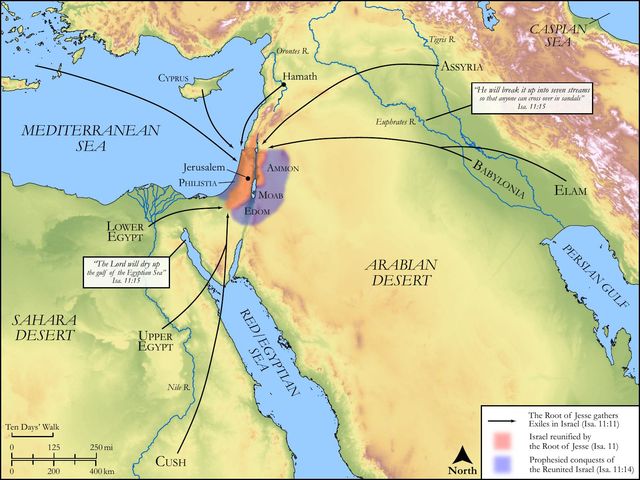
On that day the root of Jesse shall stand as a signal to the peoples; the nations shall inquire of him, and his dwelling shall be glorious. LXX: On that day the root of Jesse shall stand as a signal to the peoples; the nations shall seek him out, and his dwelling shall be honored. For his resting place has been chosen in Hebrew, Mnuatho (), which all have likewise translated. And for his honor, in Hebrew it is read as Chabod (), which clearly signifies glory. And the meaning is: his death will be glorious, so that what the Savior prays for in the Gospel may be fulfilled: Father, glorify me with the glory which I had before the world was with you (John 17:5). It has been said about his birth, it has been said about the others in the midst of the Sacraments: he came to death, which is not called by the usual name of mortals, but because eternal life was in Christ, it is called rest. But we, in order to make the meaning clear to the reader, translate it as dormition and rest, with another word but the same meaning, we turn it into a tomb. Therefore, in that time, when the Gospel of Christ will shine forth throughout the whole world, and the knowledge of the Lord will fill all the earth like the waters cover the sea, the root of Jesse will be and the one who will rise from his lineage as a sign for all peoples, so that the nations may see the sign of the Son of Man in heaven (Matt. 24). He will have horns in his hands, in which his strength will be hidden, so that when exalted, he may draw all things to himself (Hab. 3). As the Septuagint translated, he will rise from the dead to be the prince of all nations, and all peoples will hope in him. This is also testified by Jacob in a mystical message about the tribe of Judah: The prince will not fail from Judah, nor the leader from his loins, until he comes to whom it belongs, and he will be the expectation of the nations. And in that day, the Lord will stretch out his hand a second time to possess the remnant of his people, which will be left behind by the Assyrians, and by Egypt, and by Phut, and by Ethiopia, and by Elam, and by Shinar, and by Hamath, and by the islands of the sea. And He will lift up a signal for the nations, and will gather the outcasts of Israel, and assemble the scattered ones of Judah from the four corners of the earth. The jealousy of Ephraim will depart, and the enemies of Judah will be destroyed. Ephraim will not be jealous of Judah, and Judah will not fight against Ephraim. They will swoop down on the Philistines' shoulder through the sea, together they will plunder the sons of the East. And Edom and Moab will be under their control, and the sons of Ammon will obey them. In that day, which is the time mentioned before, when the Root of Jesse rises as a signal for the peoples, in order to rule over the nations, the Lord will stretch out His hand a second time, so that not according to our Jewish understanding at the end of the world, when the fullness of the Gentiles has come in, then all Israel will be saved (Rom. XI); but let us understand all these things in relation to His first coming. For we cannot, when the same day is said both now and above, refer it to the first coming, and the one below to the second: lest by these things which follow, and those which precede, Christ whom the Jews contend has not yet come but is to come, should be referred to him. After the calling of the Gentiles, therefore, which were formerly reckoned in the tail, Israel shall be reckoned in the tail, in order that the Lord may again put forth his hand a second time, and possess the remnant of his people, of whom we have read above, not all Israel, but the remnants are to be saved, which shall be left by the Assyrians and by Egypt, and by the various nations around. For first the Twelve Apostles, and seventy, and one hundred twenty souls, and five hundred, who were gathered together, the Lord appeared to them, then three thousand, and five thousand Jews believed in the Lord. James also speaks to the apostle Paul, who himself was among the others: See, brother, how many thousands there are of believing Jews? all of these are zealous for the law (Acts 21:20). And in the same volume we read: Now there were dwelling in Jerusalem Jews, devout men from every nation under heaven, who were amazed and said: Are not all these Galileans, and how is it that we hear, each of us in his own native language? Parthians, Medes, Elamites, and residents of Mesopotamia, Judea and Cappadocia, Pontus and Asia, Phrygia and Pamphylia, Egypt and the parts of Libya near Cyrene; visitors from Rome, both Jews and converts to Judaism; Cretans and Arabs—we hear them declaring the wonders of God in our own tongues! (Acts 2:9-11) From all these nations, people from Israel, through the apostles, will be saved. The Ecclesiastical Histories report that the apostles preached the Gospel in the whole world, in such a way that some reached Persia and India, and Ethiopia extended its hands to God, and gifts for Christ were brought from across the rivers of Ethiopia. So that it may not seem to signify only the eastern peoples, it also includes the rest: And from the islands of the sea. However, the islands of the sea signify the western region, which is enclosed by the circuit of the ocean. Therefore, the sign of the Cross will be raised among all nations, and first it will gather the people of Israel from the synagogues, in order to fulfill the command of the Savior given to the Apostles, who said: Go to the lost sheep of the house of Israel (Matthew 10:6). Finally, Paul also speaks to the unbelievers among the Jews, saying: It was necessary for the word of God to be spoken to you first; but since you have rejected it and judge yourselves unworthy of eternal life, behold, we turn to the Gentiles, as the Lord has commanded us (Acts 13:46-47). But the four cardinal directions, east and west, south and north, signify, as by these the calling of the world is demonstrated. In that time, Isaiah says, Ephraim and Judah, who now, as prophesied by me, dissent with hostile hatred between themselves, will not be enemies, but according to the prophecy of Ezekiel, two rods will be joined into one rod, and they will be joined in the Church of Christ, who were previously separated (Ezek. VII), so that they may work together in the nations and willingly bear the burden of the Philistines on their shoulders across the sea, that is, they may first preach to the coastal Palestinians and swiftly proceed by sea to the other nations. Or according to the Seventy Interpreters: they will fly in the ships of foreigners, they will plunder the sea together; from which let us understand the example of the apostle Paul, who was carried by ships of foreigners through Pamphylia, and Asia, and Macedonia, and Achaia, and various islands and provinces, even to Italy (Acts 28), and as he himself writes, to Spain also (Romans 15). Therefore, Ephraim and Judah, that is, those who believed in Christ from the twelve tribes of the Jews, will plunder the East together, and extend their hands in Idumea and Moab, according to what Christ speaks mystically in the person of David: I will stretch out my shoe to Idumea: to me foreigners will serve (Psalm 59:10). For at that time when Isaiah prophesied, these nations were adversaries to the people of Judah, and therefore he now says that after the root of Jesse rises, to reign over the nations, and the banner of the Cross for the salvation of the whole world is raised up, then even Idumea, Moab, and the sons of Ammon, in fact, the entire extent of Arabia, will give their hands to the Apostles, and in the places of idolatry the Church of Christ will be raised up.
And the Lord will dry up the tongue of the sea of Egypt, and he will lift his hand over the river with the strength of his spirit, and he will strike it in the seven streams, so that people can cross it in sandals. And there will be a highway for the remnant of my people who are left from Assyria, just as there was for Israel on the day when they came up from the land of Egypt. Just as Edom and Moab, and the sons of Ammon will submit their hands to the Apostles, so that they may obey the preaching of the Gospel, in the same way the Lord himself, who fulfilled those things in his Apostles, will dry up not the sea according to the Septuagint, but according to the Hebrews, the tongue of the sea of Egypt, which previously blasphemed against the Lord and presided over the Egyptian superstition. And in the Psalms we read: This great and spacious sea, wherein are reptiles without number (Psalm 10:25-26). It is said of them: This dragon, whom you have made to mock at him. Therefore, he shall desolate, that is, put under a curse, as Theodotion, Aquila, and Symmachus translated it, the tongue of the Egyptian sea, and he shall lift up his hand over the rivers of Egypt in the strength of his spirit, or his most violent spirit, which we understand to be the kingdom of the Romans. For when Caesar Augustus was reigning (Luke 2), when the flower of Jesse's root ascended, and the first census was made in the Roman world, the most powerful kingdom of the Egyptians, which lasted for many generations, was destroyed by the death of Cleopatra, and the Egyptian river was struck into seven streams, or into seven valleys. For the Nile, which previously flowed in one channel and was impassable, was divided and cut into seven very humble valleys and streams, so that it could be crossed on foot. However, this symbolically signifies that the nation of the Egyptians, given over to such great idolatry and worthless superstition, consecrated hawks, owls, dogs, goats, and donkeys with divine names, in order to distribute the infinite power of the kingdom through individual judges of the Roman empire, so that Thebes has one judge, Libya has another, Pentapolis has another, Egypt has another, Alexandria has another, and various regions, which the Egyptians call 'laws'. Therefore, under the metaphor, the Nile is divided into parts and cut into streams, so that the Evangelical word can flow freely and reach the farthest people of Egypt without any hindrance. And just as in the time of Moses the Red Sea was dried up so that the people could flee from Egypt, in contrast, the rivers of Egypt will dry up so that the remaining people of God, who will be saved from the Assyrians and various nations, can pass into Egypt, not fleeing from it, but entering and treading on it with their own feet. A wise and Christian reader should have this rule of the promises of the prophets, that we may teach spiritually things which the Jews, and not only our, rather not our Judaizers, contend carnally will happen in the future, lest we be compelled to judaize by the occasion of such fables and inextricable questions, according to the Apostle (II Tim. II).
“And I will strike for you a covenant on that day with the beasts of the field, the birds of the air and with what crawls on the ground; and I will destroy the bow, the sword and war from the earth; and I will make them sleep in safety.” According to the Septuagint, “And I will arrange for them a covenant on that day with the beasts of the field, the birds of the air and with what crawls on the ground; and I will destroy war from the earth; and I will make them live in hope.” When all talk of false religion is removed from the people who confess the Lord and, he said, when they call me “my husband,” no longer daring to cry to “Baal” (which means “my idol”), then I will strike for them a covenant and an agreement with the beasts of the field and with the birds of the sky and with what crawls on the ground. Of this moment Isaiah also speaks: “The wolf will dwell with the lamb, and the leopard will lie down with the kid, and the calf, the lion and the lamb will remain together, and a small child will lead them.” The cow and the bear will feed together and relax with their young; and the lion will eat hay like the ox, no longer desiring to eat flesh and blood at all, but enjoying its food with the pure and simple. To enable him to receive Cornelius from the Gentiles, it was revealed and commanded to Peter that he could eat any animal and that he should consider nothing to be unclean when, after being seized with thanksgiving, he later heard: “What God has purified, you must not call common.” At the coming of the Lord our Savior, therefore, after the triumph of his resurrection and ascension to the Father, two walls will be joined at the cornerstone by him who “made both one.” He called her “pitied” who was once called “not pitied,” and he called them his people who was once called “not my people.” And the bow, the sword and war will be destroyed, granting peace to all. For instruments of war are unnecessary when there is no one to wage war. Israel will be joined to the Gentiles, and what was said in Deuteronomy will be fulfilled: “Rejoice, Gentiles, with his people.” For “God is known in Judah, his name is great in Israel.”
The promise will be fulfilled when kings, peasants and the poor all gather equally around the one table of Christ (believed and seen by us); according to the prophet Isaiah: “Then the wolf will dine with the lamb, and the leopard will lie down with the kid, and the cow, the lion and the lamb will eat straw together, and a small child will feed them.”
For behold, we who appear clothed in a religious habit have come together from various states of life in the world for the sake of faith in the omnipotent Lord and for hearing his word. We were gathered from many kinds of iniquity into the concord of holy church to make it seen clearly that what was said through the prophet Isaiah about the promise of the church has been accomplished: “The wolf shall dwell with the lamb, and the leopard will lie down with the kid.” For it is through the organs of holy charity that the wolf will dwell with the lamb, since those who were plunderers in the world now rest in peace with the meek and the tame. And the leopard will lie down with the kid because the person who was stained with the multitude of his sins now agrees to be humbled with the person who despises himself and confesses himself to be a sinner. Isaiah also adds, “and the calf and the lion and the sheep will remain together.” One who prepares himself as a daily sacrifice to God through a contrite heart, and another who once raged with cruelty like a lion, and yet another who remains in the simplicity of his innocence like a lamb have all come together in the folds of holy church. Behold the kind of charity that enkindles, consumes, melds and reforms such a diversity of minds as though into one species of gold.
Continue studying Isaiah 11:6 across the web’s major study libraries — every link below opens this exact verse, chapter, or book on the destination site.
Read & Compare
 BibleGatewayThis verse in more than 200 translations and 70 languages.
 Bible.comThe YouVersion reader — hundreds of translations, reading plans, and highlights.
 ESV.orgCrossway's official English Standard Version reader.
 NET BibleThe NET translation with 60,000+ translators' notes on every rendering decision.
 STEP BibleTyndale House's free study tool — original text, vocabulary, and scholarly resources.
 BibliaLogos Bible Software's free web reader.
 USCCBThe New American Bible (Revised Edition) with the U.S. bishops' study notes.
Commentaries
 BibleHub CommentariesDozens of classic commentaries on this verse, gathered on one page.
 StudyLightMore than 100 commentary sets — the largest collection on the web.
 BibleRefPlain-English commentary on what this verse means, verse by verse.
 Enduring WordDavid Guzik's free commentary on this chapter, widely used by Bible teachers.
 Bible Study ToolsVerse commentary alongside Greek and Hebrew study aids.
Original Language & Research
- BibleHub InterlinearThe verse word by word — original language, transliteration, and English.
- BibleHub LexiconEvery word's original-language definition and Strong's entry.
 Blue Letter BibleDeep-study tools — Strong's numbers, concordance, and word studies.
 SefariaThe Hebrew text with Rashi and centuries of Jewish commentary.
Sermons, Hymns & Audio


TrulyRandomVerse is not affiliated with these sites and doesn’t control their content. They’re linked because they’re genuinely useful.
Summary
Isaiah 11:6 presents a profoundly poetic and prophetic vision of the Messianic age, depicting a world utterly transformed by the righteous reign of the "Branch from Jesse." It portrays a radical reversal of the natural order, where predator and prey coexist in perfect harmony, symbolizing a comprehensive peace that extends beyond the animal kingdom to encompass all of creation and human relationships. This idyllic scene, culminating in the gentle, non-coercive leadership of a small child, foreshadows a future kingdom characterized by divine justice, universal tranquility, and the complete eradication of fear and enmity, reflecting God's ultimate redemptive purpose for the earth.
Context
ShowHideLiterary Context
Isaiah 11:6 is a pivotal verse within a larger prophetic oracle (Isaiah 11:1-16) concerning the coming Messiah, often referred to as the "Branch" or "Root of Jesse." The preceding verses, specifically Isaiah 11:1-5, meticulously describe the character and attributes of this future King: His anointing by the Spirit of the Lord, His wisdom, understanding, counsel, might, knowledge, and fear of the Lord. These qualities establish His righteous and just rule, particularly His impartial judgment of the poor and meek. Verse 6 then transitions from the Messiah's personal characteristics and judicial reign to describe the profound impact His kingdom will have on the natural world, illustrating the comprehensive scope of His peace. This vivid imagery serves as a powerful contrast to the strife, injustice, and desolation depicted elsewhere in Isaiah's prophecies, offering a hopeful glimpse into God's ultimate plan for restoration and the consummation of His kingdom.
Historical & Cultural Context
Isaiah prophesied during a turbulent period in Judah's history (8th century BCE), marked by the looming threat of the Assyrian Empire, political instability, and widespread spiritual apostasy among God's people. The world Isaiah inhabited was one of constant warfare, fear, and violence, where nations devoured nations, and injustice was rampant even within Judah's own borders. In such a climate, the imagery of natural enemies—wolf and lamb, leopard and kid, lion and calf—coexisting peacefully was utterly revolutionary and counter-cultural. It challenged the prevailing understanding of power dynamics, which relied on military might and dominance, and offered a radical vision of shalom (peace, wholeness, well-being) that transcended human capacity. The "little child" leading fierce animals also subverted conventional notions of leadership, which typically relied on strength and coercion, pointing instead to a divine, gentle, yet utterly authoritative reign.
Key Themes
ShowHideThis verse powerfully contributes to several overarching themes in Isaiah and the broader biblical narrative. Firstly, it highlights Universal Peace and Harmony, portraying a world where the fundamental enmity between creatures is abolished, symbolizing a deeper, comprehensive peace that permeates all of creation, including human society. This vision stands in stark contrast to the chaos and violence of the fallen world and points towards a future where violence and fear are eradicated. Secondly, it speaks to the Restoration of Creation, echoing the pre-Fall state in the Garden of Eden, where all creatures coexisted without harm. It anticipates a "new heavens and new earth," as later described in Isaiah 65:17 and Revelation 21:1, where God's original design for peace and life is fully realized. Thirdly, the image of "a little child" leading them underscores the theme of Gentle, Righteous Leadership. This profound peace is not achieved through force or dominance but through a humble, pure, and divinely empowered authority, symbolizing the Messiah's reign of grace, under which even the fiercest natures are subdued and transformed by His very presence, as seen in the broader context of Isaiah 11.
Exposition and Analysis
ShowHideKey Word Analysis
ShowHideThis primitive root means "to turn aside from the road (for a lodging or any other purpose), i.e. sojourn (as a guest)." While it can imply a temporary stay, in this prophetic context, it takes on a deeper meaning of permanent, harmonious cohabitation. The wolf, a natural predator, will not merely pass by the lamb but will "dwell" with it, suggesting a complete cessation of their predatory nature and an establishment of secure, intimate proximity, indicative of a transformed relationship.
This term refers to a young goat. Paired with the leopard, its natural predator, the "kid" emphasizes the extreme vulnerability of the prey animal. Its inclusion highlights the radical nature of the peace envisioned: even the most helpless will be safe from their most fearsome adversaries, signifying a world utterly devoid of threat and fear, where the weak are perfectly secure.
This primitive root means "to drive forth (a person, an animal or chariot), i.e. lead, carry away; reflexively, to proceed (i.e. impel or guide oneself)." In the context of a child leading wild animals, it signifies a gentle, non-coercive, yet utterly effective guidance. This leadership is not by force or dominance, but by an inherent, perhaps spiritual, authority that transforms and directs, embodying the Messiah's humble yet powerful reign that brings about willing submission.
Verse Breakdown
ShowHide"The wolf also shall dwell with the lamb"
This opening clause immediately sets the tone for a radical reversal of the natural order. The wolf, a symbol of ferocity, danger, and rapaciousness, will peacefully cohabit with the lamb, the epitome of innocence, vulnerability, and docility. This imagery signifies the cessation of violence and fear, establishing a foundational peace where natural enmity is eradicated and former adversaries live in secure, intimate proximity.
"and the leopard shall lie down with the kid"
Reinforcing the initial image, this clause reiterates the theme of predator and prey coexisting. The leopard, known for its swiftness and deadly hunting prowess, will repose alongside the young goat, a common prey animal. "Lie down" suggests deep rest, security, and trust, indicating a complete absence of threat and a profound state of tranquility.
"and the calf and the young lion and the fatling together"
This expands the scope of harmonious coexistence to a trio of animals, again pairing a strong, dangerous predator (young lion) with docile, domesticated animals (calf, fatling). The term "fatling" implies a well-fed, healthy animal, typically raised for consumption, further emphasizing the abundance, security, and transformation of this peaceful kingdom where such animals are no longer prey. "Together" signifies unity, shared space, and mutual well-being, devoid of conflict.
"and a little child shall lead them"
This culminating phrase is profoundly symbolic and climactic. The most powerful and dangerous animals, now transformed in nature, are led not by a mighty warrior or king demonstrating physical strength, but by a "little child." This symbolizes the gentle, pure, and innocent nature of the Messiah's rule. It signifies that the peace of this kingdom is not enforced by might or coercion but emanates from a divine, humble authority that transforms hearts and natures, bringing all creation into willing submission and perfect harmony.
Literary Devices
ShowHideIsaiah 11:6 is exceptionally rich in Symbolism, using vivid animal imagery to convey profound theological truths. The wolf, leopard, and young lion symbolize the destructive, violent, and predatory aspects of the fallen world and human nature, while the lamb, kid, calf, and fatling represent innocence, vulnerability, and peace. Their harmonious coexistence symbolizes the complete eradication of enmity, not just in the animal kingdom, but in human society and all of creation under the Messiah's reign. The powerful Juxtaposition of these natural enemies ("wolf... with the lamb," "leopard... with the kid," "young lion... with the fatling") dramatically highlights the radical nature of the transformation. This stark contrast underscores the miraculous and divine intervention required to bring about such comprehensive peace. Furthermore, the verse employs Hyperbole or Idealism to paint a picture of an ultimate, perfect state. While some theological traditions may anticipate a literal fulfillment in a renewed creation, the primary intent is to convey the absolute and comprehensive nature of the Messianic peace, where even the most ingrained instincts of violence are overcome by divine grace. The image of "a little child" leading them is a powerful Metaphor for the Messiah's gentle yet absolute authority, subverting conventional expectations of leadership and emphasizing humility, purity, and divine anointing as the source of true, transformative power.
Theological and Thematic Connections
ShowHideIsaiah 11:6 stands as a cornerstone prophecy of the Messianic kingdom, deeply rooted in the biblical narrative of creation, fall, and redemption. It echoes the original harmony of Genesis 1-2 before sin introduced discord, violence, and enmity into creation. This verse anticipates the complete restoration of God's creation, where the curse is reversed, and the perfect shalom of Eden is re-established under the righteous rule of the Messiah. It speaks to God's unwavering commitment to redeem not only humanity but all of creation, bringing it back into alignment with His perfect will. The transformation of predatory animals into peaceful companions signifies the ultimate triumph of grace over fallen nature, pointing towards a future where all things are made new and God's glory fills the earth, culminating in the renewal of all things.
Reflection and Application
ShowHideIsaiah 11:6 offers a powerful beacon of hope and a profound vision for the future, reminding us of God's ultimate plan for a world free from conflict, suffering, and fear. While we currently live in a fallen world marked by discord, injustice, and brokenness, this prophecy calls believers to both anticipate God's coming kingdom and to actively participate in its values now. It encourages us to cultivate peace in our own spheres of influence, seeking to reconcile differences, foster harmony, and extend grace, thereby reflecting the character of the kingdom that is to come. Just as natural enemies are transformed in this vision, we are reminded of God's transformative power to change hardened hearts, heal broken relationships, and overcome deep-seated hostilities through the gospel. The imagery of the "little child" leading serves as a humble yet profound reminder that true influence and lasting peace often stem not from power, dominance, or coercion, but from humility, innocence, and a complete reliance on God's gentle, sovereign hand. This verse compels us to live with eschatological hope, knowing that a perfect future awaits, and to embody its principles in the present, acting as ambassadors of reconciliation and agents of shalom in a world desperately in need of it.
Questions for Reflection
ShowHideFAQ
ShowHideIs the prophecy in Isaiah 11:6 literal or symbolic?
ShowHideBiblical scholars generally interpret Isaiah 11:6 as primarily symbolic, representing a profound spiritual and moral transformation that will occur in the Messianic kingdom. The imagery of natural enemies coexisting peacefully vividly illustrates the complete cessation of violence, fear, and enmity in all aspects of creation, including human relationships. It speaks to a radical change in nature, where predatory instincts are abolished, and perfect harmony reigns. While some theological traditions might hold to a literal fulfillment in a renewed creation (the new heavens and new earth), the immediate and profound impact of the verse lies in its powerful symbolism of comprehensive shalom under the Messiah's righteous rule. It signifies a world where the effects of sin are fully reversed, and God's original design for harmony is perfectly restored.
How does this verse relate to the Christian life today, before the full realization of the Messianic kingdom?
ShowHideWhile the full realization of Isaiah 11:6 awaits the eschatological kingdom of God, it profoundly impacts the Christian life today. Firstly, it provides immense hope and a clear vision of God's ultimate plan for creation, encouraging believers to anticipate the coming of Christ's perfect reign. Secondly, it calls believers to be agents of peace and reconciliation in a broken world. Though we cannot fully eradicate all conflict, we are commanded to be peacemakers (Matthew 5:9) and to live in harmony with others (Romans 12:18). The transformation of the animals symbolizes the transformative power of the gospel in human hearts, enabling us to overcome our own "predatory" natures of selfishness, anger, and division, and instead live in love and unity. This reflects the values of the kingdom that is both "already" here in part through Christ's first coming and "not yet" fully consummated.
Christ-Centered Fulfillment
ShowHideIsaiah 11:6 finds its ultimate fulfillment in Jesus Christ, the promised "Branch from Jesse" (Isaiah 11:1). He is the Prince of Peace (Isaiah 9:6) whose reign brings about the radical transformation envisioned. While the complete peace of predator and prey dwelling together awaits His second coming and the establishment of the new heavens and new earth (Revelation 21:1-4), Jesus inaugurated this peace through His first advent. He came as the gentle Lamb of God who takes away the sin of the world (John 1:29), demonstrating humility and self-sacrifice rather than worldly power or dominance. His ministry brought peace between God and humanity (Romans 5:1) and broke down the dividing walls of hostility between people groups (Ephesians 2:14). The "little child" leading the animals powerfully foreshadows Christ's meek and lowly heart (Matthew 11:29), through which He draws all to Himself, transforming hearts and natures. His kingdom, though spiritual now and advancing through the church, is progressively working to subdue all things, culminating in a future where His perfect peace will permeate every fiber of creation, fulfilling Isaiah's glorious prophecy and bringing all things into subjection to His gracious rule (1 Corinthians 15:28).