


1 Kings 11:4
- וַיְהִיvay·Hiand it wasH1961Conj-w ¦ V-Qal-ConsecImperf-3msVerb Qal Consecutive Imperfect 3rd Singular Masculineוַandיְהִיit was
- לְעֵתle·'Etto [the] time ofH6256Prep-l ¦ N-cscNoun Singular common gender Constructלְtoעֵת[the] time of
- זִקְנַתzik·Nat[the] old age ofH2209N-fscNoun Singular Feminine Construct
- שְׁלֹמֹהshe·lo·MohSolomonH8010N-proper-mNoun Proper Masculine
- נָשָׁיוna·Shavhis wivesH802N-mpc ¦ 3msNoun Plural Masculine Constructנָשָׁיwivesוhis
- הִטּוּhi·Tuthey turned asideH5186V-Hiphil-Perf-3cpVerb Hiphil Perfect 3rd Plural common gender
- אֶת'et<obj.>H853DirObjMParticle Object Indicator
- לְבָבוֹle·va·Vohis heartH3824N-msc ¦ 3msNoun Singular Masculine Constructלְבָבheartוֹhis
- אַחֲרֵי'a·cha·ReiafterH310Adj-mpcAdjective Numerical Plural Masculine Construct
- אֱלֹהִים'E·lo·HimgodsH430N-mpNoun Plural Masculine Absolute
- אֲחֵרִים'a·che·RimotherH312Adj-mpAdjective Plural Masculine Absolute
- וְלֹאve·lo'and notH3808Conj-w ¦ NegParticle Negativeוְandלֹאnot
- הָיָהha·Yahit wasH1961V-Qal-Perf-3msVerb Qal Perfect 3rd Singular Masculine
- לְבָבוֹle·va·Vohis heartH3824N-msc ¦ 3msNoun Singular Masculine Constructלְבָבheartוֹhis
- שָׁלֵםsha·LemcompleteH8003Adj-msAdjective Singular Masculine Absolute
- עִם'imwithH5973PrepPreposition
- יְהוָהYah·wehYahwehH3068N-properNoun Proper Title
- אֱלֹהָיו'e·lo·Havhis GodH430N-mpc ¦ 3msNoun Plural Masculine ConstructאֱלֹהָיGodוhis
- כִּלְבַבkil·Vavlike [the] heart ofH3824Prep-k ¦ N-mscNoun Singular Masculine Constructכִּlikeלְבַב[the] heart of
- דָּוִידda·VidDavidH1732N-proper-mNoun Proper Masculine
- אָבִיו'a·Vivhis fatherH1N-msc ¦ 3msNoun Singular Masculine Constructאָבִיfatherוhis
English is a literal word-by-word gloss of the Hebrew, not the KJV's wording. Why?
This is the original text the KJV's translators worked from — each Hebrew word with its own literal English meaning in this verse, prepared by scholars at Tyndale House, Cambridge. The KJV translates whole sentences, not word by word, so its wording differs: one Hebrew word can become several English words, and the KJV may choose “the LORD” where the gloss reads “Yahweh”. Both are faithful — they answer different questions. For the KJV's own rendering, switch to the KJV text.
Details
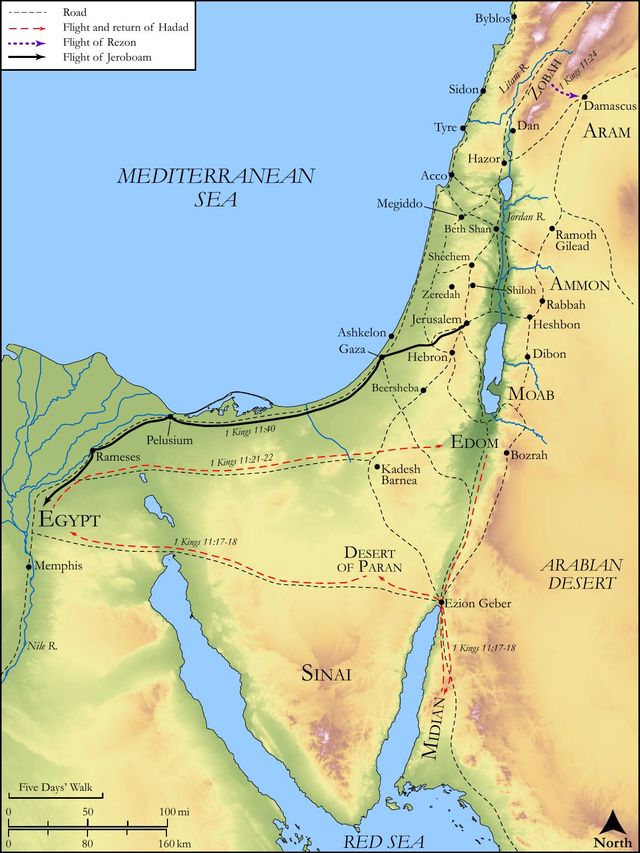
See on the biblical-era maps

Study this verse
Public-domain commentary
Matthew Henry
From his Commentary on the Whole Bible. Henry comments on passages, not single verses — this entry covers 1 Kings 11:1–8. His three-level outline is real structure in the source text, so it is rendered as structure.
This is a sad story, and very surprising, of Solomon's defection and degeneracy.
I.Let us enquire into the occasions and particulars of it.
Shall Solomon fall, that was the beauty of Israel, and so great a blessing of his generation? Yes, it is too true, and the scripture is faithful in relating it, and repeating it, and referring to it long after, Neh 13:26. There was no king like Solomon who was beloved of his God, yet even him did outlandish women cause to sin. There is the summary of his apostasy; it was the woman that deceived him, and was first in the transgression.
1.He doted on strange women, many strange women. Here his revolt began.
(1.)He gave himself to women, which his mother had particularly cautioned him against. Pro 31:3, Give not thy strength unto women (perhaps alluding to Samson, who lost his strength by giving information of it to a woman), for it is that which, as much as any thing, destroys kings. His father David's fall began with the lusts of the flesh, which he should have taken warning by. The love of women has cast down many wounded (Pro 7:26) and many (says bishop Hall) have had their head broken by their own rib.
(2.)He took many women, so many that, at last, they amounted to 700 wives and 300 concubines, 1000 in all, and not one good one among them, as he himself owns in his penitential sermon (Ecc 7:28), for no woman of established virtue would be one of such a set. God had, by his law, particularly forbidden the kings to multiply either horses or wives, Deu 17:16, Deu 17:17. How he broke the former law, in multiplying horses, and having them out of Egypt too (which was expressly prohibited in that law) we read Kg1 10:29, and here we are told how he broke the latter (which proved of more fatal consequence) in multiplying wives. Note, Less sins, made gold with, open the door to greater. David had multiplied wives too much, and perhaps that made Solomon presume it lawful. Note, If those that are in reputation for religion in any thing set a bad example, they know not what a deal of mischief they may do by it, particularly to their own children. One bad act of a good man may be of more pernicious consequence to others than twenty of a wicked man. Probably Solomon, when he began to multiply wives, intended not to exceed his father's number. But the way of sin is down-hill; those that have got into it cannot easily stop themselves. Divine wisdom has appointed one woman for one man, did so at first; and those who do not think one enough will not think two or three enough. Unbridled lust will be unbounded, and the loosened hind will wander endlessly. But this was not all:
(3.)They were strange women, Moabites, Ammonites, etc., of the nations which God had particularly forbidden them to intermarry with, Kg1 11:2. Some think it was in policy that he married these foreigners, by them to get intelligence of the state of those countries. I rather fear it was because the daughters of Israel were too grave and modest for him, and those foreigners pleased him with the looseness and wantonness of their dress, and air, and conversation. Or, perhaps, it was looked upon as a piece of state to have his seraglio, as his other treasures, replenished with that which was far-fetched; as if that were too great an honour for the best of his subjects which would really have been a disgrace to the meanest of them - to be his mistresses. And,
(4.)To complete the mischief, Solomon clave unto these in love, Kg1 11:2. He not only kept them, but was extravagantly fond of them, set his heart upon them, spent his time among them, thought every thing well they said and did, and despised Pharaoh's daughter, his rightful wife, who had been dear to him, and all the ladies of Israel, in comparison of them. Solomon was master of a great deal of knowledge, but to what purpose, when he had no better a government of his appetites?
2.He was drawn by them to the worship of strange gods, as Israel to Baal-peor by the daughters of Moab. This was the bad consequence of his multiplying wives. We have reason to think it impaired his health, and hastened upon him the decays of age; it exhausted his treasure, which, though vast indeed, would be found little enough to maintain the pride and vanity of all these women; perhaps it occasioned him, in his latter end, to neglect his business, by which he lost his supplies from abroad, and was forced, for the keeping up of his grandeur, to burden his subjects with those taxes which they complained of, Kg1 12:4. But none of these consequences were so bad as this: His wives turned away his heart after other gods, Kg1 11:3, Kg1 11:4.
(1.)He grew cool and indifferent in his own religion and remiss in the service of the God of Israel: His heart was not perfect with the Lord his God (Kg1 11:4), nor did he follow him fully (Kg1 11:6), like David. We cannot suppose that he quite cast off the worship of God, much less that he restrained or hindered it (the temple-service went on as usual); but he grew less frequent, and less serious, in his ascent to the house of the Lord and his attendance on his altar. He left his first love, lost his zeal for God, and did not persevere to the end as he had begun; therefore it is said he was not perfect, because he was not constant; and he followed not God fully, because he turned from following him, and did not continue to the end. His father David had many faults, but he never neglected the worship of God, nor grew remiss in that, as Solomon did (his wives using all their arts to divert him from it), and there began his apostasy.
(2.)He tolerated and maintained his wives in their idolatry and made no scruple of joining with them in it. Pharaoh's daughter was proselyted (as is supposed) to the Jews' religion, but, when he began to grow careless in the worship of God himself, he used no means to convert his other wives to it; in complaisance to them, he built chapels for their gods (Kg1 11:7, Kg1 11:8), maintained their priests, and occasionally did himself attend their altars, making a jest of it, asking, "What harm is there in it? Are not all religions alike?" which (says bishop Patrick) has been the disease of some great wits. When he humoured one thus, the rest would take it ill if he did not, in like manner, gratify them, so that he did it for all his wives (Kg1 11:8), and at last came to such a degree of impiety that he set up a high place for Chemosh in the hill that is before Jerusalem, the mount of Olives, as if to confront the temple which he himself had built. These high places continued here, not utterly demolished, till Josiah's time, Kg2 23:13. This is the account here given of Solomon's apostasy.
II.Let us now pause awhile, and lament Solomon's fall; and we may justly stand and wonder at it.
How has the gold become dim! How has the most fine gold changed! Be astonished, O heavens! at this, and be horribly afraid, as the prophet exclaims in a like case, Jer 2:12.
1.How strange,
(1.)That Solomon, in his old age, should be ensnared with fleshly lusts, youthful lusts. As we must never presume upon the strength of our resolutions, so neither upon the weakness of our corruptions, so as to be secure and off our guard.
(2.)That so wise a man as Solomon was, so famed for a quick understanding and sound judgment, should suffer himself to be made such a fool of by these foolish women.
(3.)That one who had so often and so plainly warned others of the danger of the love of women should himself be so wretchedly bewitched with it; it is easier to see a mischief, and to show it to others, than to shun it ourselves.
(4.)That so good a man, so zealous for the worship of God, who had been so conversant with divine things, and who prayed that excellent prayer at the dedication of the temple, should do these sinful things. Is this Solomon? Have all his wisdom and devotion come to this at last? Never was gallant ship so wrecked; never was crown so profaned.
2.What shall we say to all this? Why God permitted it it is not for us to enquire; his way is in the sea and his path in the great waters; he knew how to bring glory to himself out of it. God foresaw it when he said concerning him that should build the temple, If he commit iniquity, etc., Sa2 7:14. But it concerns us to enquire what good use we may make of it.
(1.)Let him that thinks he stands take heed lest he fall. We see how weak we are of ourselves, without the grace of God; let us therefore live in a constant dependence on that grace.
(2.)See the danger of a prosperous condition, and how hard it is to overcome the temptations of it. Solomon, like Jeshurun, waxed fat and then kicked. The food convenient, which Agur prayed for, is safer and better than the food abundant, which Solomon was even surfeited with.
(3.)See what need those have to stand upon their guard who have made a great profession of religion, and shown themselves forward and zealous in devotion, because the devil will set upon them most violently, and, if they misbehave, the reproach is the greater. It is the evening that commends the day; let us therefore fear, lest, having run well, we seem to come short.
Continue studying 1 Kings 11:4 across the web’s major study libraries — every link below opens this exact verse, chapter, or book on the destination site.
Read & Compare
 BibleGatewayThis verse in more than 200 translations and 70 languages.
 Bible.comThe YouVersion reader — hundreds of translations, reading plans, and highlights.
 ESV.orgCrossway's official English Standard Version reader.
 NET BibleThe NET translation with 60,000+ translators' notes on every rendering decision.
 STEP BibleTyndale House's free study tool — original text, vocabulary, and scholarly resources.
 BibliaLogos Bible Software's free web reader.
 USCCBThe New American Bible (Revised Edition) with the U.S. bishops' study notes.
Commentaries
 BibleHub CommentariesDozens of classic commentaries on this verse, gathered on one page.
 StudyLightMore than 100 commentary sets — the largest collection on the web.
 BibleRefPlain-English commentary on what this verse means, verse by verse.
 Enduring WordDavid Guzik's free commentary on this chapter, widely used by Bible teachers.
 Bible Study ToolsVerse commentary alongside Greek and Hebrew study aids.
Original Language & Research
- BibleHub InterlinearThe verse word by word — original language, transliteration, and English.
- BibleHub LexiconEvery word's original-language definition and Strong's entry.
 Blue Letter BibleDeep-study tools — Strong's numbers, concordance, and word studies.
 SefariaThe Hebrew text with Rashi and centuries of Jewish commentary.
Sermons, Hymns & Audio


TrulyRandomVerse is not affiliated with these sites and doesn’t control their content. They’re linked because they’re genuinely useful.
Summary
1 Kings 11:4 marks a poignant and tragic turning point in the narrative of King Solomon, revealing the spiritual decline of Israel's once-glorious monarch in his old age. Despite his unparalleled wisdom and the privilege of building the Temple of the Lord, this verse details how his numerous foreign wives, contrary to divine command, subtly but decisively led his heart astray from exclusive devotion to Yahweh, the God of Israel. It starkly contrasts his compromised loyalty with the wholehearted devotion attributed to his father, King David, setting the stage for the kingdom's subsequent division and judgment.
Context
ShowHideLiterary Context
This verse is strategically placed in the latter half of Solomon's reign, following chapters detailing his immense wealth, wisdom, and the construction of the Temple and his own palace. It immediately precedes God's declaration of judgment against Solomon for his idolatry and the subsequent rise of adversaries and the prophecy of the kingdom's division (e.g., God's judgment on Solomon). It serves as the pivotal moment explaining the downfall of a king who started with such promise, connecting his personal spiritual failure directly to the national consequences that unfold in the subsequent chapters of 1 Kings.
Historical & Cultural Context
Among the kings of that day, royal marriages were often strategic alliances, sealing political treaties and ensuring peace. Solomon's acquisition of 700 wives and 300 concubines from various nations (e.g., Moabites, Ammonites, Edomites, Sidonians, Hittites, as mentioned in Solomon's foreign wives) was likely intended to solidify his vast empire. However, Mosaic Law explicitly warned Israelite kings against multiplying wives, especially foreign ones, because they would "turn away your heart after their gods" (Deuteronomy's warning against multiplying wives). The cultural practice of polytheism meant that these wives brought their native deities and cultic practices into the Israelite court, creating a direct spiritual conflict with the monotheistic covenant of Israel.
Key Themes
ShowHideThe verse powerfully underscores the danger of idolatry and compromise, illustrating how even a king of Solomon's stature could be subtly led astray by seemingly political or personal choices that violated divine commands. It highlights the theme of the divided heart, where Solomon's attempt to accommodate foreign deities alongside Yahweh revealed a lack of wholehearted devotion, a concept deeply antithetical to the exclusive covenant relationship God demanded from Israel (The First Commandment). This spiritual decline also foreshadows the consequences of disobedience, as Solomon's actions directly led to the tearing away of the kingdom from his lineage, a theme central to the Deuteronomistic history's emphasis on covenant faithfulness and its repercussions (Deuteronomy's blessings and curses).
Exposition and Analysis
ShowHideKey Word Analysis
ShowHideThe KJV translation "perfect" here derives from the Hebrew root shâlêm (H8003), which conveys the idea of being complete, whole, sound, or undivided. When applied to the heart in a spiritual context, as in "his heart was not perfect with the LORD," it signifies a lack of wholehearted, undivided, and unreserved devotion. Solomon's heart was no longer singularly oriented towards Yahweh; it was compromised, fragmented, and pulled in multiple directions by competing loyalties, a stark contrast to the ideal of covenant faithfulness.
The verb nâṭâh (H5186) means "to incline," "to stretch out," "to turn aside," or "to deviate." This word implies a gradual, subtle, and perhaps even imperceptible process of deviation rather than an abrupt, sudden fall. It suggests that Solomon's wives exerted a persistent influence that slowly but surely caused his heart's allegiance to shift from Yahweh towards other gods, highlighting the insidious nature of spiritual drift through compromise and unholy alliances.
Verse Breakdown
ShowHide"For it came to pass, when Solomon was old"
This opening clause indicates that Solomon's spiritual decline was not a youthful indiscretion but a tragic culmination of choices made over a lifetime, manifesting fully in his later years. It suggests a gradual erosion of devotion, perhaps born of complacency or the cumulative weight of long-term compromises, rather than a sudden, dramatic apostasy.
"that his wives turned away his heart after other gods"
This is the direct cause and central accusation. Solomon's foreign wives, explicitly forbidden by God's law, became instruments of spiritual seduction. They did not merely practice their own religions; their influence actively "turned away" Solomon's heart, leading him to participate in or at least condone the worship of their deities, violating the first commandment.
"and his heart was not perfect with the LORD his God"
This phrase serves as the theological diagnosis of Solomon's condition. His heart, the seat of his will, intellect, and affections, lacked the wholeness, integrity, and exclusive devotion required by the covenant. He attempted to serve both Yahweh and other gods, demonstrating a divided loyalty that God utterly rejects.
"as was the heart of David his father."
This concluding comparison is a powerful indictment. David, despite his significant moral failings (e.g., Bathsheba, census), is consistently portrayed in Scripture as fundamentally devoted to Yahweh, a "man after God's own heart" (1 Samuel 13:14). Solomon, who began with far greater wisdom and resources, failed to maintain the singular, unwavering allegiance that characterized his father's overall spiritual orientation.
Literary Devices
ShowHideThe verse employs several potent literary devices to convey its tragic message. Contrast is paramount, most notably between Solomon's compromised heart and the "perfect" heart of his father David. This highlights Solomon's failure not in isolation, but against the benchmark of covenant faithfulness embodied by his predecessor, amplifying the tragedy of his fall. The phrase "turned away his heart" utilizes metaphor, depicting the heart as the spiritual compass of a person, which has been reoriented from its true north (Yahweh) towards false deities. This metaphorical language emphasizes the internal, volitional nature of Solomon's apostasy. Furthermore, the verse serves as significant foreshadowing, hinting at the severe consequences that will soon befall Solomon and his kingdom. His spiritual deviation directly sets the stage for the divine judgment and the tearing away of the kingdom, which is explicitly prophesied later in the chapter (God's judgment declared).
Theological and Thematic Connections
ShowHide1 Kings 11:4 stands as a profound theological statement on the absolute necessity of exclusive devotion to God within the covenant relationship. It vividly illustrates the insidious nature of idolatry, not merely as overt worship of other gods, but as any compromise that divides the heart's loyalty from Yahweh. God demands a "perfect" or whole heart, one that is undivided in its allegiance, recognizing that even subtle deviations, often masked by political expediency or personal desires, inevitably lead to spiritual apostasy and judgment. Solomon's failure underscores the enduring truth that wisdom and privilege do not inoculate one against temptation; rather, constant vigilance and unwavering commitment to God's commands are essential for covenant faithfulness.
Reflection and Application
ShowHideSolomon's tragic fall, as depicted in 1 Kings 11:4, serves as an enduring and sobering warning for all believers. It reminds us that spiritual decline is often a gradual process, a slow turning away of the heart, rather than an abrupt departure. Like Solomon, we can be subtly influenced by worldly pressures, relationships, or ambitions that, while seemingly innocuous, can insidiously erode our exclusive devotion to God. This verse compels us to rigorously examine our own hearts, asking what or who might be competing for our ultimate allegiance. It calls for a vigilant guarding of our spiritual integrity, ensuring that our loyalty to Christ remains undivided and whole. We must proactively identify and remove any idols—whether they be wealth, career, relationships, comfort, or cultural acceptance—that threaten to turn our hearts away from the Lord, lest we, too, suffer the consequences of a compromised faith.
Questions for Reflection
ShowHideFAQ
ShowHideWhy were Solomon's foreign wives such a problem, beyond just being "foreign"?
ShowHideThe problem with Solomon's foreign wives was not merely their nationality but their religious practices and the spiritual compromise they introduced. God's law explicitly warned Israelite kings against multiplying wives, especially from nations that worshipped other gods (Deuteronomy's warning against multiplying wives). The primary concern was that these wives would "turn away your heart after their gods." This is precisely what happened with Solomon. They brought their deities and cultic practices into Israel, and Solomon, in an attempt to maintain political alliances or perhaps out of personal affection, not only tolerated but participated in their idolatry, building high places for Chemosh and Molech (Solomon builds high places for idols). This directly violated the First Commandment, which demanded exclusive worship of Yahweh (The First Commandment), leading to a divided heart and national apostasy.
What does it mean for Solomon's "heart was not perfect with the LORD his God"?
ShowHideThe phrase "his heart was not perfect with the LORD his God" signifies a lack of complete, undivided, and unwavering devotion. The Hebrew word shalem (שָׁלֵם), translated as "perfect," means whole, sound, or complete. In a spiritual sense, it refers to integrity and single-minded loyalty to God. Unlike his father David, whose heart was generally oriented towards God despite his moral failures, Solomon's heart was compromised. He attempted to serve both Yahweh and the gods of his foreign wives, demonstrating a fragmented loyalty. This "imperfect" heart indicates a spiritual state where God was no longer the sole object of his worship and obedience, leading to a profound breach of the covenant.
How could Solomon, renowned as the wisest man, fall so far into idolatry?
ShowHideSolomon's fall, despite his unparalleled wisdom, is a tragic testament to the insidious nature of sin and the deceptive power of compromise. His wisdom was primarily for governance and discernment, but it did not guarantee spiritual fidelity, especially when confronted with persistent temptation and the allure of worldly power and pleasure. The text suggests a gradual decline, occurring "when Solomon was old," indicating a slow erosion of his devotion. His political alliances, cemented by numerous foreign marriages, became his spiritual undoing. He likely rationalized these actions, perhaps believing he could maintain his devotion to Yahweh while accommodating other deities. This highlights that even the wisest among us are vulnerable to spiritual drift if we neglect God's explicit commands and allow our hearts to be pulled away by competing loyalties, demonstrating that knowledge alone is insufficient without a steadfast, obedient heart.
Christ-Centered Fulfillment
ShowHide1 Kings 11:4, with its depiction of Solomon's divided heart and ultimate failure, powerfully underscores humanity's desperate need for a perfect King and a new heart. Solomon, though blessed with wisdom and the privilege of building God's Temple, ultimately failed to maintain a "perfect" or wholehearted devotion to the Lord, succumbing to the allure of foreign gods and compromising his covenant fidelity. This tragic narrative highlights the inherent inability of even the greatest human kings to perfectly fulfill God's righteous demands. However, this failure points forward to Jesus Christ, the true and greater Son of David, who alone possesses a perfectly undivided heart towards God. Unlike Solomon, who "turned away his heart," Jesus perfectly embodied obedience and exclusive devotion to the Father, even unto death on the cross (Christ's obedience to death). He is the King who never compromises, never deviates, and whose heart is eternally "perfect" with the Lord. Furthermore, where Solomon's sin led to the tearing of the kingdom, Christ's perfect obedience and atoning sacrifice offer the promise of a new covenant, where God gives His people new hearts and new spirits, enabling them to walk in His statutes with undivided loyalty (The promise of a new heart). Thus, Solomon's tragic fall in 1 Kings 11:4 serves as a stark reminder of our own propensity to wander, while simultaneously magnifying the glory of Christ, who perfectly fulfills the ideal of kingship and offers us the very heart of devotion that Solomon lacked.