


1 Samuel 13:14
- וְעַתָּהve·'a·Tahand nowH6258Conj-w ¦ AdvAdverbוְandעַתָּהnow
- מַמְלַכְתְּךָmam·lakh·te·Khayour kingdomH4467N-fsc ¦ 2msNoun Singular Feminine Constructמַמְלַכְתְּkingdomךָyour
- לֹאlo'notH3808NegParticle Negative
- תָקוּםta·Kumit will endureH6965V-Qal-Imperf-3fsVerb Qal Imperfect 3rd Singular Feminine
- בִּקֵּשׁbi·Keshhe has soughtH1245V-Piel-Perf-3msVerb Piel Perfect 3rd Singular Masculine
- יְהוָהYah·wehYahwehH3068N-properNoun Proper Title
- לוֹlofor <the> himselfPrep-l ¦ 3msSuffix Personal 3rd Singular Masculineלfor <the>וֹhimself
- אִישׁ'isha manH376N-msNoun Singular Masculine Absolute
- כִּלְבָבוֹkil·va·Voaccording to his own heartH3824Prep-k ¦ N-msc ¦ 3msNoun Singular Masculine Constructכִּaccording toלְבָבown heartוֹhis
- וַיְצַוֵּהוּvay·tza·Ve·huand he has appointed himH6680Conj-w ¦ V-Piel-ConsecImperf-3ms ¦ 3msVerb Piel Consecutive Imperfect 3rd Singular Masculineוַandיְצַוֵּhe has appointedהוּhim
- יְהוָהYah·wehYahwehH3068N-properNoun Proper Title
- לְנָגִידle·na·Gidto rulerH5057Prep-l ¦ N-msNoun Singular Masculine Absoluteלְtoנָגִידruler
- עַל'aloverH5921PrepPreposition
- עַמּוֹa·Mohis peopleH5971N-msc ¦ 3msNoun Singular Masculine Constructעַמּpeopleוֹhis
- כִּיkiforH3588PrtParticle Conditional
- לֹאlo'notH3808NegParticle Negative
- שָׁמַרְתָּsha·Mar·tayou have keptH8104V-Qal-Perf-2msVerb Qal Perfect 2nd Singular Masculine
- אֵת'et<obj.>H853DirObjMParticle Object Indicator
- אֲשֶׁר'a·Sher[that] whichH834RelParticle Relative
- צִוְּךָtzi·ve·Khahe commanded youH6680V-Piel-Perf-3ms ¦ 2msVerb Piel Perfect 3rd Singular Masculineצִוְּhe commandedךָyou
- יְהוָהYah·wehYahwehH3068N-properNoun Proper Title
English is a literal word-by-word gloss of the Hebrew, not the KJV's wording. Why?
This is the original text the KJV's translators worked from — each Hebrew word with its own literal English meaning in this verse, prepared by scholars at Tyndale House, Cambridge. The KJV translates whole sentences, not word by word, so its wording differs: one Hebrew word can become several English words, and the KJV may choose “the LORD” where the gloss reads “Yahweh”. Both are faithful — they answer different questions. For the KJV's own rendering, switch to the KJV text.
Details
See on the biblical-era map
Study this verse
Public-domain commentary
Matthew Henry
From his Commentary on the Whole Bible. Henry comments on passages, not single verses — this entry covers 1 Samuel 13:8–14. His three-level outline is real structure in the source text, so it is rendered as structure.
Here is, I. Saul's offence in offering sacrifice before Samuel came. Samuel, when he anointed him, had ordered him to tarry for him seven days in Gilgal, promising that, at the end of those days, he would be sure to come to him, and both offer sacrifices for him and direct him what he should do. This we had Sa1 10:8. Perhaps that order, though inserted there, was given him afterwards, or was given him as a general rule to be observed in every public congress at Gilgal, or, as is most probable, though not mentioned again, was lately repeated with reference to this particular occasion; for it is plain that Saul himself understood it as obliging him from God now to stay till Samuel came, else he would not have made so many excuses as he did for not staying, Sa1 13:11. This order Saul broke. He staid till the seventh day, yet had not patience to wait till the end of the seventh day. Perhaps he began to reproach Samuel as false to his word, careless of his country, and disrespectful of his prince, and thought it more fit that Samuel should wait for him than he for Samuel. However, 1. He presumed to offer sacrifice without Samuel, and nothing appears to the contrary but that he did it himself, though he was neither priest nor prophet, as if, because he was a king, he might do any thing, a piece of presumption which king Uzziah paid dearly for, Ch2 26:16, etc. 2. He determined to engage the Philistines without Samuel's directions, though he had promised to show him what he should do. So self-sufficient Saul was that he thought it not worth while to stay for a prophet of the Lord, either to pray for him or to advise him. This was Saul's offence, and that which aggravated it was, (1.) That for aught that appears, he did not send any messenger to Samuel, to know his mind, to represent the case to him, and to receive fresh directions from him, though he had enough about him that were swift enough of foot at this time. (2.) That when Samuel came he rather seemed to boast of what he had done than to repent of it; for he went forth to salute him, as his brother-sacrificer, and seemed pleased with the opportunity he had of letting Samuel know that he needed him not, but could do well enough without him. He went out to bless him, so the word is, as if he now thought himself a complete priest, empowered to bless as well as sacrifice, whereas he should have gone out to be blessed by him. (3.) That he charged Samuel with breach of promise: Thou camest not within the days appointed (Sa1 13:11), and therefore if any thing was amiss Samuel must bear the blame, who was God's minister; whereas he did come according to his word, before the seven days had expired. Thus the scoffers of the latter days think the promise of Christ's coming is broken, because he does not come in their time, though it is certain he will come at the set time. (4.) That when he was charged with disobedience he justified himself in what he had done, and gave no sign at all of repentance for it. It is not sinning that ruins men, but sinning and not repenting, falling and not getting up again. See what excuses he made, Sa1 13:11, Sa1 13:12. He would have this act of disobedience pass, [1.] For an instance of his prudence. The people were most of them scattered from him, and he had no other way than this to keep those with him that remained and to prevent their deserting too. If Samuel neglected the public concerns, he would not. [2.] For an instance of his piety. He would be thought very devout, and in great care not to engage the Philistines till he had by prayer and sacrifice engaged God on his side: "The Philistines," said he, "will come down upon me, before I have made my supplication to the Lord, and then I am undone. What! go to war before I have said my prayers!" Thus he covered his disobedience to God's command with a pretence of concern for God's favour. Hypocrites lay a great stress upon the external performances of religion, thinking thereby to excuse their neglect of the weightier matters of the law. And yet, lastly, He owns it went against his conscience to do it: I forced myself and offered a burnt-offering, perhaps boasting that he had broken through his convictions and got the better of them, or at least thinking this extenuated his fault, that he knew he should not have done as he did, but did it with reluctancy. Foolish man! to think that God would be well pleased with sacrifices offered in direct opposition both to his general and particular command.
II.The sentence passed upon Saul for this offence.
Samuel found him standing by his burnt-offering, but, instead of an answer of peace, was sent to him with heavy tidings, and let him know that the sacrifice of the wicked is abomination to the Lord, much more when he brings it, as Saul did, with a wicked mind.
1.He shows him the aggravations of his crime, and says to this king, Thou art wicked, which it is not for any but a prophet of the Lord to say, Job 34:18. He charges him with being an enemy to himself and his interest - Thou hast done foolishly, and a rebel to God and his government - "Thou hast not kept the commandment of the Lord thy God, that commandment wherewith he intended to try thy obedience." Note, Those that disobey the commandments of God do foolishly for themselves. Sin is folly, and sinners are the greatest fools.
2.He reads his doom (Sa1 13:14): "Thy kingdom shall not continue long to thee or thy family; God has his eye upon another, a man after his own heart, and not like thee, that will have thy own will and way." The sentence is in effect the same with Mene tekel, only now there seems room left for Saul's repentance, upon which this sentence would have been reversed; but, upon the next act of disobedience, it was made irreversible, Sa1 15:29. And now, better a thousand times he had continued in obscurity tending his asses than to be enthroned and so soon dethroned. But was not this hard, to pass so severe a sentence upon him and his house for a single error, an error that seemed so small, and in excuse for which he had so much to say? No, The Lord is righteous in all his ways and does no man any wrong, will be justified when he speaks and clear when he judges. By this,
(1.)He shows that there is no sin little, because no little god to sin against; but that every sin is a forfeiture of the heavenly kingdom, for which we stood fair.
(2.)He shows that disobedience to an express command, though in a small matter, is a great provocation, as in the case of our first parents.
(3.)He warns us to take heed of our spirits, for that which to men may seem but a small offence, yet to him that knows from what principle and with what disposition of mind it is done, may appear a heinous crime.
(4.)God, in rejecting Saul for an error seemingly little, sets off, as by a foil, the lustre of his mercy in forgiving such great sins as those of David, Manasseh, and others.
(5.)We are taught hereby how necessary it is that we wait on our God continually. Saul lost his kingdom for want of two or three hours' patience.
Historical interpretation
Seven Centuries of Reception
11 surviving comments on this verse. Each one is dated, so this reads as a timeline rather than a list.
Select a marker to jump to its quote. Markers stagger vertically where authors wrote within a few decades of each other.
The God of this people of Israel chose our fathers, and exalted the people when they dwelt as strangers in the land of Egypt, and with an high arm brought he them out of it. And about the time of forty years suffered he their manners in the wilderness. And when he had destroyed seven nations in the land of Chanaan, he divided their land to them by lot. And after that he gave unto them judges about the space of four hundred and fifty years, until Samuel the prophet. And afterward they desired a king: and God gave unto them Saul the son of Cis, a man of the tribe of Benjamin, by the space of forty years. And when he had removed him, he raised up unto them David to be their king; to whom also he gave testimony, and said, I have found David the son of Jesse, a man after mine own heart, which shall fulfil all my will. [1 Samuel 13:14] Of this man's seed hath God according to his promise raised unto Israel a Saviour, Jesus:
What shall we say of the celebrated David, to whom God said, “I have found a man after my own heart, David the son of Jesse, in eternal mercy I have anointed him.” But even he says to God, “Have mercy on me, O God, according to your great mercy, and according to the multitude of your tender mercies blot out my iniquity. Wash me yet more from my iniquity, and cleanse me from my sin; for I knew my iniquity, and my sin is always before me.”
And is it surprising that a person previously of good repute should afterwards fall? Saul, though good beyond all others, was afterwards overthrown by jealousy. David, a good man after the Lord’s heart, was afterwards guilty of murder and adultery. Solomon, whom the Lord had endowed with all grace and wisdom, was led by women into idolatry. To remain without sin was reserved for the Son of God alone. If then a bishop or deacon, a widow, a virgin or a teacher, or even a martyr, has lapsed from the Rule of Faith, must we conclude that heresy possesses the truth? Do we test the faith by persons or person by the faith? No one is wise, no one is faithful, no one worthy of honor unless he is a Christian, and no one is a Christian unless he perseveres to the end.
Also David was persecuted, as Jesus was persecuted. David was anointed by Samuel to be king instead of Saul who had sinned; and Jesus was anointed by John to be high priest instead of the priests, the ministers of the law. David was persecuted after his anointing; and Jesus was persecuted after his anointing. David reigned first over one tribe only and afterwards over all Israel; and Jesus reigned from the beginning over the few who believed on him, and in the end he will reign over all the world. Samuel anointed David when he was thirty years old; and Jesus when about thirty years old received the imposition of the hand from John. David wedded two daughters of the king; and Jesus wedded two daughters of kings, the congregation of the people and the congregation of the Gentiles. David repaid good to Saul his enemy; and Jesus taught, “Pray for your enemies.” David was the heart of God; and Jesus was the Son of God. David received the kingdom of Saul his persecutor; and Jesus received the kingdom of Israel his persecutor. David wept with dirges over Saul his enemy when he died; and Jesus wept over Jerusalem, his persecutor, which was to be laid waste. David handed over the kingdom to Solomon and was gathered to his people; and Jesus handed over the keys to Simon and ascended and returned to him who sent him. For David’s sake, sins were forgiven to his posterity; and for Jesus’ sake sins are forgiven to the nations.
The doctrines of the gospel were well known to holy and blessed David in his capacity of prophet, and although it was under the law that he lived his bodily life, he yet filled, as far as in him lay, the requirements of the apostolic concern and justified the witness borne to him by God in the words: I have found a man after my own heart, David, the son of Jesse. He did not avenge himself upon his foes by war, he did not oppose force of arms to those that laid wait for him, but after the pattern of the Lord, whose name and whose meekness alike he foreshadowed, when he was betrayed he entreated, when he was in danger he sang psalms, when he incurred hatred he rejoiced; and for this cause he was found a man after God’s own heart.
As, therefore, it was not lawful for one of another tribe, that was not a Levite, to offer anything or to approach the altar without the priest, so also do you do nothing without the bishop; for if any one does anything without the bishop, he does it to no purpose. For it will not be esteemed as of any avail to him. For as Saul, when he had offered without Samuel, was told, “It will not avail for you,” so every person among the laity, doing anything without the priest, labors in vain.
So whom should we cite in discoursing on clemency? Who else than the one receiving testimony from on high and especially remarkable in this case? “I found in David, son of Jesse,” Scripture says, remember, “a man after my own heart.” Now, when God gives his opinion, there are no grounds left for opposition: that verdict is proof against corruption, God judging not from favor or from hatred but making his decision on the mere virtue of the soul. It is not for this reason alone, however, that we cite him, that he received the verdict from God, but also because he is one of those nourished in the old dispensation. You see, while there is nothing remarkable for anyone in the ages of grace to be found free of resentment, forgiving enemies their sins and sparing abusers—that is, after the death of Christ, after such wonderful forgiveness of sins, after the directives redolent of sound values—in the old dispensation, by contrast, when the law permitted an eye to be plucked out for an eye, a tooth for a tooth, and vengeance to be taken on the wrongdoer in equal terms, who amongst the listeners is not struck by someone found to surpass the norm of the commandments and attain to New Testament values?
You ask, “Why did the Lord, undoubtedly having foreknowledge of the future, say ‘I choose David according to my own heart,’ although this very man committed such serious sins?” As a matter of fact, if we understand this statement concerning David himself, who was king of Israel after Saul had been condemned and slain, it was especially because God has foreknowledge of the future that he foresaw in him such great holiness and such true repentance, that he numbered him among those of whom he himself said, “Blessed are they whose iniquities are forgiven and whose sins are covered. Blessed is the one to whom the Lord has not imputed sin.” Therefore, since God foreknew that he would sin and would wash his sins away by holy humility, why should he not say, “I have found David according to my own heart?” He was not going to impute sin to him who was doing so many good acts and living in such great holiness and by this same holiness offering the sacrifice of a contrite spirit for his sins. For all these reasons, it has very truthfully been said, “I have found David according to my heart.” For, although the fact that he sinned was not according to God’s heart, the fact that he atoned for his sins with a fitting penitence was according to God’s heart. Only this, then, in him was not according to God’s heart, which God did not impute [David’s sins] to him. So, when this has been removed, that is, has not been imputed, what remains but that it be very truthfully said, “I have found David according to my own heart”?
In the same vein, take the words Samuel said to Saul.… These words are not to be taken to mean that God had intended for Saul himself to reign forever and subsequently had decided otherwise on account of Saul's sins (for God knew Saul was going to sin). They mean merely that God had planned for him to have such a kingdom as would typify an everlasting kingdom. Hence the added precision: "But your kingdom shall not continue."The kingdom which Saul's kingdom symbolized has continued and will continue—but not for Saul; for neither was he personally destined to rule forever, nor was even his progeny after him (at least in the sense of his blood successors following one after another) to make good the pledge "forever."
But your kingdom shall not arise anymore. For every plant, He says, which My heavenly Father has not planted, shall be uprooted.
The Lord sought for Himself a man after His own heart, etc. Under the persona of David, he signifies Christ and the leaders of the Christian people; hence he specifically mentions his own people, and does not add Israel; so that even the Gentiles might be shown to belong to this leader’s command. However, the Lord did not seek as if He did not know, speaking to men in a human manner, even thus speaking, He seeks us. For the Son of Man came to seek and to save that which was lost (Luke 19). We were already known to Him, so that we existed in Him before the foundation of the world. Therefore, the Lord sought for Himself a man after His own heart, that is, one who would recognize the counsel of His will with a pure mind, and who would follow it with pious devotion. This is rightly understood of David, who, understanding beyond all his teachers, recognized the uncertain and hidden things of divine wisdom by manifest revelation, and sang of them with wonderful sweetness (Psalm 51). But it is much better and perfect to understand it of the angel of great counsel, who alone is the conscious revealer of the Father’s secrets. For it is not to be believed that the heart of God, according to the Anthropomorphites, is a member of a human body, but rather signifies the inner secret of divine counsel and wisdom. As indeed it was said above, when the new priesthood of Christ and the Church, as well as here the kingdom, was prophesied to come, with the old one put aside, as the man of God said to Eli: And I will raise up for Myself a faithful priest, who shall do according to My heart and soul (1 Samuel 2).
Continue studying 1 Samuel 13:14 across the web’s major study libraries — every link below opens this exact verse, chapter, or book on the destination site.
Read & Compare
 BibleGatewayThis verse in more than 200 translations and 70 languages.
 Bible.comThe YouVersion reader — hundreds of translations, reading plans, and highlights.
 ESV.orgCrossway's official English Standard Version reader.
 NET BibleThe NET translation with 60,000+ translators' notes on every rendering decision.
 STEP BibleTyndale House's free study tool — original text, vocabulary, and scholarly resources.
 BibliaLogos Bible Software's free web reader.
 USCCBThe New American Bible (Revised Edition) with the U.S. bishops' study notes.
Commentaries
 BibleHub CommentariesDozens of classic commentaries on this verse, gathered on one page.
 StudyLightMore than 100 commentary sets — the largest collection on the web.
 BibleRefPlain-English commentary on what this verse means, verse by verse.
 Enduring WordDavid Guzik's free commentary on this chapter, widely used by Bible teachers.
 Bible Study ToolsVerse commentary alongside Greek and Hebrew study aids.
Original Language & Research
- BibleHub InterlinearThe verse word by word — original language, transliteration, and English.
- BibleHub LexiconEvery word's original-language definition and Strong's entry.
 Blue Letter BibleDeep-study tools — Strong's numbers, concordance, and word studies.
 SefariaThe Hebrew text with Rashi and centuries of Jewish commentary.
Sermons, Hymns & Audio


TrulyRandomVerse is not affiliated with these sites and doesn’t control their content. They’re linked because they’re genuinely useful.
Summary
1 Samuel 13:14 delivers God's decisive and irreversible judgment upon King Saul through the prophet Samuel, declaring the termination of Saul's dynastic reign. This pivotal pronouncement reveals that the Lord has already identified and appointed a new leader, "a man after his own heart," to serve as captain over His people, directly attributing Saul's rejection to his profound disobedience in failing to uphold God's explicit commands.
Context
ShowHideLiterary Context
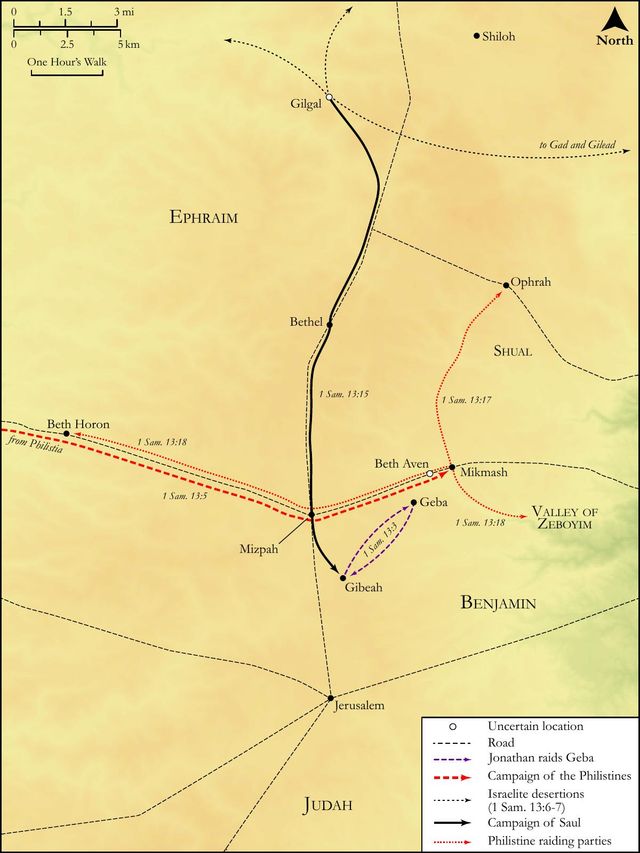
This verse serves as the climactic pronouncement of judgment following Saul's grave act of disobedience at Gilgal. In 1 Samuel 13:5-8, Saul found himself in a desperate situation: facing a massive Philistine army, his own forces dwindling, and the prophet Samuel, who was to offer the pre-battle sacrifice, delayed. Despite Samuel's explicit instruction to wait seven days for his arrival (recalled from 1 Samuel 10:8), Saul impatiently took it upon himself to offer the burnt offering. Samuel's immediate arrival after Saul's unauthorized sacrifice (as described in 1 Samuel 13:10) sets the stage for this severe divine rebuke. This moment marks a critical turning point, signifying the beginning of the end of Saul's kingship and the divine rejection of his dynasty, paving the way for a new era of leadership.
Historical & Cultural Context
The early Israelite monarchy was a nascent institution, established at the people's request to be "like all the nations" (1 Samuel 8:5), yet it was fundamentally distinct. Unlike surrounding pagan monarchies where kings often held both royal and priestly functions, Israel's covenant with Yahweh strictly separated these roles. The offering of sacrifices was a sacred prerogative reserved for the Levitical priesthood, a crucial aspect of Israel's unique worship and relationship with God. The Philistines, a technologically superior enemy with iron weaponry (as detailed in 1 Samuel 13:19-22), posed a significant threat, creating immense pressure on Saul. His act of offering the sacrifice was not merely a procedural error but a profound violation of divine order, demonstrating a dangerous self-reliance and a disregard for God's established authority and the sacred boundaries He had set for His people.
Key Themes
ShowHideThis verse powerfully articulates several foundational themes. Foremost is the consequences of disobedience to God's explicit commands, particularly for those in positions of authority. Saul's failure highlights that God values humble, faithful obedience above human expediency, perceived necessity, or outward religious acts, especially in times of crisis. Another crucial theme is God's absolute sovereignty in choosing and rejecting leaders. Despite Israel's desire for a king, God retains ultimate control over the monarchy, raising up and casting down rulers according to His perfect will and divine criteria. The introduction of "a man after his own heart" also establishes a profound theological criterion for ideal leadership: not outward appearance, military prowess, or political savvy, but an inner disposition (a "heart") that is fully aligned with God's desires and purposes. This characteristic is later explicitly attributed to David in Acts 13:22, foreshadowing the rejection of Saul's dynasty and the establishment of the enduring Davidic covenant.
Exposition and Analysis
ShowHideKey Word Analysis
ShowHideThis term refers to Saul's dominion, encompassing both his royal rule (abstractly) and the realm or country he governs (concretely). In this context, the declaration "thy kingdom shall not continue" signifies the termination of his dynastic right to rule, meaning his descendants will not succeed him on the throne. It is a pronouncement of dynastic failure, not an immediate removal from the kingship.
This primitive root means "to search out," implying a deliberate, purposeful, and often intense quest. When applied to the LORD, it underscores God's active and meticulous process in identifying a new leader. It is not a casual discovery but a divine initiative to find someone who fits His specific criteria, highlighting God's sovereign involvement in the affairs of His people and their leadership.
This word denotes the innermost part of a person—not just emotions, but the seat of intellect, will, intentions, and moral character. To be "a man after his own heart" signifies someone whose deepest desires, motivations, and overall disposition are in harmony with God's own will and purposes. It implies an inner alignment with divine priorities, a readiness to obey, and a trust in God's timing, standing in stark contrast to Saul's self-willed actions.
This term describes a "commander," "leader," or "prince." It often specifically refers to a divinely appointed leader, emphasizing God's direct selection and commissioning for a particular role of governance over His people. The use of nâgîyd here stresses that the new leader will be God's chosen instrument, serving by divine mandate rather than by human inheritance or popular acclaim, highlighting God's active role in establishing leadership for Israel.
This verb signifies a direct, authoritative instruction, order, or charge. It implies a clear, unambiguous directive from a superior (God) to a subordinate (Saul), demanding obedience. The repeated emphasis on what "the LORD commanded thee" and Saul's failure to "keep" it underscores the absolute nature of God's word and the gravity of disobedience. Saul's sin was not an oversight but a deliberate transgression of a known divine command, demonstrating a lack of reverence for God's authority.
Verse Breakdown
ShowHide"But now thy kingdom shall not continue:"
This is a definitive and irreversible declaration of divine judgment. The adverb "now" emphasizes the immediate and direct consequence of Saul's recent disobedience. The phrase "shall not continue" (Hebrew: lōʾ-ṯāqûm, "shall not rise/stand") indicates that Saul's dynasty, the right of his family to succeed him on the throne, is irrevocably terminated. While Saul himself would remain king for a period, his lineage would not establish an enduring monarchy, a severe blow in a culture where dynastic continuity was paramount and a sign of divine favor.
"the LORD hath sought him a man after his own heart,"
This clause reveals God's proactive sovereignty and His immediate response to Saul's failure. Even as Saul demonstrates his unfitness, God has already identified and is preparing His replacement. The phrase "hath sought him" (Hebrew: biqqēš) implies a deliberate and purposeful search, highlighting God's meticulous selection process. The description "a man after his own heart" defines the character God desires in a leader—one whose inner disposition, will, and motivations are perfectly aligned with God's own, a direct contrast to Saul's self-willed actions driven by fear and impatience.
"and the LORD hath commanded him [to be] captain over his people,"
This further emphasizes the divine appointment and commissioning of the new leader. Not only has God found this man, but He has also commissioned him for a specific role. The term "captain" (Hebrew: nāḡîḏ) signifies a divinely chosen leader, underscoring that this new king will rule by divine mandate and for God's purposes, rather than by human will or popular acclaim. This new leader will serve as God's shepherd for Israel, guiding them according to His will and for His glory.
"because thou hast not kept [that] which the LORD commanded thee."
This final clause provides the explicit and undeniable reason for Saul's rejection: his profound disobedience. The phrase "hast not kept" (Hebrew: lōʾ šāmarṯā, "you have not guarded/observed") means he did not heed, protect, or obey God's specific instructions. This highlights that God's judgment is not arbitrary but a just response to Saul's failure to uphold his covenantal responsibilities as king, specifically his failure to wait for Samuel and his unauthorized sacrifice, which demonstrated a lack of faith and a disregard for divine authority.
Literary Devices
ShowHideThe passage employs several potent literary devices to convey its profound message and underscore its significance. It functions as a Divine Pronouncement, a direct and authoritative declaration from God Himself, delivered through His prophet Samuel, carrying absolute weight and finality. This pronouncement establishes a stark Contrast between Saul's disobedient, self-reliant heart and the character of the future king, "a man after his own heart," thereby highlighting the qualitative difference in their relationship with God and their fitness for leadership. Furthermore, the verse serves as significant Foreshadowing, hinting at the future rise of David, though he is not yet named, and setting the stage for the establishment of the Davidic dynasty, which would become the enduring lineage of Israel's kingship. The phrase "a man after his own heart" becomes a powerful Thematic Motif that will define the ideal Israelite king and will be fully realized in David's reign, even with his imperfections.
Theological and Thematic Connections
ShowHide1 Samuel 13:14 profoundly underscores the biblical principle that obedience is paramount in God's economy, especially for those in positions of leadership. Saul's failure demonstrates that God prioritizes a heart wholly devoted to Him over human strategies, perceived necessities, or even outwardly religious acts. This verse introduces the profound concept of a leader whose inner disposition aligns with God's own will, setting a high standard for all future kings of Israel and ultimately pointing to the perfect King. It reveals God's unwavering sovereignty, demonstrating that He is actively involved in choosing and removing leaders for His people, always working to fulfill His redemptive purposes despite human failings. This divine prerogative ensures that God's ultimate plan for His people will prevail, regardless of human unfaithfulness.
Reflection and Application
ShowHideThis verse serves as a sober reminder that God looks beyond outward appearances, human rationalizations, and even dire circumstances, peering into the very heart of our motivations and intentions. Saul's disobedience, born of impatience and fear of man, illustrates how even seemingly small deviations from God's explicit commands can have profound and lasting consequences, particularly for those entrusted with significant responsibility. For believers today, this passage challenges us to cultivate a "heart after God's own heart"—one that prioritizes humble obedience, trusts in God's perfect timing, and seeks His will above all else. It calls us to examine our own lives: are we prone to taking matters into our own hands when circumstances feel overwhelming, or do we patiently wait on the Lord, even when it seems counter-intuitive or when human pressure mounts? Our faithfulness in seemingly minor acts of obedience can determine the trajectory of our spiritual journey and our capacity to serve God's greater purposes, for God values a surrendered heart more than any outward performance.
Questions for Reflection
ShowHideFAQ
ShowHideWhat does "a man after his own heart" truly mean, and how does it apply to David?
ShowHideThe phrase "a man after his own heart" (Hebrew: ish kilbabho) does not mean a perfect man, nor one who always acts exactly as God would. Rather, it describes someone whose inner disposition, desires, and will are fundamentally aligned with God's will and purposes. It implies a deep desire to please God, to prioritize His commands, and to seek His glory above personal gain or human approval. It signifies a responsiveness to God's spirit and a willingness to repent when confronted with sin. David, though he committed grievous sins (e.g., in 2 Samuel 11), consistently demonstrated this heart by his profound repentance (Psalm 51), his reliance on God in battle and kingship, and his passion for God's presence and worship (Psalm 27:4). Unlike Saul, whose heart was often driven by fear of man and self-preservation, David's ultimate desire was to honor God, even in his failures. This concept is explicitly applied to David by the Apostle Paul in Acts 13:22.
Why was Saul's sin of offering the sacrifice so severe that it cost him his kingdom?
ShowHideSaul's sin was not merely a procedural error; it was a profound act of disobedience and a usurpation of divinely ordained authority. First, he directly violated a clear command from Samuel to wait seven days (1 Samuel 10:8). This showed a profound lack of faith and trust in God's timing and His prophet. Second, by offering the burnt offering himself (1 Samuel 13:9), Saul trespassed into the priestly domain, a role explicitly reserved for the Levitical priesthood. This blurred the divinely established lines of authority between king and priest, demonstrating a dangerous presumption and disregard for God's order. It revealed a heart that prioritized expediency and human fear (his soldiers were scattering, as described in 1 Samuel 13:6-7) over humble obedience to God's explicit word. This act was symptomatic of a deeper spiritual problem: a self-reliant spirit rather than a God-reliant one, proving him unfit for a dynastic kingship that was meant to be under God's absolute rule.
Christ-Centered Fulfillment
ShowHide1 Samuel 13:14, while immediately pointing to David as "a man after God's own heart," ultimately finds its supreme and perfect fulfillment in Jesus Christ. David, despite his devotion, was still imperfect and failed in significant ways, requiring God's forgiveness and grace. Jesus, however, is the quintessential "man after God's own heart," perfectly embodying absolute obedience and complete alignment with the Father's will. He declared, "I always do what pleases him" (John 8:29), and His entire earthly ministry was characterized by humble submission to God's commands, even to the point of death on the cross (Philippians 2:8). Unlike Saul, who forfeited his earthly kingdom through disobedience, Christ, through His perfect obedience, established an eternal, unshakable kingdom (Hebrews 12:28) and became the true "Captain" (nāḡîḏ) and Shepherd of His people (Hebrews 2:10; John 10:11). He is the King whose heart perfectly mirrors the Father's, and whose reign will truly never end (Luke 1:33), forever securing His people in His perfect and righteous rule.