


1 Samuel 13:15
Bible text: King James Version (1769 Blayney text) · Public domain
Bible text: King James Version with Strong's numbers · Public domain
Bible text: Berean Standard Bible · Public domain
Bible text: American Standard Version (1901) · Public domain
Bible text: World English Bible, Messianic edition · Public domain
Bible text: Geneva Bible (1599) · Public domain
Bible text: Young's Literal Translation · Public domain
- וַיָּקָםvai·Ya·komand he aroseH6965Conj-w ¦ V-Qal-ConsecImperf-3msVerb Qal Consecutive Imperfect 3rd Singular Masculineוַandיָּקָםhe arose
- שְׁמוּאֵלshe·mu·'ElSamuelH8050N-proper-mNoun Proper Masculine
- וַיַּעַלvai·Ya·'aland he went upH5927Conj-w ¦ V-Qal-ConsecImperf-3msVerb Qal Consecutive Imperfect 3rd Singular Masculineוַandיַּעַלhe went up
- מִןminfromH4480PrepPreposition
- הַגִּלְגָּלha·gil·Gal<the> GilgalH1537Art ¦ N-properNoun Proper Locationהַ<the>גִּלְגָּלGilgal
- גִּבְעַתgiv·'AtGibeah ofH1390N-fscNoun Singular Feminine Construct
- בִּנְיָמִןbin·ya·MinBenjaminH1144N-proper-mNoun Proper Masculine
- וַיִּפְקֹדvai·yif·Kodand he musteredH6485Conj-w ¦ V-Qal-ConsecImperf-3msVerb Qal Consecutive Imperfect 3rd Singular Masculineוַandיִּפְקֹדhe mustered
- שָׁאוּלsha·'UlSaulH7586N-proper-mNoun Proper Masculine
- אֶת'et<obj.>H853DirObjMParticle Object Indicator
- הָעָםha·'Amthe peopleH5971Art ¦ N-msNoun Singular Masculine Absoluteהָtheעָםpeople
- הַנִּמְצְאִיםha·nim·tze·'Imwho were foundH4672Art ¦ V-Niphal-Prtcpl-mpVerb Niphal Participle Plural Masculine Absoluteהַwhoנִּמְצְאִיםwere found
- עִמּוֹi·Mowith himH5973Prep ¦ 3msPreposition Definiteעִמּwithוֹhim
- כְּשֵׁשׁke·Sheshabout sixH8337Prep-k ¦ N-csNoun Singular common gender Absoluteכְּaboutשֵׁשׁsix
- מֵאוֹתme·'othundred<s>H3967N-fpNoun Plural Feminine Absolute
- אִישׁ'IshmanH376N-msNoun Singular Masculine Absolute
- וַיֵּלֶךְvai·Ye·lekhand he wentH1980Conj-w ¦ V-Qal-ConsecImperf-3msVerb Qal Consecutive Imperfect 3rd Singular Masculineוַandיֵּלֶךְhe went
- לְדַרְכּוֹle·dar·Koon his wayH1870Prep-l ¦ N-csc ¦ 3msNoun Singular common gender Constructלְonדַרְכּwayוֹhis
- וְיֶתֶרve·Ye·terand the rest ofH3499Conj-w ¦ N-cscNoun Singular common gender Constructוְandיֶתֶרthe rest of
- הָעָםha·'Amthe peopleH5971Art ¦ N-csNoun Singular common gender Absoluteהָtheעָםpeople
- עָלָה'a·Lahit went upH5927V-Qal-Perf-3msVerb Qal Perfect 3rd Singular Masculine
- אַחֲרֵי'a·cha·ReiafterH310N-mpcNoun Plural Masculine Construct
- שָׁאוּלsha·'UlSaulH7586N-proper-mNoun Proper Masculine
- לִקְרַאתlik·Ratto meetH7122Prep-l ¦ V-Qal-InfVerb Qal Infinitive Constructלִtoקְרַאתmeet
- עַם'am[the] peopleH5971N-csNoun Singular common gender Absolute
- הַמִּלְחָמָהha·mil·cha·Mah[of] the battleH4421Art ¦ N-fsNoun Singular Feminine Absoluteהַ[of] theמִּלְחָמָהbattle
- וַיָּבֹאוּvai·ya·Vo·'uand they wentH935Conj-w ¦ V-Qal-ConsecImperf-3mpVerb Qal Consecutive Imperfect 3rd Plural Masculineוַandיָּבֹאוּthey went
- מִןminfromH4480PrepPreposition
- הַגִּלְגָּלha·gil·Gal<the> GilgalH1537Art ¦ N-properNoun Proper Locationהַ<the>גִּלְגָּלGilgal
English is a literal word-by-word gloss of the Hebrew, not the KJV's wording. Why?
This is the original text the KJV's translators worked from — each Hebrew word with its own literal English meaning in this verse, prepared by scholars at Tyndale House, Cambridge. The KJV translates whole sentences, not word by word, so its wording differs: one Hebrew word can become several English words, and the KJV may choose “the LORD” where the gloss reads “Yahweh”. Both are faithful — they answer different questions. For the KJV's own rendering, switch to the KJV text.
Details
See on the biblical-era map
Study this verse
Public-domain commentary
Matthew Henry
From his Commentary on the Whole Bible. Henry comments on passages, not single verses — this entry covers 1 Samuel 13:15–23.
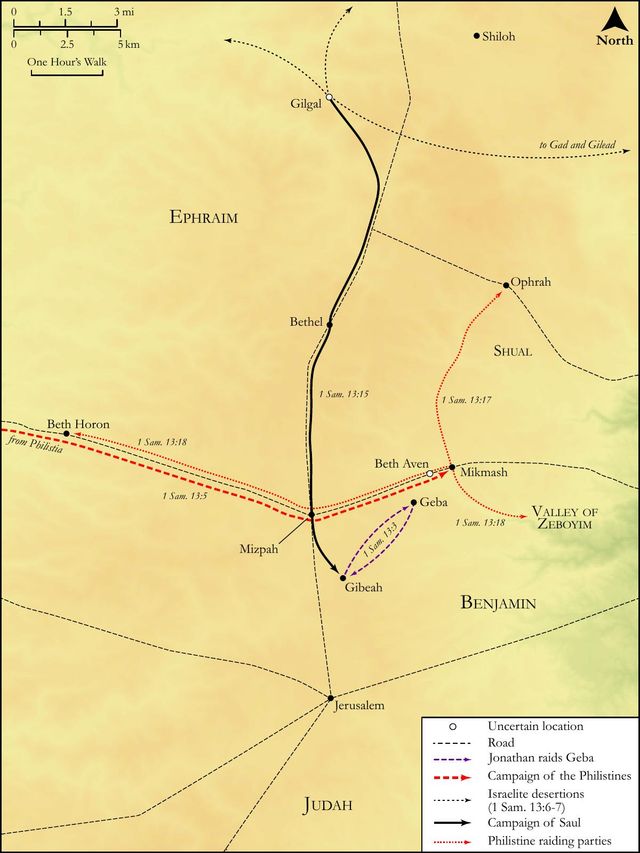
Here, 1. Samuel departs in displeasure. Saul has set up for himself, and now he is left to himself: Samuel gat him from Gilgal (Sa1 13:15), and it does not appear that he either prayed with Saul or directed him. Yet in going up to Gibeah of Benjamin, which was Saul's city, he intimated that he had not quite abandoned him, but waited to do him a kindness another time. Or he went to the college of the prophets there, to pray for Saul when he did not think fit to pray with him. 2. Saul goes after him to Gibeah, and there musters his army, and finds his whole number to be but 600 men, Sa1 13:15, Sa1 13:16. Thus were they for their sin diminished and brought low. 3. The Philistines ravage the country, and put all the adjacent parts under contribution. The body of their army, or standing camp (as it is called in the margin, Sa1 13:23), lay in an advantageous pass at Michmash, but thence they sent out three separate parties or detachments that took several ways, to plunder the country, and bring in provisions for the army, Sa1 13:17, Sa1 13:18. By these the land of Israel was both terrified and impoverished, and the Philistines were animated and enriched. This the sin of Israel brought upon them, Isa 42:24. 4. The Israelites that take the field with Saul are unarmed, having only slings and clubs, not a sword or spear among them all, except what Saul and Jonathan themselves have, Sa1 13:19, Sa1 13:22. See here, (1.) How politic the Philistines were, when they had power in their hands, and did what they pleased in Israel. They put down all the smiths' shops, transplanted the smiths into their own country, and forbade any Israelite, under severe penalties, to exercise the trade or mystery of working in brass or iron, though they had rich mines of both (Deu 8:9) in such plenty that it was said of Asher, his shoes shall be iron and brass, Deu 33:25. This was subtilely done of the Philistines, for hereby they not only prevented the people of Israel from making themselves weapons of war (by which they would be both disused to military exercises and unfurnished when there was occasion), but obliged them to a dependence upon them even for the instruments of husbandry; they must go to them, that is, to some or other of their garrisons, which were dispersed in the country, to have all their iron-work done, and no more might an Israelite do than use a file (Sa1 13:20, Sa1 13:21), and no doubt the Philistines' smiths brought the Israelites long bills for work done. (2.) How impolitic Saul was, that did not, in the beginning of his reign, set himself to redress this grievance. Samuel's not doing it was very excusable; he fought with other artillery; thunder and lightning, in answer to his prayer, were to him instead of sword and spear; but for Saul, that pretended to be a king like the kings of the nations, to leave his soldiers without swords and spears, and take no care to provide them, especially when he might have done it out of the spoils of the Ammonites whom he conquered in the beginning of his reign, was such a piece of negligence as could by no means be excused. (3.) How slothful and mean-spirited the Israelites were, that suffered the Philistines thus to impose upon them and had no thought nor spirit to help themselves. It was reckoned very bad with them when there was not a shield or spear found among 40,000 in Israel (Jdg 5:8), and it was not better now, when there was never an Israelite with a sword by his side but the king and his son, never a soldier, never a gentleman; surely they were reduced to this, or began to be so, in Samuel's time, for we never find him with sword or spear in his hand. If they had not been dispirited, they could not have been disarmed, but it was sin that made them naked to their shame.
Historical interpretation
Historical reception
1 surviving comment on this verse from the historical church.
But Samuel rose up and went up from Gilgal, etc. The prophet demonstrates the same change of the kingdom which he had predicted by word also by changing the place. For even the Lord, who said of the unbelievers: "Arise, let us go from here" (John 14); having left the Synagogue, ascended the hill of the Son of the right hand, that is, the high hearts of that people; who wished to be the Son not of any earthly, but of heavenly and eternal blessedness; and the prophetic word illuminated by the dispensation of the Savior, through the literal revelation, by which rough minds were imbued, taught those perfected in the higher and more sacred mysteries of Christ and the Church. Indeed, what was said about the two peoples, we see carried out daily in individual persons. For the people set in Gilgal by Saul are terrified, while each of the faithful, either in the revelation of knowledge, which he received as less strong; or in the mire of vices, in which he shamefully fell, weakly fixed, the soul conscious of its frailty is troubled, and for the sake of seeking its own salvation, usefully stirs up itself, lest perhaps the spiritual adversary Machmas, that is, humility, which he especially desires, be overcome; lest the revelation of heavenly doctrine be taken away; lest the walls of the other virtues be broken through by the deceitful victor. Saul waits seven days, according to the agreement of Samuel, while someone in tribulation, with faith and diligent action, seeks the promised help of the Lord. For seven consists of three and four; three pertains to faith because of the confession of the Holy Trinity; four to works, because of prudence, fortitude, temperance, and justice; by which four as corners the whole structure of spiritual virtues is established. But when someone perfectly completes these seven days, that is, the light of sevenfold devotion, according to what the Psalm advises: "Wait on the Lord, be strong, and let your heart take courage" (Psalm 27); the Lord will come into the heart, and making his abode in it, will immediately destroy all the snares of the hostile army by the illumination of his coming. But he who has less of this perfection, less patient in adversity, less confident in the regard of divine aid, having forgotten that of Ecclesiasticus: "Do not delay in the time of distress" (Ecclesiasticus 10); loses all at once the ranks of virtues in which he had congratulated himself, by despairing; just as Saul, because on the seventh day not yet well completed, he despairs of Samuel’s promised arrival, is abandoned by the people as they slip away; who, if he had completed the appointed time, would not have lacked the promised aid of the prophet: "For the Lord is near to all who call upon him in truth" (Psalm 145). But Saul increased his sin, not only by wavering about the promises of the prophet, but also by offering the burnt offering himself, which was fitting for the priest. Pelagius increases blasphemy, another so-called faithful increases it, while less diligent about divine grace, he confidently believes he can be saved by his own strength; and what is the gift of the high priest alone, he foolishly thinks to acquire by the decision of his own will. Therefore, according to the Apocalypse of John: Another comes, and receives the promised kingdom and the crown of life and blessing from such people. This change was signified not by the counsels of supernal beings, but by the human affairs themselves, as Samuel himself, when with the rejection of the unfaithful, and the election of the most faithful king foretold, he rose up and went up from Gilgal to Gibeah of Benjamin. Because the word of God sent into the world will not return to him void, but will accomplish whatever he wills, and will prosper in those to whom he sent it (Isaiah 55). And having left behind the hypocrites and cunning ones, who provoke the wrath of God, he seeks the simple and faithful, whom he may elevate to the heavenly kingdom, as hearers.
Continue studying 1 Samuel 13:15 across the web’s major study libraries — every link below opens this exact verse, chapter, or book on the destination site.
Read & Compare
 BibleGatewayThis verse in more than 200 translations and 70 languages.
 Bible.comThe YouVersion reader — hundreds of translations, reading plans, and highlights.
 ESV.orgCrossway's official English Standard Version reader.
 NET BibleThe NET translation with 60,000+ translators' notes on every rendering decision.
 STEP BibleTyndale House's free study tool — original text, vocabulary, and scholarly resources.
 BibliaLogos Bible Software's free web reader.
 USCCBThe New American Bible (Revised Edition) with the U.S. bishops' study notes.
Commentaries
 BibleHub CommentariesDozens of classic commentaries on this verse, gathered on one page.
 StudyLightMore than 100 commentary sets — the largest collection on the web.
 BibleRefPlain-English commentary on what this verse means, verse by verse.
 Enduring WordDavid Guzik's free commentary on this chapter, widely used by Bible teachers.
 Bible Study ToolsVerse commentary alongside Greek and Hebrew study aids.
Original Language & Research
- BibleHub InterlinearThe verse word by word — original language, transliteration, and English.
- BibleHub LexiconEvery word's original-language definition and Strong's entry.
 Blue Letter BibleDeep-study tools — Strong's numbers, concordance, and word studies.
 SefariaThe Hebrew text with Rashi and centuries of Jewish commentary.
Sermons, Hymns & Audio


TrulyRandomVerse is not affiliated with these sites and doesn’t control their content. They’re linked because they’re genuinely useful.
Summary
1 Samuel 13:15 encapsulates a pivotal and somber turning point in King Saul's nascent reign, immediately following his profound act of disobedience at Gilgal. This verse vividly narrates the prophet Samuel's decisive departure from the scene, simultaneously revealing the stark and dramatic reduction of Saul's military force to a mere six hundred men. This alarming diminution of his army serves as a tangible and immediate consequence of the king's spiritual failure and God's withdrawal of favor, underscoring Saul's acute vulnerability and casting a foreboding shadow over a kingship that has now been divinely rejected.
Context
ShowHideLiterary Context
The immediate literary context of 1 Samuel 13:15 is the dramatic confrontation between the prophet Samuel and King Saul at Gilgal. Samuel had previously commanded Saul to wait seven days for him to offer sacrifices before engaging the Philistines (1 Samuel 10:8). However, under immense pressure from the Philistine army and with his own troops beginning to scatter, Saul impatiently took it upon himself to offer the burnt offering and peace offerings (1 Samuel 13:8-12). Upon Samuel's arrival, he delivered a scathing rebuke, declaring that Saul had acted foolishly and that his kingdom would not endure (1 Samuel 13:13-14). Verse 15 thus describes the immediate aftermath of this divine rejection: Samuel's departure from Gilgal and the stark reality of Saul's drastically reduced fighting force, a tangible sign of God's disfavor and the precariousness of Saul's position as king. This sets the stage for the seemingly impossible battle against the Philistines in the following verses, highlighting Israel's vulnerability.
Historical & Cultural Context
Historically, this event unfolds during the nascent period of Israel's monarchy, a time of transition from the tribal confederacy led by judges to a centralized kingship. The Philistines, a powerful and technologically advanced people with a monopoly on iron weaponry (1 Samuel 13:19-22), posed a constant and existential threat to Israel. Gilgal itself was a site of immense historical and religious significance, serving as Israel's first encampment after crossing the Jordan (Joshua 4:19), where the new generation was circumcised and the Passover was observed (Joshua 5:2-10). It was also where Saul was publicly confirmed as king (1 Samuel 11:15). Culturally, the offering of sacrifices was a sacred duty reserved for priests, as ordained by the Mosaic Law. Saul's act of offering the sacrifice himself was not merely an act of impatience but a profound overstepping of his royal authority into the priestly domain, a direct challenge to the established divine order and the authority of Samuel, God's appointed prophet. This context underscores the gravity of Saul's disobedience and the immediate, visible consequences of such a transgression against God's established protocols.
Key Themes
ShowHideSeveral key themes converge in 1 Samuel 13. Foremost is the Consequences of Disobedience, vividly illustrated by Saul's rash actions and the immediate divine rejection of his kingdom (1 Samuel 13:13-14). This event highlights the principle that obedience to God's specific commands, even when seemingly inconvenient or illogical from a human perspective, is paramount for those in leadership. Another prominent theme is Divine Sovereignty over Human Authority. Despite being God's chosen king, Saul is reminded that his authority is delegated and subordinate to God's ultimate rule, mediated through the prophet Samuel. The dwindling of his army to a meager six hundred men serves as a tangible manifestation of God's withdrawal of favor, emphasizing Israel's Dependence on God, Not Military Might. This precarious situation forces a realization that victory comes from divine intervention, not overwhelming numbers, a lesson frequently taught throughout Israel's history (e.g., Judges 7:2-7). Finally, the chapter explores the Nature of True Kingship, contrasting Saul's self-reliant, fear-driven leadership with the ideal of a king who patiently trusts and obeys the Lord, foreshadowing the qualities found in David, a "man after God's own heart" (1 Samuel 13:14).
Exposition and Analysis
ShowHideKey Word Analysis
ShowHideDerived from a root meaning "to roll," Gilgal (H1537) was a historically and religiously significant site in Israel. It was where the reproach of Egypt was "rolled away" from Israel upon their entry into the Promised Land (Joshua 5:9) and later served as a key assembly point and religious center, notably where Saul was publicly confirmed as king (1 Samuel 11:15). Samuel's departure from this very place, where Saul's kingship was both affirmed and now spiritually undone, carries profound symbolic weight, marking a turning point in Saul's reign from divine favor to rejection.
This primitive root (H6485) carries a broad semantic range, including "to visit," "to oversee," "to appoint," and, as in this context, "to count" or "to muster." The act of Saul "numbering" his people here is not merely a logistical assessment but a stark revelation of the outcome of his crisis: the drastically low number of men remaining. This highlights the severe attrition of Saul's forces, a direct consequence of the fear instilled by the Philistines and, more profoundly, the tangible manifestation of God's disfavor and withdrawal of support from Saul's leadership.
Verse Breakdown
ShowHide"And Samuel arose, and gat him up from Gilgal unto Gibeah of Benjamin."
This clause signifies the immediate, decisive physical departure of the prophet Samuel from the scene of Saul's disobedience and divine rejection. Gilgal, a place of immense historical and religious importance for Israel and where Saul's kingship was affirmed, now becomes the place of its spiritual undoing. Samuel's departure is not merely a change of location but a symbolic withdrawal of God's direct prophetic presence and endorsement from Saul's immediate sphere of influence, leaving the king isolated in his folly. Gibeah of Benjamin was Saul's hometown, possibly indicating Samuel's return to his own circuit or simply a destination away from Saul, further emphasizing Saul's abandonment.
"And Saul numbered the people [that were] present with him, about six hundred men."
This second clause starkly reveals the devastating practical consequence of the Philistine threat and, implicitly, God's disfavor. The act of "numbering" (or mustering) indicates Saul's assessment of his remaining military strength. The number "about six hundred men" is shockingly low, especially when compared to the thousands who had previously gathered under Saul's command (e.g., 1 Samuel 11:8). This drastic reduction reflects widespread desertion due to fear of the formidable Philistine army and a loss of confidence in Saul's leadership, serving as a tangible sign of God's judgment and the precariousness of Saul's position. It underscores Israel's military weakness and their desperate need for divine intervention, highlighting the futility of human strength without God's backing.
Literary Devices
ShowHideThe verse employs several literary devices to convey its profound message. Juxtaposition is evident in the immediate sequence of Samuel's departure and Saul's assessment of his diminished forces; the prophet's physical absence immediately precedes the revelation of the king's military weakness, forcefully linking the spiritual rejection with the tangible consequence. The number "six hundred men" functions as a powerful Symbol of Israel's vulnerability and God's withdrawal of favor from Saul's reign. It stands in stark Contrast to the vast Philistine army mentioned earlier in the chapter and to the larger Israelite forces that had previously rallied under Saul, thereby highlighting the dramatic decline in his military might and popular support. This numerical detail also serves as a form of Understatement, as the dire situation it represents is far more catastrophic than the simple statement of a number might initially suggest, emphasizing the profound impact of Saul's disobedience on the nation's security and the king's authority.
Theological and Thematic Connections
ShowHideThis verse, though brief, is rich in theological implications, serving as a powerful testament to the principle that divine favor is contingent upon obedience, even for those in positions of power. Saul's dwindling army is not merely a logistical challenge but a visible manifestation of God's withdrawal of blessing and support. It underscores God's absolute sovereignty over human affairs and His willingness to humble even a king who presumes upon His grace or disregards His commands. The passage teaches that true strength and security for God's people do not reside in military might or human strategy, but in faithful reliance upon the Lord. When human leaders prioritize their own perceived needs or act out of fear rather than trust, they invite divine discipline, which can manifest in tangible ways, diminishing their influence and effectiveness.
Reflection and Application
ShowHideThe narrative of 1 Samuel 13:15 offers profound lessons for contemporary believers. It serves as a stark reminder that impatience and a lack of faith, even when faced with overwhelming pressure, can lead to severe spiritual and practical consequences. Saul's failure to wait for Samuel, driven by fear and a desire to control the outcome, resulted in divine rejection and a tangible weakening of his position. For us, this highlights the critical importance of patient obedience to God's revealed will, trusting His timing and His methods, rather than resorting to human shortcuts or self-reliant strategies. In moments of crisis or uncertainty, our natural inclination might be to take matters into our own hands, but this passage calls us to a deeper reliance on God's sovereignty. It challenges us to examine where we might be tempted to usurp God's role, whether in our personal lives, families, or ministries, and to remember that true spiritual authority and effectiveness flow from humble submission to His commands. The dwindling of Saul's army also reminds us that outward appearances of strength or success are meaningless without God's blessing and presence; our ultimate security and victory are found only in Him.
Questions for Reflection
ShowHideFAQ
ShowHideWhy was Saul's act of sacrificing so serious?
ShowHideSaul's act was serious not merely because it was impatient, but because it was a usurpation of priestly authority. According to the Mosaic Law, only priests were authorized to offer sacrifices. Samuel, as God's prophet, was acting in a priestly capacity by divine appointment. Saul, as king, was to rule, not to officiate religious rites. His action demonstrated a profound disrespect for God's established order and a lack of trust in God's prophet. It was an attempt to manipulate divine favor through human means, rather than humbly waiting on God's appointed time and method, revealing a heart of rebellion against God's direct command given through Samuel (1 Samuel 10:8). This act of disobedience was a clear sign of his unfitness for a lasting kingship, as declared by Samuel in 1 Samuel 13:13-14).
What does the number "six hundred men" signify?
ShowHideThe number "six hundred men" signifies the drastic and alarming reduction of Saul's fighting force. Earlier, Saul had mustered tens of thousands of men (e.g., 1 Samuel 11:8). This meager number indicates widespread desertion due to fear of the formidable Philistine army and a loss of confidence in Saul's leadership. Theologically, it serves as a tangible manifestation of God's disfavor and the withdrawal of His blessing from Saul's reign, leaving Israel in a state of extreme vulnerability. It underscores the principle that human strength is futile without divine backing, a theme consistently seen in Scripture (e.g., Psalm 33:16).
Christ-Centered Fulfillment
ShowHideThe narrative of Saul's failure in 1 Samuel 13:15 ultimately points to the superior, perfect kingship of Jesus Christ. Saul's impatience and self-reliance, which led to the rejection of his kingdom, stand in stark contrast to Christ's perfect obedience and humble submission to the Father's will. Unlike Saul, who usurped priestly duties, Jesus is the true Great High Priest who offered Himself as the ultimate, once-for-all sacrifice (Hebrews 9:26-28), perfectly fulfilling the Law and prophets. Saul's kingdom was diminished and ultimately taken away due to his disobedience, foreshadowing the temporary nature of earthly kingdoms. In contrast, Christ's kingdom is eternal and unshakable (Daniel 7:14). While Saul's army dwindled to a mere six hundred men, leaving him vulnerable, Christ, though appearing weak on the cross, conquered sin and death, establishing a spiritual army of believers who are more than conquerors through Him (Romans 8:37). His strength is made perfect in our weakness (2 Corinthians 12:9), and He never acts out of fear or impatience, but always in perfect alignment with the Father's timing and purpose, ultimately securing an eternal victory for all who trust in Him (John 6:39-40).