


1 Samuel 11:15
Bible text: King James Version (1769 Blayney text) · Public domain
Bible text: King James Version with Strong's numbers · Public domain
Bible text: Berean Standard Bible · Public domain
Bible text: American Standard Version (1901) · Public domain
Bible text: World English Bible, Messianic edition · Public domain
Bible text: Geneva Bible (1599) · Public domain
Bible text: Young's Literal Translation · Public domain
- וַיֵּלְכוּvai·ye·le·Khuand they wentH1980Conj-w ¦ V-Qal-ConsecImperf-3mpVerb Qal Consecutive Imperfect 3rd Plural Masculineוַandיֵּלְכוּthey went
- כָלkholallH3605N-mscNoun Singular Masculine Construct
- הָעָםha·'Amthe peopleH5971Art ¦ N-msNoun Singular Masculine Absoluteהָtheעָםpeople
- הַגִּלְגָּלha·gil·Gal<the> GilgalH1537Art ¦ N-properNoun Proper Locationהַ<the>גִּלְגָּלGilgal
- וַיַּמְלִכוּvai·yam·li·Khuand they made kingH4427Conj-w ¦ V-Hiphil-ConsecImperf-3mpVerb Hiphil Consecutive Imperfect 3rd Plural Masculineוַandיַּמְלִכוּthey made king
- שָׁםshamthereH8033AdvAdverb
- אֶת'et<obj.>H853DirObjMParticle Object Indicator
- שָׁאוּלsha·'UlSaulH7586N-proper-mNoun Proper Masculine
- לִפְנֵיlif·Nei<to> beforeH6440Prep-l ¦ N-mpcNoun Plural Masculine Constructלִ<to>פְנֵיbefore
- יְהוָהYah·wehYahwehH3068N-properNoun Proper Title
- בַּגִּלְגָּלba·gil·Galin <the> GilgalH1537Prep-b ¦ N-properNoun Proper Locationבַּin <the>גִּלְגָּלGilgal
- וַיִּזְבְּחוּvai·yiz·be·chuand they sacrificedH2076Conj-w ¦ V-Qal-ConsecImperf-3mpVerb Qal Consecutive Imperfect 3rd Plural Masculineוַandיִּזְבְּחוּthey sacrificed
- שָׁםshamthereH8033AdvAdverb
- זְבָחִיםze·va·ChimsacrificesH2077N-mpNoun Plural Masculine Absolute
- שְׁלָמִיםshe·la·Mimpeace offeringsH8002N-mpNoun Plural Masculine Absolute
- לִפְנֵיlif·Nei<to> beforeH6440Prep-l ¦ N-mpcNoun Plural Masculine Constructלִ<to>פְנֵיbefore
- יְהוָהYah·wehYahwehH3068N-properNoun Proper Title
- וַיִּשְׂמַחvai·yis·Machand he rejoicedH8055Conj-w ¦ V-Qal-ConsecImperf-3msVerb Qal Consecutive Imperfect 3rd Singular Masculineוַandיִּשְׂמַחhe rejoiced
- שָׁםshamthereH8033AdvAdverb
- שָׁאוּלsha·'UlSaulH7586N-proper-mNoun Proper Masculine
- וְכָלve·kholand allH3605Conj-w ¦ N-mscNoun Singular Masculine Constructוְandכָלall
- אַנְשֵׁי'an·Shei[the] men ofH582N-mpcNoun Plural Masculine Construct
- יִשְׂרָאֵלYis·ra·'ElIsraelH3478N-properNoun Proper Location
- עַד'adup toH5704PrepPreposition
- מְאֹדme·'OdmuchnessH3966Adj-msAdjective Numerical Singular Masculine Absolute
English is a literal word-by-word gloss of the Hebrew, not the KJV's wording. Why?
This is the original text the KJV's translators worked from — each Hebrew word with its own literal English meaning in this verse, prepared by scholars at Tyndale House, Cambridge. The KJV translates whole sentences, not word by word, so its wording differs: one Hebrew word can become several English words, and the KJV may choose “the LORD” where the gloss reads “Yahweh”. Both are faithful — they answer different questions. For the KJV's own rendering, switch to the KJV text.
Details
See on the biblical-era map
Study this verse
Public-domain commentary
Matthew Henry
From his Commentary on the Whole Bible. Henry comments on passages, not single verses — this entry covers 1 Samuel 11:12–15. His two-level outline is real structure in the source text, so it is rendered as structure.
We have here the improvement of the glorious victory which Saul had obtained, not the improvement of it abroad, though we take it for granted that the men of Jabesh-Gilead, having so narrowly saved their right eyes, would with them now discern the opportunity they had of avenging themselves upon these cruel enemies and disabling them from ever straitening them in like manner again; now shall they be avenged on the Ammonites for their right eyes condemned, as Samson on the Philistines for his two eyes put out, Jdg 16:28. But the account here given is of the improvement of this victory at home.
I.The people took this occasion to show their jealousy for the honour of Saul, and their resentment of the indignities done him.
Samuel, it seems, was present, if not in the action (it was too far for him to march) yet to meet them when they returned victorious; and to him, as judge, the motion was made (for they knew Saul would not be judge in his own cause) that the sons of Belial that would not have him to reign over them should be brought forth and slain, Sa1 11:12. Saul's good fortune (as foolish men commonly call it) went further with them to confirm his title than either his choice by lot or Samuel's anointing him. They had not courage thus to move for the prosecution of those that opposed him when he himself looked mean, but, now that his victory made him look great, nothing would serve but they must be put to death.
II.Saul took this occasion to give further proofs of his clemency, for, without waiting for Samuel's answer, he himself quashed the motion (Sa1 11:13): There shall not a man be put to death this day, no, not those men, those bad men, that had abused him, and therein reflected on God himself, 1. Because it was a day of joy and triumph: "To day the Lord has wrought salvation in Israel; and, since God has been so good to us all, let us not be harsh one to another. Now that God has made the heart of Israel in general so glad, let not us make sad the hearts of any particular Israelites." 2. Because he hoped they were by this day's work brought to a better temper, were now convinced that this man, under God, could save them, now honoured him whom before they had despised; and, if they are but reclaimed, he is secured from receiving any disturbance by them, and therefore his point is gained. If an enemy be made a friend, that will be more to our advantage than to have him slain. And all good princes consider that their power is for edification, not for destruction.
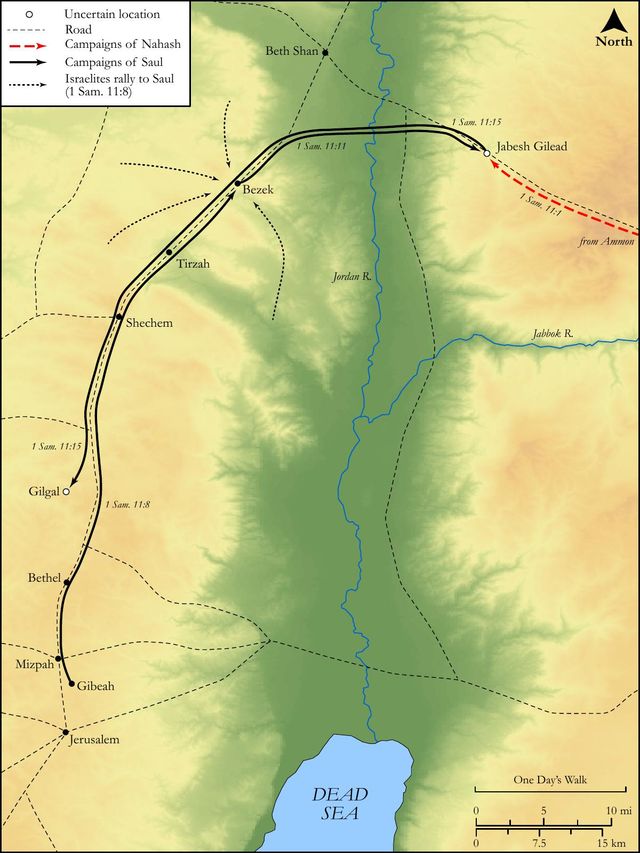
III.Samuel took this occasion to call the people together before the Lord in Gilgal, Sa1 11:14, Sa1 11:15.
1.That they might publicly give God thanks for their late victory. There they rejoiced greatly, and, that God might have the praise of that which they had the comfort of, they sacrificed to him, as the giver of all their successes, sacrifices of peace-offerings.
2.That they might confirm Saul in the government, more solemnly than had been yet done, that he might not retire again to his obscurity. Samuel would have the kingdom renewed; he would renew his resignation, and the people should renew their approbation, and so in concurrence with, or rather in attendance upon, the divine nomination, they made Saul king, making it their own act and deed to submit to him.
Historical interpretation
Historical reception
1 surviving comment on this verse from the historical church.
And Saul rejoiced there, etc. Saul rejoiced in Gilgal, which is called revelation. Jesus exulted in the Holy Spirit and said: I praise you, Father, Lord of heaven and earth, because you have hidden these things from the wise and intelligent (Matt. XI; Luke X), that is, from those trusting in serpentine wisdom, as if fighting against Israel under King Nahash; and you have revealed them to little ones, that is, to those whom in the brightness of truth and in the poverty of spirit, as if in the city of Bezek, the fear of the Lord has gathered, strengthened, and helped. Again, he says, I will see you, and your heart will rejoice, and no one will take your joy from you (John XVI).
Continue studying 1 Samuel 11:15 across the web’s major study libraries — every link below opens this exact verse, chapter, or book on the destination site.
Read & Compare
 BibleGatewayThis verse in more than 200 translations and 70 languages.
 Bible.comThe YouVersion reader — hundreds of translations, reading plans, and highlights.
 ESV.orgCrossway's official English Standard Version reader.
 NET BibleThe NET translation with 60,000+ translators' notes on every rendering decision.
 STEP BibleTyndale House's free study tool — original text, vocabulary, and scholarly resources.
 BibliaLogos Bible Software's free web reader.
 USCCBThe New American Bible (Revised Edition) with the U.S. bishops' study notes.
Commentaries
 BibleHub CommentariesDozens of classic commentaries on this verse, gathered on one page.
 StudyLightMore than 100 commentary sets — the largest collection on the web.
 BibleRefPlain-English commentary on what this verse means, verse by verse.
 Enduring WordDavid Guzik's free commentary on this chapter, widely used by Bible teachers.
 Bible Study ToolsVerse commentary alongside Greek and Hebrew study aids.
Original Language & Research
- BibleHub InterlinearThe verse word by word — original language, transliteration, and English.
- BibleHub LexiconEvery word's original-language definition and Strong's entry.
 Blue Letter BibleDeep-study tools — Strong's numbers, concordance, and word studies.
 SefariaThe Hebrew text with Rashi and centuries of Jewish commentary.
Sermons, Hymns & Audio


TrulyRandomVerse is not affiliated with these sites and doesn’t control their content. They’re linked because they’re genuinely useful.
Summary
This verse climactically describes the formal and public enthronement of Saul as Israel's first king at Gilgal, following his decisive military victory over the Ammonites. It portrays a moment of profound national unity and popular affirmation, marked by sacred worship through peace offerings and widespread rejoicing, signifying the establishment of the monarchy under divine sanction and the people's joyful acceptance of God's chosen leader.
Context
ShowHideLiterary Context
1 Samuel 11:15 serves as the triumphant culmination of the narrative arc detailing Saul's ascension to kingship, which began with his private anointing by Samuel (1 Samuel 10:1) and subsequent public presentation at Mizpah, where he was chosen by lot (1 Samuel 10:17-24). Despite this, some "worthless fellows" initially scorned him, withholding tribute (1 Samuel 10:27). The immediate catalyst for this verse is Saul's heroic response to Nahash the Ammonite's siege of Jabesh-gilead (1 Samuel 11:1-11), where, empowered by the Spirit of God, he rallied Israel to a resounding victory. This decisive triumph unequivocally demonstrated his leadership and silenced all dissent, prompting Samuel's call for the nation to gather at Gilgal "to renew the kingdom there" (1 Samuel 11:14), culminating in this formal and joyous enthronement.
Historical & Cultural Context
Gilgal held immense historical and religious significance for ancient Israel. It was the first encampment of the Israelites after their miraculous crossing of the Jordan River into the Promised Land (Joshua 4:19-20), where the covenant was renewed and the "reproach of Egypt" was symbolically "rolled away" (Joshua 5:9). As such, it was a central religious and judicial hub during the period of the Judges and early monarchy. The act of "making king" involved a public ceremony, typically accompanied by popular acclamation, sacrificial offerings, and communal feasting, all designed to solidify the leader's authority in the eyes of both the people and God. The "peace offerings" (Hebrew: shelamim) were voluntary sacrifices of thanksgiving and fellowship, a portion of which was consumed in a communal meal, symbolizing reconciliation and harmonious relationship with God and within the community. This shared feast underscored the unity and shared joy of such a momentous occasion.
Key Themes
ShowHideThis verse powerfully encapsulates several pivotal themes within the book of 1 Samuel and the broader narrative of Israel's history. Firstly, it highlights the confirmation of divine appointment through popular affirmation. While God had chosen Saul and Samuel had anointed him, his kingship is now publicly affirmed and solidified through his demonstrated leadership and military success, illustrating God's use of human agency and the importance of communal consent. Secondly, it underscores the theme of national unity and collective identity as "all the people" gather to celebrate and establish their new political structure, a stark contrast to the fragmented tribalism and internal strife characteristic of the preceding Judges period. Thirdly, the emphasis on sacrifices "before the LORD" reinforces the central theme of divine sovereignty and the sacred nature of Israel's kingship. Even as Israel desired a king "like all the nations" (1 Samuel 8:5), this act reminds them that their monarchy remains under God's ultimate authority and is consecrated through worship. Finally, the "great rejoicing" reflects the joy and hope associated with the establishment of a stable, divinely sanctioned leadership, marking a significant and hopeful transition in Israel's history.
Exposition and Analysis
ShowHideKey Word Analysis
ShowHideThis place name, H1537, meaning "circle of stones" or "rolling," carries profound historical and theological weight. It was the site where Israel first encamped after crossing the Jordan, where the covenant was renewed, and where the reproach of Egypt was "rolled away" (Joshua 5:9). By choosing Gilgal for Saul's formal enthronement, Samuel intentionally linked the new monarchy to Israel's foundational acts of covenant and national identity, grounding the political transition in sacred history and divine promise. It symbolized a fresh start and a renewed commitment to God.
This verb, H4427, from the primitive root meaning "to reign" or "to be king," is used here in its causative sense ("to induct into royalty"). While God had chosen and Samuel had anointed him, this public act at Gilgal was the formal, national acclamation and investiture. It signifies the active role of the people in installing Saul as king, demonstrating that his authority was now fully recognized and accepted by the entire nation, not just a select few. This public ceremony cemented his political legitimacy.
Derived from the root shalom (H8002), meaning "peace, wholeness, completeness," these sacrifices were voluntary offerings of thanksgiving, fellowship, and communion with God. Unlike sin or burnt offerings, a portion of the shelem was returned to the worshiper for a communal meal, symbolizing a shared meal with God and the community. Their offering at Gilgal underscored the nation's gratitude for the victory, their desire for harmonious fellowship with God and each other, and the sacred nature of the new political order. It was an act of worship that consecrated the kingship and invoked divine blessing.
Verse Breakdown
ShowHide"And all the people went to Gilgal;"
This opening clause emphasizes the widespread participation and national consensus surrounding Saul's enthronement. The phrase "all the people" signifies a unified Israel, transcending tribal divisions, gathering at a historically significant location. This collective movement highlights the popular support and anticipation for the establishment of the monarchy, demonstrating a rare moment of national cohesion.
"and there they made Saul king before the LORD in Gilgal;"
This is the central action of the verse, detailing the formal enthronement. The repetition of "Gilgal" reinforces the significance of the location, while "before the LORD" underscores the sacred nature of the event. It was not merely a political ceremony but an act performed under divine witness and sanction, acknowledging God's ultimate authority over the newly established kingship. The people's act of "making" Saul king was a ratification of God's prior choice, solidifying his position.
"and there they sacrificed sacrifices of peace offerings before the LORD;"
This clause describes the religious component of the enthronement. The offering of "peace offerings" indicates a communal act of thanksgiving, reconciliation, and fellowship. It signifies the nation's gratitude for the recent victory, their desire for a right relationship with God as they entered this new era, and a commitment to live in harmony under the new king. The repetition of "before the LORD" again highlights the divine focus and consecration of the entire event, emphasizing that the monarchy was established under God's watchful eye.
"and there Saul and all the men of Israel rejoiced greatly."
The concluding clause captures the overwhelming emotion of the occasion. The "great rejoicing" signifies a moment of profound national unity, relief, and hope. It reflects the people's satisfaction with Saul's leadership, their acceptance of the monarchy, and their shared joy in this significant transition from a fragmented tribal system to a unified kingdom. This collective celebration cemented the bond between the new king and his people, all under the blessing of God.
Literary Devices
ShowHideThe verse employs several effective literary devices to convey its profound significance. Repetition is prominent, with "Gilgal" appearing three times and "before the LORD" twice, underscoring both the sacred location and the divine oversight of the proceedings. The repeated phrase "and there" creates a sense of purposeful sequence, emphasizing the deliberate and ceremonial nature of each action: gathering, enthroning, sacrificing, and rejoicing. Symbolism is rich, with the "peace offerings" representing not just thanksgiving but also the hope for internal unity and a harmonious relationship with God under the new monarchy. The very act of "making Saul king" symbolizes the pivotal transition from a tribal confederacy to a centralized monarchy, a foundational moment in Israel's national identity. The collective "rejoicing greatly" serves as a powerful hyperbole, emphasizing the overwhelming and unanimous joy of the people, a rare moment of complete national unity that contrasts sharply with the internal strife often seen in the book of Judges and the future divisions of Israel. This moment, though joyous, also carries a subtle irony when viewed retrospectively, given Saul's tragic reign and the eventual division of the kingdom, highlighting the fleeting nature of human triumph compared to God's enduring plan.
Theological and Thematic Connections
ShowHide1 Samuel 11:15 stands as a pivotal moment in Israel's history, demonstrating the complex interplay between divine sovereignty and human agency in the establishment of leadership. While God had already chosen Saul and Samuel had anointed him, this public enthronement at Gilgal signifies the crucial element of popular affirmation and the people's active participation in accepting God's chosen leader. It highlights that even divinely appointed authority gains strength and legitimacy through the willing embrace of the community. The act of sacrificing peace offerings underscores that all national endeavors, especially the establishment of a new political order, must be consecrated through worship and conducted "before the LORD," acknowledging His ultimate dominion and seeking His blessing. This moment of unity and rejoicing, centered on shared worship, serves as an ideal, albeit temporary, picture of how Israel was meant to function under God's covenant.
Reflection and Application
ShowHideThe scene at Gilgal, where Saul is formally made king amidst national unity and worship, offers profound lessons for believers today concerning leadership, community, and the place of God in our collective endeavors. It reminds us that true authority, whether in the church, family, or society, is ultimately derived from God, and its exercise should always be "before the LORD," seeking His guidance and blessing. Just as Israel celebrated their new king with peace offerings, so too should our moments of success, transition, or new beginnings be marked by intentional thanksgiving and fellowship with God. This verse challenges us to consider how we affirm and support godly leadership, recognizing that unity and shared joy in common purpose are powerful testimonies to God's work among us. It also calls us to reflect on the importance of consecrating our collective aspirations and achievements to God, ensuring that our triumphs lead to deeper worship and humility rather than self-congratulation or human pride.
Questions for Reflection
ShowHideFAQ
ShowHideWhy was Gilgal chosen as the location for Saul's formal enthronement?
ShowHideGilgal was chosen for its profound historical and religious significance to Israel. It was the first encampment of the Israelites after crossing the Jordan into the Promised Land (Joshua 4:19), where the covenant was renewed, and the reproach of Egypt was "rolled away" (Joshua 5:9). By holding the enthronement ceremony at Gilgal, Samuel and the people connected the new monarchy to Israel's foundational acts of covenant, national identity, and divine blessing. It symbolized a renewed commitment to God and a fresh start for the nation under its first king, grounding the political transition in sacred history and invoking divine favor.
What was the significance of offering "sacrifices of peace offerings" at this event?
ShowHideThe "peace offerings" (Hebrew: shelamim) were voluntary sacrifices of thanksgiving, fellowship, and communion with God. Their offering at Saul's enthronement signified several things:
Christ-Centered Fulfillment
ShowHideThe enthronement of Saul at Gilgal, a moment of national unity and great rejoicing, serves as a significant Old Testament foreshadowing of the ultimate, eternal kingship of Jesus Christ. While Saul was an earthly king, chosen by God yet flawed by human weakness, his initial acceptance and the people's joy point to a deeper longing for perfect divine rule. The "peace offerings" sacrificed at Gilgal, meant to bring reconciliation and fellowship between God and His people, find their ultimate fulfillment in the single, perfect sacrifice of Jesus Christ on the cross. He is the true Lamb of God who takes away the sin of the world, whose atoning work establishes a new covenant and brings genuine, everlasting peace between God and humanity (Ephesians 2:14-16). Unlike Saul, whose reign was marked by eventual failure and division, Jesus is the King whose kingdom "will have no end" (Luke 1:33). The "great rejoicing" of Israel at Gilgal anticipates the far greater, eternal joy of those who, by faith, acknowledge Jesus as their Lord and King. His enthronement is not merely a historical event but a spiritual reality, as He reigns from heaven, having been given "all authority in heaven and on earth" (Matthew 28:18). Believers are called to live under His perfect, righteous reign, experiencing the true peace, unity, and everlasting joy that only His perfect kingship can provide (Colossians 1:13-14).