


1 Samuel 10:27
Bible text: King James Version (1769 Blayney text) · Public domain
Bible text: Berean Standard Bible · Public domain
Bible text: American Standard Version (1901) · Public domain
Bible text: World English Bible, Messianic edition · Public domain
Bible text: Geneva Bible (1599) · Public domain
Bible text: Young's Literal Translation · Public domain
- וּבְנֵיu·ve·Neiand sons ofH1121Conj-w ¦ N-mpcNoun Plural Masculine Constructוּandבְנֵיsons of
- בְלִיַּעַלve·li·Ya·'alworthlessnessH1100N-msNoun Singular Masculine Absolute
- אָמְרוּ'a·me·Ruthey saidH559V-Qal-Perf-3cpVerb Qal Perfect 3rd Plural common gender
- מַהmahwhat?H4100InterrogPronoun Interrogative
- יֹּשִׁעֵנוּyo·shi·'E·nuwill he deliver usH3467V-Hiphil-Imperf-3ms ¦ 1cpVerb Hiphil Imperfect 3rd Singular Masculineיֹּשִׁעֵwill he deliverנוּus
- זֶהZehthis oneH2088PrtParticle Demonstrative
- וַיִּבְזֻהוּvai·yiv·Zu·huand they despised himH959Conj-w ¦ V-Qal-ConsecImperf-3mp ¦ 3msVerb Qal Consecutive Imperfect 3rd Plural Masculineוַandיִּבְזֻthey despisedהוּhim
- וְלֹאve·lo'and notH3808Conj-w ¦ NegParticle Negativeוְandלֹאnot
- הֵבִיאוּhe·Vi·'uthey broughtH935V-Hiphil-Perf-3cpVerb Hiphil Perfect 3rd Plural common gender
- לוֹloto <the> himPrep-l ¦ 3msSuffix Personal 3rd Singular Masculineלto <the>וֹhim
- מִנְחָהmin·Chaha giftH4503N-fsNoun Singular Feminine Absolute
- וַיְהִיvay·Hiand he wasH1961Conj-w ¦ V-Qal-ConsecImperf-3msVerb Qal Consecutive Imperfect 3rd Singular Masculineוַandיְהִיhe was
- כְּמַחֲרִישׁke·ma·cha·Rishlike [one who] kept silentH2790Prep-k ¦ V-Hiphil-Prtcpl-msVerb Hiphil Participle Singular Masculine Absoluteכְּlikeמַחֲרִישׁ[one who] kept silent
English is a literal word-by-word gloss of the Hebrew, not the KJV's wording. Why?
This is the original text the KJV's translators worked from — each Hebrew word with its own literal English meaning in this verse, prepared by scholars at Tyndale House, Cambridge. The KJV translates whole sentences, not word by word, so its wording differs: one Hebrew word can become several English words, and the KJV may choose “the LORD” where the gloss reads “Yahweh”. Both are faithful — they answer different questions. For the KJV's own rendering, switch to the KJV text.
Details
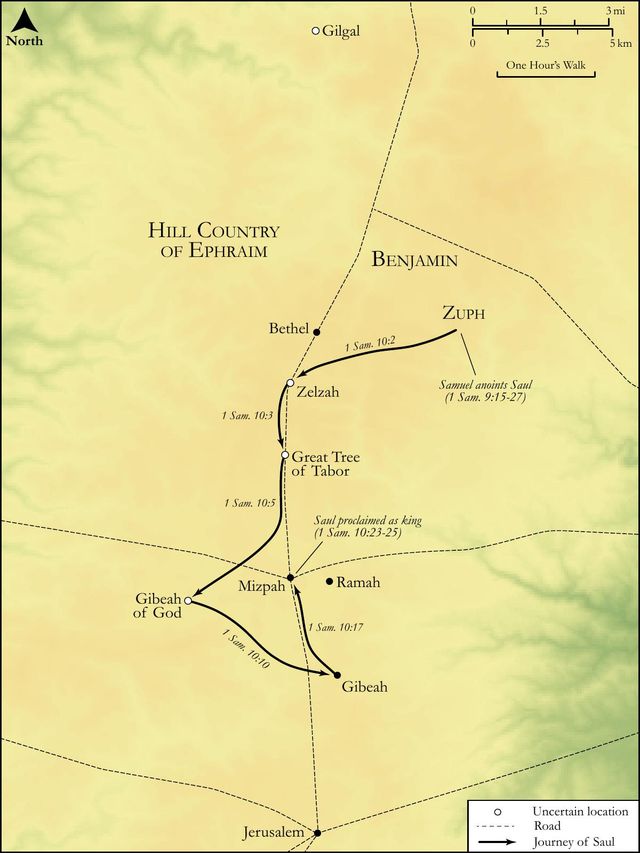
See on the biblical-era map
Study this verse
Public-domain commentary
Matthew Henry
From his Commentary on the Whole Bible. Henry comments on passages, not single verses — this entry covers 1 Samuel 10:17–27. His three-level outline is real structure in the source text, so it is rendered as structure.
Saul's nomination to the throne is here made public, in a general assembly of the elders of Israel, the representatives of their respective tribes at Mizpeh. It is probable that this convention of the states was called as soon as conveniently it might, after Saul was anointed, for, if there must be a change in their government, the sooner the better: it might be of bad consequence to be long in the doing. The people having met in a solemn assembly, in which God was in a peculiar manner present (and therefore it is said they were called together unto the Lord, Sa1 10:17), Samuel acts for God among them.
I.He reproves them for casting off the government of a prophet, and desiring that of a captain.
1.He shows them (Sa1 10:18) how happy they had been under the divine government; when God ruled them, he delivered them out of the hand of those that oppressed them, and what would they desire more? Could the mightiest man of valour do that for them which the Almighty God had done?
2.He likewise shows them (Sa1 10:19) what an affront they had put upon God (who had himself saved them out of all their tribulations, by his own power, and by such as he had immediately called and qualified) in desiring a king to save them. He tells them in plain terms, "You have this day rejected your God; you have in effect done it: so he construes it, and he might justly, for your so doing, reject you." Those that can live better by sense than by faith, that stay themselves upon an arm of flesh rather than upon the almighty arm, forsake a fountain of living waters for broken cisterns. And some make their obstinacy in this matter to be a presage of their rejecting Christ, in casting off whom they cast off God, that he should not reign over them.
II.He puts them upon choosing their king by lot.
He knew whom God had chosen, and had already anointed him, but he knew also the peevishness of that people, and that there were those among them who would not acquiesce in the choice if it depended upon his single testimony; and therefore, that every tribe and every family of the chosen tribe might please themselves with having a chance for it, he calls them to the lot, Sa1 10:19. Benjamin is taken out of all the tribes (Sa1 10:20), and out of that tribe Saul the son of Kish, Sa1 10:21. By this method it would appear to the people, as it already appeared to Samuel, that Saul was appointed of God to be king; for the disposal of the lot is of the Lord. It would also prevent all disputes and exceptions; for the lot causeth contentions to cease, and parteth between the mighty. When the tribe of Benjamin was taken, they might easily foresee that they were setting up a family that would soon be put down again; for dying Jacob had, by the spirit of prophecy, entailed the dominion upon Judah. Judah is the tribe that must rule as a lion; Benjamin shall only ravin as a wolf, Gen 49:10, Gen 49:27. Those therefore that knew the scriptures could not be very fond of the doing of that which they foresaw must, ere long, be undone again.
III.It is with much ado, and not without further enquiries of the Lord, that Saul is at length produced.
When the lot fell upon him, every one expected he should answer to his name at the first call, but, instead of that, none of his friends could find him (Sa1 10:21), he had hidden himself among the stuff (Sa1 10:22), so little fond was he now of that power which yet, when he was in possession of, he could not without the utmost indignation think of parting with.
1.He withdrew, in hopes that, upon his not appearing, they would proceed to another choice, or thus to express his modesty; for, by what had already passed, he knew he must be the man. We may suppose he was at this time really averse to take upon him the government,
(1.)Because he was conscious to himself of unfitness for so great a trust. He had not been bred up to books, or arms, or courts, and feared he should be guilty of some fatal blunder.
(2.)Because it would expose him to the envy of his neighbours that were ill-affected towards him.
(3.)Because he understood, by what Samuel had said, that the people sinned in asking a king, and it was in anger that God granted their request.
(4.)Because the affairs of Israel were at this time in a bad posture; the Philistines were strong, the Ammonites threatening: and he must be bold indeed that will set sail in a storm.
2.But the congregation, believing that choice well made which God himself made, would leave no way untried to find him out on whom the lot fell. They enquired of the Lord, either by the high priest, and his breast-plate of judgment, or by Samuel, and his spirit of prophecy; and the Lord directed them where they should find him, hidden among the carriages, and thence they fetched him, Sa1 10:23. Note, None will be losers at last by their humility and modesty. Honour, like the shadow, follows those that flee from it, but flees from those that pursue it.
IV.Samuel presents him to the people, and they accept him.
He needed not to mount the bench, or scaffold, to be seen; when he stood upon even ground with the rest he was seen above them all, for he was taller than any of them by head and shoulders, Sa1 10:23. "Look you," said Samuel, "what a king God has chosen for you, just such a one as you wished for; there is none like him among all the people, that has so much majesty in his countenance and such a graceful stateliness in his mien; he is in the crowd like a cedar among the shrubs. Let your own eyes be judges, is he not a brave and gallant man?" The people hereupon signified their approbation of the choice, and their acceptance of him; they shouted and said, Let the king live, that is, "Let him long reign over us in health and prosperity." Subjects were wont to testify their affection and allegiance to their prince by their good wishes, and those turned (as our translation does this) into addresses to God. Psa 72:15, Prayer shall be made for him continually. See Psa 20:1. Samuel had told them they would soon be weary of their king, but, in the mind they are now in, they will never be so: Let the king live.
V.Samuel settles the original contract between them, and leaves it upon record, Sa1 10:25.
He had before told them the manner of the king (Sa1 8:11), how he would abuse his power; now he tells them the manner of the kingdom, or rather the law, or judgment, or constitution, of it, what power the prince might challenge and the utmost of the property the subject might claim. He fixed the land-marks between them, that neither might encroach upon the other. Let them rightly understand one another at first, and let the agreement remain in black and white, which will tend to preserve a good understanding between them ever after. The learned bishop Patrick thinks he now repeated and registered what he had told them (Sa1 8:11) of the arbitrary power their kings would assume, that it might hereafter be a witness against them that they had drawn the calamity upon themselves, for they were warned what it would come to and yet they would have a king.
VI.The convention was dissolved when the solemnity was over:
Samuel sent every man to his house. Here were no votes passed, nor, for aught that appears, so much as a motion made, for the raising of money to support the dignity of their new-elected king; if therefore he afterwards thinks fit to take what they do not think fit to give (which yet it was necessary that he should have), they must thank themselves. They went every man to his house, pleased with the name of a king over them, and Saul also went home to Gibeah, to his father's house, not puffed up with the name of a kingdom under him. At Gibeah he had no palace, no throne, no court, yet thither he goes. If he must be a king, as one mindful of the rock out of which he was hewn, he will make his own city the royal city, nor will he be ashamed (as too many are when they are preferred) of his mean relations. Such a humble spirit as this puts a beauty and lustre upon great advancements. The condition rising, and the mind not rising with it, behold how good and pleasant it is! But,
1.How did the people stand affected to their new king? The generality of them, it should seem, did not show themselves much concerned: They went every man to his own house. Their own domestic affairs lay nearer their hearts than any interests of the public; this was the general temper. But,
(1.)There were some so faithful as to attend him: A band of men whose hearts God had touched, Sa1 10:26. Not the body of the people, but a small company, who because they were fond of their own choice of a king, or because they had so much more sense than their neighbours as to conclude that if he was a king he ought to be respected accordingly, went with him to Gibeah, as his life-guard. They were those whose hearts God had touched, in this instance, to do their duty. Note, Whatever good there is in us, or is done by us, at any time, it must be ascribed to the grace of God. If the heart bend at any time the right way, it is because he has touched it. One touch is enough, when it is divine.
(2.)There were others so spiteful as to affront him; children of Belial, men that would endure no yoke, that would be pleased with nothing that either God or Samuel did; they despised him (Sa1 10:27) for the meanness of his tribe and family, the smallness of his estate, and the privacy of his education; and they said, How shall this man save us? Yet they did not propose any man more likely; nor, whomsoever they had, must their salvation come from the man, but from God. They would not join with their neighbours in testifying an affection to him and his government, by bringing him presents, or addressing him upon his accession to the crown. Perhaps those discontented spirits were most earnest for a king, and yet, now that they had one, they quarrelled with him, because he was not altogether such a one as themselves. It was reason enough for them not to like him because others did. Thus differently are men affected to our exalted Redeemer. God hath set him king upon the holy hill of Sion. There is a remnant that submit to him, rejoice in him, bring him presents, and follow him wherever he goes; and they are those whose hearts God has touched, whom he has made willing in the day of his power. But there are others who despise him, who ask, How shall this man save us? They are offended in him, stumble at his external meanness, and they will be broken by it.
2.How did Saul resent the bad conduct of those that were disaffected to his government? He held his peace. Margin, He was as though he had been deaf. He was so far from resenting it that he seemed not to take notice of it, which was an evidence of his humility and modesty, and the mercifulness of his disposition, and also that he was well satisfied with his title to the crown; for those are commonly most jealous of their honour, and most revengeful of affronts, that gain their power by improper means. Christ held his peace when he was affronted, for it was the day of his patience; but there is a day of recompence coming.
Historical interpretation
Historical reception
2 surviving comments on this verse. Each one is dated, so this reads as a timeline rather than a list.
In vain also do they object that what we have established from Scripture in the books of Kings [which includes Samuel] and Chronicles—that when God wills the accomplishment of something which ought not to be done except by people who will it, their hearts will be inclined to will this, with God producing this inclination, who in a marvelous and ineffable way works also in us that we will—is not pertinent to the subject with which we are dealing. What else is this but to contradict without saying anything? Unless perhaps they gave you some explanation of why it seems this way to them, but you have chosen not to mention it in your letters. But what that explanation could be, I do not know. Do our brothers perhaps think that because we have shown that God so acted in the human hearts and led the wills of those whom it pleased him to lead, that Saul or David was established as king, these examples are not pertinent to the subject, since it is one thing to reign temporally in this world and another to reign eternally with God? Do they suppose, accordingly, that God moves the wills of those whom he has wished to the creation of earthly kingdoms but that he does not move them to the attainment of a heavenly kingdom?
Accordingly, there is no doubt that human wills cannot resist the will of God, “who has done whatever he pleased in heaven and on earth,” and who has even “done the things that are to come.” Nor can the human will prevent him from doing what he wills, seeing that even with human wills he does what he wills, when he wills to do it. Take, for instance, the case of Saul. When God willed to give the kingdom to Saul, was it in the power of the Israelites to subject themselves to him or not to subject themselves? In a sense, yes; but not in such a way that they were able to resist God himself. As a matter of fact, God carried the matter through by means of the wills of people themselves, having, as he undoubtedly does, the almighty power to bend human hearts in whatever direction he pleases. So it is written: “And Samuel sent away all the people, everyone to his own house. Saul also departed to his own house in Gibeah; and there went with him a part of the army, whose hearts God had touched. But the children of Belial said, ‘Shall this fellow be able to save us?’ And they despised him, and brought him no presents.” Surely, no one will say that any of the children of Belial, whose hearts God had not so touched, did go with him.
Continue studying 1 Samuel 10:27 across the web’s major study libraries — every link below opens this exact verse, chapter, or book on the destination site.
Read & Compare
 BibleGatewayThis verse in more than 200 translations and 70 languages.
 Bible.comThe YouVersion reader — hundreds of translations, reading plans, and highlights.
 ESV.orgCrossway's official English Standard Version reader.
 NET BibleThe NET translation with 60,000+ translators' notes on every rendering decision.
 STEP BibleTyndale House's free study tool — original text, vocabulary, and scholarly resources.
 BibliaLogos Bible Software's free web reader.
 USCCBThe New American Bible (Revised Edition) with the U.S. bishops' study notes.
Commentaries
 BibleHub CommentariesDozens of classic commentaries on this verse, gathered on one page.
 StudyLightMore than 100 commentary sets — the largest collection on the web.
 BibleRefPlain-English commentary on what this verse means, verse by verse.
 Enduring WordDavid Guzik's free commentary on this chapter, widely used by Bible teachers.
 Bible Study ToolsVerse commentary alongside Greek and Hebrew study aids.
Original Language & Research
- BibleHub InterlinearThe verse word by word — original language, transliteration, and English.
- BibleHub LexiconEvery word's original-language definition and Strong's entry.
 Blue Letter BibleDeep-study tools — Strong's numbers, concordance, and word studies.
 SefariaThe Hebrew text with Rashi and centuries of Jewish commentary.
Sermons, Hymns & Audio


TrulyRandomVerse is not affiliated with these sites and doesn’t control their content. They’re linked because they’re genuinely useful.
Summary
1 Samuel 10:27 captures a pivotal moment immediately following Saul's public acclamation as Israel's first king, revealing the instant emergence of cynical opposition. Despite the widespread rejoicing and divine appointment, a faction of "children of Belial" scorned his leadership, questioning his ability to deliver salvation and withholding the customary tokens of allegiance. In response to this direct challenge and disrespect, Saul remarkably chose silence, demonstrating an initial humility and restraint that would both define and foreshadow aspects of his complex reign.
Context
ShowHideLiterary Context
This verse immediately follows the dramatic public selection of Saul by lot at Mizpah and his presentation to the assembled tribes of Israel by the prophet Samuel. Having previously been privately anointed by Samuel in 1 Samuel 10:1, Saul was now publicly confirmed as king. The preceding verses (1 Samuel 10:17-26) detail Samuel's rebuke of Israel for rejecting God's direct rule in favor of a king, the process of the lot, and Saul's initial hiding due to humility or apprehension, before being brought forth and standing head and shoulders above the people. The people's enthusiastic acclamation, "Long live the king!", sets a celebratory tone that is abruptly interrupted by the dissent of the "children of Belial" in verse 27, highlighting the immediate challenges to Saul's nascent authority and foreshadowing the internal strife that would plague his reign.
Historical & Cultural Context
The transition from a charismatic judgeship to a monarchy was a profound shift in Israelite governance, driven by the people's desire to be "like all the nations" (1 Samuel 8:5). In Israel, the presentation of "presents" (Hebrew: minchâh), often tribute or gifts, was a customary act of homage and recognition of a king's authority, as when all who came to Solomon "brought every man his present." To withhold such presents was a direct and public act of insubordination, a clear refusal to acknowledge the legitimacy of the monarch. The term "children of Belial" (Hebrew: bĕliyya‘al) was a common cultural idiom for individuals who were worthless, lawless, rebellious, or morally depraved, often associated with those who defied divine or legitimate human authority. Their cynical question, "How shall this man save us?", reflects a common expectation that a king's primary role was to deliver military victory and security, a challenge to Saul's perceived lack of military experience or royal pedigree.
Key Themes
ShowHideThis verse contributes significantly to several overarching themes in 1 Samuel. Firstly, it underscores the theme of divine appointment versus human skepticism, illustrating that even a leader chosen by God can face immediate and vocal opposition from within the community. Secondly, it introduces the theme of the nature of true leadership, particularly in its initial stages, where Saul's response of "holding his peace" reflects humility and restraint rather than aggressive assertion of power, a stark contrast to his later impulsive actions. Thirdly, it highlights the testing of a new leader, demonstrating that the path to leadership is rarely smooth and often involves confronting internal dissent before external threats. Finally, it subtly reinforces the broader narrative of Israel's transition to monarchy, revealing the inherent tensions and challenges in establishing a new political order, even one divinely sanctioned. This immediate opposition sets the stage for Saul's first major test and victory against the Ammonites, where he would demonstrate his capacity to "save" Israel, leading to the vindication of his kingship and a temporary resolution to this initial dissent (1 Samuel 11:12-13).
Exposition and Analysis
ShowHideKey Word Analysis
ShowHideThis term (H1100), often translated as "worthlessness," "wickedness," or "depravity," is not a proper name but a descriptive epithet. It literally means "without profit" or "uselessness," and in this context, it designates individuals who are morally corrupt, rebellious, and openly contemptuous of legitimate authority, whether human or divine. To be a "child of Belial" (H1121, bên) implies an inherent character of lawlessness and defiance.
The verb bâzâh (H959) conveys a strong sense of scorn, disdain, or contempt. It implies looking down upon someone as insignificant, worthless, or beneath one's consideration. The "children of Belial" did not merely disagree with Saul; they actively belittled and rejected him as a person and as a leader, reflecting a deep-seated contempt for his humble background or perceived lack of kingly qualities.
The verb chârash (H2790) means "to scratch, engrave, plough," but by implication from the use of tools, to "fabricate," and figuratively, to "devise." More relevantly here, from the idea of secrecy, it means "to be silent," "to let alone," or "to keep quiet." In this context, it signifies a deliberate and measured non-response from Saul. It is not a sign of weakness or fear, but rather of self-control, patience, and perhaps a strategic wisdom to allow God to vindicate him or for circumstances to prove his worth, rather than engaging in immediate confrontation.
Verse Breakdown
ShowHide"But the children of Belial said, How shall this man save us?"
This clause introduces the dissenting faction, identifying them by their morally corrupt character. Their question, using the verb yâshaʻ (H3467, "to save"), is rhetorical and cynical, challenging Saul's ability to fulfill the primary expectation of a king – to deliver his people from their enemies. It reveals their scorn for his ordinary background and their doubt in his capacity for military or political leadership, expressed through their speech (ʼâmar, H559, "to say").
"And they despised him, and brought him no presents."
This part details the active manifestation of their contempt. "Despised him" (H959, bâzâh) reiterates their profound scorn, while "brought him no presents" (H935, bôwʼ, "to bring"; H4503, minchâh, "presents") signifies a deliberate and public act of rebellion. In Israel, the offering of gifts or tribute was a customary sign of allegiance and recognition of a new monarch's authority. Their refusal was a clear declaration that they did not acknowledge Saul as their king.
"But he held his peace."
This concluding clause highlights Saul's remarkable initial response. Instead of reacting with anger, asserting his authority, or punishing the dissenters, he chose silence (H2790, chârash). This act of self-restraint demonstrates a nascent humility, patience, and perhaps a trust that his actions, or God's intervention, would ultimately prove his legitimacy and capability, contrasting sharply with his later impulsive and self-serving behaviors as king.
Literary Devices
ShowHideThe verse employs several impactful literary devices. Contrast is prominent, setting the enthusiastic acclamation of the majority against the cynical dissent of the "children of Belial." This highlights the immediate division within Israel regarding Saul's kingship. Foreshadowing is also evident in Saul's initial humility and restraint, which stands in stark contrast to the pride and impulsiveness that would later characterize his reign and lead to his downfall. This early display of quiet strength offers a glimpse of the potential for a righteous king, even as the seeds of future failure are implicitly present in the challenge to his authority. Furthermore, the use of the epithet "children of Belial" serves as a form of characterization, immediately labeling the dissenters as morally corrupt and rebellious, thus framing their opposition not merely as political disagreement but as a manifestation of inherent wickedness.
Theological and Thematic Connections
ShowHideThis verse powerfully illustrates the tension between divine appointment and human resistance, a recurring theme throughout biblical history. God's chosen leader, even when publicly affirmed, faces immediate skepticism and rejection from those whose hearts are not aligned with divine purposes. Saul's initial response of silence is a profound theological statement, reflecting a trust that God's vindication would eventually overcome human contempt. It underscores that true authority, particularly that which is divinely ordained, does not always need to assert itself through force or immediate retaliation, but can be established through patient endurance and reliance on God. The "children of Belial" represent a spirit of lawlessness and rebellion against legitimate authority, a spiritual condition that fundamentally opposes God's order and His chosen instruments.
Reflection and Application
ShowHide1 Samuel 10:27 offers timeless wisdom for navigating leadership, criticism, and personal integrity. Saul's initial response of "holding his peace" in the face of scorn provides a powerful model for leaders and individuals alike. It teaches us that not every insult requires an immediate defense, nor every challenge an instant rebuttal. There are moments when silence, patience, and trust in God's ultimate vindication are the wisest and most powerful responses. This humility, especially at the outset of power, is a rare and valuable trait, demonstrating self-control and a reliance on a higher authority. It reminds us that our character is often most revealed, and most refined, not in moments of triumph, but in the crucible of undeserved criticism and opposition. True strength is often found in restraint, allowing God to work on our behalf and demonstrate His purposes through our quiet endurance.
Questions for Reflection
ShowHideFAQ
ShowHideWho were the "children of Belial" and why were they significant?
ShowHideThe "children of Belial" (Hebrew: bĕliyya‘al) were not a specific group or tribe, but a descriptive term for individuals characterized by worthlessness, wickedness, and lawlessness. They were morally corrupt and openly rebellious against legitimate authority, whether human or divine. Their significance in 1 Samuel 10:27 lies in their immediate and vocal opposition to Saul's divinely appointed kingship. By questioning his ability to "save" Israel and refusing to bring him presents (a customary act of homage), they publicly rejected his authority. This highlights that even a leader chosen by God can face internal dissent from those whose hearts are not aligned with God's will. The term appears in other biblical contexts to describe wicked individuals, such as the men of Gibeah in Judges 19:22 or the sons of Eli in 1 Samuel 2:12.
Why did Saul "hold his peace" instead of confronting his detractors?
ShowHideSaul's decision to "hold his peace" (Hebrew: chârash, meaning to be silent or keep quiet) was a remarkable display of initial humility, wisdom, and self-restraint. Instead of reacting with anger or asserting his newfound authority by punishing the dissenters, he chose not to engage them directly. This response can be interpreted in several ways: it might have been a sign of his genuine humility, his trust that God would ultimately vindicate him, or a strategic patience to avoid immediate conflict that could undermine his nascent reign. This quiet endurance stands in stark contrast to his later impulsive and disobedient actions as king. Indeed, after his first major victory against the Ammonites, Saul demonstrated a continued merciful spirit towards these very "children of Belial," refusing to allow them to be put to death (1 Samuel 11:12-13), further illustrating his initial character of restraint.
Christ-Centered Fulfillment
ShowHideThe initial humility and silent endurance of Saul in the face of contempt in 1 Samuel 10:27 finds its ultimate and perfect fulfillment in the person of Jesus Christ, the true and eternal King. While Saul was a divinely appointed king who faced rejection, his reign ultimately faltered due to pride and disobedience. Jesus, however, is the King of kings, the Lamb of God who takes away the sin of the world, who willingly embraced rejection and scorn without retaliating. Like Saul, Jesus was "despised and rejected by men" (Isaiah 53:3), yet unlike Saul, He perfectly "held His peace" before His accusers, offering no defense when falsely charged (Matthew 27:12-14). He did not come to establish an earthly kingdom by force, but a spiritual one through humble sacrifice, declaring that His kingdom is "not of this world" (John 18:36). Where Saul was questioned about his ability to "save," Jesus is the only one truly able to save His people from their sins (Matthew 1:21). His silent suffering, refusal to retaliate, and ultimate submission to the Father's will (1 Peter 2:23) represent the perfect fulfillment of humble, righteous kingship, securing eternal salvation for all who believe, in stark contrast to the temporary and flawed salvation offered by any human king.