


1 Samuel 11:1
Bible text: King James Version (1769 Blayney text) · Public domain
Bible text: King James Version with Strong's numbers · Public domain
Bible text: Berean Standard Bible · Public domain
Bible text: American Standard Version (1901) · Public domain
Bible text: World English Bible, Messianic edition · Public domain
Bible text: Geneva Bible (1599) · Public domain
Bible text: Young's Literal Translation · Public domain
- וַיַּעַלvai·Ya·'aland he went upH5927Conj-w ¦ V-Qal-ConsecImperf-3msVerb Qal Consecutive Imperfect 3rd Singular Masculineוַandיַּעַלhe went up
- נָחָשׁna·ChashNahashH5176N-proper-mNoun Proper Masculine
- הָעַמּוֹנִיha·'a·mo·Nithe AmmoniteH5984Art ¦ N-msNoun Gentilic Singular Masculine AbsoluteהָtheעַמּוֹנִיAmmonite
- וַיִּחַןvai·Yi·chanand he encampedH2583Conj-w ¦ V-Qal-ConsecImperf-3msVerb Qal Consecutive Imperfect 3rd Singular Masculineוַandיִּחַןhe encamped
- עַל'alonH5921PrepPreposition
- יָבֵשׁya·VeshJabeshH3003N-properNoun Proper Location
- גִּלְעָדgil·'AdGileadH1568N-properNoun Proper Location
- וַיֹּאמְרוּvai·Yo·me·Ruand they saidH559Conj-w ¦ V-Qal-ConsecImperf-3mpVerb Qal Consecutive Imperfect 3rd Plural Masculineוַandיֹּאמְרוּthey said
- כָּלkolallH3605N-mscNoun Singular Masculine Construct
- אַנְשֵׁי'an·Shei[the] men ofH582N-mpcNoun Plural Masculine Construct
- יָבֵישׁya·VeishJabeshH3003N-properNoun Proper Location
- אֶל'eltoH413PrepPreposition
- נָחָשׁna·ChashNahashH5176N-proper-mNoun Proper Masculine
- כְּרָתke·rotmakeH3772V-Qal-Imp-2msVerb Qal Imperative 2nd Singular Masculine
- לָנוּLa·nuto <the> usPrep-l ¦ 1cpSuffix Personal 1st Plural common genderלָto <the>נוּus
- בְרִיתve·Rita covenantH1285N-fsNoun Singular Feminine Absolute
- וְנַעַבְדֶךָּve·na·'av·De·kaand we will serve youH5647Conj-w ¦ V-Qal-ConjImperf-1cp ¦ 2msVerb Qal Conjunction+Imperfect 1st Plural common genderוְandנַעַבְדֶwe will serveךָּyou
English is a literal word-by-word gloss of the Hebrew, not the KJV's wording. Why?
This is the original text the KJV's translators worked from — each Hebrew word with its own literal English meaning in this verse, prepared by scholars at Tyndale House, Cambridge. The KJV translates whole sentences, not word by word, so its wording differs: one Hebrew word can become several English words, and the KJV may choose “the LORD” where the gloss reads “Yahweh”. Both are faithful — they answer different questions. For the KJV's own rendering, switch to the KJV text.
Details
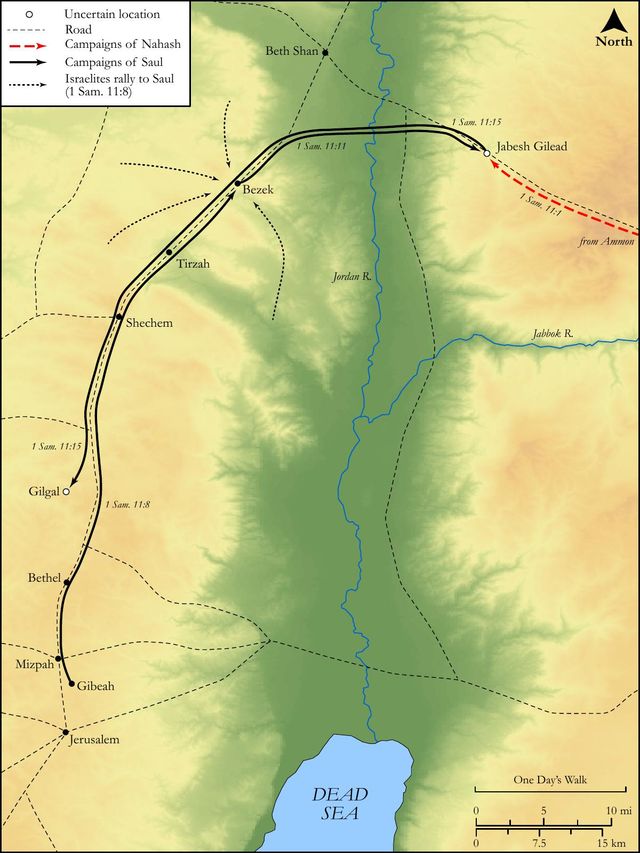
See on the biblical-era map
Study this verse
Public-domain commentary
Matthew Henry
From his Commentary on the Whole Bible. Henry comments on passages, not single verses — this entry covers 1 Samuel 11:1–4. His two-level outline is real structure in the source text, so it is rendered as structure.
The Ammonites were bad neighbours to those tribes of Israel that lay next them, though descendants from just Lot, and, for that reason, dealt civilly with by Israel. See Deu 2:19. Jephthah, in his time, had humbled them, but now the sin of Israel had put them into a capacity to make head again, and avenge that quarrel. The city of Jabesh-Gilead had been, some ages ago, destroyed by Israel's sword of justice, for not appearing against the wickedness of Gibeah (Jdg 21:10); and now being replenished again, probably by the posterity of those that then escaped the sword, it is in danger of being destroyed by the Ammonites, as if some bad fate attended the place. Nahash, king of Ammon (Ch1 19:1) laid siege to it. Now here,
I.The besieged beat a parley (Sa1 11:1):
"Make a covenant with us, and we will surrender upon terms, and serve thee." They had lost the virtue of Israelites, else they would not have thus lost the valour of Israelites, nor tamely yielded to serve an Ammonite, without one bold struggle for themselves. Had they not broken their covenant with God, and forsaken his service, they needed not thus to have courted a covenant with a Gentile nation, and offered themselves to serve them.
II.The besiegers offer them base and barbarous conditions; they will spare their lives, and take them to be their servants, upon condition that they shall put out their right eyes, Sa1 11:2. The Gileadites were content to part with their liberty and estates for the ransom of their blood; and, had the Ammonites taken them at their word, the matter would have been so settled immediately, and the Gileadites would not have sent out for relief. But their abject concessions make the Ammonites more insolent in their demands, and they cannot be content to have them for their servants, but,
1.They must torment them, and put them to pain, exquisite pain, for so the thrusting out of an eye would do.
2.They must disable them for war, and render them incapable, though not of labour (that would have been a loss to their lords), yet of bearing arms; for in those times they fought with shields in their left hands, which covered their left eye, so that a soldier without his right eye was in effect blind.
3.They must put a reproach upon all Israel, as weak and cowardly, that would suffer the inhabitants of one of their chief cities to be thus miserably used, and not offer to rescue them.
III.The besieged desire, and obtain, seven days' time to consider of this proposal, Sa1 11:3.
If Nahash had not granted them this respite, we may suppose the horror of the proposal would have made them desperate, and they would rather have died with their swords in their hands than have surrendered to such merciless enemies: therefore Nahash, not imagining it possible that, in so short a time, they should have relief, and being very secure of the advantages he thought he had against them, in a bravado gave them seven days, that the reproach upon Israel, for not rescuing them, might be the greater, and his triumphs the more illustrious. But there was a providence in it, that his security might be his infatuation and ruin.
IV.Notice is sent of this to Gibeah.
They said they would send messengers to all the coasts of Israel (Sa1 11:3), which made Nahash the more secure, for that, he thought, would be a work of time, and none would be forward to appear if they had not one common head; and perhaps Nahash had not yet heard of the new-elected king. But the messengers, either of their own accord or by order from their masters, went straight to Gibeah, and, not finding Saul within, told their news to the people, who fell a weeping upon hearing it, Sa1 11:4. They would sooner lament their brethren's misery and danger than think of helping them, shed their tears for them than shed their blood. They wept, as despairing to help the men of Jabesh-Gilead, and fearing lest, if that frontier-city should be lost, the enemy would penetrate into the very bowels of their country, which now appeared in great hazard.
Historical interpretation
Historical reception
1 surviving comment on this verse from the historical church.
And all the men of Jabesh said to Nahash, etc. Many faithful men of the Church, united in true love, often consented to serve humbly by obeying teachers, whom they esteemed as wise as serpents in frequent meditation on the Scriptures; but they did not fail to be as doves in keeping ecclesiastical peace. However, because there is nothing hidden that will not be revealed, the fabricators of errors and cultivators of perverse doctrines continually revealed themselves, showing that they did not have the enlightened eyes of the heart, nor could it be said of them, "Your eyes are like doves" (Cant. II); but rather they desired to remove the right eyes from all their listeners, that is, the senses of heavenly and supreme contemplation, and to deflect them to see only the left and perverse things, rendering them impotent in the daily battle we wage against spiritual wickedness in high places. For this reason Nahash wanted to gouge out the right eyes of the Jabeites, so that while they covered the left side of their faces with shields in battle, they would not be able to see what they should do against the enemy, or for their own salvation. For this reason the ancient enemy tries to deprive the faithful of heavenly light, to render them useless in every spiritual fight.
Continue studying 1 Samuel 11:1 across the web’s major study libraries — every link below opens this exact verse, chapter, or book on the destination site.
Read & Compare
 BibleGatewayThis verse in more than 200 translations and 70 languages.
 Bible.comThe YouVersion reader — hundreds of translations, reading plans, and highlights.
 ESV.orgCrossway's official English Standard Version reader.
 NET BibleThe NET translation with 60,000+ translators' notes on every rendering decision.
 STEP BibleTyndale House's free study tool — original text, vocabulary, and scholarly resources.
 BibliaLogos Bible Software's free web reader.
 USCCBThe New American Bible (Revised Edition) with the U.S. bishops' study notes.
Commentaries
 BibleHub CommentariesDozens of classic commentaries on this verse, gathered on one page.
 StudyLightMore than 100 commentary sets — the largest collection on the web.
 BibleRefPlain-English commentary on what this verse means, verse by verse.
 Enduring WordDavid Guzik's free commentary on this chapter, widely used by Bible teachers.
 Bible Study ToolsVerse commentary alongside Greek and Hebrew study aids.
Original Language & Research
- BibleHub InterlinearThe verse word by word — original language, transliteration, and English.
- BibleHub LexiconEvery word's original-language definition and Strong's entry.
 Blue Letter BibleDeep-study tools — Strong's numbers, concordance, and word studies.
 SefariaThe Hebrew text with Rashi and centuries of Jewish commentary.
Sermons, Hymns & Audio


TrulyRandomVerse is not affiliated with these sites and doesn’t control their content. They’re linked because they’re genuinely useful.
Summary
First Samuel 11:1 introduces a pivotal moment in Israel's nascent monarchy, depicting the aggressive siege of Jabesh-Gilead by Nahash the Ammonite. This verse immediately establishes a severe national crisis, as the vulnerable inhabitants of Jabesh-Gilead, faced with overwhelming military might, desperately offer to enter into a covenant of submission and servitude to Nahash. This dire predicament serves as the urgent catalyst that compels King Saul to step into his divinely appointed role and demonstrate the leadership necessary to deliver his people.
Context
ShowHideLiterary Context
This verse marks a dramatic shift in the narrative following Saul's anointing and public acclamation as king at Mizpah in 1 Samuel 10. Despite being chosen by God and confirmed by the people, Saul has not yet fully embraced or demonstrated his kingly authority; he is depicted returning to his agricultural pursuits, indicating a period of quietude and perhaps a lack of immediate, pressing royal duties. The sudden and brutal threat posed by Nahash the Ammonite in 1 Samuel 11:1 shatters this calm, providing the urgent crisis that forces Saul to activate his leadership. This event is crucial for solidifying his reign and demonstrating God's empowerment, as his decisive response and subsequent victory will rally the tribes and confirm his kingship in the eyes of all Israel, setting the stage for the narrative of Saul's early reign.
Historical & Cultural Context
The Ammonites, descendants of Lot through his younger daughter (Genesis 19:38), were perennial adversaries of Israel, particularly for the tribes situated east of the Jordan River. Their history with Israel is replete with territorial disputes and military conflicts, as evidenced during the period of the Judges when they oppressed Israel for eighteen years (Judges 10:7-9). Nahash, a name meaning "serpent," was likely a dynastic name for Ammonite kings, symbolizing their aggressive and insidious nature. Jabesh-Gilead, located in the Transjordanian territory of Gad, occupied a vulnerable position on the frontier. Furthermore, its population had been severely depleted in a devastating civil war against the other Israelite tribes (the Benjamite War, detailed in Judges 21), leaving it with a reduced and isolated populace. This historical trauma and geographical exposure likely contributed to their immediate willingness to negotiate terms of surrender rather than mount a defense, a course the Gibeonites also took before Joshua when they said, "We are your servants: therefore now make ye a league with us," to avoid complete annihilation.
Key Themes
ShowHideThe opening of 1 Samuel 11:1 immediately introduces several profound themes. Foremost is the crisis of leadership in Israel; despite having a king, the nation faces an existential threat, underscoring that human leadership alone is insufficient without divine empowerment and direction. The desperation of Jabesh-Gilead highlights the theme of vulnerability and the search for security, revealing humanity's innate tendency to seek immediate, often compromising, solutions when confronted by overwhelming fear. This verse also sets the stage for the demonstration of God's chosen king, as Saul's Spirit-empowered response to this crisis will not only validate his anointing but also establish his authority, showcasing God's sovereign provision for His people through a divinely appointed leader, as dramatically unfolded in 1 Samuel 11:6-11.
Exposition and Analysis
ShowHideKey Word Analysis
ShowHideMeaning "serpent." This name for the Ammonite king is highly symbolic, immediately associating him with cunning, deception, and malevolence, as serpents are often depicted in biblical narratives (e.g., Genesis 3). The name itself foreshadows the cruel and humiliating terms Nahash will propose in the subsequent verse, emphasizing the insidious nature of his aggression against Jabesh-Gilead.
Meaning "to incline; by implication, to decline (of the slanting rays of evening); specifically, to pitch a tent; gen. to encamp (for abode or siege)." In this context, it denotes a military siege, where an army establishes a camp around a city to cut off supplies, isolate its inhabitants, and eventually force surrender through starvation or direct assault. This action signifies a deliberate and sustained act of hostility.
Meaning "a compact (because made by passing between pieces of flesh); confederacy, (con-) feder(-ate), covenant, league." While bᵉrîyth typically refers to a solemn, binding agreement, often with sacred or divine implications, its use here describes a forced pact of submission rather than a mutually beneficial treaty. The men of Jabesh-Gilead are not seeking an alliance but a desperate surrender, hoping to secure their lives at the cost of their freedom and dignity. This "covenant" is a plea to be made servants, where the weaker party submits entirely to the will of the stronger.
Meaning "to work (in any sense); by implication, to serve, till, (causatively) enslave." The phrase "we will serve thee" explicitly signifies a willingness to enter into servitude as tributaries. This would entail paying tribute, obeying the Ammonite king's decrees, and potentially providing forced labor or military support. It underscores the profound fear and utter desperation of the men of Jabesh-Gilead, who are prepared to relinquish their autonomy and become subjects of a foreign, hostile power to preserve their lives.
Verse Breakdown
ShowHide"¶ Then Nahash the Ammonite came up, and encamped against Jabeshgilead:"
This opening clause immediately introduces the antagonist, Nahash, identified by his ethnicity as an Ammonite, a long-standing enemy of Israel. The phrase "came up" suggests a military advance, possibly an ascent over terrain or a movement into Israelite territory. "Encamped against" clearly indicates a siege, a common military tactic designed to isolate and starve a city into submission. Jabesh-Gilead, a vulnerable Israelite city located east of the Jordan, is the direct target, highlighting its strategic importance or its perceived weakness and isolation.
"and all the men of Jabesh said unto Nahash, Make a covenant with us, and we will serve thee."
This second clause reveals the immediate and desperate reaction of the besieged city. Instead of preparing for defense or seeking assistance from their newly appointed king, the men of Jabesh-Gilead directly address Nahash. Their plea to "Make a covenant with us" is not a request for a treaty between equals but an offer of unconditional surrender. The accompanying phrase, "and we will serve thee," explicitly clarifies their willingness to become his servants, subject to Nahash's rule and demands. This demonstrates their profound fear and perceived lack of any viable alternative to avoid complete destruction.
Literary Devices
ShowHideThe verse employs several impactful literary devices. The In medias res opening immediately plunges the reader into the midst of a crisis, generating tension and urgency without extensive preamble. The naming of Nahash ("serpent") functions as powerful symbolism, instantly signaling the malevolent, cunning, and dangerous nature of the antagonist, aligning him with biblical motifs of evil and deception. The phrase "encamped against Jabeshgilead" serves as potent foreshadowing, indicating the impending conflict and the dire situation the city faces, which will necessitate a dramatic intervention. The men of Jabesh-Gilead's swift offer to "make a covenant" and "serve thee" presents a poignant example of irony, as the very people who should be trusting in God's deliverance through their recently anointed king are instead seeking a humiliating and potentially destructive peace with an enemy. This highlights their immediate fear and apparent lack of faith or awareness of Saul's new status, setting up a dramatic contrast with Saul's Spirit-empowered and courageous response in the subsequent verses.
Theological and Thematic Connections
ShowHideThis initial encounter between Nahash and Jabesh-Gilead serves as a stark reminder of Israel's persistent vulnerability without strong, God-ordained leadership and their human tendency to compromise when faced with overwhelming fear. The immediate willingness of Jabesh-Gilead to "serve" a pagan king underscores the theological principle that true security and lasting deliverance come from trusting in Yahweh and His appointed instruments, not from human negotiation or capitulation to evil. It highlights the ongoing tension between human weakness and divine strength, setting the stage for God to dramatically demonstrate His faithfulness through Saul, thereby validating His choice of king for His people and revealing His ongoing commitment to His covenant with Israel.
Reflection and Application
ShowHideThe desperate plea of Jabesh-Gilead in 1 Samuel 11:1 resonates deeply with the human condition. Faced with overwhelming threats—whether physical, financial, relational, or spiritual—our initial instinct can often be to seek the path of least resistance, to compromise our values, or to surrender to circumstances rather than trusting in God's power and provision. This verse challenges us to critically examine where we place our ultimate hope and security. Do we, like the men of Jabesh-Gilead, immediately look to human solutions or capitulation when confronted with fear, or do we remember that God often uses crises as profound opportunities to demonstrate His sovereignty and to raise up leaders or empower His people for courageous action? This narrative reminds us that even when our resources seem depleted, our options limited, and our future uncertain, God is able to provide miraculous deliverance and reveal His strength through unexpected means, often through those He has prepared and equipped for such a time. Our response to overwhelming challenges reveals the true object of our faith.
Questions for Reflection
ShowHideFAQ
ShowHideWhy did the men of Jabesh-Gilead immediately offer to "serve" Nahash instead of fighting or seeking help?
ShowHideThe men of Jabesh-Gilead were in an extremely vulnerable position, both geographically and historically. Located east of the Jordan River, they were frequently exposed to attacks from eastern peoples like the Ammonites. More significantly, their city had been nearly annihilated in a past civil war among the Israelite tribes (Judges 21:8-10). This traumatic history likely left them with a diminished population, limited military capacity, and a profound sense of isolation and vulnerability. Faced with a powerful besieging army, their immediate offer of surrender and servitude was a desperate, pragmatic attempt to preserve their lives and avoid the complete destruction that often accompanied prolonged sieges. They may also not have been aware of Saul's recent anointing or believed he could provide timely and effective assistance.
What was the nature of the "covenant" they proposed?
ShowHideThe "covenant" (Hebrew: bᵉrîyth) proposed by the men of Jabesh-Gilead was not a league between equals but an offer of unconditional surrender, leading to servitude. In practice, this meant they would become a subject city, obligated to pay tribute (taxes), provide forced labor or military service, and obey the Ammonite king's decrees. The phrase "we will serve thee" explicitly indicates their willingness to become subservient to Nahash, relinquishing their autonomy and dignity in exchange for their lives. The true, cruel nature of Nahash's terms for this "covenant" is revealed in 1 Samuel 11:2, demonstrating that his intent was not merely to establish servitude but to inflict humiliation and control.
Christ-Centered Fulfillment
ShowHideThe desperate situation of Jabesh-Gilead and their plea for a covenant of submission to Nahash profoundly foreshadows humanity's own spiritual predicament. Trapped by the pervasive power of sin and facing the oppressive dominion of spiritual enemies, humanity is utterly helpless, often seeking to "make a covenant" with lesser powers or compromise with evil in a futile attempt to save itself. However, just as Saul, empowered by the Spirit of God, arose as a divinely appointed deliverer for Israel from a physical enemy, so too does Jesus Christ emerge as the ultimate, Spirit-empowered King and Deliverer. He is the true Son of David, the Anointed One who confronts and decisively defeats the oppressive powers of sin, death, and the devil. Unlike the temporary and flawed deliverance offered by human kings like Saul, Christ offers a perfect and eternal salvation, not through a humiliating covenant of submission to an enemy, but through a new covenant of grace and redemption forged by His own sacrificial death on the cross (Jeremiah 31:31-34 and Hebrews 8:6-13). He is the Lamb of God who takes away the sin of the world, delivering us from the dominion of darkness and transferring us into His glorious kingdom (Colossians 1:13-14). In Christ, we find not a humiliating surrender, but a victorious freedom and a King who truly serves His people by laying down His life for them (Mark 10:45).