


1 Samuel 11:4
Bible text: King James Version (1769 Blayney text) · Public domain
Bible text: King James Version with Strong's numbers · Public domain
Bible text: Berean Standard Bible · Public domain
Bible text: American Standard Version (1901) · Public domain
Bible text: World English Bible, Messianic edition · Public domain
Bible text: Geneva Bible (1599) · Public domain
Bible text: Young's Literal Translation · Public domain
- וַיָּבֹאוּvai·ya·Vo·'uand they cameH935Conj-w ¦ V-Qal-ConsecImperf-3mpVerb Qal Consecutive Imperfect 3rd Plural Masculineוַandיָּבֹאוּthey came
- הַמַּלְאָכִיםha·mal·'a·Khimthe messengersH4397Art ¦ N-mpNoun Plural Masculine Absoluteהַtheמַּלְאָכִיםmessengers
- גִּבְעַתgiv·'AtGibeah ofH1390N-fscNoun Singular Feminine Construct
- שָׁאוּלsha·'UlSaulH7586N-proper-mNoun Proper Masculine
- וַיְדַבְּרוּvay·da·be·Ruand they spokeH1696Conj-w ¦ V-Piel-ConsecImperf-3mpVerb Piel Consecutive Imperfect 3rd Plural Masculineוַandיְדַבְּרוּthey spoke
- הַדְּבָרִיםha·de·va·Rimthe wordsH1697Art ¦ N-mpNoun Plural Masculine Absoluteהַtheדְּבָרִיםwords
- בְּאָזְנֵיbe·'a·ze·Neiin [the] ears ofH241Prep-b ¦ N-fdcNoun Dual Feminine Constructבְּinאָזְנֵי[the] ears of
- הָעָםha·'Amthe peopleH5971Art ¦ N-msNoun Singular Masculine Absoluteהָtheעָםpeople
- וַיִּשְׂאוּvai·yis·'Uand they lifted upH5375Conj-w ¦ V-Qal-ConsecImperf-3mpVerb Qal Consecutive Imperfect 3rd Plural Masculineוַandיִּשְׂאוּthey lifted up
- כָלkholallH3605N-mscNoun Singular Masculine Construct
- הָעָםha·'Amthe peopleH5971Art ¦ N-msNoun Singular Masculine Absoluteהָtheעָםpeople
- אֶת'et<obj.>H853DirObjMParticle Object Indicator
- קוֹלָםko·Lamtheir voiceH6963N-msc ¦ 3mpNoun Singular Masculine Constructקוֹלָvoiceםtheir
- וַיִּבְכּוּvai·yiv·Kuand they weptH1058Conj-w ¦ V-Qal-ConsecImperf-3mpVerb Qal Consecutive Imperfect 3rd Plural Masculineוַandיִּבְכּוּthey wept
English is a literal word-by-word gloss of the Hebrew, not the KJV's wording. Why?
This is the original text the KJV's translators worked from — each Hebrew word with its own literal English meaning in this verse, prepared by scholars at Tyndale House, Cambridge. The KJV translates whole sentences, not word by word, so its wording differs: one Hebrew word can become several English words, and the KJV may choose “the LORD” where the gloss reads “Yahweh”. Both are faithful — they answer different questions. For the KJV's own rendering, switch to the KJV text.
Details
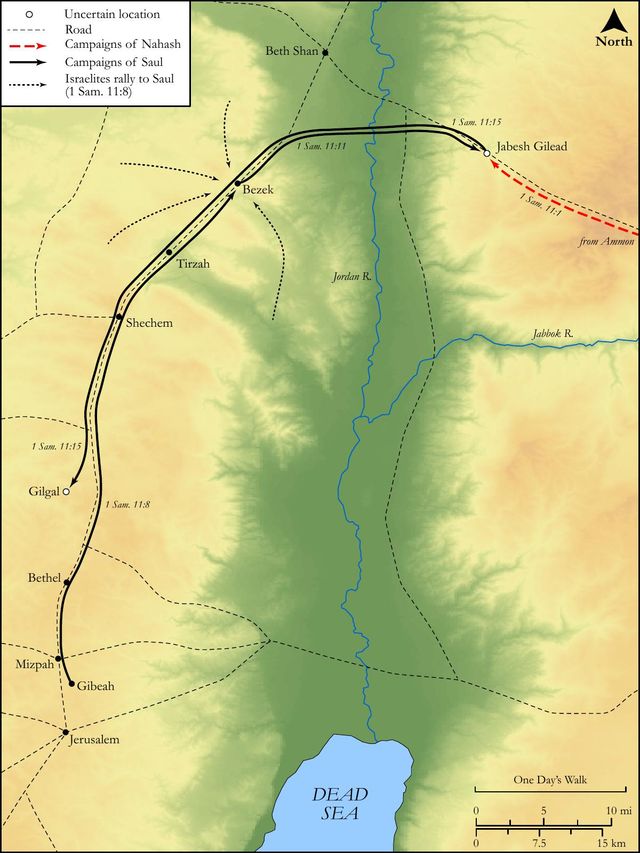
See on the biblical-era map
Study this verse
Public-domain commentary
Matthew Henry
From his Commentary on the Whole Bible. Henry comments on passages, not single verses — this entry covers 1 Samuel 11:1–4. His two-level outline is real structure in the source text, so it is rendered as structure.
The Ammonites were bad neighbours to those tribes of Israel that lay next them, though descendants from just Lot, and, for that reason, dealt civilly with by Israel. See Deu 2:19. Jephthah, in his time, had humbled them, but now the sin of Israel had put them into a capacity to make head again, and avenge that quarrel. The city of Jabesh-Gilead had been, some ages ago, destroyed by Israel's sword of justice, for not appearing against the wickedness of Gibeah (Jdg 21:10); and now being replenished again, probably by the posterity of those that then escaped the sword, it is in danger of being destroyed by the Ammonites, as if some bad fate attended the place. Nahash, king of Ammon (Ch1 19:1) laid siege to it. Now here,
I.The besieged beat a parley (Sa1 11:1):
"Make a covenant with us, and we will surrender upon terms, and serve thee." They had lost the virtue of Israelites, else they would not have thus lost the valour of Israelites, nor tamely yielded to serve an Ammonite, without one bold struggle for themselves. Had they not broken their covenant with God, and forsaken his service, they needed not thus to have courted a covenant with a Gentile nation, and offered themselves to serve them.
II.The besiegers offer them base and barbarous conditions; they will spare their lives, and take them to be their servants, upon condition that they shall put out their right eyes, Sa1 11:2. The Gileadites were content to part with their liberty and estates for the ransom of their blood; and, had the Ammonites taken them at their word, the matter would have been so settled immediately, and the Gileadites would not have sent out for relief. But their abject concessions make the Ammonites more insolent in their demands, and they cannot be content to have them for their servants, but,
1.They must torment them, and put them to pain, exquisite pain, for so the thrusting out of an eye would do.
2.They must disable them for war, and render them incapable, though not of labour (that would have been a loss to their lords), yet of bearing arms; for in those times they fought with shields in their left hands, which covered their left eye, so that a soldier without his right eye was in effect blind.
3.They must put a reproach upon all Israel, as weak and cowardly, that would suffer the inhabitants of one of their chief cities to be thus miserably used, and not offer to rescue them.
III.The besieged desire, and obtain, seven days' time to consider of this proposal, Sa1 11:3.
If Nahash had not granted them this respite, we may suppose the horror of the proposal would have made them desperate, and they would rather have died with their swords in their hands than have surrendered to such merciless enemies: therefore Nahash, not imagining it possible that, in so short a time, they should have relief, and being very secure of the advantages he thought he had against them, in a bravado gave them seven days, that the reproach upon Israel, for not rescuing them, might be the greater, and his triumphs the more illustrious. But there was a providence in it, that his security might be his infatuation and ruin.
IV.Notice is sent of this to Gibeah.
They said they would send messengers to all the coasts of Israel (Sa1 11:3), which made Nahash the more secure, for that, he thought, would be a work of time, and none would be forward to appear if they had not one common head; and perhaps Nahash had not yet heard of the new-elected king. But the messengers, either of their own accord or by order from their masters, went straight to Gibeah, and, not finding Saul within, told their news to the people, who fell a weeping upon hearing it, Sa1 11:4. They would sooner lament their brethren's misery and danger than think of helping them, shed their tears for them than shed their blood. They wept, as despairing to help the men of Jabesh-Gilead, and fearing lest, if that frontier-city should be lost, the enemy would penetrate into the very bowels of their country, which now appeared in great hazard.
Historical interpretation
Historical reception
1 surviving comment on this verse from the historical church.
Therefore, messengers came to Gibeah of Saul, etc. Messengers sent out of necessity of the faith came to Jerusalem, or some other notable city of the faith, in which it was not doubtful that the Lord reigned; and they narrated to themselves that the Church was disturbed by heresy. Hearing this, all the people of correct belief testified to the pain of their innermost heart with tears and weeping; as has often happened, anyone who has read the church's history will find.
Continue studying 1 Samuel 11:4 across the web’s major study libraries — every link below opens this exact verse, chapter, or book on the destination site.
Read & Compare
 BibleGatewayThis verse in more than 200 translations and 70 languages.
 Bible.comThe YouVersion reader — hundreds of translations, reading plans, and highlights.
 ESV.orgCrossway's official English Standard Version reader.
 NET BibleThe NET translation with 60,000+ translators' notes on every rendering decision.
 STEP BibleTyndale House's free study tool — original text, vocabulary, and scholarly resources.
 BibliaLogos Bible Software's free web reader.
 USCCBThe New American Bible (Revised Edition) with the U.S. bishops' study notes.
Commentaries
 BibleHub CommentariesDozens of classic commentaries on this verse, gathered on one page.
 StudyLightMore than 100 commentary sets — the largest collection on the web.
 BibleRefPlain-English commentary on what this verse means, verse by verse.
 Enduring WordDavid Guzik's free commentary on this chapter, widely used by Bible teachers.
 Bible Study ToolsVerse commentary alongside Greek and Hebrew study aids.
Original Language & Research
- BibleHub InterlinearThe verse word by word — original language, transliteration, and English.
- BibleHub LexiconEvery word's original-language definition and Strong's entry.
 Blue Letter BibleDeep-study tools — Strong's numbers, concordance, and word studies.
 SefariaThe Hebrew text with Rashi and centuries of Jewish commentary.
Sermons, Hymns & Audio


TrulyRandomVerse is not affiliated with these sites and doesn’t control their content. They’re linked because they’re genuinely useful.
Summary
1 Samuel 11:4 captures the immediate and profound despair of the people of Gibeah upon receiving the devastating news of Nahash the Ammonite's brutal ultimatum to Jabesh-Gilead. This verse vividly portrays a community overwhelmed by fear and helplessness, collectively expressing their anguish through loud, unrestrained weeping, a desperate cry that underscores the gravity of Israel's crisis and sets the stage for divine intervention and the emergence of Saul as their deliverer.
Context
ShowHideLiterary Context
This verse serves as a crucial narrative pivot, immediately following the dire situation described in 1 Samuel 11:1-3. The inhabitants of Jabesh-Gilead, under siege by Nahash the Ammonite, had been given a horrific ultimatum: surrender and have their right eyes gouged out. They requested seven days to seek a deliverer, dispatching messengers throughout Israel. The arrival of these messengers in Gibeah, Saul's hometown, with these "tidings" (news) immediately precipitates the intense emotional outburst described in 1 Samuel 11:4. This collective lamentation serves to underscore the gravity of the threat and to highlight Israel's desperate need for a leader, directly preceding Saul's Spirit-empowered response in 1 Samuel 11:6. The narrative skillfully builds tension, moving from a specific local crisis to a widespread national emergency, culminating in Saul's decisive action as God's chosen king.
Historical & Cultural Context
The period of 1 Samuel marks a pivotal transition in Israel's history, moving from the decentralized tribal system of the Judges to a centralized monarchy. During this era, Israel frequently faced existential threats from surrounding nations such as the Ammonites, Philistines, and Moabites, often lacking unified leadership. The practice of gouging out eyes was a brutal act of humiliation and incapacitation in war, designed to break the spirit of a conquered people, render them militarily useless, and serve as a stark warning to others, as when the Philistines took Samson and put out his eyes. The collective weeping and lamentation observed in Gibeah was a culturally recognized and powerful expression of communal grief, fear, and despair in response to overwhelming calamity. It was not merely private sorrow but a public, audible outpouring, often indicative of a desperate plea for divine or human intervention. The absence of a strong, unified central authority, a recurring theme in the Book of Judges, left individual communities vulnerable, making the news from Jabesh-Gilead particularly terrifying and highlighting the urgent need for a king.
Key Themes
ShowHideThis verse powerfully contributes to several overarching themes in 1 Samuel. Firstly, it emphasizes Israel's vulnerability and desperate need for a king, a theme introduced in 1 Samuel 8. The people's weeping is a raw expression of their perceived helplessness without a strong leader to protect them from such atrocities. Secondly, it highlights the theme of divine deliverance in response to human distress. Much like the pattern in the Book of Judges where God raises up deliverers when Israel cries out (e.g., Judges 3:9), this collective lamentation sets the stage for God's Spirit to empower Saul. Thirdly, it underscores the burden of leadership and the immediate challenges facing the newly anointed King Saul, providing the context for his first major act of national leadership and demonstrating God's anointing upon him for this specific purpose of protecting His people.
Exposition and Analysis
ShowHideKey Word Analysis
ShowHideThis primitive root means "to go or come" in a wide variety of applications, often implying arrival or entry. In this context, it signifies the direct and impactful arrival of the messengers, bringing the news of the crisis to Gibeah. Their coming is not incidental but purposeful, setting in motion the chain of events that follow.
This root means "to lift" or "to bear," with a vast array of applications including raising, exalting, or carrying. When combined with "voices," it forms an idiom signifying a loud, audible, and often collective outcry. It denotes an unrestrained, public expression of emotion, indicating the profound intensity of the people's reaction.
This word refers to a "voice" or "sound," encompassing anything from a whisper to a thunderous roar. In conjunction with "lifted up," it emphasizes the audible and widespread nature of the people's lamentation. It was not a quiet, private sorrow but a communal wail that would have resonated throughout the town, signaling deep distress.
This primitive root signifies "to weep" or "to bemoan," often implying deep emotional sorrow accompanied by tears. When combined with the "lifting up of voices," it emphasizes the profound and overwhelming nature of the people's grief. This verb speaks to a visceral, communal outpouring of anguish, a sign of their utter helplessness and a desperate plea for relief in the face of the horrific tidings.
Verse Breakdown
ShowHide"Then came the messengers to Gibeah of Saul,"
This clause establishes the immediate geographical and personal connection to Saul. Gibeah was Saul's hometown, where he had returned after his anointing and public recognition as king (1 Samuel 10:26). The arrival of the messengers from Jabesh-Gilead directly to his community underscores the urgency and the expectation that a deliverer might emerge from among them, or that the newly appointed king himself would respond to this national crisis.
"and told the tidings in the ears of the people:"
This phrase highlights the direct, public, and impactful dissemination of the horrific news. The "tidings" (or "word" in Hebrew, dâbâr) were not merely whispered but proclaimed, ensuring that the full weight of Nahash's brutal ultimatum and Jabesh-Gilead's desperate plight was understood by everyone present. The phrase "in the ears of the people" emphasizes the immediate, direct, and communal reception of the message, leaving no one untouched by its implications.
"and all the people lifted up their voices, and wept."
This final clause describes the immediate, collective, and overwhelming emotional response. The phrase "all the people" signifies a unanimous and widespread reaction, indicating the depth of the crisis and the shared sense of vulnerability that permeated the entire community. Their loud, unrestrained weeping is a powerful, visceral expression of despair, fear, and perhaps a silent, desperate plea for divine intervention, setting the stage for Saul's Spirit-empowered response in the subsequent verses.
Literary Devices
ShowHideThe verse employs several powerful literary devices to convey the gravity of the situation and the depth of the people's distress. The most prominent is Pathos, as the narrative masterfully evokes deep pity and sorrow in the reader by depicting the raw, collective despair of an entire community. The phrase "lifted up their voices, and wept" is a vivid example of Hyperbole or Intensification, emphasizing the extreme and widespread nature of their grief, suggesting a wail of anguish that permeated the entire town and left no one unaffected. This collective expression also serves as a powerful instance of Collective Action, highlighting the unified response of the people, which underscores their shared vulnerability and desperate need for strong, decisive leadership. Furthermore, this scene functions as potent Foreshadowing, as the profound despair and weeping directly precede and necessitate Saul's dramatic, Spirit-empowered intervention, setting the stage for his first significant act as king and demonstrating God's provision for His people in their moment of acute distress.
Theological and Thematic Connections
ShowHideThis verse vividly portrays the human experience of profound despair and helplessness in the face of overwhelming evil, a recurring theme throughout biblical history. The collective weeping of the people of Gibeah is a primal cry for deliverance, echoing the laments of Israel throughout its history when under oppression. Theologically, it underscores God's attentiveness to the cries of His people, often moving to raise up deliverers in moments of national crisis. This moment of deep distress serves as a crucible, preparing the way for the manifestation of divine power through a chosen leader, demonstrating that even in the darkest hours, God's plan for His people's salvation is at work. Their tears are a form of lament that often precedes divine intervention.
Reflection and Application
ShowHideThe scene in Gibeah reminds us that despair is a natural, human response to overwhelming threats and seemingly impossible situations. It illustrates how moments of collective crisis can lay bare our deepest needs—for strong, compassionate leadership, for unity, and ultimately, for divine intervention. For believers, this verse offers a profound lesson: our tears and cries of anguish are not unnoticed by God. Often, it is in the depths of our despair, when we have exhausted all human solutions, that God's power is most clearly manifested. This should encourage us to bring our fears and anxieties before God, trusting that He hears our cries and is able to raise up instruments of deliverance, whether through human leaders, community action, or direct supernatural intervention. It also calls us to cultivate empathy for those who are suffering, recognizing that collective distress can often precede a powerful move of God, transforming sorrow into a testimony of His faithfulness and power. Our lament, far from being a sign of weakness, can be a profound act of faith, acknowledging our dependence on God.
Questions for Reflection
ShowHideFAQ
ShowHideWhy did the people of Gibeah weep so intensely, and what does it signify?
ShowHideThe people of Gibeah wept intensely because the messengers brought news of a horrific ultimatum from Nahash the Ammonite to their fellow Israelites in Jabesh-Gilead: surrender and have their right eyes gouged out. This was not just a threat of defeat but of profound humiliation and incapacitation, a fate that could easily befall them next. Their weeping, described as "lifting up their voices," signifies a deep, collective outpouring of fear, despair, and anguish. It reflects their profound sense of vulnerability and helplessness in the face of such a brutal enemy, highlighting the absence of a strong, unified leader to protect Israel. It was a culturally recognized expression of extreme sorrow and a desperate cry for deliverance, setting the stage for Saul's divinely empowered response in 1 Samuel 11:6, demonstrating that their distress was heard and would be answered.
Christ-Centered Fulfillment
ShowHideWhile 1 Samuel 11:4 depicts the people's despair and their immediate need for a human deliverer in Saul, it ultimately points to the greater, eternal need for a perfect and eternal King. The weeping of Gibeah foreshadows the profound sorrow and brokenness of humanity under the dominion of sin, awaiting a true deliverer from a far more pervasive and destructive enemy. Just as Saul was empowered by the Spirit of God to bring salvation to Israel from the Ammonites, Jesus Christ, the ultimate King and Son of God, came empowered by the Holy Spirit to deliver humanity from the far greater oppression of sin and death. His arrival brought comfort to those who "weep" over their spiritual bondage and the brokenness of the world, as prophesied in Isaiah 61:1-3. The tears shed in Gibeah find their ultimate answer not in a temporary military victory, but in the redemptive work of Christ on the cross, where He bore the weight of human despair and offered eternal hope and freedom. He is the one who ultimately "wipes away every tear from their eyes" (Revelation 21:4), transforming the lament of a fallen world into the everlasting joy of salvation and the promise of a new heaven and new earth.