


1 Samuel 30:4
Bible text: King James Version (1769 Blayney text) · Public domain
Bible text: Berean Standard Bible · Public domain
Bible text: American Standard Version (1901) · Public domain
Bible text: World English Bible, Messianic edition · Public domain
Bible text: Geneva Bible (1599) · Public domain
Bible text: Young's Literal Translation · Public domain
- וַיִּשָּׂאvai·yi·Sa'and he lifted upH5375Conj-w ¦ V-Qal-ConsecImperf-3msVerb Qal Consecutive Imperfect 3rd Singular Masculineוַandיִּשָּׂאhe lifted up
- דָוִדda·VidDavidH1732N-proper-mNoun Proper Masculine
- וְהָעָםve·ha·'Amand the peopleH5971Conj-w ¦ Art ¦ N-msNoun Singular Masculine Absoluteוְandהָtheעָםpeople
- אֲשֶׁר'a·SherwhichH834RelParticle Relative
- אִתּוֹ'i·To[was] with himH854Prep ¦ 3msPreposition Definiteאִתּ[was] withוֹhim
- אֶת'et<obj.>H853DirObjMParticle Object Indicator
- קוֹלָםko·Lamtheir voiceH6963N-msc ¦ 3mpNoun Singular Masculine Constructקוֹלָvoiceםtheir
- וַיִּבְכּוּvai·yiv·Kuand they weptH1058Conj-w ¦ V-Qal-ConsecImperf-3mpVerb Qal Consecutive Imperfect 3rd Plural Masculineוַandיִּבְכּוּthey wept
- עַד'aduntilH5704PrepPreposition
- אֲשֶׁר'a·SherthatH834RelParticle Relative
- אֵין'einnotH369N-mscNoun Singular Masculine Construct
- בָּהֶםba·Hem[was] in <the> themPrep-b ¦ 3mpSuffix Personal 3rd Plural Masculineבָּ[was] in <the>הֶםthem
- כֹּחַKo·achstrengthH3581N-msNoun Singular Masculine Absolute
- לִבְכּוֹתliv·Kotto weepH1058Prep-l ¦ V-Qal-InfVerb Qal Infinitive Constructלִtoבְכּוֹתweep
English is a literal word-by-word gloss of the Hebrew, not the KJV's wording. Why?
This is the original text the KJV's translators worked from — each Hebrew word with its own literal English meaning in this verse, prepared by scholars at Tyndale House, Cambridge. The KJV translates whole sentences, not word by word, so its wording differs: one Hebrew word can become several English words, and the KJV may choose “the LORD” where the gloss reads “Yahweh”. Both are faithful — they answer different questions. For the KJV's own rendering, switch to the KJV text.
Details
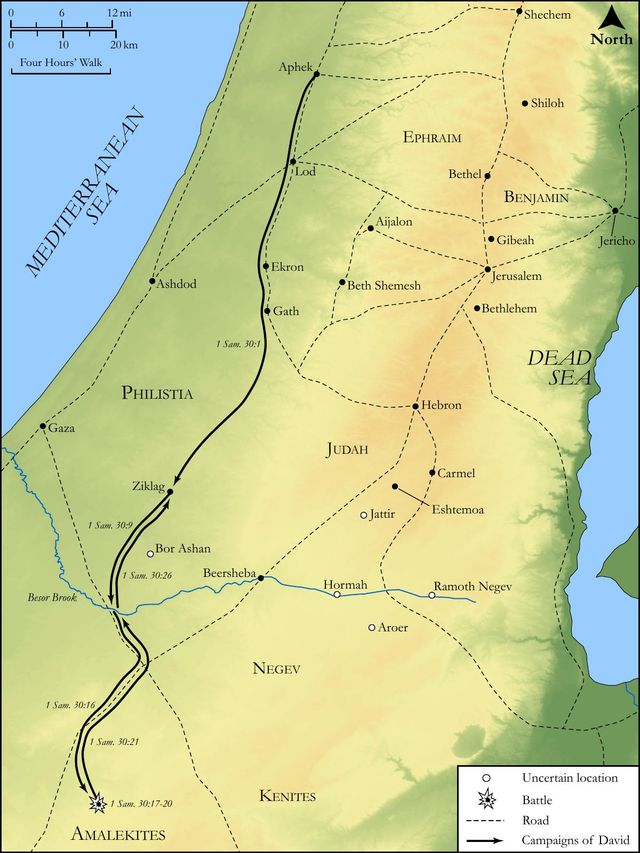
See on the biblical-era map
Study this verse
Public-domain commentary
Matthew Henry
From his Commentary on the Whole Bible. Henry comments on passages, not single verses — this entry covers 1 Samuel 30:1–6. His two-level outline is real structure in the source text, so it is rendered as structure.
Here we have, I. The descent which the Amalekites made upon Ziklag in David's absence, and the desolations they made there. They surprised the city when it was left unguarded, plundered it, burnt it, and carried all the women and children captives, Sa1 30:1, Sa1 30:2. They intended, by this to revenge the like havoc that David had lately made of them and their country, Sa1 27:8. He that had made so many enemies ought not to have left his own concerns so naked and defenceless. Those that make bold with others must expect that others will make as bold with them and provide accordingly. Now observe in this, 1. The cruelty of Saul's pity (as it proved) in sparing the Amalekites; if he had utterly destroyed them, as he ought to have done, these would not have been in being to do this mischief. 2. How David was corrected for being so forward to go with the Philistines against Israel. God showed him that he had better have staid at home and looked after his own business. When we go abroad in the way of our duty we may comfortably hope that God will take care of our families in our absence, but not otherwise. 3. How wonderfully God inclined the hearts of these Amalekites to carry the women and children away captives, and not to kill them. When David invaded them he put all to the sword (Sa1 27:9), and no reason can be given why they did not retaliate upon this city, but that God restrained them; for he has all hearts in his hands, and says to the fury of the most cruel men, Hitherto thou shalt come, and no further. Whether they spared them to lead them in triumph, or to sell them, or to use them for slaves, God's hand must be acknowledged, who designed to make use of the Amalekites for the correction, not for the destruction, of the house of David.
II.The confusion and consternation that David and his men were in when they found their houses in ashes and their wives and children gone into captivity. Three days' march they had from the camp of the Philistines to Ziklag, and now that they came thither weary, but hoping to find rest in their houses and joy in their families, behold a black and dismal scene was presented to them (Sa1 30:3), which made them all weep (David himself not excepted), though they were men of war, till they had no more power to weep, Sa1 30:4. The mention of David's wives, Ahinoam and Abigail, and their being carried captive, intimates that this circumstance went nearer his heart than any thing else. Note, It is no disparagement to the boldest and bravest spirits to lament the calamities of relations and friends. Observe,
1.This trouble came upon them when they were absent. It was the ancient policy of Amalek to take Israel at an advantage.
2.It met them at their return, and, for aught that appears, their own eyes gave them the first intelligence of it. Note, When we go abroad we cannot foresee what evil tidings may meet us when we come home again. The going out may be very cheerful, and yet the coming in be very doleful. Boast not thyself therefore of tomorrow, nor of tonight either, for thou knowest not what a day, or a piece of a day, may bring forth, Pro 27:1. If, when we come off a journey, we find our tabernacles in peace, and not laid waste as David here found his, let the Lord be praised for it.
III.The mutiny and murmuring of David's men against him (Sa1 30:6):
David was greatly distressed, for, in the midst of all his losses, his own people spoke of stoning him,
1.Because they looked upon him as the occasion of their calamities, by the provocation he had given the Amalekites, and his indiscretion in leaving Ziklag without a garrison in it. Thus apt are we, when we are in trouble, to fly into a rage against those who are in any way the occasion of our trouble, while we overlook the divine providence, and have not that regard to the operations of God's hand in it which would silence our passions, and make us patient.
2.Because now they began to despair of that preferment which they had promised themselves in following David. They hoped ere this to have been all princes; and now to find themselves all beggars was such a disappointment to them as made them grow outrageous, and threaten the life of him on whom, under God, they had the greatest dependence. What absurdities will not ungoverned passions plunge men into? This was a sore trial to the man after God's own heart, and could not but go very near him. Saul had driven him from his country, the Philistines had driven him from their camp, the Amalekites had plundered his city, his wives were taken prisoners, and now, to complete his woe, his own familiar friends, in whom he trusted, whom he had sheltered, and who did eat of his bread, instead of sympathizing with him and offering him any relief, lifted up the heel against him and threatened to stone him. Great faith must expect such severe exercises. But it is observable that David was reduced to this extremity just before his accession to the throne. At this very time, perhaps, the stroke was struck which opened the door to his advancement. Things are sometimes at the worst with the church and people of God just before they begin to mend.
IV.David's pious dependence upon the divine providence and grace in this distress:
But David encouraged himself in the Lord his God. His men fretted at their loss. The soul of the people was bitter, so the word is. Their own discontent and impatience added wormwood and gall to the affliction and misery, and made their case doubly grievous. But 1. David bore it better, though he had more reason than any of them to lament it; they gave liberty to their passions, but he set his graces on work, and by encouraging himself in God, while they dispirited each other, he kept his spirit calm and sedate. Or, 2. There may be a reference to the threatening words his men gave out against him. They spoke of stoning him; but he, not offering to avenge the affront, nor terrified by their menaces, encouraged himself in the Lord his God, believed, and considered with application to his present case, the power and providence of God, his justice and goodness, the method he commonly takes of bringing low and then raising up, his care of his people that serve him and trust in him, and the particular promises he had made to him of bringing him safely to the throne; with these considerations he supported himself, not doubting but the present trouble would end well. Note, Those that have taken the Lord for their God may take encouragement from their relation to him in the worst of times. It is the duty and interest of all good people, whatever happens, to encourage themselves in God as their Lord and their God, assuring themselves that he can and will bring light out of darkness, peace out of trouble, and good out of evil, to all that love him and are the called according to his purpose, Rom 8:28. It was David's practice, and he had the comfort of it, What time I am afraid I will trust in thee. When he was at his wits' end he was not at his faith's end.
Continue studying 1 Samuel 30:4 across the web’s major study libraries — every link below opens this exact verse, chapter, or book on the destination site.
Read & Compare
 BibleGatewayThis verse in more than 200 translations and 70 languages.
 Bible.comThe YouVersion reader — hundreds of translations, reading plans, and highlights.
 ESV.orgCrossway's official English Standard Version reader.
 NET BibleThe NET translation with 60,000+ translators' notes on every rendering decision.
 STEP BibleTyndale House's free study tool — original text, vocabulary, and scholarly resources.
 BibliaLogos Bible Software's free web reader.
 USCCBThe New American Bible (Revised Edition) with the U.S. bishops' study notes.
Commentaries
 BibleHub CommentariesDozens of classic commentaries on this verse, gathered on one page.
 StudyLightMore than 100 commentary sets — the largest collection on the web.
 BibleRefPlain-English commentary on what this verse means, verse by verse.
 Enduring WordDavid Guzik's free commentary on this chapter, widely used by Bible teachers.
 Bible Study ToolsVerse commentary alongside Greek and Hebrew study aids.
Original Language & Research
- BibleHub InterlinearThe verse word by word — original language, transliteration, and English.
- BibleHub LexiconEvery word's original-language definition and Strong's entry.
 Blue Letter BibleDeep-study tools — Strong's numbers, concordance, and word studies.
 SefariaThe Hebrew text with Rashi and centuries of Jewish commentary.
Sermons, Hymns & Audio


TrulyRandomVerse is not affiliated with these sites and doesn’t control their content. They’re linked because they’re genuinely useful.
Summary
1 Samuel 30:4 powerfully depicts the overwhelming and physically exhausting grief experienced by David and his 600 men upon their return to Ziklag, only to discover their city burned and their families abducted by the Amalekites. This verse captures a moment of profound, collective lamentation, as they cried out in sorrow until their physical strength was completely depleted, highlighting the raw and relatable human response to catastrophic loss and despair.
Context
ShowHideLiterary Context
This verse immediately follows a devastating discovery. David and his men, having been dismissed from the Philistine army, arrived back at their home in Ziklag to find it utterly destroyed by an Amalekite raid. The preceding verses vividly recount the burning of the city and the abduction of their wives and children, leaving nothing but desolation 1 Samuel 30:1-3. The initial shock and disbelief quickly gave way to an agonizing, communal outpouring of sorrow, as expressed in this verse. This incident represents an absolute nadir for David, who had already endured relentless pursuit by King Saul and years of living as a fugitive 1 Samuel 27. The profound despair described here serves as a critical turning point, setting the stage for David's remarkable act of encouraging himself in the Lord and his subsequent pursuit and recovery of all that was lost 1 Samuel 30:6-8.
Historical & Cultural Context
The practice of raiding settlements and taking captives, particularly women and children, was a brutal and common aspect of warfare among the nations of that day. Such actions were designed to cripple an enemy's future generations, resources, and morale, often leading to enslavement or forced assimilation. Ziklag, having been granted to David by Achish, king of Gath 1 Samuel 27:6, represented David's base of operations and a symbol of his tenuous security. Its destruction was a direct and devastating blow. Culturally, public and intense displays of grief—involving loud wailing, tearing clothes, and prostration—were normative expressions of lament in response to profound loss, death, or disaster. The collective nature of their weeping underscores the deep communal bond and shared suffering among David and his seasoned warriors, a band forged through numerous trials.
Key Themes
ShowHideThis verse profoundly contributes to several overarching themes within the book of Samuel and David's narrative. Firstly, it highlights the Profound Grief and Despair that even the strongest leaders and warriors can experience. It demonstrates the raw, unvarnished reality of human emotion in the face of devastating loss, showing that no one, regardless of their spiritual standing or physical prowess, is immune to deep sorrow. The phrase "lifted up their voice and wept, until they had no more power to weep" vividly portrays an extreme depth of sorrow, indicating a prolonged, physically exhausting outpouring of lamentation. Secondly, it underscores the theme of Shared Suffering and Solidarity, as David, the future king, and his men were united in their grief, forging a deeper bond through collective adversity. This shared experience emphasizes the universal nature of loss and the comfort found in communal lament. Thirdly, and crucially, this moment of utter despair sets the stage for the theme of Divine Sovereignty and David's Dependence on God. While this verse captures a low point, it immediately precedes David's pivotal decision to seek the Lord's guidance 1 Samuel 30:6, illustrating that even in the deepest valleys, faith can emerge, and God's intervention can bring about restoration and renewed strength.
Exposition and Analysis
ShowHideKey Word Analysis
ShowHideA primitive root meaning "to weep" or "to bemoan." This word signifies a deep, audible lamentation, often accompanied by tears and physical expressions of grief. It conveys not just internal sadness but an outward, unrestrained outpouring of sorrow, characteristic of intense mourning in Israel.
Meaning "vigor," "force," "capacity," or "strength." Its use here, "no more power," emphasizes the complete physical and emotional exhaustion that resulted from their prolonged and intense outpouring of sorrow. Their grief had literally drained them of all energy, reaching a point of absolute physical depletion, indicating the extreme and overwhelming nature of their despair.
Meaning "a voice or sound." When combined with "lifted up" (from H5375, nâsâʼ, "to lift"), as in "lifted up their voice," it forms a common Hebrew idiom signifying a loud, communal outcry or wailing. This indicates that their lament was not quiet or private, but a public, audible expression of their profound anguish, heard by all present.
Verse Breakdown
ShowHide"Then David and the people that [were] with him"
This clause establishes the subjects of the action: David, the leader and future king, and his 600 loyal men. This group, composed of seasoned warriors and companions, had followed him through numerous trials, emphasizing their collective identity and shared experience in facing this profound tragedy.
"lifted up their voice and wept,"
This describes the immediate, overwhelming, and public response to their discovery. It signifies a loud, communal wailing, an unrestrained and audible outpouring of grief. The use of both "lifted up their voice" (an idiom for crying aloud) and "wept" emphasizes the intensity, audibility, and depth of their lamentation, a culturally expected expression of profound sorrow in that era.
"until they had no more power to weep."
This final clause vividly portrays the extreme depth, duration, and physical toll of their grief. It means their weeping was so prolonged and intense that it physically exhausted them, draining them of all strength and energy. This is a hyperbolic expression, indicating the utter devastation and despair that consumed them, pushing them to the brink of physical and emotional collapse.
Literary Devices
ShowHideThe verse employs several powerful literary devices to convey the profound despair of David and his men. Hyperbole is strikingly evident in the phrase "until they had no more power to weep," which exaggerates the duration and intensity of their weeping to emphasize the overwhelming nature of their grief. This is not a literal physical inability to produce tears, but rather a vivid depiction of complete emotional and physical exhaustion. Pathos is strongly evoked, drawing the reader into the raw, relatable human experience of devastating loss and sorrow. The vivid Imagery of a collective, loud wailing that continues to the point of utter depletion paints a powerful mental picture of shared suffering. The structure of the phrase "lifted up their voice and wept" also exhibits a form of hendiadys, where two verbs ("lifted up" and "wept") are used to express a single, complex idea—in this case, a single, intense act of audible lamentation and sorrow.
Theological and Thematic Connections
ShowHideThis verse powerfully illustrates the biblical recognition of deep human suffering and the legitimacy of lament before God. It underscores that even righteous leaders and faithful individuals are not immune to overwhelming sorrow and despair. The shared grief of David and his men highlights the communal aspect of suffering and the importance of solidarity in times of crisis, demonstrating that lament is not merely an individual act but can be a collective outpouring of a broken heart. This profound moment of despair, however, is not the end of the story; it serves as a crucible that prepares David for a renewed turning to God, demonstrating how God can use even our lowest points to draw us closer to Him and reveal His sustaining power and faithfulness.
Reflection and Application
ShowHide1 Samuel 30:4 offers profound insights into the human experience of grief and God's presence within it. It grants us "permission to grieve," validating the natural and necessary process of lament in the face of overwhelming loss. David, a man after God's own heart and a mighty warrior, along with his men, wept to the point of utter exhaustion, demonstrating that sorrow is not a sign of weakness but a deeply human and appropriate response to pain. This communal outpouring of grief also highlights the importance of shared burden and solidarity in suffering; we are not meant to bear our deepest sorrows alone. In our own lives, when faced with overwhelming loss, this verse reminds us that it is acceptable, even biblical, to express profound sorrow, to cry out to God and to others. Furthermore, it sets the stage for the crucial truth found in the very next verse: that even from the depths of despair, hope can emerge as we turn to God. Our lowest points can become opportunities for divine intervention, renewed trust, and the experience of God's comforting presence that empowers us to move forward.
Questions for Reflection
ShowHideFAQ
ShowHideWhat does "no more power to weep" mean literally and figuratively?
ShowHideLiterally, it means David and his men were physically and emotionally drained to the point of utter exhaustion, unable to continue the act of weeping. The Hebrew phrase implies a complete depletion of their strength and energy. Figuratively, it conveys the utter devastation and overwhelming nature of their grief. It's a hyperbolic expression indicating that their sorrow was so intense and prolonged that it pushed them to the absolute limit of their human endurance. It speaks to a level of despair that transcends mere sadness, reaching into the realm of physical and emotional collapse from the sheer weight of their loss.
Why is it significant that David, a future king and warrior, is shown weeping so profoundly?
ShowHideIt is highly significant because it profoundly humanizes David and demonstrates that even the most formidable leaders and faithful individuals are susceptible to intense emotional pain. It counters any notion that strength, leadership, or faith precludes profound sorrow. David's raw, unrestrained grief makes him relatable and authentic, showing that true leadership does not require stoicism in the face of catastrophe. Furthermore, it sets the stage for his subsequent act of encouraging himself in the Lord 1 Samuel 30:6, highlighting that genuine faith is not the absence of pain, but the ability to turn to God even in the deepest valleys of despair, finding strength in Him when all human strength is gone.
Christ-Centered Fulfillment
ShowHideThe profound weeping of David and his men in 1 Samuel 30:4, a raw and exhaustive expression of human sorrow in the face of devastating loss, finds its ultimate echo and transformation in the person of Jesus Christ. While David and his men wept over a temporary loss that would eventually be restored, Jesus, the true King and perfect Man, experienced and perfectly embodied human suffering, weeping over the spiritual blindness of Jerusalem Luke 19:41 and even shedding tears at the tomb of Lazarus, a profound display of empathy and grief over the effects of sin and death John 11:35. He is the "man of sorrows, and acquainted with grief" Isaiah 53:3, who bore the ultimate loss—separation from God on the cross—to redeem humanity from its greatest sorrow, the consequence of sin. Through His suffering, death, and resurrection, Christ ensures that those who mourn are blessed, for they "shall be comforted" Matthew 5:4. He promises a future where God Himself will "wipe away every tear from their eyes; there shall be no more death, nor sorrow, nor crying. There shall be no more pain, for the former things have passed away" Revelation 21:4. Thus, the exhaustive weeping of David's men foreshadows the depth of human brokenness that only Christ's redemptive work can ultimately heal, transforming a world of tears into an eternity of joy and peace.