


1 Samuel 30:2
Bible text: King James Version (1769 Blayney text) · Public domain
Bible text: Berean Standard Bible · Public domain
Bible text: American Standard Version (1901) · Public domain
Bible text: World English Bible, Messianic edition · Public domain
Bible text: Geneva Bible (1599) · Public domain
Bible text: Young's Literal Translation · Public domain
- וַיִּשְׁבּוּvai·yish·Buand they had taken captiveH7617Conj-w ¦ V-Qal-ConsecImperf-3mpVerb Qal Consecutive Imperfect 3rd Plural Masculineוַandיִּשְׁבּוּthey had taken captive
- אֶת'et<obj.>H853DirObjMParticle Object Indicator
- הַנָּשִׁיםha·na·Shimthe womenH802Art ¦ N-mpNoun Plural Masculine Absoluteהַtheנָּשִׁיםwomen
- אֲשֶׁר'a·SherwhoH834RelParticle Relative
- בָּהּbah[were] in <the> itPrep-b ¦ 3fsSuffix Personal 3rd Singular Feminineבָּ[were] in <the>הּit
- מִקָּטֹןmi·ka·Tonfrom smallH6996Prep-m ¦ Adj-msAdjective Singular Masculine Absoluteמִfromקָּטֹןsmall
- וְעַדve·'adand untoH5704Conj-w ¦ PrepPrepositionוְandעַדunto
- גָּדוֹלga·DolgreatH1419Adj-msAdjective Singular Masculine Absolute
- לֹאlo'notH3808NegParticle Negative
- הֵמִיתוּhe·Mi·tuthey had killedH4191V-Hiphil-Perf-3cpVerb Hiphil Perfect 3rd Plural common gender
- אִישׁ'IshanyoneH376N-msNoun Singular Masculine Absolute
- וַיִּנְהֲגוּvai·yin·ha·Guand they had driven them awayH5090Conj-w ¦ V-Qal-ConsecImperf-3mpVerb Qal Consecutive Imperfect 3rd Plural Masculineוַandיִּנְהֲגוּthey had driven them away
- וַיֵּלְכוּvai·ye·le·Khuand they had goneH1980Conj-w ¦ V-Qal-ConsecImperf-3mpVerb Qal Consecutive Imperfect 3rd Plural Masculineוַandיֵּלְכוּthey had gone
- לְדַרְכָּםle·dar·Kamto their wayH1870Prep-l ¦ N-csc ¦ 3mpNoun Singular common gender Constructלְtoדַרְכָּwayםtheir
English is a literal word-by-word gloss of the Hebrew, not the KJV's wording. Why?
This is the original text the KJV's translators worked from — each Hebrew word with its own literal English meaning in this verse, prepared by scholars at Tyndale House, Cambridge. The KJV translates whole sentences, not word by word, so its wording differs: one Hebrew word can become several English words, and the KJV may choose “the LORD” where the gloss reads “Yahweh”. Both are faithful — they answer different questions. For the KJV's own rendering, switch to the KJV text.
Details
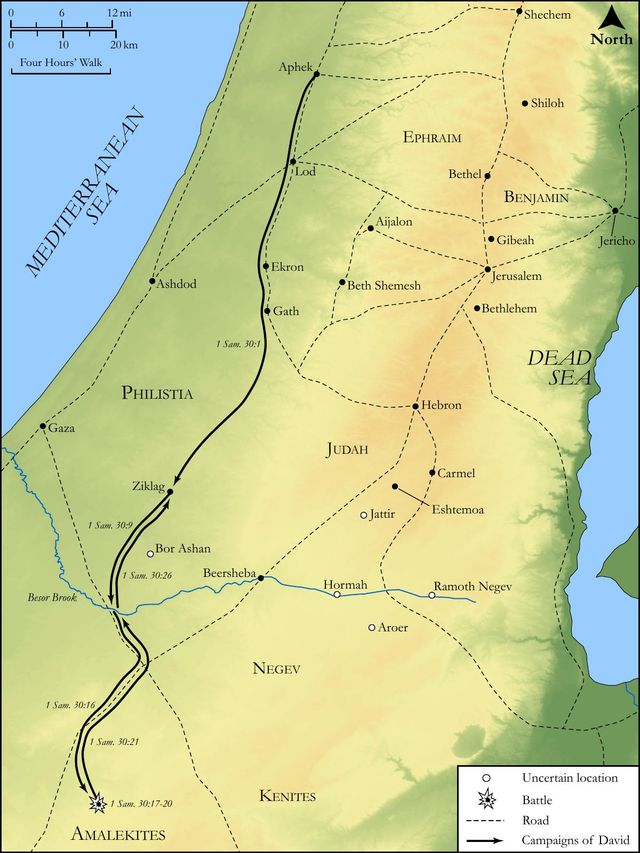
See on the biblical-era map
Study this verse
Public-domain commentary
Matthew Henry
From his Commentary on the Whole Bible. Henry comments on passages, not single verses — this entry covers 1 Samuel 30:1–6. His two-level outline is real structure in the source text, so it is rendered as structure.
Here we have, I. The descent which the Amalekites made upon Ziklag in David's absence, and the desolations they made there. They surprised the city when it was left unguarded, plundered it, burnt it, and carried all the women and children captives, Sa1 30:1, Sa1 30:2. They intended, by this to revenge the like havoc that David had lately made of them and their country, Sa1 27:8. He that had made so many enemies ought not to have left his own concerns so naked and defenceless. Those that make bold with others must expect that others will make as bold with them and provide accordingly. Now observe in this, 1. The cruelty of Saul's pity (as it proved) in sparing the Amalekites; if he had utterly destroyed them, as he ought to have done, these would not have been in being to do this mischief. 2. How David was corrected for being so forward to go with the Philistines against Israel. God showed him that he had better have staid at home and looked after his own business. When we go abroad in the way of our duty we may comfortably hope that God will take care of our families in our absence, but not otherwise. 3. How wonderfully God inclined the hearts of these Amalekites to carry the women and children away captives, and not to kill them. When David invaded them he put all to the sword (Sa1 27:9), and no reason can be given why they did not retaliate upon this city, but that God restrained them; for he has all hearts in his hands, and says to the fury of the most cruel men, Hitherto thou shalt come, and no further. Whether they spared them to lead them in triumph, or to sell them, or to use them for slaves, God's hand must be acknowledged, who designed to make use of the Amalekites for the correction, not for the destruction, of the house of David.
II.The confusion and consternation that David and his men were in when they found their houses in ashes and their wives and children gone into captivity. Three days' march they had from the camp of the Philistines to Ziklag, and now that they came thither weary, but hoping to find rest in their houses and joy in their families, behold a black and dismal scene was presented to them (Sa1 30:3), which made them all weep (David himself not excepted), though they were men of war, till they had no more power to weep, Sa1 30:4. The mention of David's wives, Ahinoam and Abigail, and their being carried captive, intimates that this circumstance went nearer his heart than any thing else. Note, It is no disparagement to the boldest and bravest spirits to lament the calamities of relations and friends. Observe,
1.This trouble came upon them when they were absent. It was the ancient policy of Amalek to take Israel at an advantage.
2.It met them at their return, and, for aught that appears, their own eyes gave them the first intelligence of it. Note, When we go abroad we cannot foresee what evil tidings may meet us when we come home again. The going out may be very cheerful, and yet the coming in be very doleful. Boast not thyself therefore of tomorrow, nor of tonight either, for thou knowest not what a day, or a piece of a day, may bring forth, Pro 27:1. If, when we come off a journey, we find our tabernacles in peace, and not laid waste as David here found his, let the Lord be praised for it.
III.The mutiny and murmuring of David's men against him (Sa1 30:6):
David was greatly distressed, for, in the midst of all his losses, his own people spoke of stoning him,
1.Because they looked upon him as the occasion of their calamities, by the provocation he had given the Amalekites, and his indiscretion in leaving Ziklag without a garrison in it. Thus apt are we, when we are in trouble, to fly into a rage against those who are in any way the occasion of our trouble, while we overlook the divine providence, and have not that regard to the operations of God's hand in it which would silence our passions, and make us patient.
2.Because now they began to despair of that preferment which they had promised themselves in following David. They hoped ere this to have been all princes; and now to find themselves all beggars was such a disappointment to them as made them grow outrageous, and threaten the life of him on whom, under God, they had the greatest dependence. What absurdities will not ungoverned passions plunge men into? This was a sore trial to the man after God's own heart, and could not but go very near him. Saul had driven him from his country, the Philistines had driven him from their camp, the Amalekites had plundered his city, his wives were taken prisoners, and now, to complete his woe, his own familiar friends, in whom he trusted, whom he had sheltered, and who did eat of his bread, instead of sympathizing with him and offering him any relief, lifted up the heel against him and threatened to stone him. Great faith must expect such severe exercises. But it is observable that David was reduced to this extremity just before his accession to the throne. At this very time, perhaps, the stroke was struck which opened the door to his advancement. Things are sometimes at the worst with the church and people of God just before they begin to mend.
IV.David's pious dependence upon the divine providence and grace in this distress:
But David encouraged himself in the Lord his God. His men fretted at their loss. The soul of the people was bitter, so the word is. Their own discontent and impatience added wormwood and gall to the affliction and misery, and made their case doubly grievous. But 1. David bore it better, though he had more reason than any of them to lament it; they gave liberty to their passions, but he set his graces on work, and by encouraging himself in God, while they dispirited each other, he kept his spirit calm and sedate. Or, 2. There may be a reference to the threatening words his men gave out against him. They spoke of stoning him; but he, not offering to avenge the affront, nor terrified by their menaces, encouraged himself in the Lord his God, believed, and considered with application to his present case, the power and providence of God, his justice and goodness, the method he commonly takes of bringing low and then raising up, his care of his people that serve him and trust in him, and the particular promises he had made to him of bringing him safely to the throne; with these considerations he supported himself, not doubting but the present trouble would end well. Note, Those that have taken the Lord for their God may take encouragement from their relation to him in the worst of times. It is the duty and interest of all good people, whatever happens, to encourage themselves in God as their Lord and their God, assuring themselves that he can and will bring light out of darkness, peace out of trouble, and good out of evil, to all that love him and are the called according to his purpose, Rom 8:28. It was David's practice, and he had the comfort of it, What time I am afraid I will trust in thee. When he was at his wits' end he was not at his faith's end.
Historical interpretation
Historical reception
1 surviving comment on this verse from the historical church.
And they had killed no one, etc. Heretics captivate but do not kill; who though they may rob the simplicity of faith from the less instructed, yet they cannot take away the fervor of charity, which is the life of virtues.
Continue studying 1 Samuel 30:2 across the web’s major study libraries — every link below opens this exact verse, chapter, or book on the destination site.
Read & Compare
 BibleGatewayThis verse in more than 200 translations and 70 languages.
 Bible.comThe YouVersion reader — hundreds of translations, reading plans, and highlights.
 ESV.orgCrossway's official English Standard Version reader.
 NET BibleThe NET translation with 60,000+ translators' notes on every rendering decision.
 STEP BibleTyndale House's free study tool — original text, vocabulary, and scholarly resources.
 BibliaLogos Bible Software's free web reader.
 USCCBThe New American Bible (Revised Edition) with the U.S. bishops' study notes.
Commentaries
 BibleHub CommentariesDozens of classic commentaries on this verse, gathered on one page.
 StudyLightMore than 100 commentary sets — the largest collection on the web.
 BibleRefPlain-English commentary on what this verse means, verse by verse.
 Enduring WordDavid Guzik's free commentary on this chapter, widely used by Bible teachers.
 Bible Study ToolsVerse commentary alongside Greek and Hebrew study aids.
Original Language & Research
- BibleHub InterlinearThe verse word by word — original language, transliteration, and English.
- BibleHub LexiconEvery word's original-language definition and Strong's entry.
 Blue Letter BibleDeep-study tools — Strong's numbers, concordance, and word studies.
 SefariaThe Hebrew text with Rashi and centuries of Jewish commentary.
Sermons, Hymns & Audio


TrulyRandomVerse is not affiliated with these sites and doesn’t control their content. They’re linked because they’re genuinely useful.
Summary
First Samuel 30:2 describes the aftermath of an Amalekite raid on Ziklag, David's city, while he and his men were absent with the Philistine army. This pivotal verse reveals that the Amalekites, a notoriously brutal enemy, did not kill anyone, "either great or small," but instead took all the women and children captive and departed. This unusual act of preservation, contrary to their typical practice of wholesale slaughter, sets the stage for David's subsequent pursuit and the miraculous recovery of all that was lost, profoundly underscoring God's sovereign hand of providence and preservation even in moments of profound devastation and despair.
Context
ShowHideLiterary Context
This verse immediately follows David's forced departure from the Philistine army, as the Philistine lords, distrusting his loyalty, sent him and his men away before their battle against Israel (1 Samuel 29). David's three-day journey back to Ziklag culminates in the horrific discovery detailed in this chapter: his city burned, and his family and the families of his men taken captive. The profound shock and grief that engulf David and his loyal followers are vividly portrayed in the subsequent verses (1 Samuel 30:3-4), highlighting their utter desperation. The specific, crucial detail in 1 Samuel 30:2—that no one was killed—serves as a critical narrative pivot. This detail transforms what would have been an irreversible tragedy into a recoverable loss, thereby establishing the narrative foundation for David's divinely inspired pursuit and God's miraculous intervention, leading to a complete and total recovery.
Historical & Cultural Context
The Amalekites were an ancient, nomadic, and persistently hostile enemy of Israel, descended from Esau. They were infamous for their opportunistic and cruel attacks, particularly targeting the weak and vulnerable, such as Israel's stragglers during the exodus (Deuteronomy 25:17-19). God had commanded Israel to utterly blot out the memory of Amalek (Exodus 17:14-16), a command King Saul notoriously failed to fully execute, leading to his rejection as king (1 Samuel 15). The practice of raiding and taking captives was a common aspect of warfare among the nations of that day, often motivated by the desire for ransom, slave trade, or as a demonstration of power, rather than indiscriminate slaughter, which might yield less tangible profit. Ziklag itself was a Philistine border town, strategically vulnerable, which had been granted to David by Achish, the king of Gath (1 Samuel 27:6). The Amalekites likely perceived David's absence as a prime opportunity for plunder, unaware of the divine purpose behind their unusual restraint.
Key Themes
ShowHideThis verse serves as a profound introduction to the themes of divine providence and preservation amidst overwhelming disaster. The Amalekites' uncharacteristic restraint in not killing anyone, despite their well-documented brutality, is a powerful indication of God's unseen, controlling hand at work, actively preserving life for a higher purpose. This divine preservation directly facilitates the subsequent theme of restoration and recovery, as the fact that the families were taken captive rather than massacred means they could be, and indeed were, miraculously rescued (1 Samuel 30:18-19). The narrative also implicitly highlights the theme of consequences and divine discipline, as David's alliance with the Philistines and his presence in their camp left his own people vulnerable to this devastating crisis. Yet, even within this moment of disciplinary consequence, God's unwavering faithfulness to David and His overarching plan for him as the future king of Israel is unmistakably evident through the preservation of his family and the families of his loyal men.
Exposition and Analysis
ShowHideKey Word Analysis
ShowHideThe Hebrew word אִשָּׁה (ʼishshâh), the feminine of אִישׁ, refers to a woman. In this context, it broadly encompasses the female inhabitants of Ziklag, including wives, daughters, and potentially other female dependents. The focus on "women" highlights the vulnerability of those left behind and the devastating impact of their abduction on the community's fabric. Their capture, rather than their slaughter, is the crucial detail that sets the stage for the narrative's resolution.
The Hebrew verb מוּת (mûwth) means "to die" or, in the causative, "to kill" or "to slay." The explicit negation, "slew not," is profoundly significant. Given the Amalekites' historical reputation for ruthless violence and their typical practice of total destruction against their enemies (as seen in other biblical accounts), their decision to spare lives here is remarkably atypical and stands out as an extraordinary act of restraint, widely interpreted as a direct manifestation of divine intervention.
The Hebrew verb נָהַג (nâhag) means "to drive forth," "to lead," or "to carry away." It implies a forceful removal or abduction, often of persons, animals, or chariots. In this verse, its use emphasizes the thoroughness and deliberateness of the Amalekites' action. They didn't just take a few; they "carried them away," signifying a complete removal of the captives from Ziklag, which, paradoxically, also provided David with a clear trail to follow.
Verse Breakdown
ShowHide"And had taken the women captives, that [were] therein:"
This initial clause establishes the primary devastating action of the Amalekite raid: the abduction of the women and children (implied by "women" in this context) who were present in Ziklag. The term "captives" emphasizes their forced removal and their status as spoils of war, highlighting the immediate and profound loss experienced by David and his men upon their return.
"they slew not any, either great or small,"
This is the most crucial and surprising statement of the verse. It explicitly declares that no one, regardless of age, status, or importance ("great or small"), was killed by the Amalekites. This detail is highly counter-cultural for the brutal Amalekites and is widely understood as a direct act of God's providential hand, preventing a total massacre and preserving lives for a greater purpose. It transforms an otherwise complete and irreversible tragedy into a situation where recovery and restoration are still possible.
"but carried [them] away, and went on their way."
This concluding clause reiterates the act of abduction, emphasizing the thoroughness of the Amalekites' operation ("carried them away"). Their subsequent departure, "went on their way," signifies the successful completion of their raid from their perspective. However, from David's perspective, this departure, leaving a clear trail, paradoxically provides the means for him to pursue them, setting the stage for the dramatic and divinely orchestrated recovery that follows.
Literary Devices
ShowHideThe verse employs several significant literary devices that enrich its meaning and underscore its theological implications. Contrast is powerfully evident in the juxtaposition of the devastating consequences of the raid (the city burned, families abducted) with the unexpected preservation of life ("they slew not any"). This stark difference creates a profound tension, highlighting God's hidden but active hand. There is also a strong sense of Irony, as the Amalekites, a people notoriously merciless and divinely commanded to be utterly destroyed, are here seen exercising an unusual restraint that ultimately serves God's sovereign purposes for David and his lineage. Furthermore, the preservation of life functions as a crucial piece of Foreshadowing, signaling to the reader that while the situation is dire and seemingly hopeless, it is not beyond divine intervention. This specific detail directly sets up the narrative of David's pursuit and the complete recovery of all that was lost, powerfully demonstrating God's faithfulness and His ability to bring about good and restoration even out of the most calamitous and despairing circumstances.
Theological and Thematic Connections
ShowHideThe sparing of lives in 1 Samuel 30:2, despite the Amalekites' notorious reputation for brutality, serves as a profound testament to God's sovereign control over all circumstances, extending even to the actions of His enemies. It powerfully illustrates that even in moments of deep distress, apparent defeat, and profound vulnerability, God's providential hand can be actively at work, preserving what is vital for the unfolding of His divine plan. This seemingly small detail transforms an otherwise irreversible catastrophe into a recoverable loss, demonstrating that God can limit the destructive power of evil and create opportunities for restoration where none seem humanly possible. It reminds believers that even when circumstances appear bleakest, God's ultimate purposes cannot be thwarted, and He often works in unseen, unexpected ways to protect His people and advance His kingdom, often through means that defy human logic or expectation.
Reflection and Application
ShowHideThe narrative of 1 Samuel 30:2, though describing a moment of profound loss and despair for David and his men, offers a deeply resonant message of hope and resilience for believers today. When we face situations where everything seems to be stripped away—whether it be financial security, physical health, cherished relationships, or long-held dreams—this verse powerfully reminds us to look for the "slew not any" moments. These are the subtle but undeniable glimmers of God's preserving grace, the unexpected restraints on destructive forces, or the partial losses that, while undeniably painful, leave room for future restoration and divine intervention. It encourages us to trust that even when the enemy has seemingly done their worst, God's hidden mercy can be actively at work, preventing total annihilation and meticulously setting the stage for a miraculous divine recovery. Our faith is not predicated on the absence of trials, but rather on the unwavering presence of a sovereign God who can orchestrate events, even through the seemingly random actions of our adversaries, to bring about ultimate good and to fulfill His perfect purposes for our lives. This perspective empowers us to press into God with renewed fervor in our distress, knowing that His hand is always active, preparing the way for our eventual rescue and complete restoration.
Questions for Reflection
ShowHideFAQ
ShowHideWhy did the Amalekites not kill anyone in Ziklag?
ShowHideWhile the biblical text does not explicitly state the Amalekites' specific motivation, the most compelling theological interpretation is that their unusual restraint was a direct act of divine providence. The Amalekites were well-known for their extreme brutality and often engaged in total destruction of their enemies. However, in this particular instance, God supernaturally limited their destructive capacity, preventing a massacre and preserving the lives of David's family and the families of his men. From a purely human or strategic perspective, taking captives was also a common practice in ancient warfare, as captives held value for ransom, as slaves, or as a display of power, which might have been more economically or politically advantageous than a wholesale slaughter. Nevertheless, the overarching biblical narrative consistently points to God's unseen hand guiding events to fulfill His sovereign purposes, particularly in the life of David, His anointed king. This preservation was absolutely crucial for the subsequent recovery of the families and, more significantly, for the continuation of David's lineage, through which the Messiah would eventually come, highlighting God's meticulous care for His covenant promises.
Christ-Centered Fulfillment
ShowHideThe preservation of life in 1 Samuel 30:2, where the Amalekites "slew not any," powerfully foreshadows the ultimate redemptive work of Jesus Christ. Just as David's family was taken captive but miraculously not destroyed, allowing for their eventual rescue, so too was humanity held captive by the devastating forces of sin and death, yet not utterly annihilated. The ultimate enemy, Satan, indeed came "to steal and kill and destroy" (John 10:10), but God, in His boundless mercy and sovereign plan, intervened decisively. Jesus Christ, the true and greater Davidic King, came into the world not to condemn it, but specifically "that the world through Him might be saved" (John 3:17). Through His sacrificial death on the cross and His glorious resurrection, He decisively defeated the ultimate enemies—sin, death, and the devil—disarming the spiritual powers and authorities that held humanity captive (Colossians 2:15). He is the triumphant One who "led captivity captive," setting free those who were enslaved by the fear of death and the bondage of sin (Ephesians 4:8; Hebrews 2:14-15). The physical recovery of families in Ziklag serves as a potent earthly type, pointing to the profound spiritual recovery and eternal redemption offered exclusively in Christ, where believers are brought from spiritual death to new life (Ephesians 2:1-5) and will ultimately experience the full, glorious restoration of all things in the new heavens and new earth, where God Himself will "wipe away every tear" (Revelation 21:4).