


1 Samuel 27:11
Bible text: King James Version (1769 Blayney text) · Public domain
Bible text: King James Version with Strong's numbers · Public domain
Bible text: Berean Standard Bible · Public domain
Bible text: American Standard Version (1901) · Public domain
Bible text: World English Bible, Messianic edition · Public domain
Bible text: Geneva Bible (1599) · Public domain
Bible text: Young's Literal Translation · Public domain
- וְאִישׁve·'Ishand a manH376Conj-w ¦ N-msNoun Singular Masculine Absoluteוְandאִישׁa man
- וְאִשָּׁהve·'i·Shahand a womanH802Conj-w ¦ N-fsNoun Singular Feminine Absoluteוְandאִשָּׁהa woman
- לֹאlo'notH3808NegParticle Negative
- יְחַיֶּהye·chai·Yehhe let liveH2421V-Piel-Imperf-3msVerb Piel Imperfect 3rd Singular Masculine
- דָוִדda·VidDavidH1732N-proper-mNoun Proper Masculine
- לְהָבִיאle·ha·Vi'to bringH935Prep-l ¦ V-Hiphil-InfVerb Hiphil Infinitive Constructלְtoהָבִיאbring
- גַתgatGathH1661N-properNoun Proper Location
- לֵאמֹרle·Mor<to> sayingH559Prep-l ¦ V-Qal-InfVerb Qal Infinitive Constructלֵ<to>אמֹרsaying
- פֶּןpenlestH6435PrtParticle Conditional
- יַגִּדוּya·Gi·duthey should tellH5046V-Hiphil-Imperf-3mpVerb Hiphil Imperfect 3rd Plural Masculine
- עָלֵינוּ'a·Lei·nuon usH5921Prep ¦ 1cpPreposition Definiteעָלֵיonנוּus
- לֵאמֹרle·Mor<to> sayingH559Prep-l ¦ V-Qal-InfVerb Qal Infinitive Constructלֵ<to>אמֹרsaying
- כֹּהkohthusH3541AdvAdverb
- עָשָׂה'a·Sahhe has doneH6213V-Qal-Perf-3msVerb Qal Perfect 3rd Singular Masculine
- דָוִדda·VidDavidH1732N-proper-mNoun Proper Masculine
- וְכֹהve·Khohand [is] thusH3541Conj-w ¦ AdvAdverbוְandכֹה[is] thus
- מִשְׁפָּטוֹmish·pa·Tohis practiceH4941N-msc ¦ 3msNoun Singular Masculine Constructמִשְׁפָּטpracticeוֹhis
- כָּלkolallH3605N-mscNoun Singular Masculine Construct
- הַיָּמִיםhai·ya·Mimthe daysH3117Art ¦ N-mpNoun Plural Masculine Absoluteהַtheיָּמִיםdays
- אֲשֶׁר'a·SherwhichH834RelParticle Relative
- יָשַׁבya·Shavhe has dweltH3427V-Qal-Perf-3msVerb Qal Perfect 3rd Singular Masculine
- בִּשְׂדֵהbis·Dehin [the] region ofH7704Prep-b ¦ N-mscNoun Singular Masculine Constructבִּinשְׂדֵה[the] region of
- פְלִשְׁתִּיםfe·lish·Tim[the] PhilistinesH6430N-mpNoun Gentilic Plural Masculine Absolute
English is a literal word-by-word gloss of the Hebrew, not the KJV's wording. Why?
This is the original text the KJV's translators worked from — each Hebrew word with its own literal English meaning in this verse, prepared by scholars at Tyndale House, Cambridge. The KJV translates whole sentences, not word by word, so its wording differs: one Hebrew word can become several English words, and the KJV may choose “the LORD” where the gloss reads “Yahweh”. Both are faithful — they answer different questions. For the KJV's own rendering, switch to the KJV text.
Details
See on the biblical-era map
Study this verse
Public-domain commentary
Matthew Henry
From his Commentary on the Whole Bible. Henry comments on passages, not single verses — this entry covers 1 Samuel 27:8–12.
Here is an account of David's actions while he was in the land of the Philistines, a fierce attack he made upon some remains of the devoted nations, his success in it, and the representation he gave of it to Achish. 1. We may acquit him of injustice and cruelty in this action because those people whom he cut off were such as heaven had long since doomed to destruction, and he that did it was one whom heaven had ordained to dominion; so that the thing was very fit to be done, and he was very fit to do it. It was not for him that was anointed to fight the Lord's battles to sit still in sloth, however he might think fit, in modesty, to retire. He desired to be safe from Saul only that he might expose himself for Israel. He avenged an old quarrel that God had with these nations, and at the same time fetched in provisions for himself and his army, for by their swords they must live. The Amalekites were to be all cut off. Probably the Geshurites and Gezrites were branches of Amalek. Saul was rejected for sparing them, David makes up the deficiency of his obedience before he succeeds him. He smote them, and left none alive, Sa1 27:8, Sa1 27:9. The service paid itself, for they carried off abundance of spoil, which served for the subsistence of David's forces. 2. Yet we cannot acquit him of dissimulation with Achish in the account he gave him of this expedition. (1.) David, it seems, was not willing that he should know the truth, and therefore spared none to carry tidings to Gath (Sa1 27:11), not because he was ashamed of what he had done as a bad thing, but because he was afraid, if the Philistines knew it, they would be apprehensive of danger to themselves or their allies by harbouring him among them and would expel him from their coasts. It would be easy to conclude, If so he did, so will be his manner, and therefore he industriously conceals it from them, which, it seems, he could do by putting them all to the sword, for none of their neighbours would inform against him, nor perhaps would soon come to the knowledge of what was done, intelligence not being so readily communicated then as now. (2.) He hid it from Achish with an equivocation not at all becoming his character. Being asked which way he had made his sally, he answered, Against the south of Judah, v. 13. It was true he had invaded those countries that lay south of Judah, but he made Achish believe he had invaded those that lay south in Judah, the Ziphites for example, that had once and again betrayed him; so Achish understood him, and thence inferred that he had made his people Israel to abhor him, and so riveted himself in the interest of Achish. The fidelity of Achish to him, his good opinion of him, and the confidence he put in him, aggravate his sin in deceiving him thus, which, with some other such instances, David seems penitently to reflect upon when he prays, Remove from me the way of lying.
Historical interpretation
Historical reception
2 surviving comments on this verse. Each one is dated, so this reads as a timeline rather than a list.
David did not bring to life a man and a woman, etc. Christ forbids those converted to Him from living in sins. Just as first showing this to the teacher of His Church, He commands the multitudes of impure hearts, saying: Rise, Peter, kill and eat (Acts X). And Paul teaches that they are not dead to sin, but living to God in Christ Jesus (Ephesians II). But neither does He now command believers to undergo martyrdom or deaths for His name from the impious.
Saying, Lest perhaps they speak, etc. Therefore, he did not bring to life, lest they speak against him. For the listener bears witness against his teacher, who, less perfectly educated either in believing or in acting, shows himself less extinguished by improper action or thought.
Continue studying 1 Samuel 27:11 across the web’s major study libraries — every link below opens this exact verse, chapter, or book on the destination site.
Read & Compare
 BibleGatewayThis verse in more than 200 translations and 70 languages.
 Bible.comThe YouVersion reader — hundreds of translations, reading plans, and highlights.
 ESV.orgCrossway's official English Standard Version reader.
 NET BibleThe NET translation with 60,000+ translators' notes on every rendering decision.
 STEP BibleTyndale House's free study tool — original text, vocabulary, and scholarly resources.
 BibliaLogos Bible Software's free web reader.
 USCCBThe New American Bible (Revised Edition) with the U.S. bishops' study notes.
Commentaries
 BibleHub CommentariesDozens of classic commentaries on this verse, gathered on one page.
 StudyLightMore than 100 commentary sets — the largest collection on the web.
 BibleRefPlain-English commentary on what this verse means, verse by verse.
 Enduring WordDavid Guzik's free commentary on this chapter, widely used by Bible teachers.
 Bible Study ToolsVerse commentary alongside Greek and Hebrew study aids.
Original Language & Research
- BibleHub InterlinearThe verse word by word — original language, transliteration, and English.
- BibleHub LexiconEvery word's original-language definition and Strong's entry.
 Blue Letter BibleDeep-study tools — Strong's numbers, concordance, and word studies.
 SefariaThe Hebrew text with Rashi and centuries of Jewish commentary.
Sermons, Hymns & Audio


TrulyRandomVerse is not affiliated with these sites and doesn’t control their content. They’re linked because they’re genuinely useful.
Summary
1 Samuel 27:11 encapsulates a morally complex episode in David's wilderness years, where, having sought refuge with King Achish of Gath, he conducted strategic raids against non-Israelite populations. To maintain his deceptive alliance with the Philistine king and prevent exposure of his true targets, David ruthlessly ensured no survivors from these attacks, thereby eliminating any potential witnesses who could report his actions back to Gath. This verse starkly illustrates David's pragmatic cunning and desperate measures for survival during a period of intense pressure, revealing the challenging ethical landscape he navigated before his ascension to the throne of Israel.
Context
ShowHideLiterary Context
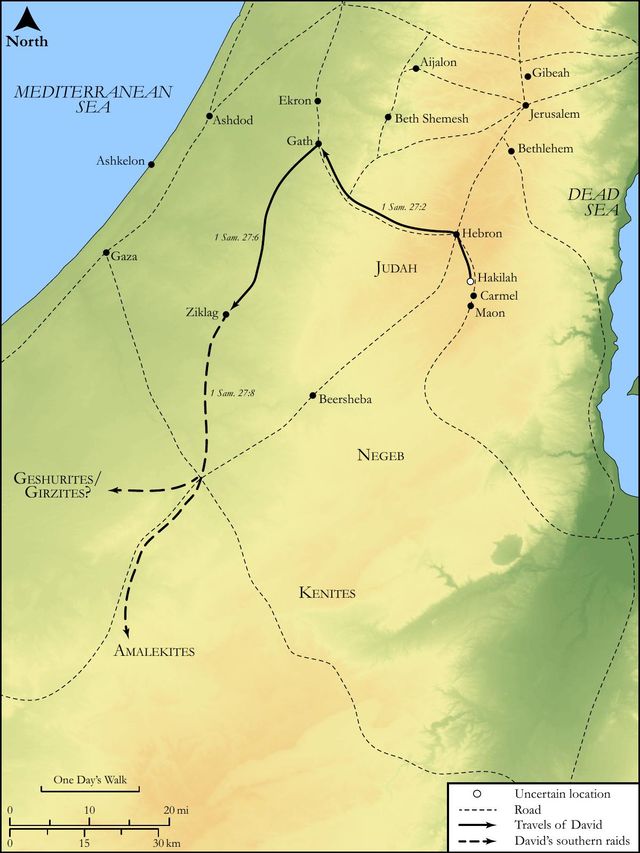
This verse is situated within a pivotal and precarious period of David's life, following his repeated narrow escapes from King Saul's relentless pursuit. Having previously feigned madness to escape Gath (1 Samuel 21:10-15), David now makes the desperate and strategic choice to seek genuine asylum with Achish, the Philistine king of Gath. Achish, perhaps seeing an opportunity to gain a powerful Israelite defector, grants David the Philistine city of Ziklag as his base (1 Samuel 27:6). For a year and four months, David operates from Ziklag (1 Samuel 27:7), leading raids. While Achish believes David is attacking Israelite territory, thereby weakening Saul's kingdom and solidifying David's loyalty to the Philistines, David is, in fact, targeting traditional enemies of Israel, such as the Geshurites, Gezrites, and Amalekites (1 Samuel 27:8). The complete annihilation of these groups, as described in verse 11, is a calculated, ruthless measure designed to prevent any information from reaching Achish that would expose David's true targets and intentions, thus preserving his sanctuary, his strategic advantage, and ultimately, his life and the lives of his men.
Historical & Cultural Context
The era of the Judges and the nascent monarchy in ancient Israel was characterized by constant tribal warfare, shifting allegiances, and the struggle for dominance in the land of Canaan. The Philistines, a powerful seafaring people who settled on the southwestern coast of Canaan, were formidable adversaries of Israel, often holding technological superiority (e.g., iron weaponry) and posing a significant threat to Israelite sovereignty. David's decision to seek refuge with them was highly unusual and fraught with peril, underscoring the extreme nature of his predicament under Saul's persecution. The practice of "saving neither man nor woman alive" reflects the brutal realities of warfare in that day. While the concept of herem (total destruction, often divinely commanded against certain Canaanite groups) existed, David's application here is driven by strategic deception rather than a direct divine mandate. This act was intended to eliminate all potential threats, prevent retaliation, and, crucially for David, suppress any information that could compromise his precarious position. Gath was one of the five principal Philistine city-states (the "Philistine Pentapolis"), and its king, Achish, commanded significant power and influence. David's actions, though ethically challenging, must be understood within the harsh geopolitical landscape of the time, where survival often necessitated ruthlessness and cunning.
Key Themes
ShowHideThis verse contributes significantly to several overarching themes within 1 Samuel and the broader narrative of David's life. Foremost is the theme of deception and survival, as David employs cunning and extreme measures to navigate a treacherous situation, protecting himself from Saul while simultaneously deceiving his Philistine hosts. This period highlights the lengths to which David was willing to go to preserve his life and the future of his lineage, a stark contrast to the divine promise of kingship that had been given to him. It also underscores the moral ambiguity present even in the lives of biblical heroes; David, though later described as "a man after God's own heart," engages in actions that challenge simplistic notions of righteousness, revealing his human fallibility and the complex, often brutal, choices demanded by leadership and survival in a fallen world. Furthermore, the passage subtly points to God's sovereignty amidst human imperfection, demonstrating that despite David's questionable methods and his reliance on worldly cunning, God's ultimate plan to establish him as king of Israel remains on course. This period also illustrates the cost of distrust, as David's fear of Saul led him to seek refuge among Israel's enemies, forcing him into a deeply compromising position, a theme echoed in other instances of human fear overriding divine trust, such as Saul's unlawful sacrifice in 1 Samuel 13:11-14.
Exposition and Analysis
ShowHideKey Word Analysis
ShowHideThe Hebrew verb ḥāyâ (H2421) fundamentally means "to live" or "to keep alive," and causatively, "to revive." In this negative construction ("saved neither... alive"), it powerfully conveys the complete and utter destruction of the inhabitants. This was not merely a military victory with some casualties, but a deliberate act of extermination to ensure no witnesses remained. The phrase emphasizes the totality of David's action, leaving no one to "live" and therefore no one to "tell" his true activities. The accompanying words "man" (H376, ʼîysh) and "woman" (H802, ʼishshâh) underscore the comprehensive nature of the slaughter, leaving no demographic group spared.
The Hebrew verb nâgad (H5046) means "to front," "to manifest," and by implication, "to announce" or "to report" (always by word of mouth to one present). In this context, David's fear is that survivors would "tell" or "report" his true activities to King Achish. This word highlights the direct, verbal communication of information that David was desperate to prevent. He understood that a direct report from a survivor would immediately expose his deception and undermine his carefully constructed alliance.
The Hebrew noun mishpâṭ (H4941) is rich in meaning, encompassing "a verdict," "justice," "law," "custom," or "manner." Here, it refers to David's established pattern of conduct or his customary way of operating. David's concern was that if his true targets were revealed, Achish would realize that his "manner" of raiding was not against Israel, as he claimed, but against other peoples, thereby exposing his long-term deception and calculated strategy. It speaks to the consistent pattern of behavior David needed to maintain to keep his cover.
Verse Breakdown
ShowHide"And David saved neither man nor woman alive,"
This opening clause immediately establishes the extreme and ruthless nature of David's military campaigns during this period. It signifies a complete and total annihilation of the populations he raided, leaving no survivors. This was not merely a consequence of battle, but a deliberate policy aimed at eradicating any potential witnesses, underscoring the calculated and cold-blooded aspect of his actions.
"to bring [tidings] to Gath, saying,"
This phrase clarifies the strategic rationale behind the complete destruction. David's paramount objective was to prevent any "report" or "news" from reaching King Achish in Gath. The KJV's insertion of "[tidings]" accurately captures the intent: to prevent any information, any word, from being carried back to the Philistine court that could expose David's true targets and intentions.
"Lest they should tell on us, saying, So did David,"
This clause reveals David's specific fear and the precise nature of the information he sought to suppress. He anticipated that any survivors would report his actions directly ("tell on us"), specifically detailing the nature of his raids ("So did David"). This direct testimony would confirm that he was attacking non-Israelite tribes rather than Israelite territory, thereby undermining his credibility and jeopardizing his alliance with Achish.
"and so [will be] his manner all the while he dwelleth in the country of the Philistines."
This final clause highlights David's concern for the long-term consistency of his deception. He needed to maintain the facade that he was continually raiding Israelite territory, thereby proving his loyalty to Achish and justifying his presence among the Philistines. If his true "manner" or pattern of raids (against non-Israelites) were revealed, Achish would realize he had been thoroughly deceived, leading to severe and potentially fatal consequences for David and his men.
Literary Devices
ShowHideThe passage employs several Literary Devices to convey its complex message and deepen its impact. Characterization is prominently featured, revealing a pragmatic, ruthless, and cunning side of David, which stands in stark contrast to his more idealized portrayal elsewhere in Scripture (e.g., as a shepherd, musician, or man of faith). This verse presents a morally ambiguous David, a leader willing to take extreme measures for survival and strategic advantage, complicating any simplistic understanding of his character. The narrative also uses Foreshadowing; this period of deception and moral compromise subtly hints at later, more significant moral failings in David's life, such as the infamous Bathsheba incident in 2 Samuel 11 and the census in 2 Samuel 24. There is also a strong element of Dramatic Irony, as the reader is privy to David's true intentions and actions—that he is raiding non-Israelite tribes—while Achish remains completely oblivious, believing David to be a loyal Philistine servant. This creates significant tension and highlights the precariousness of David's position, as his very survival depends on the success of his elaborate deception. Finally, the stark, unembellished description of the slaughter ("saved neither man nor woman alive") serves as a powerful, almost clinical, statement of fact. This Understatement allows the gravity of David's actions to speak for itself without explicit authorial condemnation, leaving the reader to grapple with the profound ethical implications and the moral cost of David's survival strategy.
Theological and Thematic Connections
ShowHide1 Samuel 27:11 presents a challenging theological dilemma: how does a "man after God's own heart" engage in such ruthless deception and wholesale slaughter? This passage serves as a sobering reminder that biblical heroes are not perfect, sinless figures, but deeply flawed individuals through whom God nonetheless works His sovereign purposes. David's actions here are driven by fear, desperation, and a pragmatic desire for survival, illustrating the moral compromises that can arise when trust in God's immediate provision and protection wavers, leading to reliance on human cunning and worldly means. While God's overarching sovereignty is undeniably evident in His continued protection and eventual elevation of David to the throne, this does not condone David's methods. Instead, it highlights God's profound ability to work through and even redeem imperfect human choices, demonstrating His grace, long-suffering patience, and unwavering commitment to His covenant promises, even when His chosen instruments fall short. The passage implicitly critiques the human tendency to resort to worldly wisdom and extreme measures when facing intense pressure, even when a divine promise of kingship and protection has been given. It underscores the tension between human agency and divine providence, and the often-messy reality of God's work in a fallen world.
Reflection and Application
ShowHide1 Samuel 27:11 offers a sobering and profoundly realistic glimpse into the complexities of human nature, even within the lives of those chosen by God. It challenges us to move beyond simplistic, sanitized portrayals of biblical figures and to embrace the full humanity of individuals like David, who wrestled with profound fear, made difficult and morally ambiguous choices, and sometimes resorted to ruthless means for self-preservation. This passage prompts us to critically examine our own lives: under what circumstances do we feel tempted to compromise our integrity, bend the truth, or resort to deceptive actions for the sake of security, personal advantage, or perceived survival? It serves as a powerful reminder that while God is sovereign and can indeed work through imperfect people, our actions still carry significant moral weight and have consequences, both for ourselves and for others. True faith, in contrast to David's actions here, calls for unwavering integrity and a deep, abiding trust in God's provision and protection, even when circumstances seem dire or when fear threatens to overwhelm us. It is a call to reflect on the inherent tension between our natural instincts for survival and the ethical principles of God's kingdom, urging us to always seek God's wisdom and guidance in navigating life's most difficult and compromising choices, rather than relying on cunning or ruthless tactics.
Questions for Reflection
ShowHideFAQ
ShowHideWas David justified in his actions to save neither man nor woman alive?
ShowHideFrom a purely strategic and pragmatic standpoint in the context of warfare in that day, David's actions were effective in maintaining his elaborate deception and ensuring his survival and the safety of his followers among the Philistines. However, from a moral and theological perspective, the biblical text does not explicitly condone his actions. While the Bible often records the actions of its characters without direct moral commentary, the ruthlessness displayed here raises significant ethical questions. David was a man chosen by God, but he was also deeply flawed and capable of grave sin. His actions in 1 Samuel 27:11 are driven by fear and self-preservation, not by divine command or a clear moral imperative from God. They stand in stark contrast to the ethical standards often promoted elsewhere in the Old Testament, such as the value of human life and the importance of truthfulness. This period highlights David's human fallibility and the moral compromises he made under extreme duress, serving as a cautionary tale rather than a model for righteous conduct.
How does this passage reconcile with David being called "a man after God's own heart"?
ShowHideThe phrase "a man after God's own heart" (found in 1 Samuel 13:14 and affirmed in Acts 13:22) does not imply moral perfection or sinlessness on David's part. Instead, it speaks to David's fundamental orientation towards God, his deep desire to please God, his passion for worship, his general responsiveness to God's will, and crucially, his profound repentance when confronted with his sins (as powerfully seen after the Bathsheba incident in 2 Samuel 12). This passage in 1 Samuel 27, like other instances of David's moral failings (e.g., the census in 2 Samuel 24), serves as a powerful reminder that even the greatest figures of faith were deeply human and capable of significant moral failings. God works through imperfect people, not because He condones their sin, but because of His sovereign grace, His unwavering faithfulness to His promises, and His ability to bring about His purposes despite human weakness and sin.
Christ-Centered Fulfillment
ShowHideWhile David's actions in 1 Samuel 27:11 demonstrate a leader resorting to deception and ruthless force for survival, they ultimately underscore the profound need for a perfect King, one who would never need to compromise truth or resort to such means. David, in his cunning and moral ambiguity, foreshadows the inherent limitations and human fallibility of even the best earthly rulers. In stark contrast, Jesus Christ is the King who embodies perfect truth, integrity, and righteousness. He did not seek to preserve His life through deception or violence but willingly laid it down as the Lamb of God, who takes away the sin of the world!, fulfilling the ultimate sacrifice for humanity. Unlike David, who eliminated witnesses to hide his true intentions and maintain his precarious position, Christ's life and mission were characterized by radical transparency, openly declaring His identity and purpose, even when it led directly to His unjust crucifixion (John 18:20-21). David's temporary refuge among the Philistines and his reliance on worldly wisdom highlight the brokenness of a world under the dominion of sin, a brokenness that only Christ's perfect reign can fully redeem. He is the true Shepherd who protects His flock not through cunning and violence, but through self-sacrificial love and the ultimate triumph of His resurrection, establishing an eternal kingdom of righteousness and peace that will have no end (Isaiah 9:6-7).