


1 Samuel 27:10
Bible text: King James Version (1769 Blayney text) · Public domain
Bible text: King James Version with Strong's numbers · Public domain
Bible text: Berean Standard Bible · Public domain
Bible text: American Standard Version (1901) · Public domain
Bible text: World English Bible, Messianic edition · Public domain
Bible text: Geneva Bible (1599) · Public domain
Bible text: Young's Literal Translation · Public domain
- וַיֹּאמֶרvai·Yo·merand he saidH559Conj-w ¦ V-Qal-ConsecImperf-3msVerb Qal Consecutive Imperfect 3rd Singular Masculineוַandיֹּאמֶרhe said
- אָכִישׁ'a·KhishAchishH397N-proper-mNoun Proper Masculine
- אַל'alagainst [where]H413InterrogParticle Interrogative
- פְּשַׁטְתֶּםpe·sha·Temdid you make a raidH6584V-Qal-Perf-2mpVerb Qal Perfect 2nd Plural Masculine
- הַיּוֹםhai·Yomthis dayH3117Art ¦ N-msNoun Singular Masculine Absoluteהַthisיּוֹםday
- וַיֹּאמֶרvai·Yo·merand he saidH559Conj-w ¦ V-Qal-ConsecImperf-3msVerb Qal Consecutive Imperfect 3rd Singular Masculineוַandיֹּאמֶרhe said
- דָּוִדda·VidDavidH1732N-proper-mNoun Proper Masculine
- עַל'alonH5921PrepPreposition
- נֶגֶבNe·gev[the] Negev ofH5045N-properNoun Proper Location
- יְהוּדָהye·hu·DahJudahH3063N-properNoun Proper Location
- וְעַלve·'aland onH5921Conj-w ¦ PrepPrepositionוְandעַלon
- נֶגֶבNe·gev[the] Negev ofH5045N-properNoun Proper Location
- הַיַּרְחְמְאֵלִיhai·yar·che·me·'e·Lithe Jerahmeelite[s]H3397Art ¦ N-msNoun Gentilic Singular Masculine AbsoluteהַtheיַּרְחְמְאֵלִיJerahmeelite[s]
- וְאֶלve·'eland againstH413Conj-w ¦ PrepPrepositionוְandאֶלagainst
- נֶגֶבNe·gev[the] Negev ofH5045N-properNoun Proper Location
- הַקֵּינִיha·kei·Nithe Kenite[s]H7017Art ¦ N-msNoun Gentilic Singular Masculine AbsoluteהַtheקֵּינִיKenite[s]
English is a literal word-by-word gloss of the Hebrew, not the KJV's wording. Why?
This is the original text the KJV's translators worked from — each Hebrew word with its own literal English meaning in this verse, prepared by scholars at Tyndale House, Cambridge. The KJV translates whole sentences, not word by word, so its wording differs: one Hebrew word can become several English words, and the KJV may choose “the LORD” where the gloss reads “Yahweh”. Both are faithful — they answer different questions. For the KJV's own rendering, switch to the KJV text.
Details
See on the biblical-era map
Study this verse
Public-domain commentary
Matthew Henry
From his Commentary on the Whole Bible. Henry comments on passages, not single verses — this entry covers 1 Samuel 27:8–12.
Here is an account of David's actions while he was in the land of the Philistines, a fierce attack he made upon some remains of the devoted nations, his success in it, and the representation he gave of it to Achish. 1. We may acquit him of injustice and cruelty in this action because those people whom he cut off were such as heaven had long since doomed to destruction, and he that did it was one whom heaven had ordained to dominion; so that the thing was very fit to be done, and he was very fit to do it. It was not for him that was anointed to fight the Lord's battles to sit still in sloth, however he might think fit, in modesty, to retire. He desired to be safe from Saul only that he might expose himself for Israel. He avenged an old quarrel that God had with these nations, and at the same time fetched in provisions for himself and his army, for by their swords they must live. The Amalekites were to be all cut off. Probably the Geshurites and Gezrites were branches of Amalek. Saul was rejected for sparing them, David makes up the deficiency of his obedience before he succeeds him. He smote them, and left none alive, Sa1 27:8, Sa1 27:9. The service paid itself, for they carried off abundance of spoil, which served for the subsistence of David's forces. 2. Yet we cannot acquit him of dissimulation with Achish in the account he gave him of this expedition. (1.) David, it seems, was not willing that he should know the truth, and therefore spared none to carry tidings to Gath (Sa1 27:11), not because he was ashamed of what he had done as a bad thing, but because he was afraid, if the Philistines knew it, they would be apprehensive of danger to themselves or their allies by harbouring him among them and would expel him from their coasts. It would be easy to conclude, If so he did, so will be his manner, and therefore he industriously conceals it from them, which, it seems, he could do by putting them all to the sword, for none of their neighbours would inform against him, nor perhaps would soon come to the knowledge of what was done, intelligence not being so readily communicated then as now. (2.) He hid it from Achish with an equivocation not at all becoming his character. Being asked which way he had made his sally, he answered, Against the south of Judah, v. 13. It was true he had invaded those countries that lay south of Judah, but he made Achish believe he had invaded those that lay south in Judah, the Ziphites for example, that had once and again betrayed him; so Achish understood him, and thence inferred that he had made his people Israel to abhor him, and so riveted himself in the interest of Achish. The fidelity of Achish to him, his good opinion of him, and the confidence he put in him, aggravate his sin in deceiving him thus, which, with some other such instances, David seems penitently to reflect upon when he prays, Remove from me the way of lying.
Historical interpretation
Historical reception
1 surviving comment on this verse from the historical church.
But Achis said to him: Against whom have you made a raid today? etc. Although he seems to deceive in the literal sense, who, rising against the Philistines, devastating the province not far from them, said he had made a raid against the one who arouses their king against his own people: yet the figure of speech does not deceive, because while he draws the nations to faith, Christ arises against the clear and burning blasphemy of the Jews. For by His just judgement, blindness in part has happened to Israel, until the fullness of the Gentiles has come in, and thus all Israel shall be saved (Rom. XI): therefore, while bringing in the nations, He rises against Judea, which, out of pride, broke not a few branches of the good olive tree, so that by grafting in the wild olive tree, He might make it a partaker of the good root and fatness of the olive tree. And it is well said to be a rising against, because He who falls, says He, upon this rock, will be broken; but on whomsoever it shall fall, it will grind him to powder (Luke XX).
Continue studying 1 Samuel 27:10 across the web’s major study libraries — every link below opens this exact verse, chapter, or book on the destination site.
Read & Compare
 BibleGatewayThis verse in more than 200 translations and 70 languages.
 Bible.comThe YouVersion reader — hundreds of translations, reading plans, and highlights.
 ESV.orgCrossway's official English Standard Version reader.
 NET BibleThe NET translation with 60,000+ translators' notes on every rendering decision.
 STEP BibleTyndale House's free study tool — original text, vocabulary, and scholarly resources.
 BibliaLogos Bible Software's free web reader.
 USCCBThe New American Bible (Revised Edition) with the U.S. bishops' study notes.
Commentaries
 BibleHub CommentariesDozens of classic commentaries on this verse, gathered on one page.
 StudyLightMore than 100 commentary sets — the largest collection on the web.
 BibleRefPlain-English commentary on what this verse means, verse by verse.
 Enduring WordDavid Guzik's free commentary on this chapter, widely used by Bible teachers.
 Bible Study ToolsVerse commentary alongside Greek and Hebrew study aids.
Original Language & Research
- BibleHub InterlinearThe verse word by word — original language, transliteration, and English.
- BibleHub LexiconEvery word's original-language definition and Strong's entry.
 Blue Letter BibleDeep-study tools — Strong's numbers, concordance, and word studies.
 SefariaThe Hebrew text with Rashi and centuries of Jewish commentary.
Sermons, Hymns & Audio


TrulyRandomVerse is not affiliated with these sites and doesn’t control their content. They’re linked because they’re genuinely useful.
Summary
In 1 Samuel 27:10, King Achish of Gath confronts David about the targets of his recent military expeditions. David, who has sought refuge with Achish from King Saul, masterfully employs a strategic deception, claiming to have raided the southern territories of Judah, specifically targeting the Jerahmeelites and Kenites. This calculated falsehood was a critical maneuver, designed to convince Achish that David was actively attacking Israel's allies or even Judahite territory, thereby cementing David's perceived enmity towards Israel and securing his continued trust, protection, and operational freedom within Philistine domains.
Context
ShowHideLiterary Context
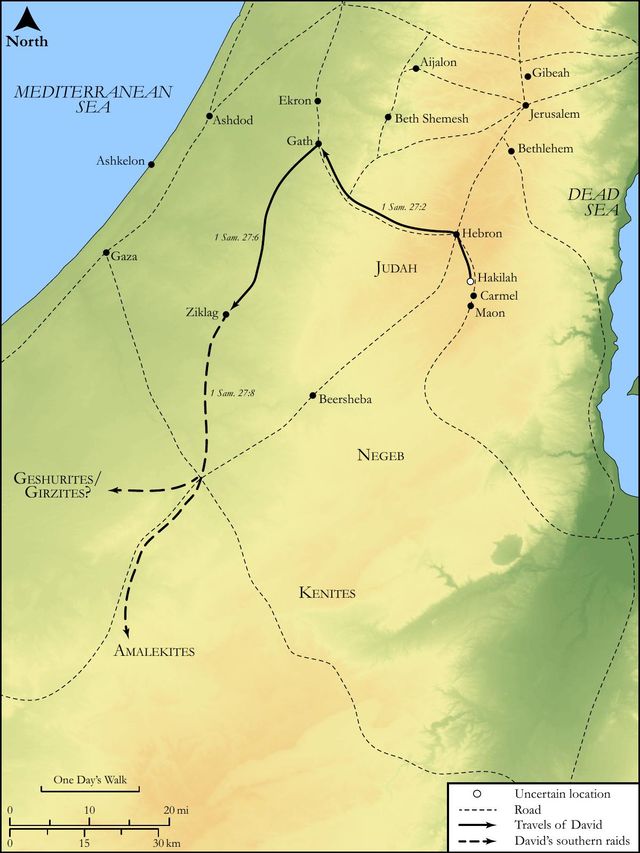
This verse is strategically placed within a morally complex and pivotal period of David's life, immediately following his second flight from King Saul's relentless pursuit, as detailed in 1 Samuel 26. Having exhausted all options for safety within Israelite territory, David makes the desperate decision to seek asylum with Achish, the Philistine king of Gath, a move foreshadowed earlier in 1 Samuel 21:10. Achish, recognizing David's military prowess and potential as a defector, grants David and his 600 men the city of Ziklag, a Philistine border town, to reside in (1 Samuel 27:6). While ostensibly serving Achish and conducting raids, David secretly targets ancient enemies of Israel—the Geshurites, Gezrites, and Amalekites—ensuring no survivors to report his true targets (1 Samuel 27:8-9). Verse 10 captures the moment Achish, as David's patron, questions him about these incursions, setting the stage for David's elaborate deception, which is crucial for maintaining his cover and securing vital provisions for his growing company.
Historical & Cultural Context
David's seeking asylum with a Philistine king, an enemy of Israel, was a desperate but not entirely unprecedented act in that day. Powerful rulers often offered protection to exiles or dissidents from rival kingdoms in exchange for military service or political leverage. The Philistines were a formidable confederacy, controlling significant portions of the coastal plain and exerting considerable influence over the Israelite highlands. Gath was one of their five principal city-states. The "Jerahmeelites" and "Kenites" were semi-nomadic tribes inhabiting the arid Negev desert region, situated to the south of Judah. The Jerahmeelites were descendants of Jerahmeel, a son of Hezron, from the tribe of Judah (1 Chronicles 2:9, 25-27). The Kenites, descendants of Jethro, Moses' father-in-law, had a long-standing, often allied, relationship with Israel and frequently lived among them (Judges 1:16). By claiming to raid these specific groups, David shrewdly implied he was attacking Judah's allies or even Judahite territory itself, thereby convincing Achish of his complete defection from Israel and his unwavering loyalty to the Philistine cause.
Key Themes
ShowHideDavid's actions in this chapter, and particularly in this verse, illuminate several significant themes. Deception and Expediency are at the forefront, as David deliberately fabricates a story to protect himself and his people, highlighting the morally ambiguous choices faced by biblical figures in dire circumstances. This period underscores Survival and Protection as David's primary motivations; his strategic deception is a means to safeguard his followers from Saul's relentless pursuit and to secure necessary resources. Furthermore, the narrative implicitly showcases Divine Providence Amidst Human Flaws. Despite David's dishonesty, the text suggests God's continued oversight and preparation of David for his future kingship. This episode, like many others in David's life, demonstrates that God can work through imperfect individuals and complex, even ethically questionable, circumstances to achieve His ultimate purposes, as evidenced by the eventual establishment of David's enduring dynasty and the covenant made with him in 2 Samuel 7:16. The tension between David's human failings and God's faithfulness is a recurring motif throughout the books of Samuel.
Exposition and Analysis
ShowHideKey Word Analysis
ShowHideThe Philistine king of Gath. His name's derivation is uncertain, but he is consistently portrayed as a powerful ruler who, for a time, provided asylum to David. His questioning of David underscores his authority and his interest in David's military activities, which he presumed were in service of Philistine interests.
This verb literally means "to strip off," "to spread out," or "to raid." In military contexts, it specifically refers to making a hostile incursion or a raid, often with the intent of plundering. The King James Version's "made a road" is an archaic but accurate rendering of a military expedition or hostile advance. David's use of this term confirms that Achish understood his activities as aggressive military actions, and David's deception hinged on misdirecting Achish about the target of these raids.
A clan descended from Jerahmeel, a son of Hezron, who was a descendant of Judah (1 Chronicles 2:25). They inhabited the southern parts of Judah, making a raid against them appear to Achish as an attack on Judahite interests or territory, thus confirming David's supposed break with his own people.
A nomadic or semi-nomadic people, often associated with the Midianites, who had a long history of interaction and often alliance with Israel, particularly since the time of Moses (Numbers 10:29-32). They also lived in the southern regions of Judah. Claiming to attack them further reinforced David's supposed hostility toward Israel and its allies, making his defection seem complete and his service to Achish invaluable.
Verse Breakdown
ShowHide"And Achish said, Whither have ye made a road to day?"
This opening clause establishes the immediate context of the interrogation. Achish, as David's patron and sovereign, is exercising his right to inquire about his servant's military activities. The phrase "to day" indicates a regular, perhaps daily or frequent, inquiry, suggesting David's raids were consistent and expected, and Achish was diligently keeping tabs on his supposed new ally. It highlights the power dynamic between the Philistine king and his Israelite refugee.
"And David said, Against the south of Judah"
This is the pivotal point of David's deception. By stating "the south of Judah," David immediately directs Achish's thoughts towards Israelite territory, implying that his raids were directly against his own people. This would be highly favorable to Achish, as it would confirm David's loyalty to the Philistine cause and his complete severance from Israel, making him a valuable asset in the ongoing conflict with Saul.
"and against the south of the Jerahmeelites, and against the south of the Kenites."
David elaborates on his lie by naming specific groups known to inhabit or be associated with the southern regions of Judah. These groups, while not necessarily core Judahite tribes, were either related to Judah (Jerahmeelites) or traditionally allied with Israel (Kenites). By claiming to attack them, David reinforces the impression that he is systematically weakening Judah's periphery, making his defection seem utterly convincing and his service to Achish indispensable. The specificity lends credibility to his fabricated account.
Literary Devices
ShowHideThe passage employs several literary devices to convey its meaning and underlying tension. Deception is the most prominent, as David deliberately misleads Achish, showcasing his cunning and strategic thinking in a desperate situation. This deception creates Dramatic Irony, as the reader is fully aware of David's true targets (the Geshurites, Gezrites, and Amalekites, who were ancient enemies of Israel, as revealed in 1 Samuel 27:8), while Achish remains entirely oblivious to David's true allegiance and actions. The narrative also uses Foreshadowing, subtly hinting at David's future as a shrewd and capable king who would skillfully navigate complex political landscapes, even if it meant employing morally ambiguous tactics for the greater good of his people. The detailed naming of the "Jerahmeelites" and "Kenites" serves as Verisimilitude, lending an air of authenticity and believability to David's fabricated account in the eyes of Achish.
Theological and Thematic Connections
ShowHideThis episode in David's life, marked by calculated deception, presents a complex theological challenge. It highlights the reality that even figures chosen by God for great purposes are deeply flawed and operate within the messy realities of human existence. David's actions here are not presented as morally exemplary or as a divine command, but rather as a testament to his desperate struggle for survival and God's sovereign ability to work through imperfect means to achieve His perfect will. The narrative implicitly affirms that God's plan for David's kingship remained on track despite, or perhaps even through, David's morally ambiguous choices. This passage reminds us that divine providence is not contingent upon human perfection, but often unfolds amidst human compromise and weakness, ultimately demonstrating God's faithfulness to His covenant promises and His capacity to bring good out of situations that are far from ideal.
Reflection and Application
ShowHideDavid's strategic deception in 1 Samuel 27:10 offers a stark reminder of the complexities of human morality and the immense pressures faced by individuals in desperate circumstances. While the Bible faithfully records David's actions without sanitizing them, it does not necessarily endorse them as a model for ethical conduct. Instead, it invites us to grapple with the tension between survival and integrity, acknowledging that even heroes of faith were fallible and made choices that were less than ideal. For believers today, this passage serves as a powerful testament to God's unwavering sovereignty and His ability to work through imperfect people and situations to accomplish His divine purposes. It encourages humility, recognizing our own capacity for error and compromise, while simultaneously fostering profound trust in God's overarching plan, even when our paths are winding or our choices less than perfectly righteous. It prompts us to consider how we navigate difficult ethical dilemmas, always striving for truth and righteousness, yet understanding that God's grace extends even to our failings, and His ultimate plan will prevail.
Questions for Reflection
ShowHideFAQ
ShowHideWas David's lie justifiable given his circumstances?
ShowHideThe biblical text records David's lie without explicitly condemning or condoning it, leaving room for theological reflection. From a human perspective, David was in an extremely precarious situation, fleeing Saul's relentless pursuit and seeking asylum with an enemy king. His deception was a strategic maneuver to protect his family and his 600 men, secure vital resources, and continue fighting Israel's true enemies (the Amalekites, Geshurites, Gezrites, as explicitly stated in 1 Samuel 27:8-9). While it achieved these immediate goals and allowed God's plan for David to continue unfolding, the Scriptures consistently uphold truthfulness as a divine attribute and a virtue for believers (Proverbs 12:22). This episode highlights the complex ethical dilemmas faced by biblical figures and the reality that even those chosen by God are fallible and operate within a fallen world.
What happened to the Jerahmeelites and Kenites after David's claims?
ShowHideDavid did not actually raid the Jerahmeelites or Kenites; he merely claimed to have done so to Achish. His actual raids were against the Geshurites, Gezrites, and Amalekites (1 Samuel 27:8). Therefore, these tribes were not directly harmed by David's actions during this period. The Jerahmeelites and Kenites continued to exist in the southern regions of Judah, and the Kenites, in particular, maintained their association and often alliance with Israel, as seen in later biblical narratives (e.g., Judges 1:16 and 1 Chronicles 2:55).
How did Achish react to David's deception later on?
ShowHideAchish remained convinced of David's loyalty for a significant period, demonstrating a remarkable degree of trust. He trusted David so completely that he even intended for David and his men to accompany the Philistine army into battle against Israel (1 Samuel 28:1-2). However, the other Philistine lords did not share Achish's trust, fearing David's potential defection during battle and reminding Achish of David's past victories against them (1 Samuel 29:3-5). Consequently, David was sent back to Ziklag, a providential turn of events that spared him from fighting against his own people and positioned him to reclaim Ziklag from the Amalekites, who had raided it in his absence (1 Samuel 30:1-20).
Christ-Centered Fulfillment
ShowHideWhile David's actions in 1 Samuel 27:10 involve a strategic deception, a behavior not directly mirrored in Christ, this passage nonetheless points to Christ in profound ways. David, as the anointed king-in-waiting, operates in a fallen world, navigating political intrigue and personal danger through imperfect means. His cunning, though ethically ambiguous, ultimately serves to preserve his life and his company, preparing him for the throne and the establishment of God's covenant dynasty (2 Samuel 7:12-16). Christ, the true and perfect Son of David (Matthew 1:1), never resorted to deception, for He is the embodiment of truth and righteousness (John 14:6). Yet, like David, Christ strategically navigated hostile environments, often speaking in parables or withdrawing from danger until His appointed time (John 7:6). More significantly, David's role as a deliverer, secretly fighting Israel's enemies while under the guise of serving their foes, foreshadows Christ's ultimate work. Jesus, while appearing in humble form, secretly conquered the true enemies of humanity—sin, death, and the devil—through His sacrificial death and glorious resurrection (Colossians 2:15). Thus, David's imperfect, human-driven preservation of his future kingdom points to the perfect, divine preservation and establishment of God's eternal kingdom through Christ, the King who truly delivers His people from all their enemies, not through deception, but through truth, ultimate sacrifice, and triumphant power (Hebrews 2:14-15).