


Galatians 2:13
- καὶkaiAndG2532CONJConjunction
- συνυπεκρίθησανsunupekrithēsanacted hypocriticallyG4942V-API-3PVerb Aorist Passive Indicative 3rd Plural
- αὐτῷautōwith himG846P-DSMPersonal pronoun Dative Singular Masculine
- καὶkaialsoG2532CONJConjunction
- οἱhoitheG3588T-NPMDefinite article Nominative Plural Masculine
- λοιποὶloipoirestG3062A-NPMAdjective Nominative Plural Masculine
- ἸουδαῖοιIoudaioiof [the] JewsG2453N-NPM-PGNoun Nominative Plural Masculine Person Gentilic
- ὥστεhōsteso thatG5620CONJConjunction
- καὶkaievenG2532CONJConjunction
- ΒαρναβᾶςBarnabasBarnabasG921N-NSM-PNoun Nominative Singular Masculine Individual
- συναπήχθηsunapēchthēwas carried awayG4879V-API-3SVerb Aorist Passive Indicative 3rd Singular
- αὐτῶνautōnof themG846P-GPMPersonal pronoun Genitive Plural Masculine
- τῇtēaby theG3588T-DSFDefinite article Dative Singular Feminine
- ὑποκρίσειhupokriseihypocrisyG5272N-DSFNoun Dative Singular Feminine
English is a literal word-by-word gloss of the Greek, not the KJV's wording. Why?
This is the original text the KJV's translators worked from — each Greek word with its own literal English meaning in this verse, prepared by scholars at Tyndale House, Cambridge. The KJV translates whole sentences, not word by word, so its wording differs: one Greek word can become several English words, and the KJV may choose “charity” where the gloss reads “love”. Both are faithful — they answer different questions. For the KJV's own rendering, switch to the KJV text.
Details
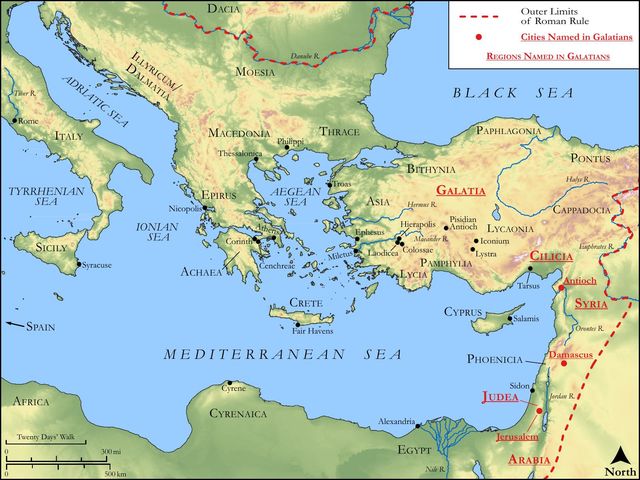
See on the biblical-era map

Study this verse
Public-domain commentary
Matthew Henry
From his Commentary on the Whole Bible. Henry comments on passages, not single verses — this entry covers Galatians 2:11–21. His four-level outline is real structure in the source text, so it is rendered as structure.
I.From the account which Paul gives of what passed between him and the other apostles at Jerusalem, the Galatians might easily discern both the falseness of what his enemies had insinuated against him and their own folly and weakness in departing from that gospel which he had preached to them. But to give the greater weight to what he had already said, and more fully to fortify them against the insinuations of the judaizing teachers, he acquaints them with another interview which he had with the apostle Peter at Antioch, and what passed between them there, _Gal 2:11-14. Antioch was one of the chief churches of the Gentile Christians, as Jerusalem was of those Christians who turned from Judaism to the faith of Christ. There is no colour of reason for the supposition that Peter was bishop of Antioch. If he had, surely Paul would not have withstood him in his own church, as we here find he did; but, on the contrary, it is here spoken of as an occasional visit which he made thither. In their other meeting, there had been good harmony and agreement. Peter and the other apostles had both acknowledged Paul's commission and approved his doctrine, and they parted very good friends. But in this Paul finds himself obliged to appose Peter, for he was to be blamed, a plain evidence that he was not inferior to him, and consequently of the weakness of the pope's pretence to supremacy and infallibility, as the successor of Peter. Here we may observe,
1.Peter's fault. When he came among the Gentile churches, he complied with them, and did eat with them, though they were not circumcised, agreeably to the instructions which were given in particular to him (Acts 10), when he was warned by the heavenly vision to call nothing common or unclean. But, when there came some Jewish Christians from Jerusalem, he grew more shy of the Gentiles, only to humour those of the circumcision and for fear of giving them offence, which doubtless was to the great grief and discouragement of the Gentile churches. Then he withdrew, and separated himself. His fault herein had a bad influence upon others, for the other Jews also dissembled with him; though before they might be better disposed, yet now, from his example, they took on them to scruple eating with the Gentiles, and pretended they could not in conscience do it, because they were not circumcised. And (would you think it?) Barnabas himself, one of the apostles of the Gentiles, and one who had been instrumental in planting and watering the churches of the Gentiles, was carried away with their dissimulation. Here note,
(1.)The weakness and inconstancy of the best of men, when left to themselves, and how apt they are to falter in their duty to God, out of an undue regard to the pleasing of men. And,
(2.)The great force of bad examples, especially the examples of great men and good men, such as are in reputation for wisdom and honour.
2.The rebuke which Paul gave him for his fault. Notwithstanding Peter's character, yet, when he observes him thus behaving himself to the great prejudice both of the truth of the gospel and the peace of the church, he is not afraid to reprove him for it. Paul adhered resolutely to his principles, when others faltered in theirs; he was as good a Jew as any of them (for he was a Hebrew of the Hebrews), but he would magnify his office as the apostle of the Gentiles, and therefore would not see them discouraged and trampled upon. When he saw that they walked not uprightly, according to the truth of the gospel - that they did not live up to that principle which the gospel taught, and which they had professed to own and embrace, namely, that by the death of Christ the partition-wall between Jew and Gentile was taken down, and the observance of the law of Moses was no longer in force - when he observed this, as Peter's offence was public, so he publicly reproved him for it: He said unto him before them all, If thou, being a Jew, livest after the manner of the Gentiles, and not as do the Jews, why compellest thou the Gentiles to live as do the Jews? Herein one part of his conduct was a contradiction to the other; for if he, who was a Jew, could himself sometimes dispense with the use of the ceremonial law, and live after the manner of the Gentiles, this showed that he did not look upon the observance of it as still necessary, even for the Jews themselves; and therefore that he could not, consistently with his own practice, impose it upon the Gentile Christians. And yet Paul charges him with this, yea, represents him as compelling the Gentiles to live as did the Jews - not by open force and violence, but this was the tendency of what he did; for it was in effect to signify this, that the Gentiles must comply with the Jews, or else not be admitted into Christian communion.
II.Paul having thus established his character and office, and sufficiently shown that he was not inferior to any of the apostles, no, not to Peter himself, from the account of the reproof he gave him he takes occasion to speak of that great fundamental doctrine of the gospel - That justification is only by faith in Christ, and not by the works of the law (though some think that all he says to the end of the chapter is what he said to Peter at Antioch), which doctrine condemned Peter for his symbolizing with the Jews. For, if it was the principle of his religion that the gospel is the instrument of our justification and not the law, then he did very ill in countenancing those who kept up the law, and were for mixing it with faith in the business of our justification. This was the doctrine which Paul had preached among the Galatians, to which he still adhered, and which it is his great business in this epistle to mention and confirm. Now concerning this Paul acquaints us,
1.With the practice of the Jewish Christians themselves: "We," says he, "who are Jews by nature, and not sinners of the Gentiles (even we who have been born and bred in the Jewish religion, and not among the impure Gentiles), knowing that a man is not justified by the works of the law, but by the faith of Jesus Christ, even we ourselves have believed in Jesus Christ, that we might be justified by the faith of Christ, and not by the works of the law. And, if we have thought it necessary to seek justification by the faith of Christ, why then should we hamper ourselves with the law? What did we believe in Christ for? Was it not that we might be justified by the faith of Christ? And, if so, is it not folly to go back to the law, and to expect to be justified either by the merit of moral works or the influence of any ceremonial sacrifices or purifications? And if it would be wrong in us who are Jews by nature to return to the law, and expect justification by it, would it not be much more so to require this of the Gentiles, who were never subject to it, since by the works of the law no flesh shall be justified?" To give the greater weight to this he adds (Gal 2:17), "But if, while we seek to be justified by Christ, we ourselves also are found sinners, is Christ the minister of sin? If, while we seek justification by Christ alone, and teach others to do so, we ourselves are found giving countenance or indulgence to sin, or rather are accounted sinners of the Gentiles, and such as it is not fit to have communion with, unless we also observe the law of Moses, is Christ the minister of sin? Will it not follow that he is so, if he engage us to receive a doctrine that gives liberty to sin, or by which we are so far from being justified that we remain impure sinners, and unfit to be conversed with?" This, he intimates, would be the consequence, but he rejects it with abhorrence: "God forbid," says he, "that we should entertain such a thought of Christ, or of his doctrine, that thereby he should direct us into a way of justification that is defective and ineffectual, and leave those who embrace it still unjustified, or that would give the least encouragement to sin and sinners." This would be very dishonourable to Christ, and it would be very injurious to them also. "For," says he (Gal 2:18), "if I build again the things which I destroyed - if I (or any other), who have taught that the observance of the Mosaic law is not necessary to justification, should now, by word or practice, teach or intimate that it is necessary - I make myself a transgressor; I own myself to be still an impure sinner, and to remain under the guilt of sin, notwithstanding my faith in Christ; or I shall be liable to be charged with deceit and prevarication, and acting inconsistently with myself." Thus does the apostle argue for the great doctrine of justification by faith without the works of the law from the principles and practice of the Jewish Christians themselves, and from the consequences that would attend their departure from it, whence it appeared that Peter and the other Jews were much in the wrong in refusing to communicate with the Gentile Christians, and endeavouring to bring them under the bondage of the law.
2.He acquaints us what his own judgment and practice were.
(1.)That he was dead to the law. Whatever account others might make of it, yet, for his part, he was dead to it. He knew that the moral law denounced a curse against all that continue not in all things written therein, to do them; and therefore he was dead to it, as to all hope of justification and salvation that way. And as for the ceremonial law, he also knew that it was now antiquated and superseded by the coming of Christ, and therefore, the substance having come, he had no longer any regard to the shadow. He was thus dead to the law, through the law itself; it discovered itself to be at an end. By considering the law itself, he saw that justification was not to be expected by the works of it (since none could perform a perfect obedience to it) and that there was now no further need of the sacrifices and purifications of it, since they were done away in Christ, and a period was put to them by his offering up himself a sacrifice for us; and therefore, the more he looked into it the more he saw that there was no occasion for keeping up that regard to it which the Jews pleaded for. But, though he was thus dead to the law, yet he did not look upon himself as with law. He had renounced all hopes of justification by the works of it, and was unwilling any longer to continue under the bondage of it; but he was far from thinking himself discharged from his duty to God; on the contrary, he was dead to the law, that he might live unto God. The doctrine of the gospel, which he had embraced, instead of weakening the bond of duty upon him, did but the more strengthen and confirm it; and therefore, though he was dead to the law, yet it was only in order to his living a new and better life to God (as Rom 7:4, Rom 7:6), such a life as would be more agreeable and acceptable to God than his observance of the Mosaic law could now be, that is, a life of faith in Christ, and, under the influence thereof, of holiness and righteousness towards God. Agreeably hereunto he acquaints us,
(2.)That, as he was dead to the law, so he was alive unto God through Jesus Christ (Gal 2:20): I am crucified with Christ, etc. And here in his own person he gives us an excellent description of the mysterious life of a believer.
[1.]He is crucified, and yet he lives; the old man is crucified (Rom 6:6), but the new man is living; he is dead to the world, and dead to the law, and yet alive to God and Christ; sin is mortified, and grace quickened.
[2.]He lives, and yet not he. This is strange: I live, and yet not I; he lives in the exercise of grace; he has the comforts and the triumphs of grace; and yet that grace is not from himself, but from another. Believers see themselves living in a state of dependence.
[3.]He is crucified with Christ, and yet Christ lives in him; this results from his mystical union with Christ, by means of which he is interested in the death of Christ, so as by virtue of that to die unto sin; and yet interested in the life of Christ, so as by virtue of that to live unto God.
[4.]He lives in the flesh, and yet lives by faith; to outward appearance he lives as other people do, his natural life is supported as others are; yet he has a higher and nobler principle that supports and actuates him, that of faith in Christ, and especially as eyeing the wonders of his love in giving himself for him. Hence it is that, though he lives in the flesh, yet he does not live after the flesh. Note, Those who have true faith live by that faith; and the great thing which faith fastens upon is Christ's loving us and giving himself for us. The great evidence of Christ's loving us is his giving himself for us; and this is that which we are chiefly concerned to mix faith with, in order to our living to him.
Lastly, The apostle concludes this discourse with acquainting us that by the doctrine of justification by faith in Christ, without the works of the law (which he asserted, and others opposed), he avoided two great difficulties, which the contrary opinion was loaded with: - 1. That he did not frustrate the grace of God, which the doctrine of the justification by the works of the law did; for, as he argues (Rom 11:6), If it be of works, it is no more of grace. 2. That he did not frustrate the death of Christ; whereas, if righteousness come by the law, then it must follow that Christ has died in vain; for, if we look for salvation by the law of Moses, then we render the death of Christ needless: for to what purpose should he be appointed to die, if we might have been saved without it?
Historical interpretation
Five Centuries of Reception
6 surviving comments on this verse. Each one is dated, so this reads as a timeline rather than a list.
Select a marker to jump to its quote. Markers stagger vertically where authors wrote within a few decades of each other.
Well, but Marcion, finding the Epistle of Paul to the Galatians (wherein he rebukes even apostles ) for "not walking uprightly according to the truth of the gospel," as well as accuses certain false apostles of perverting the gospel of Christ), labours very hard to destroy the character of those Gospels which are published as genuine and under the name of apostles, in order, forsooth, to secure for his own Gospel the credit which he takes away from them.
What then should we understand by “their insincerity”? Even Peter and Barnabas and the other Jews had not truly gone to the length of living their lives according to Jewish practice. They even pretended to do so as an ad hoc measure, because of the fears of those around them. And therefore, he says, even Barnabas acquiesced in their insincerity.
"Insomuch that even Barnabas was carried away with their dissimulation."
Be not surprised at his giving this proceeding the name of dissimulation, for he is unwilling, as I said before, to disclose the true state of the case, in order to the correction of his disciples. On account of their vehement attachment to the Law, he calls the present proceeding "dissimulation," and severely rebukes it, in order effectually to eradicate their prejudice. And Peter too, hearing this joins in the feint, as if he had erred, that they might be corrected by means of the rebuke administered to him. Had Paul reproved these Jews, they would have spurned at it with indignation, for they held him in slight esteem; but now, when they saw their Teacher silent under rebuke, they were unable to despise or resist Paul's sentence.
(Verse 11 onwards) But when Peter came to Antioch, I opposed him to his face, because he stood condemned. For before certain men came from James, he was eating with the Gentiles. But when they came, he withdrew and separated himself, fearing those of the circumcision. And the rest of the Jews acted hypocritically along with him, so that even Barnabas was led astray by their hypocrisy. When I saw that they were not walking straight, according to the truth of the gospel, I said to Peter in the presence of all, 'If you, who are a Jew, live like the Gentiles and not like the Jews, how can you compel the Gentiles to live like Jews?' We are Jews by nature, and not Gentile sinners, but we know that a person is not justified by the works of the law, but through faith in Jesus Christ. Therefore, when the apostle Paul saw that the grace of Christ was in danger, he employed a new battle tactic of the old warrior, to correct the dispensation of Peter, by which he desired the salvation of the Jews, with a new dispensation of contradiction, and to resist him to his face. Not arguing against his intention, but rather publicly contradicting him, so that by Paul's argument and resistance, those who had believed from the Gentiles would be saved. Now if anyone thinks that Paul truly resisted the apostle Peter and boldly did wrong to his predecessor for the sake of the truth of the Gospel, that person's argument will not stand. For even Paul became a Jew to the Jews in order to gain the Jews, and he will be held guilty of the same hypocrisy when he shaved his head in Cenchreae and offered a sacrifice in Jerusalem (Acts 18), and when he circumcised Timothy (Ibid., 16), and practiced foot-washing, which are clearly ceremonial practices of the Jews. Therefore, if the one who was sent to preach to the Gentiles did not think it necessary to say: 'Be without offense to the Jews and to the Church of God' (1 Corinthians 10:32); how can I please everyone in all things, not seeking my own profit, but the profit of many, so that they may be saved? And he did certain things that were contrary to the freedom of the Gospel, so as not to scandalize the Jews. With what authority, with what audacity does he dare to reprehend this in Peter, who was an apostle of the circumcision, when he himself, the apostle of the Gentiles, is accused of committing the same? But as we have already said, he yielded to the public opinion, to Peter and the rest, so that the hypocrisy of observing the Law, which was harming those who had believed from the Gentiles, would be corrected by the hypocrisy of correction, and both peoples would be saved, both those who praise circumcision follow Peter; and those who do not want to be circumcised, preach Paul's freedom. But what he said was blameworthy, therefore he moderated the fasting; so that we understand that he was not so blameworthy to Paul, as he separated himself from those brothers with whom he had eaten before. But a useful simulation, and one to be adopted in time, let us teach an example of King Jehu of Israel, who could not kill the priests of Baal unless he pretended to want to worship the idol, saying: 'Gather (or 'gather together') for me all the priests of Baal: for if Ahab served Baal in few things, I will serve him in many.' (4 Kings 10:18). And David, when he changed his appearance before Abimelech, and who dismissed him and went away. (1 Kings 21) And it is not surprising, even though righteous men, nevertheless, pretend for a time, for their own and others’ salvation, when our Lord Himself, not having sin nor the flesh of sin, assumed the pretense of sinful flesh, so that, condemning sin in the flesh, He would make us the righteousness of God in Himself. Certainly, Paul had read in the Gospel the Lord commanding: But if your brother sins against you, go and correct him between you and him alone. If your brother sins against you, rebuke him; and if he repents, forgive him. (Luke 17:3) And in what way, when he even commanded this to be done to the least of the brothers, did he dare to rebuke the greatest of the apostles so boldly and steadfastly in public; unless it had pleased Peter to be rebuked in this way, and Paul had not done him any harm, about whom he had said before: I went to Jerusalem to see Peter, and I stayed with him for fifteen days: but I saw none of the other apostles. And again: For he who worked in Peter for the apostleship of the circumcision. And below: Peter and James and John, who seemed to be pillars, and the others whom he praises in his praises. Many times, when I was a young man in Rome, I would engage in debates on fictitious lawsuits and exercise myself in true competitions. I would run to the courts of the judges, and I would see the most eloquent orators contending with each other with such bitterness that they would often neglect their duties and turn to personal insults, biting each other with jokes. If they do this, so that they may not incur any suspicion of prevarication, and deceive the surrounding people, what do we think the great pillars of the Church, Peter and Paul, and the vessels of wisdom, ought to have done among the dissenting Jews and Gentiles? Unless it was for the purpose of making their pretended contention the peace of the believers, and the faith of the Church might be established by a holy dispute among them. There are some who think that Cephas, whom Paul writes that he confronted to his face, is not the apostle Peter, but another one of the seventy disciples called by that name. They say that Peter could not have avoided the company of the Gentiles, as he had also baptized the centurion Cornelius. And when he went up to Jerusalem, those who were of the circumcision argued against him, saying: Why did you go to men uncircumcised and eat with them? After recounting the vision, he concluded his response with these words: Therefore, if God gave them the same gift as he gave us when we believed in the Lord Jesus Christ, who was I to hinder God? When they heard this, they fell silent and glorified God, saying, 'So then, even to the Gentiles God has granted repentance unto life.' Especially since the writer of the history, Luke, makes no mention of this disagreement; nor does he ever say that Peter was in Antioch with Paul, and that Porphyry was blaspheming; but if it is believed that Peter erred or that Paul insolently refuted the chief of the apostles, first it must be answered that we do not know the name of some other Cephas, unless it is the one who is called both Cephas and Peter in the Gospel, in Paul's other Epistles, and also in this very passage. Not that Peter signifies one thing and Cephas another, but that as we call the rock in Latin and Greek, so the Hebrews and Syrians, because of the similarity of their languages, name it Cephas. Moreover, the entire argument of the epistle, which is indirectly mentioned concerning Peter, James, and John, contradicts this interpretation. It is not surprising that Luke has remained silent on this matter, considering that he has omitted many other things that Paul claims to have endured, by the liberty of a historian, and it is not necessarily contradictory if one deemed worthy of recounting what another left out among other things for a different reason. Lastly, we have learned that Peter was the first bishop of the Church of Antioch, and then transferred to Rome, which Luke completely omitted. Finally, if we are to create another person called Cephas because of Porphyry's blasphemy, so that Peter is not thought to have erred, countless divine Scriptures will have to be erased, which he condemns because he does not understand. But also against Porphyry, we will fight in another way if Christ commands it: now let us continue with the rest.
Paul never fell into any pretense, for he everywhere observed a principle which seemed fitting both to Gentile and to Jewish churches, that he should nowhere take away a custom whose observation did not prevent the receiving of God’s kingdom.… Peter, however, when he came to Antioch, was rebuked by Paul not because he observed the Jewish custom in which he was born and reared, although he did not observe it among the Gentiles, but because he wanted to impose it on the Gentiles. This happened after seeing certain persons come from James—that is, from Judea, since James was the head of the church in Jerusalem. It was therefore in fear of those who still thought that salvation resided in these observances that Peter separated himself from the Gentiles and pretended to consent in imposing those burdens of servitude on the Gentiles.
By hypocrisy he means the observation of the Law, and he teaches that they should be separated from it.
Continue studying Galatians 2:13 across the web’s major study libraries — every link below opens this exact verse, chapter, or book on the destination site.
Read & Compare
 BibleGatewayThis verse in more than 200 translations and 70 languages.
 Bible.comThe YouVersion reader — hundreds of translations, reading plans, and highlights.
 ESV.orgCrossway's official English Standard Version reader.
 NET BibleThe NET translation with 60,000+ translators' notes on every rendering decision.
 STEP BibleTyndale House's free study tool — original text, vocabulary, and scholarly resources.
 BibliaLogos Bible Software's free web reader.
 USCCBThe New American Bible (Revised Edition) with the U.S. bishops' study notes.
Commentaries
 BibleHub CommentariesDozens of classic commentaries on this verse, gathered on one page.
 StudyLightMore than 100 commentary sets — the largest collection on the web.
 BibleRefPlain-English commentary on what this verse means, verse by verse.
 Enduring WordDavid Guzik's free commentary on this chapter, widely used by Bible teachers.
 Bible Study ToolsVerse commentary alongside Greek and Hebrew study aids.
Original Language & Research
- BibleHub InterlinearThe verse word by word — original language, transliteration, and English.
- BibleHub LexiconEvery word's original-language definition and Strong's entry.
 Blue Letter BibleDeep-study tools — Strong's numbers, concordance, and word studies.
 CNTR CollationThe earliest Greek manuscripts of this verse, collated letter by letter.
Sermons, Hymns & Audio


TrulyRandomVerse is not affiliated with these sites and doesn’t control their content. They’re linked because they’re genuinely useful.
Summary
Galatians 2:13 captures a critical moment in the early church where the influential apostle Peter's fear-driven withdrawal from table fellowship with Gentile believers led to widespread hypocrisy among other Jewish Christians, including Barnabas, thereby threatening the gospel's core truth of justification by faith alone and the unity of Jew and Gentile in Christ.
Context
ShowHideLiterary Context
This verse immediately follows Paul's direct and public confrontation with Peter (Cephas) in Antioch, as recounted in Galatians 2:11-12. Peter, who had previously enjoyed table fellowship with Gentile Christians, abruptly withdrew and separated himself when certain Jewish believers, described as "from James," arrived from Jerusalem. This action was not a matter of personal preference but a theological statement implying that Gentiles were somehow unclean or less acceptable without adherence to Jewish customs, specifically dietary laws. Verse 13 then details the devastating ripple effect of Peter's compromise, showing how his influential example quickly corrupted the behavior of other Jewish Christians in the community, escalating the crisis from an individual lapse to a widespread dissimulation that endangered the very fabric of the gospel.
Historical & Cultural Context
The early church grappled intensely with the integration of Jewish and Gentile believers, particularly concerning the continued relevance of the Mosaic Law. Jewish Christians, especially those from Jerusalem, often felt pressure to maintain traditional Jewish practices, including dietary laws and circumcision, viewing them as essential for true righteousness or full inclusion in God's people. This tension is evident throughout Acts and Paul's epistles. Antioch, a vibrant and diverse city, was a significant center for Gentile Christianity and a crucial hub for missionary activity, making it a melting pot where these cultural and theological differences frequently came to a head. The arrival of "certain men from James" (likely traditionalist Jewish Christians from Jerusalem) exerted immense social and religious pressure on Peter and other Jewish believers, leading them to compromise their convictions out of fear of condemnation from this more conservative faction.
Key Themes
ShowHideGalatians 2:13 powerfully illustrates several key themes central to Paul's letter. Firstly, it underscores the pervasiveness of hypocrisy (Greek: hypókrisis), revealing how easily fear of man can lead even prominent leaders like Peter and Barnabas to act contrary to their true convictions and the truth of the gospel. This compromise threatened the unity of the body of Christ, creating a de facto segregation between Jewish and Gentile believers despite their shared faith in Jesus, challenging the very notion that in Christ "there is neither Jew nor Gentile" (Galatians 3:28). Most critically, this dissimulation directly undermined the foundational doctrine of justification by faith alone, implying that Gentile believers needed to adopt Jewish customs to be truly righteous or fully accepted, thereby adding works to grace and distorting the freedom found in Christ (Galatians 2:16). Paul's subsequent public rebuke in Galatians 2:14 highlights his unwavering commitment to protecting the integrity of the gospel message.
Exposition and Analysis
ShowHideKey Word Analysis
ShowHideThis term, derived from "Judah," refers to those belonging to the Jewish people or from Judea. In this context, it specifically denotes Jewish Christians who, influenced by Peter's actions, adopted a hypocritical stance, separating themselves from Gentile believers in table fellowship. Their identity as "Jews" here is significant because it highlights the ethnic and cultural dimension of the conflict, which Paul argues is superseded by the new identity in Christ.
This compound verb, formed from syn (with) and hypokrínomai (to act a part, pretend), literally means "to act hypocritically in concert with" or "to dissemble together." It describes a deliberate pretense, where one's outward actions do not align with their inward convictions or previous behavior. In this case, the Jewish believers were feigning a stricter adherence to Jewish customs (likely dietary laws) than they genuinely believed was necessary for Christian fellowship, doing so to appease the "men from James" and following Peter's lead.
This verb means "to take off together," "to transport with," or passively, "to be led astray" or "to yield." The passive voice here emphasizes that Barnabas was not actively choosing to dissemble but was swept along by the collective influence and pressure of Peter and the other Jewish Christians. It conveys a sense of being involuntarily drawn into a course of action, highlighting the powerful, almost infectious, nature of Peter's compromise and the difficulty even strong leaders face in resisting group dynamics when truth is compromised.
Verse Breakdown
ShowHide"And the other Jews dissembled likewise with him;"
This clause reveals the immediate and widespread impact of Peter's actions. "The other Jews" refers to Jewish Christians in Antioch who, observing Peter's withdrawal from table fellowship with Gentiles, followed his example. The phrase "dissembled likewise with him" indicates that they adopted the same hypocritical behavior, pretending to adhere to stricter Jewish customs than they had previously, solely because Peter, a respected apostle, had done so. This highlights the dangerous power of influence and the ease with which compromise can spread within a community.
"insomuch that Barnabas also was carried away with their dissimulation."
This second clause emphasizes the severity of the situation by naming Barnabas, a highly respected leader, Paul's missionary companion, and "son of encouragement" (Acts 4:36), as a victim of this widespread hypocrisy. The phrase "carried away" (Greek synapágō) suggests he was swept along, perhaps against his better judgment, by the current of dissimulation. His fall underscores that even mature believers are susceptible to peer pressure and the fear of man, especially when prominent figures set a compromising example. This demonstrates the profound threat this dissimulation posed to the integrity of the gospel and the unity of the church.
Literary Devices
ShowHideGalatians 2:13 employs several potent literary devices to convey its critical message. The most prominent is Exemplification, as the verse uses Barnabas's regrettable actions to powerfully illustrate the pervasive and corrupting influence of Peter's hypocrisy. Barnabas, known for his steadfastness and spiritual maturity, succumbing to the dissimulation underscores the gravity of the situation and the immense pressure exerted by the "men from James." This serves as a cautionary tale, demonstrating that no one, regardless of their spiritual standing, is immune to compromise when the fear of man outweighs the fear of God. Furthermore, the passage utilizes Pathos by evoking a sense of disappointment and alarm; the reader is meant to feel the weight of this betrayal of gospel truth, especially through the unexpected fall of Barnabas. The repeated emphasis on "dissimulation" (from hypokrisis) also highlights Irony, as those who should be living in the freedom and truth of the gospel are instead engaging in pretense and legalistic segregation, acting contrary to the very spirit of the new covenant they proclaim.
Theological and Thematic Connections
ShowHideGalatians 2:13 is a pivotal verse that underscores the profound theological implications of practical behavior within the Christian community. Peter's dissimulation and the subsequent widespread adoption of this hypocrisy by other Jewish believers, including Barnabas, directly threatened the core truth of the gospel: that salvation and acceptance before God come solely through faith in Christ, not through adherence to the Law or ethnic distinction. This incident exposed the deep tension between Christian liberty and legalism, demonstrating how fear of external judgment can lead believers to compromise the universal reach of the gospel, thereby undermining the unity of Jew and Gentile in Christ. Paul's forceful response, as detailed in the following verses, reveals his unwavering commitment to safeguarding the purity of the message of grace and ensuring that the church's practice aligns with its theological confession.
Reflection and Application
ShowHideGalatians 2:13 serves as a sobering mirror for believers today, challenging us to examine the authenticity of our faith and the integrity of our actions. The ease with which Peter, and subsequently Barnabas and other Jewish believers, succumbed to hypocrisy out of fear of human judgment reminds us that even seasoned Christians are susceptible to compromise. This verse calls us to a radical commitment to gospel truth, urging us to prioritize Christ's finished work and the unity it creates over social pressures, cultural expectations, or the fear of offending traditionalists. True Christian fellowship should be marked by genuine acceptance and love, transcending ethnic, social, or denominational divides, reflecting the truth that in Christ, all are one. We must vigilantly guard against any behavior or teaching that adds conditions to God's free grace or creates divisions where Christ has established unity, always striving to live out the freedom and truth of the gospel with unwavering integrity.
Questions for Reflection
ShowHideFAQ
ShowHideWhat does "dissembled" mean in this context, and why was it so problematic?
ShowHideIn Galatians 2:13, "dissembled" (Greek synypokrínomai) means to act hypocritically in concert with others, to pretend or put on a false front. It describes Peter's action of withdrawing from table fellowship with Gentile Christians when Jewish believers from Jerusalem arrived, and the subsequent imitation of this behavior by other Jewish Christians, including Barnabas. This was problematic because it contradicted the truth of the gospel, which teaches that both Jews and Gentiles are justified by faith in Christ alone, without needing to adhere to the Mosaic Law. By separating, they were implicitly suggesting that Gentile believers were somehow "unclean" or less acceptable unless they conformed to Jewish customs, thereby undermining the unity of the church and adding works to God's grace. Paul saw this as a direct threat to the integrity of the gospel message, as it denied the universal reach and freedom found in Christ.
Why was Barnabas's involvement particularly significant?
ShowHideBarnabas's involvement was particularly significant because he was a highly respected leader in the early church, known for his faith, generosity, and his role as Paul's missionary companion (Acts 13:2). He had previously demonstrated a heart for Gentile inclusion, even being called "Son of Encouragement" (Acts 4:36). His being "carried away" (Greek synapágō, meaning swept along) by the dissimulation highlights the immense pressure and pervasive nature of Peter's compromising example. It underscores that even strong, godly individuals are susceptible to the fear of man and group influence, making the situation even more alarming and demonstrating the profound threat this hypocrisy posed to the gospel's integrity. His fall served as a powerful illustration of how widespread and dangerous this compromise had become.
Christ-Centered Fulfillment
ShowHideGalatians 2:13, though detailing a moment of human failure and compromise, ultimately points to the supreme integrity and truth of Christ. The dissimulation of Peter and the other Jewish believers stands in stark contrast to Jesus, who consistently exposed hypocrisy and lived a life of perfect authenticity. Jesus condemned the religious leaders of His day for their outward show of righteousness that masked inward corruption, famously calling them "whitewashed tombs" (Matthew 23:27). He is the embodiment of truth, and His gospel breaks down all dividing walls, making "one new humanity" out of Jew and Gentile (Ephesians 2:14-16). The gospel's power is precisely in its ability to unite diverse peoples by grace through faith, without the need for legalistic adherence or cultural assimilation. Paul's unwavering stand against Peter's hypocrisy, even at great personal cost, reflects Christ's own uncompromising commitment to truth and His mission to establish a church where all are genuinely accepted and unified in Him, free from the burden of the law and the pretense of human approval. The cross of Christ, which abolishes the need for works and distinctions, is the ultimate answer to the dissimulation described here, calling believers to live consistently with the freedom and unity purchased by His blood (Galatians 5:1).